

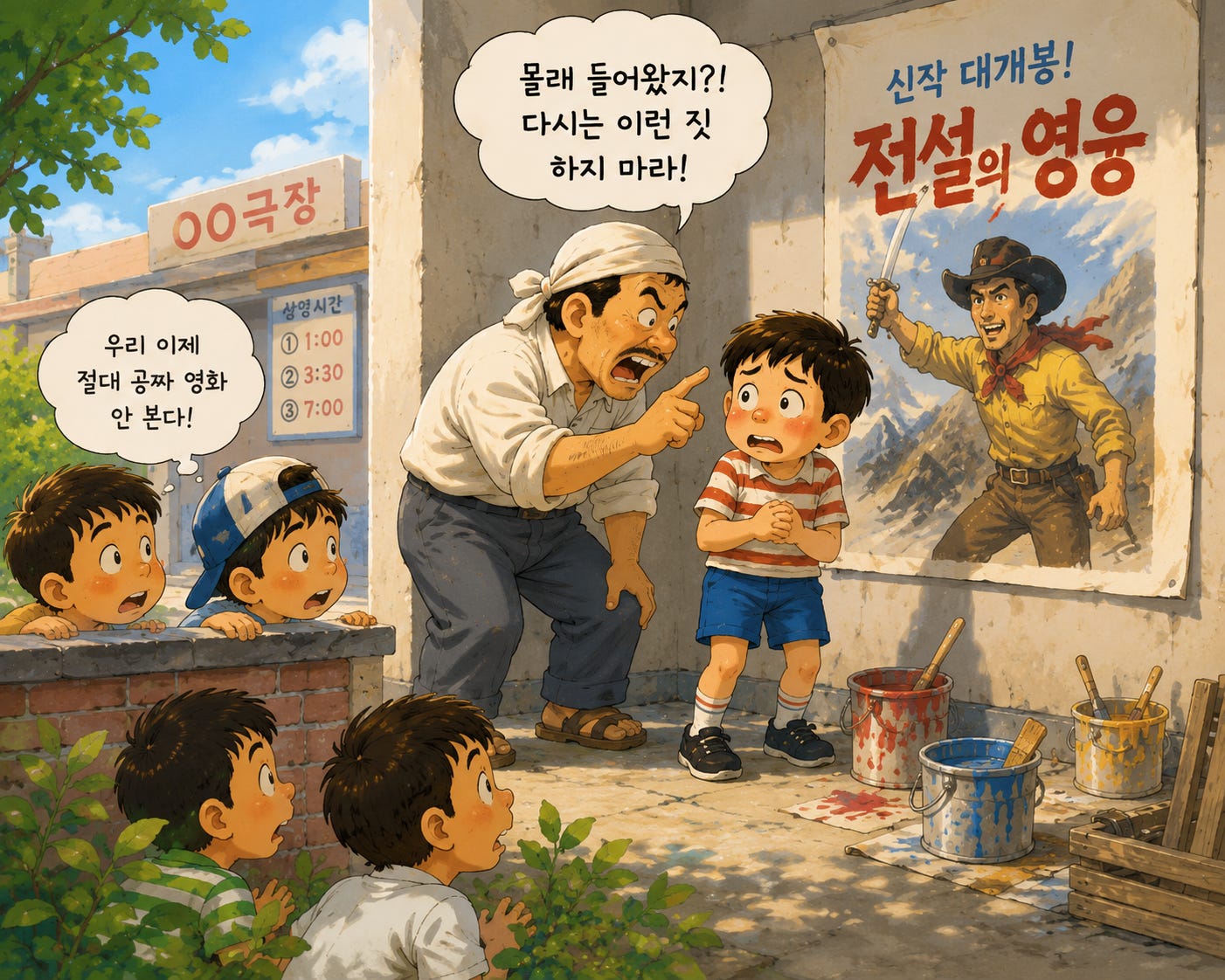
Image credit: Illustration generated with OpenAI’s ChatGPT image-generation tool, 2026.
Childhood Memories of the Movies
Two Cinematic Adventures in the Art of Getting Something for Nothing
Summary
This essay recounts two memorable childhood adventures involving movie theaters in 1960s Korea. In the first, the author and a friend, unable to afford admission, agree to put up approximately fifty movie posters in exchange for free tickets. After enduring the bitter winter cold and completing their work, they finally enter the theater, sit near a heater, and fall asleep barely ten minutes into the film. Their disappointing cinematic experience becomes a cherished source of humor decades later.
The second story describes a more troubling adventure. Hoping to watch a movie without paying, the author and several friends attempt to sneak into a theater by climbing over a brick wall. When one friend is caught by a man painting promotional posters, the boy suffers a humiliating and inappropriate punishment involving red paint. The others flee, leaving their companion to face the consequences alone. Although the incident ends their dreams of free movies, it leaves the author with a lasting sense of guilt over his cowardice and a desire to apologize to his friend.
Through humor, self-reflection, and the gentle irony, the essay explores youthful foolishness, the consequences of dishonesty, the limitations of clever schemes, and the enduring responsibilities of friendship. Ultimately, these childhood memories suggest that growing wiser means not only learning to laugh at our mistakes but also finding the courage to acknowledge them, accept responsibility, and make amends.
Keywords: Childhood Memories; Korean Childhood; Movie Theaters; Satire and Irony; Nostalgia; Childhood Mischief; Honesty and Integrity; Friendship and Loyalty; Moral Responsibility; Regret and Forgiveness; Life Lessons
The Movies We Never Quite Saw
Some childhood memories grow fainter with the passing years. Others, quite inexplicably, become funnier. The older we grow, the more clearly we recognize the absurdity of our youthful adventures, especially those in which our ingenuity was considerable, our judgment questionable, and our good intentions—when they existed at all—sadly underfunded.
Growing up in Korea, I had several memorable encounters with the wonderful world of cinema. In those days, going to the movies was a treat, not an ordinary evening’s entertainment. A few coins could open the door to another world, provided, of course, that one possessed those coins. Unfortunately, my childhood friends and I occasionally suffered from an embarrassing shortage of the very things required to purchase admission.
Looking back, I am reminded of Mark Twain’s talent for discovering the comedy hidden inside human folly. Twain understood that boys are not necessarily wicked; they are simply capable of devising remarkably elaborate schemes to avoid doing what common sense recommends. My own cinematic adventures provide two modest examples. In the first, my friend and I worked so hard to earn free admission that we fell asleep before the movie had properly begun. In the second, another friend learned that the price of a free movie could be considerably higher than the price printed on the ticket.
Both stories belong to a distant Korea, but their lessons remain surprisingly fresh. One concerns the dangers of confusing hard work with successful entertainment. The other concerns the unfortunate consequences of allowing a clever idea to outrun one’s conscience.
The Temptation of Movie Posters
One bitterly cold day during winter vacation in elementary school, a friend and I found ourselves suffering from that peculiar childhood affliction known as having absolutely nothing to do. The winter seemed endless, the streets were freezing, and the hours stretched before us with the cruelty of a schoolteacher who has discovered that the class has finished its assignments too early.
We wanted to see a movie.
There was, however, one small difficulty. We had no money for admission.
To a practical adult, this might have suggested staying home. To two resourceful boys, it suggested opening negotiations with the management.
We approached the owner of a local movie theater and explained our unfortunate financial circumstances. We may have presented ourselves as two impoverished young gentlemen of considerable cultural ambition, although I cannot now remember whether we actually used those words. What I remember clearly is that the owner proved unexpectedly sympathetic.
He agreed to let us watch a movie for free, provided that we performed a little work first.
We were to put up approximately fifty movie posters around town.
Fifty!
At that age, fifty posters seemed a reasonable price to pay for an afternoon of cinematic pleasure. We accepted the arrangement with the enthusiasm of two businessmen who have just secured an extraordinarily favorable contract without reading the fine print.
Our duties were divided efficiently. I carried out the actual posting, while my friend accompanied me with a can containing the posters, paste, and a brush. Together, we trudged through the freezing streets, attaching each poster to its designated location.
It was not glamorous work. The paste was cold, our fingers grew numb, and our arms and legs began to complain about a business agreement they had never been consulted about. Every poster required another stop, another application of paste, and another small battle against the winter wind.
By the time we had finished, we had acquired a thorough education in the physical demands of movie promotion. We had also begun to understand why the theater owner had been so generous with his offer.
Nevertheless, we returned to the theater, exhausted but triumphant. We had fulfilled our contract, and the cinema was now ours to enjoy—or so we imagined.
The owner thanked us for our hard work and cheerfully invited us inside. Since we had arrived just in time for the final screening of the day, there was no reason to waste another minute.
We rushed into the theater and selected two seats in the very front row, directly in the path of the warm air blowing from the heating system. After hours in the winter cold, those seats felt less like ordinary theater seats than like two luxurious armchairs in a royal palace.
We sat down side by side, delighted with our success.
At last, we were going to see a movie!
The film began. For approximately ten minutes, everything went according to plan. The screen glowed, the story unfolded, and the two young patrons of the cinema industry enjoyed the fruits of their labor.
Then something unexpected happened.
We fell asleep.
Perhaps the cold had exhausted us. Perhaps the physical labor had been too much. Or perhaps the warm air from the heater had accomplished what neither the director nor the actors could manage: it had completely captured our attention by putting us to sleep.
Whatever the explanation, our cinematic experience came to an abrupt end when a theater employee began shaking us awake.
The movie was over. It was late, and we had to go home.
We opened our eyes to discover that the entire entertainment industry had continued operating without our participation. The story had reached its conclusion, the audience had departed, and the theater was ready to be cleaned. We had paid for our tickets with fifty posters, only to miss virtually the entire film.
If this had been a business venture, our return on investment would have been disastrous. We had invested hours of manual labor in exchange for ten minutes of entertainment and an unplanned nap.
Even Mark Twain might have admired the efficiency with which we had managed to turn a free movie into an expensive afternoon.
There was nothing to do but leave.
We stepped out into the dark winter streets, which seemed even colder than before. With our arms linked together, we walked home, consoling one another as though we had just survived a national calamity rather than a minor failure in the pursuit of amusement.
We had earned our movie tickets honestly. We had completed the work. We had entered the theater on time. Yet we had somehow managed to miss the movie.
More than forty years later, I still find myself smiling whenever I go to a cinema. Occasionally, the memory returns without warning, and I wonder whether the theater owner ever realized how little entertainment his two young employees had actually received.
Perhaps he considered the arrangement a success. He obtained fifty posters displayed around town, and two boys learned something about the relationship between labor and reward.
As for us, we discovered a fundamental truth about the movie business: sometimes the most memorable part of a film is everything that happens before you sit down to watch it.
And sometimes, if the seats are warm enough, even that part is too exhausting to remember.
The Free Movie and the Lesson of Red Paint
My second cinematic adventure took place on a hot, tedious summer day in the mid-1960s, when I was still in elementary school. The weather was oppressive, the afternoon seemed interminable, and my friends and I were searching for something exciting to do.
Once again, the movies came to mind.
Once again, our finances failed to cooperate.
The admission price, as I recall, was approximately 45 to 50 Korean won. By modern standards, that sounds almost laughably inexpensive. But a price is never measured in isolation. It must be measured against the money one actually possesses, and at that moment our collective purchasing power was tragically inadequate.
Instead of accepting the limitations of our circumstances, we began exploring alternative methods of admission.
Our proposed solution was simple, bold, and morally indefensible: we would sneak into the theater without paying.
We called it, in effect, getting a free movie. A more accurate description would have been unauthorized entry in pursuit of entertainment. But children rarely give their schemes such unflattering names. We preferred to think of ourselves as clever adventurers rather than amateur criminals with an underdeveloped understanding of consequences.
There were approximately four of us, including me. After examining the theater building, we concluded that the only practical route into the cinema was over the brick wall surrounding the property.
We developed a plan.
One of our friends, who was apparently the most agile member of our little expedition, would climb over first. The rest of us would help by bending over beside the wall, forming something resembling a human mounting block. Once he reached the other side, we hoped he could enter the theater and enjoy the film without paying.
The plan was elegant in its simplicity. It required no money, no tickets, and no negotiations with management. Its only significant weakness was that it depended on nobody catching us.
We had neglected to consider that possibility.
Our nimble friend began climbing. The rest of us waited in a posture that would have looked more appropriate at a children’s game than during a criminal operation. For a brief moment, everything seemed to be proceeding according to plan.
Then we heard a man’s angry shout.
Almost immediately, our friend’s voice followed.
“Please, sir! Just let me go this once! I promise I will never do it again!”
His words came mixed with cries of desperation and humiliation. Whatever opportunities the future might have offered him as a professional negotiator, his first major negotiation with an adult authority figure was not going well.
The rest of us responded with remarkable unanimity.
We ran.
We scattered in every direction as though the police had announced that the entire neighborhood was under arrest. Our elaborate plan had lasted only a few moments, but our retreat demonstrated a level of athletic ability that none of us had displayed while climbing the wall.
In retrospect, the most impressive feature of our operation was not the plan itself but the speed with which we abandoned it.
Our friend, unfortunately, had been left behind.
What happened to him? Where was he being taken? Would his parents be informed? Would the theater owner summon the police? These questions troubled us, although not sufficiently to persuade any of us to return and investigate.
As the afternoon passed, our curiosity and anxiety increased. Eventually, we managed to find one another and began discussing the fate of our missing companion.
Toward evening, we finally encountered him again.
He looked absolutely miserable.
His face expressed a combination of anger, shame, and disbelief. He appeared to have returned from a battlefield on which the enemy had employed weapons of a particularly humiliating kind.
We gathered around him and asked what had happened.
His explanation was more extraordinary than anything we could have imagined.
When he had climbed over the wall, he had landed inside the theater grounds, where a man was preparing advertising posters for an upcoming film. Several cans of brightly colored paint had been arranged nearby, and the man was busy painting the promotional materials.
The painter apparently needed no lengthy investigation to determine why a small boy had suddenly appeared on the other side of the wall. Our friend had not arrived through the entrance, presented a ticket, or offered a convincing explanation. His method of entry had supplied all the evidence necessary.
The man caught him immediately.
What followed, according to our friend’s account, was a punishment so peculiar and humiliating that it has remained fixed in my memory for more than half a century.
The man took red paint and applied it to the most private part of our friend’s anatomy.
I shall spare the reader further anatomical details. This is a childhood memoir, not a medical report, and I have no desire to turn an already painful memory into an unnecessarily graphic account.
The essential point is that our friend received a very personal lesson in the dangers of trying to obtain something for nothing. The punishment was not merely unpleasant; it was designed, apparently, to make the thought of sneaking into a cinema unforgettable.
Our friend had been caught, humiliated, and eventually released to return home. How he managed to remove the brilliant red paint was a question none of us could answer. We could only imagine the difficulties involved, and our imaginations were more than adequate to the task.
Even now, I find it difficult to determine which aspect of the incident was more astonishing: the extraordinary nature of the punishment or the fact that our friend had survived the experience with his dignity sufficiently intact to tell us about it.
Of course, the incident was not funny to him at the time. Nor should we pretend that the punishment was reasonable merely because the story has acquired a comic quality with the passage of years. A child caught trespassing deserved an appropriate and proportionate consequence, not a humiliating act that could cause physical harm.
Yet childhood memories are complicated things. We remember the fear, the absurdity, the shame, and sometimes the uncomfortable recognition that we were not quite as clever as we had imagined.
In this case, the memory also carries a more personal burden.
I was among the boys who had helped devise the scheme. When the danger appeared, I ran away and left my friend to face the consequences alone. I was relieved to escape, of course, but relief is not the same as courage, and survival is not the same as loyalty.
We had entered the adventure together. We had planned the operation together. Yet when the plan collapsed, our friendship proved less reliable than our legs.
That realization has troubled me far longer than the failed attempt to see the movie.
The admission fee had been approximately 45 to 50 won. We had hoped to save a few coins, but our attempt to do so exposed the weakness of our judgment and, more painfully, the weakness of our friendship. We had tried to exchange a little money for a little dishonesty and discovered that the price could be much higher than expected.
From that day forward, I never again entertained the fantasy of sneaking into a movie theater. The attraction of free admission had disappeared completely. A legitimate ticket suddenly seemed a remarkably reasonable investment.
I had learned that some bargains are expensive precisely because their true costs are not printed anywhere.
There is one thing I would still like to do if I could meet that friend again. I would apologize.
I would tell him that I am sorry for running away when he needed his friends most. I would explain that, although we were all children and frightened by the unexpected turn of events, fear does not entirely excuse abandonment. I would ask his forgiveness for my cowardice.
I do not know whether he would remember the incident as vividly as I do. Perhaps he would laugh. Perhaps he would shake his head and remind me of the red paint. Or perhaps he would simply accept the apology, recognizing that the boy who ran away had grown into a man who finally understood what he had done.
Some debts cannot be settled with money. They remain on the books of memory until we find the courage to acknowledge them.
What the Movies Taught Me
Looking back on these two adventures, I am struck by how differently they ended, despite their common beginning.
In the first, my friend and I worked honestly to earn free admission. We suffered through the winter cold, completed our assignment, and entered the theater with a clear conscience. Our only real mistake was falling asleep before the film had properly begun. We lost the movie, but we gained a story that has continued to entertain me for decades.
In the second, we attempted to obtain the same pleasure through dishonesty. Our plan failed almost immediately, one friend suffered a humiliating punishment, and I discovered something unpleasant about my own character. We had tried to save a few coins but risked something far more valuable: our integrity and our responsibility to one another.
The contrast is almost too convenient for a moral lesson. A writer might be tempted to arrange the two stories as a neat demonstration that honesty is rewarded and dishonesty punished. Life, however, is rarely so tidy. Honest effort does not guarantee success, as our unsuccessful movie outing demonstrated. Nor does every dishonest act result in an immediate or proportionate consequence.
What these experiences taught me was something more modest and perhaps more useful: our decisions reveal who we are, especially when circumstances become uncomfortable.
The first story reminds me that life does not always reward effort in the way we expect. We may do everything required, fulfill our obligations, and still miss the show. The sensible response is to accept the disappointment, laugh at ourselves, and remember that not every unsuccessful venture is a tragedy.
The second story is more difficult. It reminds me that the desire to gain an advantage can distort our judgment, while fear can persuade us to abandon people who depend on us. It also reminds me that growing older should mean more than accumulating years. We should become better at recognizing our mistakes and more willing to accept responsibility for them.
Mark Twain might have found material for a fine comic episode in our adventures. He understood that human beings are often most ridiculous when they are most convinced of their own cleverness. We imagine ourselves masters of circumstances, only to discover that the world has prepared a surprise for us. Our schemes reveal not our brilliance but our limitations, and sometimes the laughter that follows is the beginning of wisdom.
I cannot claim that these two experiences transformed me into a model of virtue. Childhood lessons do not work like software updates, installing a new moral operating system overnight. Their effects are slower, less certain, and often visible only when we look backward.
But I have never forgotten those boys, the cold streets, the brick wall, the movie posters, and the friend who was left behind.
More than half a century has passed since those summer and winter afternoons. The movie theaters of my childhood have changed, the price of admission has risen far beyond a few dozen won, and modern audiences can watch films on screens that fit in their pockets. The technology has changed almost beyond recognition.
Human nature, however, remains remarkably familiar.
We still search for shortcuts. We still convince ourselves that a small deception is harmless. We still discover that a seemingly attractive bargain may conceal an unexpected cost. And we still have opportunities, sometimes long after the original event, to acknowledge our mistakes and make peace with the people we have hurt.
If I could offer one lesson from these childhood adventures, it would be this: pay the admission fee when you can, stay awake long enough to enjoy the movie, and never run so fast from trouble that you leave a friend alone behind you.
After all, a movie lasts only a few hours. The stories we create while trying to get into one may stay with us for the rest of our lives.
And sometimes, long after the final credits have rolled, the most important scene is the one in which we finally learn to laugh at ourselves—and have the courage to say we are sorry.
Originally written on September 8, 2010
영화에 얽힌 어린 시절의 추억
공짜 영화를 보려다 겪은 두 가지 모험
끝내 제대로 보지 못한 영화들
어린 시절의 추억 가운데는 세월이 흐르면서 희미해지는 것도 있지만, 이상하게도 시간이 지날수록 더욱 재미있어지는 것도 있다. 나이가 들수록 우리는 어린 시절의 모험 속에 숨어 있던 어처구니없는 일들을 더욱 선명하게 알아본다. 특히 우리의 기발한 생각은 대단했지만 판단력은 의심스러웠고, 좋은 의도가 있었다고 해도 그것을 실행할 돈은 턱없이 부족했던 일들을 떠올리면 더욱 그렇다.
한국에서 어린 시절을 보내던 나는 영화와 관련하여 기억에 남을 만한 몇 가지 경험을 했다. 그 시절 영화관에 가는 것은 오늘날처럼 평범한 저녁 여가 활동이 아니라 특별한 즐거움이었다. 동전 몇 개만 있으면 다른 세상으로 들어갈 수 있었다. 물론, 그 동전 몇 개를 가지고 있다는 전제하에서 말이다. 안타깝게도 나와 친구들은 가끔 영화 관람에 필요한 바로 그 돈이 부족하다는 난처한 문제에 직면하곤 했다.
지금 돌이켜보면, 인간의 어리석음 속에서 웃음을 발견하는 마크 트웨인의 재능이 생각난다. 트웨인은 소년들이 반드시 나쁜 아이들은 아니며, 단지 상식이 권하는 일을 피하기 위해 놀라울 정도로 복잡한 계획을 세울 수 있는 존재라는 사실을 잘 알고 있었다. 나의 영화관 모험도 그 소박한 사례 두 가지를 보여 준다. 첫 번째 이야기에서는 공짜 영화를 보기 위해 너무 열심히 일한 나머지 영화가 시작된 지 얼마 지나지 않아 잠들어 버렸다. 두 번째 이야기에서는 또 다른 친구가 공짜 영화의 대가가 영화표에 적힌 가격보다 훨씬 비쌀 수도 있다는 사실을 몸소 배웠다.
두 이야기는 아주 오래전 한국에서 일어난 일이지만, 그 교훈은 오늘날에도 놀라울 만큼 생생하다. 하나는 열심히 일하는 것과 즐거운 시간을 보내는 것이 반드시 같은 결과를 가져오지는 않는다는 이야기다. 다른 하나는 영리한 생각이 양심보다 앞서 달릴 때 얼마나 불행한 결과가 생길 수 있는지를 보여 준다.
영화 포스터를 붙이는 유혹
초등학교 시절, 몹시 추웠던 겨울방학 어느 날이었다. 친구와 나는 이른바 어린 시절의 고질병인 ‘정말이지 아무것도 할 일이 없는 상태’에 빠져 있었다. 겨울은 끝날 기미가 보이지 않았고, 거리는 얼어붙을 듯 추웠으며, 시간은 숙제를 너무 일찍 끝낸 학생을 발견한 선생님처럼 잔인할 정도로 느리게 흘러갔다.
우리는 영화를 보고 싶었다.
그러나 한 가지 작은 문제가 있었다. 입장료를 낼 돈이 없었다.
현실적인 어른이라면 집에 머무는 것이 좋겠다고 생각했을 것이다. 하지만 기발한 생각을 좋아하던 두 소년은 극장 경영진과 협상해 보기로 했다.
우리는 동네 영화관 주인아저씨를 찾아가 우리의 불우한 경제 사정을 설명했다. 지금 생각하면 우리는 문화적 열망은 대단하지만 경제적 형편은 어려운 두 젊은 신사처럼 자신들을 소개했을지도 모른다. 물론 실제로 그런 표현을 사용했는지는 기억나지 않는다. 분명히 기억나는 것은 주인아저씨가 뜻밖에도 우리의 사정을 이해해 주었다는 사실이다.
그는 먼저 일을 조금 해 주면 공짜로 영화를 보게 해 주겠다고 했다.
우리가 해야 할 일은 시내 곳곳에 영화 포스터 약 50장을 붙이는 것이었다.
무려 50장이나!
그 나이에 50장의 포스터는 오후 한때 영화의 즐거움을 누리기 위해 치러야 할 합당한 대가처럼 보였다. 우리는 계약서의 작은 글씨는 읽지도 않은 채 매우 유리한 계약을 따낸 사업가들처럼 의기양양하게 제안을 받아들였다.
우리는 역할을 효율적으로 나누었다. 나는 직접 포스터를 붙였고, 친구는 포스터와 풀, 붓이 든 깡통을 들고 나를 따라다녔다. 우리는 얼어붙을 듯한 거리를 돌아다니며 지정된 장소마다 포스터를 하나씩 붙였다.
그 일은 결코 멋진 일이 아니었다. 풀은 차가웠고 손가락은 감각을 잃어 갔으며, 팔과 다리는 자신들이 동의한 적도 없는 사업 계약에 대해 불평하기 시작했다. 포스터를 한 장 붙일 때마다 다시 멈춰 서서 풀을 바르고, 또 한 번 겨울바람과 싸워야 했다.
일을 마칠 무렵 우리는 영화 홍보 업무가 얼마나 힘든 일인지 충분히 알게 되었다. 그리고 영화관 주인아저씨가 왜 그렇게 흔쾌히 공짜 관람을 허락했는지도 조금씩 이해하기 시작했다.
그래도 우리는 지친 몸을 이끌고 의기양양하게 극장으로 돌아왔다. 약속한 일을 모두 끝냈으니 이제 영화를 즐길 차례였다. 적어도 우리는 그렇게 생각했다.
주인아저씨는 우리의 수고를 치하하며 기분 좋게 극장 안으로 들어가라고 했다. 마침 그날 마지막 상영 시간에 맞춰 도착했으니 더 이상 시간을 낭비할 이유가 없었다.
우리는 서둘러 극장 안으로 들어가 맨 앞줄에 나란히 앉았다. 난방 장치에서 따뜻한 바람이 나오는 바로 그 자리였다. 겨울 추위 속에서 몇 시간이나 고생한 우리에게 그 좌석은 평범한 영화관 의자가 아니라 왕궁의 고급 안락의자 두 개처럼 느껴졌다.
우리는 나란히 앉아 우리의 성공을 만끽했다.
드디어 영화를 보게 된 것이다!
영화가 시작되었다. 처음 약 10분 동안은 모든 일이 계획대로 진행되었다. 스크린은 환하게 빛났고, 이야기는 전개되었으며, 영화 홍보 산업에 기여한 두 젊은 관객은 자신들의 노동이 가져다준 결실을 즐겼다.
그런데 예상하지 못한 일이 벌어졌다.
우리는 잠들어 버렸다.
겨울 추위에 너무 지쳤던 것일까? 육체노동이 우리에게 지나치게 힘들었던 것일까? 아니면 난방 장치에서 나오는 따뜻한 바람이 감독이나 배우들도 해내지 못한 일을 해낸 것일까? 그것은 바로 우리의 관심을 완전히 사로잡아 잠들게 만드는 일이었다.
이유가 무엇이었든 우리의 영화 관람은 극장 직원이 우리를 흔들어 깨우는 순간 갑자기 끝났다.
영화는 이미 끝나 있었다. 시간은 늦었으니 집에 가야 한다는 것이었다.
우리는 눈을 뜨고 영화 산업 전체가 우리 없이도 아무 문제 없이 운영되었다는 사실을 알게 되었다. 이야기는 결말에 도달했고, 관객들은 모두 떠났으며, 극장은 청소할 준비를 하고 있었다. 우리는 영화표 값을 포스터 50장으로 치렀지만, 정작 영화는 거의 보지 못했다.
이것이 사업 투자였다면 우리의 투자수익률은 참담했을 것이다. 우리는 몇 시간 동안 육체노동을 하고 고작 10분의 영화 관람과 예정에 없던 낮잠을 얻었다.
마크 트웨인이라면 공짜 영화를 비싼 오후의 경험으로 바꾸어 놓은 우리의 능률에 감탄했을지도 모른다.
이제 남은 일은 집으로 돌아가는 것뿐이었다.
우리는 극장 밖으로 나왔다. 겨울밤의 거리는 오기 전보다 훨씬 더 추워진 것 같았다. 우리는 서로 팔짱을 끼고 걸어가며 위로를 주고받았다. 마치 영화 관람에 실패한 것이 아니라 국가적 재난에서 간신히 살아 돌아온 사람들처럼 말이다.
우리는 정직하게 영화표 값을 벌었다. 맡은 일도 끝냈다. 상영 시간에 맞춰 극장에도 도착했다. 그런데도 어쩐 일인지 영화를 놓치고 말았다.
40여 년이 지난 지금도 나는 영화관에 갈 때면 가끔 그때의 기억을 떠올리며 웃음을 짓는다. 때로는 그 기억이 아무런 예고도 없이 되살아나면서, 영화관 주인아저씨가 자신의 어린 직원 두 명이 실제로 영화를 얼마나 적게 보았는지 알고 있었을까 하는 생각이 든다.
어쩌면 그는 그 거래를 성공적이라고 생각했을지도 모른다. 그는 시내 곳곳에 포스터 50장을 붙였고, 두 소년은 노동과 보상 사이의 관계에 대해 무언가를 배웠으니 말이다.
우리에게 남은 교훈은 영화 산업에 관한 하나의 근본적인 진리였다. 때로는 영화에서 가장 기억에 남는 부분이 영화를 보기 위해 좌석에 앉기 전까지 일어나는 모든 일일 수 있다는 것이다.
그리고 때로는 좌석이 충분히 따뜻하면 그 과정조차 기억하기 어려울 만큼 피곤해질 수 있다.
공짜 영화와 빨간 페인트가 가르쳐 준 교훈
두 번째 영화관 모험은 1960년대 중반의 어느 무덥고 지루한 여름날에 일어났다. 그때 나는 아직 초등학생이었다. 날씨는 숨이 막힐 만큼 더웠고, 오후는 끝날 기미가 보이지 않았으며, 나와 친구들은 무언가 신나는 일을 찾고 있었다.
다시 영화가 생각났다.
그리고 또다시 우리의 주머니 사정이 발목을 잡았다.
내 기억으로 당시 영화관 입장료는 약 45~50원이었다. 오늘날의 기준으로 보면 거의 우스울 정도로 적은 금액이다. 그러나 가격은 그 자체만으로 평가할 수 없다. 실제로 자신이 가진 돈과 비교해야 한다. 그 순간 우리 모두의 구매력은 비극적일 만큼 부족했다.
우리는 현실적인 형편을 받아들이는 대신 다른 입장 방법을 궁리하기 시작했다.
우리가 생각해 낸 해결책은 간단하고 대담했지만 도덕적으로는 정당화할 수 없었다. 돈을 내지 않고 몰래 영화관에 들어가는 것이었다.
우리는 그것을 사실상 공짜 영화라고 불렀다. 하지만 좀 더 정확하게 표현하자면, 영화 관람을 목적으로 한 무단 침입이었다. 어린아이들은 자신들의 계획에 그렇게 불리한 이름을 붙이지 않는다. 우리는 스스로를 미숙한 범죄자가 아니라 영리한 모험가라고 생각하고 싶었다. 물론 그때는 결과에 대한 이해가 충분히 발달하지 못했지만 말이다.
나를 포함해 네 명 정도가 함께 있었던 것으로 기억한다. 우리는 영화관 건물을 살펴본 뒤, 극장을 둘러싼 벽돌 담장을 넘어가는 것이 유일한 방법이라고 결론 내렸다.
우리는 계획을 세웠다.
우리 중 가장 날렵한 친구가 먼저 담을 넘기로 했다. 나머지 친구들은 담장 옆에 몸을 숙여 그가 올라갈 수 있도록 도와주기로 했다. 마치 사람으로 만든 발판과도 같은 자세였다. 그 친구가 반대편에 도착하면 영화관 안으로 들어가 돈을 내지 않고 영화를 즐길 수 있으리라 기대했다.
계획은 단순하고 그럴듯했다. 돈도 필요 없고, 표도 필요 없으며, 극장 경영진과 협상할 필요도 없었다. 이 계획의 유일한 중대한 약점은 아무도 우리를 붙잡지 않아야 한다는 것이었다.
우리는 바로 그 가능성을 간과했다.
날렵한 친구가 담을 오르기 시작했다. 나머지 우리는 어린이 놀이를 할 때나 어울릴 법한 자세로 몸을 구부린 채 기다렸다. 잠깐 동안은 모든 일이 계획대로 진행되는 것처럼 보였다.
그때 한 남자의 격앙된 고함이 들려왔다.
곧이어 우리 친구의 목소리가 들렸다.
“아저씨, 제발 이번 한 번만 용서해 주세요! 다시는 이런 짓을 하지 않을게요!”
그의 말에는 절박함과 수치심이 뒤섞여 있었다. 장차 전문 협상가로서 성공할 가능성이 있었는지는 모르겠지만, 어른이라는 권위자와 벌인 첫 번째 중요한 협상은 순조롭게 진행되지 않았다.
나머지 우리는 놀라울 정도로 일치된 반응을 보였다.
도망친 것이다.
우리는 사방으로 흩어져 달아났다. 마치 경찰이 동네 전체에 체포 명령을 내린 것처럼 행동했다. 우리의 치밀한 계획은 불과 몇 분 만에 끝났지만, 도주 속도만큼은 담을 넘을 때 어느 누구도 보여 주지 못했던 운동 능력을 입증했다.
지금 돌이켜보면 우리 작전에서 가장 인상적인 부분은 계획 자체가 아니라 계획이 무너졌을 때 얼마나 신속하게 서로를 버렸는가 하는 점이다.
불행히도 우리 친구 한 명은 그 자리에 남겨졌다.
그에게 무슨 일이 일어났을까? 어디로 끌려간 것일까? 부모님께 이 사실이 알려질까? 극장 주인이 경찰을 부를까? 이런 질문들이 우리를 괴롭혔다. 하지만 그를 구하거나 상황을 알아보기 위해 돌아갈 만큼 용감하지는 않았다.
오후가 지나면서 호기심과 불안은 더욱 커졌다. 마침내 우리는 서로를 다시 찾아 모였고, 사라진 친구의 운명에 관해 이야기하기 시작했다.
저녁 무렵, 우리는 마침내 그 친구를 다시 만났다.
그는 몹시 비참해 보였다.
얼굴에는 분노와 수치심, 그리고 도저히 믿을 수 없다는 표정이 뒤섞여 있었다. 마치 적군이 유난히 모욕적인 무기를 사용한 전쟁터에서 돌아온 사람 같았다.
우리는 그에게 무슨 일이 있었는지 물었다.
그의 설명은 우리가 상상할 수 있었던 그 어떤 일보다도 기상천외했다.
그 친구가 담장을 넘었을 때, 극장 구내에서는 한 남자가 다음 영화의 홍보 포스터를 그리고 있었다고 한다. 여러 가지 색깔의 페인트통이 주변에 줄지어 놓여 있었고, 그 남자는 열심히 광고 포스터를 제작하고 있었다.
그 남자는 작은 소년이 갑자기 담장 반대편에서 나타난 이유를 알아내는 데 긴 조사 따위가 필요하지 않았던 모양이다. 우리 친구는 정문으로 들어오지도 않았고, 입장권을 제시하지도 않았으며, 설득력 있는 설명을 내놓지도 않았다. 그가 극장에 들어온 방법 자체가 모든 증거를 제공하고 있었다.
그 남자는 즉시 그를 붙잡았다.
그다음에 벌어진 일은 너무나 기이하고 굴욕적이어서 반세기가 훨씬 지난 지금까지도 내 기억 속에 남아 있다.
그 남자는 빨간 페인트를 가져와 우리 친구의 신체에서 가장 은밀한 부위에 발랐다.
더 이상의 신체적 세부 묘사는 독자들에게 맡기고 싶다. 이 글은 어린 시절의 회고록이지 의학 보고서가 아니다. 이미 고통스러운 기억을 불필요하게 노골적인 이야기로 만들고 싶지는 않다.
중요한 점은 우리 친구가 공짜로 무언가를 얻으려는 행동의 위험성을 아주 개인적이고도 잊기 어려운 방식으로 배웠다는 사실이다. 그 처벌은 단순히 불쾌한 수준을 넘어섰다. 겉으로 보기에는 다시는 공짜 영화를 보러 몰래 들어갈 생각조차 하지 못하도록 하려는 것이었던 듯하다.
우리 친구는 붙잡혀 굴욕을 당한 뒤 결국 풀려나 집으로 돌아왔다. 그가 그 선명한 빨간 페인트를 어떻게 지웠는지는 우리 가운데 누구도 알 수 없었다. 우리는 그 과정이 얼마나 어려웠을지 상상할 수밖에 없었는데, 다행인지 불행인지 우리의 상상력은 그런 일을 떠올리기에 충분했다.
지금도 나는 그 사건에서 어느 쪽이 더 놀라운지 판단하기 어렵다. 처벌의 기이한 성격이었을까, 아니면 우리 친구가 그 일을 겪고도 자신이 당한 일을 우리에게 이야기할 만큼은 존엄성을 지켜 냈다는 사실이었을까?
물론 당시 그 친구에게 그 사건은 조금도 우스운 일이 아니었다. 이야기가 세월이 흐르면서 희극적인 색채를 띠게 되었다고 해서 그 처벌이 정당했다고 가장해서도 안 된다. 무단 침입을 하다 붙잡힌 아이에게는 적절하고 비례적인 결과가 따르는 것이 마땅하다. 신체적 위해를 초래할 수도 있는 굴욕적인 행위가 정당한 처벌이 될 수는 없다.
그렇지만 어린 시절의 추억은 복잡하다. 우리는 두려움과 어처구니없는 상황, 수치심을 기억한다. 때로는 우리가 스스로 생각했던 것만큼 영리하지 못했다는 불편한 깨달음도 함께 기억한다.
이 사건에는 좀 더 개인적이고 무거운 기억도 담겨 있다.
나는 그 계획을 세우는 데 가담했던 소년들 가운데 한 명이었다. 위험이 닥치자 나는 도망쳤고, 친구가 혼자서 결과를 감당하도록 내버려 두었다. 물론 붙잡히지 않았다는 사실에 안도했다. 그러나 안도감이 곧 용기를 의미하는 것은 아니며, 무사히 도망쳤다고 해서 친구에 대한 의무를 다한 것도 아니었다.
우리는 함께 모험을 시작했다. 함께 작전을 세웠다. 그러나 계획이 무너지자 우리의 우정은 우리의 다리보다 믿음직하지 못했다.
이 사실을 깨달았다는 것이 공짜 영화를 보려다 실패한 기억보다 훨씬 오랫동안 내 마음을 괴롭혀 왔다.
당시 입장료는 약 45~50원이었다. 우리는 몇 푼을 아끼려고 했지만, 그 과정에서 우리의 판단력이 얼마나 부족했는지, 그리고 더 고통스럽게는 친구로서의 책임감이 얼마나 약했는지를 드러내고 말았다. 우리는 약간의 돈을 아끼기 위해 약간의 부정직함과 거래하려 했고, 그 대가가 예상보다 훨씬 클 수 있다는 사실을 발견했다.
그날 이후 나는 다시는 영화관에 몰래 들어가려는 생각을 하지 않았다. 공짜 입장에 대한 매력은 완전히 사라졌다. 정당한 방법으로 입장권을 사는 것이 갑자기 매우 합리적인 투자처럼 느껴졌다.
나는 어떤 거래가 진정으로 비싼 이유는 그 실제 비용이 어디에도 표시되어 있지 않기 때문일 수 있다는 사실을 배웠다.
그 친구를 다시 만날 수 있다면 지금이라도 꼭 하고 싶은 일이 하나 있다. 바로 사과하는 것이다.
그가 가장 필요로 하던 순간에 도망쳐 버린 일을 사과하고 싶다. 우리 모두가 어린아이였고 예상하지 못한 상황에 두려움을 느꼈다는 사실을 설명하고 싶다. 그러나 두려움이 친구를 버린 행동을 완전히 정당화하지는 못한다는 점도 인정하고 싶다. 나의 비겁함을 용서해 달라고 부탁하고 싶다.
그 친구가 나만큼 그 사건을 생생하게 기억할지는 알 수 없다. 어쩌면 그는 웃을지도 모른다. 고개를 저으며 빨간 페인트 이야기를 다시 꺼낼 수도 있다. 아니면 그저 사과를 받아들이면서, 도망쳤던 소년이 마침내 자신이 무슨 일을 했는지 이해하는 어른으로 성장했다는 사실을 인정해 줄지도 모른다.
어떤 빚은 돈으로 갚을 수 없다. 그런 빚은 우리가 그것을 인정할 용기를 찾을 때까지 기억이라는 장부에 남아 있다.
영화가 내게 가르쳐 준 것들
두 가지 모험을 되돌아보면, 출발점은 비슷했지만 결말은 얼마나 달랐는지 새삼 놀라게 된다.
첫 번째 이야기에서 친구와 나는 정직한 방법으로 공짜 입장권을 얻기 위해 일했다. 겨울 추위를 견디며 맡은 일을 마쳤고, 양심에 거리낌 없이 극장에 들어갔다. 우리의 유일한 실수는 영화가 시작된 지 얼마 지나지 않아 잠들어 버린 것이었다. 영화는 놓쳤지만, 수십 년 동안 나를 즐겁게 해 준 이야기를 얻었다.
두 번째 이야기에서 우리는 부정직한 방법으로 같은 즐거움을 얻으려 했다. 계획은 거의 즉시 실패했고, 한 친구는 굴욕적인 처벌을 받았으며, 나는 내 성격의 불편한 한 단면을 발견했다. 우리는 몇 푼을 아끼려다 훨씬 더 소중한 것, 즉 정직성과 서로에 대한 책임감을 위험에 빠뜨렸다.
이 두 이야기는 교훈을 전달하기에 지나치게 편리한 대비처럼 보일 수도 있다. 작가라면 정직은 보상을 받고 부정직은 처벌을 받는다는 단순한 도덕적 교훈으로 이야기를 깔끔하게 정리하고 싶을 것이다. 그러나 인생은 그렇게 단정하게 흘러가지 않는다. 정직한 노력이 반드시 성공을 보장하지는 않는다. 우리가 첫 번째 영화관 모험에서 경험했듯이 말이다. 또한 모든 부정직한 행동이 즉각적이고 비례적인 결과를 초래하는 것도 아니다.
이 경험들이 내게 가르쳐 준 것은 좀 더 소박하면서도 실용적인 진실이었다. 우리의 선택은 우리가 어떤 사람인지를 드러낸다는 것이다. 특히 상황이 불편해질 때 더욱 그렇다.
첫 번째 이야기는 인생이 우리의 노력에 언제나 기대한 방식으로 보답하지는 않는다는 사실을 일깨워 준다. 우리는 해야 할 일을 모두 하고 의무를 다했는데도 정작 공연을 놓칠 수 있다. 그럴 때 현명한 대응은 실망을 받아들이고, 스스로를 웃음거리로 삼을 줄 알며, 모든 실패가 비극은 아니라는 사실을 기억하는 것이다.
두 번째 이야기는 좀 더 무거운 교훈을 준다. 무언가를 유리하게 얻으려는 욕망은 판단력을 흐릴 수 있으며, 두려움은 우리에게 의지하는 사람을 버리도록 만들 수 있다는 것이다. 또한 나이가 든다는 것은 단순히 세월을 축적하는 것 이상의 의미가 있어야 한다는 사실도 일깨워 준다. 우리는 자신의 실수를 더 잘 알아보고, 그에 대한 책임을 기꺼이 받아들이는 사람이 되어야 한다.
마크 트웨인이라면 우리의 모험에서 훌륭한 희극적 장면을 만들어 냈을 것이다. 그는 인간이 스스로의 영리함을 가장 확신할 때 오히려 가장 우스꽝스러워진다는 사실을 잘 알고 있었다. 우리는 상황을 완전히 통제할 수 있다고 생각하지만, 세상은 언제나 예상치 못한 일을 준비해 놓는다. 우리의 계획은 우리의 천재성을 드러내기보다 한계를 드러내며, 때로는 그 뒤에 터져 나오는 웃음이 지혜의 시작이 된다.
이 두 경험이 나를 완벽한 도덕적 인간으로 변화시켰다고 주장할 수는 없다. 어린 시절의 교훈은 소프트웨어 업데이트처럼 작동하지 않는다. 버튼 하나를 누르면 하룻밤 사이에 새로운 도덕적 운영체제가 설치되는 것이 아니다. 그 효과는 더디고 불확실하며, 종종 뒤를 돌아볼 때에야 비로소 드러난다.
그러나 나는 그 소년들, 추운 거리, 벽돌 담장, 영화 포스터, 그리고 홀로 남겨졌던 친구를 결코 잊지 않았다.
여름과 겨울의 그 오후들로부터 반세기 이상이 흘렀다. 어린 시절의 영화관은 달라졌고, 입장료는 수십 원을 훨씬 넘어섰으며, 오늘날 관객들은 손바닥 안에 들어오는 화면으로도 영화를 볼 수 있다. 기술은 알아볼 수 없을 만큼 변했다.
그러나 인간의 본성은 놀라울 정도로 익숙한 모습 그대로 남아 있다.
우리는 여전히 지름길을 찾는다. 작은 속임수는 별문제가 아니라고 스스로를 설득한다. 매력적으로 보이는 거래에 예상하지 못한 대가가 숨어 있다는 사실을 뒤늦게 발견하기도 한다. 그리고 때로는 사건이 일어난 지 오랜 세월이 흐른 뒤에도 자신의 실수를 인정하고, 상처를 준 사람과 화해할 기회를 얻는다.
이 어린 시절의 모험에서 한 가지 교훈을 전한다면 다음과 같다.
가능하면 영화표 값을 내라. 영화를 즐길 수 있을 만큼 오래 깨어 있어라. 그리고 곤경에서 너무 빨리 도망친 나머지 담장 너머에 친구를 혼자 남겨 두는 일은 하지 말라.
결국 영화 한 편은 몇 시간 동안 상영될 뿐이다. 그러나 영화관에 들어가려다 우리가 만들어 낸 이야기는 평생 우리 곁에 남을 수도 있다.
그리고 때로는 마지막 자막이 올라간 지 오랜 시간이 지난 뒤에도 가장 중요한 장면은 여전히 남아 있다. 바로 우리가 마침내 자신의 어리석음을 웃어넘길 줄 알게 되고, 잘못을 인정하며, 용기를 내어 미안하다고 말하는 장면이다. +++
원문 작성일: 2010년 9월 8일
About the Author

Prof. Dr. Young Choi (Editor-in-Chief) — Regent University
Full list of his K-GSP columns
Full list of his Books at Amazon.com
Young B. Choi is a Professor in the Department of Engineering & Computer Science at Regent University. He published 38 books with ‘Selected Readings in Cybersecurity’ (2018) (about 800 copies archived globally at university/college libraries around the world) and ‘Cybersecurity Applications and Artificial Intelligence’ (2023) available in seven major world languages. He proposed the world’s first global and universal telecommunications “Service Order Handling (SOH)” Model (T-SOH Model) (1995) with Dr. Adrian Tang. With this innovative research work, he received the IEEE NOMS ’96 Best Paper Award and became the first recipient of the Outstanding Contribution Award of the TeleManagement Forum in 1998. His research areas include Natural Language Processing-focused AI, AI-applied cybersecurity, network and telecom service management, and Korean studies on Gani Choi Rip’s Jeonggwan (靜觀: Quiet Contemplation) philosophy and Shilhak ( 實學: Practical Learning).
Suggested Citation
Choi, Y. B. (2026). Childhood Memories of the Movies: Two Cinematic Adventures in the Art of Getting Something for Nothing. K-GSP Forum.
한글 요약
이 수필은 1960년대 한국에서 초등학생 시절에 겪었던 두 가지 영화관 관련 모험을 회상하며, 어린 시절의 순수함과 어리석음, 정직과 우정의 의미를 유머와 자기성찰을 통해 풀어낸 이야기이다.
첫 번째 이야기는 추운 겨울방학에 친구와 함께 공짜 영화를 보기 위해 영화관 주인아저씨의 제안을 받아들인 경험이다. 두 소년은 영화 포스터 약 50장을 붙이는 일을 맡아 추위 속에서 고생한 끝에 마침내 극장에 들어갔다. 그러나 난방 장치에서 나오는 따뜻한 바람에 몸이 나른해진 나머지 영화가 시작된 지 약 10분 만에 잠들고 말았다. 결국 영화의 결말은 보지도 못한 채 극장 직원에게 깨워져 집으로 돌아왔다. 이 어처구니없는 경험은 세월이 흐른 지금까지도 웃음을 자아내는 소중한 추억으로 남아 있다.
두 번째 이야기는 무더운 여름날 친구들과 입장료를 아끼려고 영화관 담장을 넘어 몰래 들어가려 했던 사건이다. 먼저 담장을 넘은 친구는 영화 홍보 포스터를 제작하던 어른에게 붙잡혔고, 굴욕적이고 부적절한 처벌을 받았다. 나머지 친구들은 두려움에 사로잡혀 도망쳤으며, 저자 역시 친구를 홀로 남겨 두었다. 당시 입장료는 약 45~50원에 불과했지만, 몇 푼을 아끼려던 행동은 정직과 우정, 책임감의 가치를 되돌아보게 하는 뼈아픈 경험이 되었다.
저자는 마크 트웨인의 유머와 풍자적 시각을 통해 인간이 자신의 영리함을 과신할 때 얼마나 우스꽝스러워질 수 있는지를 보여 준다. 동시에 자신의 과거 행동을 솔직하게 돌아보며, 진정한 성장은 실수를 단순히 웃어넘기는 데 그치지 않고 잘못을 인정하고 책임을 받아들이는 데 있음을 강조한다. 반세기가 넘는 세월이 흘렀지만, 저자는 당시 도망쳤던 친구에게 사과하고 싶은 마음을 간직하고 있다.
결국 이 수필은 영화 한 편을 보기 위해 벌였던 어린 시절의 소동을 넘어, 정직과 우정, 양심과 용기, 후회와 용서에 관한 보편적인 인생의 교훈을 전한다. 영화는 몇 시간 만에 끝나지만, 우리가 살아가며 만들어 낸 이야기는 평생 기억에 남을 수 있다.
핵심어
어린 시절의 추억(Childhood Memories); 한국의 어린 시절(Korean Childhood); 영화관(Movie Theaters); 마크 트웨인의 유머(Mark Twain’s Humor); 풍자와 반어(Satire and Irony); 향수(Nostalgia); 어린 시절의 장난(Childhood Mischief); 정직과 성실( Honesty and Integrity); 우정과 의리(Friendship and Loyalty); 도덕적 책임(Moral Responsibility); 후회와 용서(Regret and Forgiveness); 인생의 교훈(Life Lessons)
© K-Global Scholars and Professionals Forum. All rights reserved. 2026. Content published in the K-GSP Forum may not be reproduced, distributed, or transmitted in any form without prior written permission from the K-GSP Forum, except for brief quotations with full attribution.