

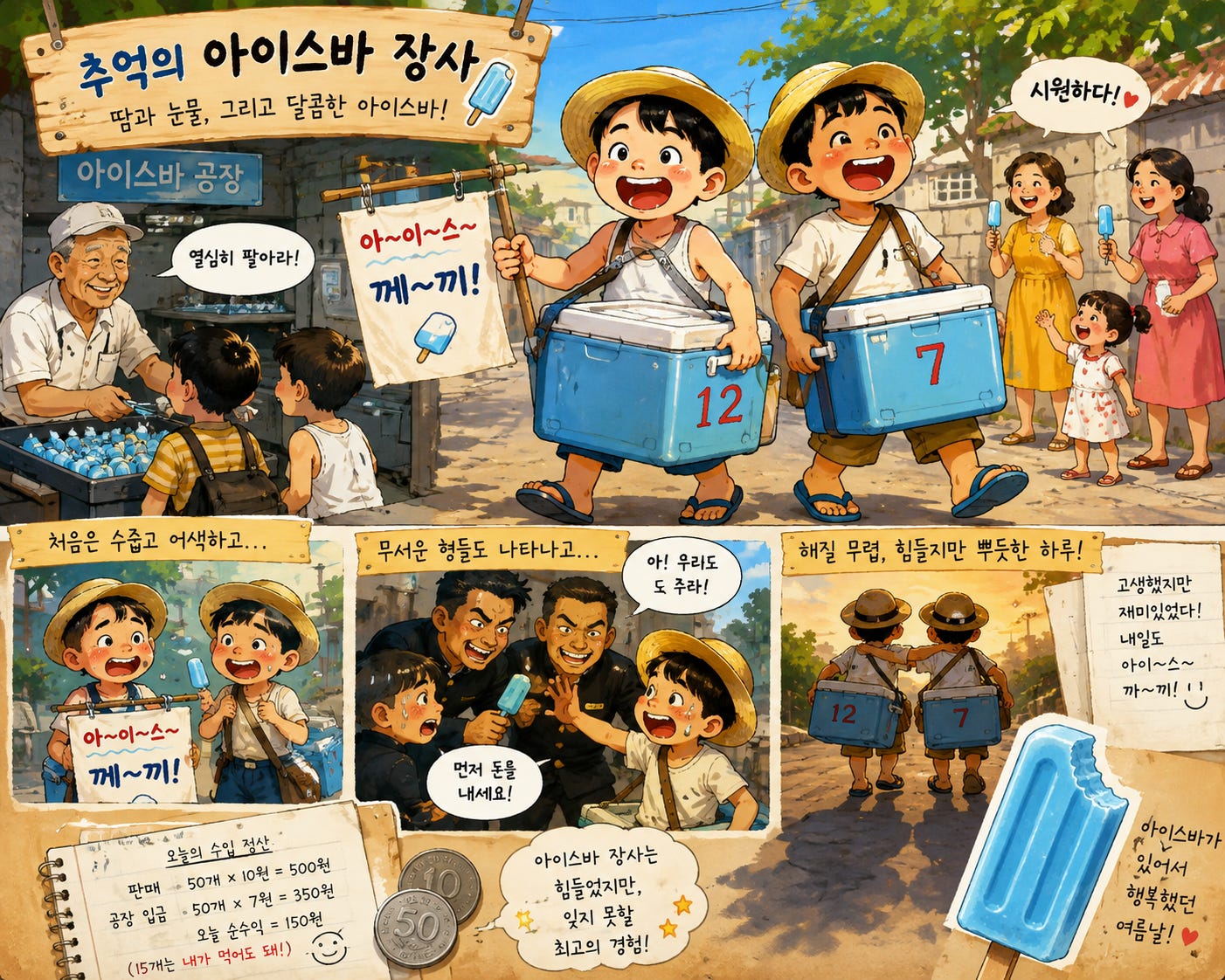
Image credit: Illustration generated with OpenAI’s ChatGPT image-generation tool, 2026.
Ice Bars
A Childhood Business Venture in the School of Hard Knocks
Abstract
This essay is a humorous and reflective memoir recounting the author’s childhood experience of selling ice bars with his friends during a sweltering summer vacation, when he was in the third or fourth grade of elementary school. After obtaining their merchandise from an ice-bar factory, the young boys set out into the streets, initially struggling with shyness but gradually becoming accustomed to their new roles as street vendors. Although they experience small joys through the kindness of customers and college students, they also encounter practical difficulties, particularly when neighborhood toughs take their ice bars without paying the full price. As they wander the streets carrying heavy insulated containers, their legs grow tired, their shoulders ache, and the summer heat gradually melts their precious merchandise. Through satire, exaggeration, and witty comparisons, distinctive humor, the essay vividly captures the comedy that emerges from the contrast between the boys’ innocent ambitions and the harsh realities of the marketplace. At the same time, this modest business venture offers their first lessons in honesty, unfairness, labor, reward, friendship, and perseverance. Even decades later, the author smiles whenever he sees an ice bar, remembering those exhausting yet memorable summer days. Ultimately, the essay demonstrates how ordinary childhood experiences can become cherished memories and how even hardship and failure can be transformed into stories that enrich our understanding of life.
Keywords: Ice-Bar Business, Childhood Memories, Summer Vacation, Humor, Satire and Wit, Childhood Ambition, Labor and Reward, Friendship, Life Lessons, Reflective Memoir
I believe I was in the third or fourth grade of elementary school when this little adventure took place. Summer vacation had arrived, bringing with it the sort of heat that made a boy feel as though he had been sentenced to life imprisonment in a giant outdoor oven. The days were long, the afternoons were sweltering, and boredom settled over the neighborhood like a second layer of humidity. I began wondering whether there might be something cool, refreshing, and entertaining to do.
Then, one day, my friends presented me with what they considered a brilliant business proposition.
“Why don’t we sell ice bars?”
It was a magnificent idea. It promised adventure, independence, and, best of all, unlimited access to frozen refreshments—or so I imagined. When I asked how we were supposed to get started, my friends assured me that the matter had already been thoroughly investigated. All we had to do was visit an ice-bar factory and speak to the owner.
“Come on,” they said. “Let’s go now.”
I followed them without further investigation, which was probably the first business mistake of my career.
The factory was about ten minutes from home. As we approached it, we could almost feel the coolness radiating from within. The prospect of handling hundreds of ice bars filled us with an excitement that would have been difficult to explain to anyone who had never been a hot, bored, and hungry elementary-school boy. We were not merely going to sell frozen treats. We were about to enter the world of commerce, armed with youthful ambition and an appetite that had not yet learned the difference between inventory and personal consumption.
The factory owner gave us a quick, skeptical glance. I could not tell whether he was questioning our business qualifications or wondering whether someone had sent him a group of stray children to dispose of for the afternoon.
Perhaps he felt sorry for us. Perhaps we pleaded more persuasively than I remember. Or perhaps he simply decided that a little adventure would do us no harm. Whatever the reason, he finally agreed to let us sell his ice bars.
He went into a storage area and returned with light-blue insulated containers, each marked with a red number so that he could tell which container belonged to which aspiring entrepreneur. The containers were lined with Styrofoam to keep their contents cold, or at least to postpone the inevitable consequences of doing business in the middle of a very hot and humid Korean summer.
The owner first lined each container with a plastic sheet. Then he opened what looked to us like an enormous refrigerator, took out the ice bars, and loaded approximately fifty into each container. Finally, he explained the wholesale price we would have to pay him for every bar sold.
As I recall, each ice bar sold for ten won.
Ten won! To an elementary-school boy, that sounded like real money. We were no longer children merely wandering about in the summer heat. We were retailers. We had inventory, a supplier, numbered containers, and a pricing structure. If we had possessed neckties, we might have looked like a delegation from the national chamber of commerce.
We divided ourselves into pairs and set off in different directions, carrying our blue containers through the streets.
Our sales campaign began with a traditional Korean street cry:
“Ah—ee—seu—kke—kki!”
The expression was a familiar call used by street vendors selling ice bars. Its purpose was to announce our merchandise to prospective customers, although our first attempts probably announced something else: that two painfully shy boys had been forced to make public appearances against their will.
At first, we could barely bring ourselves to shout. We looked at each other, burst into embarrassed laughter, and tried again. Every time we called out, we felt that the entire neighborhood was watching us. We would have preferred to sell our merchandise by silently placing price lists under people’s doors, but that method had apparently not yet been adopted by the Korean frozen-dessert industry.
After a while, however, embarrassment gave way to habit. We learned to project our voices, approach potential customers, and conduct ourselves with the confidence of boys who had absolutely no idea what they were doing but were determined not to let the customers find out.
Most of our customers behaved admirably. Housewives, young women, and little children generally treated us kindly. Some bought an ice bar simply because they wanted one; others may have bought one because two small boys carrying heavy containers looked too pitiful to ignore.
College students were often generous, too. Perhaps they remembered their own childhoods. Perhaps they found us amusing. Or perhaps they understood that a ten-won purchase was a small price to pay for encouraging the promising next generation of Korean entrepreneurs.
Our real difficulty, however, came from a different class of customer: the neighborhood toughs, particularly boys in middle and high school.
They seemed to have an extraordinary talent for gathering in groups beneath shady trees, where they could avoid both the summer sun and, presumably, the more demanding responsibilities of education. They stood around in clusters of three, five, or whatever number happened to be available, looking as though they were holding an emergency conference on how best to spend an afternoon without accomplishing anything.
Whenever they spotted us, their expressions brightened.
“Hey! Come here!”
We approached with the hopeful innocence of young businessmen who had not yet studied the relationship between customer acquisition and personal safety.
“Give us some ice bars,” they ordered. “One for each of us.”
We tried to explain our elementary accounting policy.
“Please pay first,” we said.
This was not an unreasonable request. It was, after all, the foundation of our entire business model. Even at our tender age, we understood that a customer who received merchandise without paying for it was not exactly a pillar of commercial reliability.
The older boys, however, had developed an alternative theory of economics.
“Hey, you little brat! I said give them to us. Hand them over!”
They delivered these instructions with the kind of confidence normally associated with people who believe that the law is something that applies exclusively to other people.
We had little choice but to surrender the ice bars one by one. Occasionally, their consciences stirred, or perhaps one of them remembered that his mother had raised him to be a reasonably decent human being. They would collect whatever coins they had among themselves and hand the money to us.
Unfortunately, their combined financial resources rarely matched the value of the merchandise they had consumed.
We were therefore introduced to a commercial practice that modern business schools might describe as involuntary discounting, although I suspect that a more accurate term would be robbery with a frozen dessert attached.
I imagined that these boys had performed so poorly in their studies that they were being kept busy with supplementary classes during the summer vacation. Their minds, meanwhile, appeared to have wandered far beyond the reach of mathematics, literature, and any other subject their teachers might have hoped to teach them.
Their school uniforms were carelessly unbuttoned at the top, their language was rough, and their principal intellectual pursuits seemed to consist of teasing younger children and inventing increasingly creative ways to avoid doing anything useful.
They looked like a collection of young men who had been expelled from the classroom by boredom but had not yet discovered what to do with the freedom they had obtained.
We, on the other hand, were learning economics, psychology, negotiation, and risk management in a single afternoon. Our tuition was paid in ice bars.
Whenever possible, my partner and I exchanged a meaningful glance. No words were necessary. We had developed a sophisticated system of nonverbal communication, the central message of which was: Run!
We would escape as quickly as circumstances permitted, carrying our diminished inventory and whatever remained of our professional dignity.
At the time, I did not realize that these encounters were providing us with an unusually practical education. We were learning that a market does not always operate according to the textbook assumptions of voluntary exchange, honest payment, and mutually beneficial transactions. Sometimes, the customer simply takes the product, and the seller learns an important lesson about the difference between theoretical economics and the Korean street economics.
Eventually, the afternoon began to fade. The sun lowered itself toward the horizon, and our great commercial enterprise approached its daily reckoning.
We had to return to the factory and settle our accounts with the owner.
The arithmetic was simple enough. If each ice bar sold for ten won, we were expected to pay the factory owner approximately seven won per bar sold. The remaining three won represented our potential profit.
Suppose we had received fifty ice bars. Our obligation to the factory owner, if we sold all fifty, would be:
50 × 7 won = 350 won.
If we sold thirty-five bars, we would collect 350 won from customers and pay the entire amount to the owner. The fifteen remaining bars would be ours to consume or sell, with the proceeds becoming our profit.
At least, that was the theory.
In practice, the business contained several complications that our youthful enthusiasm had failed to anticipate.
First, some customers consumed our merchandise without paying the full price. Second, walking around all day with a heavy container was exhausting. Third, the summer heat was not especially sympathetic to our inventory.
By late afternoon, many of the remaining ice bars had become soft, misshapen, and depressingly close to liquid. The insulated containers could slow the melting process, but they could not repeal the laws of thermodynamics. The sun continued to shine with the merciless determination of a tax collector, and our ice bars continued their journey from solid merchandise toward an increasingly inconvenient state of matter.
There were days when eating four or five intact ice bars was about all I could manage. The rest were either sold, lost to the ravages of heat, or rendered too unappetizing to count as a satisfactory reward for our labor.
Meanwhile, my legs ached from walking, and the straps of the container dug painfully into my shoulders. The business had begun in the spirit of adventure, but it was ending in the spirit of a forced march.
My ambitious young partners generally returned in much the same condition. We would gather and exchange accounts of our daily exploits, each of us presenting his misfortunes as though he had survived a military campaign rather than a few hours of selling frozen desserts.
One had encountered a particularly demanding group of older boys. Another had walked farther than expected. Someone else had probably lost a promising customer to the irresistible attraction of a shady tree.
We listened to one another’s stories with the solemn attention of veterans comparing battle scars. Our adventures were not exactly heroic, but we had suffered enough to make them sound heroic to one another.
Our clothes were coated with sweat and dust. They clung to our bodies like leeches, except that leeches are generally smaller, less conspicuous, and easier to remove. Our eyes drooped, our shoulders sagged, and our legs seemed to have filed formal complaints against the rest of our bodies.
The hot, darkening streets of the hot and humid Korean summer stretched ahead of us. With heavy steps, we trudged home, each boy carrying the remains of his day’s ambitions.
The ice-bar business had promised excitement, independence, and the possibility of earning a little money. It had delivered all three, but not necessarily in the proportions we had expected. We had discovered that entrepreneurship required more than enthusiasm. It also required stamina, sound judgment, a reliable supply chain, customers who paid their bills, and some ways of keeping the product from melting before the end of the working day.
We had entered the marketplace as hopeful young capitalists and emerged as exhausted specialists in the practical limitations of commerce.
Yet I cannot remember the experience without smiling.
Even now, whenever I buy an ice bar or enjoy one on a hot summer day, my thoughts sometimes return to those childhood afternoons. I remember the blue containers, the red identification numbers, our hesitant cries echoing through the streets, the older boys beneath their shady trees, and the long, weary walk home at dusk.
I remember, too, the extraordinary seriousness with which we approached our little enterprise. We were children, but for those few summer weeks we imagined ourselves independent businessmen, responsible for our own inventory, our own customers, and our own profits. We had no business plans, no formal training, and no understanding of how difficult it could be to protect a modest investment from both human nature and the weather.
But we had ambition. We had friendship. And we had ice bars—at least until they melted.
Looking back, I suspect that our venture taught us more about life than we understood at the time. The world does not always reward hard work fairly. Some people are kind, some are opportunistic, and some will take advantage of anyone too small to resist them. A promising business may be defeated by circumstances that no amount of enthusiasm can control. And the difference between a successful entrepreneur and a tired little boy may sometimes be no more than the amount of ice left in his container.
Still, we had one advantage that many modern business executives might envy: we were young enough to turn even a miserable day into a story worth remembering.
And so, whenever I see an ice bar today, I find myself smiling at the memory of our brief and rather unconventional careers in the frozen-dessert industry.
After all, what was it about an ice bar that could inspire such ambition, provoke such hardship, and leave behind so much laughter?
Perhaps it was never merely an ice bar.
Perhaps it was the hot taste of summer, the excitement of childhood, and our first small encounter with the great, complicated business of being human.
Or perhaps the ice bars were simply delicious, and we were too young to know when to quit.
I leave the final judgment to the reader.
Original essay written on November 19, 2010.
아이스바
세상이라는 학교에서 호된 수업을 받은 어린 시절의 사업 이야기
아마 내가 초등학교 3학년이나 4학년이었을 때의 일인 것 같다. 여름방학이 시작되자, 한 소년이 마치 거대한 야외 화덕에 종신형을 선고받은 듯 느낄 정도로 무더운 날씨가 찾아왔다. 하루는 길고 오후의 열기는 숨이 막힐 지경이었으며, 동네 전체에는 습기만큼이나 두꺼운 지루함이 내려앉았다. 나는 시원하고 재미있는 일이 없을까 궁리하기 시작했다.
그러던 어느 날, 친구들이 우리가 생각하기에 아주 기발한 사업 제안을 내놓았다.
“우리 아이스바를 팔아 보면 어떨까?”
그야말로 대단한 아이디어였다. 모험과 독립심, 그리고 무엇보다도 얼음처럼 시원한 간식을 마음껏 접할 기회를 약속하는 계획이었다. 적어도 당시의 내 상상 속에서는 그랬다. 어떻게 시작해야 하느냐고 묻자, 친구들은 이미 모든 것을 철저히 조사해 놓았다는 듯 자신 있게 대답했다. 아이스바 공장에 가서 주인아저씨를 만나기만 하면 된다는 것이었다.
“자, 가자. 지금 가 보자!”
나는 별다른 조사도 하지 않은 채 친구들을 따라나섰다. 아마도 그것이 내 사업 경력에서 저지른 첫 번째 실수였을 것이다.
공장은 집에서 걸어서 십 분 정도 떨어진 곳에 있었다. 공장에 가까워질수록 우리는 안에서부터 시원한 기운이 뿜어져 나오는 듯한 기분을 느꼈다. 수백 개의 아이스바를 취급하게 된다는 생각만으로도 가슴이 벅찼다. 한여름의 더위와 지루함, 그리고 배고픔에 시달려 본 초등학생이 아니라면 도저히 이해하기 어려운 흥분이었을 것이다.
우리는 단순히 얼린 간식을 팔러 가는 것이 아니었다. 우리는 이제 장사라는 세계에 발을 들여놓으려 하고 있었다. 젊은이다운 야심으로 무장한 채, 상품 재고와 개인적인 식욕을 아직 구분하지 못하는 배고픈 소년들의 모습으로 말이다.
공장 주인아저씨는 우리를 의심스러운 눈초리로 힐끗 바라보았다. 우리의 사업 능력을 평가하는 것인지, 아니면 누군가가 오후 내내 처치 곤란한 아이들을 맡아 달라며 자신에게 보내기라도 한 것인지 나는 알 수 없었다.
아마 우리를 가엾게 여기셨을 수도 있다. 어쩌면 우리가 기억하는 것보다 훨씬 더 간절하게 졸랐는지도 모른다. 아니면 어린아이들에게 작은 모험쯤은 나쁘지 않겠다고 생각하셨을 수도 있다. 이유야 어떻든, 주인아저씨는 마침내 우리에게 아이스바를 팔아 보도록 허락하셨다.
그분은 창고로 들어가더니 하늘색 통을 가지고 나오셨다. 통마다 빨간색으로 번호가 적혀 있어 어느 통이 누구의 것인지 구분할 수 있었다. 통 안에는 아이스바를 차갑게 보관하기 위한 스티로폼이 들어 있었다. 아니, 적어도 무더운 한국의 여름 한복판에서 장사하는 사람들이 피할 수 없는 운명을 조금이라도 늦춰 주기 위한 장치였다.
주인아저씨는 먼저 통 안에 비닐을 깔았다. 그런 다음 우리 눈에는 거대한 냉장고처럼 보이는 곳을 열고 아이스바를 꺼내어 통마다 대략 쉰 개씩 담아 주셨다. 마지막으로 판매한 아이스바 한 개당 얼마를 자신에게 지불해야 하는지 설명해 주셨다.
내 기억으로는 아이스바 한 개의 판매 가격이 10원이었다.
10원이라니! 초등학생에게는 꽤 큰돈처럼 들렸다. 우리는 더 이상 한여름의 거리를 빈둥거리며 돌아다니는 아이들이 아니었다. 우리는 소매상이었다. 상품 재고가 있었고, 공급자가 있었으며, 번호가 적힌 통과 가격 체계까지 갖추고 있었다. 만약 우리에게 넥타이까지 있었다면, 전국 상공회의소 대표단쯤으로 보였을지도 모른다.
우리는 두 명씩 짝을 지어 각자 다른 방향으로 흩어졌다. 하늘색 통을 들고 거리로 나선 것이다.
우리의 판매 활동은 한국의 거리에서 흔히 들을 수 있었던 장사꾼들의 외침으로 시작되었다.
“아~이~스~께~끼!”
아이스바를 파는 행상들이 손님을 부를 때 사용하던 익숙한 외침이었다. 잠재 고객에게 우리 상품을 알리는 것이 목적이었지만, 처음 우리의 외침이 전달한 메시지는 아마 다른 것이었을 것이다. 몹시 수줍어하는 두 소년이 원하지도 않는 공개 공연에 강제로 동원되었다는 사실 말이다.
처음에는 소리를 지르는 것조차 쉽지 않았다. 우리는 서로를 바라보다가 쑥스러워 웃음을 터뜨리고는 다시 시도했다. 외칠 때마다 온 동네 사람들이 우리를 지켜보는 것 같았다. 차라리 사람들 집 문틈으로 가격표를 조용히 밀어 넣는 방식으로 장사하고 싶었다. 그러나 안타깝게도 당시 한국의 냉동 디저트 산업에는 그런 판매 방식이 아직 도입되지 않았던 모양이다.
하지만 시간이 흐르자 부끄러움은 차츰 습관에 자리를 내주었다. 우리는 목소리를 높이는 법을 익혔고, 손님에게 다가가는 법도 배웠으며, 정작 자신이 무슨 일을 하고 있는지 전혀 모르면서도 손님만큼은 그 사실을 눈치채지 못하게 하려는 소년 특유의 자신감으로 장사에 임했다.
대부분의 손님은 훌륭한 고객이었다. 주부들과 젊은 여성들, 그리고 어린아이들은 대체로 우리에게 친절했다. 어떤 사람들은 아이스바가 먹고 싶어서 샀고, 어떤 사람들은 무거운 통을 들고 다니는 어린 소년 둘이 너무 안쓰러워 보여서 사 주었는지도 모른다.
대학생들도 대체로 인심이 후했다. 아마 자신들의 어린 시절을 떠올렸을 것이다. 우리가 귀엽다고 생각했을 수도 있다. 아니면 10원짜리 아이스바 하나쯤 사 주는 것이 한국의 차세대 기업가를 격려하는 데 드는 작은 투자라는 사실을 이해했는지도 모른다.
그러나 진짜 문제는 다른 부류의 손님들에게서 발생했다. 바로 동네의 불량배들, 특히 중학생과 고등학생들이었다.
그들은 여름 햇볕을 피할 수 있을 뿐 아니라, 아마도 공부라는 더 까다로운 의무까지 피할 수 있는 나무 그늘 아래에 무리를 지어 모이는 특별한 재능을 가지고 있었다. 서너 명, 대여섯 명, 혹은 그때그때 모일 수 있는 인원만큼 모여 서서, 아무것도 하지 않고 오후를 보내는 가장 효율적인 방법을 놓고 긴급회의라도 하는 듯한 모습이었다.
그들이 우리를 발견하면 얼굴이 환해졌다.
“야! 이리 와 봐!”
우리는 손님 확보와 신변 안전 사이의 관계를 아직 배우지 못한 젊은 사업가들답게 순진한 기대를 품고 다가갔다.
“아이스바 좀 줘. 여기 있는 사람 수대로 하나씩!”
그들은 명령했다.
우리는 초등학생 수준의 회계 원칙을 설명하려고 했다.
“먼저 돈을 내세요.”
우리가 말했다.
그것은 전혀 무리한 요구가 아니었다. 사실 그것이야말로 우리 사업 모델의 기초였다. 어린 나이에도 우리는 상품을 받아 가면서 돈을 내지 않는 손님이 상거래의 모범적인 인물이 될 수 없다는 정도는 알고 있었다.
그러나 나이가 조금 더 많은 그 형들은 자신들만의 대안적 경제 이론을 개발해 놓은 상태였다.
“야, 이 새끼야! 주라고 하면 내놓을 것이지!”
그들은 법이란 오직 다른 사람들에게만 적용되는 것이라고 믿는 사람들 특유의 당당함으로 우리에게 명령했다.
우리에게는 아이스바를 하나씩 내줄 수밖에 다른 도리가 없었다. 가끔은 그들의 양심이 조금이나마 깨어나기도 했다. 아니면 그중 한 명이 어머니에게 제법 괜찮은 인간으로 키워졌다는 사실을 잠시 기억했을 수도 있다. 그들은 주머니에 있는 동전을 모두 모아 우리에게 건네곤 했다.
안타깝게도 그들이 모은 돈은 자신들이 먹어 치운 상품의 가치에 미치지 못하는 경우가 대부분이었다.
그렇게 우리는 현대 경영대학원에서라면 ‘비자발적 가격 할인’이라고 부를 법한 상거래 관행을 배웠다. 하지만 좀 더 정확한 표현은 아마도 ‘얼린 디저트를 곁들인 강탈’이었을 것이다.
나는 그 형들이 공부를 너무 못해서 여름방학에도 보충수업을 듣고 있는 것이라고 생각했다. 그들의 정신세계는 수학과 문학은 물론, 선생님들이 가르치려 했던 다른 어떤 과목의 손길도 미치지 못할 만큼 멀리 떠나 있는 듯했다.
교복 윗단추는 건방지게 풀어 놓았고, 말투는 거칠었으며, 그들의 주된 지적 활동이라고는 어린아이들을 괴롭히고 유용한 일을 하지 않을 새로운 방법을 궁리하는 것뿐인 듯했다.
그들은 지루함 때문에 교실에서 쫓겨났지만, 막상 얻은 자유를 어디에 써야 할지는 아직 발견하지 못한 젊은이들의 집단처럼 보였다.
반면 우리는 단 한 번의 오후 동안 경제학과 심리학, 협상술, 위험 관리까지 배우고 있었다. 우리의 수업료는 아이스바로 지불되고 있었다.
가능할 때마다 나와 짝꿍은 의미심장한 눈빛을 주고받았다. 말은 필요하지 않았다. 우리는 이미 정교한 비언어적 의사소통 체계를 개발해 놓고 있었으며, 그 체계의 핵심 메시지는 단 하나였다.
도망쳐!
우리는 상황이 허락하는 한 재빨리 그 자리를 벗어났다. 줄어든 상품 재고와 그나마 남아 있는 사업가로서의 자존심을 챙긴 채 말이다.
그때는 미처 몰랐지만, 그런 경험은 우리에게 아주 실용적인 교육을 제공하고 있었다. 시장이 언제나 교과서의 가정대로 움직이는 것은 아니라는 사실을 배우고 있었던 것이다. 자발적인 교환, 정직한 대금 지급, 상호 이익이 되는 거래라는 원칙이 현실에서 항상 지켜지는 것은 아니었다. 때로는 손님이 그냥 상품을 가져가 버리고, 판매자는 ‘이론 경제학’과 ‘한국 거리 경제학’의 차이를 뼈저리게 깨닫게 되는 것이다.
마침내 오후가 저물기 시작했다. 해는 지평선 쪽으로 내려앉았고, 우리의 거창한 상업 활동도 하루의 결산을 맞이하게 되었다.
우리는 공장으로 돌아가 주인아저씨와 장부를 정리해야 했다.
계산 자체는 간단했다. 아이스바 한 개를 10원에 팔면, 판매한 아이스바 한 개당 약 7원을 공장 주인아저씨에게 지불해야 했다. 나머지 3원이 우리의 잠재적 이익이었다.
아이스바 쉰 개를 받았다고 가정해 보자. 쉰 개를 모두 팔았다면 공장 주인아저씨에게 지불해야 할 금액은 다음과 같았다.
50 × 7원 = 350원.
아이스바 서른다섯 개를 팔았다면 손님들에게서 350원을 받아 주인아저씨에게 전액 지불하면 되었다. 남은 열다섯 개는 우리가 먹거나 팔 수 있었고, 그것을 팔아 얻은 돈은 우리의 이익이 되었다.
적어도 이론상으로는 그랬다.
실제로는 우리의 젊은 열정이 미처 예상하지 못한 여러 가지 문제가 있었다.
첫째, 일부 손님은 상품을 가져가면서 제값을 지불하지 않았다. 둘째, 무거운 통을 들고 하루 종일 걸어 다니는 일은 몹시 힘들었다. 셋째, 한여름의 더위는 우리의 상품 재고에 그다지 호의적이지 않았다.
오후 늦게 남아 있는 아이스바는 대부분 물렁물렁해지고 모양이 망가져, 안타깝게도 액체 상태에 거의 가까워져 있었다. 보냉 통은 녹는 속도를 늦출 수는 있었지만, 열역학 법칙을 무효로 만들 수는 없었다. 태양은 세금 징수원처럼 무자비한 집념으로 내리쬐었고, 우리의 아이스바는 고체 상품에서 점점 더 처치 곤란한 물질 상태로 여행을 계속하고 있었다.
어떤 날은 온전한 아이스바 네다섯 개를 먹는 것만으로도 내가 감당할 수 있는 한계에 도달했다. 나머지는 팔렸거나, 더위의 혹독한 공격을 받아 녹아 버렸거나, 노동의 보상이라고 부르기에는 너무 볼품없는 상태가 되어 버렸다.
그동안 다리는 걸을 때마다 쑤셨고, 통의 끈은 어깨를 아프게 파고들었다. 모험심으로 시작한 사업은 어느새 강제 행군으로 끝나 가고 있었다.
야심만만했던 나의 어린 동업자들도 대체로 나와 비슷한 상태로 돌아왔다. 우리는 서로 모여 그날의 무용담을 주고받았다. 고작 몇 시간 동안 냉동 간식을 팔았을 뿐인데도, 각자 겪은 불운을 마치 군사 작전을 치르고 살아 돌아온 사람처럼 이야기했다.
누군가는 특히 까다로운 형들을 만났다고 했다. 다른 누군가는 생각보다 훨씬 먼 거리를 걸었다고 했다. 또 다른 누군가는 아마도 나무 그늘 아래에서 빈둥거리던 사람들의 거부할 수 없는 매력 때문에 유망한 고객을 놓쳤을 것이다.
우리는 전쟁터에서 돌아온 노병들이 상처를 비교하듯 진지한 표정으로 서로의 이야기를 들었다. 우리의 모험이 특별히 영웅적인 것은 아니었지만, 서로에게 들려주기에는 충분히 고생스러운 일이었다. 고생이 어느 정도 쌓이면 평범한 하루도 영웅담이 되는 법이다.
우리의 옷은 땀과 먼지로 뒤범벅이 되어 있었다. 옷은 거머리처럼 몸에 달라붙었다. 다만 거머리는 대체로 더 작고, 덜 눈에 띄며, 떼어 내기도 쉽다는 차이가 있었다. 눈꺼풀은 축 처졌고 어깨는 늘어졌으며, 다리는 마치 나머지 신체 부위를 상대로 공식적인 항의서를 제출한 것처럼 움직이기조차 힘들었다.
후덥지근한 한국의 여름, 어둠이 내려앉는 거리가 우리 앞에 길게 펼쳐졌다. 우리는 무거운 발걸음으로 집을 향해 터벅터벅 걸어갔다. 각자 하루 동안 품었던 야심의 잔해를 짊어진 채였다.
아이스바 장사는 우리에게 재미와 독립심, 그리고 약간의 돈을 벌 수 있는 가능성을 약속했다. 그 약속은 모두 실현되었다. 다만 우리가 기대했던 비율대로 이루어진 것은 아니었다. 우리는 기업가 정신에는 열정만 필요한 것이 아니라는 사실을 깨달았다. 체력과 분별력, 믿을 만한 공급망, 대금을 제대로 지불하는 손님, 그리고 근무가 끝나기도 전에 상품이 녹아 버리지 않도록 하는 방법도 필요했다.
우리는 희망에 찬 어린 자본가로 시장에 들어갔다가, 상업의 현실적 한계를 전문적으로 체험한 지친 소년들로 돌아왔다.
그럼에도 나는 그 경험을 떠올릴 때마다 웃음을 참을 수 없다.
지금도 아이스바를 사거나 무더운 여름날 하나를 먹을 때면 어린 시절의 그 오후들이 문득 생각난다. 하늘색 통과 빨간색 식별 번호, 거리에서 쑥스럽게 외치던 우리의 목소리, 나무 그늘 아래에 모여 있던 형들, 그리고 해 질 무렵 지친 몸으로 걸어오던 긴 귀갓길이 떠오른다.
나는 우리가 그 작은 사업에 얼마나 진지하게 임했는지도 기억한다. 우리는 어린아이들이었지만, 그 몇 주 동안만큼은 독립적인 사업가라고 생각했다. 우리 상품과 고객, 그리고 이익을 스스로 책임지는 사람들이라고 믿었다. 사업계획서도 없었고 정식 교육도 받지 않았으며, 인간의 본성과 날씨라는 두 가지 적으로부터 작은 투자금을 지키는 일이 얼마나 어려운지도 알지 못했다.
그러나 우리에게는 야심이 있었다. 우정이 있었다. 그리고 아이스바가 있었다. 적어도 녹아 버리기 전까지는 말이다.
돌이켜 보면, 그 경험은 당시 우리가 이해했던 것보다 훨씬 많은 것을 가르쳐 주었다. 세상은 언제나 열심히 일한 사람에게 공정한 보상을 주지는 않는다. 친절한 사람도 있고, 기회를 노리는 사람도 있으며, 자신에게 저항할 힘이 없는 사람을 이용하려는 사람도 있다. 아무리 열정이 넘쳐도 통제할 수 없는 상황 때문에 유망한 사업이 실패할 수 있다. 그리고 성공한 기업가와 지친 어린 소년의 차이는 때로 아이스바 통 안에 얼음이 얼마나 남아 있느냐에 불과할 수도 있다.
그래도 우리에게는 오늘날의 많은 기업 경영자들도 부러워할 만한 장점이 하나 있었다. 아무리 고달픈 하루라도 훗날 웃으며 이야기할 만한 추억으로 바꿀 수 있을 만큼 우리가 어렸다는 사실이다.
그래서 오늘도 아이스바를 볼 때면, 나는 냉동 디저트 업계에서 잠시 몸담았던 우리의 짧고도 파란만장한 경력을 떠올리며 미소를 짓는다.
도대체 아이스바가 무엇이기에 그토록 큰 야심을 불러일으키고, 그토록 많은 고생을 안겨 주었으며, 이토록 많은 웃음을 남겼을까?
어쩌면 그것은 결코 ‘단순한 아이스바’가 아니었을 것이다.
그것은 ‘여름의 맛’이었고, ‘어린 시절의 설렘’이었으며, ‘복잡하고 거대한 인간 세상의 사업에 우리가 처음으로 발을 들여놓았던 순간’이었을지도 모른다.
아니면 아이스바가 그저 너무나 맛있었을 뿐이고, 우리는 언제 그만두어야 하는지 알기에는 너무 어렸던 것인지도 모른다.
최종 판단은 독자 여러분께 맡기겠다.
원문 작성일: 2010년 11월 19일.
한글 초록
이 수필은 초등학교 3~4학년 무렵, 무더운 여름방학에 친구들과 함께 아이스바를 팔았던 어린 시절의 경험을 유머와 해학으로 풀어낸 회고록이다. 아이스바 공장에서 상품을 받아 거리로 나선 어린 소년들은 처음에는 수줍음에 어쩔 줄 몰라 하면서도 점차 장사에 익숙해진다. 친절한 손님들과 대학생들의 도움으로 작은 기쁨을 맛보지만, 돈을 제대로 지불하지 않고 아이스바를 가져가는 불량배들을 만나면서 현실적인 어려움도 경험한다. 무거운 아이스바 통을 들고 하루 종일 거리를 누비는 동안 다리는 아프고 어깨는 쑤시며, 한여름의 열기에 아이스바마저 녹아내린다. 이러한 고생을 마크 트웨인 특유의 풍자와 과장, 익살스러운 비유로 재구성하여 어린 소년들의 순진한 야심과 현실의 냉혹함 사이에서 발생하는 웃음을 생생하게 전달한다. 동시에 이 작은 사업은 정직과 불공정, 노동과 보상, 우정과 인내에 관한 삶의 첫 번째 교훈을 제공한다. 글쓴이는 세월이 흐른 뒤에도 아이스바를 볼 때마다 그 시절을 떠올리며 미소 짓는다. 결국 이 수필은 평범한 어린 시절의 경험이 시간이 지나면서 소중한 추억이 되고, 실패와 고생조차 삶을 풍요롭게 만드는 이야기로 바뀔 수 있음을 따뜻하게 보여 준다.
핵심어
아이스바 장사, 어린 시절의 추억, 여름방학, 유머, 풍자와 해학, 어린이의 순진한 야심, 노동과 보상, 우정, 삶의 교훈, 회고 수필
About the Author

Prof. Dr. Young Choi (Editor-in-Chief) — Regent University
Full list of his K-GSP columns
Full list of his Books at Amazon.com
Young B. Choi is a Professor in the Department of Engineering & Computer Science at Regent University. He published 38 books with ‘Selected Readings in Cybersecurity’ (2018) (about 800 copies archived globally at university/college libraries around the world) and ‘Cybersecurity Applications and Artificial Intelligence’ (2023) available in seven major world languages. He proposed the world’s first global and universal telecommunications “Service Order Handling (SOH)” Model (T-SOH Model) (1995) with Dr. Adrian Tang. With this innovative research work, he received the IEEE NOMS ’96 Best Paper Award and became the first recipient of the Outstanding Contribution Award of the TeleManagement Forum in 1998. His research areas include Natural Language Processing-focused AI, AI-applied cybersecurity, network and telecom service management, and Korean studies on Gani Choi Rip’s Jeonggwan (靜觀: Quiet Contemplation) philosophy and Shilhak ( 實學: Practical Learning).
Suggested Citation
Choi, Y. B. (2026). Ice Bars: A Childhood Business Venture in the School of Hard Knocks. K-GSP Forum.
© K-Global Scholars and Professionals Forum. All rights reserved. 2026. Content published in the K-GSP Forum may not be reproduced, distributed, or transmitted in any form without prior written permission from the K-GSP Forum, except for brief quotations with full attribution.