
Korean Football at a Crossroads
Son Heung-min, Generational Tensions, and a Crisis of Trust
Summary
Korean football stands at a critical turning point following the disappointing elimination of its national team in the group stage of the 2026 FIFA World Cup. Reports of generational tensions within the squad, debates over captain Son Heung-min’s role, questions concerning the Korea Football Association’s administrative accountability, and uncertainty surrounding the appointment of the next head coach have emerged simultaneously. In an article published on October 30, 2026, John Duerden of The Guardian examined relationships between Son and some of his younger teammates, dissatisfaction with the national team’s leadership structure, and police investigations involving the Korea Football Association. However, reports of internal conflict and speculation that certain players considered withdrawing from international duty should be distinguished from facts independently confirmed by all parties involved. Drawing on materials from FIFA, the Korea Football Association (KFA), the Asian Football Confederation (AFC), Yonhap News Agency, and international media, this essay distinguishes established facts from reported allegations, interpretations, and projections. It examines Korean football’s challenges not simply as personal disagreements among individual players but as broader questions involving intergenerational communication, leadership, administrative transparency, and institutional trust. The forthcoming 2027 AFC Asian Cup will provide an important opportunity to assess whether Korean football can address these problems and establish a stronger foundation for future competitiveness.
Keywords: Son Heung-min, Korean football, Korea Football Association (KFA), generational tensions, team leadership, football administration, 2026 FIFA World Cup, 2027 AFC Asian Cup
Football Is About More Than What Happens on the Pitch
Football is a sport in which two teams compete over ninety minutes. Yet sustained success at the national level requires more than technical ability and tactical preparation. Trust among players, effective coaching, competent football administration, and public support must work together. When any of these elements becomes unstable, the team’s performance may suffer.
Korean football has long attracted attention for its determination, organizational discipline, and willingness to challenge established powers on the international stage. The national team’s run to the semifinals of the 2002 FIFA World Cup remains a landmark in the country’s sporting history. Since then, Korea has qualified for multiple World Cups, while players such as Son Heung-min have enhanced the country’s reputation through their achievements in international football.
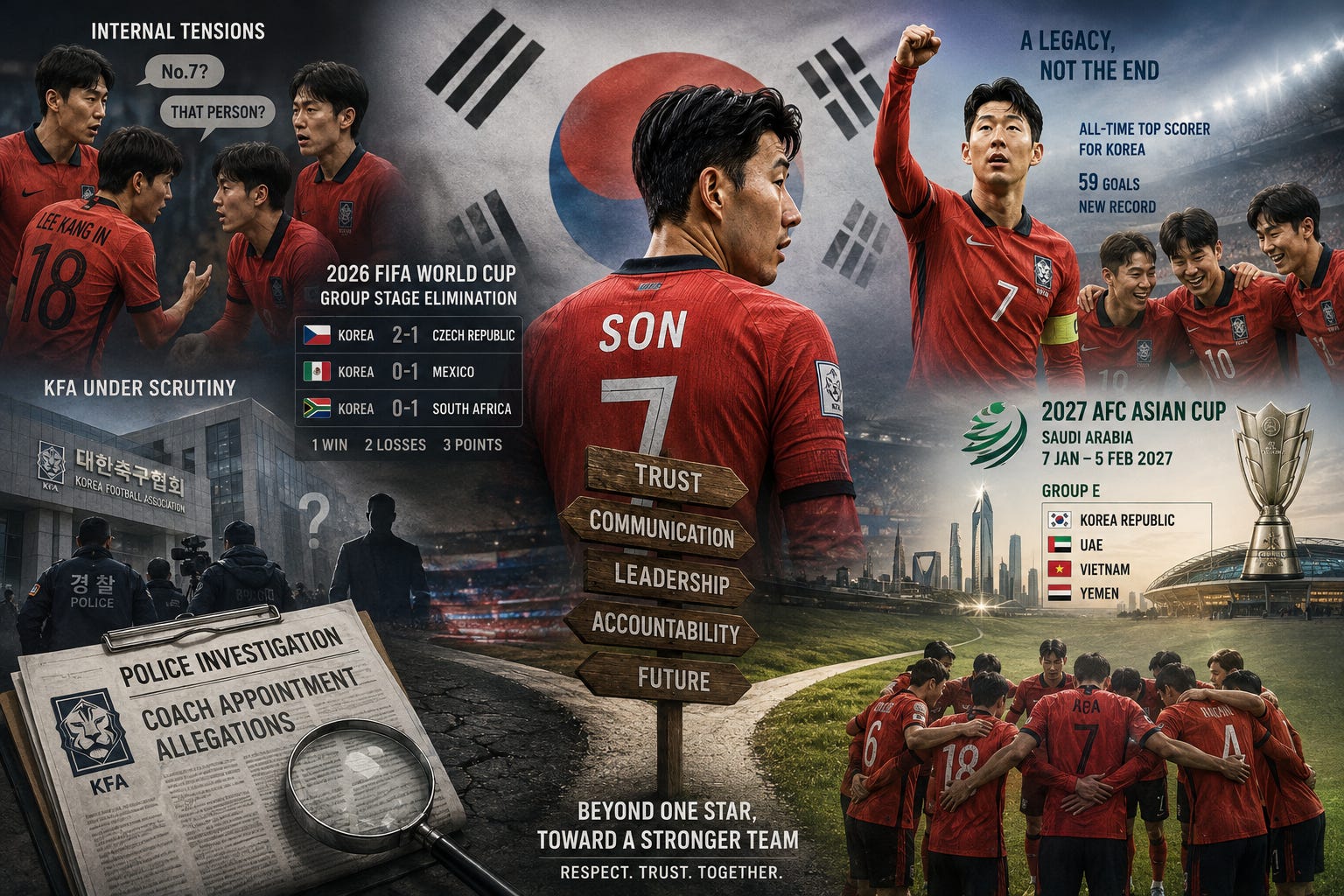
The 2026 World Cup, however, delivered a painful setback. Korea opened its campaign with a 2–1 victory over the Czech Republic but subsequently lost 0–1 to Mexico and 0–1 to South Africa. The team finished third in Group A with one victory, two defeats, and three points, failing to advance to the Round of 32 (Korea Football Association [KFA], 2026a).
The disappointing results were not the only concern. Following the tournament, questions arose about the accountability of the head coach and the KFA leadership, while reports of generational tensions within the national team attracted considerable attention. Police investigations into the association’s operations and coaching appointment procedures added another layer of uncertainty.
Korean football now faces a challenge that extends beyond winning its next match: rebuilding the national team as an organization worthy of public confidence.
Son Heung-min: A National Icon and the Limits of Individual Achievement
Son Heung-min is one of the most internationally recognized figures in Korean football. During his long career with Tottenham Hotspur, he developed into one of the English Premier League’s leading attacking players and captained the club to victory in the UEFA Europa League. He subsequently moved to Los Angeles FC in Major League Soccer, entering a new professional environment as he prepared for the 2026 World Cup.
Son’s influence extends far beyond the pitch. He symbolizes the achievements of Korean players competing abroad and has helped raise the country’s profile in world football. Whenever he appears in the national team’s colors, many supporters continue to place enormous expectations on his shoulders.
Nevertheless, past achievements cannot guarantee present performance indefinitely. Son was 34 years old in 2026. Duerden (2026) suggested that he was no longer the attacking player he had been at his peak. This was the journalist’s assessment of Son’s current playing level, rather than an objectively established conclusion. Even so, questions about his role in the national team have become increasingly relevant, including whether he should continue to start regularly or whether a different role might better serve the team.
At the same time, it would be a mistake to underestimate Son’s continuing value. On October 6, 2026, he scored from a free kick in the sixth minute of a friendly against Uzbekistan. The goal was his 59th for the national team, making him Korea’s all-time leading scorer in men’s international football, surpassing the previous record held by Cha Bum-kun. At that time, Son also held the record for the most appearances for the national team (Yoo, 2026a).
This achievement demonstrates that Son remains capable of contributing to Korean football. Yet the debate about his future cannot be settled by reputation alone. The national team must consider how best to use his experience and game-management skills, whether he should continue to occupy a central attacking role, and how leadership responsibilities might gradually be transferred to younger players.
Every great player eventually encounters the question of succession. What matters is whether that transition takes place through mutual respect and constructive agreement. Discussing Son’s role should not be an exercise in diminishing his accomplishments. Rather, it should be part of preparing Korean football for its next stage of development.
Internal Tensions Within the Squad: Established Facts and Reported Allegations
On October 21, 2026, during a parliamentary meeting, Representative Jeong Yeon-wook asked Lee Young-soo, acting president of the Korea Football Association, whether he had heard that national team players referred to Son not by his name but as “No. 7” or “that person.” Lee asked whether the question referred to Son but avoided providing a substantive answer. The exchange brought questions about relationships within the national team into the public debate (Duerden, 2026).
However, neither the question nor the response establishes that players actually used those expressions or demonstrates the extent of any conflict within the squad. A politician’s question raises an issue for investigation; it is not equivalent to confirmation by the people concerned or to independently verified evidence.
The Guardian reported allegations that Kim Min-jae, Hwang In-beom, and Hwang Hee-chan, all born in 1996, were dissatisfied with the national team’s leadership structure and wanted a new captain and head coach after the World Cup. The article also discussed reports that these players had considered leaving international football but reconsidered after being persuaded by KFA officials (Duerden, 2026). These accounts must be treated as reported claims rather than facts personally confirmed by all three players.
Public comments by members of the squad have nevertheless raised concerns about the team’s atmosphere. After the match against Venezuela on October 2, 2026, Hwang In-beom said that he was physically and mentally exhausted. He also indicated that, despite having been involved with the national team for approximately nine years, necessary changes in football and other aspects of the team’s environment had not materialized as they should have. Kim Min-jae likewise expressed disappointment over the perception that some players had not adequately fulfilled their responsibilities to the team (Duerden, 2026).
These remarks suggest that the national team may face unresolved problems. However, reducing those problems to a personal feud between Son and particular teammates would be an oversimplification. The sources of dissatisfaction need to be examined more precisely: tactics, training methods, match management, the distribution of responsibilities, and communication may all be relevant.
The confrontation involving Son and several younger players, including Lee Kang-in, over table tennis during the 2024 Asian Cup is already widely known. Son injured a finger during the incident, and the two players subsequently reconciled. Nevertheless, the earlier episode should not automatically be treated as proof of current tensions. Past disagreements may provide context, but they do not establish that the same conflict continues or that recent problems have the same causes.
Korean football’s task is not to amplify rumors but to establish what has actually happened and identify workable solutions. If players have concerns, those concerns should be addressed through formal and constructive dialogue. When silence and speculation persist, even minor misunderstandings can grow into serious distrust.
Korean Hierarchy and Communication in Modern Football
In Korean society, age and seniority have traditionally played important roles in social relationships. The sporting environment is no exception. Younger players may be expected to use honorific language when addressing older teammates, defer to senior players’ opinions, and exercise caution when expressing disagreement publicly.
This culture has certain advantages. Respect for experienced players can strengthen team discipline and help maintain order. Problems arise, however, when respect becomes unquestioning obedience. Football requires immediate decisions and rapid communication. If younger players hesitate to give necessary instructions to senior teammates, or if senior players refuse to consider younger teammates’ perspectives, the entire team’s ability to respond effectively may suffer.
When Guus Hiddink became Korean national football team coach in 2001, he recognized that hierarchical relationships among players could interfere with communication during matches. He sought to reduce the psychological distance between senior and junior players, including by encouraging them to sit together at meals. His broader objective was to foster a team culture in which younger players could communicate freely with their seniors during games (Duerden, 2026).
The lesson for today’s national team is straightforward: respect does not require silence. Players should be able to respect their seniors while still challenging questionable decisions. Similarly, listening to younger teammates does not diminish a senior player’s authority.
In modern football, leadership cannot be determined by age and experience alone. Playing ability, accountability, communication skills, and consideration for teammates all matter. A captain should not merely issue commands to every member of the squad. The captain should also help build trust between players and coaching staff.
For Korean football to progress, the strengths of its seniority culture must be preserved while barriers to open communication are addressed. Team discipline does not emerge from silence. It develops when players understand their respective roles, exchange ideas, and share responsibility for collective outcomes.
The Korea Football Association: Administrative Accountability and Institutional Trust
The national team’s difficulties extend beyond relationships among players. The administration and leadership structure of the Korea Football Association have also become central concerns.
First, the timing of head coach Hong Myung-bo’s departure must be distinguished from that of KFA president Chung Mong-gyu. Hong resigned after Korea’s elimination from the 2026 World Cup group stage. Chung, by contrast, had already announced on May 29, 2026, his intention to step down after the tournament. Following the national team’s early elimination, the process was accelerated, and he officially resigned on July 6 (Yonhap News Agency, 2026a, 2026b).
It would therefore be inaccurate to describe both departures as sudden decisions made immediately after the World Cup elimination. Nevertheless, the departures of both figures illustrate the seriousness of the questions raised about national team management and the association’s administrative responsibilities.
The KFA also became the subject of a police investigation concerning the appointment of Hong as head coach. On August 6, 2026, police conducted searches at the association’s headquarters in Cheonan and its football center in Seoul. The investigation sought to examine allegations concerning possible improper intervention and whether the procedures used in the 2024 coaching appointment had been properly conducted (Yonhap News Agency, 2026c).
An important distinction must be maintained here. Police searches demonstrate that an investigation is underway; they do not establish that a particular individual has committed a crime or violated the law. Until investigative findings and legal determinations become available, allegations must remain distinct from established facts.
The appointment of a national team head coach is an administrative decision with long-term implications for the team’s direction. The KFA should therefore make its selection criteria, evaluation procedures, and decision-making rationale transparent. Technical committees and related bodies must be able to function independently, and responsibility for decisions must be clearly defined.
In September 2026, the KFA appointed Spanish coach Robert Moreno as interim head coach of the men’s national team. The association announced that the appointment followed an open recruitment process. Moreno’s initial contract ran until November 27, and he was assigned to lead the team through its September and October matches and two additional matches scheduled for November. The association left open the possibility of retaining him through the Asian Cup, depending on match results and its evaluation of his performance (KFA, 2026b; FIFA, 2026).
This interim arrangement can be understood as an attempt to stabilize the national team after the World Cup. However, appointing an interim coach cannot, by itself, resolve structural problems within the KFA. Transparency in coaching appointments, the independence of technical committees, clear accountability for administrative decisions, and consistent standards for player selection and evaluation must also be addressed.
When a national team performs well, administrative shortcomings can temporarily fade from public view. When results deteriorate, institutional weaknesses often reappear. Sustainable football development cannot depend on a single victory or an individual leader.
What Can Korea Learn from Its World Cup Failure?
Korea’s group-stage elimination at the 2026 World Cup delivered a clear warning. The team defeated the Czech Republic but subsequently lost to Mexico and South Africa, finishing with one victory, two defeats, and three points. Under the expanded 48-team format, some third-place teams with sufficiently strong records could also advance to the Round of 32. Korea failed to secure one of those places (FIFA, 2026; KFA, 2026a).
The national team must reassess several areas, including tactical consistency, the allocation of responsibilities among players, in-game adaptability, and squad cohesion. The presence of internationally accomplished players does not automatically produce a strong team. Having excellent players is one thing; building an excellent team is another.
The competitiveness of leading national teams around the world rests not only on individual talent but also on coordinated training, clear tactical principles, mutual trust, and professional support systems. Korean football should not measure its strength simply by counting overseas-based players or pointing to the presence of internationally recognized stars.
Nor is it sufficient to assign responsibility for the World Cup failure exclusively to the head coach. The coach must be accountable for tactics and match management, but the association must also take responsibility for recruitment, oversight, and support. Players must fulfill their roles and responsibilities on the pitch. Meaningful change begins when each party acknowledges its own obligations rather than shifting blame to others.
Failure is painful, but a rigorous examination of its causes can provide valuable lessons for the next generation. If the parties involved instead continue to blame one another, the same problems are likely to recur.
Preparing Korean Football for the Era After Son Heung-min
Son has left an extraordinary legacy in Korean football. Nevertheless, the future of the national team must not depend on one individual. No player can remain at the center of the team forever. The essential task is to ensure that the achievements of one generation become a foundation upon which the next generation can build.
Through his experience and leadership, Son can continue to support younger teammates. At the same time, younger players must develop their own abilities, accept responsibility, and help create a new culture within the national team. A generational transition should not be understood as the removal of one generation by another. It should be a process of combining experience with fresh energy.
The question of who should wear the captain’s armband deserves the same approach. Whether Son remains captain or another player eventually assumes the role, the decision should be based on the team’s needs and the confidence of the squad, not merely on personal popularity or age.
It is difficult to predict whether Son will continue representing Korea at the 2030 World Cup. Regardless of the role he eventually assumes, Korean football needs a long-term development strategy that extends beyond his name. A genuinely strong team remains competitive even after its greatest star retires.
Achieving this goal requires simultaneous progress in youth development, the competitiveness of the domestic league, cooperation between overseas-based and domestic players, science-based player management, and professional coaching systems. A national team’s future cannot be created through a few months of preparation immediately before a World Cup. It is the product of a football ecosystem developed over many years.
The 2027 Asian Cup: An Opportunity to Rebuild Trust
Korea has not won the AFC Asian Cup since 1960. The 2027 tournament therefore represents an opportunity not only to end a decades-long championship drought but also to evaluate the national team’s organization, leadership, and competitive readiness.
According to the AFC’s final draw for the 2027 Asian Cup, Korea was placed in Group E alongside the United Arab Emirates, Vietnam, and the winner of the qualifying contest between Lebanon and Yemen. Yemen defeated Lebanon in June 2026 to secure its place in the tournament. Korea’s final group-stage opponents are therefore the UAE, Vietnam, and Yemen (AFC, 2026a, 2026b).
The tournament is scheduled to take place in Saudi Arabia from January 7 to February 5, 2027. On October 26, 2026, the AFC finalized and announced the match schedule and venues, from the opening match through the final. The tournament is scheduled to begin in Riyadh with Saudi Arabia playing Palestine, while the final is scheduled to take place in the same city on February 5, 2027 (AFC, 2026c).
Security concerns in the Middle East nevertheless remain an important variable in preparations for the tournament. Concerns about Saudi Arabia’s security environment, including attacks associated with Houthi forces, have prompted some media reports to raise the possibility of postponement. The Associated Press reported that the Korea Professional Football Players Association emphasized the importance of prioritizing the safety of players and supporters. Saudi Arabia’s local organizing committee, however, stated that preparations were proceeding as planned.
Given the AFC’s announcement of the finalized schedule and venues on October 26, 2026, the officially published opening date remains January 7, 2027. Reports discussing the possibility of postponement must be distinguished from an official decision to change the tournament schedule (Associated Press, 2026; AFC, 2026c).
For Korea, the Asian Cup means more than competing for a championship. It will test whether the national team can recover its unity after the World Cup disappointment, demonstrate consistent performances under interim leadership, and address concerns about generational tensions.
The tournament could also be significant for Son. Whatever role he assumes, contributing to an end to Korea’s long wait for another Asian Cup title would represent a meaningful achievement. Yet the team’s overall preparation will matter more than the performance of any one player.
Conclusion: What Matters More Than an Individual Star
Korean football stands at a critical crossroads. The group-stage elimination at the 2026 World Cup, reports of internal tensions within the squad, changes in coaching and association leadership, police investigations, and uncertainty ahead of the Asian Cup have converged to create a period of profound challenge.
Explaining all these problems as a conflict between Son Heung-min and a handful of younger players would be an excessively simplistic interpretation. Communication within the squad is connected to the broader organizational culture, while coaching effectiveness is influenced by the association’s administrative and support structures. Public confidence in the KFA depends on transparent decision-making and responsible governance.
Three priorities are essential if Korean football is to achieve meaningful change.
First, the national team must foster a culture in which players can express their views honestly, regardless of age or status. Respect for senior players and freedom of expression among younger teammates are not mutually exclusive values. A team that can offer necessary criticism while maintaining mutual respect is better equipped to succeed.
Second, transparency in coaching appointments and association governance must be strengthened, and administrative accountability must be clearly established. Allegations associated with police investigations should be examined through objective procedures, while the KFA should be prepared to explain the rationale behind its decisions to the public and its supporters.
Third, Korean football needs a long-term national team development system that allows the next generation to grow without depending excessively on any individual star. Respecting Son’s achievements and preparing new leaders are complementary objectives, not competing priorities.
Son is an invaluable asset to Korean football. Nevertheless, the country’s footballing future cannot rest solely on his shoulders. Creating an environment in which a new generation can thrive while building upon his legacy is far more important.
In football, a captain can lead a team but cannot replace the team as a whole. A coach can design a tactical system but cannot make it work without the players’ trust. A football association can provide institutional support, but it cannot achieve sustainable progress without the confidence of the public and its supporters.
What Korean football needs now is not another hero to rescue it. It needs a healthy system in which people respect one another, share responsibility, and grow together.
A star can inspire a team, but a sustainable system creates the conditions in which the next generation can thrive.
References
Asian Football Confederation. (2026a, May 10). AFC Asian Cup Saudi Arabia 2027™ primed for spectacular showdowns. https://www.the-afc.com/en/national/afc_asian_cup.html/news/afc-asian-cup-saudi-arabia-2027%E2%84%A2-primed-for-spectacular-showdowns
Asian Football Confederation. (2026b, June 5). Yemen complete Saudi Arabia 2027 cast. https://www.the-afc.com/en/national/afc_asian_cup.html/news/yemen-complete-saudi-arabia-2027-cast
Asian Football Confederation. (2026c, October 26). AFC Asian Cup Saudi Arabia 2027™: Match schedule finalised for #AsianCup2027. https://www.the-afc.com/en/national/afc_asian_cup.html/news/match-schedule-finalised-asiancup2027
Associated Press. (2026, October). Asian Cup in Saudi Arabia stays on track as safety fears grow amid Middle East conflict. https://apnews.com/article/6e84ad35e25582f3b9f45e598fc1e4e7
Duerden, J. (2026, October 30). Roster rifts, police raids and Son’s uncertain future leave South Korea at a crossroads. The Guardian. https://www.theguardian.com/football/2026/oct/30/south-korea-national-team-scandals-son-heung-min
FIFA. (2026, September 1). Moreno appointed as interim Korea Republic coach. https://www.fifa.com/en/tournaments/mens/worldcup/canadamexicousa2026/articles/robert-moreno-named-interim-korea-republic-coach
Korea Football Association. (2026a, June 25). Korea Republic bow out of FIFA World Cup 26™ after missing Round of 32 with one win and two defeats. https://www.kfa.or.kr/layer_popup/popup_live.php?act=news_tv_detail&check_url=bGF5ZXI%3D&div_code=news&idx=28094&lang=EN
Korea Football Association. (2026b, September 1). [Press release] Korea Football Association appoints Moreno as interim head coach of men’s national team. https://media.kfa.or.kr/bbs/bbs.php?act=bbs_view&con=4c834a4b6c110bf38b034ebe33ef6318&idx=5132
Korea Football Association. (2026c, May 29). [Press release] KFA President Chung Mong-gyu announces intention to resign after 2026 FIFA World Cup. https://media.kfa.or.kr/bbs/bbs.php?act=bbs_view&con=803627a10fb431d84d45cf5f3631bed2&idx=5085
Yonhap News Agency. (2026a, May 29). S. Korean football chief Chung Mong-gyu to step down after 2026 World Cup. https://en.yna.co.kr/view/AEN20260529005300315
Yonhap News Agency. (2026b, July 6). Chung Mong-gyu resigns as nat’l football chief. https://en.yna.co.kr/view/AEN20260706004400315
Yonhap News Agency. (2026c, August 6). Police raid Korea Football Association over controversial appointment of ex-head coach Hong. https://en.yna.co.kr/view/AEN20260806003200315
Yoo, J. (2026a, October 6). Son Heung-min becomes all-time S. Korean men’s goals leader. Yonhap News Agency. https://en.yna.co.kr/view/AEN20261006010752315
기로에 선 한국 축구
손흥민, 세대 간 갈등, 그리고 신뢰의 위기
한글 요약
2026년 FIFA 월드컵에서 조별리그 탈락이라는 실망스러운 결과를 거둔 한국 축구가 중요한 전환점에 서 있다. 대표팀 내부의 세대 갈등에 관한 보도, 주장 손흥민의 역할을 둘러싼 논쟁, 대한축구협회의 행정적 책임 문제, 그리고 차기 감독 선임을 둘러싼 불확실성이 동시에 제기되고 있다. 영국 《가디언》의 존 듀어든 기자는 2026년 10월 30일 보도에서 손흥민과 일부 후배 선수들 사이의 관계, 대표팀의 지도 체계에 대한 불만, 축구협회에 대한 경찰 수사 등을 조명했다. 그러나 선수단 내부의 갈등과 일부 선수들의 대표팀 이탈 검토설은 언론에 보도된 주장으로, 당사자들이 모두 확인한 사실과 구분해야 한다. 본 글은 FIFA, 대한축구협회, 아시아축구연맹(AFC), 연합뉴스 및 국제 언론의 자료를 대조하여 확인된 사실과 보도된 주장, 해석과 전망을 구별한다. 이를 바탕으로 한국 축구의 문제를 특정 선수들의 개인적 갈등이 아니라 세대 간 소통, 지도력, 행정의 투명성, 제도적 신뢰라는 관점에서 살펴본다. 다가오는 2027년 AFC 아시안컵은 한국 축구가 이러한 문제를 해결하고 새로운 경쟁력을 구축할 수 있는지를 보여주는 중요한 시험대가 될 것이다.
핵심어: 손흥민, 한국 축구, 대한축구협회, 세대 갈등, 선수단 리더십, 축구 행정, 2026 FIFA 월드컵, 2027 AFC 아시안컵
축구는 경기장 안에서만 이루어지지 않는다
축구는 90분 동안 승부를 겨루는 스포츠다. 그러나 한 국가의 대표팀이 지속적으로 성공하려면 경기장 안에서의 기술과 전술만으로는 충분하지 않다. 선수들 사이의 신뢰, 감독의 지도력, 축구협회의 행정 능력, 그리고 팬들의 지지가 함께 작동해야 한다. 어느 하나가 흔들리면 경기력에도 영향을 미칠 수밖에 없다.
한국 축구는 오랫동안 투지와 조직력, 그리고 세계 무대에서 보여준 도전 정신으로 주목받아 왔다. 2002년 월드컵 4강 진출은 한국 축구 역사에서 중요한 이정표였다. 이후 한국은 여러 차례 월드컵 본선에 진출했고, 손흥민을 비롯한 여러 선수가 세계적인 무대에서 활약하면서 한국 축구의 위상을 높였다.
그러나 2026년 월드컵은 한국 축구에 뼈아픈 결과를 남겼다. 한국은 체코를 상대로 2대 1 승리를 거두며 대회를 시작했지만, 멕시코에 0대 1로 패했고 마지막 경기에서도 남아프리카공화국에 0대 1로 패했다. 결국 1승 2패, 승점 3점으로 A조 3위에 머물렀으며 32강 진출에 실패했다(Korea Football Association [KFA], 2026a).
실망스러운 성적만이 문제는 아니었다. 대회가 끝난 뒤 감독과 축구협회 지도부의 책임 문제가 제기되었고, 대표팀 내부의 세대 갈등에 관한 보도가 이어졌다. 축구협회 운영과 감독 선임 절차를 둘러싼 경찰 수사도 진행되었다. 한국 축구는 이제 다음 경기의 승리뿐 아니라 대표팀을 다시 신뢰할 수 있는 조직으로 만드는 과제에 직면했다.
손흥민: 국가대표팀의 상징과 한 개인의 한계
손흥민은 한국 축구를 대표하는 세계적인 선수다. 토트넘 홋스퍼에서 오랫동안 활약하며 잉글랜드 프리미어리그를 대표하는 공격수로 성장했고, 주장으로서 팀을 유럽축구연맹 유로파리그 우승으로 이끌었다. 이후 그는 미국 메이저리그사커의 로스앤젤레스 FC로 이적했다. 2026년 월드컵을 준비하는 과정에서 새로운 환경을 선택한 것이다.
손흥민의 영향력은 경기장 안에만 머물지 않는다. 해외에서 활약하는 한국 선수의 상징이자 세계 축구 무대에서 한국의 존재감을 높인 인물이다. 그가 대표팀 유니폼을 입고 경기장에 등장할 때마다 많은 팬은 여전히 큰 기대를 품는다.
그렇지만 한 선수의 과거 업적이 현재의 경기력을 영원히 보장하지는 않는다. 손흥민은 2026년 현재 34세다. 《가디언》은 그가 더 이상 전성기 수준의 공격수는 아니라는 평가를 내놓았다(Duerden, 2026). 이는 기자의 경기력에 대한 판단이지 객관적으로 확정된 사실은 아니다. 다만 대표팀에서 그가 어떤 역할을 맡아야 하는지, 선발 출전이 여전히 최선인지에 대한 논의가 필요해졌다는 점은 분명하다.
그렇다고 손흥민의 현재 가치를 과소평가해서도 안 된다. 그는 2026년 10월 6일 우즈베키스탄과의 친선경기에서 전반 6분 프리킥으로 득점했다. 이 골은 그의 국가대표팀 통산 59번째 득점으로, 차범근의 종전 기록을 넘어 한국 남자 축구 대표팀 역대 최다 득점 기록을 세운 골이었다. 그는 당시 대표팀 최다 출전 기록도 보유하고 있었다(Yoo, 2026a).
이 기록은 손흥민이 여전히 대표팀에 기여할 수 있는 선수임을 보여준다. 동시에 그의 미래 역할을 둘러싼 논쟁은 과거의 명성만으로 결정할 수 없는 문제이기도 하다. 경험과 경기 운영 능력을 살리는 방식으로 기용할 것인지, 공격의 중심에서 계속 뛸 것인지, 또는 후배들에게 리더십을 점진적으로 넘겨줄 것인지를 검토해야 한다.
위대한 선수에게도 세대교체의 시기는 찾아온다. 중요한 것은 그 과정이 존중과 합의를 바탕으로 이루어지는가 하는 점이다. 손흥민의 역할을 논의하는 일은 그를 평가절하하는 일이 아니라 한국 축구의 다음 단계를 준비하는 일이어야 한다.
선수단 내부의 갈등: 확인된 사실과 보도된 주장
2026년 10월 21일 국회 관련 회의에서 정연욱 의원은 대한축구협회장 직무대행 이영수에게 대표팀 선수들이 손흥민을 이름 대신 ‘No. 7’ 또는 ‘그 사람’이라고 부른다는 이야기를 들었는지 질문했다. 이영수 직무대행은 손흥민을 가리키는 것이냐고 되물었지만, 구체적인 답변은 피했다. 이 장면은 대표팀 내부의 관계에 대한 의문을 공개적인 논쟁으로 확대했다(Duerden, 2026).
그러나 이 질문과 답변만으로 선수들이 실제로 손흥민을 그렇게 불렀는지, 또는 대표팀 내부에 어떤 수준의 갈등이 존재하는지를 확정할 수는 없다. 정치인의 질문은 문제 제기이며, 당사자의 확인이나 독립적인 증거와는 구별되어야 한다.
《가디언》은 1996년생 선수들인 김민재, 황인범, 황희찬 등이 대표팀의 지도 체계와 리더십에 불만을 품었으며, 월드컵 이후 새로운 주장과 감독을 원했다는 여러 보도를 소개했다. 이들이 국가대표팀을 떠날 생각까지 했으나 축구협회 관계자의 설득으로 마음을 바꾸었다는 보도도 언급했다(Duerden, 2026). 하지만 이 내용은 언론에 보도된 주장으로, 세 선수가 모두 직접 확인한 사실로 취급해서는 안 된다.
선수들의 공개 발언은 대표팀 분위기에 대한 우려를 보여준다. 2026년 10월 2일 베네수엘라와의 경기 후 황인범은 신체적으로나 정신적으로 지쳐 있다고 말하며, 대표팀에 합류한 지 약 9년이 지났지만 축구와 여러 영역에서 바뀌어야 할 것이 제대로 바뀌지 않는다는 취지로 발언했다. 김민재 역시 일부 선수들이 팀의 책임을 충분히 다하지 않았다는 취지로 아쉬움을 나타냈다(Duerden, 2026).
이러한 발언은 대표팀에 해결해야 할 문제가 있을 가능성을 보여준다. 그러나 이를 특정 선수와 손흥민 사이의 개인적인 불화로 단순화해서는 안 된다. 선수들의 불만이 전술, 훈련 방식, 경기 운영, 책임 분담, 의사소통 중 어느 부분에서 비롯되었는지 구체적으로 확인할 필요가 있다.
2024년 아시안컵 당시 손흥민과 이강인을 포함한 일부 젊은 선수들 사이에 탁구를 둘러싼 충돌이 있었고, 그 과정에서 손흥민이 손가락을 다친 사건은 이미 널리 알려져 있다. 당시 두 선수는 이후 화해했다. 그러나 과거의 사건을 현재의 갈등을 입증하는 증거로 사용하는 것은 신중해야 한다. 과거의 갈등과 최근의 대표팀 문제는 관련성이 있을 수 있지만, 동일한 사건은 아니다.
한국 축구가 해야 할 일은 소문을 확대하는 것이 아니라 문제의 실체를 확인하고 해결책을 찾는 것이다. 선수들의 불만이 있다면 공식적인 대화의 장에서 다루어야 한다. 침묵과 추측이 계속되면 작은 오해도 큰 불신으로 자라날 수 있다.
한국적 위계질서와 현대 축구의 소통
한국 사회에서 나이와 선후배 관계는 오랫동안 중요한 사회적 규범으로 작동해 왔다. 스포츠 현장도 예외는 아니다. 나이가 많은 선수에게 존댓말을 사용하고, 선배의 의견을 존중하며, 후배가 공개적으로 반대 의견을 내는 것을 조심스러워하는 문화가 존재한다.
이러한 문화에는 장점이 있다. 경험 많은 선수를 존중하고 팀의 질서를 유지하는 데 도움이 될 수 있다. 그러나 존중이 일방적인 복종으로 변하면 문제가 발생한다. 축구 경기 중에는 순간적인 판단과 신속한 의사소통이 필요하기 때문이다. 후배가 선배에게 필요한 지시를 하지 못하거나 선배가 후배의 의견을 듣지 않는다면 팀 전체의 대응 능력이 떨어질 수 있다.
2001년 한국 대표팀 감독으로 부임한 거스 히딩크는 선수들 사이의 위계질서가 경기 중 의사소통을 방해할 수 있다고 판단했다. 그는 선수들이 식사할 때 함께 앉도록 하는 등 선후배 사이의 심리적 거리를 줄이려 했다. 어린 선수가 경기 중 선배에게도 자유롭게 지시할 수 있는 팀 문화를 만들려는 시도였다(Duerden, 2026).
이 사례가 오늘날 한국 대표팀에 주는 교훈은 분명하다. 존중은 침묵을 의미하지 않는다. 선배를 존중하면서도 잘못된 판단을 지적할 수 있어야 한다. 후배의 의견을 듣는 것이 권위의 상실을 의미하지도 않는다.
현대 축구에서 리더십은 나이와 경력만으로 결정되지 않는다. 선수의 경기력, 책임감, 소통 능력, 동료에 대한 배려가 함께 평가되어야 한다. 주장 역시 모든 선수에게 명령을 내리는 사람이 아니라 선수단과 감독 사이의 신뢰를 연결하는 역할을 해야 한다.
한국 축구가 발전하려면 선후배 문화의 장점은 유지하되, 자유로운 의견 교환을 가로막는 요소는 바꾸어야 한다. 팀의 질서는 침묵에서 나오는 것이 아니라 서로의 역할을 이해하고 책임을 공유하는 과정에서 만들어진다.
대한축구협회: 행정의 책임과 제도적 신뢰
대표팀의 위기는 선수단 내부에만 국한되지 않는다. 대한축구협회의 행정과 지도 체계도 중요한 문제로 떠올랐다.
먼저 홍명보 감독과 정몽규 회장의 사임 시점을 정확히 구분할 필요가 있다. 홍명보 감독은 2026년 월드컵 조별리그 탈락 이후 사임했다. 반면 정몽규 회장은 월드컵이 끝난 뒤 물러나겠다는 뜻을 2026년 5월 29일 이미 발표했다. 이후 한국 대표팀의 조기 탈락에 따라 사임 절차를 앞당겨 7월 6일 공식 사임했다(Yonhap News Agency, 2026a, 2026b).
따라서 두 사람의 사임을 모두 월드컵 탈락 직후 갑작스럽게 이루어진 결정으로 설명하는 것은 정확하지 않다. 다만 두 지도자의 퇴진은 대표팀 운영과 축구협회 행정에 대한 책임 문제가 얼마나 심각하게 제기되었는지를 보여준다.
대한축구협회는 홍명보 감독 선임 과정과 관련해 경찰 수사도 받았다. 2026년 8월 6일 경찰은 천안의 대한축구협회 본부와 서울의 축구회관 등을 압수수색했다. 수사는 2024년 감독 선임 과정에서 협회가 부당하게 개입했는지, 관련 절차가 적절하게 진행되었는지에 관한 의혹을 확인하기 위한 것이었다(Yonhap News Agency, 2026c).
여기서 중요한 구분이 필요하다. 경찰의 압수수색은 수사가 진행되고 있다는 사실을 보여주지만, 특정 인물의 범죄나 위법 행위가 이미 입증되었다는 뜻은 아니다. 수사 결과와 법적 판단이 나오기 전까지는 의혹과 확인된 사실을 구분해야 한다.
감독 선임 과정은 대표팀의 장기적인 방향을 결정하는 중요한 행정 행위다. 따라서 축구협회는 선임 기준과 평가 과정, 의사결정의 근거를 투명하게 공개할 필요가 있다. 기술위원회와 관련 기구가 독립적으로 기능하고, 책임 소재가 명확해야 한다.
2026년 9월 대한축구협회는 스페인 출신 로베르트 모레노를 남자 대표팀 임시 감독으로 선임했다. 협회는 이번 선임이 공개 모집 절차를 통해 이루어졌다고 발표했다. 모레노의 초기 계약은 11월 27일까지이며, 그는 9월과 10월의 경기 및 11월 예정된 두 차례의 경기까지 대표팀을 지휘하도록 임명되었다. 협회는 경기 결과와 평가를 바탕으로 아시안컵까지 그에게 지휘를 맡길 가능성을 열어두었다(KFA, 2026b; FIFA, 2026).
이러한 임시 체제는 월드컵 이후 대표팀을 안정시키기 위한 조치로 이해할 수 있다. 그러나 임시 감독의 선임만으로 축구협회의 구조적인 문제가 해결되는 것은 아니다. 감독 선임 과정의 투명성, 기술위원회의 독립성, 의사결정의 책임 소재, 선수 선발과 평가 기준을 함께 개선해야 한다.
대표팀이 좋은 성적을 거두면 행정의 문제는 잠시 가려질 수 있다. 그러나 성적이 나빠지면 제도적 결함은 다시 드러난다. 지속 가능한 축구 발전은 한 번의 승리나 한 명의 지도자에게 의존할 수 없다.
월드컵의 실패에서 무엇을 배울 것인가
2026년 월드컵의 조별리그 탈락은 한국 축구에 분명한 경고를 보냈다. 한국은 체코를 상대로 승리했지만 멕시코와 남아프리카공화국에 연이어 패했다. 최종 성적은 1승 2패, 승점 3점이었다. 48개국 체제로 확대된 이번 대회에서는 각 조 1·2위뿐 아니라 성적이 좋은 3위 팀 일부도 32강에 진출할 수 있었지만, 한국은 그 기회를 얻지 못했다(FIFA, 2026; KFA, 2026a).
대표팀은 전술적 일관성, 선수들의 역할 분담, 경기 중 대응 능력, 선수단의 결속력 등 여러 영역을 점검해야 한다. 특히 세계 수준의 선수들이 모여 있다고 해서 자동으로 강한 팀이 만들어지는 것은 아니다. 좋은 선수들이 함께 뛰는 것과 좋은 팀이 되는 것은 서로 다른 문제다.
세계적인 강팀들의 경쟁력은 뛰어난 개인 능력뿐 아니라 조직적인 훈련, 명확한 전술, 선수 간 신뢰, 전문적인 지원 체계에서 나온다. 한국 축구도 해외파 선수의 숫자나 유명 선수의 존재만으로 경쟁력을 평가해서는 안 된다.
월드컵 실패를 감독 한 사람의 책임으로만 돌리는 것도 충분하지 않다. 감독은 전술과 경기 운영에 책임을 져야 하지만, 협회는 감독 선임과 지원에 책임이 있다. 선수들은 경기장에서 자신의 역할과 책임을 다해야 한다. 각 주체가 자신의 책임을 인정할 때 비로소 변화가 시작된다.
실패는 고통스럽지만, 그 원인을 정확히 분석한다면 다음 세대를 위한 귀중한 교훈이 될 수 있다. 반대로 실패의 원인을 서로에게 떠넘긴다면 같은 문제가 반복될 가능성이 높다.
손흥민 이후를 준비하는 한국 축구
손흥민은 한국 축구에 큰 유산을 남긴 선수다. 그러나 한국 축구의 미래가 손흥민 한 사람에게 달려 있어서는 안 된다. 어떤 선수도 영원히 대표팀의 중심에 있을 수는 없다. 중요한 것은 한 세대의 성취를 다음 세대가 이어받을 수 있도록 준비하는 일이다.
손흥민은 자신의 경험과 리더십을 통해 후배들에게 도움을 줄 수 있다. 동시에 젊은 선수들은 자신의 능력과 책임으로 대표팀의 새로운 문화를 만들어야 한다. 세대교체는 기존 세대를 밀어내는 과정이 아니라 경험과 새로운 에너지를 조화시키는 과정이어야 한다.
주장직을 누가 맡을 것인지도 같은 관점에서 접근해야 한다. 손흥민이 계속 주장으로 남든 다른 선수가 그 역할을 이어받든, 결정의 기준은 개인적인 인기나 연령이 아니라 팀의 필요와 선수단의 신뢰여야 한다.
손흥민이 2030년 월드컵까지 대표팀에서 활약할 수 있을지는 현재로서는 예측하기 어렵다. 그러나 그가 앞으로 어떤 역할을 맡든 한국 축구는 그의 이름을 넘어서는 장기적인 발전 계획을 마련해야 한다. 한 명의 스타가 은퇴한 뒤에도 경쟁력을 유지하는 팀이 진정으로 강한 팀이다.
이를 위해서는 유소년 선수 육성, 국내 리그의 경쟁력 강화, 해외파 선수와 국내 선수의 조화, 과학적인 선수 관리, 전문적인 코칭 시스템이 함께 발전해야 한다. 대표팀의 미래는 월드컵 직전 몇 달의 준비로 만들어지는 것이 아니다. 오랜 기간 축적된 축구 생태계의 결과다.
2027년 아시안컵: 다시 신뢰를 얻을 기회
한국은 1960년 이후 AFC 아시안컵에서 우승하지 못했다. 2027년 대회는 오랜 우승의 갈증을 해소할 기회인 동시에 대표팀의 조직력과 지도 체계를 점검하는 중요한 무대가 될 것이다.
AFC의 2027년 아시안컵 최종 조 추첨 결과에 따르면 한국은 E조에 편성되었다. 같은 조에는 아랍에미리트(UAE), 베트남, 그리고 레바논과 예멘의 예선 최종 승자가 포함되었다. 예멘은 2026년 6월 레바논을 꺾고 본선 진출을 확정했다. 따라서 한국의 E조 상대는 UAE, 베트남, 예멘으로 최종 결정되었다(AFC, 2026a, 2026b).
대회는 사우디아라비아에서 2027년 1월 7일부터 2월 5일까지 열릴 예정이다. AFC는 2026년 10월 26일 개막 경기부터 결승전까지의 경기 일정과 경기장을 확정해 발표했다. 개막전은 리야드에서 사우디아라비아와 팔레스타인의 경기로 시작되며, 결승전은 2월 5일 같은 도시에서 열릴 예정이다(AFC, 2026c).
다만 중동 지역의 안보 상황은 대회 준비에 중요한 변수로 남아 있다. 후티 반군의 공격 등으로 사우디아라비아의 안전 문제가 제기되면서 일부 언론은 대회 연기 가능성을 보도했다. AP통신은 한국 프로축구선수협회가 선수와 팬의 안전을 최우선으로 고려해야 한다고 강조했다고 전했다. 그러나 사우디아라비아 현지 조직위원회는 대회 준비가 예정대로 진행되고 있다고 밝혔다. 10월 26일 AFC가 경기 일정과 경기장을 확정해 발표한 점을 고려하면, 현재 공식적으로 확인되는 일정은 2027년 1월 7일 개막이다. 연기 가능성에 관한 보도와 공식적인 일정 변경은 구별해야 한다(Associated Press, 2026; AFC, 2026c).
한국 대표팀에 아시안컵은 단순한 우승 경쟁 이상의 의미를 갖는다. 월드컵 실패 이후 선수단이 다시 하나로 뭉칠 수 있는지, 임시 감독 체제에서 안정적인 경기력을 보여줄 수 있는지, 세대 간 갈등을 해결할 수 있는지를 확인하는 시험대이기 때문이다.
손흥민에게도 이 대회는 중요한 기회가 될 수 있다. 그가 대표팀에서 어떤 역할을 맡든, 한국 축구가 오랜 우승의 갈증을 해소하는 데 기여한다면 의미 있는 성과가 될 것이다. 그러나 우승을 위해서는 손흥민 한 사람의 활약보다 팀 전체의 준비가 더 중요하다.
결론: 한 명의 스타보다 중요한 것
한국 축구는 지금 중요한 갈림길에 서 있다. 2026년 월드컵의 조별리그 탈락, 선수단 내부 갈등에 관한 보도, 감독과 축구협회 지도부의 교체, 경찰 수사, 그리고 아시안컵을 앞둔 불확실성이 동시에 나타나고 있다.
이 모든 문제를 손흥민과 몇몇 후배 선수 사이의 갈등으로만 설명하는 것은 지나치게 단순한 접근이다. 선수단의 소통 문제는 더 넓은 조직 문화와 연결되어 있으며, 감독의 지도력은 축구협회의 행정과 지원 체계에 영향을 받는다. 축구협회의 신뢰는 투명한 의사결정과 책임 있는 운영에서 비롯된다.
한국 축구가 진정으로 바뀌려면 세 가지가 필요하다.
첫째, 선수들이 나이와 지위에 관계없이 솔직하게 의견을 나눌 수 있는 문화를 만들어야 한다. 선배에 대한 존중과 후배의 자유로운 의견 제시는 서로 대립하는 가치가 아니다. 서로를 존중하면서도 필요한 비판을 할 수 있는 팀이 더 강한 팀이다.
둘째, 감독 선임과 협회 운영의 투명성을 높이고 행정적 책임을 분명히 해야 한다. 경찰 수사와 관련된 의혹은 객관적인 절차에 따라 규명되어야 하며, 축구협회는 의사결정의 근거를 국민과 팬에게 설명할 수 있어야 한다.
셋째, 특정 스타 선수에 의존하지 않고 다음 세대가 성장할 수 있는 장기적인 대표팀 운영 체계를 마련해야 한다. 손흥민의 성취를 존중하는 것과 새로운 리더를 준비하는 일은 서로 모순되지 않는다.
손흥민은 한국 축구의 소중한 자산이다. 그러나 한국 축구의 미래는 손흥민 한 사람의 어깨에만 놓여 있지 않다. 그가 남긴 성취를 존중하면서도 새로운 세대가 성장할 수 있는 환경을 만드는 것이 더 중요하다.
축구에서 주장은 팀을 이끌지만 팀 전체를 대신할 수는 없다. 감독은 전술을 설계하지만 선수들의 신뢰 없이는 그 전술을 완성할 수 없다. 협회는 대표팀을 지원하지만 국민과 팬의 신뢰 없이는 지속적인 발전을 이루기 어렵다.
한국 축구가 지금 필요한 것은 또 다른 영웅을 찾는 일이 아니다. 서로를 존중하고 책임을 나누며 함께 성장할 수 있는 건강한 시스템을 만드는 일이다.
스타는 팀에 영감을 줄 수 있지만, 지속 가능한 시스템은 다음 세대가 성장할 수 있는 환경을 만든다.
참고문헌
Asian Football Confederation. (2026a, May 10). AFC Asian Cup Saudi Arabia 2027™ primed for spectacular showdowns. https://www.the-afc.com/en/national/afc_asian_cup.html/news/afc-asian-cup-saudi-arabia-2027%E2%84%A2-primed-for-spectacular-showdowns
Asian Football Confederation. (2026b, June 5). Yemen complete Saudi Arabia 2027 cast. https://www.the-afc.com/en/national/afc_asian_cup.html/news/yemen-complete-saudi-arabia-2027-cast
Asian Football Confederation. (2026c, October 26). AFC Asian Cup Saudi Arabia 2027™: Match schedule finalised for #AsianCup2027. https://www.the-afc.com/en/national/afc_asian_cup.html/news/match-schedule-finalised-asiancup2027
Associated Press. (2026, October). Asian Cup in Saudi Arabia stays on track as safety fears grow amid Middle East conflict. https://apnews.com/article/6e84ad35e25582f3b9f45e598fc1e4e7
Duerden, J. (2026, October 30). Roster rifts, police raids and Son’s uncertain future leave South Korea at a crossroads. The Guardian. https://www.theguardian.com/football/2026/oct/30/south-korea-national-team-scandals-son-heung-min
FIFA. (2026, September 1). Moreno appointed as interim Korea Republic coach. https://www.fifa.com/en/tournaments/mens/worldcup/canadamexicousa2026/articles/robert-moreno-named-interim-korea-republic-coach
Korea Football Association. (2026a, June 25). Korea Republic bow out of FIFA World Cup 26™ after missing Round of 32 with one win and two defeats. https://www.kfa.or.kr/layer_popup/popup_live.php?act=news_tv_detail&check_url=bGF5ZXI%3D&div_code=news&idx=28094&lang=EN
Korea Football Association. (2026b, September 1). [Press release] Korea Football Association appoints Moreno as interim head coach of men’s national team. https://media.kfa.or.kr/bbs/bbs.php?act=bbs_view&con=4c834a4b6c110bf38b034ebe33ef6318&idx=5132
Korea Football Association. (2026c, May 29). [Press release] KFA President Chung Mong-gyu announces intention to resign after 2026 FIFA World Cup. https://media.kfa.or.kr/bbs/bbs.php?act=bbs_view&con=803627a10fb431d84d45cf5f3631bed2&idx=5085
Yonhap News Agency. (2026a, May 29). S. Korean football chief Chung Mong-gyu to step down after 2026 World Cup. https://en.yna.co.kr/view/AEN20260529005300315
Yonhap News Agency. (2026b, July 6). Chung Mong-gyu resigns as nat’l football chief. https://en.yna.co.kr/view/AEN20260706004400315
Yonhap News Agency. (2026c, August 6). Police raid Korea Football Association over controversial appointment of ex-head coach Hong. https://en.yna.co.kr/view/AEN20260806003200315
Yoo, J. (2026a, October 6). Son Heung-min becomes all-time S. Korean men’s goals leader. Yonhap News Agency. https://en.yna.co.kr/view/AEN20261006010752315
About the Author

Prof. Dr. Young Choi (Editor-in-Chief) — Regent University
Full list of his K-GSP columns
Full list of his Books at Amazon.com
Young B. Choi is a Professor in the Department of Engineering & Computer Science at Regent University. He published 38 books with ‘Selected Readings in Cybersecurity’ (2018) (about 800 copies archived globally at university/college libraries around the world) and ‘Cybersecurity Applications and Artificial Intelligence’ (2023) available in seven major world languages. He proposed the world’s first global and universal telecommunications “Service Order Handling (SOH)” Model (T-SOH Model) (1995) with Dr. Adrian Tang. With this innovative research work, he received the IEEE NOMS ’96 Best Paper Award and became the first recipient of the Outstanding Contribution Award of the TeleManagement Forum in 1998. His research areas include Natural Language Processing-focused AI, AI-applied cybersecurity, network and telecom service management, and Korean studies on Gani Choi Rip’s Jeonggwan (靜觀: Quiet Contemplation) philosophy and Shilhak ( 實學: Practical Learning).
Suggested Citation
Choi, Y. B. (2026). Korean Football at a Crossroads: Son Heung-min, Generational Tensions, and a Crisis of Trust. K-GSP Forum.
© K-Global Scholars and Professionals Forum. All rights reserved. 2026. Content published in the K-GSP Forum may not be reproduced, distributed, or transmitted in any form without prior written permission from the K-GSP Forum, except for brief quotations with full attribution.