
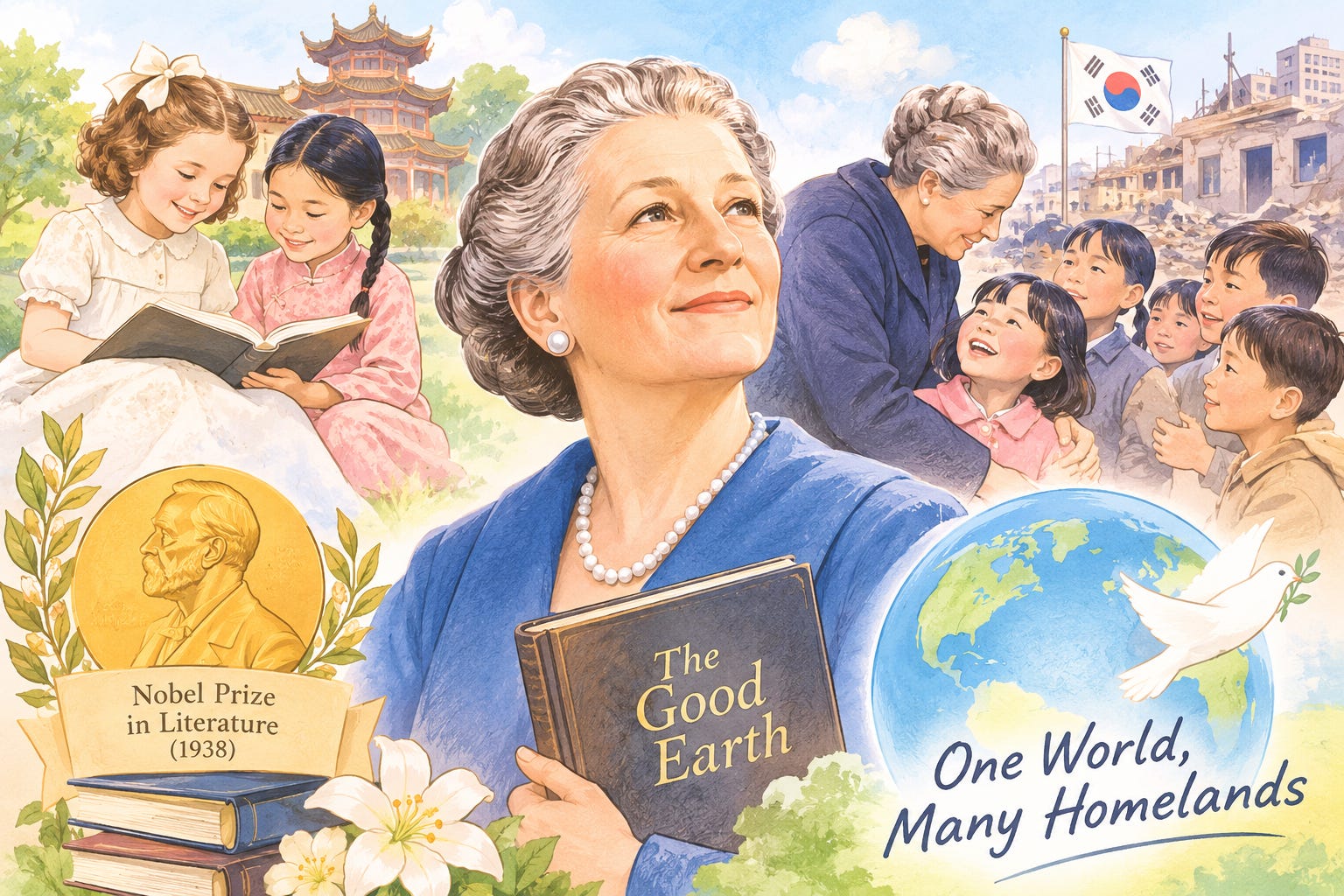
Image credit: Illustration generated with OpenAI’s ChatGPT image-generation tool with the author’s idea, 2026
Pearl S. Buck: Two Homelands, One Humanity
Born in China, Raised in America, and Deeply Moved by Korea: The Story of a Global Humanitarian
Beyond Borders: Pearl S. Buck, the Korean Diaspora, and the Universal Meaning of Humanity
Abstract
Pearl S. Buck (1892–1973) was an American-born author and humanitarian who grew up in China and later developed a profound interest in Korea’s history, culture, and social challenges. Through her 1931 novel The Good Earth, she introduced the lives of Chinese farmers and universal human values to international readers, earning the Nobel Prize in Literature in 1938. Her life illustrates the experiences of diaspora and the complexities of cultural identity across national boundaries. Following her visit to Korea in 1960, Buck devoted considerable attention to children marginalized by the Korean War and social prejudice, particularly children of mixed Korean and foreign ancestry. She also published The Living Reed: A Novel of Korea in 1963, introducing Korea’s modern history and struggle for independence to a broader international audience. For Buck, Korea was not merely a foreign country in need of assistance but a community with its own historical experiences, cultural identity, and remarkable resilience. This essay reexamines her literary achievements and humanitarian contributions in Korea through the perspectives of diaspora, cultural identity, global citizenship, and human dignity. It further explores the meaning of homeland and belonging in immigrant and multicultural societies, emphasizing the importance of mutual understanding, cultural inclusion, and universal humanity beyond national and racial boundaries.
Keywords: Pearl S. Buck, Korean Diaspora, Diaspora Identity, The Good Earth, The Living Reed, Modern Korean History, Children of Mixed Ancestry, Humanitarianism, Cultural Diversity, Global Citizenship, Human Dignity, Multicultural Society
Prologue: Why Did She Love Korea?
Where is a person’s homeland?
Is it the place where one is born, the place where one spends childhood, or the place to which one devotes one’s life? The life of Pearl S. Buck (1892–1973), the American Nobel Prize-winning author, makes this question difficult to answer. She was born in the United States but grew up in China. She was an American, yet she developed an extraordinary understanding of Chinese people and their culture. Although she was Western by birth, she did not regard the East merely as an unfamiliar civilization or an object of academic observation. Later in life, she traveled to Korea and developed a deep concern for children suffering from the wounds of war, poverty, and social discrimination. For Buck, national borders were not lines that divided humanity. Rather, she believed that understanding the suffering of others beyond those borders was part of our responsibility as human beings.
Today, in 2026, as the world continues to experience immigration, refugee crises, diaspora, racial discrimination, and cultural conflict, Pearl Buck’s life carries particular significance. She was more than a Western writer who admired Eastern cultures. She was someone who experienced the loneliness of living between cultures and transformed that experience into a lifelong commitment to caring for others. Her story is not simply the biography of a literary figure. It is a story about how one person can belong to more than one cultural homeland.
Childhood: Two Languages, Two Worlds
Pearl Buck was born on June 26, 1892, in Hillsboro, West Virginia. Her parents were Presbyterian missionaries, and shortly after her birth, she accompanied them to China. China, rather than America, became the setting of her childhood. Chinese language and everyday life were not foreign experiences to her. She learned Chinese from an early age and grew up interacting with Chinese neighbors. She became familiar with the rhythms of Chinese society, family relationships, poverty, and rural life. She was not simply a foreigner observing China from a distance. She was someone whose formative years unfolded within Chinese society.
Yet she was not entirely Chinese, either. When she returned to America, she was seen as an American who had grown up in China. In China, she was regarded as the daughter of American missionaries. The feeling of not belonging completely to either side left a lasting impression on her life.
After graduating from Randolph-Macon Woman’s College in Virginia, she returned to China. Living in rural communities, she observed the struggles of poor farmers and the hardships experienced by women. These experiences became an important foundation for her literary imagination (University of Pennsylvania, n.d.). Her upbringing can be understood in relation to what we now call the experience of diaspora. Diaspora does not simply refer to groups of people who have migrated to another country. It also encompasses the experience of living between two or more cultures, sometimes without feeling a complete sense of belonging to any one of them.
Pearl Buck grew up precisely at such a cultural crossroads. Later, she transformed her own experience of being an outsider into a way of understanding the lives of others. Questions about her own identity became the starting point for respecting the identities of people around her.
The Good Earth: Turning the Lives of Chinese Farmers into a Universal Story
Published in 1931, The Good Earth transformed Pearl Buck’s life. The novel follows Wang Lung, a Chinese farmer, and his family. Through their experiences, Buck explores land, family, poverty, wealth, and human desire. Although the story takes place in China, the questions it raises are universal.
What do people live for? What do family and material possessions mean to human beings? How can people preserve their dignity in the face of poverty? Buck did not present Chinese farmers to Western readers as exotic subjects for curiosity. Instead, she demonstrated that they were human beings who loved, felt jealousy, suffered, and hoped, just like anyone else.
The Good Earth won the Pulitzer Prize for Fiction in 1932. In 1938, Buck received the Nobel Prize in Literature, becoming the first American woman to receive the award (Pulitzer Prizes, n.d.; American Academy of Arts and Sciences, n.d.). Her Nobel recognition was not simply the result of her ability to portray China. It reflected her achievement in transforming the lives of Chinese farmers into literature that communicated universal human experiences.
Here we find an interesting paradox. A writer born in America introduced the lives of Chinese people to the world, and her literary success influenced how Western readers viewed the East. She became a literary bridge between two cultures.
Her Encounter with Korea: A Country She Came to Understand Through Its People
In 1960, Pearl Buck visited Korea for the first time. At that time, Korea was still struggling to recover from the devastation of the Korean War. Although the fighting had ended, poverty and social instability remained widespread. Children who had lost their families and children born to Korean mothers and foreign fathers were often exposed to severe social prejudice.
In particular, children of mixed Korean and foreign ancestry frequently struggled to gain acceptance in the very country where they had been born. Some had fathers who had left Korea, while others had grown up in broken families. Beyond economic hardship, many experienced discriminations because of their appearance and circumstances of birth.
Pearl Buck did not turn away from their situation. To her, these children were neither incomplete Koreans nor incomplete Americans. They were simply children suffering because of war and adult prejudice. At this point, her personal experiences intersected with Korean history. As an American who had grown up in China, Buck understood something about the complexities of cultural identity and belonging. She could recognize the challenges faced by Korean children of mixed ancestry who struggled to find acceptance.
Of course, the two experiences were not identical. Buck was a writer raised between cultures, while these Korean children faced the specific historical consequences of war, racial discrimination, and family separation. Nevertheless, their experiences raised a common question:
Should anyone be denied a sense of belonging in society simply because of where they were born or the color of their skin?
Pearl Buck’s answer was clear: No.
After visiting Korea, she became involved in efforts to support the protection, education, and social integration of children of mixed ancestry. The Pearl S. Buck Foundation in Korea was established in 1965, and the Sosa Hope Center opened in Bucheon, Gyeonggi Province, in 1967. The center provided children with protection and educational opportunities (Pearl S. Buck Foundation Korea, n.d.).
Her work went beyond ordinary charitable activities. At its heart was the conviction that children should be able to live in the country where they were born without discrimination. This was not merely a matter of social welfare. It was a declaration about human dignity and the fundamental right to belong.
The Living Reed: Introducing Korean History to the World
Pearl Buck’s interest in Korea did not end with humanitarian work. She also wanted to introduce Korean history and its struggle for independence to international readers. The result was The Living Reed: A Novel of Korea, published in 1963. The novel follows several generations of the Kim family against the background of Korea’s modern historical upheavals.
It explores the political turmoil of the late Joseon Dynasty, foreign intervention, the loss of national sovereignty, Japanese colonial rule, and the Korean people’s struggle for independence. Buck did not portray Korea merely as a small nation victimized by powerful countries. She recognized that Koreans possessed their own history, culture, and determination to protect their families and communities. Their determination was passed from one generation to the next.
The title, The Living Reed, evokes the image of a reed that bends in the wind but does not easily break. It suggests the resilience of the Korean people, whose identity and way of life endured despite the powerful forces of history. Buck studied Korean history and culture extensively in preparing the novel. Her collaboration with Professor Jang Wang-rok of Seoul National University was also important in the publication process. The appearance of both English and Korean editions was particularly noteworthy (Bucheon Cultural Center, n.d.). The Literature Translation Institute of Korea also describes the novel as a multigenerational account of Korean independence and modern history through the lives of the Kim family (LTI Korea, n.d.). A 2025 academic article further examined the representation of modern Korean history in The Living Reed (Eum, 2025).
Here we can recognize what made Pearl Buck distinctive. She did not see Korea merely as a poor country deserving sympathy. While acknowledging the suffering of its people, she also recognized their dignity, resistance, family loyalty, and community spirit. To her, Korea was not simply a country in need of assistance. It was also a nation with historical experiences from which the rest of the world could learn. That is the difference between simple sympathy and genuine understanding.
Park Jin-ju (朴眞珠): An American Writer Who Embraced Korea
Pearl Buck also had a special connection to Korea through a Korean-style name. She used the name “Park Jin-ju,” reflecting the meaning of her English name. The word “Pearl” translates into Korean as “Jinju,” meaning pearl. The name expressed her affection for and familiarity with Korean culture.
She visited Korea, interacted with Korean writers, and studied Korean history and culture. Records maintained by the Pearl S. Buck Foundation Korea and the Bucheon Cultural Center describe her visits, relationships with Korean literary figures, and the warm reception she received in Korea. In 1968, she was also awarded honorary citizenship of Seoul (Pearl S. Buck Foundation Korea, n.d.; Bucheon Cultural Center, n.d.). Her love for Korea, however, should not be measured simply by her use of a Korean name. It was demonstrated through her actions, particularly her commitment to children who were socially marginalized during one of Korea’s most difficult periods.
People often find it easy to love a country because of its beautiful landscapes or economic prosperity. It is much harder to love a country by embracing its historical wounds and the people its society tends to overlook. Pearl Buck chose the latter.
Diaspora: The Story of People with Two Homelands
When we revisit Pearl Buck’s life through the contemporary concept of diaspora, we discover even deeper meaning. Diaspora does not simply refer to people living outside their country of origin. It describes the lives of people who settle in new societies while retaining their language, culture, memories, and identity.
During this process, people often confront three fundamental questions:
Where did I come from?
To which society do I belong today?
What cultural identity will my children carry into the future?
Pearl Buck experienced these questions throughout her life.
She was born in America, grew up in China, and later established her career in the United States. China was the homeland of her childhood and the source of much of her literary inspiration, while America was the country where she pursued her professional life and social commitments. For her, there did not have to be only one homeland. This perspective has particular relevance for Korean Americans and Korean diaspora communities throughout the world. Second- and third-generation Korean Americans may not speak Korean fluently. They may not understand Korean history and culture in exactly the same way as their parents. Yet this does not mean that their Korean heritage has disappeared.
Likewise, people who grew up in Korea do not lose their connection to Korea simply because they move to America or another country. Cultural identity cannot be fully explained by a single nationality or language. Pearl Buck demonstrated this through her own life.
Her concern for Korean children of mixed ancestry was also connected to this understanding. At the time, society repeatedly questioned whether these children were Korean or foreign, and where they belonged. Pearl Buck, however, first recognized that they were human beings. This issue remains important for children of international marriages, immigrant families, refugees, and multicultural households today. Rather than forcing children to choose only one culture, we should build societies in which they can proudly preserve multiple cultural roots. That is one of the most important lessons diaspora communities can learn from Pearl Buck’s life.
The Practice of Love and the Limitations of Her Historical Era
When evaluating Pearl Buck’s humanitarian work from a contemporary perspective, another issue deserves consideration. During that period, international adoption was one of the important responses to the needs of children of mixed ancestry and war orphans in Korea. Buck participated in establishing Welcome House in 1949, which helped Asian and multiracial children find new lives with American families. In 1964, she established the Pearl S. Buck Foundation to address broader child welfare issues that could not be resolved through international adoption alone (National Women’s History Museum, n.d.; Pearl S. Buck International, n.d.).
Today, however, we should avoid idealizing all the activities of that era without examining their limitations. International adoption provided many children with new families and educational opportunities. At the same time, it raised complicated issues involving separation from families, access to birth records, personal identity, and cultural disconnection.
Therefore, carrying forward Pearl Buck’s legacy should not simply mean commemorating international adoption programs. It should mean supporting children so that, whenever possible, they can grow up safely within their birth families and communities. When they must grow up in another country, their roots and cultural identities should still be respected and protected. This is why her humanitarian legacy deserves to be reconsidered in light of contemporary child rights and cultural identity.
A Legacy Connecting Korea, America, and the World
Pearl Buck passed away on March 6, 1973. Yet the work and values she helped establish did not disappear. Pearl S. Buck International in the United States and the Pearl S. Buck Foundation in Korea have continued activities supporting children and families from diverse cultural backgrounds.
In particular, the Pearl S. Buck Foundation Korea celebrated its 60th anniversary in 2025. This milestone demonstrated the continuation of the work that began in Korea in 1965 (Pearl S. Buck Foundation Korea, n.d.). Her legacy can be understood in three important dimensions.
First, her literary legacy.
Through The Good Earth, she brought the lives of Chinese farmers into the center of world literature. Through The Living Reed, she introduced Korea’s modern history and struggle for independence to international readers.
Second, her humanitarian legacy.
She devoted attention to children suffering from war and racial discrimination. She translated her belief that human dignity should never depend on one’s birthplace or skin color into concrete action.
Third, her cultural legacy.
Through a life connecting America, China, and Korea, she demonstrated that cultural boundaries do not necessarily have to produce conflict and division.
Her life also connects closely with the principles emphasized by K-GSP today: global citizenship, diaspora identity, cultural inclusion, and human-centered social responsibility.
Seven Questions Her Life Raises for Us Today
Pearl Buck’s story should not end with commemorating an admirable historical figure. It should challenge the societies in which we live today.
Do we fully accept the children of immigrants and multicultural families as equal members of our societies?
Do we allow birthplace, skin color, or parental nationality to determine a person’s social value?
Do we give children from diaspora families opportunities to respect both their parents’ cultural heritage and the culture in which they grow up?
Are we protecting children suffering from war and political conflict beyond national and ideological boundaries?
What role can literature and education play in helping people understand different cultures?
Beyond providing financial assistance, what can we do to change the structures of discrimination and inequality?
Do we care about the suffering of people in other countries as much as we care about the countries in which we were born?
These questions are relevant not only to Korea and the United States but also to every country experiencing immigration and multicultural transformation.
Epilogue: A Homeland Does Not Have to Be Singular
Looking back on Pearl Buck’s life, we discover an important paradox. She was not Korean. She was neither born in Korea nor raised from childhood in the Korean language and history. Nevertheless, during one of Korea’s most difficult periods, she refused to ignore the country’s painful realities.
When she encountered Korean children of mixed ancestry, she may have recognized some of the questions of cultural identity and belonging that had shaped her own life. Her experience as an American raised in China, unable to define herself exclusively through one culture, may have helped her understand the suffering of others. This does not mean that she understood every aspect of Korea perfectly. Korea’s historical experiences and the wounds of war must also be remembered and explained through the voices of Koreans themselves.
But she did something important: she accepted the suffering of another country as a human concern and acted to reduce it. That is what made her extraordinary. We often think of patriotism as love for the country in which we were born. Pearl Buck’s life, however, demonstrates that patriotism and universal humanity do not necessarily conflict. We can love our own homeland while respecting the homelands of others. We can cherish our own culture while appreciating the beauty of different cultures.
For Korean Americans, Korea may represent the history of their parents and ancestors, while America may be the homeland in which they were born and live today. There is no need to abandon one homeland to embrace the other. Pearl Buck demonstrated that such a life is possible. She was born in America, carried China in her heart as the homeland of her childhood, and devoted part of her life to Korea’s history and people, especially its marginalized children. For her, national borders were never the end of humanity.
Nationality is not required to love another human being. Sharing the same skin color is not necessary to understand another person’s suffering. What we need is the willingness to value another person’s life as deeply as our own—and the courage to translate that willingness into action.
Perhaps this is the greatest legacy Pearl Buck has left to us today.
A person does not need only one homeland. But the human heart should have no borders.
References
American Academy of Arts and Sciences. (n.d.). Pearl S. Buck. https://www.amacad.org/person/pearl-s-buck
Bucheon Cultural Center. (n.d.). Pearl Buck’s life and literature: The Living Reed. https://www.bcmuseum.or.kr/comm/file/down?id=515
Eum, Y.-C. (2025). Aspects of modern Korean history in Pearl S. Buck’s The Living Reed. The Journal of the Korea Contents Association, 25(8), 192–203. https://doi.org/10.5392/JKCA.2025.25.08.192
Kim, Y. (2013). 1950~60nyeondae Peolbeok suyonggwa Miguk [American symbol of ‘Pearl Buck’ in the 1950s and 1960s]. Korean Literary Theory and Criticism, 17(1), 435–457. https://www.kci.go.kr/kciportal/ci/sereArticleSearch/ciSereArtiView.kci?sereArticleSearchBean.artiId=ART001759267
National Women’s History Museum. (n.d.). Pearl S. Buck. https://www.womenshistory.org/education-resources/biographies/pearl-buck
Pearl S. Buck International. (n.d.). About our founder: Pearl S. Buck. https://pearlsbuck.org/about/biography/
Pearl S. Buck International. (2025). The Pearl S. Buck Foundation in Korea: Celebrating 60 years (1965–2025). https://pearlsbuck.org/korea-foundation/
Pearl S. Buck Foundation Korea. (n.d.). The 60th anniversary of the Pearl S. Buck Foundation: Pearl Buck’s life and activities in Korea. https://pearlsbuck.or.kr/60years/
Pulitzer Prizes. (n.d.). Pearl S. Buck: The Good Earth. https://www.pulitzer.org/winners/pearl-s-buck
University of Pennsylvania, Department of English. (n.d.). Rediscovering Pearl Buck. https://www.english.upenn.edu/projects/buck/preface.html
Literature Translation Institute of Korea. (n.d.). Living Reed. Digital Library of Korean Literature. https://library.ltikorea.or.kr/originalworks/405761
펄 벅(Pearl S. Buck): 두 개의 조국, 하나의 인간애
중국에서 태어나 미국에서 살았지만, 한국의 아픔을 자신의 아픔으로 받아들인 세계시민
국경을 넘어: 펄 벅, 한국 디아스포라, 그리고 인류애의 보편적 의미
요약
펄 벅(Pearl S. Buck, 1892–1973)은 미국에서 태어나 중국에서 성장하고, 인생의 후반부에는 한국의 역사와 사회적 아픔에 깊은 관심을 기울인 작가이자 인도주의자였다. 1931년 출간된 『대지(The Good Earth)』를 통해 중국 농민들의 삶과 인간의 보편적 가치를 세계에 알렸으며, 1938년 노벨문학상을 수상했다. 그녀의 삶은 서로 다른 문화와 정체성 사이에서 살아가는 디아스포라의 경험을 잘 보여준다. 특히 1960년 한국을 방문한 이후 전쟁과 사회적 편견으로 소외된 혼혈 아동들의 보호와 교육을 위해 노력했으며, 1963년에는 한국의 근대사와 독립운동을 다룬 소설 『살아있는 갈대(The Living Reed)』를 발표했다. 펄 벅에게 한국은 단순히 도움을 주어야 할 외국이 아니라, 고유한 역사와 문화적 정체성, 강인한 생명력을 지닌 공동체였다. 본 수필은 그녀의 문학적 업적과 한국에서의 인도주의적 활동을 디아스포라, 문화적 정체성, 세계시민의식 및 인간 존엄성의 관점에서 재조명한다. 나아가 그녀의 삶을 통해 이민과 다문화 사회에서 고향과 정체성의 의미를 탐구하고, 국경과 인종을 초월한 상호 이해와 인간애의 중요성을 강조한다.
핵심단어: 펄 벅, 한국 디아스포라, 디아스포라 정체성, 『대지』, 『살아있는 갈대』, 한국 근대사, 혼혈 아동, 인도주의, 문화적 다양성, 세계시민의식, 인간 존엄성, 다문화 사회
프롤로그: 그녀는 왜 한국을 사랑했을까?
한 사람의 고향은 어디일까?
태어난 곳일까, 어린 시절을 보낸 곳일까, 아니면 자신의 삶을 바친 곳일까? 미국의 노벨문학상 작가 펄 벅(Pearl S. Buck, 1892–1973)의 삶을 들여다보면 이 질문에 쉽게 답하기 어렵다. 그녀는 미국에서 태어났지만 중국에서 성장했다. 미국인이었지만 중국인의 삶과 문화를 누구보다 깊이 이해하려고 노력했다. 서양인이었지만 동양을 낯선 문명이나 연구 대상으로만 바라보지 않았다. 그리고 인생의 후반부에는 한국을 찾아와 전쟁의 상처와 사회적 차별 속에서 살아가던 아이들에게 깊은 관심과 사랑을 보냈다. 그녀에게 국경은 인간을 나누는 선이 아니었다. 오히려 국경 너머에서 서로의 고통을 이해하고 책임지는 것이 인간의 의무였다.
2026년 오늘, 세계 곳곳에서 이민과 난민, 디아스포라, 인종적 차별과 문화적 갈등이 계속되는 현실에서 펄 벅의 삶은 특별한 의미를 갖는다. 그녀는 단순히 동양을 사랑한 서양 작가가 아니었다. 서로 다른 문화 사이에서 살아가는 사람들의 외로움을 자신의 삶으로 경험하고, 그 외로움을 다른 사람을 돌보는 행동으로 바꾼 사람이었다. 그녀의 이야기는 문학가의 전기가 아니라, 한 인간이 어떻게 여러 문화의 고향을 가질 수 있는지를 보여주는 이야기다.
어린 시절: 두 개의 언어, 두 개의 세계
펄 벅은 1892년 6월 26일 미국 웨스트버지니아주 힐스버러에서 태어났다. 부모는 장로교 선교사였으며, 그녀는 생후 얼마 지나지 않아 부모를 따라 중국으로 건너갔다. 그녀가 성장한 곳은 미국이 아니라 중국이었다. 중국의 언어와 생활방식은 그녀에게 낯선 외국 문화가 아니었다. 어린 시절부터 중국어를 익혔고, 중국인 이웃과 함께 생활하면서 중국 사회의 일상과 가족관계, 가난과 농촌의 현실을 가까이에서 경험했다. 그녀는 중국을 멀리서 관찰하는 외국인이 아니었다. 중국인의 삶 속에서 성장한 사람이었다.
그렇다고 그녀가 완전히 중국인이었던 것도 아니다. 미국에 돌아가면 중국에서 성장한 미국인으로 보였고, 중국에서는 미국인 선교사의 딸이었다. 어느 한쪽에 완전히 속하지 못한다는 감정은 그녀의 삶에 깊은 흔적을 남겼다. 미국 버지니아주의 랜돌프-메이컨 여자대학(Randolph-Macon Woman’s College)을 졸업한 뒤 그녀는 다시 중국으로 돌아갔다. 중국 농촌에서 생활하면서 가난한 농민들의 삶과 여성들의 고통을 관찰했고, 그것은 훗날 그녀의 문학세계를 형성하는 중요한 경험이 되었다(University of Pennsylvania, n.d.).
이러한 성장 배경은 오늘날 우리가 말하는 디아스포라(Diaspora)의 경험과 연결해서 생각할 수 있다. 디아스포라는 단순히 외국으로 이주한 사람들의 집단만을 의미하지 않는다. 그것은 두 개 이상의 문화와 정체성 사이에서 살아가며, 때로는 어느 한쪽에서도 완전한 소속감을 느끼지 못하는 경험을 포함한다. 펄 벅은 바로 그러한 문화적 경계에서 성장했다. 그녀는 나중에 자신이 경험한 이방인의 감정을 다른 사람들의 삶을 이해하는 통로로 활용했다. 자신의 정체성에 대한 질문이 다른 사람의 정체성을 존중하는 출발점이 된 것이다.
『대지』: 중국 농민의 삶을 세계의 이야기로 만들다
1931년 출간된 소설 『대지(The Good Earth)』는 펄 벅의 인생을 바꾸었다. 이 작품은 중국의 한 농민 왕룽(Wang Lung)과 그의 가족을 중심으로 토지, 가족, 가난, 부와 인간의 욕망을 그린 작품이다. 이야기의 무대는 중국이었지만, 작품이 던지는 질문은 중국에만 국한되지 않았다. 사람은 무엇을 위해 살아가는가? 가족과 재산은 인간에게 어떤 의미가 있는가? 가난한 사람은 어떻게 존엄을 지키는가?
그녀는 중국 농민을 서양 독자들에게 이국적인 구경거리로 소개하지 않았다. 그들도 사랑하고, 질투하고, 고통받고, 희망을 품는 보편적인 인간이라는 사실을 보여주었다.『대지』는 1932년 퓰리처상 소설 부문을 수상했다. 1938년에는 노벨문학상을 수상했다. 그녀는 노벨문학상을 받은 최초의 미국 여성이었다(Pulitzer Prizes, n.d.; American Academy of Arts and Sciences, n.d.).
그녀가 노벨문학상을 받은 이유는 단지 중국을 잘 묘사했기 때문만은 아니다. 중국 농민의 삶을 통해 인간의 보편적인 경험을 문학으로 승화시켰다는 점이 중요했다. 여기서 한 가지 흥미로운 역설이 나타난다. 미국에서 태어난 작가가 중국인의 삶을 세계에 알렸고, 그 문학적 성공은 다시 서양인들이 동양을 바라보는 시각에 영향을 주었다. 그녀는 두 문화를 연결하는 문학적 다리가 되었다.
한국과의 만남: 멀리서 바라본 나라가 아니라 마음으로 이해한 사람들
1960년, 펄 벅은 처음으로 한국을 방문했다. 당시 한국은 6·25전쟁의 상처를 극복하기 위해 애쓰고 있었다. 전쟁은 끝났지만 가난과 사회적 불안은 계속되었고, 가족을 잃은 아이들과 전쟁으로 태어난 혼혈 아동들은 심각한 사회적 편견에 노출되어 있었다. 특히 한국인 어머니와 외국인 아버지 사이에서 태어난 아이들은 자신이 태어난 나라에서도 온전한 소속감을 인정받지 못하는 경우가 많았다. 아버지가 떠났거나 가족이 해체된 아이들은 경제적 어려움뿐 아니라 외모와 출생 배경 때문에 차별을 경험했다. 펄 벅은 이 아이들의 현실을 외면하지 않았다. 그녀에게 이 아이들은 미국인도 한국인도 아닌 불완전한 존재가 아니었다. 그들은 단지 어른들의 전쟁과 편견 때문에 고통받는 아이들이었다.
이 장면에서 그녀의 개인적 경험과 한국의 역사가 만난다. 중국에서 성장한 미국인으로서 문화적 경계의 의미를 경험했던 그녀는 한국의 혼혈 아동들이 겪는 소속감의 문제를 이해할 수 있었다. 물론 두 경험이 동일한 것은 아니다. 펄 벅은 문화적 경계에서 성장한 작가였고, 한국의 혼혈 아동들은 전쟁과 인종차별, 가족 해체라는 구체적인 역사적 조건에 놓여 있었다. 그러나 서로 다른 두 경험 사이에는 공통된 질문이 있었다.
사람은 자신의 출생이나 피부색 때문에 어느 사회에서도 환영받지 못하는 존재가 되어야 하는가?
펄 벅의 대답은 분명했다. 그렇지 않다는 것이었다.
그녀는 한국을 방문한 뒤 혼혈 아동들의 보호와 교육, 사회적 정착을 위한 활동에 나섰다. 1965년 한국펄벅재단이 설립되었고, 1967년에는 경기도 부천에 소사희망원이 문을 열었다. 이곳은 아동들에게 보호와 교육의 기회를 제공하는 공간이었다(한국펄벅재단, n.d.). 그녀의 활동은 단순한 자선사업에 머물지 않았다. 아이들이 태어난 나라에서 차별 없이 살아갈 수 있어야 한다는 생각이 그 중심에 있었다. 그녀의 활동을 설명할 때 자주 인용되는 정신은 다음과 같이 요약할 수 있다.
Children should be able to grow up in the country where they were born.
아이들은 자신이 태어난 나라에서 성장할 수 있어야 한다. 이것은 단순한 복지의 문제가 아니라 인간의 존엄성과 사회적 소속감에 관한 선언이었다.
『살아있는 갈대』: 한국의 역사를 세계에 알리다
한국을 향한 펄 벅의 관심은 사회사업에만 머물지 않았다. 그녀는 한국의 역사와 독립을 위한 투쟁을 세계에 알리고 싶어 했다. 그 결과물이 1963년 출간된 『살아있는 갈대(The Living Reed: A Novel of Korea)』였다. 이 소설은 한반도의 근대적 격변기를 배경으로 김씨 가문의 여러 세대에 걸친 삶을 그린 역사소설이다. 작품에는 조선 말기의 정치적 혼란과 외세의 침략, 국권 상실, 일본의 식민지배, 그리고 한국인들의 독립을 위한 투쟁이 담겨 있다.
특히 그녀는 한국의 역사를 단순히 강대국 사이에서 희생된 작은 나라의 이야기로만 다루지 않았다. 한국인들에게는 자신들의 문화와 역사, 가족과 공동체를 지키려는 의지가 있었다. 그 의지는 세대에서 세대로 이어졌다. 소설의 제목인 The Living Reed는 살아 있는 갈대라는 의미다. 갈대는 바람에 흔들리지만 쉽게 부러지지 않는다. 이 이미지는 역사의 거센 바람 속에서도 삶과 민족의 정체성을 지키려는 한국인의 모습을 생각하게 한다.
펄 벅은 이 작품을 쓰기 위해 한국의 역사와 문화를 깊이 공부했다. 서울대학교 장왕록 교수와의 협력도 작품의 출판 과정에서 중요한 역할을 했다. 한국어판과 영어판이 함께 출간되었다는 점도 주목할 만하다(부천문화원, n.d.). 한국문학번역원(LTI Korea)의 작품 소개 역시 이 소설이 김씨 가문의 여러 세대를 통해 한국의 독립운동과 근대사를 그린 작품이라는 점을 설명한다(한국문학번역원, n.d.). 2025년에는 『살아있는 갈대』에 나타난 한국 근대사를 분석한 학술논문도 발표되었다(Eum, 2025). 여기서 펄 벅의 특별함을 발견할 수 있다.
그녀는 한국을 불쌍한 나라로만 바라보지 않았다. 한국인의 역사적 고통을 이해하면서도 그 안에 존재하는 자존심과 저항정신, 가족의 사랑과 공동체의 힘을 보았다. 그녀에게 한국은 도움을 받아야 하는 대상이면서 동시에 세계가 배워야 할 역사적 경험을 가진 나라였다. 이것이 단순한 동정과 깊은 이해의 차이다.
박진주(朴眞珠): 한국을 사랑한 미국 작가
펄 벅에게는 한국과 관련된 특별한 이름도 있었다. 그녀는 자신의 이름을 한국식으로 표현한 ‘박진주’라는 이름을 사용했다. 펄(Pearl)이 진주라는 뜻이라는 점에서 나온 이름이다. 이 이름에는 한국 문화에 대한 친밀감과 애정이 담겨 있다. 그녀는 한국을 방문하고, 한국의 문인들과 교류하고, 한국의 역사와 문화를 연구했다. 한국펄벅재단의 역사 자료와 부천문화원의 기록에는 그녀의 한국 방문과 한국 문인들과의 교류, 한국 사회에서 받은 환대가 소개되어 있다. 1968년에는 서울 명예시민증을 받기도 했다(한국펄벅재단, n.d.; 부천문화원, n.d.).
그녀가 한국을 사랑했다는 사실은 단순히 한국식 이름을 사용했다는 데 있지 않다. 그 사랑은 한국의 가장 어려운 시기에 사회적으로 외면당하던 아이들을 위해 행동했다는 데 있다. 사람들은 아름다운 풍경이나 번영하는 나라를 사랑하기 쉽다. 그러나 한 나라의 상처와 그 사회가 외면하는 사람들까지 사랑하는 일은 훨씬 어렵다. 펄 벅은 후자를 선택했다.
디아스포라: 두 개의 고향을 가진 사람들의 이야기
펄 벅의 삶을 오늘날의 디아스포라 관점에서 다시 읽으면 더욱 흥미로운 의미가 나타난다. 디아스포라는 단순히 외국에 거주하는 사람들을 가리키는 말이 아니다. 그것은 고향을 떠나 새로운 사회에 정착하면서도 자신의 언어와 문화, 기억과 정체성을 간직하는 사람들의 삶을 의미한다.
이 과정에서 사람들은 종종 세 가지 질문을 마주한다.
나는 어디에서 왔는가?
나는 지금 어느 사회에 속해 있는가?
나의 자녀들은 어떤 문화적 정체성을 가지고 살아갈 것인가?
펄 벅은 이러한 질문을 평생 경험했다.
그녀는 미국에서 태어나 중국에서 성장했고, 다시 미국에서 활동했다. 중국은 그녀의 어린 시절과 문학적 영감이 형성된 고향이었으며, 미국은 그녀가 작가로서 활동하고 사회적 책임을 실천한 나라였다. 그녀에게 고향은 하나만 존재할 필요가 없었다. 이러한 관점은 오늘날 한국계 미국인과 세계 각지의 한인 디아스포라에게도 중요한 의미를 가진다. 미국에서 태어난 한국계 2세와 3세는 한국어를 완벽하게 구사하지 못할 수도 있다. 한국의 역사와 문화를 부모 세대와 똑같이 이해하지 못할 수도 있다. 그렇다고 그들의 한국적 뿌리가 사라지는 것은 아니다. 반대로 한국에서 성장한 사람이 미국이나 다른 나라로 이주했다고 해서 한국과의 관계가 끊어지는 것도 아니다.
문화적 정체성은 하나의 국적이나 언어로 완전히 설명할 수 없다. 펄 벅은 이러한 복합적 정체성을 자신의 삶으로 보여주었다. 그녀가 한국의 혼혈 아동들에게 관심을 가진 것도 이와 연결된다. 당시 사회는 아이들에게 한국인인지 외국인인지, 어느 쪽에 속하는지 끊임없이 물었다. 그러나 펄 벅은 먼저 그 아이들이 한 인간이라는 사실을 보았다.
오늘날 국제결혼 가정의 자녀, 이민자 가정의 자녀, 난민 아동, 다문화 가정의 아이들에게도 이 문제는 여전히 중요하다. 우리는 아이들에게 어느 한 문화만 선택하도록 강요할 것이 아니라, 서로 다른 문화적 뿌리를 자랑스럽게 간직하면서 살아갈 수 있는 사회를 만들어야 한다. 그것이 펄 벅의 삶에서 디아스포라 공동체가 배울 수 있는 중요한 교훈이다.
사랑의 실천과 그 시대의 한계
펄 벅의 활동을 오늘날의 관점에서 평가할 때 한 가지 더 생각할 문제가 있다. 당시 한국의 혼혈 아동과 전쟁고아를 돕는 과정에서 해외입양은 중요한 대안 중 하나였다. 펄 벅은 1949년 웰컴 하우스(Welcome House)를 설립하는 데 참여했고, 아시아계 아동과 다인종 아동들이 미국 가정에서 새로운 삶을 시작할 수 있도록 지원했다. 1964년에는 펄 S. 벅 재단(Pearl S. Buck Foundation)을 설립해 해외입양만으로 해결할 수 없는 아동복지 문제에도 관심을 기울였다(National Women’s History Museum, n.d.; Pearl S. Buck International, n.d.).
그러나 오늘날 우리는 당시의 활동을 무조건 이상화해서는 안 된다. 국제입양은 많은 아동에게 새로운 가정과 교육의 기회를 제공했지만, 동시에 가족과의 분리, 출생기록과 정체성의 문제, 문화적 단절이라는 복잡한 문제도 남겼다. 따라서 펄 벅의 유산을 계승한다는 것은 단순히 입양사업을 기념하는 일이 아니다. 가능하다면 아이들이 자신의 출생 가족과 공동체 안에서 안전하게 성장하도록 지원하고, 불가피하게 다른 나라에서 성장하더라도 자신의 뿌리와 정체성을 존중받도록 보장하는 일이어야 한다. 그녀의 활동을 오늘날의 아동권리와 문화적 정체성의 관점에서 재해석할 필요가 있는 이유다.
한국과 미국, 그리고 세계를 연결하는 유산
펄 벅은 1973년 3월 6일 세상을 떠났다. 그러나 그녀가 시작한 활동과 정신은 사라지지 않았다. 미국의 펄 S. 벅 인터내셔널(Pearl S. Buck International)과 한국펄벅재단은 서로 다른 문화적 배경을 가진 아동과 가족을 지원하는 활동을 이어왔다. 특히 한국펄벅재단은 2025년 설립 60주년을 맞았다. 이는 1965년 시작된 한국에서의 활동이 오랜 시간 이어져 왔음을 보여준다(한국펄벅재단, n.d.).
그녀의 유산은 세 가지 측면에서 생각할 수 있다.
첫째, 문학적 유산이다.
『대지』를 통해 중국 농민의 삶을 세계문학의 중심으로 가져왔으며, 『살아있는 갈대』를 통해 한국의 근대사와 독립을 위한 투쟁을 국제사회에 소개했다.
둘째, 인도주의적 유산이다.
전쟁과 인종차별로 고통받던 아동들에게 관심을 기울였으며, 인간의 존엄성은 출생이나 피부색에 따라 달라질 수 없다는 신념을 행동으로 옮겼다.
셋째, 문화적 유산이다.
미국과 중국, 한국을 연결하는 삶을 통해 문화적 경계가 반드시 갈등과 분열을 의미하지는 않는다는 사실을 보여주었다.
그녀의 삶은 오늘날 K-GSP가 강조하는 글로벌 시민의식(Global Citizenship), 디아스포라의 정체성, 문화적 포용성, 인간 중심의 사회적 책임과도 깊이 연결된다.
오늘날 우리에게 던지는 일곱 가지 질문
펄 벅의 이야기는 과거의 훌륭한 인물을 기념하는 데서 끝나서는 안 된다. 오늘날 우리가 살아가는 사회에 다음과 같은 질문을 던진다.
우리는 이민자와 다문화 가정의 자녀들을 완전한 사회 구성원으로 받아들이고 있는가?
출생지와 피부색, 부모의 국적이 한 인간의 사회적 가치를 결정하도록 허용하고 있지는 않은가?
디아스포라의 자녀들에게 부모의 문화와 자신이 성장한 문화 모두를 존중할 기회를 주고 있는가?
전쟁과 정치적 갈등으로 고통받는 어린이들을 국가와 이념의 경계를 넘어 보호하고 있는가?
문학과 교육은 서로 다른 문화를 이해하는 데 어떤 역할을 할 수 있는가?
경제적 원조를 넘어 차별과 불평등의 구조 자체를 개선하기 위해 무엇을 해야 하는가?
우리는 자신이 태어난 나라를 사랑하는 만큼, 다른 나라 사람들의 고통에도 관심을 기울이고 있는가?
이 질문들은 한국과 미국뿐 아니라 이민과 다문화 사회를 경험하는 세계 모든 국가에 해당한다.
에필로그: 고향은 하나일 필요가 없다
펄 벅의 인생을 돌아보면 한 가지 역설을 발견하게 된다. 그녀는 한국인이 아니었다. 한국에서 태어나지도 않았고, 한국의 언어와 역사를 어린 시절부터 배운 사람도 아니었다. 그런데도 한국 사회가 가장 어려웠던 시기에 한국의 아픈 현실을 외면하지 않았다. 그녀는 한국의 혼혈 아동들을 보면서 자신이 경험했던 문화적 경계와 소속감의 문제를 떠올렸을 것이다. 중국에서 성장한 미국인으로서, 어느 한쪽에만 자신을 가둘 수 없었던 경험이 다른 사람의 고통을 이해하는 데 도움이 되었을 것이다. 그렇다고 그녀가 한국의 모든 문제를 완벽하게 이해했다고 말할 수는 없다. 한국 사회의 역사적 경험과 전쟁의 상처는 한국인 스스로의 목소리로 설명되고 기억되어야 한다. 하지만 그녀는 적어도 다른 나라의 고통을 자기 일처럼 받아들이고, 그 고통을 줄이기 위해 행동했다. 이것이 그녀를 특별하게 만든다.
우리는 흔히 애국심을 자신이 태어난 나라를 사랑하는 마음이라고 생각한다. 그러나 펄 벅의 삶은 애국심과 인간애가 반드시 충돌하는 것이 아님을 보여준다. 자신의 고향을 사랑하면서도 다른 사람의 고향을 존중할 수 있다. 자신의 문화를 소중하게 간직하면서도 다른 문화의 아름다움을 인정할 수 있다. 한국계 미국인에게 한국은 부모와 조상의 역사일 수 있고, 미국은 자신이 태어나고 살아가는 현재의 고향일 수 있다. 두 고향 가운데 하나를 포기할 필요는 없다. 펄 벅은 그러한 삶이 가능하다는 사실을 보여주었다. 그녀는 미국에서 태어났지만 중국을 마음의 고향으로 간직했고, 한국을 방문한 뒤에는 한국의 역사와 사람들, 특히 소외된 아이들에게 자신의 삶의 일부를 바쳤다. 그녀에게 국경은 인간애의 끝이 아니었다.
사람을 사랑하는 데 국적은 필요하지 않다. 다른 사람의 고통을 이해하는 데 같은 피부색도 필요하지 않다. 필요한 것은 타인의 삶을 자신의 삶처럼 소중하게 여기는 마음과 그것을 행동으로 옮기는 용기다.
어쩌면 펄 벅이 오늘날 우리에게 남긴 가장 큰 유산은 바로 이것일 것이다.
고향은 하나일 필요가 없다. 그러나 인간을 사랑하는 마음에는 국경이 없어야 한다.
참고문헌
American Academy of Arts and Sciences. (n.d.). Pearl S. Buck. https://www.amacad.org/person/pearl-s-buck
부천문화원. (n.d.). 펄 벅의 삶과 문학: The Living Reed. https://www.bcmuseum.or.kr/comm/file/down?id=515
Eum, Y.-C. (2025). Aspects of modern Korean history in Pearl S. Buck’s The Living Reed. The Journal of the Korea Contents Association, 25(8), 192–203. https://doi.org/10.5392/JKCA.2025.25.08.192
Kim, Y. (2013). 1950~60년대 펄벅 수용과 미국 [American symbol of ‘Pearl Buck’ in 1950’s and 1960’s]. 한국문학이론과 비평, 17(1), 435–457. https://www.kci.go.kr/kciportal/ci/sereArticleSearch/ciSereArtiView.kci?sereArticleSearchBean.artiId=ART001759267
National Women’s History Museum. (n.d.). Pearl S. Buck. https://www.womenshistory.org/education-resources/biographies/pearl-buck
Pearl S. Buck International. (n.d.). About our founder: Pearl S. Buck. https://pearlsbuck.org/about/biography/
Pearl S. Buck International. (2025). The Pearl S. Buck Foundation in Korea: Celebrating 60 years (1965–2025). https://pearlsbuck.org/korea-foundation/
Pulitzer Prizes. (n.d.). Pearl S. Buck: The Good Earth. https://www.pulitzer.org/winners/pearl-s-buck
University of Pennsylvania, Department of English. (n.d.). Rediscovering Pearl Buck. https://www.english.upenn.edu/projects/buck/preface.html
한국문학번역원. (n.d.). Living Reed. Digital Library of Korean Literature. https://library.ltikorea.or.kr/originalworks/405761
한국펄벅재단. (n.d.). 펄벅재단 60주년: 펄 벅의 삶과 한국에서의 활동. https://pearlsbuck.or.kr/60years/
About the Author

Prof. Dr. Young Choi (Editor-in-Chief) — Regent University
Full list of his K-GSP columns
Full list of his Books at Amazon.com
Young B. Choi is a Professor in the Department of Engineering & Computer Science at Regent University. He published 38 books with ‘Selected Readings in Cybersecurity’ (2018) (about 800 copies archived globally at university/college libraries around the world) and ‘Cybersecurity Applications and Artificial Intelligence’ (2023) available in seven major world languages. He proposed the world’s first global and universal telecommunications “Service Order Handling (SOH)” Model (T-SOH Model) (1995) with Dr. Adrian Tang. With this innovative research work, he received the IEEE NOMS ’96 Best Paper Award and became the first recipient of the Outstanding Contribution Award of the TeleManagement Forum in 1998. His research areas include Natural Language Processing-focused AI, AI-applied cybersecurity, network and telecom service management, and Korean studies on Gani Choi Rip’s Jeonggwan (정관(靜觀): Quiet Contemplation) philosophy and Shilhak (실학(實學): Practical Learning).
Suggested Citation
Choi, Y. B. (2026). Pearl S. Buck: Two Homelands, One Humanity - Born in China, Raised in America, and Deeply Moved by Korea: The Story of a Global Humanitarian. K-GSP Forum.
© K-Global Scholars and Professionals Forum. All rights reserved. 2026. Content published in the K-GSP Forum may not be reproduced, distributed, or transmitted in any form without prior written permission from the K-GSP Forum, except for brief quotations with full attribution.