

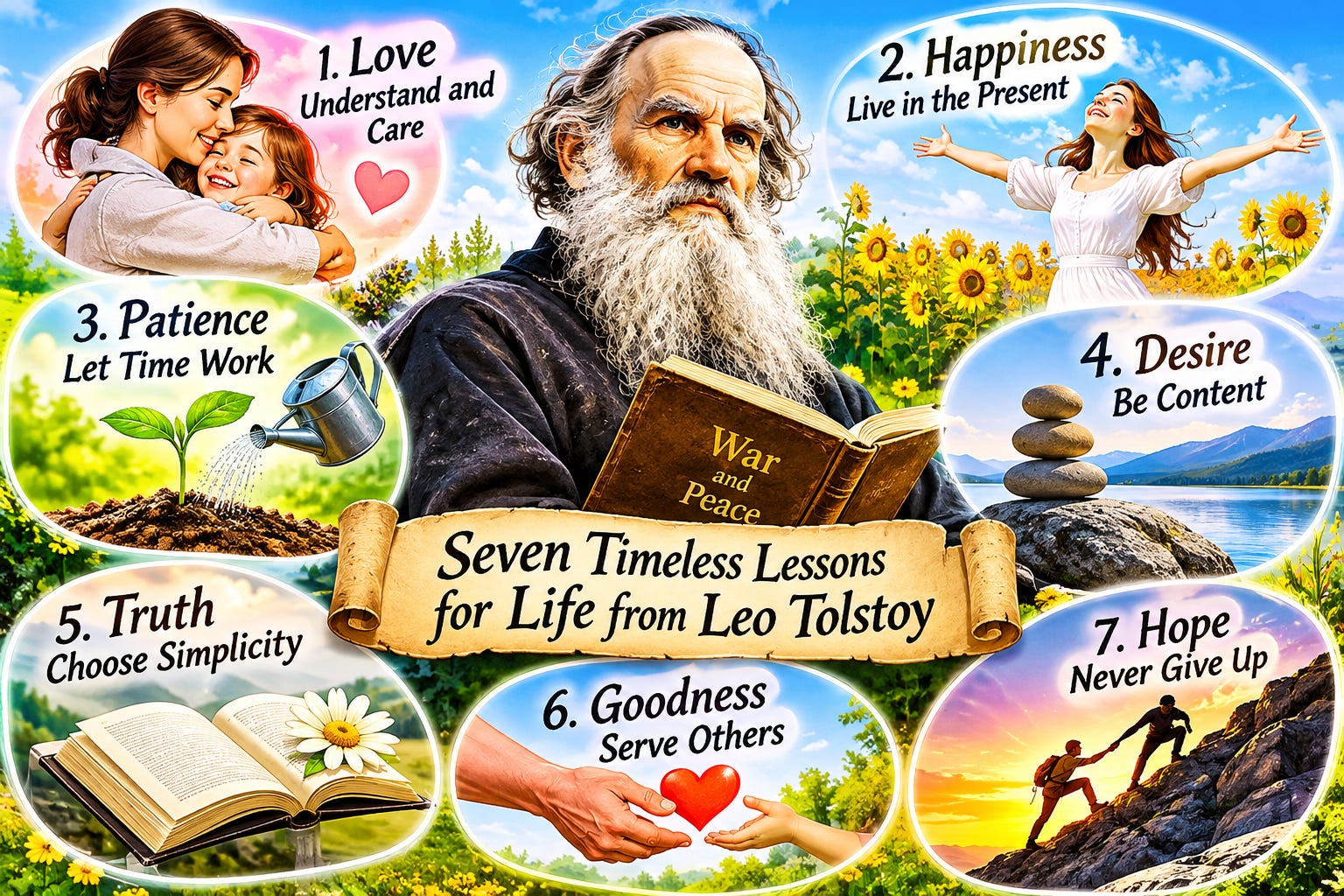
Image credit: Illustration generated with OpenAI’s ChatGPT image-generation tool, 2026
Seven Timeless Lessons for Life from Leo Tolstoy
Love, Happiness, Patience, Desire, Truth, Goodness and Service, and Hope
What Makes a Life Truly Meaningful?
We often measure success by money, fame, power, and social status. We assume that owning more, reaching higher positions, and receiving greater recognition will make us happier. Yet Leo Tolstoy (1828–1910), the great Russian novelist and philosopher, viewed life from a different perspective. To him, what mattered most was not how much a person possessed, but how deeply that person loved, how honestly they acted, and how faithfully they followed their conscience.
His masterpieces, War and Peace and Anna Karenina, explore the complexities of human love, desire, happiness, suffering, and moral conflict. In his later writings, Tolstoy placed even greater emphasis on simple living, love, humility, truth, nonviolence, and moral responsibility (Tolstoy, 1869/2001, 1877, 1894).
Let us explore seven timeless lessons from his works and philosophy that remain meaningful today.
Love: The Deepest Language of Human Understanding
First, love is the essence of life.
“Love is life. All, everything that I understand, I understand only because I love.”
(Tolstoy, 1869/2001, Book 12, Chapter 16)
This reflection appears in War and Peace as Prince Andrei contemplates life, love, and death. Love is more than an emotion or a romantic relationship. It is a fundamental human capacity that enables us to understand the suffering of others and see the world more deeply.
Today, artificial intelligence allows us to access enormous amounts of knowledge and develop remarkable technologies. Yet possessing knowledge does not necessarily mean understanding other people. What ultimately makes us human is our capacity for love and empathy.
Happiness: Live in the Present Moment
Second, do not miss the moments of happiness.
“Seize the moments of happiness, love and be loved!”
(Tolstoy, 1869/2001, Book 4, Chapter 11)
This memorable passage from War and Peace offers a simple but powerful message about happiness. We often tell ourselves that we will be happy after finding a better job, earning more money, or achieving a higher social position. However, happiness does not exist only in some distant future.
It can be found in a meal shared with family, a conversation with a friend, the warmth of the morning sun, or a quiet walk. Those who continually postpone happiness until tomorrow may overlook the happiness already present today.
Patience: Time Is an Invisible Force
Third, be patient and do not rush through life.
“Patience and time are my warriors, my champions.”
(Tolstoy, 1869/2001, Book 13, Chapter 17)
This statement reflects the attitude of General Kutuzov in War and Peace. He understood that not every problem could be solved through immediate action or force.
The same principle applies to life. Academic achievement, meaningful relationships, professional expertise, and trust cannot be built overnight. Just as a tree needs time to grow, human beings need time to mature.
In an age obsessed with speed and instant results, patience is an increasingly valuable quality. Being patient does not mean giving up. It means continuing toward a goal while allowing enough time for growth and maturity.
Desire: Having More Does Not Always Mean Being Happier
Fourth, do not confuse desire with happiness.
In Anna Karenina, Tolstoy explores the complicated relationship between human desire and happiness. Count Vronsky eventually discovers that obtaining what he had long desired does not necessarily bring the happiness he expected. Tolstoy challenges the assumption that happiness simply means fulfilling one’s desires (Tolstoy, 1877, Part 5, Chapter 8).
We constantly want a better house, a more expensive car, or a higher position. Yet once one desire is satisfied, another often takes its place.
Happiness does not come from possessing everything. It comes from understanding what we truly need and recognizing the value of what we already have.
Truth: Greatness Is Not About Appearances
Fifth, pursue simplicity, goodness, and truth.
“And there is no greatness where simplicity, goodness, and truth are absent.”
(Tolstoy, 1869/2001, Book 14, Chapter 18)
In War and Peace, Tolstoy critically examines historical heroes and powerful leaders. He particularly challenges the idea that Napoleon’s power and reputation should automatically be equated with true human greatness.
Even today, people often try to demonstrate their worth through impressive careers, public recognition, and outward success. Yet genuine character is revealed through how we treat others, whether we keep our promises, and whether we have the courage to tell the truth in difficult circumstances.
This is why honest actions are remembered longer than impressive words.
Goodness and Service: Look Beyond Yourself
Sixth, create meaning through good deeds and service to others.
Love for one’s neighbors and moral responsibility are central themes in Tolstoy’s later philosophy. In The Kingdom of God Is Within You, he emphasizes conscience, love, practical morality, and nonresistance to violence as essential elements of authentic Christian living (Tolstoy, 1894).
Near the end of Anna Karenina, Levin reaches an important realization: life is no longer meaningless because he can find purpose through goodness and the daily practice of living according to his conscience (Tolstoy, 1877, Part 8, Chapter 19).
Success pursued only for oneself can eventually become empty. In contrast, positively influencing the lives of others creates meaning beyond individual achievement.
Teachers illuminate the futures of their students. Researchers contribute to solving society’s problems. Parents pass love and wisdom to the next generation. Although their professions and responsibilities differ, their contributions are connected by a common purpose: helping others.
Becoming a successful person is important, but becoming someone who makes a positive difference in the lives of others is even more meaningful.
Hope: Life Always Offers Another Beginning
Seventh, never give up on life’s possibilities.
“While there is life there is happiness. There is much, much before us.”
(Tolstoy, 1869/2001, Book 15, Chapter 17)
In War and Peace, Pierre expresses this hopeful outlook after experiencing the suffering of war and imprisonment. Even when everything seems lost, life can offer the possibility of a new beginning.
Life rarely unfolds exactly as we plan. Failure, loss, and unexpected changes are unavoidable. Sometimes we may feel that everything we have worked for is falling apart.
Yet what appears to be the end can become the beginning of something new. We cannot change the past, but we can change how we understand it and how we choose to move forward.
Hope is not simply the expectation that everything will turn out well. It is the ability to discover reasons to live and possibilities for growth even in difficult circumstances.
Ultimately, How Should We Live?
Tolstoy’s seven lessons may appear to address different aspects of life, but they ultimately lead to one fundamental question: How should human beings live?
His answer is surprisingly simple: Love. Appreciate the happiness of the present moment. Be patient. Do not become a prisoner of your desires. Act truthfully. Live for others. And never lose hope, regardless of your circumstances.
Through War and Peace and Anna Karenina, Tolstoy revealed both the greatness and the weaknesses of human nature. Although he experienced fame and success during his earlier years, he increasingly devoted his later life to examining moral responsibility and the meaning of a genuinely human existence.
Today, artificial intelligence can calculate faster than humans, process enormous amounts of information, and even generate sophisticated writing and images. Yet technological progress does not necessarily mean human maturity. Having more information does not automatically make us wiser.
Ultimately, what matters is not how much we know or possess, but how deeply we love, how honestly we act, and how much goodness we leave behind.
Perhaps this is the most important question Tolstoy’s philosophy continues to ask us, more than a century after his death.
References
Tolstoy, L. (1869/2001). War and peace (L. & A. Maude, Trans.). Project Gutenberg. https://www.gutenberg.org/ebooks/2600 (Original work published 1869)
Tolstoy, L. (1877). Anna Karenina (C. Garnett, Trans.). Christian Classics Ethereal Library. https://ccel.org/ccel/tolstoy/karenina
Tolstoy, L. (1894). The kingdom of God is within you: Christianity not as a mystic religion but as a new theory of life (C. Garnett, Trans.). Cassell Publishing Company.
톨스토이가 우리에게 남긴 일곱 가지 삶의 지혜
사랑, 행복, 인내, 욕망, 진실, 선행과 봉사, 그리고 희망
무엇이 가치 있는 삶을 만드는가?
우리는 흔히 성공을 돈, 명예, 권력, 사회적 지위로 측정한다. 더 많이 소유하고, 더 높은 자리에 오르고, 더 많은 사람에게 인정받으면 행복해질 것이라고 생각한다. 그러나 러시아의 대문호 레프 톨스토이(Leo Tolstoy, 1828–1910)는 인간의 삶을 다른 관점에서 바라보았다. 그에게 중요한 것은 얼마나 많이 가졌는가가 아니라 어떻게 사랑하고, 어떻게 행동하며, 어떤 양심으로 살아가는가였다.
《전쟁과 평화》와 《안나 카레니나》는 인간의 사랑과 욕망, 행복과 고통, 도덕적 갈등을 깊이 탐구한 작품이다. 특히 후기 저술에서 톨스토이는 단순한 삶, 사랑, 겸손, 진실, 비폭력과 도덕적 책임을 강조했다(Tolstoy, 1869/2001, 1877; 1894).
그의 작품과 사상을 통해 오늘날에도 의미 있는 일곱 가지 삶의 교훈을 살펴보자.
사랑: 인간을 이해하는 가장 깊은 언어
첫째, 사랑은 삶의 본질이다.
“Love is life. All, everything that I understand, I understand only because I love.”
(Tolstoy, 1869/2001, Book 12, Chapter 16)
“사랑은 삶이다. 내가 이해하는 모든 것은 사랑하기 때문에 이해할 수 있다.”
《전쟁과 평화》에서 안드레이 공작이 삶과 죽음을 성찰하며 떠올리는 생각이다. 사랑은 단순한 감정이나 낭만적인 관계가 아니다. 타인의 고통을 이해하고, 세상을 더 깊이 바라보게 하는 인간의 근본적인 힘이다.
오늘날 우리는 인공지능을 통해 방대한 지식을 얻고 놀라운 기술을 만들어 낸다. 그러나 지식이 많다고 반드시 타인을 이해하는 것은 아니다. 인간을 인간답게 만드는 것은 결국 사랑과 공감이다.
행복: 지금 이 순간을 살아라
둘째, 행복의 순간을 놓치지 말라.
“Seize the moments of happiness, love and be loved!”
(Tolstoy, 1869/2001, Book 4, Chapter 11)
“행복의 순간을 붙잡아라. 사랑하고 사랑받아라.”
《전쟁과 평화》에 등장하는 이 문장은 행복에 대한 간결하면서도 강력한 메시지다. 우리는 흔히 더 좋은 직장, 더 많은 재산, 더 높은 사회적 지위를 얻은 다음에 행복해지겠다고 생각한다. 그러나 행복은 미래의 어느 날에만 존재하지 않는다.
가족과 함께하는 식사, 친구와 나누는 대화, 아침 햇살, 조용한 산책에도 행복은 숨어 있다. 행복을 미래로 미루는 사람은 현재의 행복을 놓치기 쉽다.
인내: 시간은 보이지 않는 힘이다
셋째, 서두르지 말고 인내하라.
“Patience and time are my warriors, my champions.”
(Tolstoy, 1869/2001, Book 13, Chapter 17)
“인내와 시간은 나의 전사이며 나를 지켜 주는 용사다.”
《전쟁과 평화》에서 쿠투조프 장군의 태도를 보여 주는 문장이다. 그는 모든 문제를 즉각적인 행동과 힘으로 해결할 수 있다고 믿지 않았다.
인생에서도 마찬가지다. 학문적 성취, 인간관계, 전문성, 신뢰는 하루아침에 만들어지지 않는다. 나무가 자라는 데 시간이 필요하듯 인간의 성장에도 시간이 필요하다.
빠른 결과에 집착하는 시대일수록 인내는 더욱 중요한 능력이다. 서두르지 않는다는 것은 포기한다는 뜻이 아니다. 목표를 향해 꾸준히 나아가되 성숙할 시간을 허락한다는 뜻이다.
욕망: 많이 가진다고 반드시 행복한 것은 아니다
넷째, 욕망과 행복을 혼동하지 말라.
톨스토이는 《안나 카레니나》에서 인간의 욕망과 행복 사이의 모순을 날카롭게 묘사한다. 브론스키는 오랫동안 바라던 것을 얻었지만 기대했던 행복을 발견하지 못한다. 톨스토이는 인간이 행복을 욕망의 실현이라고 생각하는 데 근본적인 오류가 있다고 지적한다(Tolstoy, 1877, Part 5, Chapter 8).
우리는 끊임없이 더 좋은 집, 더 비싼 자동차, 더 높은 직책을 원한다. 그러나 하나의 욕망을 충족하면 또 다른 욕망이 등장한다.
행복은 모든 것을 소유하는 데 있지 않다. 자신에게 진정으로 필요한 것이 무엇인지 깨닫고, 이미 가진 것의 가치를 발견하는 데 있다.
진실: 위대함은 화려함이 아니다
다섯째, 단순함과 선함과 진실함을 추구하라.
“And there is no greatness where simplicity, goodness, and truth are absent.”
(Tolstoy, 1869/2001, Book 14, Chapter 18)
“단순함과 선함과 진실함이 없는 곳에는 위대함도 없다.”
《전쟁과 평화》에서 톨스토이는 역사적 영웅과 권력자의 위대함을 비판적으로 바라본다. 특히 나폴레옹의 권력과 명성을 인간의 도덕적 가치와 동일시해서는 안 된다고 강조한다.
오늘날에도 사람들은 화려한 경력과 외적인 성공을 통해 자신의 가치를 증명하려 한다. 그러나 진정한 인격은 다른 사람을 대하는 태도, 약속을 지키는 행동, 어려운 상황에서도 진실을 말하는 용기에서 드러난다.
화려한 말보다 정직한 행동이 더 오래 기억되는 이유다.
선행과 봉사: 자신을 넘어 타인을 생각하라
여섯째, 선한 행동으로 삶의 의미를 만들어라.
톨스토이의 후기 사상에서 중요한 주제는 이웃에 대한 사랑과 도덕적 책임이다. 그는 《하나님의 나라는 너희 안에 있다》에서 참된 기독교적 삶의 핵심을 폭력에 대한 비저항, 양심, 사랑과 실천적 윤리에서 찾았다(Tolstoy, 1894).
《안나 카레니나》의 마지막 부분에서 레빈은 자신의 삶이 더 이상 무의미하지 않으며, 자신이 실천할 수 있는 선함을 통해 삶의 의미를 만들어 갈 수 있다는 깨달음에 도달한다(Tolstoy, 1877, Part 8, Chapter 19).
자신만을 위한 성공은 어느 순간 공허해질 수 있다. 반면 다른 사람의 삶에 긍정적인 영향을 주는 일은 개인의 성취를 넘어 더 큰 의미를 만든다.
교사는 학생의 미래를 밝히고, 연구자는 사회의 문제를 해결하며, 부모는 다음 세대에 사랑과 지혜를 전달한다. 직업과 역할은 다르지만 타인을 위해 기여한다는 점에서 삶의 의미는 서로 연결된다.
성공한 사람이 되는 것도 중요하지만, 다른 사람에게 도움이 되는 사람이 되는 것은 더욱 중요하다.
희망: 삶은 언제나 다시 시작될 수 있다
일곱째, 살아 있는 한 가능성을 포기하지 말라.
“While there is life there is happiness. There is much, much before us.”
(Tolstoy, 1869/2001, Book 15, Chapter 17)
“살아 있는 한 행복은 존재한다. 우리 앞에는 아직도 수많은 가능성이 펼쳐져 있다.”
《전쟁과 평화》에서 피에르는 전쟁과 포로 생활이라는 고통스러운 경험을 겪은 뒤 이러한 말을 한다. 모든 것을 잃었다고 생각한 순간에도 새로운 삶이 시작될 수 있다는 깨달음이다.
인생은 계획대로만 흘러가지 않는다. 실패와 상실, 예상하지 못한 변화가 찾아온다. 때로는 지금까지 쌓아 온 모든 것이 무너지는 것처럼 느껴지기도 한다.
그러나 끝이라고 생각한 순간이 새로운 출발점이 될 수도 있다. 과거를 되돌릴 수는 없지만, 과거를 바라보는 관점과 앞으로의 선택은 바꿀 수 있다.
희망은 모든 일이 잘될 것이라는 막연한 기대가 아니다. 어려움 속에서도 다시 살아갈 이유와 가능성을 발견하는 힘이다.
결국, 어떻게 살 것인가?
톨스토이의 일곱 가지 삶의 교훈은 서로 다른 이야기를 하는 것처럼 보이지만 하나의 질문으로 모인다. 인간은 어떻게 살아야 하는가? 그의 대답은 의외로 단순하다. 사랑하라. 현재의 행복을 소중히 여겨라. 인내하라. 욕망에 지배당하지 말라. 진실하게 행동하라. 타인을 위해 살아라. 그리고 어떤 상황에서도 희망을 잃지 말라.
톨스토이는 《전쟁과 평화》와 《안나 카레니나》를 통해 인간의 위대함과 나약함을 동시에 보여 주었다. 그는 젊은 시절 명성과 성공을 경험했지만, 인생 후반부에는 부와 권력보다 도덕적 책임과 인간다운 삶의 의미를 더욱 깊이 고민했다.
오늘날 인공지능은 인간보다 빠르게 계산하고, 방대한 지식을 처리하며, 글과 그림까지 만들어 낸다. 그러나 기술의 발전이 곧 인간의 성숙을 의미하지는 않는다. 더 많은 정보를 가진다고 더 지혜로운 사람이 되는 것도 아니다.
결국 중요한 것은 얼마나 많은 것을 알고 소유했는가가 아니라, 얼마나 깊이 사랑하고, 얼마나 진실하게 행동하며, 얼마나 선한 흔적을 남겼는가이다.
어쩌면 이것이 한 세기 이상이 지난 지금도 톨스토이의 사상이 우리에게 던지는 가장 중요한 질문일 것이다.
References
Tolstoy, L. (1869/2001). War and peace (L. & A. Maude, Trans.). Project Gutenberg. https://www.gutenberg.org/ebooks/2600 (Original work published 1869)
Tolstoy, L. (1877). Anna Karenina (C. Garnett, Trans.). Christian Classics Ethereal Library. https://ccel.org/ccel/tolstoy/karenina
Tolstoy, L. (1894). The kingdom of God is within you: Christianity not as a mystic religion but as a new theory of life (C. Garnett, Trans.). Cassell Publishing Company.
About the Author

Prof. Dr. Young Choi (Editor-in-Chief) — Regent University
Full list of his K-GSP columns
Full list of his Books at Amazon.com
Young B. Choi is a Professor in the Department of Engineering & Computer Science at Regent University. He published 38 books with ‘Selected Readings in Cybersecurity’ (2018) (about 800 copies archived globally at university/college libraries around the world) and ‘Cybersecurity Applications and Artificial Intelligence’ (2023) available in seven major world languages. He proposed the world’s first global and universal telecommunications “Service Order Handling (SOH)” Model (T-SOH Model) (1995) with Dr. Adrian Tang. With this innovative research work, he received the IEEE NOMS ’96 Best Paper Award and became the first recipient of the Outstanding Contribution Award of the TeleManagement Forum in 1998. His research areas include Natural Language Processing-focused AI, AI-applied cybersecurity, network and telecom service management, and Korean studies on Gani Choi Rip’s Jeonggwan (靜觀: Quiet Contemplation) philosophy and Shilhak ( 實學: Practical Learning).
Suggested Citation
Choi, Y. B. (2026). Seven Timeless Lessons for Life from Leo Tolstoy: Love, Happiness, Patience, Desire, Truth, Goodness and Service, and Hope. K-GSP Forum.
© K-Global Scholars and Professionals Forum. All rights reserved. 2026. Content published in the K-GSP Forum may not be reproduced, distributed, or transmitted in any form without prior written permission from the K-GSP Forum, except for brief quotations with full attribution.