
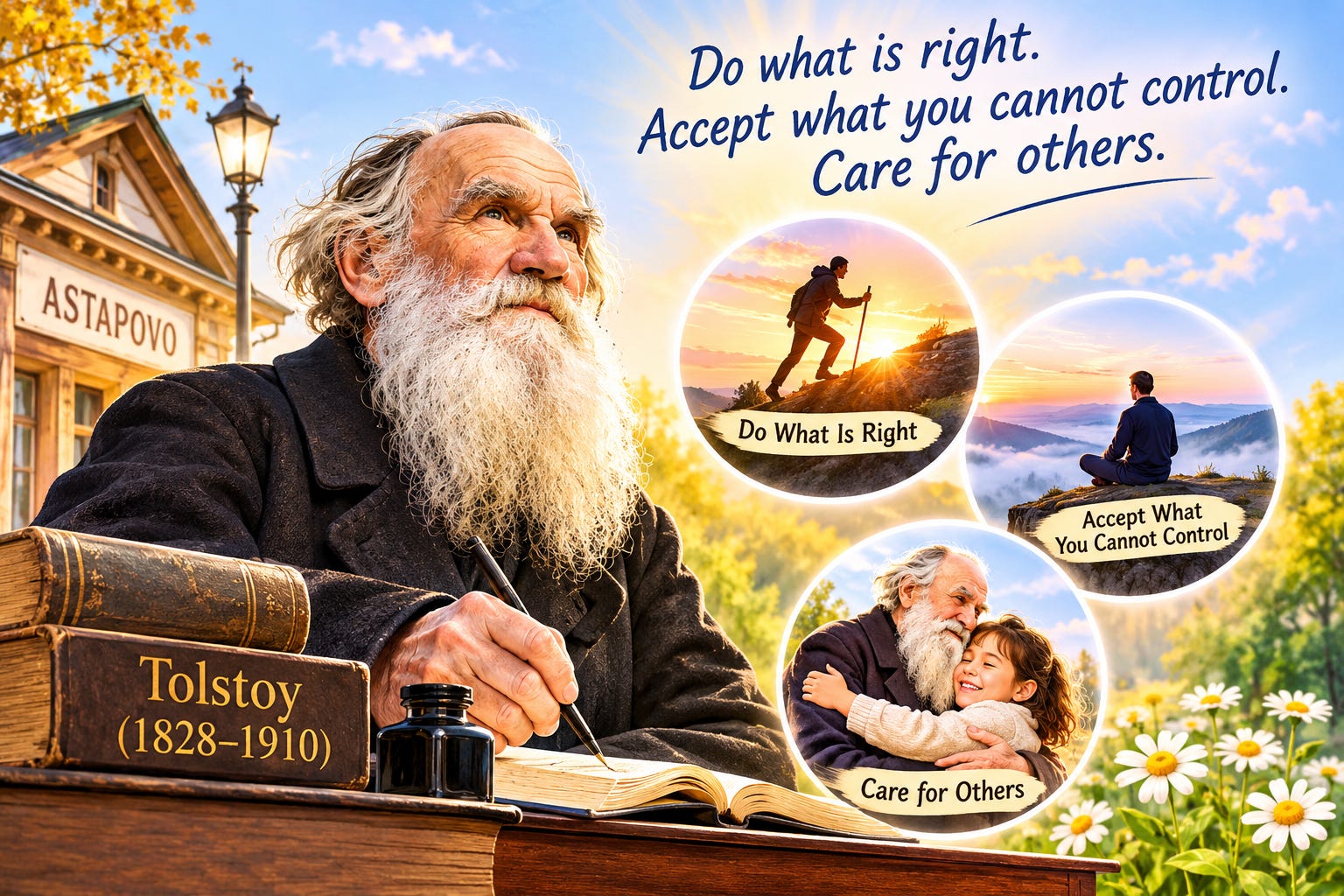
Image credit: Illustration generated with OpenAI’s ChatGPT image-generation tool with the author’s idea, 2026
The Last Diary of Leo Tolstoy at Age 82
The Wisdom of Living a Meaningful Life
Do What Is Right, Accept What You Cannot Control, and Care for Others
A Few Words at the End of a Lifetime
On November 3, 1910, Leo Tolstoy (1828–1910), one of the greatest writers in world literature, wrote the final entry in his diary at the Astapovo railway station in Russia. He was 82 years old, seriously ill, and approaching the end of his life. He died four days later, on November 7 according to the Russian calendar then in use (November 20 in the Gregorian calendar).
After approximately 63 years of diary writing, Tolstoy left behind a remarkably brief reflection. His final entry included the unfinished French expression:
“Fais ce que doit, adv...”
The complete proverb is “Fais ce que doit, advienne que pourra,” meaning, “Do what must be done, and let come what may.”
He concluded his diary with another thought:
“And all is for the good of others and, above all, for me.”
These words appear in the original Russian collected works, Volume 58, page 126 (Tolstoy, 1934). They are remarkable for their simplicity. After a lifetime of exploring human nature, love, suffering, morality, and the meaning of existence, Tolstoy left a final reflection on responsibility, acceptance, and concern for others.
What can we learn from these final words about living a meaningful life?
A Lifetime of Self-Reflection
Tolstoy began keeping a diary in 1847, when he was 18 years old. He continued this practice, with interruptions, until November 1910. His diaries document his personal struggles, ambitions, relationships, and intellectual development over more than six decades.
His celebrated novels, including War and Peace, Anna Karenina, and The Death of Ivan Ilyich, explored the complexities of human relationships, morality, suffering, and personal choices. Yet his diaries reveal another dimension of his life: a man continually examining his own behavior and questioning whether he was living according to his beliefs.
Paperno (2014) explains that diary writing was central to Tolstoy’s lifelong effort to understand and represent himself. His early diaries show how he attempted to bring moral order to his life through continuous observation and self-examination.
Tolstoy’s experience offers an important lesson: Knowledge and achievement do not automatically make a person wise. Wisdom requires self-awareness, honesty, and the willingness to recognize one’s weaknesses.
We should not spend all our time evaluating other people while neglecting to examine ourselves.
Do What Is Right, Regardless of the Outcome
The first part of Tolstoy’s final reflection emphasizes personal responsibility. We cannot control everything that happens in life. We can, however, control how carefully we think, how honestly, we act, and how responsibly we make decisions. We plan our careers, educate our children, build relationships, and pursue professional goals. Naturally, we hope our efforts will produce favorable results. Yet circumstances change, plans fail, and even sincere efforts may be misunderstood.
Tolstoy’s principle reminds us to focus on what is within our control: our intentions, decisions, and actions. This does not mean ignoring consequences or abandoning careful planning. Rather, it means doing what conscience tells us is right without allowing uncertainty to prevent responsible action.
A teacher should teach sincerely, even when every student does not succeed. A researcher should pursue truth, even when recognition is delayed. A leader should make ethical decisions, even when they are unpopular. The value of an action should not be measured only by its immediate outcome. Integrity matters even when success is uncertain.
Accept What You Cannot Control
Tolstoy’s words also teach us the importance of accepting uncertainty. Acceptance, however, is not surrender. We should correct mistakes, challenge injustice, and work to improve difficult situations. But after making a sincere effort, we must recognize that not every outcome is ours to determine.
Parents can guide their children but cannot make every decision for them. Teachers can inspire students but cannot control their future choices. Professionals can prepare carefully but cannot predict every challenge. Much unnecessary anxiety comes from trying to control things beyond our influence.
A balanced life requires two complementary attitudes: determination in action and humility toward outcomes. We should do our best without becoming prisoners of expectation. We should learn from disappointment without allowing it to define our lives. Tolstoy’s final words do not suggest that every outcome will be favorable. Rather, they invite us to maintain our moral direction even when life does not follow our plans.
A Good Life Includes the Well-Being of Others
One of the most meaningful aspects of Tolstoy’s final reflection is its concern for others. His later philosophical writings emphasized love, compassion, simplicity, and nonviolence. In The Kingdom of God Is Within You, Tolstoy (1894/1894) developed his understanding of Christian ethics, emphasizing love and nonresistance to evil. This perspective challenges the tendency to measure success through wealth, status, professional titles, and public recognition.
Such achievements may be worthwhile, but they are not sufficient measures of a good life. A successful professional can mentor younger colleagues. A business leader can create opportunities for employees. A scientist can consider the social consequences of research. A teacher can find fulfillment in the growth of students. Even small acts matter: listening patiently, offering encouragement, forgiving a mistake, sharing knowledge, or helping someone in difficulty.
We often remember people not for their titles or possessions but for how they treated us. Tolstoy’s final reflection suggests that personal fulfillment and the well-being of others should not be separated. A meaningful life is one in which our own development contributes to the lives of others.
The Wisdom of Aging
At 82, Tolstoy had experienced literary success, international recognition, family relationships, personal conflicts, and profound philosophical struggles. His final days were not entirely peaceful. He was seriously ill, and his departure from his family home had been accompanied by emotional difficulties. Historical accounts describe the complicated circumstances surrounding his final journey and his last days at Astapovo (Chertkov, 1922). His final diary entry should therefore not be interpreted as proof that he had resolved every personal conflict. Rather, it reveals a principle he continued to value despite suffering and uncertainty.
As we grow older, our understanding of success often changes. In youth, we may focus on ambition and opportunity. In middle age, family and professional responsibilities occupy much of our attention. Later in life, more fundamental questions emerge. Did I treat people fairly? Did I spend enough time with those I loved? Did I use my knowledge to help others? Did I allow pride or anger to damage important relationships? These questions should not be postponed until old age.
The wisdom of aging is not simply knowing more. It is learning what deserves our time, attention, and care.
A Lesson for the Age of Artificial Intelligence
Tolstoy’s final reflection is also relevant to today’s age of artificial intelligence. AI can generate information, analyze data, translate languages, and assist with increasingly complex decisions. Yet the ability to produce an answer does not automatically provide moral judgment. An AI system may recommend an action, but human beings remain responsible for determining whether it is accurate, fair, ethical, and beneficial. This distinction is reflected in UNESCO’s (2021) Recommendation on the Ethics of Artificial Intelligence, which emphasizes human dignity, human rights, fairness, transparency, and human oversight.
In education, AI should support learning rather than replace independent thinking. In cybersecurity, technical effectiveness must be balanced with privacy and human protection. In business, productivity should not become more important than fairness and social responsibility. The central question is not simply what technology can do, but what we ought to do with it.
Tolstoy’s principle remains relevant: Human beings must take responsibility for their decisions, regardless of how sophisticated their tools become. Knowledge provides possibilities, but conscience helps determine how those possibilities should be used.
The Meaning of a Meaningful Life
After approximately 63 years of diary writing, Tolstoy left a final reflection that can be expressed in three simple principles: Do what is right, accept what you cannot control, and consider the well-being of others. These principles do not promise an easy life or guarantee success. They offer something more enduring: a way to live with integrity, humility, and compassion.
We do not need to become famous, wealthy, or exceptionally successful to live meaningful lives. We can begin with ordinary decisions: keeping our promises, treating others fairly, learning from our mistakes, sharing our experience, and helping those who need us. Every day provides another opportunity to become a better human being.
Perhaps the greatest lesson of Tolstoy’s final diary is that the value of life is not determined by how much we accomplish or how widely we are recognized. It is reflected in how sincerely we fulfill our responsibilities and how thoughtfully we treat others.
Do what is right. Accept what you cannot control. Live with a clear conscience. And remember that the good of others is also part of a meaningful life.
That is a simple philosophy, but practicing it throughout a lifetime may be one of the greatest achievements of all.
References
Chertkov, V. G. (1922). The last days of Tolstoy (N. A. Duddington, Trans.). William Heinemann. https://www.gutenberg.org/ebooks/40260
Paperno, I. (2014). “Who, what am I?”: Tolstoy struggles to narrate the self. Cornell University Press. https://doi.org/10.7591/cornell/9780801453342.001.0001
Tolstoy, L. N. (1934). Дневники и записные книжки: 1910 [Diaries and notebooks: 1910] (Vol. 58). Государственное издательство «Художественная литература». (Полное собрание сочинений в 90 томах).
United Nations Educational, Scientific and Cultural Organization. (2021). Recommendation on the ethics of artificial intelligence. https://unesdoc.unesco.org/ark:/48223/pf0000381137
톨스토이가 82세 때 쓴 마지막 일기
의미 있는 삶을 위한 지혜
옳은 일을 행하고, 통제할 수 없는 것은 받아들이며, 다른 사람을 배려하는 삶
생애의 끝자락에 남긴 몇 마디
1910년 11월 3일, 러시아의 위대한 작가 레프 톨스토이는 82세의 나이로 자신의 마지막 일기를 기록했다. 당시 그는 집을 떠나 여행하던 중 아스타포보(Astapovo) 역에 머물고 있었다. 그로부터 며칠 뒤인 11월 7일(러시아 구력), 그는 세상을 떠났다. 오늘날 사용하는 그레고리력으로는 11월 20일이다.
그의 마지막 일기에는 다음과 같은 문장이 남아 있다.
“Вот и план мой. Fais ce que doit, adv...... И все на благо и другим, и главное, мне.”
이를 영어로 옮기면 대략 다음과 같은 뜻이다.
“Here is my plan. Do what must be done, and let come what may. And all is for the good of others and, above all, for me.”
우리말로 번역하면 다음과 같다.
“이것이 나의 계획이다. 해야 할 일을 하라. 그다음에 무슨 일이 일어나든 받아들여라. 그리고 모든 것은 다른 사람들에게도 좋고, 무엇보다 나 자신에게도 좋은 것이어야 한다.”
여기서 주목할 점은 톨스토이가 프랑스어 격언을 완성된 형태로 기록하지 않았다는 사실이다. 그는 “Fais ce que doit, adv……”라고 미완성으로 남겼다. 이는 “해야 할 일을 하고, 그 결과는 하늘의 뜻에 맡겨라”라는 의미의 프랑스어 격언을 가리키는 것으로 해석된다. 짧은 문장이지만, 이 기록에는 한 인간이 평생에 걸쳐 고민했던 삶의 태도와 윤리적 가치가 응축되어 있다. 해야 할 일을 다하고, 자신의 힘으로 통제할 수 없는 결과를 받아들이며, 다른 사람과 자신의 삶에 선한 영향을 남기려는 자세가 담겨 있기 때문이다(Tolstoy, 1934).
평생에 걸친 자기 성찰
톨스토이는 1847년부터 생애 마지막 해인 1910년까지, 중간에 중단된 시기도 있었지만, 약 63년 동안 일기를 기록했다. 그의 일기는 단순히 일상생활을 기록한 개인적인 메모가 아니었다. 그것은 자신의 생각과 행동을 돌아보고, 도덕적 결함을 발견하며, 더 나은 인간이 되기 위해 끊임없이 노력한 자기 성찰의 기록이었다. 그는 자신의 삶에서 무엇이 옳고 그른지, 인간은 어떻게 살아야 하는지, 부와 명예가 과연 행복을 보장하는지, 그리고 진정한 삶의 가치는 어디에서 비롯되는지를 끊임없이 질문했다.
톨스토이의 일기를 연구한 문학자 이리나 파페르노(Irina Paperno)는 그의 일기 쓰기를 자기 자신을 이해하고 서술하려는 지속적인 지적·도덕적 노력의 과정으로 분석했다(Paperno, 2014). 이러한 관점에서 보면, 마지막 일기의 짧은 문장은 갑자기 떠오른 생각이라기보다 오랜 세월 이어진 자기 성찰의 결과로 이해할 수 있다. 그는 인생의 마지막 순간까지도 자신에게 무엇이 중요한지 질문하고 있었던 것이다.
결과와 관계없이 옳은 일을 하라
톨스토이의 마지막 일기에서 가장 인상적인 부분은 “해야 할 일을 하라”는 메시지다. 우리는 살아가면서 자신의 행동이 어떤 결과를 가져올지 끊임없이 계산한다. 성공할 가능성이 있는지, 다른 사람들이 어떻게 평가할지, 노력한 만큼 보상을 받을 수 있을지 걱정한다. 물론 미래를 신중하게 계획하고 결과를 고려하는 일은 중요하다.
그러나 모든 결과를 자신의 뜻대로 통제할 수는 없다. 때로는 최선을 다했음에도 실패할 수 있고, 정직하게 행동했음에도 오해를 받을 수 있다. 반대로 당장의 이익을 얻었더라도 그 과정에서 양심과 신뢰를 잃을 수도 있다.
톨스토이의 마지막 기록은 우리에게 결과만을 기준으로 삶을 평가하지 말라고 일깨운다. 중요한 것은 자신이 해야 할 일을 올바르게 판단하고, 그에 따라 행동하는 것이다. 이러한 태도는 개인의 일상뿐 아니라 교육, 직업, 정치, 경영, 과학기술 분야에서도 중요하다. 진정한 책임감은 성공했을 때만 나타나는 것이 아니다. 결과가 불확실하더라도 옳다고 믿는 일을 성실하게 수행하는 데서 드러난다.
통제할 수 없는 것을 받아들이는 지혜
톨스토이가 인용하려 했던 프랑스어 격언의 핵심은 해야 할 일을 다한 뒤에는 그 결과를 받아들이라는 것이다. 이것은 수동적으로 운명에 순응하라는 뜻이 아니다. 오히려 자신의 책임과 한계를 구분하는 성숙한 태도에 가깝다.
우리는 자신의 생각과 행동을 선택할 수 있지만, 다른 사람의 판단이나 세상의 모든 변화를 통제할 수는 없다. 과거를 되돌릴 수도 없고, 미래에 일어날 모든 일을 미리 알 수도 없다. 그럼에도 많은 사람이 자신이 통제할 수 없는 일에 지나치게 많은 시간과 감정을 소비한다. 이미 지나간 일을 후회하고, 다른 사람의 평가에 집착하며, 아직 일어나지 않은 일을 걱정한다.
톨스토이의 마지막 일기는 이러한 삶의 태도를 다시 생각하게 한다. 자신이 할 수 있는 일에는 최선을 다하되, 자신의 힘으로 바꿀 수 없는 결과까지 붙잡고 괴로워하지 않는 것. 그것이야말로 지혜로운 삶의 한 모습일 것이다.
다른 사람의 행복도 자신의 행복이다
마지막 일기의 또 다른 중요한 부분은 “다른 사람들에게도 좋고, 무엇보다 나 자신에게도 좋은 것”이라는 문장이다. 이 표현은 개인의 행복과 다른 사람의 행복이 서로 분리된 것이 아니라는 점을 생각하게 한다. 우리는 흔히 행복을 개인적인 성공이나 소유의 관점에서 이해한다. 더 많은 재산, 높은 지위, 사회적 명성, 편리한 생활이 행복을 가져다줄 것이라고 생각한다. 그러나 이러한 것만으로 인간의 삶이 충분히 의미 있어지는 것은 아니다. 다른 사람을 배려하고, 어려움에 처한 사람을 돕고, 자신이 가진 지식과 경험을 나누며, 주변 사람들과 신뢰를 쌓는 과정에서도 깊은 행복을 발견할 수 있다.
톨스토이의 마지막 문장은 자기 자신을 위한 행복과 타인을 위한 선행을 대립시키지 않는다. 오히려 다른 사람에게 좋은 일이 자신에게도 좋은 삶의 일부가 될 수 있음을 보여준다. 이러한 관점에서 의미 있는 삶이란 단순히 자신의 욕구를 충족시키는 삶이 아니다. 자신의 존재가 다른 사람에게도 긍정적인 영향을 미치는 삶이다.
나이 들어간다는 것의 지혜
82세의 톨스토이가 남긴 마지막 일기는 나이가 든다는 것의 의미도 생각하게 한다. 인생의 젊은 시절에는 성취와 성장, 경쟁과 성공이 중요한 목표가 되기 쉽다. 그러나 세월이 흐르면 삶을 바라보는 관점도 달라질 수 있다. 무엇을 더 많이 소유했는가보다 무엇을 남겼는가, 얼마나 높은 자리에 올랐는가보다 어떤 사람으로 살아왔는가가 더 중요하게 다가온다.
나이가 든다는 것은 단순히 시간이 흐르는 일이 아니다. 경험을 통해 자신과 세상을 이해하고, 삶에서 진정으로 중요한 것이 무엇인지 분별하는 과정이기도 하다. 물론 나이가 많다고 해서 반드시 지혜로운 것은 아니다. 지혜는 나이 자체가 아니라 경험을 돌아보고, 자신의 잘못을 인정하며, 다른 사람의 관점을 이해하려는 노력에서 비롯된다.
톨스토이의 마지막 일기는 삶의 끝자락에서도 인간은 자신을 돌아보고 더 나은 삶을 추구할 수 있음을 보여준다.
인공지능 시대에 되새기는 톨스토이의 교훈
오늘날 우리는 인공지능이 인간의 글쓰기와 분석, 의사결정까지 지원하는 시대에 살고 있다. 인공지능은 방대한 정보를 빠르게 처리하고, 복잡한 문제에 대한 여러 해결책을 제시하며, 인간이 과거에는 상상하기 어려웠던 작업을 수행할 수 있다. 그러나 기술적으로 가능한 일이 반드시 윤리적으로 옳은 일은 아니다. 인공지능이 효율적인 답을 제시하더라도 그 결과가 인간의 존엄성과 공정성, 사회적 책임에 부합하는지는 인간이 판단해야 한다.
유네스코(UNESCO)의 인공지능 윤리에 관한 권고 역시 인간의 존엄성, 인권, 공정성, 투명성 및 인간의 감독을 중요한 원칙으로 강조한다(UNESCO, 2021). 이러한 시대에 톨스토이의 마지막 일기는 더욱 의미 있는 질문을 던진다.
우리는 무엇을 할 수 있는가만이 아니라, 무엇을 해야 하는가를 물어야 한다. 더 빠르고 효율적인 기술을 개발하는 것만큼이나 그 기술을 어떤 목적으로, 누구를 위해, 어떤 책임 아래 사용할 것인지 고민해야 한다. 인공지능은 정보를 제공하고 선택지를 제시할 수 있지만, 인간의 양심과 도덕적 책임을 대신할 수는 없다. 결국 기술의 발전이 인간의 삶을 더 나은 방향으로 이끌기 위해서는 인간의 판단력과 지혜가 함께 성장해야 한다.
의미 있는 삶이란 무엇인가
톨스토이가 82세에 남긴 마지막 일기는 길지 않다. 그러나 그 짧은 기록은 한 인간이 평생에 걸쳐 고민했던 삶의 의미를 되새기게 한다. 그가 남긴 메시지는 오늘날에도 단순하고 분명하다. 해야 할 일을 하라. 자신의 힘으로 통제할 수 없는 결과는 받아들여라. 양심에 따라 살아라. 그리고 다른 사람의 행복 역시 자신의 삶에서 중요한 가치로 여기라.
의미 있는 삶은 반드시 위대한 업적이나 극적인 성공으로 이루어지는 것이 아니다. 매일의 작은 선택과 행동 속에서 만들어진다. 정직하게 말하고, 약속을 지키며, 다른 사람을 존중하고, 자신이 맡은 책임을 다하는 일들이 모여 한 사람의 인생을 형성한다.
인생의 마지막 순간에 톨스토이가 남긴 짧은 문장은 오늘을 살아가는 우리에게도 조용하지만 깊은 질문을 던진다.
나는 오늘 해야 할 일을 다했는가? 다른 사람에게 선한 영향을 주었는가? 그리고 내 삶을 스스로 돌아보았을 때 부끄럽지 않은가?
어쩌면 의미 있는 삶의 지혜는 복잡한 철학이나 거창한 성공의 공식에 있는 것이 아닐지도 모른다. 옳은 일을 행하고, 통제할 수 없는 것을 받아들이며, 다른 사람과 함께 선한 삶을 만들어 가는 데 있을 것이다.
참고문헌
Chertkov, V. G. (1922). The last days of Tolstoy (N. A. Duddington, Trans.). William Heinemann. https://www.gutenberg.org/ebooks/40260
Paperno, I. (2014). “Who, what am I?”: Tolstoy struggles to narrate the self. Cornell University Press. https://doi.org/10.7591/cornell/9780801453342.001.0001
Tolstoy, L. N. (1934). Дневники и записные книжки: 1910 [Diaries and notebooks: 1910] (Vol. 58). Государственное издательство «Художественная литература». (Полное собрание сочинений в 90 томах).
United Nations Educational, Scientific and Cultural Organization. (2021). Recommendation on the ethics of artificial intelligence. https://unesdoc.unesco.org/ark:/48223/pf0000381137
About the Author

Prof. Dr. Young Choi (Editor-in-Chief) — Regent University
Full list of his K-GSP columns
Full list of his Books at Amazon.com
Young B. Choi is a Professor in the Department of Engineering & Computer Science at Regent University. He published 38 books with ‘Selected Readings in Cybersecurity’ (2018) (about 800 copies archived globally at university/college libraries around the world) and ‘Cybersecurity Applications and Artificial Intelligence’ (2023) available in seven major world languages. He proposed the world’s first global and universal telecommunications “Service Order Handling (SOH)” Model (T-SOH Model) (1995) with Dr. Adrian Tang. With this innovative research work, he received the IEEE NOMS ’96 Best Paper Award and became the first recipient of the Outstanding Contribution Award of the TeleManagement Forum in 1998. His research areas include Natural Language Processing-focused AI, AI-applied cybersecurity, network and telecom service management, and Korean studies on Gani Choi Rip’s Jeonggwan (靜觀: Quiet Contemplation) philosophy and Shilhak ( 實學: Practical Learning).
Suggested Citation
Choi, Y. B. (2026). The Last Diary of Leo Tolstoy at Age 82: The Wisdom of Living a Meaningful Life. K-GSP Forum.
© K-Global Scholars and Professionals Forum. All rights reserved. 2026. Content published in the K-GSP Forum may not be reproduced, distributed, or transmitted in any form without prior written permission from the K-GSP Forum, except for brief quotations with full attribution.
톨스토이와 점점 더 비슷한 생각이듭니다. 😊