
Image credit: Illustration generated with OpenAI’s ChatGPT image-generation tool, 2026
The School Lunch Duty
Cornbread, Conscience, and Two Enterprising Second Graders
Summary
The School Lunch Duty: Cornbread, Conscience, and Two Enterprising Second Graders is a humorous and reflective memoir of childhood in postwar Korea, when food was scarce and American-aid cornmeal rolls were a treasured school lunch. As a second-grade student, the author and his friend Kim Sun-kyung were assigned to collect bread for their classmates. Tempted by hunger and the delicious aroma of freshly baked cornmeal rolls, the two boys secretly added extra rolls to their basket whenever the school nurse was distracted. Their teacher later distributed the bread according to the students’ classroom-cleaning efforts and generously rewarded the two boys with whatever remained.
Looking back as an adult, the author recalls these adventures with affection, amusement, and a measure of embarrassment. Although the boys’ ingenuity brought them considerable happiness, he recognizes that their actions were not entirely honest. The essay explores the relationship between hunger, childhood innocence, moral responsibility, and human compassion. Ultimately, this seemingly trivial memory reveals a profound truth: scarcity can test both the body and the conscience, while understanding human behavior requires compassion without abandoning honesty.
Keywords
School Lunch Duty; Childhood Memories; Postwar Korea; American Food Aid; Cornmeal Bread; Hunger and Scarcity; Childhood Friendship; Moral Responsibility; Honesty and Conscience; Human Compassion; Humor; Nostalgia; Life Lessons
The Korean expression geupsik dangbeon (급식당번: 給食當番), meaning “school lunch duty,” carries a faintly unpleasant historical echo, as though some dusty remnant of Japanese imperial rule had survived in the vocabulary long after the empire itself had departed. Yet whenever I hear those words, they awaken a memory that has lingered in my mind for decades—a small childhood adventure involving hunger, ingenuity, and a rather flexible interpretation of honesty.
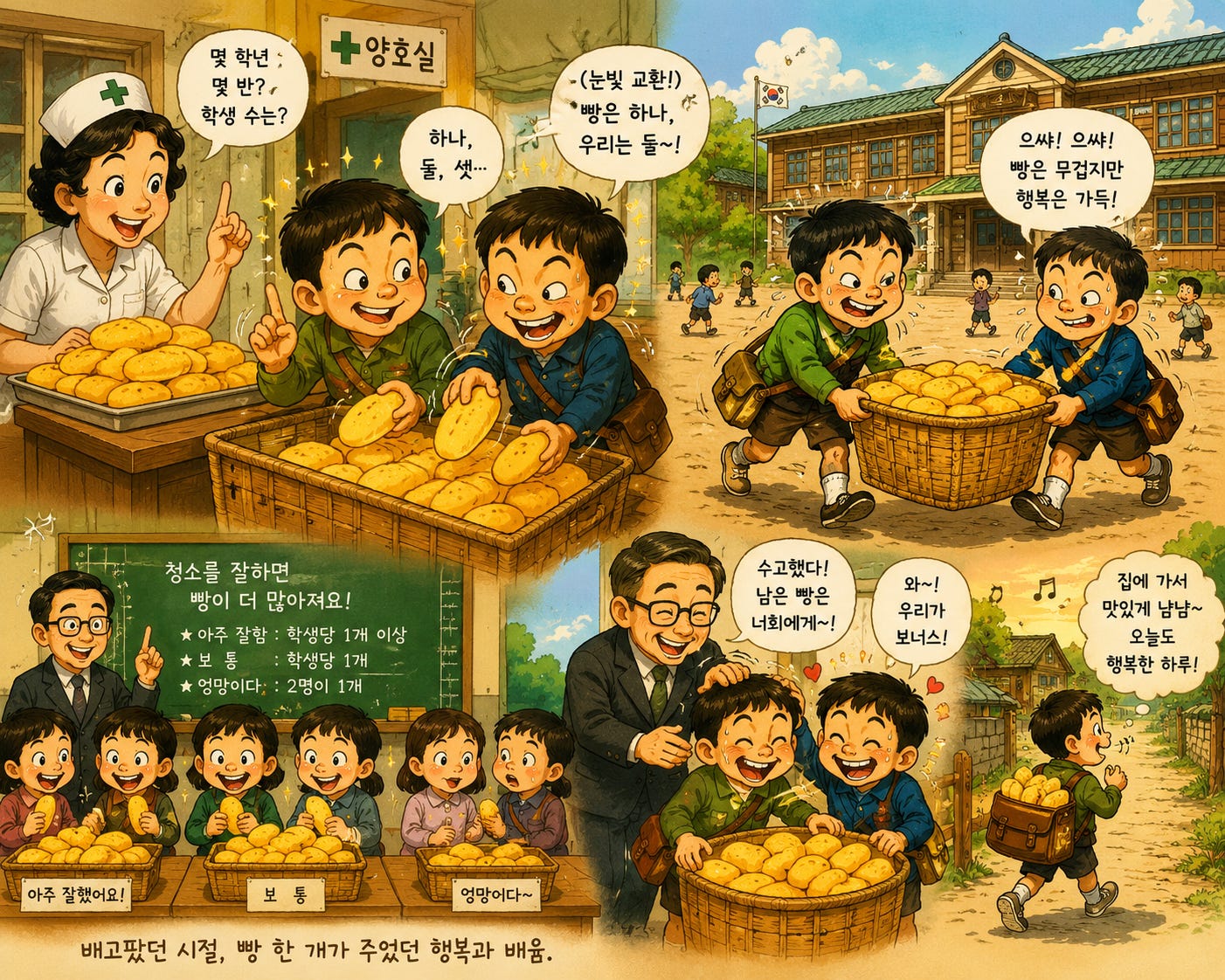
I believe I was in the second grade of elementary school at the time. I was taller and more solidly built than most boys my age, a physical distinction that seemed to qualify me for responsibilities far beyond my years. My homeroom teacher therefore regularly appointed my classmate and close friend, Kim Sun-kyung, and me to perform an important afternoon mission. Around cleaning time, we were to cross the schoolyard, which seemed enormous to our small legs, and collect our daily school rations from the infirmary beside the auditorium, which also served as the school gymnasium.
The school lunch was a cornmeal roll made from corn flour supplied to Korea through American military aid. The bread had a distinctive shape, resembling a pair of old-fashioned mittens joined together—or, if one was feeling less charitable, a small culinary experiment that had escaped from the kitchen before anyone could determine what it was supposed to be. But appearances meant little to hungry children. The bread smelled wonderfully of roasted corn, and its warm, nutty fragrance could awaken an appetite in a child who had only recently finished wondering whether he was still hungry. In those difficult years, the rolls were immensely popular. Usually, each child received one, though occasionally the distribution was less generous.
The school nurse in charge of the rations would first ask us which grade and class we represented. Then came the critical question: How many students were in our class? The answer determined how many rolls we were entitled to carry away.
In one corner of the infirmary stood a substantial pile of freshly baked rolls. We began counting them, one by one, and placing them in a large rectangular basket woven from bamboo strips. The basket was built like a sturdy crate, apparently designed to withstand both the weight of the bread and the questionable character of the boys entrusted with it.
It was at this point that trouble—or, from our perspective, opportunity—usually presented itself.
One of us would begin calling out the student numbers, starting with one, while the other placed the corresponding rolls into the basket. Under ordinary circumstances, this would have been a perfectly respectable exercise in arithmetic and cooperation. Unfortunately, we had discovered that arithmetic could be made considerably more interesting when the person doing the counting and the person handling the bread shared a common financial interest, except that our currency was cornmeal.
Whenever the nurse turned her attention to some administrative task, our eyes would meet in a brief but eloquent exchange. We had no need for a conference, a written agreement, or even a whispered consultation. A quick glance was enough. At certain numbers, one roll would quietly become two. The official count remained unchanged, but the basket grew heavier.
We were not sophisticated criminals. We had no elaborate system, no secret ledger, and certainly no intention of overthrowing the school administration. We were merely two hungry second-graders conducting a modest experiment in supply enhancement. If anyone had asked us to explain the procedure, we might have defended it as a practical adjustment to the limitations of the official allocation system.
Eventually, we would reach the number assigned to the last student on the class register. I remember that our class probably had more than sixty students. In those days, class registers often followed the order of students’ heights, from the shortest to the tallest, and my own number was usually somewhere in the sixty-something range. I had apparently been blessed with enough physical stature to qualify for the rear end of the alphabetically challenged—or, more precisely, the vertically organized—world of elementary school attendance.
When the final roll had been placed in the basket, we would announce to the nurse that the count was complete. She would usually glance at the basket and tell us to take it back to the classroom.
Looking back, I sometimes suspect that she knew perfectly well what was happening. Perhaps she had noticed that our arithmetic was unusually generous, or that the number of rolls occasionally seemed to exceed the number of children by a margin that no respectable mathematical theory could explain. Yet she never appeared to investigate the matter.
Those were difficult years, when many families struggled to put enough food on the table. Perhaps the nurse understood that hunger could make even an otherwise well-behaved child negotiate with his conscience. If she did know, her silence may have been an act of quiet compassion. Or perhaps she simply preferred not to conduct a criminal investigation into the activities of two boys carrying a basket of cornmeal bread. Whatever her reasons, we were grateful for her administrative efficiency.
Kim and I then faced the return journey.
We had to cross that enormous schoolyard again, this time carrying a basket whose weight seemed to increase with every step. The two of us would sweat profusely, stop to rest, resume walking, and stop again. The distance had not changed, of course, but the laws of physics appeared to become much more persuasive when one was carrying a basket full of bread.
At last, we would reach our classroom, housed in a wooden school building of the Japanese colonial era. We would report to our teacher that the precious cargo had arrived safely. The teacher would thank us for our efforts, and we would receive the sort of acknowledgment that makes a young boy feel he has performed a task of national importance.
But the real business of the afternoon had only just begun.
While we had been away, the other students were supposed to be cleaning the classroom. Our teacher inspected the results and distributed the cornmeal rolls according to the cleanliness of each group’s assigned area. The system was an early form of performance-based compensation, implemented long before anyone in our classroom had heard of productivity metrics, incentive structures, or management consulting.
The rewards varied according to the quality of the cleaning. A group that had done an excellent job could expect at least one roll per student. A group that had performed at an average level might receive the standard allocation of one roll per student. But a group that had neglected its duties and devoted itself instead to the fine art of loafing could suffer a severe reduction: one roll for every two students.
The message was unmistakable. Clean the classroom, and eat. Neglect your responsibilities, and learn to appreciate the economic consequences of leisure.
In retrospect, our teacher was conducting a small experiment in behavioral economics. She was using bread as an incentive, cleanliness as a measurable outcome, and hunger as the most persuasive management consultant available. Her methods may not have satisfied every modern educational standard, but I doubt that anyone in the class misunderstood the relationship between work and reward.
When the distribution was over, however, there were always rolls left over.
By now, I imagine the reader has already solved this mystery. The surplus was not the result of a miracle, a clerical error, or an unexpected improvement in agricultural productivity. It was the natural consequence of our private contributions to the school food supply.
Our teacher would award the remaining rolls as bonuses to students who had cleaned especially well or demonstrated good classroom behavior. These extra portions were a form of recognition, a small reward for merit in a world where even a piece of bread could carry considerable emotional and economic value.
And then came our reward.
Because Kim and I had worked so hard to bring the bread back to the classroom, the teacher would give us all the rolls that remained. She considered it a suitable expression of gratitude for our labor. We considered it an extraordinary demonstration of the principle that hard work pays.
Neither of us seems to have raised the question of whether our compensation package had been calculated on the basis of the original allocation or the revised one. We were young, and accounting transparency had not yet become one of our professional interests.
I would gather the extra rolls, stuff them firmly into my schoolbag, and carry the added weight home on my back. The bag seemed heavier than it had that morning, but it was a pleasant burden. There is a peculiar happiness in knowing that one’s schoolbag contains not merely books and notebooks but also a substantial reserve of food.
At home, I could enjoy the rolls at my leisure, savoring their sweet, nutty flavor and the satisfaction of having brought something valuable back from school. It was a simple pleasure, but in those days, simple pleasures were not always easy to come by. I can still remember the sense of abundance, the quiet excitement, and the almost immeasurable happiness of having more bread than I had expected.
Of course, memory has a way of polishing certain experiences until they shine more brightly than they deserve. It is tempting to remember only the delicious bread, the heavy schoolbag, and the innocent ingenuity of two boys who had discovered a way to improve their afternoon prospects. But an honest recollection must eventually allow the conscience to enter the room.
When I look back now, I have to admit that our little operation was not entirely honest. We had deliberately manipulated the count to obtain more bread than our class was officially entitled to receive. Hunger may explain our behavior, but explanation is not the same thing as justification.
We were children growing up in difficult circumstances. Food was not an abstract item in a household budget or a minor line in a school administration report. It was one of life’s fundamental necessities, and its absence could make a child’s world seem considerably smaller. Under such conditions, even a modest piece of bread could acquire a significance that an adult living in comfortable circumstances might find difficult to imagine.
Still, I cannot claim that hunger entirely absolved us of responsibility. My conscience, though not yet fully developed, was apparently present at the scene. It simply seems to have been temporarily outnumbered by two growing boys and a basket of warm cornmeal rolls.
That experience taught me something about the importance of food long before I had the vocabulary to explain it. Among the three essentials of human life—clothing, food, and shelter—food occupies a uniquely powerful place. Clothing can be patched, and shelter can sometimes be improvised, but hunger has a way of making itself heard with an urgency that few other needs can match.
The memory also reminds me how easily moral judgments become complicated when scarcity enters the picture. It is easy to lecture children about honesty when their stomachs are full. It is more difficult to understand their small transgressions when the smell of fresh bread fills the room and the next meal is not something they can take for granted.
I do not offer this story as a defense of our arithmetic. Mathematics was innocent; we were the ones who had given it a questionable assignment. Nor do I offer it as a recommendation for improving school meal programs. Modern administrators would probably prefer a more transparent inventory system, and I would not advise anyone to adopt two hungry second-graders as auditors.
I tell it because the memory has remained with me, tucked away in the storeroom of my past, where certain experiences refuse to disappear no matter how many years pass. It contains the warmth of childhood friendship, the smell of freshly baked bread, the generosity of a nurse who may have understood more than she said, and the kindness of a teacher who rewarded us for a difficult job.
It also contains a small, uncomfortable truth about myself.
I remember the bread with affection, but I remember the counting with a measure of embarrassment. Time has softened the memory without entirely erasing the moral lesson. The boy who once thought that a little extra bread was a brilliant achievement has grown into a man who understands that scarcity can test both the stomach and the conscience.
If there is any wisdom in this childhood episode, it is not that hunger makes dishonesty acceptable, nor that cleverness can turn a questionable act into a virtue. It is that human beings are complicated, especially when they are young, hungry, and living in difficult times. Compassion helps us understand their behavior, while honesty asks us to acknowledge it without pretending that every childhood adventure was an act of heroism.
And so, whenever I hear the expression geupsik dangbeon—school lunch duty—I no longer think only of the peculiar historical echo in the word. I remember a vast schoolyard, a bamboo basket, a friend named Kim Sun-kyung, a pile of warm cornmeal rolls, and two second-graders whose arithmetic improved remarkably whenever the nurse looked away.
We did not invent a new system of food distribution. We merely discovered, at an embarrassingly early age, that the human appetite can be a very persuasive mathematician.
And if those extra rolls tasted especially good when I ate them at home, perhaps it was because they carried two flavors: the sweetness of childhood happiness and the faint, lingering aftertaste of a conscience that had begun to wake up.
Original essay written on January 12, 2011.
급식당번
옥수수빵과 양심, 그리고 야심만만했던 두 명의 초등학교 2학년생
일본제국주의(日本帝國主義)의 흔적이 아직도 어휘 속에 희미하게 남아 있는 듯한 말이 바로 ‘급식당번(給食當番)’이다. 하지만 나는 이 말을 들을 때마다 수십 년이 지난 지금까지도 기억 속에서 좀처럼 사라지지 않는 어린 시절의 한 사건을 떠올리곤 한다. 배고픔과 기지, 그리고 정직이라는 덕목을 조금은 융통성 있게 해석했던 두 소년의 이야기다.
내가 초등학교 2학년 때였던 것으로 기억한다. 나는 또래 아이들보다 키가 크고 체격도 제법 건장했다. 어쩌면 그런 신체적 조건 덕분에 나이에 걸맞지 않은 중책을 맡게 되었는지도 모르겠다. 담임선생님께서는 오후 청소 시간이 다가오면 나와 짝꿍 김순경이에게 특별 임무를 맡기셨다. 넓디넓은 운동장을 가로질러 체육관으로도 사용하던 강당 옆 양호실에 가서 급식빵을 받아 오라는 것이었다.
그 시절 우리 학교에서 학생들에게 나누어 주던 급식은 미국의 군사원조 물자로 우리나라에 들어온 옥수수가루로 만든 빵이었다. 빵 모양은 벙어리장갑을 닮았다. 조금 심술궂게 표현하자면, 부엌에서 무슨 음식인지 미처 판정이 나기도 전에 탈출해 버린 요리 실험작품 같았다고나 할까?
하지만 배고픈 아이들에게 빵의 외모 따위는 아무런 문제가 되지 않았다. 갓 구운 옥수수빵에서는 고소하고 구수한 냄새가 풍겼다. 그 향기는 방금 밥을 먹고도 다시 배가 고픈지 아닌지 고민하던 아이의 식욕마저 단번에 깨워 놓을 정도였다. 당시에는 먹을 것이 넉넉하지 않았으므로 이 빵의 인기가 대단했다. 대개 한 사람에게 한 개씩 돌아갔지만, 때로는 배급 사정에 따라 그보다 넉넉하지 못한 경우도 있었다.
급식을 담당하는 간호사 선생님께서는 먼저 우리가 몇 학년 몇 반인지 물으셨다. 다음 질문은 더욱 중요했다.
“너희 반 학생이 몇 명이지?”
그 대답에 따라 우리가 가져갈 빵의 수량이 결정되었다.
양호실 한쪽 구석에는 갓 구워 낸 빵들이 수북이 쌓여 있었다. 우리는 빵을 하나씩 세면서 대나무를 엮어 만든 커다란 직육면체 바구니에 담기 시작했다. 바구니는 제법 튼튼했다. 빵의 무게는 물론이고, 그 바구니를 맡은 소년들의 인격적 결함까지도 견뎌 낼 수 있을 만큼 튼튼해 보였다.
그런데 바로 이 순간이면 늘 문제가 발생했다. 물론 우리 입장에서 보면 문제라기보다는 절호의 기회에 가까웠다.
우리 둘 중 한 명이 ‘하나’부터 학생 수를 세기 시작하면, 다른 한 명은 그 숫자에 맞추어 빵을 바구니에 넣었다. 정상적인 상황이라면 산수와 협동심을 기르는 아주 모범적인 활동이었을 것이다. 그러나 우리는 숫자를 세는 아이와 빵을 집어넣는 아이가 서로 이해관계를 같이할 때 산수가 얼마나 흥미진진한 학문으로 변할 수 있는지 이미 알아 버렸다. 물론 우리에게는 돈 대신 옥수수빵이 화폐 역할을 했다.
간호사 선생님께서 잠시 다른 행정 업무를 보시는 순간이면 우리 두 소년의 눈빛이 재빨리 교차했다. 회의를 열 필요도 없었고, 계약서를 작성할 필요도 없었다. 속삭이는 말 한마디조차 필요하지 않았다. 눈짓 한 번이면 충분했다.
그리하여 어떤 숫자에서는 빵 한 개가 조용히 두 개로 변신했다. 숫자는 여전히 그대로였지만 바구니의 무게는 조금씩 늘어났다.
물론 우리는 대단한 범죄 조직은 아니었다. 치밀한 범행 계획이 있었던 것도 아니고, 비밀 장부를 작성한 것도 아니었다. 그렇다고 학교 행정체계를 무너뜨릴 원대한 야망을 품었던 것도 아니다. 우리는 그저 배고픈 초등학교 2학년생 두 명이 급식 배급량을 조금 개선해 보려는 소박한 실험을 하고 있었을 뿐이다.
누군가 우리에게 그 절차를 설명해 보라고 했다면, 아마도 공식 배급 제도의 한계를 보완하기 위한 실용적인 조정이었다고 당당하게 주장했을지도 모른다.
마침내 출석부에 적힌 마지막 학생의 번호에 이르렀다. 당시 우리 반에는 아마 60명이 훌쩍 넘는 학생이 있었던 것으로 기억한다. 그 시절에는 키가 작은 학생부터 큰 학생 순서로 출석번호를 정하는 경우가 많았는데, 내 번호는 대개 60번대 중반쯤이었다.
나는 그때부터 이미 남다른 신체 조건을 자랑했던 모양이다. 출석번호를 정하는 기준이 키였으니, 내 번호는 어린이 세계의 수직적 질서에서 상당히 뒤쪽에 자리 잡고 있었다.
마지막 빵을 바구니에 넣고 나면 우리는 간호사 선생님께 빵을 모두 담았다고 말씀드렸다. 선생님께서는 대개 바구니를 한 번 힐끗 보신 다음, 교실로 가져가라고 하셨다.
지금 생각해 보면 간호사 선생님은 우리 두 소년이 벌이는 일을 이미 알고 계셨는지도 모르겠다. 어쩌면 우리의 산수가 유난히 너그러웠다는 사실을 눈치채셨을 수도 있다. 아니면 학생 수보다 빵이 조금 더 많은 현상을 설명하기 위해 새로운 수학 이론이라도 개발해야 하는 상황임을 깨달으셨는지도 모른다.
그런데도 선생님께서는 한 번도 우리를 추궁하지 않으셨다.
당시에는 많은 가정이 끼니를 해결하는 것조차 쉽지 않았다. 어쩌면 선생님은 배고픔이 평소에는 얌전한 아이의 양심마저 협상 테이블로 끌어낼 수 있다는 사실을 알고 계셨을 것이다. 만약 선생님이 우리의 비밀을 알고도 모른 척하셨다면, 그것은 조용한 연민의 표현이었을지도 모른다.
아니면 빵 바구니를 들고 다니는 초등학교 2학년생 두 명을 상대로 범죄 수사에 착수하는 것이 별로 생산적인 행정 업무가 아니라고 판단하셨을 수도 있다.
어쨌든 우리는 선생님의 탁월한 행정적 효율성에 깊이 감사했다.
이제 나와 순경이는 귀환 작전에 돌입해야 했다.
넓디넓은 운동장을 다시 가로질러야 했는데, 이번에는 아까보다 훨씬 무거워진 바구니를 들고 가야 했다. 우리는 땀을 뻘뻘 흘리며 걷다가 멈추고, 잠시 쉬었다가 다시 걷고, 또 멈추기를 반복했다.
물론 운동장의 크기가 갑자기 늘어난 것은 아니었다. 다만 빵을 가득 담은 바구니를 들고 나면 물리학의 법칙이 평소보다 훨씬 설득력 있게 느껴질 뿐이었다.
마침내 우리는 일제강점기에 지어진 목조 교실에 도착했다. 귀중한 화물을 무사히 운반해 왔다고 선생님께 보고하자, 선생님께서는 수고했다며 우리를 격려하셨다.
그 순간 우리는 어린 소년들이 흔히 느끼는 자부심을 맛보았다. 마치 국가적으로 매우 중요한 임무를 완수하고 돌아온 사람들처럼 말이다.
그러나 오후의 진짜 중요한 일은 이제부터 시작이었다.
우리가 양호실에 다녀오는 동안 다른 학생들은 교실 청소를 하고 있어야 했다. 선생님께서는 청소 상태를 살펴보신 뒤 각 분단에 배정된 구역을 얼마나 깨끗하게 청소했는지에 따라 옥수수빵을 나누어 주셨다.
지금의 경영학 용어를 빌리자면, 그것은 생산성과 성과에 따라 보상을 차등 지급하는 일종의 성과급 제도였다. 당시 우리 교실에서는 생산성 지표나 인센티브 구조, 경영 컨설팅이라는 말은 아무도 들어 본 적이 없었지만 말이다.
청소를 아주 잘한 분단에는 적어도 학생 한 명당 빵 한 개씩이 돌아갔다. 보통 수준으로 청소한 분단도 학생 한 명당 한 개씩 받았다. 그러나 청소는 거의 하지 않은 채 노는 일에 온 힘을 쏟은 분단에는 가혹한 경제적 제재가 가해졌다. 빵 한 개를 학생 두 명이 나누어 먹어야 하는 경우도 있었다.
메시지는 분명했다.
교실을 깨끗하게 청소하면 빵을 먹을 수 있다. 맡은 일을 소홀히 하고 놀기만 한다면 여가 활동의 경제적 대가를 몸소 배워야 한다.
돌이켜 보면 담임선생님께서는 작은 행동경제학 실험을 진행하고 계셨던 셈이다. 빵을 보상으로 삼고, 청소 상태를 측정 가능한 성과로 설정하고, 배고픔을 가장 설득력 있는 경영 자문위원으로 활용하셨던 것이다.
오늘날의 교육 기준으로 보면 그 방법이 모든 면에서 완벽했다고 말하기는 어려울 것이다. 하지만 당시 학생 중 누구도 노력과 보상의 관계를 이해하지 못했다고 주장하기는 힘들 것 같다.
그런데 빵 배급이 끝나면 언제나 빵이 남았다.
이쯤 되면 독자 여러분께서는 그 이유를 이미 알아차리셨으리라 믿는다. 남은 빵은 기적의 결과도 아니었고, 행정상의 착오도 아니었으며, 갑자기 농업 생산성이 향상된 덕분도 아니었다.
그것은 우리가 학교의 식량 공급 체계에 비공식적으로 기여한 결과였다.
선생님께서는 남은 빵을 특별히 청소를 잘한 학생이나 평소 학습 태도가 좋은 학생들에게 보너스처럼 나누어 주셨다. 빵 한 개에도 상당한 경제적·정서적 가치가 있던 시절이었으니, 그것은 나름대로 의미 있는 포상이었다.
그리고 마침내 우리 차례가 돌아왔다.
나와 순경이가 빵을 교실까지 가져오느라 고생했으므로 선생님께서는 남은 빵을 전부 우리에게 주시곤 했다. 선생님께서는 우리의 수고에 대한 적절한 보답이라고 생각하셨을 것이다.
우리 두 소년은 그것을 노동의 대가가 얼마나 달콤한지를 보여 주는 훌륭한 사례라고 생각했다.
우리는 자신들의 보상 체계가 최초의 배급량을 기준으로 계산된 것인지, 아니면 우리가 임의로 수정한 배급량을 기준으로 계산된 것인지 굳이 묻지 않았다. 우리는 아직 어렸고, 회계의 투명성은 장차 내가 관심을 갖게 될 전문 분야 중 하나가 아니었다.
나는 추가로 받은 빵들을 모아 책가방 속에 꾹꾹 눌러 담았다. 집으로 돌아가는 길에 책가방은 아침보다 훨씬 무거워졌지만, 그 무게는 결코 불쾌하지 않았다.
책가방 속에 책과 공책만 들어 있는 것이 아니라 상당한 양의 식량 비축분까지 들어 있다는 사실은 어린아이에게 묘한 행복을 안겨 준다.
집에 도착하면 나는 빵을 천천히 꺼내 먹을 수 있었다. 고소하고 달콤한 옥수수빵의 맛을 음미하면서, 학교에서 귀한 것을 한가득 가져왔다는 뿌듯함도 함께 즐겼다.
그것은 소박한 기쁨이었다. 하지만 당시에는 그런 소박한 기쁨조차 언제나 쉽게 누릴 수 있는 것이 아니었다.
나는 예상보다 많은 빵을 갖게 되었을 때 느꼈던 풍족함과 조용한 흥분, 그리고 그 행복을 지금도 기억한다. 어린 시절의 나에게 그것은 말로 다 표현하기 어려울 만큼 큰 기쁨이었다.
물론 기억이라는 녀석은 때때로 과거의 경험을 지나치게 반짝반짝하게 닦아 놓는다. 세월이 흐르면 어떤 기억은 실제보다 훨씬 아름답고 유쾌하게 보이기 마련이다.
맛있는 빵과 무거운 책가방, 그리고 오후의 운을 개선하는 방법을 발견한 두 소년의 천진난만한 기지만 떠올린다면, 이 이야기는 그저 유쾌한 어린 시절의 모험담으로 남을 것이다.
그러나 정직한 회고라면 언젠가는 양심도 그 방에 들어오도록 자리를 내주어야 한다.
지금 돌이켜 보면 우리 두 소년의 작전이 완전히 정직했던 것은 아니었다. 우리는 의도적으로 숫자를 조작하여 우리 반에 공식적으로 배정된 것보다 더 많은 빵을 얻으려 했다.
배고픔은 우리의 행동을 설명해 줄 수는 있지만, 설명과 정당화는 서로 다른 문제다.
우리는 어려운 시절을 살아가던 아이들이었다. 먹을거리는 가계부의 추상적인 항목도 아니었고, 학교 행정 보고서에 적힌 사소한 숫자도 아니었다. 그것은 인간이 살아가는 데 반드시 필요한 것이었으며, 부족할 때면 아이들의 세상은 그만큼 작아졌다.
그런 상황에서는 빵 한 조각조차 오늘날 넉넉한 환경에서 살아가는 어른들이 쉽게 상상하기 어려울 만큼 큰 의미를 가질 수 있다.
그렇다고 배고픔이 우리의 책임을 완전히 면제해 준다고 주장할 수는 없다. 당시에는 아직 충분히 성장하지 못했던 양심도 분명 현장에 উপস্থিত하고 있었을 것이다. 다만 자라나는 두 소년과 따끈따끈한 옥수수빵 한 바구니의 숫자에 밀려 잠시 목소리를 내지 못했을 뿐이다.
이 경험은 내가 그 의미를 설명할 만한 어휘를 갖기도 전에 음식이 얼마나 중요한 것인지를 가르쳐 주었다.
인간 생활의 세 가지 기본 요소인 의식주 가운데 식(食)은 유난히 강력한 힘을 지닌다. 옷은 기워 입을 수 있고, 집은 때로 임시방편으로 마련할 수도 있다. 하지만 배고픔은 다른 어떤 필요보다도 절박하게 자신의 존재를 알린다.
이 기억은 또한 결핍이 개입하는 순간 도덕적 판단이 얼마나 복잡해질 수 있는지를 일깨워 준다.
배부른 아이에게 정직하게 행동하라고 훈계하는 것은 어렵지 않다. 그러나 방 안에 갓 구운 빵 냄새가 가득하고 다음 끼니를 당연하게 기대할 수 없는 상황에서 아이가 저지른 작은 잘못을 이해하는 일은 그보다 훨씬 어렵다.
나는 이 이야기를 우리의 산수 실력을 변호하기 위해 꺼내는 것이 아니다. 산수는 죄가 없었다. 잘못된 과제를 부여한 것은 우리였다.
그렇다고 이 이야기를 학교 급식 제도의 개선 방안으로 제안하는 것도 아니다. 오늘날의 학교 행정가라면 아마도 훨씬 투명한 재고 관리 체계를 선호할 것이다. 나 역시 배고픈 초등학교 2학년생 두 명을 급식 재고 감사관으로 임명하라고 권하고 싶지는 않다.
내가 이 이야기를 꺼내는 이유는 이 기억이 과거라는 창고 한구석에 오랫동안 보관되어 있으면서 세월이 아무리 흘러도 좀처럼 사라지지 않기 때문이다.
그 안에는 어린 시절 친구와 나누었던 우정의 온기가 있고, 갓 구운 빵의 향기가 있으며, 말보다 더 많은 것을 이해했을지도 모르는 간호사 선생님의 너그러움이 있다. 그리고 힘든 일을 해냈다는 이유로 우리를 격려해 주셨던 담임선생님의 따뜻한 마음도 담겨 있다.
하지만 그 기억 속에는 나 자신에 관한 조금 불편한 진실도 들어 있다.
나는 그 빵을 애틋하게 기억하지만, 빵을 세던 순간만큼은 약간의 부끄러움과 함께 기억한다. 세월은 기억을 부드럽게 만들었지만, 그 안에 담긴 도덕적 교훈까지 완전히 지워 버리지는 못했다.
한때 빵 몇 개를 더 얻어 낸 일을 대단한 성취라고 생각했던 소년은 이제 어른이 되었다. 그리고 결핍이라는 것이 인간의 배뿐만 아니라 양심까지 시험할 수 있다는 사실을 이해하게 되었다.
이 어린 시절의 일화에서 어떤 교훈을 얻을 수 있다면, 그것은 배고픔이 부정직을 정당화한다는 것도 아니고, 재치가 있으면 의심스러운 행동도 미덕으로 바뀐다는 것도 아니다.
그보다는 인간이란 존재가 얼마나 복잡한지를 이해하는 데 있을 것이다. 특히 어린 나이에 배고픔을 겪으며 어려운 시대를 살아가는 인간은 더욱 그렇다.
연민은 사람들의 행동을 이해하도록 도와준다. 정직은 그 행동을 미화하거나 모든 어린 시절의 모험을 영웅적인 일로 꾸미지 말고, 있는 그대로 인정하라고 요구한다.
그래서 나는 이제 ‘급식당번’이라는 말을 들으면 단순히 그 단어에 남아 있는 묘한 역사적 흔적만 떠올리지는 않는다.
대신 넓디넓은 운동장과 대나무 바구니, 김순경이라는 친구, 따끈따끈한 옥수수빵 더미, 그리고 간호사 선생님이 고개를 돌릴 때마다 산수 실력이 놀라울 정도로 향상되었던 초등학교 2학년생 두 명을 떠올린다.
우리는 새로운 식량 배급 제도를 발명한 것이 아니었다. 그저 인간의 식욕이 얼마나 설득력 있는 수학자가 될 수 있는지를 조금 부끄러울 만큼 이른 나이에 발견했을 뿐이다.
그리고 집에 돌아와 먹었던 그 빵이 유난히 맛있었다면, 어쩌면 그 안에 두 가지 맛이 함께 들어 있었기 때문인지도 모른다.
하나는 어린 시절의 행복이 주는 달콤함이었고, 다른 하나는 이제 막 깨어나기 시작한 양심이 남긴 희미하고도 오래가는 뒷맛이었다. +++
원문 작성일: 2011년 1월 12일
한글 요약
「급식당번: 옥수수빵과 양심, 그리고 야심만만했던 두 명의 초등학교 2학년생」은 전후 한국의 어려웠던 시절, 초등학교 급식빵을 둘러싸고 벌어진 어린 시절의 추억을 유머와 해학으로 풀어낸 회고 수필이다.
당시 미국의 군사원조로 공급된 옥수수가루로 만든 빵은 배고픈 어린이들에게 무척 귀한 간식이었다. 초등학교 2학년이었던 글쓴이는 단짝 친구 김순경과 함께 급식빵을 받아 오는 임무를 맡았다. 두 소년은 간호사 선생님이 잠시 다른 일을 보는 틈을 이용해 빵을 조금씩 더 바구니에 넣었다. 교실에 도착한 빵은 청소 상태와 학습 태도에 따라 학생들에게 배분되었으며, 남은 빵은 운반하느라 수고한 두 소년에게 주어지곤 했다. 덕분에 글쓴이는 무거운 책가방에 빵을 가득 담아 집으로 돌아가는 특별한 행복을 누렸다.
그러나 세월이 흐른 뒤, 글쓴이는 그때의 행동이 단순히 영리한 장난만은 아니었음을 깨닫는다. 배고픔과 물질적 결핍은 어린아이의 판단에 영향을 미쳤지만, 그렇다고 부정직한 행동이 정당화되는 것은 아니었다. 이 수필은 마크 트웨인 특유의 자기풍자와 익살스러운 회고를 통해 어린 시절의 천진난만함과 도덕적 책임 사이의 미묘한 관계를 탐구한다. 나아가 음식이 인간의 삶에서 차지하는 절실한 의미와 어려운 처지에 놓인 사람을 이해하는 연민의 가치를 되새긴다.
결국 이 이야기는 어린 시절의 잘못을 무조건 미화하지 않으면서도, 그 행동이 비롯된 시대적 상황과 인간적인 약점을 따뜻하게 돌아보게 한다. 배고픔은 인간의 몸뿐 아니라 양심까지 시험할 수 있으며, 진정한 성찰은 자신의 과거를 솔직하게 인정하면서 타인에게는 이해와 연민을 베푸는 데서 시작된다는 것이 이 수필의 핵심 메시지다.
핵심어
급식당번, 어린 시절의 추억, 전후 한국, 미국의 식량 원조, 옥수수빵, 배고픔과 결핍, 어린 시절의 우정, 정직과 양심, 도덕적 책임, 인간적 연민, 유머와 해학, 자기풍자, 향수와 회고, 삶의 교훈
About the Author

Prof. Dr. Young Choi (Editor-in-Chief) — Regent University
Full list of his K-GSP columns
Full list of his Books at Amazon.com
Young B. Choi is a Professor in the Department of Engineering & Computer Science at Regent University. He published 38 books with ‘Selected Readings in Cybersecurity’ (2018) (about 800 copies archived globally at university/college libraries around the world) and ‘Cybersecurity Applications and Artificial Intelligence’ (2023) available in seven major world languages. He proposed the world’s first global and universal telecommunications “Service Order Handling (SOH)” Model (T-SOH Model) (1995) with Dr. Adrian Tang. With this innovative research work, he received the IEEE NOMS ’96 Best Paper Award and became the first recipient of the Outstanding Contribution Award of the TeleManagement Forum in 1998. His research areas include Natural Language Processing-focused AI, AI-applied cybersecurity, network and telecom service management, and Korean studies on Gani Choi Rip’s Jeonggwan (靜觀: Quiet Contemplation) philosophy and Shilhak ( 實學: Practical Learning).
Suggested Citation
Choi, Y. B. (2026). The School Lunch Duty: Cornbread, Conscience, and Two Enterprising Second-Graders. K-GSP Forum.
© K-Global Scholars and Professionals Forum. All rights reserved. 2026. Content published in the K-GSP Forum may not be reproduced, distributed, or transmitted in any form without prior written permission from the K-GSP Forum, except for brief quotations with full attribution.