

Strategic Analysis
War Ends at the Breaking Point: Why America Will Redefine, Not Win, Its Next Conflicts
Paul C. Hong | Distinguished University Professor, University of Toledo
Recent strains on munitions stockpiles, growing alliance tensions in Europe, and renewed instability in global energy markets make one thing clear: the limits of U.S. power are no longer theoretical — they are already shaping strategic choices in Washington.
The United States now confronts a familiar but uncomfortable reality — it cannot indefinitely sustain multiple major conflicts at once.
The answer lies not in battlefield victory, but in what might be called the break point.
The Break Point: Where Wars Actually Turn
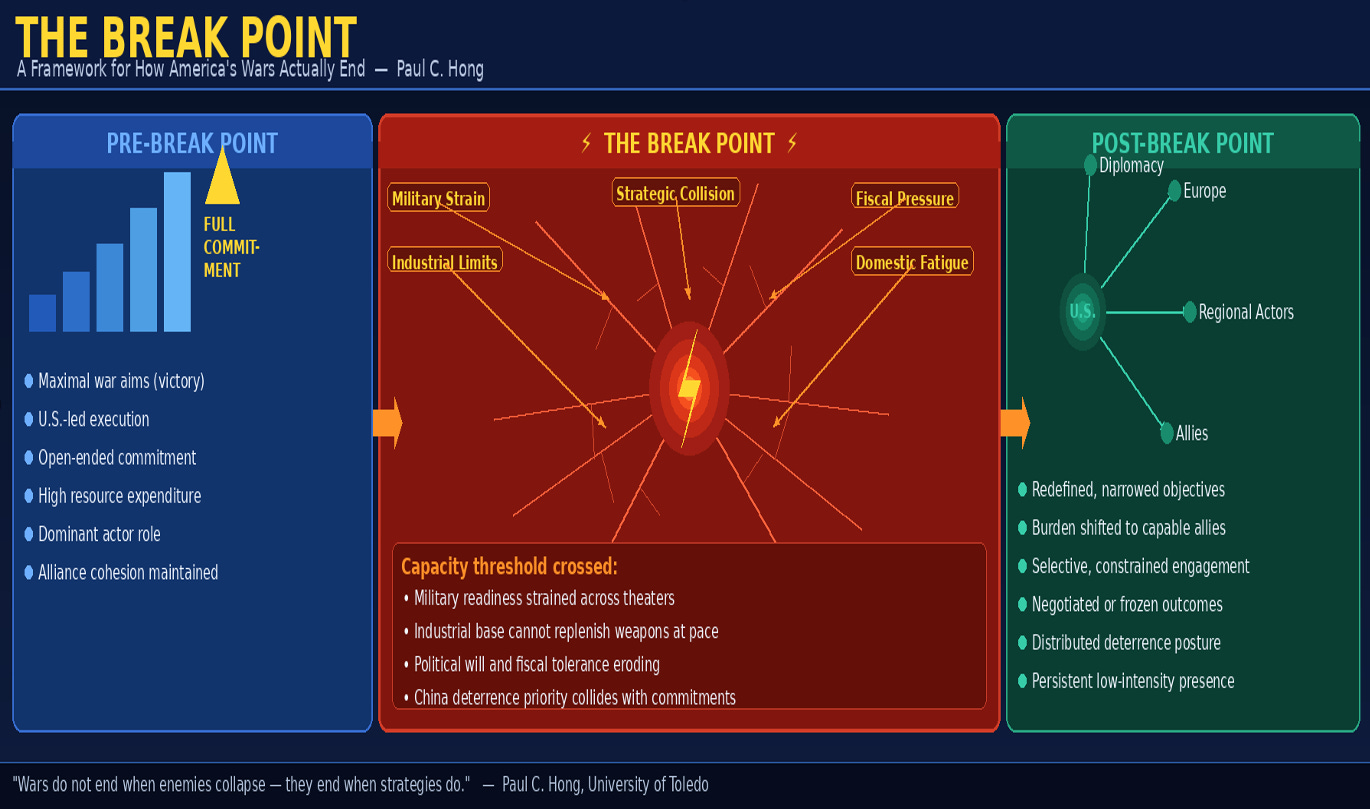
A break point is not defeat. Nor is it victory. It is the moment when a nation recognizes that continuing a war on its current terms is no longer sustainable — militarily, economically, politically, or strategically. At that threshold, the nature of the war changes. Objectives narrow. Commitments shift. Responsibility is redistributed.
This pattern is not new. The Vietnam War, the Iraq War, and the War in Afghanistan did not end with decisive victories. They ended when the United States reached a threshold beyond which continuation no longer aligned with national priorities. The language shifted — “peace with honor,” “responsible withdrawal” — but the underlying logic was the same.
Today’s environment is even more complex. Unlike earlier conflicts, the United States now faces simultaneous strategic demands, with finite industrial capacity, political tolerance, and alliance cohesion. The break point is therefore not hypothetical — it is embedded in the structure of the current moment.
Five Signals of an Approaching Break Point
The break point emerges not from a single shock, but from the convergence of five pressures:
Military strain — extended deployments and munitions depletion begin to affect readiness elsewhere. Industrial limits — production systems struggle to replenish advanced weapons at required speed. Fiscal pressure — war spending remains possible, but increasingly inefficient and contested. Domestic fatigue — public and political support for open-ended commitments erodes. Strategic collision — other priorities, especially China deterrence, begin to dominate.
When these forces align, strategy changes — not because of failure, but because of recalibration.
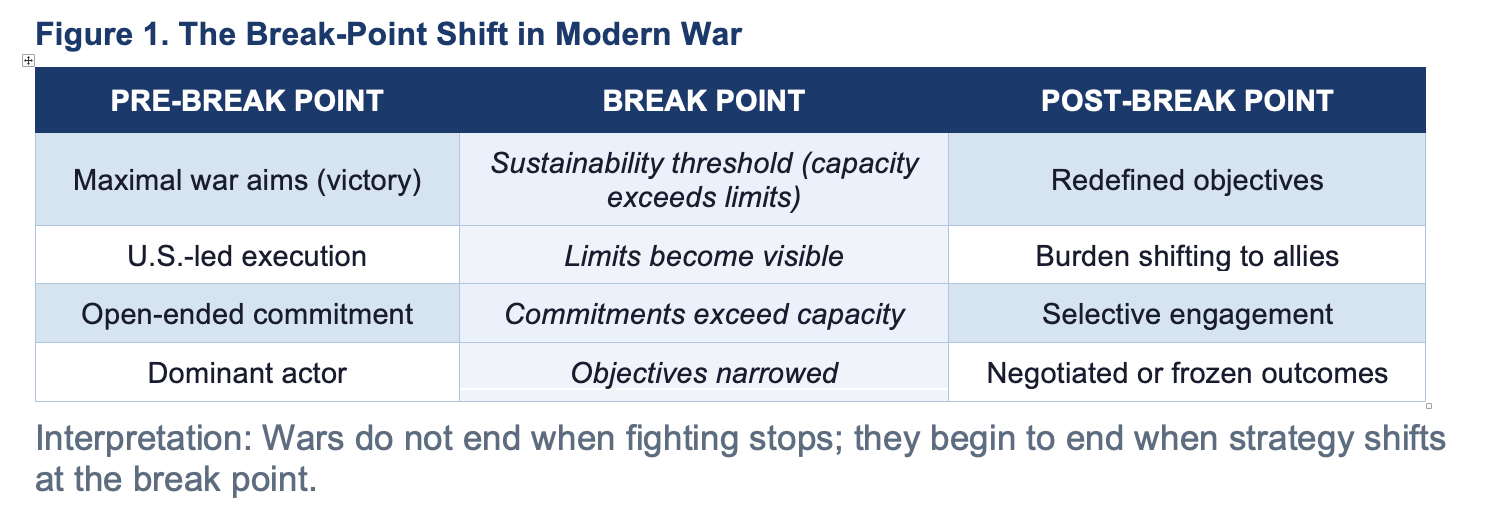
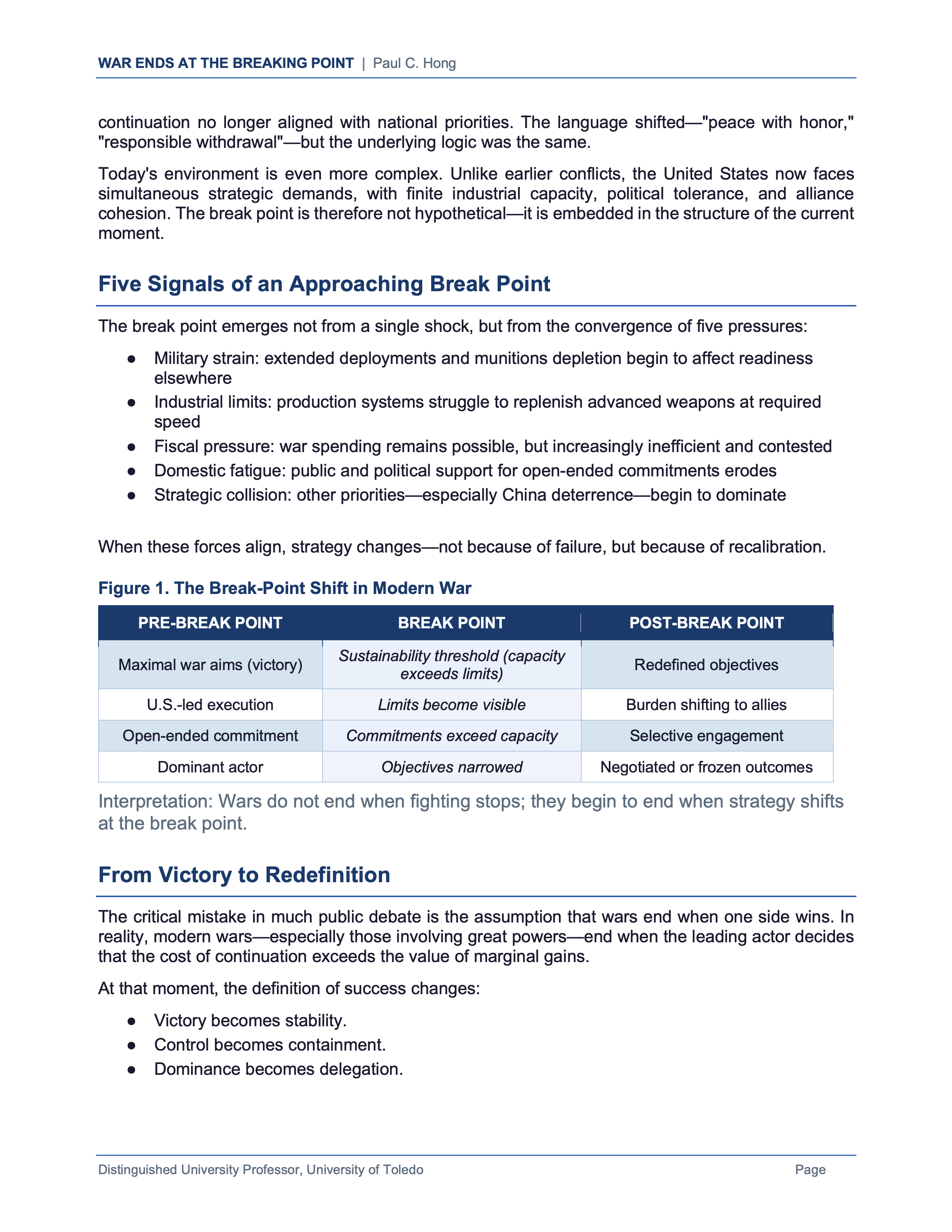
Figure 1. The Break-Point Shift in Modern War
Pre-Break Point — Maximal war aims (victory) · U.S.-led execution · Open-ended commitment · Dominant actor.
Break Point — Sustainability threshold (capacity exceeds limits) · Limits become visible · Commitments exceed capacity · Objectives narrowed.
Post-Break Point — Redefined objectives · Burden shifting to allies · Selective engagement · Negotiated or frozen outcomes.
Interpretation: Wars do not end when fighting stops; they begin to end when strategy shifts at the break point.
From Victory to Redefinition
The critical mistake in much public debate is the assumption that wars end when one side wins. In reality, modern wars — especially those involving great powers — end when the leading actor decides that the cost of continuation exceeds the value of marginal gains.
At that moment, the definition of success changes: Victory becomes stability. Control becomes containment. Dominance becomes delegation.
This shift is already visible. In Ukraine, discussions increasingly emphasize Europe’s role in long-term defense and reconstruction. In the Middle East, regional actors are playing a growing role in managing escalation and deterrence. These are not signs of disengagement. They are signs of strategic redistribution.
Four Paths After the Break Point
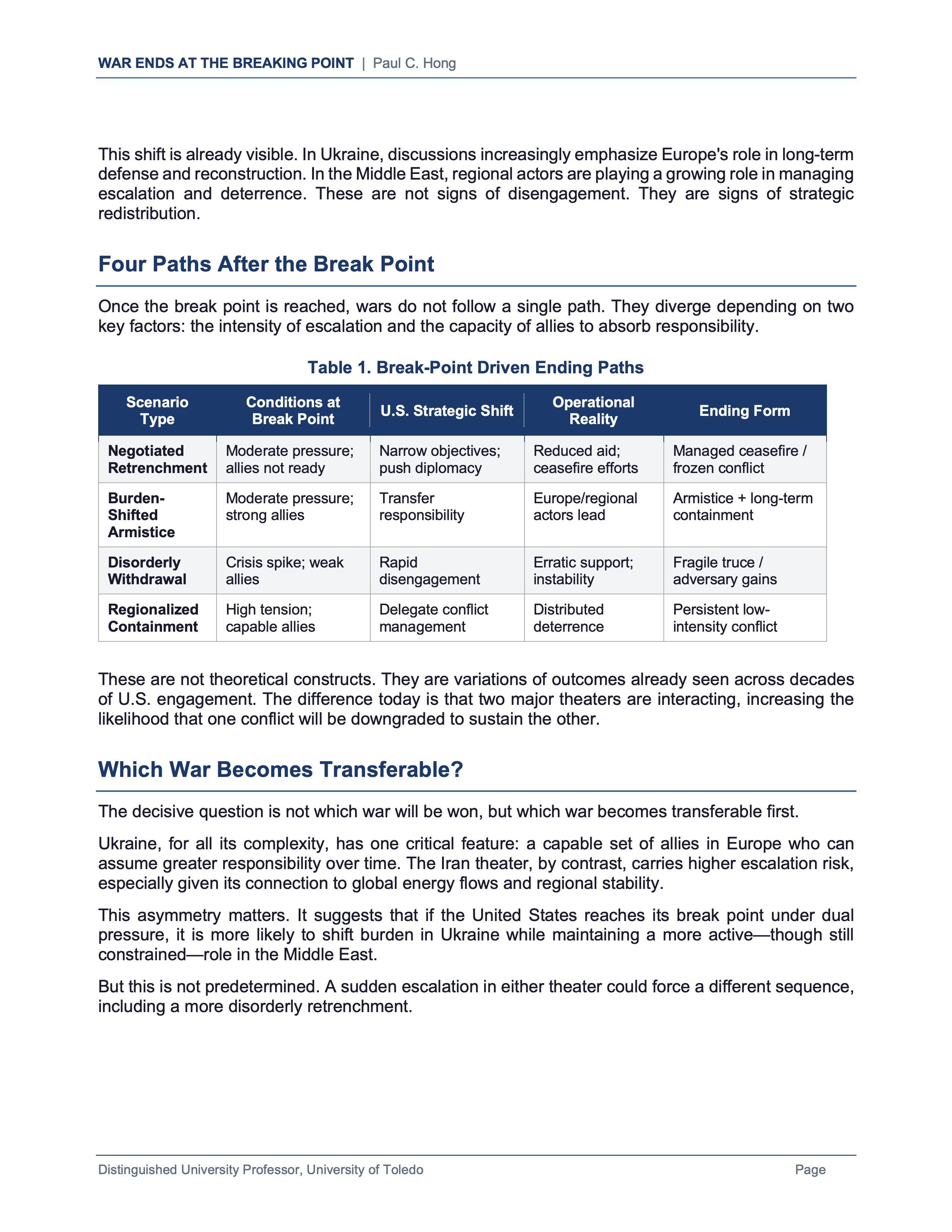
Once the break point is reached, wars do not follow a single path. They diverge depending on two key factors: the intensity of escalation and the capacity of allies to absorb responsibility.
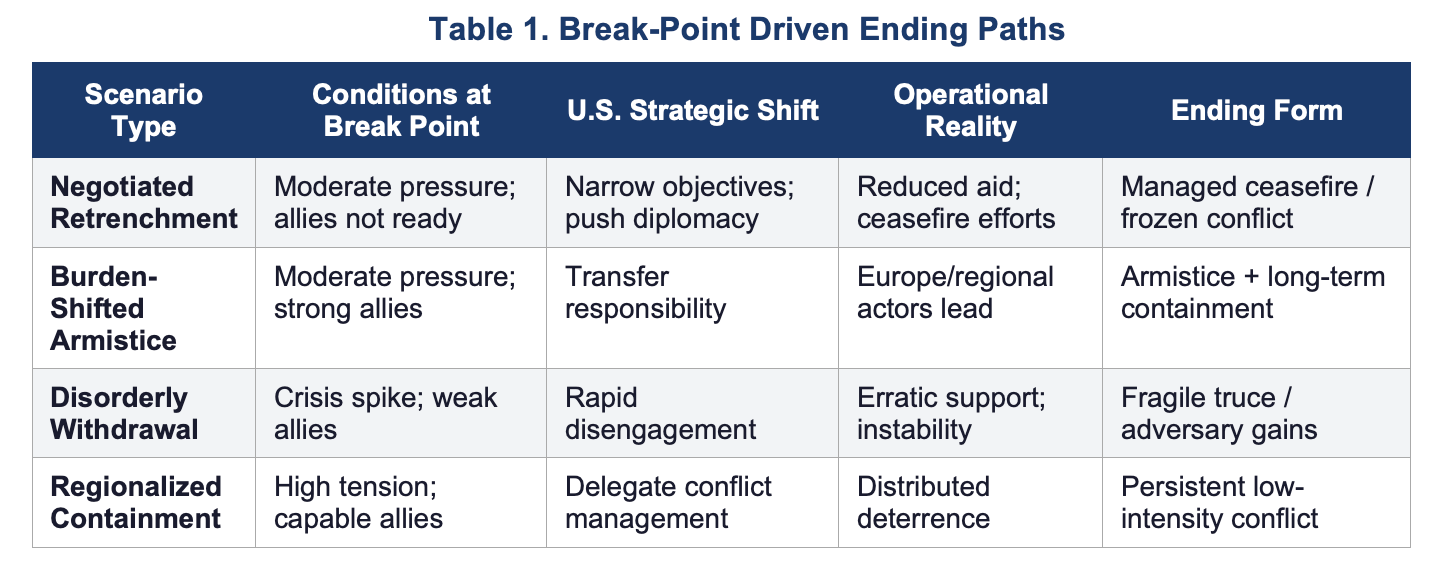
Table 1. Break-Point Driven Ending Paths
Negotiated Retrenchment — Conditions: Moderate pressure; allies not ready · U.S. Strategic Shift: Narrow objectives; push diplomacy · Operational Reality: Reduced aid; ceasefire efforts · Ending Form: Managed ceasefire / frozen conflict.
Burden-Shifted Armistice — Conditions: Moderate pressure; strong allies · U.S. Strategic Shift: Transfer responsibility · Operational Reality: Europe/regional actors lead · Ending Form: Armistice + long-term containment.
Disorderly Withdrawal — Conditions: Crisis spike; weak allies · U.S. Strategic Shift: Rapid disengagement · Operational Reality: Erratic support; instability · Ending Form: Fragile truce / adversary gains.
Regionalized Containment — Conditions: High tension; capable allies · U.S. Strategic Shift: Delegate conflict management · Operational Reality: Distributed deterrence · Ending Form: Persistent low-intensity conflict.
These are not theoretical constructs. They are variations of outcomes already seen across decades of U.S. engagement. The difference today is that two major theaters are interacting, increasing the likelihood that one conflict will be downgraded to sustain the other.
Which War Becomes Transferable?
The decisive question is not which war will be won, but which war becomes transferable first.
Ukraine, for all its complexity, has one critical feature: a capable set of allies in Europe who can assume greater responsibility over time. The Iran theater, by contrast, carries higher escalation risk, especially given its connection to global energy flows and regional stability.
This asymmetry matters. It suggests that if the United States reaches its break point under dual pressure, it is more likely to shift burden in Ukraine while maintaining a more active — though still constrained — role in the Middle East.
But this is not predetermined. A sudden escalation in either theater could force a different sequence, including a more disorderly retrenchment.
The Real Turning Point
The most important insight is this: the turning point of modern war is no longer the last battle. It is the moment when a nation decides it cannot continue on the same terms.
That moment rarely announces itself. It appears gradually — in budget debates, alliance tensions, production bottlenecks, and shifting political language. But once reached, it reshapes everything that follows.
Wars do not end when enemies collapse. They end when strategies do.
Conclusion: The Quiet Beginning of the End
In an era of prolonged conflict and constrained capacity, the United States will not decide these wars solely on the battlefield. It will decide them at the intersection of limits — where military capability, industrial capacity, political will, and strategic priorities converge.
The decisive moment in modern war is not the final offensive — it is the break point.
And when that moment arrives, the question will not be who has won, but whether the United States has the clarity to redefine its role before events redefine it instead.
Original Text:
Author:

Distinguished Professor, Dr. Paul Hong — University of Toledo
Paul Hong, PhD, CMA is a Distinguished University Professor and Chair of Information Systems and Supply Chain Management at the University of Toledo’s Neff College of Business. A certified management accountant and Fulbright-Nehru scholar, he teaches operations management, global supply chain strategy, and new product development across undergraduate, MBA, EMBA, and doctoral programs. He has supervised 25+ doctoral dissertations, published in premier journals including the Journal of Operations Management, and authored six scholarly books with Springer and Taylor & Francis.
© 2026 KGSP Forum. All rights reserved. Content published in the KGSP Journal may not be reproduced, distributed, or transmitted in any form without prior written permission from the KGSP Forum, except for brief quotations with full attribution.
Thank you, Isaac—your reflection captures the essence of the argument: strategy ultimately turns not on declared victory, but on the disciplined recognition of limits and the clarity to redefine purpose under pressure.
Dr. Paul, I really appreciated reading your piece. Honestly, the “break point” idea hit me quite strongly — the way you explained that modern wars don’t usually end in clear victory, but when a nation reaches its limit and has to redefine its goals.
As I look at the current strains in Ukraine and the Middle East, your analysis feels very real and timely. The part about shifting more responsibility to European allies while keeping focus on higher-risk areas especially resonated with me.
Personally, I find this kind of clear-eyed, honest strategic thinking more helpful than the usual victory narratives. It made me reflect a lot.
Thank you for the thoughtful analysis, Dr. Paul.