
Ask a Korean-American who grew up in a U.S. classroom what it felt like to be seen as an “Asian student,” and the stories tend to converge around a familiar discomfort.
You were assumed to be good at math. You were rarely asked about where you actually came from. And the wide, complicated world of your family’s history — the language, the migration, the particular tensions of two cultures living inside one household — was quietly set aside in the name of a stereotype that felt like a compliment but functioned like erasure.
Dr. G. Lea Lee, Professor and Director of the Tidewater Writing Project at Old Dominion University, writes from exactly that intersection of personal experience and scholarly urgency. Her article, “Supporting Asian American Students in U.S. Classrooms in the Era of Asian Immigration,” challenges educators to look past the model minority myth and engage seriously with the remarkable diversity of Asian American learners. It is a timely, practical, and quietly essential piece of work.
The Fastest-Growing Group No One Fully Knows
The numbers alone demand attention. Asian Americans now represent more than six percent of the total U.S. population — roughly 24 million people — and that figure is projected to surpass 46 million by 2060, representing a threefold increase from 2000 (U.S. Bureau of Labor Statistics, 2023; Pew Research Center, 2024). This is the fastest-growing minority population in the country, and it spans more than 20 countries across East Asia, Southeast Asia, and the Indian subcontinent.
Yet despite this growth, Asian Americans remain persistently flattened in public and educational discourse. Lee’s central provocation is simple and well-evidenced: the category “Asian American” is not a culture. It is a container holding dozens of distinct languages, immigration histories, family structures, religious traditions, and economic realities. Chinese Americans and Hmong Americans. Korean Americans and Bhutanese refugees. Families arriving with professional credentials and families arriving from communities with poverty rates approaching 19 percent (Tian & Ruiz, 2024). To treat them as one people is not just intellectually lazy — it is pedagogically harmful.
What Teachers Get Wrong
Lee documents the specific ways well-intentioned teachers fall short. Some assume all Asian students share similar beliefs, or reflexively label a Southeast Asian child as “Chinese” or “Vietnamese” without knowing the child’s actual background. Others misread culturally shaped behaviors as academic disengagement: a student who does not volunteer in class discussions, avoids direct eye contact, or maintains physical distance from a teacher of the opposite gender may simply be enacting deep-seated norms of respect, not signaling withdrawal or apathy.
These misreadings carry real costs. Publicly reprimanding an Asian American student — writing a name on the board, calling attention to misbehavior in front of peers — can produce intense shame in ways that many Western classroom management practices do not anticipate. A quiet, private conversation, Lee argues, is not merely preferable; it is often the only approach that respects the student’s cultural context.
The family dimension adds further complexity. Many Asian American families carry a powerful Confucian emphasis on filial piety, academic achievement, and collective honor — expectations that can create genuine psychological tension for children navigating American individualism at school while absorbing family loyalty at home. Academic pressure, when misunderstood, can look like motivation. It is sometimes something heavier: the weight of a family’s sacrificed possibilities resting on a child’s report card.
Culturally Responsive Teaching as the Answer
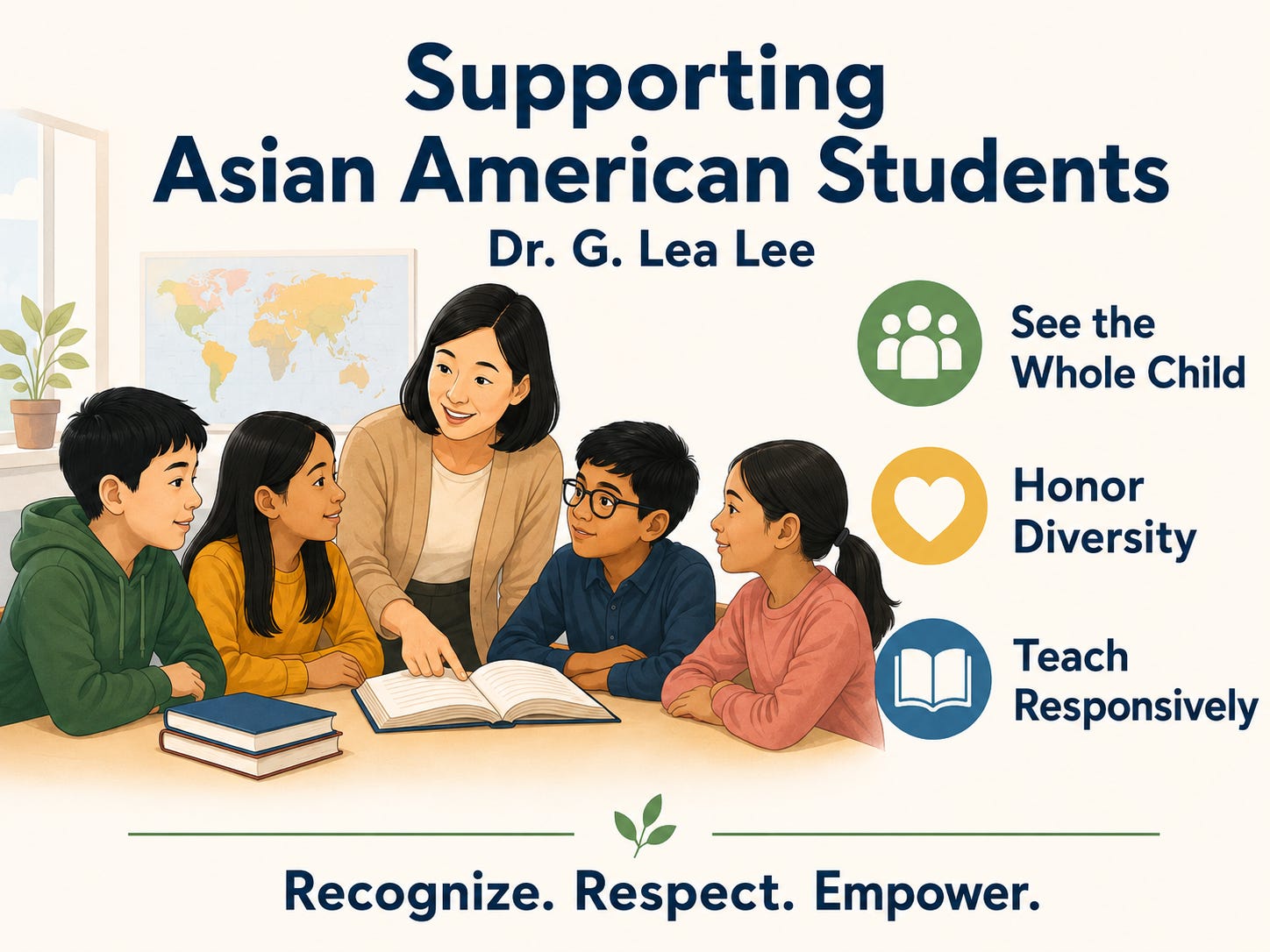
The second half of Lee’s article turns constructive, centering on Culturally Responsive Teaching (CRT) as the framework most capable of meeting Asian American students where they actually are. Drawing on Gloria Ladson-Billings’s foundational work (2021), Lee describes CRT as an asset-oriented pedagogy — one that treats students’ cultural backgrounds, multilingual identities, and family stories not as complications to manage but as resources to build on.
Her concrete suggestions for elementary classrooms are worth noting:
inviting students to teach the class words from their home languages;
using AI writing tools to help students transform family interviews into short stories;
read-alouds featuring Asian American children in everyday settings;
STEM activities highlighting contributions from Asian scientists and mathematicians.
None of these require major curriculum overhauls. They require something rarer and more durable — a teacher’s genuine curiosity about who the child in front of them actually is.
Why This Matters to the K-GSP Forum
Many of us in this community know what it is to be seen through a lens someone else chose for us. Lee’s scholarship is a reminder that the next generation of Asian American children is sitting in classrooms right now, waiting to be recognized more fully. The educators who rise to that challenge will not just improve test scores. They will shape who those children believe themselves to be.
That is not a small thing. It may be the most important thing.
Reference:
Ladson‐Billings, G. (2021, July). Three decades of culturally relevant, responsive, & sustaining pedagogy: What lies ahead? The Educational Forum, 85(4), 351–354.
Tian, Z. & Ruiz. N. G. (2024, March 27). Key facts about Asian Americans living in poverty. Pew Research Center. https://www.pewresearch.org/short-reads/2024/03/27/key-facts-about-asian-americans-living-in-poverty/
Remarks: The complete article will be published shortly in the K-GSP Journal.
About the Author:

Prof. Dr. Lea Lee, Old Dominion University
Dr. Guang-Lea Lee is Professor of Literacy Education and Director of the Tidewater Writing Project at Old Dominion University. With a PhD from the University of Minnesota and 27 years in higher education, she has authored or edited 80+ articles and book chapters on literacy, culturally responsive instruction, and the educational experiences of underrepresented students globally.
© K-Global Scholars and Professionals Forum. All rights reserved. Content published in the K-GSP Forum may not be reproduced, distributed, or transmitted in any form without prior written permission from the K-GSP Forum, except for brief quotations with full attribution.