
Today we live in an age that tries to explain everything too quickly. YouTube videos demand conclusions within seconds, lectures are expected to compress wisdom into short summaries, and even art is often judged by how “easy” it is to understand. Yet NHK’s long-running television program Sunday Art Museum (Nichiyō Bijutsukan) has followed a completely different path. Celebrating its 50th anniversary and recognized by Guinness World Records, the program achieved its remarkable longevity through an unexpected method: it taught people to love art by not trying too hard to teach them. It valued contemplation over explanation, experience over information, and reflection over predetermined answers.
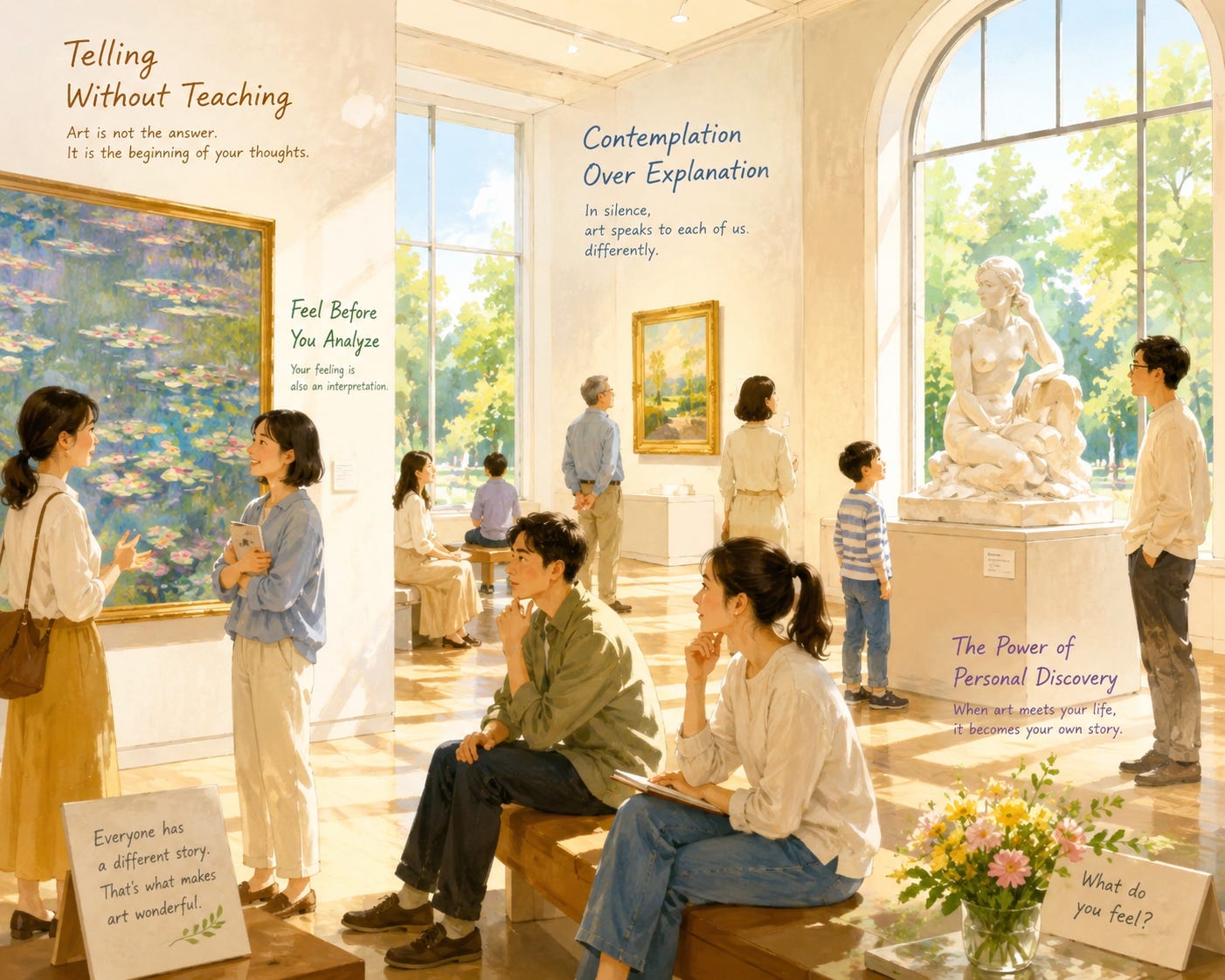
The program’s most distinctive feature is that its hosts rarely impose authoritative interpretations on artworks. Instead, the camera quietly places a painting or sculpture before the audience while guests share their own feelings, memories, and life experiences. One guest may see childhood nostalgia in a painter’s colors; another may discover loneliness within the silence of a sculpture. The program never insists, “This is the correct meaning of the artwork.” Rather, it gently asks, “What do you feel?”
From the perspective of art criticism, this approach is profoundly modern. Traditional criticism often allowed experts to monopolize interpretation. Contemporary art, however, increasingly recognizes that the viewer’s participation and interpretation are themselves part of the artistic experience. French philosopher Roland Barthes famously declared “the death of the author,” emphasizing the reader’s freedom to create meaning. NHK’s Sunday Art Museum can be seen as a broadcast embodiment of that philosophy. Art is not presented as a fixed conclusion, but as a living conversation that evolves through each viewer’s encounter with it.
One fascinating aspect of the program is its quietness. Modern media competes through speed, stimulation, and noise, but Sunday Art Museum chooses slowness and silence. The camera lingers patiently on artworks. Music is restrained. The hosts speak sparingly. Watching the program feels less like television and more like slowly walking through a museum gallery. In doing so, it restores something modern society has nearly lost: the ability to contemplate in stillness. This recalls the Korean aesthetic concept of Jeonggwan (靜觀), or “quiet contemplation,” emphasized by the Joseon-era scholar Choi Rip. Deep reflection is born not from noise, but from silent observation.
Art, after all, is not something fully understood through explanation alone. One cannot completely “learn” Vincent van Gogh’s loneliness merely by studying his paintings. Nor can Edvard Munch’s The Scream be reduced entirely to academic analysis of existential anxiety. True artistic appreciation begins before knowledge—with emotional resonance. NHK’s program honors precisely those moments of human response.
Equally important is the fact that the program does not treat art as the exclusive property of intellectual elites. Actors, writers, musicians, and even ordinary people appear to discuss their personal impressions of artworks. This democratizes art appreciation. Art is presented not as a secret language reserved for experts, but as an emotional world accessible to all human beings. Viewers therefore lose the fear of “not knowing enough about art” and instead gain confidence that they, too, are capable of meaningful engagement.
This philosophy also offers important lessons for modern education. Contemporary schooling often revolves excessively around correct answers and standardized interpretations. Students memorize explanations before they are encouraged to feel or think independently. Yet art exists to cultivate imagination, empathy, and inner freedom. NHK’s approach demonstrates the power of asking questions rather than delivering conclusions. A truly great teacher is not someone who supplies every answer, but someone who inspires others to think for themselves.
In the age of artificial intelligence, this contemplative and emotional approach becomes even more valuable. AI may surpass humans in information processing and analytical efficiency, but the deeply human act of standing quietly before a painting and reflecting upon life remains uniquely ours. Algorithms may analyze color composition or historical context, but they cannot fully comprehend the memory of first love recalled by an elderly viewer gazing at a landscape painting. Art may ultimately become one of humanity’s final sanctuaries of emotional depth.
The success of Sunday Art Museum also teaches us something essential about persuasion itself. People are moved more deeply when they discover meaning on their own rather than when ideas are imposed upon them. Being told, “This artwork is great,” rarely creates lasting inspiration. Genuine emotional transformation occurs when a work becomes connected to one’s own life experience. This principle extends far beyond art—to leadership, education, communication, and even human relationships. The most powerful persuasion is not command, but empathy.
Modern society constantly talks, explains, and argues. Yet sometimes saying less communicates far more. This quiet Japanese television program has demonstrated that truth for half a century. Soft voices, slow imagery, and sincere human reflections endure longer than flashy production or aggressive commentary. The program reminds us that art is not merely information to consume, but an experience through which we encounter ourselves.
Ultimately, the enduring success of Sunday Art Museum lies not in its technical format or production style, but in its attitude toward humanity itself. The program does not treat viewers as passive recipients lacking knowledge. Instead, it respects them as individuals capable of feeling, thinking, and discovering meaning independently. Rather than simply delivering information, it gives viewers the courage to appreciate. And perhaps that is the deepest form of education—and the most enduring power of art—in our time. +++
{Solti}
May 31, 2026

Young Choi, PhD is a Professor at Regent University bringing a rare combination of technical expertise and creative spirit to everything he does. A scholar in AI, cybersecurity, and network & telecommunications service management, he has published 38 books including AI and cybersecurity area books, over 200 refereed articles, and over 20 book chapters. Beyond the academy, Dr. Choi is a passionate poet, essayist, and wooden block laser engraving artist whose reflective writing invites readers to rediscover life’s beauty in quiet contemplation(靜觀). He lives under the motto: “Study hard and give generously without holding back! (열심히 공부해서 아낌없이 남주자 !: 열공아남!)”
Published books: https://www.amazon.com/stores/Young-Choi/author/B0DMZ5S6R7?ref=ap_rdr&shoppingPortalEnabled=true