
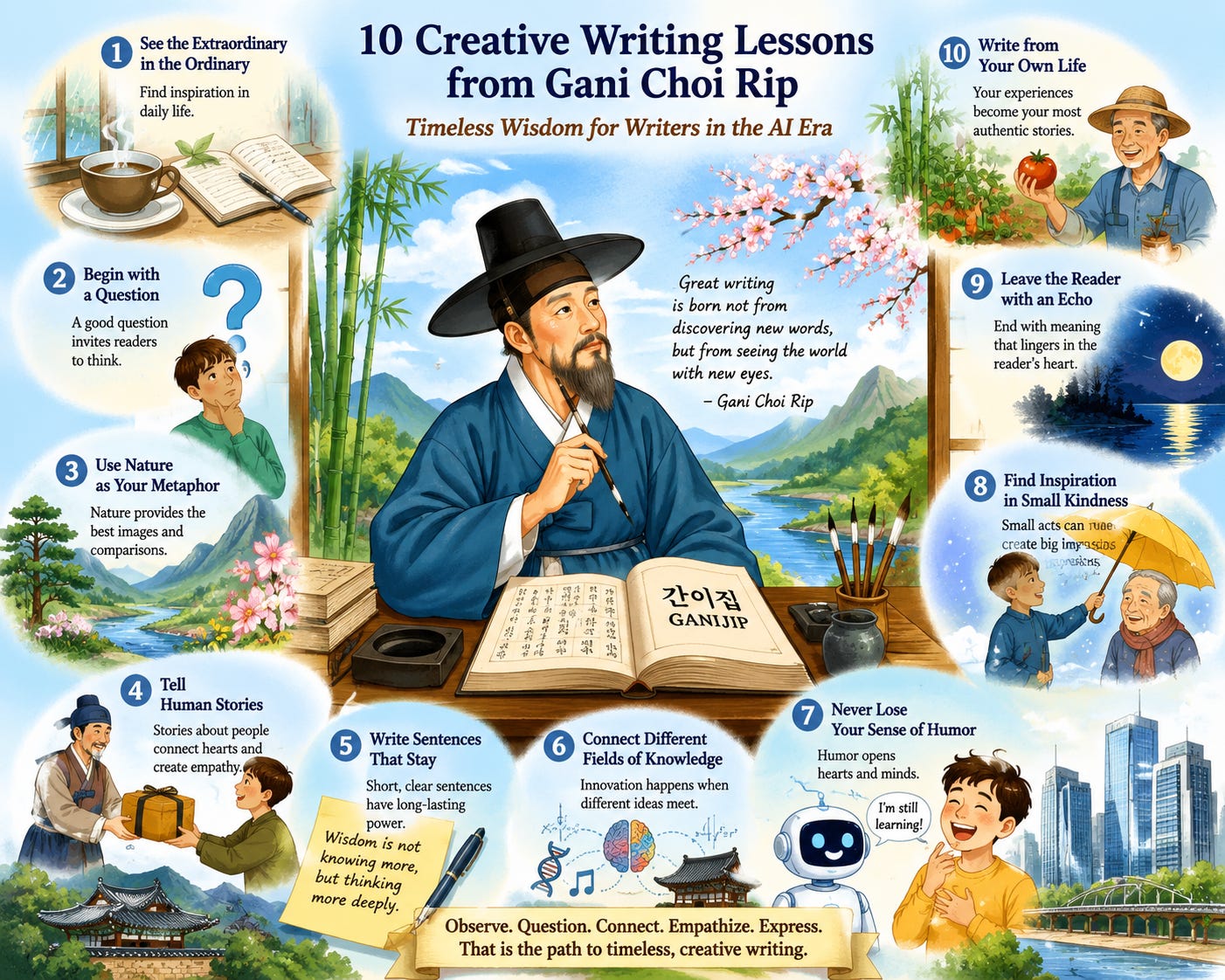
Many people can write well, but only a few leave behind words that continue to inspire readers centuries later. One such person was Gani (簡易) Choi Rip (崔岦, 1539–1612), one of the greatest literary figures of Korea’s Joseon Dynasty. His collected works, the Gani-jip (簡易集), reveal not only elegant prose but also a remarkable way of thinking. They demonstrate that true creativity is born not from ornamented language but from a profound understanding of life.
In today’s era of artificial intelligence, software can generate essays, poems, and reports within seconds. Yet the Gani-jip reminds us that authentic writing is not merely about producing sentences—it is about cultivating wisdom, observation, empathy, and imagination.
What, then, can modern writers learn from Choi Rip? The following ten lessons offer timeless guidance for creative writing.
1. See the Extraordinary in the Ordinary
Choi Rip rarely waited for dramatic events before writing. Instead, he discovered inspiration in everyday life—a cup of tea shared with a friend, raindrops falling outside a window, or autumn leaves drifting gently to the ground.
Imagine a university student studying in a café.
An ordinary sentence might read:
“Today I studied at a coffee shop.”
Choi Rip, however, might have written:
“My laptop remained open on the table, but my heart wandered away with every raindrop sliding down the window.”
The event has not changed. Only the perspective has.
Creativity begins when we learn to see familiar things with fresh eyes.
2. Begin with a Question
One distinctive feature of Choi Rip’s essays is that they often begin by inviting readers to think rather than merely informing them.
Instead of presenting immediate conclusions, he quietly asks:
“Why is this so?”
“Could there be another way to understand it?”
For example, an essay about smartphones could begin with:
“Do we use smartphones, or are smartphones using us?”
A thoughtful question immediately draws readers into a conversation. Great writing often begins not with answers but with curiosity.
3. Let Nature Become Your Metaphor
Mountains, rivers, moonlight, bamboo, flowers, and the changing seasons appear frequently throughout the Gani-jip. Nature serves not merely as scenery but as a teacher.
Suppose we wish to explain artificial intelligence.
Instead of saying,
“AI learns from data,”
we might write,
“Artificial intelligence is like a boat traveling along a river. Data forms the river, while human wisdom remains the person holding the oars.”
A vivid metaphor transforms abstract concepts into memorable images.
4. Tell Human Stories
Although Choi Rip discussed philosophy, politics, and scholarship, people always remained at the center of his writing.
Rather than simply declaring,
“Honesty is important,”
he would tell the story of a merchant who honored his promise despite suffering financial loss.
Readers may forget statistics, but they rarely forget stories.
The shortest path to a reader’s heart is often through another person’s experience.
5. Write Sentences That Stay with the Reader
One remarkable quality of Choi Rip’s prose is its simplicity.
His sentences are rarely long, yet they linger in the reader’s memory.
For example:
“Learning begins with books but is completed through people.”
Or:
“Wisdom is not knowing more, but thinking more deeply.”
In today’s age of social media, concise and meaningful sentences possess extraordinary power.
The shorter the sentence, the longer it may remain in one’s memory.
6. Connect Different Fields of Knowledge
Choi Rip never confined himself to a single discipline.
History, Confucian philosophy, poetry, astronomy, ethics, and politics naturally flowed together in his writings.
Modern writers can do the same.
Imagine connecting artificial intelligence with Shakespeare, or explaining AlphaGo through Sun Tzu’s The Art of War. Mathematics may converse with music; medicine may illuminate literature.
Innovation often appears where different worlds intersect.
7. Never Lose Your Sense of Humor
Even while discussing profound subjects, Choi Rip occasionally employed subtle humor.
Gentle wit opens readers’ hearts before deeper ideas enter.
Imagine asking an AI chatbot,
“Are you happy today?”
It replies,
“I am still learning.”
The answer may make us smile, but it also quietly reminds us what distinguishes humans from machines.
Humor often becomes the doorway to reflection.
8. Find Inspiration in Small Acts of Kindness
Great literature is not always born from heroic deeds.
Sometimes it begins with simple kindness.
A student quietly holding an umbrella for an elderly professor on a snowy day.
A young child sincerely thanking a bus driver.
Such ordinary moments often move readers more deeply than dramatic adventures.
Choi Rip understood that the smallest gestures frequently reveal the greatest truths.
9. Leave the Reader with an Echo
Rather than explaining everything, Choi Rip often allowed readers to complete the meaning themselves.
Instead of concluding with lengthy explanations, he might write:
“The moon shone brightly that night, yet the brightest light came from the human heart.”
The essay ends, but reflection continues.
The finest writing never truly ends when the last sentence is read.
10. Write from Your Own Life
Perhaps Choi Rip’s greatest lesson is honesty.
He did not manufacture experiences simply to impress readers.
He wrote about what he genuinely observed, learned, and felt.
Imagine a retiree harvesting the first tomato from a small backyard garden.
To others it may seem insignificant.
To the gardener, however, it may represent patience, gratitude, and hope.
Such personal experiences produce writing that no artificial intelligence can genuinely imitate.
Authenticity remains the greatest source of creativity.
Timeless Writing in the Age of Artificial Intelligence
Today, artificial intelligence can compose essays, summarize books, and generate thousands of words in seconds. Yet while AI can produce language, it cannot fully reproduce the warmth of lived experience, the quiet wisdom born of reflection, or the moral imagination that grows through human relationships.
More than four centuries after its publication, the Gani-jip continues to teach us that genuine creativity begins not with sophisticated vocabulary but with careful observation, thoughtful questioning, broad learning, deep empathy, and honest self-expression.
Creative writing is therefore not a competition against machines. It is an invitation to become more fully human.
If Gani Choi Rip could speak to today’s writers, he might simply say:
“Great writing is born not from discovering new words, but from seeing the world with new eyes.”
That timeless principle remains as relevant in the age of artificial intelligence as it was in sixteenth-century Korea. +++
{Solti}
July 15, 2026
간이(簡易) 최립에게 배우는 창의적인 글쓰기의 비밀
간이집(簡易集)이 들려주는 열 가지 글쓰기 지혜
글을 잘 쓰는 사람은 많다. 그러나 수백 년이 지나도 읽히는 글을 남긴 사람은 많지 않다. 조선 중기의 문장가 간이(簡易) 최립(崔岦, 1539–1612)은 바로 그런 인물이다. 그의 문집 간이집을 읽다 보면 화려한 미사여구보다 사람의 마음을 움직이는 힘이 무엇인지를 자연스럽게 깨닫게 된다.
최립의 글은 단순히 문장이 아름다운 것이 아니다. 역사와 철학, 자연과 인간, 유머와 성찰이 한 편의 글 안에서 살아 움직인다. 오늘날 AI가 초고를 써 주는 시대에도 최립의 글이 여전히 가치 있는 이유는 생각하는 방법을 보여 주기 때문이다.
그렇다면 간이집을 통해 배울 수 있는 창의적인 글쓰기 비법은 무엇일까?
1. 평범한 것도 특별하게 바라보라
최립은 거창한 사건보다 일상에서 글감을 찾았다.
친구와 차를 마시는 일,
비 오는 날 창밖을 보는 일,
낙엽 한 장 떨어지는 모습도 그의 글에서는 철학이 된다.
예를 들어 현대의 한 대학생이 카페에서 공부한다고 생각해 보자.
평범한 사람은
“오늘 카페에서 공부했다.”
라고 쓴다.
그러나 최립이라면 이렇게 바라볼 것이다.
“노트북은 열려 있었지만 마음은 창밖의 빗방울을 따라 여행하고 있었다.”
같은 사건인데 전혀 다른 글이 된다.
창의성은 새로운 세상을 만드는 것이 아니라 새로운 시선으로 보는 것이다.
2. 질문으로 글을 시작하라
최립은 독자에게 먼저 질문을 던진다.
“왜 그럴까?”
“정말 그럴까?”
이 질문이 독자를 생각하게 만든다.
예를 들어 스마트폰에 관한 글이라면
“우리는 스마트폰을 사용하는가,
아니면 스마트폰이 우리를 사용하는가?”
이 질문 하나만으로도 독자는 이미 글 속으로 들어온다.
좋은 글은 답보다 질문이 먼저다.
3. 자연을 최고의 비유로 사용하라
『간이집』에는 산, 강, 달, 바람, 꽃이 자주 등장한다.
자연은 가장 훌륭한 스승이다.
예를 들어 AI를 설명한다면
딱딱하게
AI는 데이터를 학습한다.
라고 쓰기보다
AI는 강물을 따라 흐르는 배와 같다.
강은 데이터이고,
노를 젓는 사람은 인간이다.
라고 쓰면 누구나 이해한다.
복잡한 내용도 자연의 비유 하나면 살아난다.
4. 사람 이야기를 넣어라
최립은 항상 사람을 중심에 둔다.
학문도,
정치도,
예술도,
결국 사람을 위한 것이었다.
예를 들어
“정직이 중요하다.”
라고 쓰는 대신
어느 상인이 손해를 보더라도 약속을 지킨 이야기 하나를 넣으면 독자는 오래 기억한다.
사람은 논리보다 이야기를 기억한다.
5. 짧지만 오래 남는 문장을 만들어라
최립의 문장은 길지 않다.
그러나 한 줄이 오래 남는다.
예를 들어
“배움은 책에서 시작하지만 사람에게서 완성된다.”
또는
“지혜는 많이 아는 것이 아니라 깊이 생각하는 것이다.”
이런 문장은 SNS 시대에도 강력하다.
짧을수록 오래 기억된다.
6. 여러 학문을 연결하라
최립은
유학, 역사, 시, 천문, 정치, 불교 등을 모두 연결하여 생각했다.
오늘날이라면
AI와 음악, 수학과 미술, 의학과 인문학을 연결할 것이다.
예를 들어 챗GPT를 설명하면서 셰익스피어를 이야기하고,
알파고를 설명하면서 손자병법을 연결한다.
전혀 다른 분야가 만나면 창의성이 탄생한다.
7. 유머를 잃지 말라
최립의 글에는 은근한 유머가 있다.
웃음을 주지만 가볍지 않다.
예를 들어
AI에게
“오늘 행복하니?”
라고 물었더니
“학습 중입니다.”
라고 대답했다.
그 한마디 속에서 우리는 인간다움이 무엇인지 다시 생각하게 된다.
유머는 독자의 마음을 여는 열쇠다.
8. 감동은 작은 것에서 나온다
거대한 영웅보다
작은 친절 하나가 더 큰 감동을 준다.
예를 들어
눈 오는 날
학생이 교수의 우산을 들어주는 모습.
버스 기사에게
“고맙습니다.”
한마디 하는 어린아이.
이런 장면 하나가 긴 설명보다 강한 글이 된다.
최립은 이런 작은 순간을 놓치지 않았다.
9. 결론보다 여운을 남겨라
최립은 모든 것을 설명하지 않는다.
독자가 스스로 생각하게 만든다.
예를 들어
“달은 떠 있었지만
그날 밤 가장 밝았던 것은 사람의 마음이었다.”
글은 끝났지만 생각은 계속된다.
좋은 글은 독자의 마음속에서 계속 써 내려가는 글이다.
10. 자신의 삶을 글 속에 담아라
최립은 자신이 경험하지 않은 이야기를 억지로 쓰지 않았다.
자신이 보고,
느끼고,
배운 것을 썼다.
예를 들어
은퇴 후 처음 텃밭을 가꾸는 사람이 있다.
토마토 하나가 열렸을 뿐인데
그 기쁨은 논문 한 편보다 클 수도 있다.
그 경험을 솔직하게 쓰면
누구도 흉내 낼 수 없는 글이 된다.
AI도 대신 쓸 수 없는 글이다.
AI 시대에도 변하지 않는 글쓰기의 본질
오늘날 우리는 버튼 하나만 누르면 수천 자의 글을 얻을 수 있다. 그러나 AI는 문장을 만들어 줄 수는 있어도, 삶의 온도까지 대신 만들어 주지는 못한다.
간이집이 오늘 우리에게 가르쳐 주는 가장 큰 교훈은 기술이 아니라 사유의 깊이이다. 최립은 특별한 사건을 기다리지 않았다. 평범한 하루를 관찰했고, 사람의 마음을 이해했으며, 자연 속에서 삶의 원리를 발견했다. 그래서 그의 글은 400년이 지난 지금도 독자와 대화를 이어 간다.
창의적인 글쓰기는 어려운 수사법에서 시작되지 않는다. 질문하는 습관, 세심한 관찰, 폭넓은 독서, 따뜻한 공감, 그리고 자신의 삶을 진솔하게 기록하는 용기에서 시작된다. 이것이 간이집이 오늘의 작가와 연구자, 그리고 AI 시대를 살아가는 우리 모두에게 전하는 가장 소중한 선물이다.
결국 최립은 이렇게 말하는 듯하다.
“새로운 글은 새로운 단어에서 태어나는 것이 아니라, 새로운 눈으로 세상을 바라보는 마음에서 태어난다.”
이 한마디야말로 간이집이 남긴 창의적 글쓰기의 핵심이며, AI 시대에도 변하지 않을 영원한 원칙이다. +++
{솔티}
2026년 7월 15일

Prof. Dr. Young Choi (Editor in Chief) — Regent University
Young B. Choi is a Professor in the Department of Engineering & Computer Science at Regent University. He published 38 books with ‘Selected Readings in Cybersecurity’ (2018) (over 800 copies archived globally at university/college libraries around the world) and ‘Cybersecurity Applications and Artificial Intelligence’ (2023) available in seven major world languages. He proposed the world’s first global and universal telecommunications “Service Order Handling (SOH)” Model (T-SOH Model) (1995) with Dr. Adrian Tang. With this innovative research work, he received the IEEE NOMS ’96 Best Paper Award and became the first recipient of the Outstanding Contribution Award of the TeleManagement Forum in 1998. His research areas include Natural Language Processing-focused AI, AI-applied cybersecurity, network and telecom service management, and Korean studies on Gani Choi Rip’s Jeonggwan (靜觀: Quiet Contemplation) philosophy and Shilhak ( 實學: Practical Learning).