

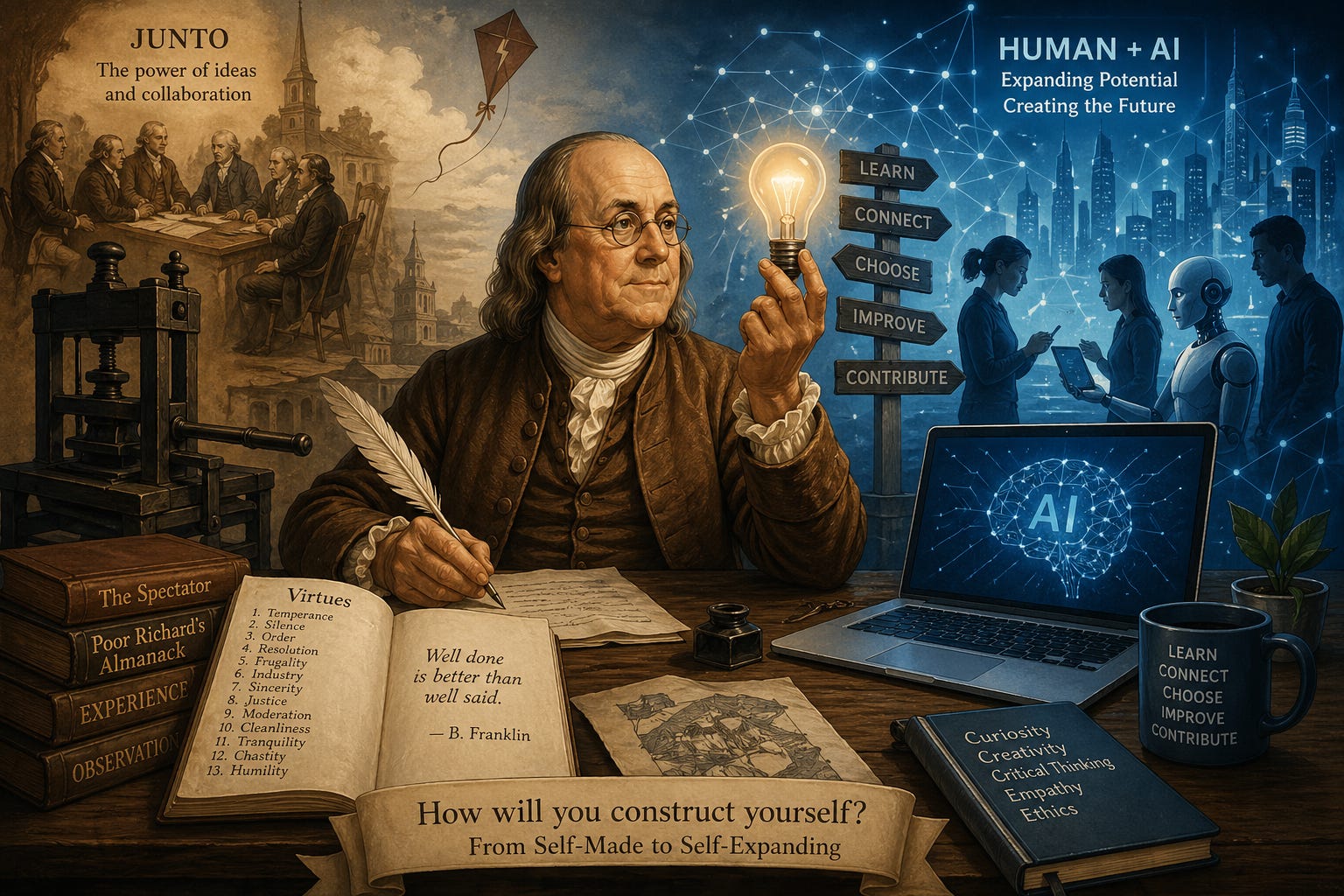
Ten Great Legacies Benjamin Franklin Left for America and the American People
From Self-Improvement to Civic Virtue—and a New Civic Spirit for the Age of Artificial Intelligence
Abstract
Benjamin Franklin remains one of the most distinctive figures of the American founding. He was a printer, publisher, scientist, inventor, educator, civic organizer, diplomat, and statesman who participated in the creation of the American republic. Yet his greatest legacy cannot be reduced to any single invention, institution, or political achievement. Franklin demonstrated a distinctive philosophy of life in which self-improvement was connected to public service, knowledge to action, and individual achievement to the common good. This essay examines ten major legacies Franklin left for America and the American people: the democratization of knowledge, civic participation, community preparedness, practical science, innovation for public purposes, lifelong learning, intellectual community, responsible communication, diplomacy, and democratic compromise. It then considers how these legacies can be reinterpreted in the age of generative artificial intelligence. Franklin lived during an information revolution generated by print culture; contemporary society is experiencing another transformation in which AI dramatically reduces the cost of producing and distributing knowledge. The comparison is instructive. Greater technological power does not eliminate the need for human judgment; it increases it. Franklin’s life therefore offers a civic philosophy for the AI age: learn continuously, think independently, collaborate with others, use technology responsibly, and direct personal capability toward the common good. His most enduring message may be summarized in a simple principle: become useful, not merely successful.
Keywords: Benjamin Franklin, American identity, civic virtue, self-improvement, democracy, education, innovation, public service, artificial intelligence, AI literacy
Beyond the Founding Father
Every nation has figures whose lives reveal something about the values that shaped its political and cultural identity. In the United States, Benjamin Franklin occupies a particularly distinctive position. Born in Boston in 1706 and dying in Philadelphia in 1790, Franklin lived through the transformation of the British colonies into an independent republic. The Library of Congress records a remarkably diverse career: he was apprenticed as a printer, founded the Junto, established the Library Company of Philadelphia, published Poor Richard’s Almanack, conducted scientific experiments, participated in the Continental Congress, served as a diplomat in France, helped negotiate the Treaty of Paris, and represented Pennsylvania at the Constitutional Convention (Library of Congress, n.d.-a). His life therefore crossed the boundaries between commerce, science, education, civic organization, politics, and diplomacy.
Yet Franklin’s importance does not lie merely in the extraordinary number of roles he occupied. More significant was his ability to connect them through a coherent philosophy of improvement. He treated knowledge as something to be practiced, not merely possessed; education as a lifelong process rather than a period of formal schooling; and personal advancement as something that could contribute to the welfare of others. Forde (1992) argues that Franklin’s Autobiography should be understood not simply as a story of individual success but as an educational project for a developing American society. Houston (2008), similarly, places the concept of “improvement” near the center of Franklin’s political and social thought. More recent scholarship has complicated the familiar image of Franklin as merely a rational self-made man by examining the deeper assumptions about freedom, self-making, and moral responsibility embedded in his Autobiography (Brennan, 2025).
The question Franklin leaves for us, therefore, is not simply, “How can I become successful?” A more consequential question is, “What should a capable and educated person do with his or her abilities?” Franklin’s life suggests that individual achievement reaches its highest value when it becomes useful to the larger community. That principle makes Franklin more than a Founding Father. It makes him an important early model of American civic character.
Knowledge Should Become a Community Resource
Franklin’s first major legacy was the democratization of knowledge. In 1731, he helped establish the Library Company of Philadelphia, an institution that grew out of the Junto’s desire for access to books and shared learning. The Library of Congress describes the organization as America’s first subscription library and notes that it emerged directly from the intellectual needs of Franklin’s Junto (Library of Congress, n.d.-b). At a time when books were expensive and relatively scarce, collective ownership and shared access represented an important cultural innovation. The underlying idea was simple but powerful: individuals did not have to possess every resource personally if a community could create a common reservoir of knowledge.
This principle has acquired new significance in the digital age. Franklin lived during a revolution in the circulation of printed information; contemporary society is living through a transformation in which the internet and generative AI have dramatically reduced the cost of accessing and producing information. Yet access to information does not automatically produce wisdom. Citizens must still distinguish evidence from opinion, recognize bias, evaluate sources, and understand the limitations of machine-generated content. DiPaola et al. (2024) argue that AI literacy should be connected to civic literacy because citizens increasingly need to understand how AI affects rights, institutions, and public life. Franklin’s library philosophy can therefore be restated for the twenty-first century: democratize access to knowledge but also democratize the ability to judge knowledge.
Citizens Should Build the Community They Inhabit
Franklin’s second legacy is civic participation. He did not assume that government should solve every problem on behalf of citizens. Instead, he repeatedly helped create voluntary organizations through which citizens could address practical needs themselves. His Junto, founded in 1727, brought together young men for discussion, mutual assistance, and intellectual improvement. According to the Library of Congress, the Junto subsequently contributed to the creation of the Library Company and the Union Fire Company (Library of Congress, n.d.-c).
This pattern reveals an important principle of democratic life. A healthy society requires citizens who do more than consume public services. They must also participate in creating them. Schools, libraries, neighborhood organizations, volunteer associations, nonprofit institutions, and civic groups all depend upon people willing to contribute time and knowledge to common purposes. Franklin’s example suggests that citizenship is not simply a legal status. It is a practice. A citizen is not merely someone who lives in a community but someone who helps make that community work.
Community Safety Begins with Preparation
Franklin’s third legacy is the idea of collective preparedness. In eighteenth-century Philadelphia, urban fires represented a serious threat. Franklin responded not simply by calling for government intervention but by helping organize citizens. The volunteer fire company associated with his civic activities illustrates the principle that communities can improve their resilience by anticipating risks and preparing together. The Library of Congress identifies Franklin’s organization of Philadelphia’s first volunteer fire company in 1736 as one of his important contributions to civic improvement (Library of Congress, n.d.-a).
The principle has become even more important in the twenty-first century. Communities now face cyberattacks, ransomware, pandemics, natural disasters, infrastructure failures, misinformation, and failures of complex digital systems. Such threats cannot be addressed effectively by individuals acting in isolation. Technical defenses must be combined with preparedness, information sharing, public education, institutional coordination, and mutual trust. Franklin’s example therefore points toward a broader understanding of resilience: community safety is not merely a service delivered to citizens; it is a public good created through shared responsibility.
Science Should Solve Human Problems
Franklin’s fourth legacy is his practical approach to science. His experiments with electricity and lightning established him as one of the most prominent scientific figures of eighteenth-century America. His scientific work was not confined to abstract speculation; he sought practical consequences for everyday life. The Franklin Papers document his work as a scientist, inventor, and observer of the natural world, including his experiments and writings on electricity (Library of Congress, n.d.-d).
The larger lesson is that science should ultimately connect knowledge with human purposes. Contemporary research in artificial intelligence, biotechnology, robotics, and quantum computing faces a similar challenge. Researchers can ask what technology makes possible, but society must also ask what technology ought to accomplish. Scientific progress without ethical and social purpose can become a competition for capability rather than an effort to improve human life. Franklin’s practical scientific spirit suggests a useful sequence: knowledge should become innovation, and innovation should contribute to human well-being.
Innovation Should Serve a Public Purpose
Franklin’s fifth legacy is innovation directed toward practical benefit. He is associated with inventions and improvements such as the Franklin stove and bifocal spectacles, while his broader scientific career demonstrated a persistent interest in solving practical problems. The Library of Congress chronology records his invention of the Pennsylvania fireplace in 1740 and his continuing scientific activities in subsequent decades (Library of Congress, n.d.-a).
Franklin did not reject commerce or economic success. On the contrary, he understood entrepreneurship and economic activity well. His example therefore does not suggest that profit and public benefit are incompatible. Instead, it suggests that innovation can be economically productive while also serving broader human interests. This question is especially important for generative AI. AI developers can pursue commercial objectives, but they must also consider privacy, autonomy, fairness, safety, misinformation, and public trust. The fact that something can be built does not establish that it should be built or deployed without safeguards. Franklin’s innovation philosophy can therefore be expressed in a contemporary phrase: innovation with public purpose.
Education Is a Lifelong Practice
Franklin’s sixth legacy is lifelong learning. His formal education was limited compared with that of many eighteenth-century intellectuals, yet he became one of the era’s most accomplished self-educated thinkers. Reading, writing, observation, experimentation, discussion, and reflection became instruments through which he continually developed himself. His Autobiography transformed this experience into a narrative of deliberate self-formation.
Forde (1992) argues that Franklin’s Autobiography has an educational dimension that extends beyond personal memoir. It presents self-development as something through which individuals can cultivate the qualities necessary for participation in a democratic society. Brennan (2025) likewise shows how contemporary scholarship can read Franklin’s account of self-making in more complex terms than the familiar myth of the purely self-made individual. Franklin’s achievement was not simply that he educated himself; it was that he treated education as an ongoing responsibility.
This principle is particularly important in the AI era. If AI can provide answers instantly, humans must become better at asking meaningful questions. If AI can generate prose, humans must become better judges of quality, evidence, and purpose. If AI can analyze data, humans must understand the assumptions and limitations underlying the analysis. Education should therefore move beyond technical AI skills toward critical thinking, creativity, ethical judgment, civic responsibility, and AI literacy (DiPaola et al., 2024). Franklin’s educational legacy reminds us that education is not merely preparation for employment; it is preparation for responsible citizenship.
Intellectual Community Is More Powerful Than Isolated Intelligence
Franklin’s seventh legacy is his commitment to intellectual community. The Junto was not merely a social club. It was a forum for discussion, mutual improvement, and practical cooperation. Members debated questions and shared knowledge, and the organization helped generate institutions that lasted far beyond the lives of its founders. The Library of Congress describes the Junto as a group established by Franklin in 1727 for debate, idea-sharing, and mutual assistance (Library of Congress, n.d.-c).
This principle is highly relevant to contemporary research and public policy. Complex problems rarely fit within a single academic discipline. AI governance requires computer scientists, lawyers, ethicists, social scientists, policymakers, educators, and citizens. Cybersecurity requires technical expertise together with organizational, legal, and human understanding. Healthcare technology requires collaboration among physicians, engineers, patients, ethicists, and policymakers. Franklin’s intellectual societies anticipated this interdisciplinary model. One person’s knowledge may solve a problem; collective intelligence can reshape a society.
Freedom of Information Requires Responsibility
Franklin’s eighth legacy concerns communication. As a printer and publisher, he understood the power of information technology to shape public opinion and civic life. He acquired the Pennsylvania Gazette and published Poor Richard’s Almanack, using print not simply as a commercial enterprise but as a means of disseminating information and ideas. The Library of Congress documents his transition from printer to publisher and his long career in print culture (Library of Congress, n.d.-a).
The contemporary information environment is vastly more powerful. Social media allows individuals to publish instantly, while generative AI allows users to create text, images, audio, and video at unprecedented speed. The cost of information production has fallen dramatically. But information abundance does not guarantee truth. Indeed, misinformation and synthetic media can spread faster than carefully verified information. This creates a new civic responsibility. Citizens must learn not only how to create information but also how to verify it. Franklin’s legacy can therefore be expressed as a simple principle: the greater our ability to communicate, the greater our responsibility for what we communicate.
National Strength Includes the Power of Relationships
Franklin’s ninth legacy is diplomacy. During the American Revolution, he served as an American commissioner in France and later as minister plenipotentiary. The Library of Congress records his diplomatic mission beginning in 1776, his negotiations with France, his role in the Treaty of Paris, and his broader diplomatic activities (Library of Congress, n.d.-a).
Franklin’s effectiveness abroad was connected to more than formal diplomatic authority. His reputation as a scientist, writer, publisher, and intellectual gave him credibility in European circles. His experience demonstrates that national strength includes relationships, trust, reputation, cultural understanding, and the ability to identify shared interests. This principle has become increasingly important in an interconnected world. Cybersecurity, AI governance, climate change, public health, and technological standards cross national borders. No country can solve all of these problems alone. Franklin’s diplomatic legacy therefore suggests that national strength includes the ability to cooperate with others on problems that exceed national boundaries.
Democracy Requires Compromise
Franklin’s tenth legacy is democratic compromise. He served on the committee that drafted the Declaration of Independence, signed the document, helped negotiate the Treaty of Paris, and represented Pennsylvania at the Constitutional Convention (Library of Congress, n.d.-a). His political career unfolded in a period when Americans disagreed intensely about representation, taxation, sovereignty, economic interests, and the structure of government.
Democracy does not require citizens to think alike. It requires institutions and habits that allow people who disagree to govern together. Franklin’s political life therefore provides a useful lesson for an increasingly polarized America. Social media and personalized information environments can intensify political divisions by surrounding people with information that confirms their existing beliefs. Under such conditions, political opponents can become enemies rather than fellow citizens. Franklin’s example points in another direction: democracy does not eliminate disagreement; it converts disagreement into negotiation and workable solutions. Compromise, when grounded in principle, is not weakness. It is one of the skills by which democratic communities survive.
The Deeper Legacy: Virtue and Improvement
The ten legacies described above ultimately converge on one central idea: improvement. Franklin sought to improve himself, but his improvement was never purely private. He improved institutions, encouraged scientific inquiry, organized citizens, supported education, communicated ideas, and served the emerging nation. Houston (2008) places improvement at the center of Franklin’s political thought, while Forde (1992) interprets the Autobiography as an educational project that connects individual formation with the needs of a democratic society.
Recent scholarship also cautions against reducing Franklin to a simplistic “self-made man.” Brennan (2025) examines the limits of enlightened self-interest in Franklin’s Autobiography and emphasizes the complexity of Franklin’s conception of human freedom and self-making. This is important because Franklin’s philosophy is often misunderstood as a celebration of individual advancement for its own sake. His life suggests something more demanding: self-improvement acquires its deepest meaning when personal capability becomes public usefulness.
That distinction is particularly important today. Contemporary self-help culture often asks, “How can I become more successful?” Franklin’s example invites a second question: “What good will my success do for other people?” The difference between these questions marks the difference between achievement and civic virtue.
Franklin in the Age of Artificial Intelligence
Franklin lived through an information revolution created by print culture. Contemporary society is experiencing another information revolution driven by digital networks and generative AI. The printing press lowered the cost of reproducing information. Newspapers and books expanded public access to ideas. The internet dramatically reduced the cost of distributing information. Generative AI is now reducing the cost of producing information itself.
The historical parallel is not exact, but it is illuminating. Every major information technology creates new opportunities and new responsibilities. Franklin’s generation had to learn how print could strengthen education and public discourse. Our generation must learn how AI can strengthen human capabilities without undermining human judgment.
AI literacy is therefore more than a technical competency. DiPaola et al. (2024) demonstrate how AI education can be connected to civic literacy and human rights. This approach is especially relevant to Franklin’s legacy because it treats technology not as an isolated tool but as part of a larger social and democratic environment. AI should expand human knowledge while preserving human agency. It should help people solve problems while leaving room for human judgment about what problems are worth solving.
Franklin’s ten legacies can therefore be translated into ten principles for the AI era: democratize knowledge; participate in community life; prepare for shared risks; connect science to human needs; innovate for public benefit; continue learning; cultivate intellectual communities; communicate responsibly; cooperate across borders; and practice democratic compromise. Taken together, these principles suggest that the ideal AI-era citizen is not the person who uses AI most frequently but the person who uses it most wisely and responsibly.
Franklin Should Be Studied Without Being Idealized
A serious examination of Franklin should not turn him into a flawless hero. Like other figures of the founding generation, he lived within the contradictions of eighteenth-century society. His career combined individual economic success with public service, scientific rationalism with religious reflection, and ideals of liberty with a society in which slavery continued to exist. His later support for abolition demonstrates that his views could evolve, but it does not erase the contradictions of his historical context. Any responsible account of Franklin must acknowledge these complexities.
Yet historical imperfection does not make historical study irrelevant. In some ways, it makes it more valuable. Franklin was not a finished human being. He was someone who continually revised, experimented, learned, and sought improvement. This may be one of his most important lessons for the present. Individuals are unfinished. Institutions are unfinished. Democracies are unfinished. Technologies are unfinished. Improvement is not a destination; it is a continuing responsibility.
The Library of Congress records that Franklin signed an antislavery petition in 1790, shortly before his death, after decades of public and intellectual activity (Library of Congress, n.d.-a). This final chapter of his public life is a useful reminder that even prominent historical figures can change their views and respond to the moral demands of their time. The lesson is not perfection but the possibility—and obligation—of continued moral development.
Become Useful, Not Merely Successful
Benjamin Franklin left America institutions, inventions, scientific discoveries, publications, civic organizations, diplomatic achievements, and political contributions. But these accomplishments, considered separately, do not fully explain his enduring significance. Their deeper connection lies in a single question: How should a capable person use knowledge and ability for the benefit of others?
America today possesses technological capabilities that Franklin could scarcely have imagined. Generative AI can write, translate, analyze, program, and create images and videos within seconds. Yet technological power does not automatically produce wisdom. Indeed, the more powerful technology becomes, the more important human judgment becomes. AI can increase what individuals are capable of doing, but it cannot by itself determine what individuals ought to do.
This is where Franklin’s eighteenth-century philosophy becomes a twenty-first-century civic message. Keep learning. Think independently. Experiment courageously. Build institutions. Work with others. Serve the community. Use technology for human benefit. Communicate responsibly. Cooperate across boundaries. Participate in democracy. And remain willing to improve yourself and your society.
Franklin’s greatest legacy may therefore be found not in the famous inventions associated with his name or even in his role among the Founding Fathers. It lies in the model of a citizen who understood that freedom and knowledge create obligations as well as opportunities. A free society needs people who can think for themselves, but it also needs people willing to use their freedom for purposes larger than themselves.
The question Franklin’s life leaves us is therefore not simply:
“What can we do with AI?”
It is the more difficult question:
“What should we do with AI?”
The first question concerns capability. The second concerns wisdom.
And perhaps that distinction captures the deepest lesson Franklin can offer the twenty-first century. The greatness of a society is not determined only by how much knowledge it possesses, how powerful its technologies become, or how wealthy its citizens are. It is also determined by what its citizens choose to do with their knowledge, freedom, and power.
Franklin’s life offers a simple but demanding ideal:
Become useful, not merely successful.
That principle began in eighteenth-century Philadelphia, but it remains remarkably relevant in twenty-first-century America. In an age when artificial intelligence can expand human capability at extraordinary speed, the enduring challenge is not merely to become more powerful.
It is to become more responsible with that power.
References
Brennan, T. (2025). Does liberalism need free will? Augustinianism, Pelagianism, and the Autobiography of Benjamin Franklin. Modern Intellectual History, 22(1–2), 28–53. https://doi.org/10.1017/S147924432500006X
DiPaola, D., Aidinoff, M., Marzilli, A., Berman, E., Champigny, M., Gundy, N., Yezzi, S., & Breazeal, C. (2024). AI literacy as civic literacy: A case study of the “AI and human rights” curriculum for middle school students. First Monday, 29(12). https://doi.org/10.5210/fm.v29i12.13869
Forde, S. (1992). Benjamin Franklin’s Autobiography and the education of America. American Political Science Review, 86(2), 357–368. https://doi.org/10.2307/1964225
Houston, A. (2008). Benjamin Franklin and the politics of improvement. Yale University Press. https://doi.org/10.12987/yale/9780300124477.001.0001
Library of Congress. (n.d.-a). Benjamin Franklin (1706–1790): Timeline. Benjamin Franklin Papers. Library of Congress
Library of Congress. (n.d.-b). The Library Company. Library of Congress
Library of Congress. (n.d.-c). Junto, the spirit of organization. Library of Congress
Library of Congress. (n.d.-d). Benjamin Franklin Papers. Library of Congress
Library of Congress. (n.d.-e). Benjamin Franklin: In his own words. Library of Congress
벤저민 프랭클린이 미국과 미국인에게 남긴 열 가지 위대한 유산
자기계발에서 시민적 덕성으로, 그리고 인공지능 시대의 새로운 시민정신으로
초록
벤저민 프랭클린은 미국 건국의 아버지 가운데 한 사람으로 기억되지만, 동시에 과학자, 발명가, 인쇄업자, 출판인, 교육자, 시민운동가, 외교관, 정치가로 활약한 매우 독특한 인물이다. 그러나 그의 가장 오래 지속되는 유산은 특정한 발명품 하나나 정치적 업적 하나로 설명할 수 없다. 프랭클린은 자기계발을 공공봉사와 연결하고, 지식을 행동으로 연결하며, 개인의 성취를 공동체의 이익으로 연결하는 삶의 철학을 보여주었다. 이 글은 프랭클린이 미국과 미국인에게 남긴 열 가지 주요 유산을 지식의 민주화, 시민 참여, 공동체의 대비와 안전, 실용적 과학, 공익을 위한 혁신, 평생학습, 지적 공동체, 책임 있는 커뮤니케이션, 외교, 민주적 타협이라는 관점에서 살펴본다. 또한 이러한 유산이 생성형 인공지능 시대에 어떻게 새롭게 해석될 수 있는지를 살펴본다. 프랭클린이 인쇄문화라는 정보혁명의 시대를 살았다면, 오늘날 우리는 지식과 정보의 생산비용을 급격히 낮추는 인공지능 혁명의 시대를 살고 있다. 그러나 기술적 능력이 커진다고 해서 인간의 판단이 덜 중요해지는 것은 아니다. 오히려 기술의 힘이 커질수록 인간의 판단력과 책임은 더욱 중요해진다. 이러한 점에서 프랭클린의 삶은 AI 시대를 위한 하나의 시민철학을 제공한다. 끊임없이 배우고, 독립적으로 생각하며, 다른 사람들과 협력하고, 기술을 책임 있게 사용하며, 개인의 능력을 공동체의 선을 위해 활용하라는 것이다. 그의 가장 오래 지속되는 메시지는 어쩌면 다음과 같이 요약할 수 있다. 단순히 성공한 사람이 되기보다, 다른 사람에게 유용한 사람이 되어라.
주제어: 벤저민 프랭클린, 미국 정체성, 시민적 덕성, 자기계발, 민주주의, 교육, 혁신, 공공봉사, 인공지능, AI 리터러시
건국의 아버지를 넘어선 미국인
모든 나라에는 그 나라를 형성한 가치와 정신을 보여주는 역사적 인물이 있다. 미국에서 벤저민 프랭클린은 특히 독특한 위치를 차지한다. 1706년 보스턴에서 태어나 1790년 필라델피아에서 세상을 떠난 프랭클린은 영국 식민지가 독립된 공화국으로 변화하는 격동의 시대를 살았다. 미국 의회도서관의 자료에 따르면 그는 인쇄공 견습생으로 시작하여 Junto를 조직하고, 필라델피아 도서관 회사를 설립했으며, 『가난한 리처드의 연감(Poor Richard’s Almanack)』을 출판하고, 과학실험을 수행했다. 또한 대륙회의에 참여했고 프랑스에서 외교관으로 활동했으며, 파리조약 협상에 참여하고 헌법제정회의에서 펜실베이니아를 대표했다(Library of Congress, n.d.-a). 그의 삶은 상업, 과학, 교육, 시민사회, 정치, 외교의 경계를 자유롭게 넘나들었다.
그러나 프랭클린의 중요성은 그가 얼마나 많은 직업을 가졌는가에 있지 않다. 더 중요한 것은 그 다양한 활동을 하나의 일관된 ‘개선(improvement)’의 철학으로 연결했다는 사실이다. 그는 지식을 단순히 소유하는 것이 아니라 실천해야 하는 것으로 보았고, 교육을 정규학교에서 끝나는 과정이 아니라 평생 계속되는 과정으로 생각했다. 또한 개인의 발전을 다른 사람들의 삶을 개선하는 데 사용할 수 있다고 보았다. Forde(1992)는 프랭클린의 『자서전』을 단순한 개인 성공담이 아니라 새로운 미국 사회에 필요한 인간을 교육하려는 시도로 해석한다. Houston(2008) 역시 ‘개선’이라는 개념을 프랭클린의 정치·사회사상의 중심에 놓는다. 최근 연구는 프랭클린을 단순히 합리적인 ‘자수성가형 인간’으로 보는 해석을 넘어 자유, 자기형성, 도덕적 책임이라는 보다 복잡한 관점에서 재평가하고 있다(Brennan, 2025).
따라서 프랭클린이 오늘날 우리에게 남긴 질문은 단순히 “어떻게 성공할 것인가?”가 아니다. 더 중요한 질문은 “능력 있고 교육받은 사람은 자신의 능력을 무엇을 위해 사용해야 하는가?”이다. 프랭클린의 삶은 개인의 성취가 더 큰 공동체의 유익으로 연결될 때 가장 높은 가치를 갖는다는 사실을 보여준다. 이런 의미에서 프랭클린은 단순한 건국의 아버지를 넘어 미국적 시민정신의 초기 모델이라고 할 수 있다.
지식은 공동체의 자산이어야 한다
프랭클린의 첫 번째 위대한 유산은 지식의 민주화다. 1731년 그는 필라델피아 도서관 회사의 설립을 주도했다. 이 조직은 Junto 회원들이 책과 지식을 함께 이용하려는 필요에서 출발했으며, 미국 최초의 회원제 도서관 가운데 하나로 발전했다(Library of Congress, n.d.-b). 당시 책은 비싸고 쉽게 구할 수 없는 자원이었기 때문에 공동으로 자원을 모아 책을 이용한다는 생각은 매우 혁신적이었다. 그 밑바탕에는 단순하지만 강력한 생각이 있었다. 개인이 모든 지식을 소유할 필요는 없으며, 공동체가 지식의 저장소를 함께 만들 수 있다는 것이다.
이 원칙은 오늘날 디지털 시대에 더욱 중요한 의미를 갖는다. 프랭클린이 인쇄문화에 의해 일어난 정보혁명을 경험했다면, 우리는 인터넷과 생성형 AI에 의해 일어나는 새로운 정보혁명을 경험하고 있다. AI는 지식에 접근하고 정보를 생산하는 비용을 크게 낮추었다. 그러나 정보에 쉽게 접근한다고 해서 자동으로 지혜로운 사람이 되는 것은 아니다. 시민은 여전히 정보의 출처를 확인하고, 편향을 발견하고, 증거와 의견을 구별하며, AI가 생성한 정보의 한계를 이해해야 한다. DiPaola et al.(2024)은 AI 리터러시를 시민적 리터러시와 연결할 필요성을 강조하면서 AI가 시민의 권리와 사회제도, 공공생활에 미치는 영향을 이해해야 한다고 주장한다. 따라서 프랭클린의 도서관 철학을 오늘날의 언어로 표현하면 다음과 같다. 지식에 대한 접근을 민주화하는 동시에 지식을 판단할 수 있는 능력도 민주화해야 한다.
시민은 자신이 살아가는 공동체를 함께 만들어야 한다
프랭클린의 두 번째 유산은 시민 참여의 정신이다. 그는 모든 사회문제를 정부가 대신 해결해야 한다고 생각하지 않았다. 오히려 시민들이 자발적으로 조직하여 현실적인 문제를 해결해야 한다고 믿었다. 1727년에 설립한 Junto는 토론, 상호지원, 지적 향상을 위해 젊은 사람들이 모인 조직이었다. 미국 의회도서관에 따르면 Junto는 이후 필라델피아 도서관 회사와 Union Fire Company의 설립으로 이어지는 중요한 시민활동의 기반이 되었다(Library of Congress, n.d.-c).
이러한 활동은 민주주의의 중요한 원리를 보여준다. 건강한 사회에는 공공서비스를 단순히 소비하는 시민만 필요한 것이 아니다. 시민 스스로가 공동체를 만드는 과정에 참여해야 한다. 학교, 도서관, 지역사회 조직, 자원봉사단체, 비영리기관 등은 공동의 목적을 위해 시간과 지식을 기꺼이 제공하는 사람들을 필요로 한다. 프랭클린의 삶은 시민권을 단순한 법적 지위로 보지 말아야 한다는 점을 보여준다. 시민의식은 하나의 실천이다. 시민이란 단순히 공동체에 사는 사람이 아니라, 그 공동체가 제대로 작동하도록 함께 만드는 사람이다.
공동체의 안전은 준비에서 시작된다
프랭클린의 세 번째 유산은 공동체의 대비와 회복력에 대한 생각이다. 18세기 필라델피아에서 도시 화재는 심각한 위험이었다. 프랭클린은 정부의 개입만 기다리는 대신 시민들을 조직했다. 1736년 필라델피아의 자원봉사 소방조직을 만드는 데 관여한 것은 시민들이 위험을 공동으로 관리할 수 있다는 그의 철학을 잘 보여준다(Library of Congress, n.d.-a).
오늘날 이러한 원칙은 더욱 중요해졌다. 현대사회가 직면한 위험은 사이버공격, 랜섬웨어, 전염병, 자연재해, 전력망 장애, 허위정보, 복잡한 AI 시스템의 오류 등 매우 다양하다. 이러한 위험은 개인 혼자 해결하기 어렵다. 기술적 방어체계와 함께 사전 대비, 정보공유, 시민교육, 기관 간 협력, 상호신뢰가 필요하다. 프랭클린의 시민조직이 보여주는 교훈은 분명하다. 공동체의 안전은 시민에게 제공되는 단순한 서비스가 아니라 시민과 기관이 함께 만들어가는 공공재다.
과학은 인간의 현실적 문제를 해결해야 한다
프랭클린의 네 번째 유산은 실용적 과학정신이다. 전기와 번개에 관한 그의 실험은 18세기 미국에서 그를 가장 유명한 과학자 가운데 한 사람으로 만들었다. 그러나 그의 과학적 활동은 추상적인 이론에만 머물지 않았다. 그는 자연현상을 이해하고 그것을 인간의 실제 생활을 개선하는 데 활용하려 했다. 미국 의회도서관의 Franklin Papers에는 그의 전기 연구와 다양한 과학적 관찰과 실험이 기록되어 있다(Library of Congress, n.d.-d).
이러한 태도는 오늘날에도 중요한 의미를 갖는다. 인공지능, 생명공학, 로봇공학, 양자컴퓨팅과 같은 첨단기술은 “무엇을 만들 수 있는가?”라는 질문만으로 충분하지 않다. 우리는 동시에 “그것을 무엇을 위해 사용해야 하는가?”를 물어야 한다. 윤리적·사회적 목적을 잃은 과학은 인간의 삶을 개선하기보다 단순한 기술 경쟁으로 변할 수 있다. 프랭클린의 실용적 과학정신은 다음과 같은 순서를 제시한다. 지식은 혁신으로 이어지고, 혁신은 궁극적으로 인간의 삶을 개선해야 한다.
혁신은 공익을 향해야 한다
프랭클린의 다섯 번째 유산은 실용적이며 공공적인 목적을 가진 혁신이다. 그는 Franklin stove와 이중초점 안경을 비롯하여 여러 기술적 개선과 발명에 기여했다. 미국 의회도서관의 자료는 그가 1740년 Pennsylvania fireplace를 개발하고 이후에도 지속적으로 과학적·기술적 활동을 이어갔음을 보여준다(Library of Congress, n.d.-a).
프랭클린은 상업이나 경제적 성공을 부정한 사람이 아니었다. 오히려 그는 사업가로서 경제활동의 중요성을 잘 이해하고 있었다. 따라서 그의 삶은 이윤과 공익이 반드시 서로 대립하는 것은 아니라는 사실을 보여준다. 기술혁신은 경제적 가치를 창출하면서 동시에 인간의 삶을 개선할 수 있다. 이 문제는 생성형 AI 시대에 더욱 중요하다. AI 개발자는 경제적 성공을 추구할 수 있지만 동시에 개인정보, 자율성, 공정성, 안전, 허위정보, 사회적 신뢰를 고려해야 한다. 기술적으로 만들 수 있다는 사실이 그것을 아무런 보호장치 없이 만들어야 한다는 뜻은 아니다. 프랭클린의 혁신철학은 오늘날의 언어로 ‘공익을 위한 혁신(innovation with public purpose)’이라고 표현할 수 있다.
교육은 평생 계속되는 실천이다
프랭클린의 여섯 번째 유산은 평생학습이다. 그는 당시의 많은 지식인들과 비교할 때 정규교육을 많이 받은 인물은 아니었다. 그러나 독서, 글쓰기, 관찰, 실험, 토론, 성찰을 통해 자신을 끊임없이 교육했고, 결국 18세기 미국에서 가장 영향력 있는 독학형 지식인 가운데 한 사람이 되었다. 그의 『자서전』은 이러한 자기교육의 경험을 하나의 이야기로 발전시켰다.
Forde(1992)는 프랭클린의 『자서전』이 단순한 회고록을 넘어 교육적 의미를 갖는다고 분석한다. 개인의 자기형성은 민주사회의 책임 있는 구성원이 되기 위한 과정이라는 것이다. Brennan(2025) 역시 프랭클린의 자기형성을 단순한 ‘자수성가’의 신화로 이해하기보다는 인간의 자유와 자기형성이라는 보다 복잡한 맥락에서 해석한다. 프랭클린의 중요한 점은 단지 스스로 공부했다는 사실이 아니다. 그는 교육을 개인이 평생 수행해야 할 책임으로 생각했다.
이 원칙은 AI 시대에 더욱 중요하다. AI가 즉시 답을 제공할 수 있다면 인간은 더 좋은 질문을 할 수 있어야 한다. AI가 글을 작성할 수 있다면 인간은 무엇이 좋은 글인지 판단할 수 있어야 한다. AI가 데이터를 분석할 수 있다면 인간은 그 분석의 가정과 한계를 이해해야 한다. 따라서 AI 시대의 교육은 AI 도구를 사용하는 기술에만 머물러서는 안 된다. 비판적 사고, 창의성, 윤리적 판단, 시민적 책임, AI 리터러시를 함께 길러야 한다(DiPaola et al., 2024). 프랭클린의 교육철학은 교육이 단순한 취업 준비가 아니라 책임 있는 시민이 되기 위한 준비라는 사실을 일깨워준다.
고립된 지능보다 지적 공동체가 강하다
프랭클린의 일곱 번째 유산은 지적 공동체를 만드는 능력이다. Junto는 단순한 사교모임이 아니었다. 그것은 토론과 상호학습, 실용적인 협력을 위한 지적 공동체였다. 회원들은 다양한 문제를 토론하고 지식을 공유했으며, 이 조직은 이후에도 오래 지속되는 여러 기관의 발전에 영향을 미쳤다. 미국 의회도서관은 Junto를 프랭클린이 1727년에 만든 토론과 아이디어 공유, 상호지원의 모임으로 설명한다(Library of Congress, n.d.-c).
이 원칙은 현대 연구와 공공정책에서도 매우 중요하다. 복잡한 문제는 하나의 학문 분야만으로 해결하기 어렵다. AI 거버넌스에는 컴퓨터과학자뿐 아니라 법률가, 윤리학자, 사회과학자, 정책전문가, 교육자, 시민이 참여해야 한다. 사이버보안도 기술뿐 아니라 법률, 조직, 인간행동을 함께 고려해야 한다. 프랭클린의 지적 공동체는 오늘날 학제간 협력의 중요성을 미리 보여준 셈이다. 한 사람의 지식이 하나의 문제를 해결할 수 있다면, 집단지성은 사회 전체를 변화시킬 수 있다.
정보의 자유가 클수록 책임도 커진다
프랭클린의 여덟 번째 유산은 커뮤니케이션의 책임이다. 그는 인쇄업자이자 출판인으로서 정보기술이 여론과 시민생활을 변화시키는 힘을 이해하고 있었다. 그는 Pennsylvania Gazette를 운영했고 Poor Richard’s Almanack을 출판하면서 인쇄매체를 상업적 수단인 동시에 정보와 아이디어를 전달하는 수단으로 활용했다. 미국 의회도서관의 자료는 그의 인쇄업자로서의 출발과 이후 출판인으로서의 활동을 상세히 보여준다(Library of Congress, n.d.-a).
오늘날의 정보환경은 당시보다 훨씬 강력하다. 소셜미디어를 통해 누구나 즉시 정보를 생산할 수 있고, 생성형 AI를 통해 몇 초 만에 글, 이미지, 오디오, 동영상을 만들 수 있다. 정보 생산비용은 극적으로 낮아졌다. 그러나 정보가 많아졌다고 해서 진실이 자동으로 증가하는 것은 아니다. 오히려 허위정보와 합성미디어가 검증된 정보보다 빠르게 확산될 수 있다. 따라서 새로운 시민적 책임이 필요하다. 시민은 정보를 만드는 방법뿐 아니라 정보를 검증하는 방법도 배워야 한다. 프랭클린의 유산을 오늘날의 언어로 표현하면 다음과 같다. 우리가 정보를 전달할 수 있는 능력이 커질수록 우리가 전달하는 정보에 대한 책임도 커진다.
국가의 힘에는 관계를 맺는 능력도 포함된다
프랭클린의 아홉 번째 유산은 외교다. 미국 독립전쟁 동안 그는 프랑스에서 미국을 대표하는 외교관으로 활동했으며, 프랑스의 지원을 확보하는 데 중요한 역할을 했다. 이후 파리조약 협상에도 참여했다. 미국 의회도서관의 자료에는 1776년부터 시작된 그의 프랑스 외교활동과 프랑스와의 협상, 파리조약에서의 역할 등이 기록되어 있다(Library of Congress, n.d.-a).
프랭클린의 외교적 성공은 공식적인 외교권한만으로 설명되지 않는다. 과학자, 작가, 출판인, 지식인으로서 쌓은 국제적 명성과 인간관계가 그의 외교적 자산이 되었다. 그의 경험은 국가의 힘이 군사력만으로 결정되지 않는다는 사실을 보여준다. 신뢰, 평판, 인간관계, 문화적 이해, 공동의 이익을 발견하는 능력도 국가의 힘이다. 오늘날에는 이러한 원칙이 더욱 중요하다. 사이버보안, AI 거버넌스, 기후변화, 공중보건, 기술표준은 국경을 넘어선다. 어느 국가도 혼자 모든 문제를 해결할 수 없다. 국가의 힘에는 다른 국가와 협력하여 국경을 넘어선 문제를 해결할 수 있는 능력도 포함된다.
민주주의에는 타협하는 능력이 필요하다
프랭클린의 열 번째 유산은 민주적 타협이다. 그는 독립선언서 작성위원으로 참여했고 문서에 서명했으며, 파리조약 협상에 참여했고, 헌법제정회의에서 펜실베이니아를 대표했다(Library of Congress, n.d.-a). 그의 정치활동은 대표성, 과세, 주권, 경제적 이해관계, 정부의 구조를 둘러싸고 미국인들이 치열하게 논쟁하던 시기에 이루어졌다.
민주주의는 모든 사람이 같은 생각을 하도록 만드는 제도가 아니다. 서로 다른 사람들이 함께 통치할 수 있도록 만드는 제도다. 따라서 프랭클린의 정치적 삶은 정치적 양극화가 심화된 오늘날 미국에 중요한 교훈을 제공한다. 소셜미디어와 개인화된 정보환경은 기존의 생각을 강화하는 정보만 접하게 만들 수 있으며, 그 결과 정치적 반대자를 단순한 의견의 경쟁자가 아니라 공동체의 적으로 바라보게 만들 수 있다. 프랭클린의 삶은 다른 방향을 보여준다. 민주주의는 의견의 차이를 없애는 것이 아니라 그 차이를 협상과 실현 가능한 해결책으로 바꾸는 제도다. 원칙에 기반한 타협은 약함이 아니다. 그것은 민주주의를 유지하는 지혜 가운데 하나다.
더 깊은 유산은 ‘덕성과 개선’이다
앞서 살펴본 열 가지 유산은 결국 하나의 중심 개념으로 모인다. 그것은 ‘개선(improvement)’이다. 프랭클린은 자신을 개선하려 했지만 그의 개선은 결코 개인적인 차원에만 머물지 않았다. 그는 제도를 개선했고, 과학적 탐구를 장려했으며, 시민을 조직하고, 교육을 지원하고, 지식을 전달하고, 새로운 국가를 위해 봉사했다. Houston(2008)은 ‘개선’을 프랭클린 정치사상의 핵심에 놓으며, Forde(1992)는 『자서전』을 개인의 형성과 민주사회가 요구하는 시민적 자질을 연결하는 교육적 프로젝트로 해석한다.
최근 연구는 프랭클린을 단순한 ‘자수성가한 인간’으로 이해하는 것을 경계한다. Brennan(2025)은 프랭클린의 『자서전』에서 계몽주의적 자기이익의 한계를 분석하면서 인간의 자유와 자기형성에 관한 보다 복합적인 문제를 제기한다. 이는 프랭클린의 철학을 이해하는 데 중요하다. 그의 철학은 개인의 발전 그 자체를 찬양하는 것이 아니었다. 자기계발의 가장 깊은 의미는 개인의 능력이 공공의 유용성으로 전환될 때 완성된다.
오늘날의 자기계발 문화는 흔히 “어떻게 하면 더 성공할 수 있을까?”라고 묻는다. 프랭클린의 삶은 여기에 또 하나의 질문을 덧붙인다. “나의 성공은 다른 사람에게 어떤 좋은 일을 할 수 있는가?” 이 두 질문의 차이가 바로 개인적 성취와 시민적 덕성의 차이일 것이다.
인공지능 시대에 다시 읽는 프랭클린
프랭클린은 인쇄문화가 만들어낸 정보혁명의 시대를 살았다. 오늘날 우리는 디지털 네트워크와 생성형 AI가 주도하는 또 하나의 정보혁명을 경험하고 있다. 인쇄술은 정보의 복제비용을 낮추었고, 신문과 책은 아이디어에 대한 대중의 접근을 확대했다. 인터넷은 정보 유통비용을 크게 낮추었다. 이제 생성형 AI는 정보 생산비용까지 급격히 낮추고 있다.
역사적 상황이 완전히 동일한 것은 아니지만 이 비교는 중요한 통찰을 제공한다. 모든 정보기술 혁명은 새로운 기회와 새로운 책임을 동시에 만들어낸다. 프랭클린의 세대는 인쇄술이 교육과 공공토론을 어떻게 강화할 수 있는지를 배워야 했다. 오늘날 우리는 AI가 인간의 능력을 어떻게 확장하면서도 인간의 판단력을 약화시키지 않을 수 있는지를 배워야 한다.
따라서 AI 리터러시는 단순한 기술능력이 아니다. DiPaola et al.(2024)은 AI 교육을 시민적 리터러시 및 인권과 연결할 필요성을 강조한다. 이러한 접근은 프랭클린의 유산과도 잘 맞는다. 기술은 고립된 도구가 아니라 사회와 민주주의의 일부이기 때문이다. AI는 인간의 지식을 확장해야 하지만 인간의 주체성을 약화시켜서는 안 된다. AI는 문제 해결을 도와야 하지만 어떤 문제가 해결할 가치가 있는지를 결정하는 인간의 판단을 대신해서는 안 된다.
프랭클린의 열 가지 유산은 따라서 AI 시대의 시민정신을 위한 열 가지 원칙으로 다시 표현할 수 있다. 지식을 민주화하라. 공동체에 참여하라. 공동의 위험에 대비하라. 과학을 인간의 필요와 연결하라. 공익을 위해 혁신하라. 계속 배우라. 지적 공동체를 만들어라. 책임 있게 소통하라. 국경을 넘어 협력하라. 민주적 타협을 실천하라. 이 원칙들을 종합하면 AI 시대의 이상적인 시민은 AI를 가장 많이 사용하는 사람이 아니라 AI를 가장 현명하고 책임 있게 사용하는 사람이다.
프랭클린을 이상화하지 않고 읽어야 한다
프랭클린을 완벽한 역사적 영웅으로 만들어서는 안 된다. 그는 다른 건국 세대 인물들과 마찬가지로 18세기 사회의 한계와 모순 속에서 살았다. 그의 삶에는 개인적 경제적 성공과 공공봉사, 과학적 합리주의와 종교적 성찰, 자유의 이상과 노예제도가 동시에 존재했던 사회의 모순이 함께 있었다. 프랭클린은 생애 후반에 노예제 폐지를 지지했지만, 이러한 사실이 그가 살았던 시대의 모순을 완전히 지워주는 것은 아니다. 따라서 프랭클린을 올바르게 이해하기 위해서는 이러한 역사적 복잡성을 인정해야 한다.
그러나 역사적 인물이 완벽하지 않다고 해서 역사에서 배울 가치가 사라지는 것은 아니다. 오히려 그 반대일 수 있다. 프랭클린은 완성된 인간이 아니었다. 그는 끊임없이 자신의 생각과 행동을 수정하고 실험하고 배우며 개선하려고 노력했다. 이것이 오늘날 우리에게 주는 중요한 교훈 가운데 하나다. 인간은 완성된 존재가 아니다. 제도도 완성되지 않았다. 민주주의도 완성되지 않았다. 기술도 완성되지 않았다. 개선은 목적지가 아니라 계속되어야 할 책임이다.
미국 의회도서관의 자료에 따르면 프랭클린은 사망하기 직전인 1790년 노예제 폐지를 요구하는 청원에 서명했다(Library of Congress, n.d.-a). 이는 역사적 인물도 자신의 생각을 변화시키고 시대의 도덕적 요구에 응답할 수 있음을 보여준다. 따라서 프랭클린의 교훈은 완벽함이 아니라 지속적인 도덕적 성장의 가능성과 의무에 있다.
성공한 사람이 아니라 유용한 사람이 되어라
벤저민 프랭클린은 미국에 도서관, 시민조직, 과학적 발견, 발명, 출판, 교육, 외교적 성취, 정치적 기여를 남겼다. 그러나 이러한 업적을 하나씩 나열하는 것만으로는 그의 지속적인 의미를 충분히 설명할 수 없다. 그 모든 업적을 연결하는 더 깊은 질문은 이것이다.
“능력 있는 인간은 자신의 지식과 능력을 다른 사람을 위해 어떻게 사용해야 하는가?”
오늘날 미국은 프랭클린이 상상하기 어려웠던 기술적 능력을 보유하고 있다. 생성형 AI는 몇 초 만에 글을 쓰고, 번역하고, 분석하고, 프로그램을 만들고, 이미지와 동영상을 생성할 수 있다. 그러나 강력한 기술이 자동으로 지혜를 만들어 주는 것은 아니다. 오히려 기술이 강력해질수록 인간의 판단은 더욱 중요해진다. AI는 인간이 할 수 있는 일을 크게 확대할 수 있지만, 인간이 무엇을 해야 하는지까지 스스로 결정해 주지는 않는다.
바로 이 지점에서 18세기 프랭클린의 철학은 21세기의 시민적 메시지가 된다.
계속 배우라. 독립적으로 생각하라. 용감하게 실험하라. 제도를 만들어라. 다른 사람들과 협력하라. 공동체를 위해 봉사하라. 기술을 인간의 유익을 위해 사용하라. 책임 있게 소통하라. 국경을 넘어 협력하라. 민주주의에 참여하라. 그리고 자신과 사회를 끊임없이 개선하라.
프랭클린의 가장 위대한 유산은 그의 이름으로 기억되는 발명품이나 건국의 아버지라는 지위에만 있는 것이 아니다. 그의 진정한 유산은 자유와 지식이 기회만이 아니라 책임도 만들어낸다는 사실을 이해한 시민의 모습에 있다. 자유로운 사회에는 스스로 생각할 수 있는 사람이 필요하지만, 동시에 그 자유를 자신보다 더 큰 목적을 위해 사용할 줄 아는 사람이 필요하다.
따라서 프랭클린의 삶이 우리에게 남기는 질문은 단순히 이것이 아니다.
“우리는 AI로 무엇을 할 수 있는가?”
더 어려운 질문은 이것이다.
“우리는 AI로 무엇을 해야 하는가?”
첫 번째 질문은 능력에 관한 것이다. 두 번째 질문은 지혜에 관한 것이다.
그리고 어쩌면 이 구별이 프랭클린이 21세기에 줄 수 있는 가장 깊은 교훈일 것이다. 사회의 위대함은 얼마나 많은 지식을 가지고 있는지, 얼마나 강력한 기술을 보유하고 있는지, 얼마나 부유한 시민을 가지고 있는지만으로 결정되지 않는다. 그보다 중요한 것은 시민들이 그 지식과 자유와 힘을 무엇을 위해 사용하는가이다.
프랭클린의 삶은 하나의 단순하지만 결코 쉽지 않은 이상을 제시한다.
“단순히 성공한 사람이 되지 말고, 유용한 사람이 되어라.”
이 원칙은 18세기 필라델피아에서 시작되었지만 21세기 미국에서도 놀라울 만큼 현재적인 의미를 갖는다. 인공지능이 인간의 능력을 전례 없는 속도로 확대하는 시대에 우리가 직면한 가장 중요한 과제는 단순히 더 강력한 인간이 되는 것이 아니다.
그 힘을 더 책임 있게 사용하는 인간이 되는 것이다.
그리고 이것이야말로 벤저민 프랭클린이 미국과 미국인, 그리고 오늘날 우리 모두에게 남긴 가장 현대적인 유산일 것이다.
참고문헌
Brennan, T. (2025). Does liberalism need free will? Augustinianism, Pelagianism, and the Autobiography of Benjamin Franklin. Modern Intellectual History, 22(1–2), 28–53. https://doi.org/10.1017/S147924432500006X
DiPaola, D., Aidinoff, M., Marzilli, A., Berman, E., Champigny, M., Gundy, N., Yezzi, S., & Breazeal, C. (2024). AI literacy as civic literacy: A case study of the “AI and human rights” curriculum for middle school students. First Monday, 29(12). https://doi.org/10.5210/fm.v29i12.13869
Forde, S. (1992). Benjamin Franklin’s Autobiography and the education of America. American Political Science Review, 86(2), 357–368. https://doi.org/10.2307/1964225
Houston, A. (2008). Benjamin Franklin and the politics of improvement. Yale University Press. https://doi.org/10.12987/yale/9780300124477.001.0001
Library of Congress. (n.d.-a). Benjamin Franklin (1706–1790): Timeline. Benjamin Franklin Papers. https://www.loc.gov/collections/benjamin-franklin-papers/articles-and-essays/timeline/
Library of Congress. (n.d.-b). The Library Company. https://www.loc.gov/item/today-in-history/november-14/
Library of Congress. (n.d.-c). Junto, the spirit of organization. https://www.loc.gov/exhibitions/join-in-voluntary-associations-in-america/about-this-exhibition/making-associations-in-early-america/junto-the-spirit-of-organization/
Library of Congress. (n.d.-d). Benjamin Franklin Papers. https://www.loc.gov/collections/benjamin-franklin-papers/
Library of Congress. (n.d.-e). Benjamin Franklin: In his own words. https://www.loc.gov/exhibits/franklin/
2026년 8월 28일
{솔티}

Prof. Dr. Young Choi (Editor in Chief) — Regent University
Young B. Choi is a Professor in the Department of Engineering & Computer Science at Regent University. He published 38 books with ‘Selected Readings in Cybersecurity’ (2018) (over 800 copies archived globally at university/college libraries around the world) and ‘Cybersecurity Applications and Artificial Intelligence’ (2023) available in seven major world languages. He proposed the world’s first global and universal telecommunications “Service Order Handling (SOH)” Model (T-SOH Model) (1995) with Dr. Adrian Tang. With this innovative research work, he received the IEEE NOMS ’96 Best Paper Award and became the first recipient of the Outstanding Contribution Award of the TeleManagement Forum in 1998. His research areas include Natural Language Processing-focused AI, AI-applied cybersecurity, network and telecom service management, and Korean studies on Gani Choi Rip’s Jeonggwan (靜觀: Quiet Contemplation) philosophy and Shilhak ( 實學: Practical Learning).
© K-GSP (K-Global Scholars and Professionals) Forum. All rights reserved. 2026.
Choi, Y. B. (2026, August 28). Ten Great Legacies Benjamin Franklin Left for America and the American People: From Self-Improvement to Civic Virtue—and a New Civic Spirit for the Age of Artificial Intelligence. K-GSP.