
Korea is already one of the leading soccer nations in Asia. The historic semifinal run at the 2002 FIFA World Cup, numerous appearances in the World Cup finals, and the success of world-class players such as Son Heung-min, Kim Min-jae, and Lee Kang-in demonstrate the strength and potential of Korean soccer. However, compared with the world’s elite soccer nations, there is still significant room for growth. Countries such as Brazil, Germany, Spain, France, and Argentina maintain their competitiveness through deep talent pools, systematic player development programs, and highly professional domestic leagues. For Korean soccer to become a true global powerhouse, it cannot rely solely on a few star players. Long-term and comprehensive reforms are essential. The following are ten practical strategies that can help elevate Korean soccer to an international level.
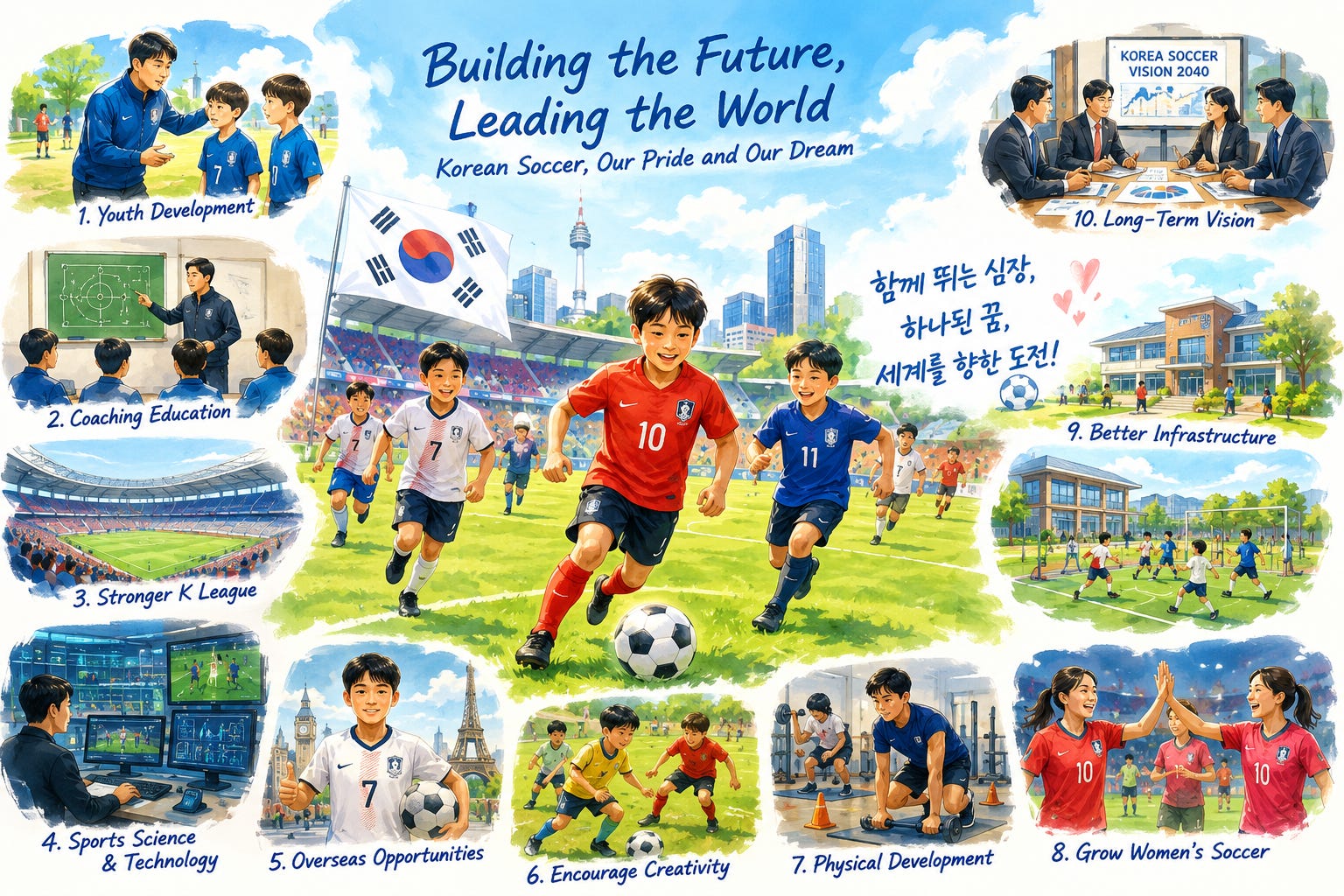
1. Reform the Youth Development System
The foundation of every soccer powerhouse is a strong youth development system. Young players should be able to balance academics and athletics while receiving high-quality professional training. Rather than focusing solely on short-term victories, youth programs should emphasize technical skills, creativity, and long-term player development.
2. Improve Coaching Education
Great players are developed by great coaches. Korea should actively adopt advanced coaching philosophies and the latest sports science practices from leading soccer nations. Coaches should be trained not only in player development but also in leadership, psychological support, and character building.
3. Strengthen the Competitiveness of the K League
The quality of the national team is closely connected to the quality of the domestic league. Improving stadium facilities, enhancing fan experiences, and implementing innovative marketing strategies can increase attendance and investment. A stronger K League will naturally produce stronger players and teams.
4. Embrace Sports Science and Technology
Artificial intelligence (AI), big data analytics, wearable sensors, and video analysis technologies should be fully integrated into player development and performance management. Modern soccer has become increasingly data-driven, and Korea must remain at the forefront of technological innovation.
5. Expand Support for Overseas Opportunities
Promising young players should be encouraged and supported to gain experience in Europe and other competitive soccer environments. Exposure to diverse playing styles and higher levels of competition will accelerate player development and strengthen the national team.
6. Foster a Culture of Creativity
Korean soccer is often praised for its discipline and organization, but creativity remains an area for improvement. Players should be encouraged to take risks, experiment with new ideas, and express themselves on the field. Soccer is not only a sport but also a form of creative art.
7. Develop Advanced Physical Training Programs
Modern soccer requires exceptional athleticism in addition to technical ability. Age-appropriate strength, conditioning, and injury-prevention programs should be developed to help Korean players compete physically against the world’s best athletes.
8. Invest in Women’s Soccer
Successful soccer nations often achieve excellence in both men’s and women’s soccer. Expanding women’s leagues, developing specialized coaching programs, and increasing participation opportunities for young girls will strengthen the overall soccer ecosystem.
9. Expand School and Community Soccer Infrastructure
Soccer should be accessible to everyone. More school fields, community soccer centers, indoor training facilities, and public sports programs will encourage participation and create a larger pool of future talent.
10. Establish a Long-Term National Soccer Vision
The world’s leading soccer nations plan decades ahead. The Korea Football Association, government agencies, professional clubs, schools, and private-sector partners should collaborate to develop and implement a consistent long-term roadmap for soccer development.
Korean soccer has already achieved remarkable success and established itself as a leading force in Asia. However, reaching the highest level of world soccer requires a systematic and sustained commitment to improvement. Youth development, coaching education, K League advancement, sports science, overseas opportunities, creativity, physical training, women’s soccer, infrastructure expansion, and long-term strategic planning are all interconnected elements of success. In an era where artificial intelligence and data analytics are transforming sports, Korea is uniquely positioned to leverage its technological strengths. With vision, perseverance, and innovation, Korean soccer can move beyond simply qualifying for World Cups and emerge as one of the world’s true soccer superpowers. +++
{Solti}
June 25, 2025
한국 축구를 국제적 수준으로 끌어올리는 10가지 방안
대한민국 축구는 이미 아시아를 대표하는 강국 중 하나이다. 2002년 FIFA 월드컵 4강 신화, 수차례 월드컵 본선 진출, 그리고 유럽 무대에서 활약하는 손흥민, 김민재, 이강인과 같은 세계적 선수들은 한국 축구의 저력을 보여준다. 그러나 세계 최정상권 국가들과 비교하면 아직도 넘어야 할 산이 많다. 브라질, 독일, 스페인, 프랑스, 아르헨티나 같은 축구 강국들은 우수한 선수층과 체계적인 육성 시스템, 선진 리그 운영을 바탕으로 꾸준한 경쟁력을 유지하고 있다. 한국 축구가 진정한 세계 강국으로 도약하기 위해서는 단순히 몇몇 스타 선수의 활약에 의존해서는 안 된다. 장기적이고 체계적인 혁신이 필요하다. 다음은 한국 축구를 국제적 수준으로 끌어올릴 수 있는 열 가지 구체적인 방안이다.
1. 유소년 축구 육성 시스템의 전면 개혁
축구 강국의 공통점은 우수한 유소년 시스템이다. 어린 선수들이 학업과 운동을 병행하면서도 전문적인 훈련을 받을 수 있는 환경을 마련해야 한다. 특히 승리 위주의 단기 성과보다 기술과 창의성을 키우는 교육이 중요하다.
2. 지도자 교육 수준 향상
좋은 선수는 좋은 지도자에게서 나온다. 유럽 선진국의 코칭 철학과 최신 스포츠 과학을 적극 도입하여 지도자의 전문성을 높여야 한다. 선수 육성뿐 아니라 인성 교육과 심리 관리 능력도 함께 강화해야 한다.
3. K리그 경쟁력 강화
국가대표팀의 수준은 국내 리그의 수준과 밀접하게 연결된다. 경기장 시설 개선, 팬 서비스 확대, 마케팅 혁신 등을 통해 K리그의 흥행과 경쟁력을 높여야 한다. 더 많은 관중과 투자가 유입될 때 리그 전체의 수준도 향상된다.
4. 축구 과학기술 적극 활용
인공지능(AI), 빅데이터, 웨어러블 센서, 영상 분석 기술을 활용하여 선수들의 체력과 경기력을 과학적으로 관리해야 한다. 세계 축구는 이미 데이터 전쟁 시대에 들어섰으며 한국도 이에 뒤처져서는 안 된다.
5. 해외 진출 지원 확대
유망 선수들이 어린 시절부터 유럽과 남미의 선진 축구 환경을 경험할 수 있도록 체계적인 지원이 필요하다. 다양한 리그에서 경쟁하며 성장한 선수들이 국가대표팀의 수준을 끌어올릴 수 있다.
6. 창의적 플레이를 장려하는 문화 조성
한국 축구는 조직력은 뛰어나지만 때로는 창의성이 부족하다는 평가를 받는다. 실수를 두려워하지 않고 새로운 시도를 장려하는 문화가 필요하다. 축구는 예술성과 창의성이 중요한 스포츠이기 때문이다.
7. 체력과 피지컬 강화 프로그램 구축
현대 축구는 기술뿐 아니라 강한 체력과 피지컬이 필수적이다. 선수들의 성장 단계에 맞춘 체계적인 체력 프로그램을 개발하여 국제 무대에서 경쟁력을 확보해야 한다.
8. 여자 축구 발전 지원
축구 선진국들은 남녀 축구가 함께 성장한다. 여자 축구 리그 활성화, 전문 지도자 양성, 유소년 여자 축구 저변 확대를 통해 국가 전체 축구 역량을 높일 수 있다.
9. 학교와 지역사회 축구 인프라 확대
누구나 쉽게 축구를 즐길 수 있는 환경이 마련되어야 한다. 학교 운동장, 지역 축구센터, 실내 훈련장 등을 확충하여 생활체육과 엘리트 체육이 함께 발전하도록 해야 한다.
10. 장기적 국가 축구 비전 수립
축구 강국은 10년, 20년 후를 내다보며 정책을 추진한다. 대한축구협회, 정부, 프로구단, 학교, 기업이 협력하여 일관된 국가 축구 발전 로드맵을 수립하고 지속적으로 실행해야 한다.
한국 축구는 이미 아시아 최고 수준의 경쟁력을 갖추고 있지만, 세계 정상에 오르기 위해서는 더욱 체계적이고 장기적인 노력이 필요하다. 유소년 육성, 지도자 교육, K리그 발전, 스포츠 과학 활용, 해외 진출 확대, 창의성 장려, 체력 강화, 여자 축구 육성, 인프라 확충, 국가 비전 수립 등은 서로 연결된 과제들이다. 특히 인공지능과 데이터 기술이 스포츠의 미래를 바꾸고 있는 시대에 한국은 IT 강국의 장점을 적극 활용해야 한다. 이러한 노력이 지속된다면 한국 축구는 단순히 월드컵 본선 진출을 넘어 세계 축구를 선도하는 진정한 축구 강국으로 성장할 수 있을 것이다. +++
{솔티}
2026년 6월 25일

Prof. Dr. Young Choi (Editor in Chief) — Regent University
Young B. Choi is a Professor in the Department of Engineering & Computer Science at Regent University. He published 38 books with ‘Selected Readings in Cybersecurity’ (2018) (over 800 copies archived globally at university/college libraries around the world) and ‘Cybersecurity Applications and Artificial Intelligence’ (2023) available in seven major world languages. He proposed the world’s first global and universal telecommunications “Service Order Handling (SOH)” Model (T-SOH Model) (1995) with Dr. Adrian Tang. With this innovative research work, he received the IEEE NOMS ’96 Best Paper Award and became the first recipient of the Outstanding Contribution Award of the TeleManagement Forum in 1998. His research areas include Natural Language Processing-focused AI, AI-applied cybersecurity, network and telecom service management, and Korean studies on Gani Choi Rip’s Jeonggwan (靜觀: Quiet Contemplation) philosophy and Shilhak ( 實學: Practical Learning).
한국축구협회 리더십과 매니지먼트 먼저 큰 개혁이 필요한 것 같습니다.