

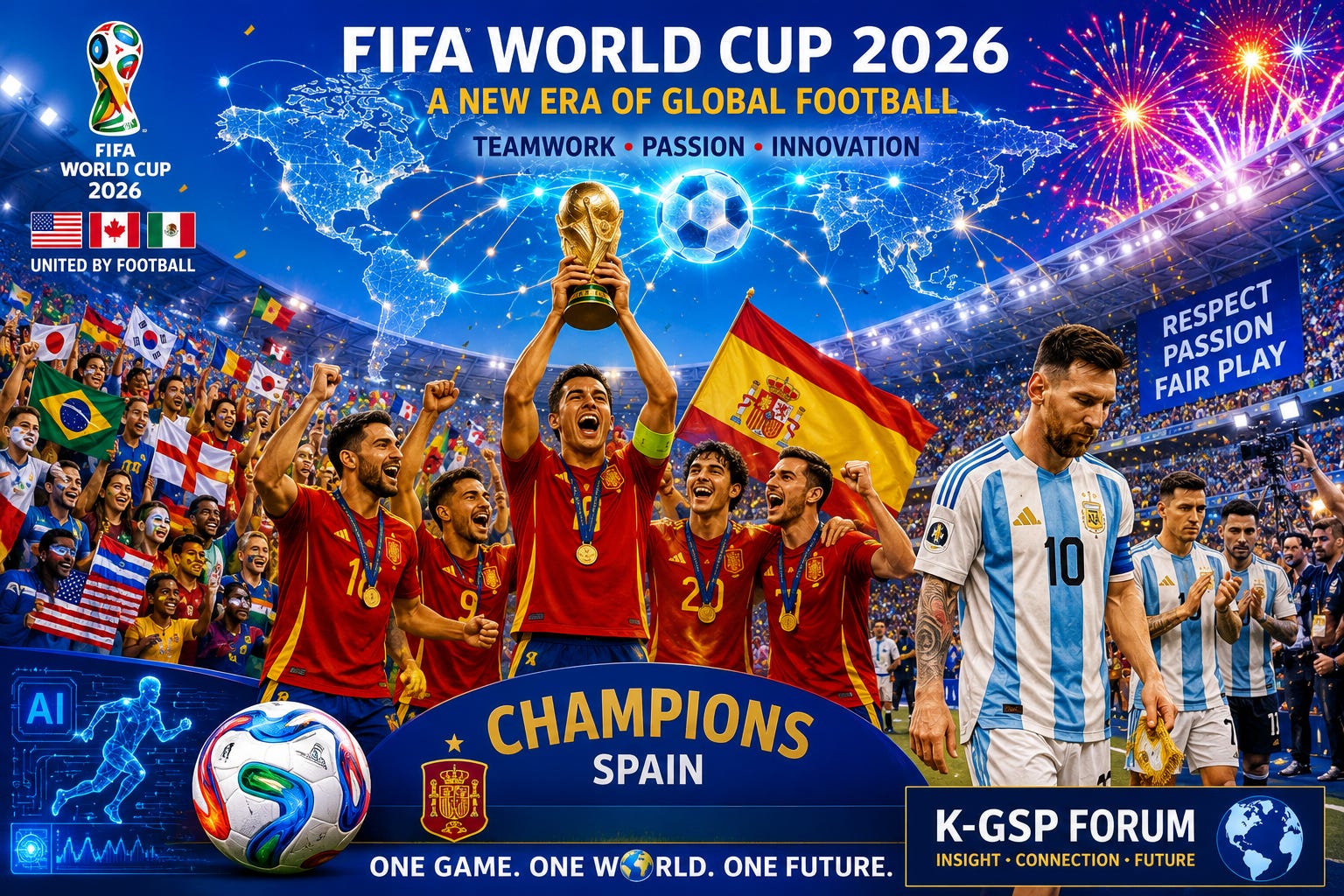
The FIFA World Cup Final is never merely a football match. It is a celebration of humanity, culture, passion, and hope. The 2026 FIFA World Cup Final between Spain and Argentina demonstrated precisely why billions of people continue to regard football as “the beautiful game.” After 120 minutes of breathtaking competition, Spain defeated defending champion Argentina 1–0 with Ferran Torres’ extra-time winner, capturing its second World Cup title while denying Lionel Messi a fairy-tale farewell.
As I watched the match unfold, I realized that I was witnessing more than the crowning of a champion. I was watching the beginning of a new era in world football.
The final itself was a fascinating contrast between two football philosophies.
Argentina represented experience, resilience, and individual brilliance. Every movement of Lionel Messi carried the weight of history. Even nearing the end of his extraordinary international career, millions hoped to witness one final masterpiece. However, it was deeply disappointing that a few Argentine players, whose actions after the match triggered a confrontation, displayed behavior that fell far short of the sportsmanship expected in football. In a sport watched and loved by fans around the world, such incidents presented an unfortunate and embarrassing image to global football supporters.
Spain, however, represented youth, collective intelligence, relentless pressing, and positional football refined over decades. Their confidence on the ball reflected years of disciplined player development rather than dependence on any single superstar.
For nearly ninety minutes neither team managed to score.
Yet the match was anything but boring.
Every pass felt meaningful.
Every interception shifted momentum.
Every tactical adjustment resembled a carefully played chess move.
Spain controlled possession patiently, while Argentina defended courageously behind the remarkable goalkeeping of Emiliano Martínez, whose numerous saves repeatedly kept his team alive.
When Argentina was reduced to ten players after Enzo Fernández’s dismissal late in regulation, many expected Spain to find an immediate breakthrough. Instead, Argentina continued to fight with extraordinary determination, reminding the world that courage is measured not by numbers but by spirit.
Then came the decisive moment.
In the 106th minute, Ferran Torres struck a magnificent left-footed shot into the top corner.
The stadium erupted.
Millions watching around the globe rose from their seats.
One goal separated triumph from heartbreak.
It was a goal born not from luck but from patience, teamwork, and technical excellence.
Beyond the result, several lessons emerged from this unforgettable final.
First, teamwork ultimately surpasses individual brilliance. Messi remains one of the greatest footballers in history, yet football continues to remind us that eleven united players often overcome even the brightest individual star. Spain’s victory celebrated collective intelligence over individual dependence.
Second, youth development determines long-term success. Spain’s academy system has consistently produced technically gifted players capable of executing complex tactical systems. Their success was not accidental but the result of decades of investment in grassroots football.
Third, tactical discipline is becoming football’s new competitive advantage. Modern football increasingly rewards teams capable of intelligent pressing, rapid transitions, positional awareness, and collective decision-making. Spain illustrated that strategy can neutralize even the world’s most talented individuals.
Fourth, resilience deserves admiration regardless of victory. Argentina never surrendered. Their defensive commitment, emotional strength, and determination embodied the competitive spirit that has made them one of football’s greatest nations.
Finally, football remains humanity’s universal language. Supporters from every continent celebrated together, proving once again that sport can unite people beyond politics, culture, language, and geography.
The 2026 tournament itself also represented an important milestone.
As the first 48-team FIFA World Cup hosted jointly by the United States, Canada, and Mexico, it demonstrated that global football continues to expand while maintaining remarkable competitive quality. Smaller football nations challenged traditional powers, new stars emerged, and millions of young fans experienced the World Cup for the first time.
Perhaps the most emotional image of the evening was Lionel Messi leaving the World Cup stage.
Even in defeat, the crowd applauded.
True greatness is measured not only by trophies but also by inspiration.
Messi’s remarkable career has inspired countless children to dream, practice, and believe that dedication can overcome limitations.
Meanwhile, Spain’s triumph symbolizes football’s future.
Their victory belongs not simply to one generation but to an entire philosophy of patient player development, technical excellence, tactical innovation, and collective leadership.
As artificial intelligence, advanced analytics, wearable technologies, and sports science continue transforming football, the game’s future will increasingly combine human creativity with technological intelligence. Yet no algorithm can replace the emotions felt when an entire stadium holds its breath before a decisive goal or when millions celebrate together across different cultures.
That remains football’s greatest miracle.
The 2026 FIFA World Cup Final reminded us that championships are won through preparation, discipline, teamwork, resilience, and unwavering belief. More importantly, it reminded us that while trophies eventually gather dust, the memories created by extraordinary sporting moments become part of humanity’s shared history.
Spain lifted the trophy.
And football itself emerged as the greatest winner of all. +++
{Solti}
July 20, 2026
2026 FIFA 월드컵 결승전 관전평: 현대 축구의 새로운 시대를 연 한 경기
FIFA 월드컵 결승전은 결코 단순한 축구 경기가 아니다. 그것은 인류의 열정과 문화, 희망과 도전이 한데 어우러지는 세계 최대의 스포츠 축제이다. 2026 FIFA 월드컵 결승전에서 스페인과 아르헨티나가 펼친 승부는 왜 수십억 명의 사람들이 축구를 ‘아름다운 게임(The Beautiful Game)’이라 부르는지를 다시 한번 증명해 주었다. 연장전까지 이어진 치열한 승부 끝에 스페인은 1대0으로 승리하며 두 번째 월드컵 우승을 차지했고, 아르헨티나는 마지막까지 명승부를 펼치며 전 세계 팬들의 존경을 받았다.
경기를 지켜보면서 나는 단순히 새로운 챔피언이 탄생하는 순간이 아니라 세계 축구의 새로운 시대가 열리는 장면을 목격하고 있다는 생각이 들었다.
이번 결승전은 두 가지 축구 철학의 아름다운 대결이었다.
아르헨티나는 경험과 투혼, 그리고 개인의 창의성이 빛나는 축구를 보여주었다. 특히 리오넬 메시가 공을 잡을 때마다 경기장은 물론 전 세계 축구팬들의 시선이 집중되었다. 그의 한 번의 패스와 드리블에는 지난 20여 년간 세계 축구를 이끌어 온 거장의 무게감이 담겨 있었다. 그러나 경기가 끝난 후의 난투극을 유발했던 아르헨티나 몇몇 선수들은 신사다운 매너를 잘 지켜야 하는 축구경기에서 세계의 축구 팬들에게 너무 부끄러운 면을 보여주어 매우 아쉬었다.
반면 스페인은 젊음과 조직력, 그리고 정교한 패스 축구를 앞세웠다. 특정 스타 선수 한 명에게 의존하지 않고 모든 선수가 하나의 유기체처럼 움직이는 모습은 오랜 유소년 육성과 체계적인 축구 철학이 만들어 낸 결실이었다.
90분 동안 양 팀 모두 쉽게 골문을 열지 못했지만 경기는 단 한 순간도 지루하지 않았다.
패스 하나에도 의미가 있었고,
태클 하나에도 긴장감이 흘렀으며,
감독들의 전술 변화는 마치 최고 수준의 체스 경기를 보는 듯했다.
스페인은 높은 볼 점유율을 바탕으로 경기를 지배했고, 아르헨티나는 뛰어난 수비 집중력과 골키퍼 에밀리아노 마르티네스의 선방으로 끝까지 버텨냈다.
후반 막판 아르헨티나가 퇴장으로 수적 열세에 놓였을 때 많은 사람들은 스페인의 승리를 예상했다. 그러나 아르헨티나는 단 한 명이 부족한 상황에서도 끝까지 포기하지 않는 놀라운 투지를 보여주었다. 그 모습은 승패를 떠나 스포츠 정신이 무엇인지를 잘 보여준 장면이었다.
그리고 마침내 연장 전반.
페란 토레스의 왼발 슛이 골망을 흔드는 순간 경기장은 폭발했다.
수만 명의 관중이 일제히 환호했고, 전 세계 수억 명의 축구팬들이 자리에서 일어났다.
그 한 골은 우연이 아니라 끈기와 조직력, 그리고 완벽한 팀워크가 만들어 낸 작품이었다.
이번 결승전을 통해 우리는 여러 가지 중요한 교훈을 얻을 수 있었다.
첫째, 최고의 개인보다 최고의 팀이 더 강하다.
메시는 역사상 가장 위대한 선수 가운데 한 명이지만 축구는 결국 11명이 함께 만드는 스포츠이다. 스페인의 우승은 개인의 천재성보다 조직력이 얼마나 중요한지를 다시 한번 보여주었다.
둘째, 유소년 육성이 국가 경쟁력이다.
스페인의 선수들은 하루아침에 탄생한 것이 아니다. 수십 년 동안 이어져 온 체계적인 유소년 시스템과 지도 철학이 오늘의 우승을 가능하게 만들었다.
셋째, 현대 축구는 전술의 시대이다.
과거에는 뛰어난 공격수 한 명이 경기를 결정하기도 했지만 이제는 압박, 공간 활용, 데이터 분석, 그리고 팀 전술이 승패를 좌우한다. 스페인은 현대 축구가 어디를 향해 가고 있는지를 가장 잘 보여준 팀이었다.
넷째, 패배 속에서도 위대한 팀은 존경받는다.
아르헨티나는 마지막 순간까지 결코 포기하지 않았다. 비록 우승은 놓쳤지만 그들의 투지와 헌신은 승리 못지않은 감동을 선사했다.
다섯째, 축구는 인류를 하나로 연결하는 세계 공통의 언어이다.
국적도, 언어도, 문화도 다른 사람들이 하나의 공을 바라보며 함께 환호하고 함께 눈물을 흘렸다. 정치가 해결하지 못하는 갈등도 스포츠는 때때로 화합으로 이끌 수 있다는 사실을 다시 느끼게 되었다.
이번 2026 FIFA 월드컵은 대회 자체로도 새로운 역사를 썼다.
미국·캐나다·멕시코가 공동 개최한 최초의 48개국 월드컵은 세계 축구의 저변이 얼마나 넓어졌는지를 보여주었다. 신흥 축구 국가들이 전통 강호들을 위협했고, 새로운 스타들이 등장했으며, 전 세계 어린이들에게 새로운 꿈을 심어 주었다.
경기 후 가장 인상 깊었던 장면 가운데 하나는 리오넬 메시를 향한 관중들의 기립박수였다.
비록 우승컵은 들어 올리지 못했지만 그는 이미 세계 축구 역사 속 영원한 전설이었다.
진정한 위대함은 우승 횟수만으로 결정되지 않는다.
얼마나 많은 사람들에게 꿈과 용기를 주었는가가 더 중요한 기준일 것이다.
한편 스페인의 우승은 미래 축구의 방향을 상징한다.
그들의 성공은 특정 선수 한 명의 능력이 아니라 장기간의 투자와 체계적인 교육, 기술 중심의 철학, 그리고 팀워크의 승리였다.
앞으로 인공지능(AI), 빅데이터, 스포츠 과학, 웨어러블 기술은 축구를 더욱 발전시킬 것이다. 선수들의 움직임은 더욱 정교하게 분석되고, 부상은 더욱 효과적으로 예방되며, 경기 전략은 더욱 과학적으로 발전할 것이다.
그러나 아무리 기술이 발전하더라도 결정적인 골이 터지는 순간 모두가 숨을 멈추고 환호하는 감동만큼은 인공지능이 대신할 수 없다.
바로 그것이 축구의 가장 위대한 가치이다.
2026 FIFA 월드컵 결승전은 우리에게 다시 한번 가르쳐 주었다.
챔피언은 철저한 준비와 조직력, 끊임없는 노력, 그리고 서로를 믿는 팀워크 속에서 탄생한다는 사실을.
그리고 우승 트로피는 시간이 지나면 박물관에 남지만, 그날의 감동과 환희는 오랫동안 인류의 기억 속에 살아남는다는 사실을.
스페인은 드디어 우승을 차지했다.
그리고 진정한 승자는, 전 세계를 하나로 연결한 축구 그 자체였다. +++
{솔티}
2026년 7월 20일

Prof. Dr. Young Choi (Editor in Chief) — Regent University
Young B. Choi is a Professor in the Department of Engineering & Computer Science at Regent University. He published 38 books with ‘Selected Readings in Cybersecurity’ (2018) (over 800 copies archived globally at university/college libraries around the world) and ‘Cybersecurity Applications and Artificial Intelligence’ (2023) available in seven major world languages. He proposed the world’s first global and universal telecommunications “Service Order Handling (SOH)” Model (T-SOH Model) (1995) with Dr. Adrian Tang. With this innovative research work, he received the IEEE NOMS ’96 Best Paper Award and became the first recipient of the Outstanding Contribution Award of the TeleManagement Forum in 1998. His research areas include Natural Language Processing-focused AI, AI-applied cybersecurity, network and telecom service management, and Korean studies on Gani Choi Rip’s Jeonggwan (靜觀: Quiet Contemplation) philosophy and Shilhak ( 實學: Practical Learning).