

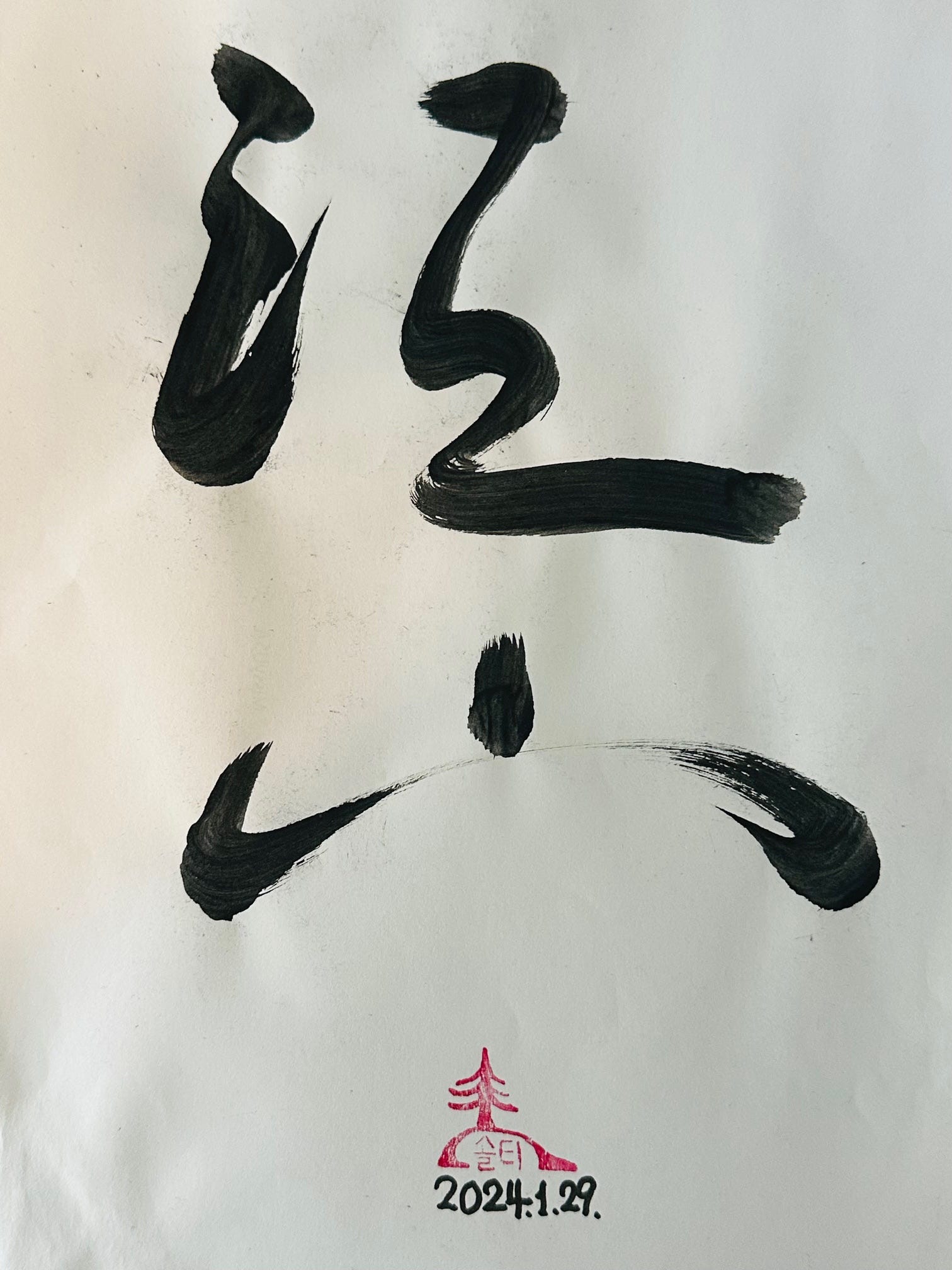
This work, when examined beyond symbolic or representational readings, reveals itself as an exploration of gesture and trace, where the essence lies not in what is written, but in how it is enacted. The character “心” (heart/mind) becomes less a linguistic signifier and more a record of embodied movement, situating the work within a performative paradigm of calligraphic practice.
First, the composition demonstrates a distinctly performative quality, wherein each stroke emerges as the residue of a decisive, time-bound action. The upper strokes exhibit contrasting rhythms—one weighted and grounded, the other fluid and ascending—capturing variations in velocity, pressure, and directional force. These are not merely formal elements, but inscriptions of corporeal temporality, encoding the artist’s breath, musculature, and kinetic intention.
The central dot functions as a critical point of suspension within this gestural continuum. It interrupts the flow with a moment of concentrated stillness, akin to a caesura in musical composition. Though minimal in form, it embodies maximal density of intention, crystallizing a pause that reconfigures the surrounding spatial and temporal dynamics.
The lower sweeping strokes articulate an extended kinetic trajectory, where the modulation of ink saturation and the fraying of the brush tip reveal the material contingencies of the medium—absorption, friction, and depletion over time. These lines are not static forms but traces of movement, mapping the passage of the body through space. In this sense, the work aligns closely with the logic of indexicality, where the mark serves as evidence of an event rather than a representation of an object.
From this perspective, the piece may be understood as the aftermath of a performative act, akin to performance art, where the visible outcome gestures toward an unseen process. The viewer is invited to reconstruct the sequence of gestures, effectively reanimating the act of inscription through perceptual engagement.
Moreover, the work negotiates a productive tension between control and contingency. The diffusion of ink, the occasional dryness of the brush, and the irregularities of contact with the paper introduce elements of chance. Yet these are neither suppressed nor corrected; instead, they are incorporated into the visual logic of the piece, yielding a form of dynamic equilibrium—an order that remains open, unstable, and alive.
The negative space operates not as absence but as a temporal field, marking intervals before, between, and after the strokes. It frames the gestures, allowing them to resonate within a broader continuum of duration and silence. In doing so, the work transcends its material boundaries, unfolding as a temporal-spatial event rather than a fixed visual artifact.
Ultimately, this work does not seek to define “心” as a stable concept. Instead, it renders the heart/mind as a processual phenomenon—a continuous becoming shaped by movement, interruption, and residue. Through this lens, calligraphy is transformed from a static inscription into a living act, where meaning emerges through the interplay of gesture, time, and material trace. +++
{Solti}
May 5, 2025

Young Choi, PhD is a Professor at Regent University bringing a rare combination of technical expertise and creative spirit to everything he does. A scholar in AI, cybersecurity, and network & telecommunications service management, he has published 38 books including AI and cybersecurity area books, over 200 refereed articles, and over 20 book chapters. Beyond the academy, Dr. Choi is a passionate poet, essayist, and wooden block engraving artist whose reflective writing invites readers to rediscover life’s beauty in quiet contemplation(靜觀). He lives under the motto: “Study hard and give generously without holding back! (열심히 공부해서 아낌없이 남주자 !)”
Published books: https://www.amazon.com/stores/Young-Choi/author/B0DMZ5S6R7?ref=ap_rdr&shoppingPortalEnabled=true
마음 심이, 강산으로 풀이되니 참으로 놀랍습니다. ^^