

Between 2025 and 2026, artificial intelligence (AI) is undergoing a profound and quiet transformation. It is no longer merely a tool that generates text. Instead, it is rapidly evolving into a system that can reason, act autonomously, and even interact with the physical world through robotics. This shift goes beyond technological progress—it is reshaping industries, societies, and the very foundations of national competitiveness.
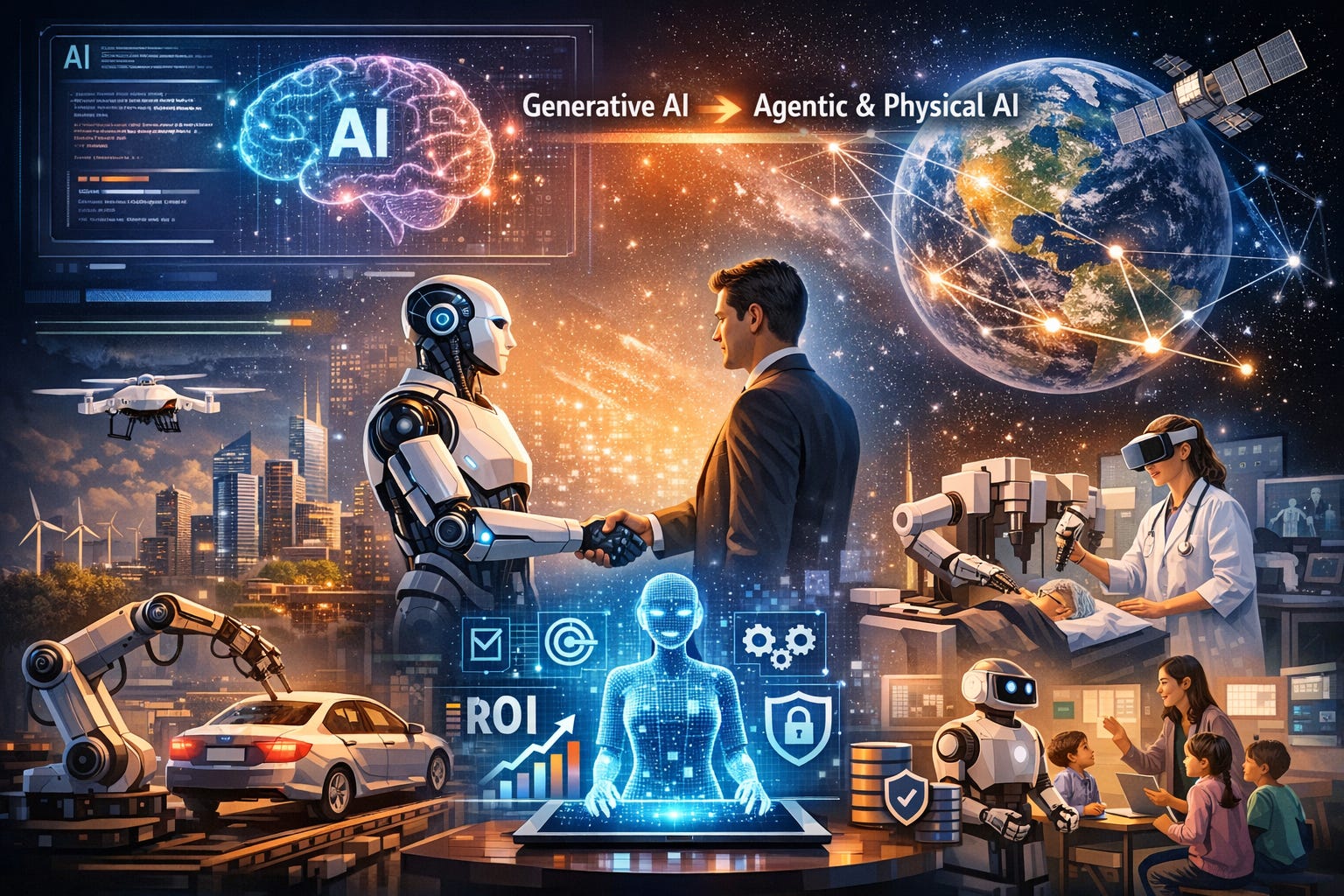
The most significant change is the transition from “generative AI” to “agentic AI.” These AI agents do not simply respond to prompts; they set goals, develop plans, and execute tasks by using external tools. In essence, AI is becoming a “digital collaborator” rather than a passive assistant. In the near future, corporate productivity will depend not only on automation but on how effectively organizations design and deploy intelligent AI agents.
At the same time, the rise of physical AI marks another turning point. By serving as the “brain” of robots, AI is extending intelligence from the digital realm into physical reality. This development is expected to transform industries such as manufacturing, logistics, healthcare, and defense. If the Industrial Revolution mechanized physical labor, we are now witnessing the mechanization of intelligence itself.
Technological advances are equally significant. Multimodal AI systems—capable of processing text, images, speech, and video simultaneously—are enabling more natural human–machine interaction. At the same time, newer models are becoming faster, more efficient, and less energy-intensive, linking AI development directly to sustainability concerns. The competition is no longer solely about performance, but also about efficiency and environmental impact.
However, technological progress does not automatically translate into success. Enterprises are increasingly demanding measurable outcomes from AI adoption. The era of inflated expectations is giving way to a more disciplined focus on return on investment (ROI). AI is no longer a “promising innovation”; it is becoming a core infrastructure that must demonstrate tangible business value.
Another important trend is the rise of sovereign AI. Countries are now seeking to build AI systems that reflect their own data, culture, language, and regulatory frameworks. AI has thus become a matter of digital sovereignty and national strategic capability. Global AI competition is no longer purely technological—it is now deeply intertwined with politics, economics, and cultural identity.
Alongside this, vertical AI—specialized systems designed for specific industries such as healthcare and education—is rapidly expanding. Rather than relying on general-purpose models, industries increasingly demand tailored solutions that deliver higher precision, reliability, and domain expertise. This suggests that the future AI landscape will be structured as a hybrid ecosystem of general platforms and industry-specific applications.
Yet these advances also bring critical challenges. Among the most urgent is the need for responsible AI—systems that are safe, transparent, and trustworthy. Issues such as misinformation, algorithmic bias, and cybersecurity vulnerabilities can scale rapidly alongside AI deployment. Equally important is data quality: poor or biased data inevitably leads to poor outcomes, reinforcing the principle that “garbage in, garbage out” remains fundamentally true.
The global AI landscape is also being reshaped by intensifying competition. The United States continues to lead, while China is rapidly narrowing the gap through aggressive investment and policy support. In this evolving duopoly, South Korea has emerged as a notable AI power, ranking among the top five globally. However, maintaining this position will require sustained innovation rather than complacency.
Ultimately, the central question is no longer “How well are we building AI?” but rather “What kind of future are we building with AI?” Technology does not determine its own direction. That responsibility lies entirely with human choice, governance, and values.
AI is no longer a trend—it is infrastructure. And infrastructure ultimately defines the quality of society. The decisions made today will shape competitiveness and societal structure for decades to come. In the age of acting AI, the question is not whether we will use AI, but whether we will remain passive users or become the architects of its direction. That moment of choice has already begun. +++

Young Choi, PhD is a Professor at Regent University bringing a rare combination of technical expertise and creative spirit to everything he does. A scholar in AI, cybersecurity, network and telecommunications service management, he has published 37 books including AI and cybersecurity area books, 219 refereed articles, 21 book chapters. Beyond the academy, Dr. Choi is a passionate poet, essayist, and wooden block engraving artist whose reflective writing invites readers to rediscover life’s beauty in quiet contemplation. He lives under the motto: “Study hard and give generously without holding back! (열심히 공부해서 아낌없이 남주자 !)”