

Executive Summary
Artificial intelligence is fundamentally transforming sales from a transactional function into a strategic capability that creates value across globally connected supply chain ecosystems. This article proposes a four-level framework—Transactional, Consultative, Collaborative, and Transformational Sales—to explain how AI progressively enhances customer engagement, organizational integration, and long-term relationship building while reinforcing the indispensable role of human judgment, trust, and ethical leadership. The framework offers practical guidance for managers and business leaders seeking to integrate AI with human intelligence to strengthen customer value, supply chain resilience, and sustainable competitive advantage in the AI Era.
Keywords: Artificial Intelligence (AI); Global Supply Chain; Sales Transformation; Intelligent Relationships; Customer Value Creation
1. Introduction
Artificial intelligence is redefining the nature of selling itself. What was once a transaction-oriented business function is rapidly becoming an intelligence-driven capability that integrates customers, organizations, and global supply chain ecosystems. Traditional sales functions, once centered primarily on product transactions and face-to-face interactions, are evolving into intelligence-driven capabilities supported by predictive analytics, digital platforms, generative AI, and real-time data integration. Sales is no longer merely the final stage of the supply chain; it has become a strategic function that connects market intelligence, customer demand, production planning, logistics, and long-term ecosystem collaboration. Recent research and industry evidence indicate that AI is rapidly becoming a standard component of customer analysis, forecasting, sales decision-making, and seller workflows (Fischer et al., 2022; Johnston & Marshall, 2024; Rogers, 2023).
From a global supply chain perspective, sales performance depends not only on the capabilities of individual salespeople but also on the coordination of suppliers, manufacturers, distributors, logistics providers, technology partners, and end customers. AI enables these participants to exchange information more rapidly, anticipate demand more accurately, personalize customer experiences, optimize inventories, and respond to market disruptions with greater agility. Consequently, successful firms are moving beyond isolated sales transactions toward integrated value creation across the entire supply chain ecosystem. By improving decision quality, resource coordination, and real-time responsiveness, AI enables sales insights to influence production, inventory, logistics, and customer service across the supply chain (Christopher, 2022; Fawcett et al., 2022; Wamba et al., 2023; Zhang et al., 2024).
This article proposes a four-level framework for understanding sales in the AI era: Transactional Sales, Consultative Sales, Collaborative Sales, and Transformational Sales. Transactional Sales emphasizes efficient exchange, Consultative Sales addresses customer problems, Collaborative Sales coordinates partners in joint value creation, and Transformational Sales helps shape customer capability, strategy, and long-term ecosystem success. Each level represents a progressively higher degree of customer engagement, organizational integration, and strategic value creation. While AI increasingly automates routine activities and enhances analytical capabilities, human judgment, ethical leadership, relationship building, and strategic vision become even more important as sales evolves from selling products to shaping long-term partnerships and enabling customer transformation (Johnston & Marshall, 2024; Kotler et al., 2022).
2. The Evolution of Sales in Global Supply Chain Ecosystems
Sales has changed as global supply chains have become more connected. In the past, sales mainly focused on moving products from manufacturers to customers through distributors and retailers. In the AI era, sales also uses market information, demand forecasts, customer data, and partner coordination to support better decisions across the supply chain. AI helps companies understand customer needs, improve planning, and create value through ongoing cooperation. Sales professionals therefore need both technical skills and human strengths such as strategic thinking, relationship management, and ethical leadership (Christopher, 2022; Fawcett et al., 2022; Wamba et al., 2023).
2.1 From Product Selling to Value Creation
In the past, sales success was measured mainly by how many products were sold and how much short-term revenue was earned, so salespeople focused on product features, prices, and promotions. These activities still matter, but customers now expect broader solutions that improve performance, reduce risk, and support long-term goals. For example, industrial equipment companies offer predictive maintenance, remote monitoring, and performance guarantees, while cloud software companies provide subscriptions that include setup, cybersecurity, regular updates, and customer support (Johnston & Marshall, 2024; Kotler et al., 2022; Kumar & Reinartz, 2018; Rust & Huang, 2021). AI speeds up this change by giving companies real-time customer information, better forecasts, and personalized recommendations. Retailers can combine physical and digital interactions to create more culturally relevant and engaging customer experiences, particularly for digitally connected consumers such as Generation Z (Hong & Kim, 2025). They can also suggest related products, while manufacturers can predict equipment problems before breakdowns occur and logistics companies can improve routes and inventory placement. These examples show that sales professionals now create value by helping customers achieve clear business results across the global supply chain (Fischer et al., 2022; Kumar & Reinartz, 2018; Park & Hong, 2024).
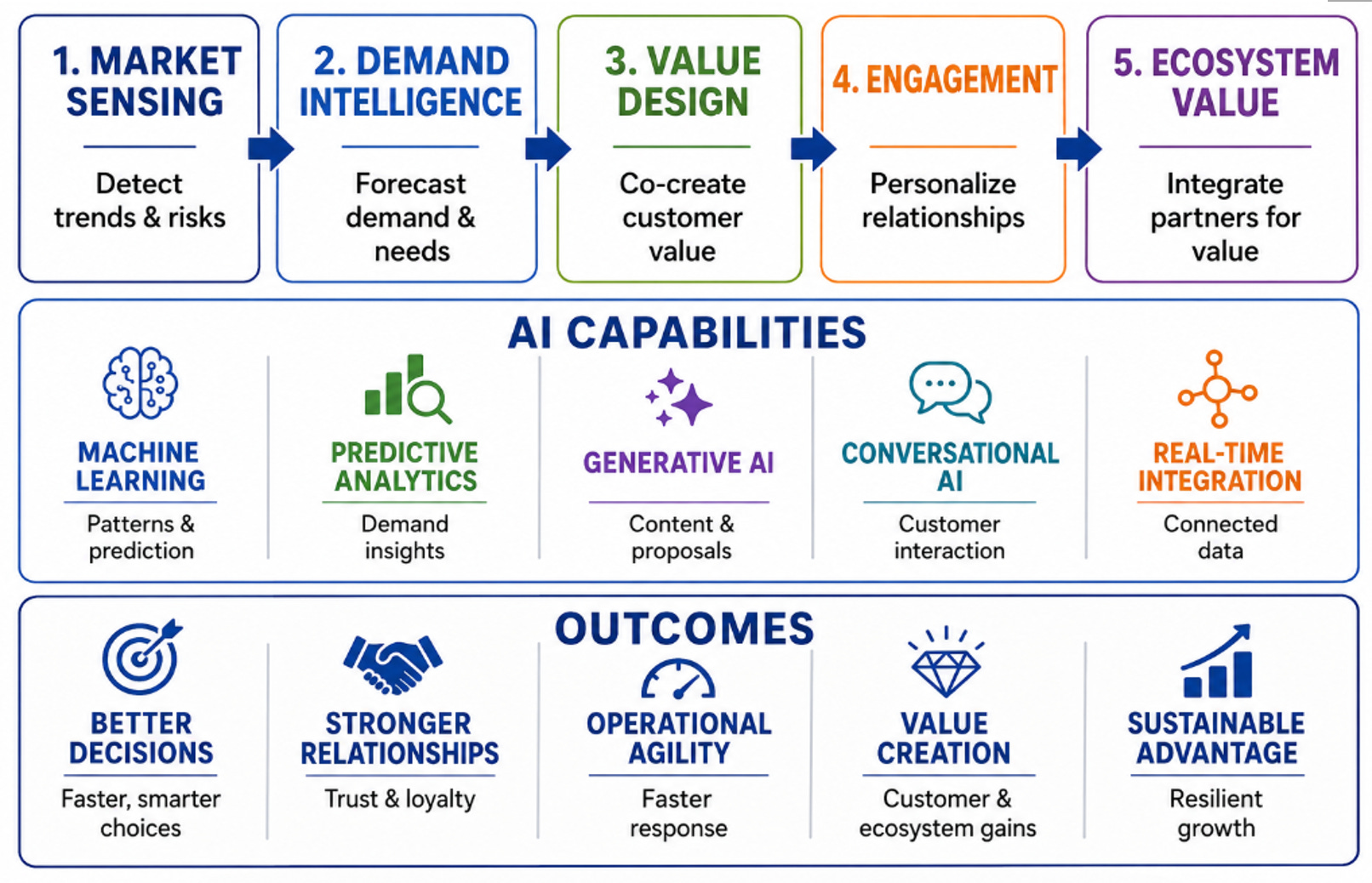
Figure 1
Sales Evolution: From Transactions to Intelligent Relationships
Note. Source: Developed by the authors with AI-assisted visual refinement.
Figure 1 presents the AI Sales Evolution (AISE) Framework, showing how sales progresses from product-centered transactions to AI-enabled strategic value creation across global supply chain ecosystems. It highlights how AI connects market sensing, demand intelligence, customer engagement, and ecosystem collaboration to improve decisions, relationships, operational agility, and long-term competitive advantage.
2.2 AI as an Intelligent Sales Partner
Artificial intelligence is improving every part of the sales process by helping companies understand customers, prepare proposals, forecast demand, and plan inventory. Sales representatives can review years of buying history, identify seasonal patterns, and create customized proposals more quickly, while pharmaceutical companies can identify likely users of new treatments and manufacturers can predict equipment problems before costly breakdowns occur. AI does not replace sales professionals; it gives them better information, faster analysis, and stronger support for making decisions and responding to customers (Fischer et al., 2022; Johnston & Marshall, 2024; Kumar & Reinartz, 2018).
AI can also handle routine work such as updating customer records, preparing price quotations, scheduling meetings, and sending follow-up messages, giving sales professionals more time to build relationships, advise customers, and manage difficult negotiations. During a supply chain disruption, AI may compare delivery routes and estimate delays, but experienced leaders must still explain the situation, negotiate new commitments, and protect customer trust. AI can analyze data and possible outcomes, while people provide empathy, creativity, ethical judgment, cultural understanding, and strategic wisdom, making the sales organization more responsive, resilient, and customer-focused (Johnston & Marshall, 2024; Rogers, 2023).
2.3 Sales as an Integrated Global Supply Chain Capability
In today’s connected supply chains, sales works closely with purchasing, manufacturing, logistics, marketing, and customer service. It links customer and market information with decisions about production, inventory, transportation, suppliers, and after-sales support. For example, a sudden increase in electric vehicle demand affects batteries, semiconductors, factory schedules, shipping capacity, and dealership inventories, while aircraft companies must coordinate engineers, suppliers, logistics providers, regulators, and service teams before promising delivery dates (Christopher, 2022; Fawcett et al., 2022; Hong et al., 2023).
AI strengthens this coordination by helping partners share information quickly, forecast needs, and make better decisions together. Retailers can use AI to move inventory, order more products from suppliers, and improve transportation during holiday demand surges, while healthcare organizations used AI during the COVID-19 pandemic to support the production and delivery of protective equipment and medical supplies. These examples show that success in the AI era depends on how well the entire supply chain works together, not only on the performance of individual salespeople (Wamba et al., 2023; Zhang et al., 2024).
AI makes sales smarter, but human judgment turns intelligence into trust and lasting value.
3. Three Foundational Sales Models in AI-Enabled Global Supply Chains
The evolution of sales reflects growing supply chain complexity as Transactional, Consultative, and Collaborative Sales progressively integrate AI-driven intelligence with human expertise, expanding the sales role beyond individual exchanges toward deeper customer engagement, organizational coordination, and strategic ecosystem relationships.
3.1 Transactional Sales: Delivering Operational Excellence
Transactional Sales focuses on matching products with customer demand quickly and accurately. Success is measured by sales volume, correct orders, reliable delivery, competitive prices, and customer convenience. AI supports this work by processing orders, recommending related products, adjusting prices, tracking demand, and improving customer service. For example, online retailers use customer data to suggest additional products and provide accurate delivery dates, while industrial distributors can automatically restock customer inventories before shortages occur (Johnston & Marshall, 2024; Kotler et al., 2022).
From a global supply chain perspective, transactional sales depends on good coordination among suppliers, manufacturers, distributors, retailers, inventory systems, and transportation providers. When demand for a new smartphone rises unexpectedly, AI can update production plans, move inventory, arrange transportation, and communicate new delivery dates. Large e-commerce companies also combine AI with warehouse robots and delivery networks to process millions of orders each day. Even with strong automation, experienced sales professionals are still needed to solve problems, negotiate alternatives, and protect customer trust, showing that strong performance comes from combining AI with human judgment (Christopher, 2022; Fawcett et al., 2022).
3.2 Consultative Sales: Solving Customer Problems
Consultative Sales focuses on understanding customer problems before recommending a product or service. Sales professionals study the customer’s goals, operating limits, and long-term needs, then use their knowledge to develop a suitable solution. For example, a manufacturing technology provider may examine production delays and worker shortages before recommending AI-enabled automation, while a healthcare technology company may study patient flow and staffing problems before proposing decision-support tools that improve care and efficiency (Johnston & Marshall, 2024; Kotler et al., 2022; Kumar & Reinartz, 2018).
AI strengthens consultative selling by analyzing customer data, identifying new needs, preparing customized proposals, and forecasting future demand. It may show that high transportation costs come from too many small shipments, helping a logistics company recommend a more integrated solution, or help a software company prepare an implementation plan and estimate the expected return on investment. Even with these capabilities, experienced sales professionals are still needed to understand the customer’s situation, manage relationships, build trust, and turn data into practical business solutions. AI supports human expertise; it does not replace it (Fischer et al., 2022; Kumar & Reinartz, 2018).
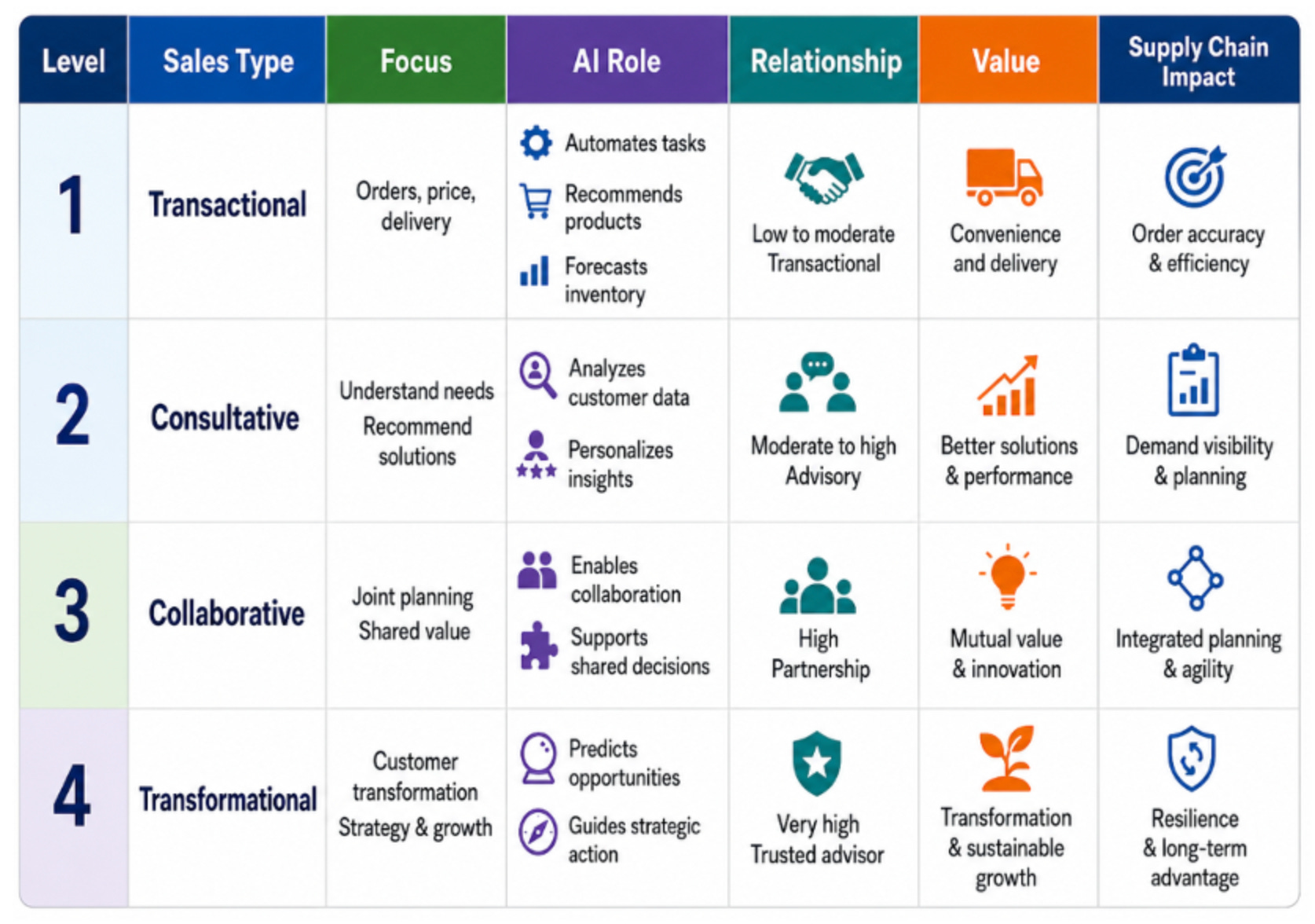
Table 1 presents the AI Sales Evolution (AISE) Framework by comparing four progressively advanced levels of sales capability—Transactional, Consultative, Collaborative, and Transformational Sales—across their primary focus, use of AI, customer relationships, value creation, and supply chain impact. The framework shows how sales develops from efficient order execution and short-term product delivery to customer problem solving, joint value creation, ecosystem coordination, and long-term transformation. As organizations move from Level 1 to Level 4, AI expands from automating routine tasks and supporting basic decisions to generating strategic insights, enabling collaboration, and guiding transformation. At the same time, the human role becomes more important through trust building, judgment, partnership management, and strategic leadership, demonstrating how AI and human intelligence together create stronger customer relationships, greater supply chain agility, and sustainable competitive advantage.
Table 1
The Four Levels of Sales in the AI Era
Note. Source: Developed by the authors.
3.3 Collaborative Sales: Building Strategic Partnerships
Collaborative Sales focuses on building long-term partnerships among customers, suppliers, logistics providers, and technology partners. These organizations share information, solve problems together, and coordinate decisions to improve planning, innovation, and daily operations. For example, automobile companies work with semiconductor suppliers, battery producers, logistics providers, and dealerships to coordinate production and launch new vehicles, while retailers and consumer goods companies share demand forecasts and inventory plans to improve service and reduce waste (Christopher, 2022; Hong et al., 2023).
AI strengthens these partnerships by improving shared forecasts, digital communication, risk monitoring, and real-time visibility across the supply chain. Food companies can share AI-based demand forecasts with farmers, packaging suppliers, transportation companies, and retailers to adjust production and delivery plans, while aerospace companies can use AI to track supplier performance, identify possible disruptions, and coordinate schedules across many countries. In this setting, sales professionals help connect partners, build trust, balance different interests, and support joint decisions. Long-term success depends on how well the entire supply chain works together, not only on the performance of one company (Wamba et al., 2023; Zhang et al., 2024).
4. Transformational Sales: Leading AI-Enabled Global Supply Chain Ecosystems
Transformational Sales represents the highest stage of the AI Sales Evolution, integrating artificial intelligence, human judgment, cross-functional collaboration, strategic vision, ethical leadership, and trusted relationships to guide customer and organizational transformation and create sustainable value and long-term competitiveness across global supply chain ecosystems.
4.1 Leading Customer and Organizational Transformation
Transformational sales professionals help customers respond to new technologies, political uncertainty, changing expectations, and growing competition. Their goal is not only to sell a product but to help customers become more competitive, resilient, and innovative over time. For example, technology companies may help manufacturers use AI, digital twins, and smart factories, while energy companies may guide utilities toward renewable energy, smarter grids, and lower-carbon operations (Johnston & Marshall, 2024; Rogers, 2023).
AI supports this work by helping organizations study future risks, compare possible scenarios, and make better decisions before major investments. Healthcare companies can use digital twins to redesign supply chains, while aerospace manufacturers can use AI simulations to improve production networks and supplier relationships. Even with these tools, transformational sales leaders are still needed to build confidence, bring different groups together, and turn new technologies into practical business models that support long-term resilience, competitiveness, and sustainable growth (Rogers, 2023; Wamba et al., 2023; Zhang et al., 2024).
4.2 Building AI-Enabled Global Supply Chain Ecosystems
Modern companies compete through connected business networks, not by working alone. Transformational sales professionals help suppliers, manufacturers, logistics providers, technology partners, governments, and customers work together and create shared value. For example, bringing an electric vehicle to market requires cooperation among battery makers, semiconductor suppliers, charging companies, logistics providers, dealerships, and government agencies, while launching a new medicine requires coordination among research laboratories, regulators, manufacturers, hospitals, insurers, and healthcare providers (Christopher, 2022; Fawcett et al., 2022; Hong et al., 2023).
AI supports this coordination by giving partners real-time information, better forecasts, shared digital tools, and early warnings about possible risks. During political or supply chain disruptions, AI can help companies compare supplier risks, transportation limits, and customer demand at the same time. Retailers can also share AI-based forecasts with suppliers and logistics providers to coordinate production, inventory, and delivery. Companies that combine AI-enabled sales with strong supply chain collaboration can respond faster to disruptions, improve innovation and sustainability, and strengthen long-term competitiveness (Wamba et al., 2023; Zhang et al., 2024).
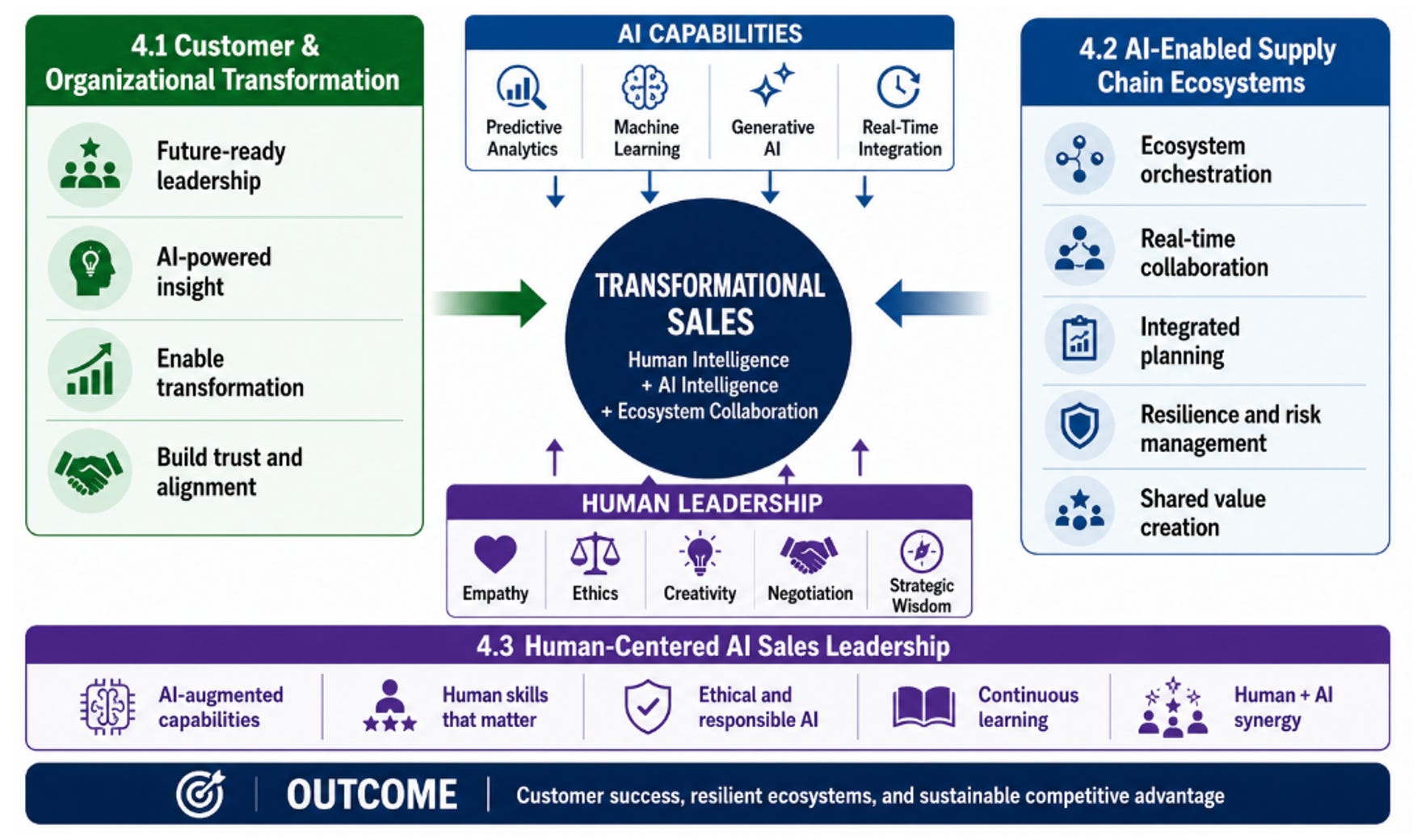
Figure 2 illustrates transformational sales as the highest stage of the AI Sales Evolution framework, where sales moves beyond transactions and solutions to become a strategic capability that helps shape customer success, organizational transformation, and ecosystem competitiveness. At the center of the figure is transformational sales, which is driven by the integration of human intelligence, AI intelligence, and ecosystem collaboration. The figure shows that AI capabilities such as predictive analytics, machine learning, generative AI, and real-time integration support this transformation, while human leadership qualities such as empathy, ethics, creativity, negotiation, and strategic wisdom remain essential. It also highlights two complementary dimensions: leading customer and organizational transformation on one side and building AI-enabled global supply chain ecosystems on the other. Together, these elements show that sustainable competitive advantage in the AI era depends on combining advanced technologies with human-centered leadership to create customer success, resilient ecosystems, and long-term value.
Figure 2
Transformational Sales in the AI Era: Leading AI-Enabled Global Supply Chain Ecosystems
4.3 Developing Human-Centered AI Sales Leadership
AI is now used throughout sales operations, including customer analysis, forecasting, communication, proposal writing, pipeline management, and after-sales support. It can automate routine work and offer useful recommendations, but lasting success still depends on human qualities such as integrity, empathy, creativity, ethical judgment, cultural understanding, negotiation, and strategic wisdom. For example, AI may identify the lowest-cost supplier during a shortage, but sales leaders must also consider long-term relationships, political risks, sustainability goals, and company reputation. International partnerships also require trust, cultural sensitivity, and ethical conduct. Leaders must therefore decide which tasks can be handled by AI and which decisions should remain under human judgment and responsibility (Fischer et al., 2022; Johnston & Marshall, 2024; Rogers, 2023).
AI also changes the role of sales leaders. They must use forecasts, manage sales pipelines, identify skill gaps, and coach employees with data-based insights. Organizations should combine new technology with continuous learning and leadership development. For example, healthcare companies using AI-assisted diagnostics must train sales professionals to address privacy, regulations, and physician trust, while manufacturers using smart factories need leaders who can guide change and connect technology investments with long-term strategy. Sales managers must become both deal coaches and AI adoption coaches, helping employees understand AI recommendations, question weak results, protect professional judgment, and use technology responsibly (Johnston & Marshall, 2024; Rogers, 2023).
The future of sales belongs to organizations that build intelligent relationships across the entire supply chain ecosystem.
5. Conclusion
AI is changing sales from a product-focused activity into a strategic way to create value across global supply chains. The four stages—Transactional, Consultative, Collaborative, and Transformational Sales—show that lasting success comes from combining AI with human judgment, ethical leadership, and trusted relationships. Organizations that connect AI insights with teamwork and strong partnerships will create greater customer value, respond better to disruptions, and support long-term innovation. In the AI era, companies will compete not only through better products, but through smarter relationships that create lasting value. Sales leaders must therefore learn when to trust AI, when to question it, and when human responsibility must take the lead. The strongest sales organizations will use technology to increase speed and insight while using people to provide judgment, trust, and purpose.
AI-Assisted Visual Disclosure: AI tools assisted in developing and refining the conceptual figures. All content, interpretation, and final presentation were reviewed and approved by the authors.
References
Christopher, M. (2022). Logistics & supply chain management (6th ed.). Pearson.
Fawcett, S. E., Ellram, L. M., & Ogden, J. A. (2022). Supply chain management: From vision to implementation (3rd ed.). Pearson.
Fischer, H., Seidenstricker, S., Berger, T., & Holopainen, T. (2022). Artificial intelligence in B2B sales: Impact on the sales process. Artificial Intelligence and Social Computing, 28, 135–142.
Hong, P., Jagani, S., Pham, P., & Jung, E. (2023). Globalization orientation, business practices and performance outcomes: An empirical investigation of B2B manufacturing firms. Journal of Business & Industrial Marketing, 38(10), 2259–2274.
Hong, P., & Kim, W. (2025). A scope–scale framework of phygital experience design: Culturally situated identity and symbolic engagement among Gen Z consumers. Journal of International Consumer Marketing, 1–25.
Johnston, M. W., & Marshall, G. W. (2024). Sales force management: Leadership, innovation, technology (14th ed.). Routledge.
Kotler, P., Keller, K. L., & Chernev, A. (2022). Marketing management (16th ed.). Pearson.
Kumar, V., & Reinartz, W. (2018). Customer relationship management: Concept, strategy, and tools (3rd ed.). Springer.
Park, Y. W., & Hong, P. (2024). Cosmetics marketing strategy in the era of the digital ecosystem. Springer Nature. https://doi.org/10.1007/978-981-97-3674-4
Rogers, D. L. (2023). The digital transformation roadmap: Rebuild your organization for continuous change (2nd ed.). Columbia Business School Publishing.
Rust, R. T., & Huang, M.-H. (2021). The service revolution and the transformation of marketing science. Marketing Intelligence & Planning, 39(8), 1031–1041.
Wamba, S. F., Queiroz, M. M., Trinchera, L., & Carillo, K. D. A. (2023). Artificial intelligence, analytics, and digital transformation in supply chain management: A systematic review. International Journal of Production Economics, 261,108881.
Zhang, Y., Dubey, R., Gunasekaran, A., & Childe, S. J. (2024). Artificial intelligence-enabled supply chains: Capabilities, resilience, and future research directions. International Journal of Production Research, 62(5), 1543–1562.
About the Authors

Distinguished Professor, Dr. Paul Hong (Editor in Chief) — University of Toledo
Paul C. Hong is a Distinguished University Professor of Information Systems and Supply Chain Management and an affiliated faculty member of the Asian Studies Program at the University of Toledo. His research covers global supply chains, AI-enabled management, digital marketing, customer experience, resilience, and strategic leadership. His recent work on digital ecosystems, cosmetics marketing, and Gen Z phygital experiences supports his current research on how AI and human judgment can strengthen customer value, trusted relationships, and sustainable performance.

Richard E. Buehrer
Professor Emeritus, University of Toledo
Richard E. Buehrer is Professor Emeritus of Marketing and Sales at the University of Toledo, where he served for more than three decades, including as Director of the Edward H. Schmidt School of Professional Sales, and later helped establish the Professional Sales program at Virginia Polytechnic Institute and State University. An internationally recognized educator and scholar, he has received multiple teaching and research awards, and his work has been published in leading journals such as the Journal of Personal Selling & Sales Management, Industrial Marketing Management, and the Journal of Business & Industrial Marketing.
© K-Global Scholars and Professionals Forum. All rights reserved. August 2026
Original Article:

Citation: Paul C. Hong and Richard E. Buehrer (August 4, 2026). The AI Sales Evolution: From Transactions to Intelligent Relationships. K-GSP Forum. pp. 1–12.
AI 영업 진화(AISE) 프레임워크: 거래에서 지능형 관계로
저자 소개: 폴 C. 홍(Paul C. Hong)은 미국 톨레도대학교의 정보시스템·공급망관리 분야 석좌교수이자 아시아학 프로그램의 겸임 교수로, 글로벌 공급망 전략, 국가 경쟁력, 회복탄력성, 지속가능성, 기술혁신을 연구해 왔다. 리처드 E. 뷰러(Richard E. Buehrer)는 톨레도대학교 마케팅·세일즈 명예교수로, 에드워드 H. 슈미트 전문영업대학원장을 역임하고 버지니아공대의 전문영업 프로그램 설립에도 기여한 국제적으로 인정받는 영업교육 연구자이다.
이 글은 인공지능이 영업을 단순한 거래 활동에서 지능형 관계와 전략적 가치 창출을 담당하는 핵심 기능으로 변화시키고 있다고 설명한다. 전통적으로 영업은 제품 판매, 가격 협상, 주문 확보에 초점을 두었지만, AI 시대의 영업은 시장정보, 고객 수요, 생산계획, 재고, 물류, 서비스와 공급망 파트너를 연결하는 통합적 기능으로 발전하고 있다. 저자들은 이러한 변화를 AI Sales Evolution(AISE) 프레임워크로 설명한다.
AISE 프레임워크는 영업을 거래형, 자문형, 협력형, 변혁형의 네 단계로 구분한다. 거래형 영업은 효율적인 주문 처리와 제품 공급에 초점을 두고, 자문형 영업은 고객의 문제와 운영상 필요를 이해하여 맞춤형 해결책을 제시한다. 협력형 영업은 고객, 공급업체, 물류기업, 기술 파트너와 공동계획과 공동가치 창출을 추진하며, 변혁형 영업은 고객의 전략, 역량, 혁신과 장기적 생태계 경쟁력까지 지원한다.
AI는 고객 분석, 수요예측, 제안서 작성, 가격결정, 재고관리, 파이프라인 관리, 고객 소통과 사후지원 등 영업 전 과정에 활용된다. 그러나 AI가 속도, 예측, 자동화, 실시간 가시성과 데이터 기반 통찰을 제공하더라도 신뢰 형성, 문화적 이해, 협상, 윤리적 판단, 창의성, 전략적 지혜는 인간 영업 전문가와 리더에게 계속 요구된다. 따라서 AI는 인간을 대체하는 수단이라기보다 인간의 판단과 관계 형성 능력을 강화하는 지능형 파트너로 이해되어야 한다.
글의 핵심 결론은 미래의 경쟁우위가 가장 많은 AI 도구를 보유하는 데서 나오지 않고, AI 지능과 인간 지능을 얼마나 효과적으로 결합하느냐에 달려 있다는 것이다. 변혁형 영업 리더는 고객의 장기 경쟁력과 조직 변화를 지원하고, 공급업체·제조업체·물류기업·기술기업·정부·고객을 연결하는 생태계 조정자로 활동해야 한다. 영업관리자는 단순한 거래 코치가 아니라 AI 도입 코치가 되어야 하며, 어떤 판단을 AI에 위임하고 어떤 결정은 인간의 책임 아래 둘 것인지 분명히 해야 한다. 이 프레임워크는 다양한 산업에서 고객가치, 공급망 회복탄력성, 혁신과 지속가능한 경쟁우위를 강화하기 위한 실무적 지침을 제공한다.