

The Airport as AI’s First Workplace: From Transportation Hub to AI Testbed
Abstract
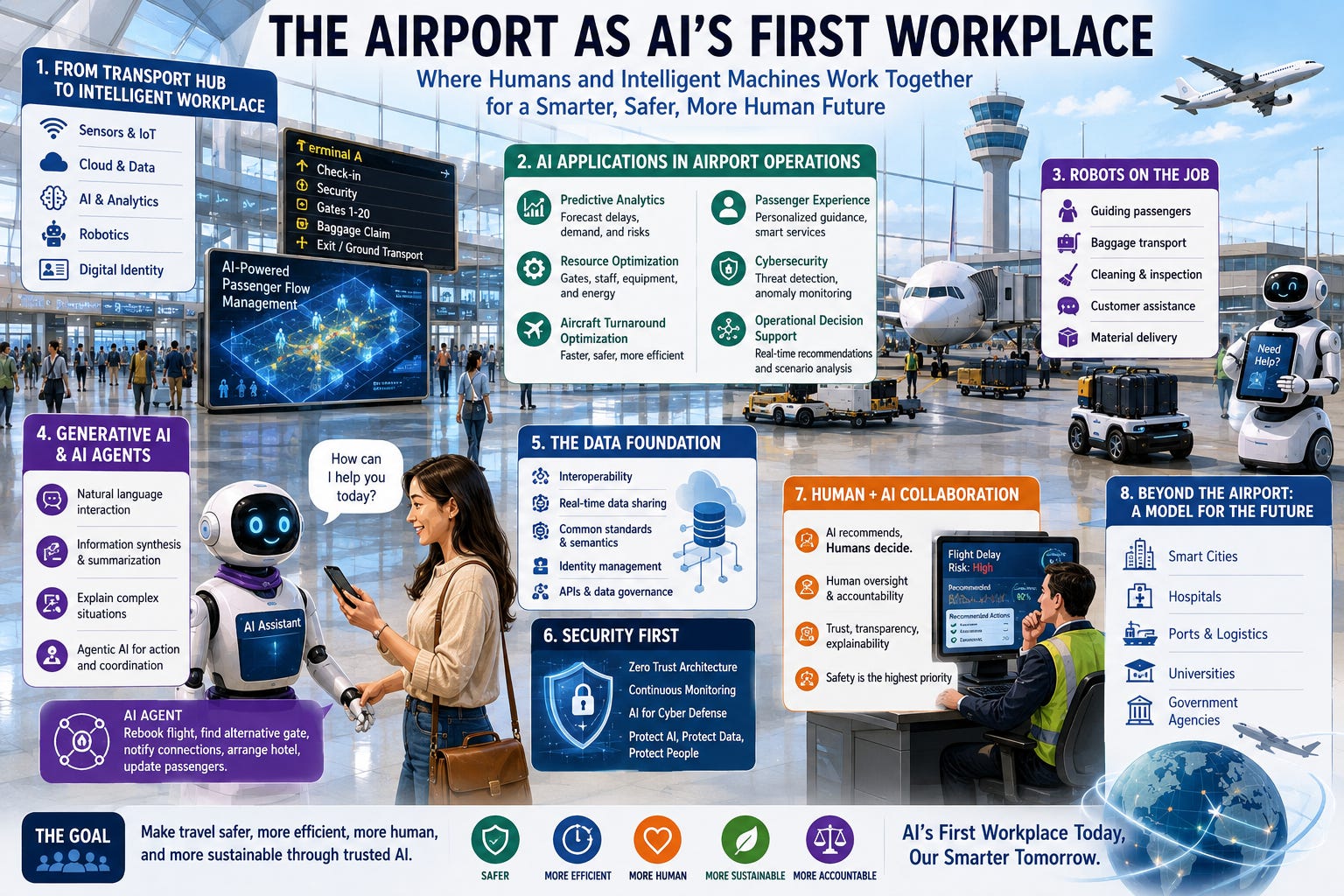
The airport is undergoing a transformation that reaches far beyond automated check-in or robotic assistance. It is becoming one of the most important real-world testbeds for artificial intelligence, generative AI, robotics, and human–AI collaboration. SITA reports that 79% of airlines regard generative AI and large language models as a leading investment priority, while airports are expanding AI applications in passenger-flow management, aircraft turnaround, cybersecurity, and operational decision-making (SITA, 2026). Recent academic research likewise identifies predictive analytics, resource optimization, safety, autonomous processes, and passenger services as major areas of AI adoption in aviation (Geske et al., 2024; Lozano Tafur et al., 2024). This transformation raises a larger question: if the airport becomes AI’s first workplace, what can aviation teach us about the future relationship between humans and intelligent machines?
Keywords: artificial intelligence, generative AI, airports, aviation, robotics, human–AI collaboration, cybersecurity
From Transportation Hub to Intelligent Workplace
For most of modern history, an airport has been a place of movement. Its purpose was to move passengers and aircraft safely and efficiently. Today, however, the airport is becoming a complex digital ecosystem in which sensors, biometric systems, cloud computing, robotics, predictive analytics, and AI operate together.
SITA’s recent industry research illustrates the scale of this transformation. AI is already being used by airports for passenger-flow management, aircraft turnaround, cybersecurity, and other operational functions, while airlines are increasingly using AI for operational decisions and passenger services. Most notably, 79% of airlines identify generative AI and large language models as a major investment priority (SITA, 2026).
The significance of this development is not simply that airports are adopting another technology. AI is moving from the laboratory into a workplace where its decisions can affect real people, real schedules, and real physical systems.
That makes the airport an unusually important testbed for the future of AI.
Why the Airport Is an Ideal AI Testbed
Airports present a unique combination of complexity, uncertainty, and time pressure. Thousands of passengers, aircraft, employees, vehicles, security systems, and digital platforms interact continuously. Weather changes, flights are delayed, gates become unavailable, passengers miss connections, and baggage systems experience disruptions.
An AI system operating in such an environment cannot merely generate a plausible answer. It must make useful predictions, integrate heterogeneous data, respond rapidly to changing circumstances, and recognize when its own recommendations are uncertain.
A systematic review by Geske et al. (2024) identifies four major areas of AI’s contribution to air passenger transport: predictive analytics, resource optimization, safety and autonomous processes, and passenger experience. Lozano Tafur et al. (2024) similarly find extensive AI applications in trajectory prediction, air traffic management, aircraft performance, sustainability, and operational risk reduction.
The airport therefore represents a transition from AI as an experimental technology to AI as an operational participant.
Robots Get Their First Jobs
The transformation is also physical.
Airport robots can guide passengers, transport materials, assist travelers, support cleaning, and provide information. Recent research demonstrates how AI-powered service robots are moving toward real-world passenger-flow management rather than remaining purely experimental technologies (Giannopoulou & Demestichas, 2026).
This development changes the meaning of automation.
Industrial machines traditionally replaced or augmented physical labor. AI-powered robots can now perceive environments, communicate with people, interpret instructions, and adapt their behavior.
A robot that simply points toward Gate 25 is an automated device.
A robot that recognizes a confused passenger, checks the passenger’s flight status, calculates walking time, and communicates with the gate represents something fundamentally different.
It is beginning to work.
Generative AI and the Rise of the AI Agent
Generative AI adds another layer to airport intelligence. Aviation is a language-intensive industry. Passengers ask questions, employees interpret instructions, managers analyze reports, and operational teams coordinate through continuous communication.
Large language models can potentially become interfaces connecting people with complex airport information systems. Instead of navigating multiple databases, an employee could ask an AI assistant a natural-language question and receive an integrated operational response.
The next step is agentic AI.
A predictive system may identify a delayed flight. A generative AI system may explain the delay. An agentic system could potentially evaluate alternative gates, passenger connections, crew availability, and baggage requirements and then recommend a recovery plan.
This represents a fundamental change:
AI is moving from answering questions to participating in decisions.
That change makes governance much more important.
The Hidden Problem: Data
The greatest obstacle to intelligent airports may not be insufficient AI.
It may be fragmented data.
Airlines, airports, ground handlers, security agencies, border authorities, and transportation providers often operate different information systems. SITA reports that data integration and consistency remain major challenges for airlines despite enormous investment in aviation technology (SITA, 2026).
An intelligent airport therefore requires more than powerful AI models. It requires an architecture in which systems can exchange information securely and understand its meaning.
Interoperability, APIs, identity management, real-time data streams, cybersecurity, and shared operational standards may ultimately be as important as the underlying AI model.
The airport cannot become intelligent if its systems cannot communicate with one another.
The Security Paradox
The smarter the airport becomes, the more attractive it becomes as a cyber target.
AI can improve cybersecurity by identifying anomalies, detecting attacks, and accelerating incident response. At the same time, AI systems introduce new vulnerabilities, including prompt injection, data poisoning, compromised APIs, manipulated sensor data, and attacks against connected devices.
SITA reports that cybersecurity remains a top technology priority for airports, while AI itself is increasingly being used as a cybersecurity tool (SITA, 2026).
This creates a fundamental paradox: AI must protect the airport while the airport must protect AI.
A trustworthy AI airport therefore requires strong identity management, least-privilege access, network segmentation, continuous monitoring, secure model development, auditability, and human authorization for high-impact decisions.
Humans Must Remain Responsible
The central issue is not whether AI will replace airport workers.
It is how humans and AI will work together.
EASA’s human-centric AI roadmap emphasizes trustworthiness, safety, human factors, and appropriate levels of human involvement in aviation AI (European Union Aviation Safety Agency [EASA], 2026). The FAA likewise recognizes that AI and machine learning require specialized assurance within aviation certification and safety frameworks (Federal Aviation Administration [FAA], 2026).
This leads to a simple principle:
The more consequential the decision, the more important meaningful human oversight becomes.
AI should be able to recommend. It should sometimes be able to automate. But humans must remain capable of understanding, challenging, and overriding AI decisions.
Aviation cannot afford a system in which responsibility disappears behind an algorithm.
The Airport as a Prototype of the Intelligent City
The importance of AI-enabled airports extends beyond aviation.
An airport is essentially a small city. It has transportation, energy, security, retail, communications, identity systems, government agencies, private businesses, and enormous numbers of people interacting simultaneously.
What is learned at an airport can therefore be transferred to hospitals, universities, ports, factories, government agencies, and smart cities.
The airport may become a prototype for the AI-enabled organization.
It will teach us how humans, robots, software agents, sensors, and institutions can operate together in real time.
Conclusion: AI’s First Workplace
The airport is no longer simply a place where people travel.
It is becoming a place where intelligent machines learn to work.
AI is already predicting, optimizing, monitoring, communicating, and supporting decisions. Robots are beginning to interact directly with passengers. Generative AI is becoming a major investment priority. The airport is consequently evolving from a transportation hub into a living laboratory for the intelligent workplace.
But the ultimate measure of success will not be the number of robots or AI systems deployed.
It will be whether those systems make travel safer, more efficient, more humane, and more accountable.
The airport may become AI’s first workplace. What we learn there will shape much more than aviation. It may determine how we design the workplaces, organizations, and cities of the coming AI civilization.
The most important question is therefore not whether machines can work.
It is whether humans can teach intelligent machines what responsible work means.
References
European Union Aviation Safety Agency. (2026). Artificial intelligence roadmap: A human-centric approach to AI in aviation. EASA.
Federal Aviation Administration. (2026). Artificial intelligence–machine learning. U.S. Department of Transportation.
Geske, A. M., Herold, D. M., & Kummer, S. (2024). Artificial intelligence as a driver of efficiency in air passenger transport: A systematic literature review and future research avenues. Journal of the Air Transport Research Society, 3, 100030. https://doi.org/10.1016/j.jatrs.2024.100030
Giannopoulou, E., & Demestichas, P. (2026). AI-powered service robots for smart airport operations: Real-world implementation and performance analysis in passenger flow management. Sensors, 26(3), 806. https://doi.org/10.3390/s26030806
Lozano Tafur, C., Camero, R. G., Aldana Rodríguez, D., Daza Rincón, J. C., & Rativa Saenz, E. (2024). Applications of artificial intelligence in air operations: A systematic review. Results in Engineering, 25, 103742. https://doi.org/10.1016/j.rineng.2024.103742
SITA. (2026). Air transport IT insights 2025. SITA.
AI의 첫 직장이 된 공항: 교통 허브에서 인공지능 실험공간으로
초록
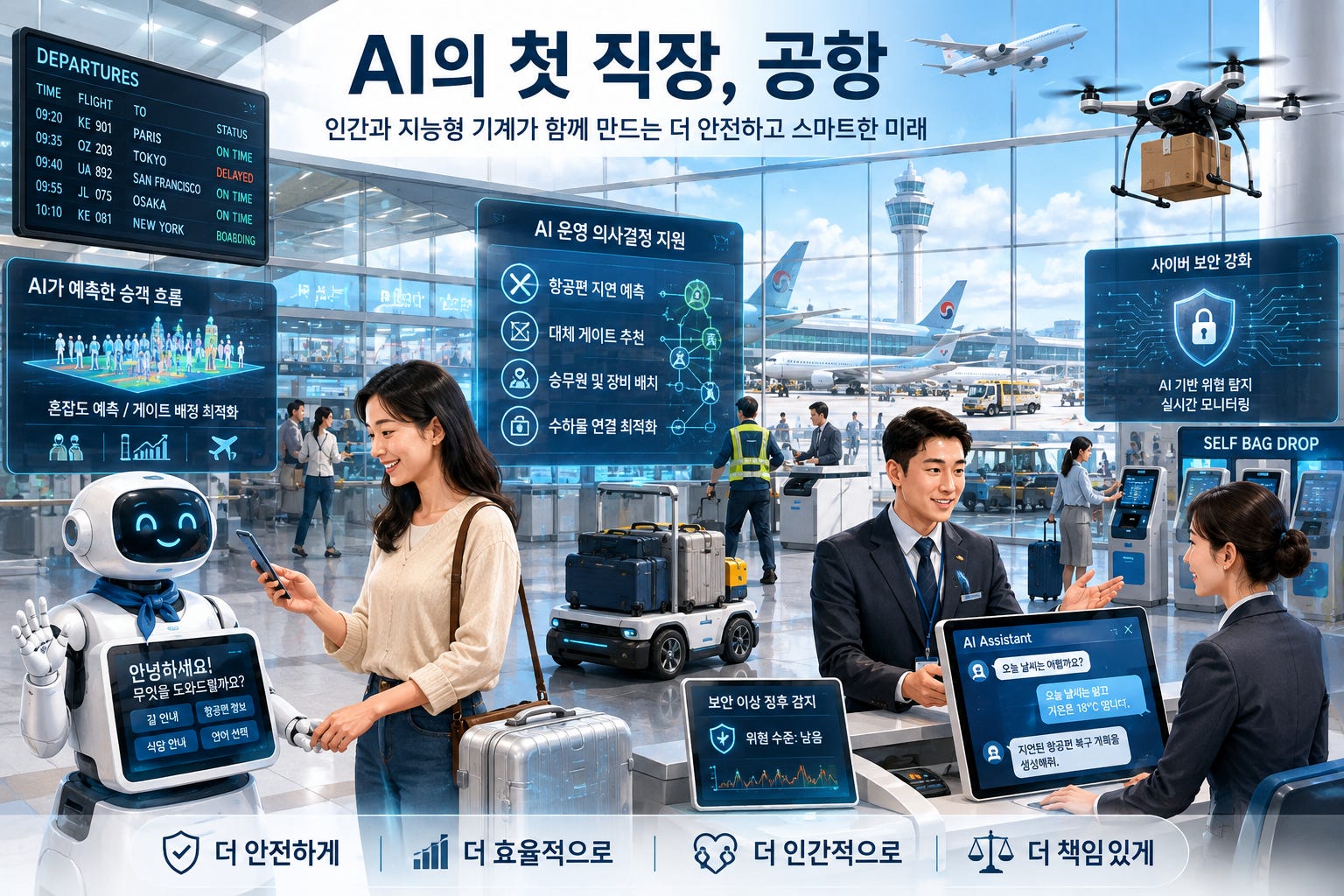
공항이 단순한 자동 체크인이나 로봇 안내 서비스를 넘어 인공지능(AI), 생성형 AI, 로봇공학, 인간–AI 협업을 실험하는 세계적인 현실 공간으로 변하고 있다. SITA의 최근 산업 조사에 따르면 항공사의 79%가 생성형 AI와 대규모 언어 모델(LLM)을 주요 투자 우선순위로 꼽고 있으며, 공항에서는 승객 흐름 관리, 항공기 턴어라운드, 사이버보안, 운영 의사결정 등으로 AI 활용 영역이 확대되고 있다(SITA, 2026). 최근 학술연구 역시 항공 분야 AI의 주요 활용 영역으로 예측 분석, 자원 최적화, 안전 및 자율화, 승객 서비스를 제시한다(Geske et al., 2024; Lozano Tafur et al., 2024). 이러한 변화는 중요한 질문을 던진다. 공항이 AI의 첫 번째 직장이 된다면, 인간과 지능형 기계의 미래 관계에 대해 항공산업은 무엇을 가르쳐줄 수 있는가?
핵심어: 인공지능, 생성형 AI, 공항, 항공산업, 로봇, 인간–AI 협업, 사이버보안
교통 허브에서 지능형 업무 공간으로
현대사 대부분에서 공항은 이동을 위한 공간이었다. 공항의 목적은 승객과 항공기를 안전하고 효율적으로 이동시키는 것이었다. 그러나 오늘날 공항은 센서, 생체인식 시스템, 클라우드 컴퓨팅, 로봇, 예측 분석, AI가 함께 작동하는 복합적인 디지털 생태계로 변하고 있다.
SITA의 최근 산업 조사에서도 이러한 변화의 규모를 확인할 수 있다. 공항들은 승객 흐름 관리, 항공기 턴어라운드, 사이버보안 및 기타 운영 분야에 AI를 활용하고 있으며, 항공사들은 운영 의사결정과 승객 서비스에 AI 활용을 확대하고 있다. 특히 항공사의 79%가 생성형 AI와 대규모 언어 모델을 주요 투자 우선순위로 보고 있다(SITA, 2026).
이 변화의 의미는 단순히 공항이 또 하나의 새로운 기술을 도입한다는 데 있지 않다. AI가 연구실을 떠나 실제 사람과 일정, 물리적 시스템에 영향을 미치는 업무 현장으로 들어오고 있다는 데 있다.
그런 의미에서 공항은 AI의 미래를 시험하는 매우 중요한 하나의 실험장이 되고 있다.
왜 공항은 AI의 이상적인 시험장인가
공항은 복잡성, 불확실성, 시간 압박이 동시에 존재하는 독특한 환경이다. 수많은 승객, 항공기, 직원, 차량, 보안 시스템과 디지털 플랫폼이 끊임없이 상호작용한다. 날씨가 변하고, 항공편이 지연되며, 게이트가 갑자기 사용할 수 없게 되고, 승객이 연결편을 놓치며, 수하물 시스템에 장애가 발생한다.
이러한 환경에서 AI는 단순히 그럴듯한 답을 만들어내는 것만으로는 충분하지 않다. 유용한 예측을 하고, 서로 다른 데이터를 통합하며, 변화하는 상황에 신속하게 대응하고, 자신의 판단이 불확실한 순간을 인식할 수 있어야 한다.
Geske et al.(2024)은 항공 여객 운송에서 AI가 기여할 수 있는 주요 영역을 예측 분석, 자원 최적화, 안전 및 자율화, 승객 경험의 네 가지로 정리한다. Lozano Tafur et al.(2024) 역시 항공 운항에서 AI가 비행경로 예측, 항공교통관리, 항공기 성능, 지속가능성, 운영 위험 감소 등에 폭넓게 활용되고 있음을 보여준다.
따라서 공항은 ‘실험적 기술로서의 AI’에서 ‘운영에 참여하는 AI’로 넘어가는 하나의 전환점이라고 말할 수 있다.
로봇이 첫 직장을 얻다
변화는 소프트웨어에만 국한되지 않는다.
공항 로봇은 승객에게 길을 안내하고, 물자를 운반하며, 여행객을 지원하고, 청소를 돕고, 정보를 제공할 수 있다. 최근 연구는 AI 기반 서비스 로봇이 단순한 실험 단계를 넘어 실제 승객 흐름 관리에 활용되는 단계로 나아가고 있음을 보여준다(Giannopoulou & Demestichas, 2026).
이러한 발전은 자동화의 의미를 변화시킨다.
산업용 기계는 전통적으로 인간의 육체노동을 대체하거나 보조했다. 그러나 AI 기반 로봇은 주변 환경을 인식하고, 사람과 의사소통하며, 지시를 해석하고, 상황에 따라 행동을 조정할 수 있다.
단순히 Gate 24 방향을 가리키는 로봇은 자동화된 기계다.
그러나 혼란스러워하는 승객을 인식하고, 승객의 항공편 상태를 확인하며, 게이트까지 걸리는 시간을 계산하고, 필요하면 게이트에 연락하는 로봇은 전혀 다른 존재다.
그것은 이제 서비스 로봇이 일하기 시작한 것이다.
생성형 AI와 AI 에이전트의 등장
생성형 AI는 공항의 지능화에 또 하나의 층위를 더한다. 항공산업은 본질적으로 언어가 많이 사용되는 산업이다. 승객은 질문하고, 직원은 지침을 해석하며, 관리자는 보고서를 분석하고, 운영팀은 끊임없이 정보를 교환한다.
‘대규모 언어 모델’은 사람과 복잡한 공항 정보 시스템을 연결하는 인터페이스가 될 가능성이 있다. 직원이 여러 데이터베이스를 직접 검색하는 대신 자연어로 질문하고 통합된 운영 정보를 얻을 수 있는 것이다.
그다음 단계는 ‘에이전틱 AI(Agentic AI)’다.
‘예측 시스템’은 항공편 지연 가능성을 알려줄 수 있다. 생성형 AI는 그 지연의 원인을 설명할 수 있다. 에이전틱 AI는 게이트, 환승 승객, 승무원, 수하물 등을 종합적으로 분석하여 회복 계획을 제안할 수 있다.
이것은 근본적인 변화를 의미한다.
AI가 질문에 답하는 단계에서 ‘의사결정에 참여하는 단계’로 이동하고 있는 것이다.
그리고 이러한 변화는 AI 거버넌스의 중요성을 더욱 높인다.
숨겨진 문제: 데이터
지능형 공항이 직면한 가장 큰 장애물은 AI 자체의 성능 부족이 아닐 수도 있다.
오히려 분산되고 단절된 데이터'가 더 큰 문제가 될 수 있다.
항공사, 공항, 지상조업업체, 보안기관, 출입국기관 및 교통기관은 서로 다른 정보시스템을 사용하는 경우가 많다. SITA는 항공산업의 막대한 기술 투자에도 불구하고 ‘데이터 통합과 일관성이 여전히 중요한 문제’라고 지적한다(SITA, 2026).
따라서 지능형 공항에는 강력한 AI 모델만 필요한 것이 아니다. 서로 다른 시스템이 안전하게 정보를 교환하고 그 의미를 공유할 수 있는 구조가 필요하다.
상호운용성, API, 신원관리, 실시간 데이터 스트림, 사이버보안, 공동 운영 표준은 AI 모델 자체만큼이나 중요할 수 있다.
시스템끼리 서로 소통하지 못한다면 공항은 지능화될 수 없다.
보안이라는 역설
공항이 지능화될수록 사이버 공격의 매력적인 목표가 될 가능성도 커진다.
AI는 이상 징후를 식별하고, 공격을 탐지하며, 사고 대응을 빠르게 함으로써 사이버보안을 강화할 수 있다. 그러나 동시에 AI 시스템 자체가 새로운 공격 표면을 만든다. 프롬트 인젝션, 데이터 오염, API 공격, 센서 데이터 조작, 연결된 장치에 대한 공격 등이 그 예다.
SITA는 사이버보안이 공항의 핵심 기술 투자 분야이며 AI 자체도 사이버보안 도구로 점점 더 활용되고 있다고 보고한다(SITA, 2026).
여기에는 중요한 역설이 있다.
AI가 공항을 보호해야 하는 동시에 공항은 AI를 보호해야 한다.
따라서 지능형 공항에는 강력한 신원관리, 최소권한 접근, 네트워크 분할, 지속적인 모니터링, 안전한 AI 모델 개발, 감사 가능성, 그리고 중요한 의사결정에 대한 인간의 승인 등이 필요하다.
인간은 책임을 유지해야 한다
가장 중요한 문제는 AI가 공항 노동자를 대체할 것인가가 아니다.
진짜 질문은 인간과 AI가 어떻게 함께 일할 것인가이다.
유럽연합항공안전청(EASA)의 인간 중심 AI 로드맵은 항공 AI에서 신뢰성, 안전, 인간요소 및 적절한 인간 참여 수준을 강조한다(EASA, 2026). 미국 연방항공청(FAA) 역시 AI와 머신러닝이 항공 인증과 안전체계 안에서 특별한 검증과 보증을 필요로 한다는 점을 강조한다(FAA, 2026).
여기서 중요한 원칙이 나온다.
의사결정의 영향력이 클수록 의미 있는 인간의 감독은 더욱 중요해진다.
AI는 권고할 수 있다. 일정한 영역에서는 자동화할 수도 있다. 그러나 인간은 AI의 결정을 이해하고, 질문하고, 필요할 경우 이를 거부하거나 수정할 수 있어야 한다.
항공산업은 책임이 알고리즘 뒤로 사라지는 시스템을 받아들일 수 없다.
지능형 도시의 원형이 되는 공항
AI 공항의 중요성은 항공산업을 넘어선다.
공항은 사실상 작은 도시와 같다. 교통, 에너지, 보안, 소매, 통신, 신원관리, 정부기관, 민간기업, 그리고 수많은 사람들이 동시에 상호작용한다.
따라서 공항에서 개발되고 검증되는 기술은 병원, 대학, 항만, 공장, 정부기관 및 스마트시티로 확산될 수 있다.
‘공항은 AI 기반 조직의 원형’이 될 수 있다.
공항은 인간, 로봇, 소프트웨어 에이전트, 센서, 기관이 실시간으로 함께 작동하는 방법을 우리에게 가르쳐줄 것이다.
결론: AI의 첫 번째 직장
공항은 더 이상 사람들이 단순히 여행하는 곳이 아니다.
공항은 지능형 기계가 일하는 방법을 배우는 공간으로 변하고 있다.
AI는 이미 예측하고, 최적화하고, 모니터링하고, 의사소통하며, 의사결정을 지원하고 있다. 로봇은 승객과 직접 상호작용하기 시작했다. 생성형 AI는 항공사의 핵심 투자 분야가 되고 있다. 공항은 교통 허브에서 지능형 업무 공간의 살아 있는 실험실로 변화하고 있다.
그러나 성공의 기준은 로봇이나 AI 시스템의 숫자가 아닐 것이다.
진정한 기준은 이러한 기술이 여행을 더 안전하고, 더 효율적이며, 더 인간적이고, 더 책임 있게 만드는가에 달려 있다.
공항은 AI의 첫 번째 직장이 될 수 있다. 그리고 그곳에서 우리가 무엇을 배우느냐에 따라 항공산업을 넘어 미래의 직장과 조직, 도시의 모습이 결정될 수 있다.
가장 중요한 질문은 결국 이것이다.
기계가 일할 수 있는가가 아니다.
인간이 지능형 기계에게 ‘책임 있게 일한다는 것’의 의미를 가르칠 수 있는가이다.
참고문헌
European Union Aviation Safety Agency. (2026). Artificial intelligence roadmap: A human-centric approach to AI in aviation. EASA.
Federal Aviation Administration. (2026). Artificial intelligence–machine learning. U.S. Department of Transportation.
Geske, A. M., Herold, D. M., & Kummer, S. (2024). Artificial intelligence as a driver of efficiency in air passenger transport: A systematic literature review and future research avenues. Journal of the Air Transport Research Society, 3, 100030. https://doi.org/10.1016/j.jatrs.2024.100030
Giannopoulou, E., & Demestichas, P. (2026). AI-powered service robots for smart airport operations: Real-world implementation and performance analysis in passenger flow management. Sensors, 26(3), 806. https://doi.org/10.3390/s26030806
Lozano Tafur, C., Camero, R. G., Aldana Rodríguez, D., Daza Rincón, J. C., & Rativa Saenz, E. (2024). Applications of artificial intelligence in air operations: A systematic review. Results in Engineering, 25, 103742. https://doi.org/10.1016/j.rineng.2024.103742
SITA. (2026). Air transport IT insights 2025. SITA.
2026년 8월 23일
{솔티}

Prof. Dr. Young Choi (Editor in Chief) — Regent University
Young B. Choi is a Professor in the Department of Engineering & Computer Science at Regent University. He published 38 books with ‘Selected Readings in Cybersecurity’ (2018) (over 800 copies archived globally at university/college libraries around the world) and ‘Cybersecurity Applications and Artificial Intelligence’ (2023) available in seven major world languages. He proposed the world’s first global and universal telecommunications “Service Order Handling (SOH)” Model (T-SOH Model) (1995) with Dr. Adrian Tang. With this innovative research work, he received the IEEE NOMS ’96 Best Paper Award and became the first recipient of the Outstanding Contribution Award of the TeleManagement Forum in 1998. His research areas include Natural Language Processing-focused AI, AI-applied cybersecurity, network and telecom service management, and Korean studies on Gani Choi Rip’s Jeonggwan (靜觀: Quiet Contemplation) philosophy and Shilhak ( 實學: Practical Learning).
© K-GSP (K-Global Scholars and Professionals) Forum. All rights reserved. 2026.
Choi, Y. B. (2026, August 23). The Airport as AI’s First Workplace: From Transportation Hub to AI Testbed. K-GSP.