

EXECUTIVE SUMMARY
Reflection helps people convert experience and information into understanding, wisdom, and purposeful action. Drawing on biblical traditions, classical and literary illustrations, historical records, and broader insights into reflective practice, this research note presents reflection as a disciplined cycle of pausing, observing, writing, interpreting, examining, realigning, and responding. From Robinson Crusoe and Tolstoy to Augustine, The Annals of the Joseon Dynasty, and Peter, the article shows how reflection becomes most meaningful when experience is examined, interpreted, recorded, reconsidered, and translated into renewed action. Reflective writing provides a practical way to preserve lessons, recognize recurring patterns, clarify priorities, strengthen relationships, and align everyday choices with deeper values and purpose.
Keywords: reflection; reflective writing; wisdom; self-examination; purposeful action
1. Introduction
When Robinson Crusoe found himself alone after shipwreck, his first challenge was survival, but over time another challenge emerged: how to understand what had happened to him and what his life now meant. By keeping a journal, taking inventory of his circumstances, recording losses and blessings, and reconsidering his choices, Crusoe gradually transformed raw experience into learning and perspective (Defoe, 2007). His story illustrates a simple but enduring principle: experience by itself does not necessarily make us wiser. What matters is whether we pause long enough to examine what has happened, put it into words, recognize what it is teaching us, and allow that understanding to influence how we live next.
This principle resonates with my own experience as both a missional leader and an IT professional. I have spent much of my life in environments that reward activity, productivity, responsiveness, and constant problem-solving. Ministry can quickly fill with teaching, counseling, planning, and caring for people, while information technology requires precision, continuous learning, and rapid response to changing problems. Over time, however, I have learned that meaningful work is not sustained by activity alone. Whether in ministry, professional life, relationships, or personal growth, reflection is essential because it helps us understand what we are doing, why it matters, what experience is teaching us, and what we should continue, correct, or change.
The need for such reflection has become more important in a world characterized by abundant information, constant communication, competing responsibilities, and pressure for immediate response. People may read widely, attend meetings, listen to teaching, accomplish demanding tasks, and accumulate years of experience while still failing to convert those experiences into deeper understanding, better judgment, healthier relationships, or purposeful direction (Lee, 2026). Busyness can easily be mistaken for progress, accumulated information for wisdom, and repeated experience for learning. Reflection interrupts this pattern by creating a deliberate space between experience and response in which people can identify assumptions, recognize patterns, reconsider priorities, learn from mistakes, and clarify what deserves sustained attention.
Reflection, therefore, is not merely private contemplation or occasional journaling but a disciplined practice of pausing, observing, writing, interpreting, examining, realigning, and acting. In the biblical tradition, it includes listening, pondering, self-examination, gratitude, repentance, and the translation of insight into faithful action, while reflective writing strengthens the process by making thoughts, questions, convictions, and lessons visible enough to revisit and test (Foster, 1998; Peterson, 2005; Willard, 2002). Written reflection is especially valuable because memory fades, impressions remain vague, and lessons are easily lost unless they are articulated and preserved. This article therefore examines how reflection and writing can transform everyday routines, relationships, successes, failures, and accumulated experience into greater self-understanding, wiser judgment, responsible leadership, and purposeful living. By integrating personal, spiritual, literary, historical, and leadership perspectives, this research note develops a practical framework for understanding how accumulated experience can be transformed through reflection into wiser judgment and purposeful action.
2. Balancing Activity and Reflection
A balanced life requires more than efficient activity, because Tolstoy’s The Death of Ivan Ilyich shows how professional achievement, social respectability, and busy routines can fill a life without clarifying its meaning, until crisis forces us to ask whether what we have accomplished has actually shaped us toward deeper values, wiser judgment, and purposeful living (Tolstoy, 2009).
2.1. Daily Routines: Creating Space to Notice and Learn
Daily routines are one of the most practical settings for reflection because much of life is formed through repeated habits rather than dramatic decisions. How people begin the morning, organize work, use technology, manage interruptions, rest, exercise, read, pray, and prepare for the next day gradually shapes attention, character, and well-being. Reflection can be built into these routines through simple practices: reviewing the day, identifying what went well, noticing what created stress or distraction, and naming one adjustment for tomorrow. Biblical traditions of prayer, meditation, Sabbath, and attentiveness reinforce the broader principle that activity becomes more meaningful when people periodically stop to observe what they are becoming through what they repeatedly do (Foster, 1998; Wilhoit, 2008; Willard, 2002).
2.2. Relational Interactions: Learning Through Encounters with Others
Relationships provide another important arena for reflection because interactions often reveal dimensions of ourselves that solitary thinking cannot. Conversations with family members, colleagues, friends, mentors, and people with whom we disagree can expose assumptions, emotional reactions, communication habits, and blind spots. Reflective people ask not only what another person said or did, but also how they themselves responded, whether they listened carefully, what they may have misunderstood, and what responsibility they bear for improving the relationship. The biblical emphasis on compassion, humility, forgiveness, patience, and service offers one framework for this process; the broader lesson is universal: relationships become sources of wisdom when encounters are examined rather than simply experienced and forgotten (Peterson, 2005; Wilhoit, 2008).
2.3. Personal Reflection: Turning Experience into Meaning and Direction
Personal reflection creates intentional space to integrate experiences from work, relationships, successes, failures, disappointments, and unexpected events. It may occur through prayer, journaling, reflective writing, quiet thought, reading, walking, or conversation with trusted mentors, but the purpose is similar: to move beyond immediate reaction and ask what an experience means, what it reveals, and what should follow from it. In the Christian tradition, reflection includes listening to Scripture, examining one’s heart, seeking spiritual guidance, and considering how insight should lead to action; in broader settings, it also includes clarifying values, recognizing recurring patterns, and making more deliberate choices. Reflection becomes most valuable when it leads beyond self-analysis toward wiser judgment, healthier relationships, responsible action, and a clearer sense of purpose (Foster, 1998; Pennebaker, 1997).
Daniel Defoe’s Robinson Crusoe offers a vivid literary example of how interruption can become a school of reflection. Crusoe begins as a restless young man driven by adventure, independence, and the desire to make his own way, but shipwreck and isolation abruptly remove the routines and ambitions that had carried him forward. On the island, he begins to inventory his resources, observe patterns, record events, compare losses with blessings, and reconsider the meaning of his survival through a journal that turns experience into interpretation (Defoe, 2007). His circumstances do not become easy, but his way of seeing them changes as solitude forces him to examine what he values, what he depends on, and what kind of person he is becoming. The larger lesson is that reflection often begins when ordinary momentum is interrupted: experience becomes formative when we stop long enough to observe it, write about it, and ask what it is teaching us.
Reflection turns everyday experience into deeper understanding, wisdom, and purposeful action.
Figure 1
Illustrations of the Value of Reflection and Writing
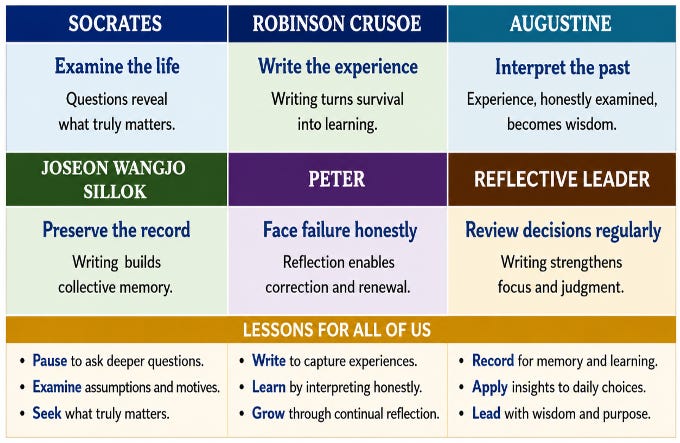
Figure 1 illustrates the value of reflection and writing through six examples: Socrates emphasizes examining life through deeper questions; Robinson Crusoe shows how writing turns experience into learning; Augustine demonstrates how interpreting the past produces wisdom; The Annals of the Joseon Dynasty (조선왕조실록) shows how written records preserve collective memory; Peter illustrates how honest reflection supports correction and renewal; and the reflective leader demonstrates how regular writing strengthens focus and judgment. Together, these examples show that reflection becomes more powerful when experience is paused, examined, interpreted, written down, and revisited rather than simply allowed to pass. The central lesson is that disciplined reflection and writing help individuals and leaders learn from experience, clarify what matters, preserve important insights, improve decisions, and act with greater wisdom and purpose.
Writing turns experience into insight—and insight into wiser action.
3. Sources of Deeper Reflection
Deeper reflection draws on sources that can challenge immediate preference and self-centered interpretation. These include creation and the world around us, Scripture and enduring wisdom, exemplary lives, and inner discernment. Together, they broaden perspective and help reflection move from private feeling toward tested judgment, moral direction, and responsible action.
3.1. Learning from Creation and the World Around Us
The biblical creation account presents a pattern of speaking, observing, and recognizing what is good, suggesting that careful attention to the world can itself become a form of reflection. Nature invites people to notice order, change, interdependence, beauty, limits, and renewal; ordinary life offers similar lessons through work, family, community, and changing circumstances. Reflection begins when people move beyond simply passing through these experiences and ask what they reveal about responsibility, resilience, stewardship, and human dependence on one another and on the larger environment. The natural world and everyday experience can therefore become important teachers when approached with curiosity, humility, and sustained attention (Brueggemann, 1997; Goldingay, 2003).
3.2. Learning from Scripture, Enduring Wisdom, and Exemplary Lives
Reflection is also strengthened by engaging sources of wisdom that have endured across generations. Within the Christian tradition, Scripture provides a framework for examining character, responsibility, justice, suffering, forgiveness, hope, and purpose, while the life of Jesus offers a concrete model of compassion, courage, humility, service, and integrity. For a wider audience, the same principle extends to serious engagement with literature, philosophy, history, biography, and other traditions of moral thought. Such sources matter when they do more than provide information, when they challenge assumptions and raise difficult questions about how we live, treat others, respond to adversity, use power, and define a meaningful life.
Augustine’s Confessions illustrates how reflection can reconstruct the meaning of a life rather than merely record its events. Looking backward, Augustine revisits ambition, friendships, intellectual searching, desires, mistakes, and conversion, asking how experiences that once seemed disconnected fit within a larger story of longing and transformation (Augustine, 1991). The power of the work lies not simply in what happened to him, but in how he interprets what happened and what those experiences reveal about the person he was becoming. In this sense, memory becomes more than recollection; it becomes a disciplined source of self-knowledge, gratitude, correction, and direction. Experience itself does not automatically produce wisdom; interpreted experience does.
Korea’s written historical culture offers a complementary example of reflection at the institutional level. The Annals of the Joseon Dynasty (조선왕조실록) documented more than 470 years of royal and governmental life through a disciplined system of court historiographers whose records were protected from direct royal interference and preserved for later generations (National Institute of Korean History, n.d.; UNESCO, 1997). The purpose was not merely to store information but to create an enduring historical memory through which later rulers and officials could examine earlier decisions, successes, failures, and consequences. The National Institute of Korean History describes this tradition as providing a “mirror for reflection” to future generations, capturing an important principle: written culture allows experience to outlive the people who first lived it. For individuals, organizations, churches, and nations alike, disciplined records can therefore become more than archives; they can become instruments of accountability, institutional learning, identity, and wiser future judgment.
3.3. Cultivating Inner Discernment and Transformative Response
The Christian tradition describes the Holy Spirit as a source of guidance, conviction, comfort, and inner transformation, emphasizing that reflection must reach beyond intellectual understanding into conscience, motivation, and action. More broadly, reflective living requires attentiveness to inner responses, fears, hopes, impulses, values, and recurring patterns, and the willingness to test whether those responses are consistent with the person one seeks to become. Writing, prayer, quiet reflection, and conversation with trusted mentors can make these inner movements more visible and open to examination. The goal is not endless introspection, but clearer judgment, greater self-awareness, stronger relationships, and actions increasingly aligned with one’s deepest values and sense of purpose (Foster, 1998; Willard, 2002).
4. From Reflection to Response
Meaningful reflection moves beyond receiving information and experience toward thoughtful response. It helps us interpret what happens, accept responsibility, correct our course, and make wiser choices so that listening and self-examination lead to purposeful action, gratitude, and renewed commitment.
4.1. Responding Constructively: From Insight to Responsible Action
A constructive response begins with careful listening and the willingness to act on what one has learned. Biblical figures such as Abraham, Moses, Isaiah, and Mary illustrate this movement from reflection to commitment: Abraham moved toward an uncertain future, Moses confronted fear and self-doubt to accept responsibility, Isaiah acknowledged his limitations before responding to a call, and Mary accepted a difficult vocation despite personal uncertainty. These stories point to a broadly recognizable pattern: meaningful action requires trust, courage, humility, and movement beyond comfort. Reflection reaches maturity when insight changes behavior, priorities, and relationships, whether through taking responsibility at work, changing an ineffective practice, speaking when necessary, listening more carefully, apologizing, forgiving, or keeping a difficult commitment.
4.2. Responding Poorly: Learning from Avoidance, Anger, and Misjudgment
Biblical narratives also preserve examples of destructive responses because failure can be an important teacher. Adam responds to wrongdoing with fear, hiding, and blame; Cain allows disappointment and resentment to develop into violence despite warning signs; and Solomon, despite extraordinary wisdom and early promise, gradually permits competing desires to weaken earlier commitments. These stories expose familiar tendencies: avoiding responsibility, ignoring warning signs, rationalizing questionable choices, and allowing short-term desire to overpower long-term values. Similar patterns appear in contemporary professional and personal life when criticism, mistakes, conflict, or disappointment are met with denial, defensiveness, blame, or avoidance. Reflection can interrupt this pattern by asking difficult questions: What am I avoiding? What role did I play? What assumptions are shaping my reaction? What will happen if I continue in this direction? (Calvin, 1960; Goldingay, 2003).
4.3. Reconsidering, Correcting, and Beginning Again
One of the most important dimensions of reflection is the ability to reconsider one’s direction. The biblical concept of repentance, expressed through shuv, turning or returning, and metanoia, a change of mind and direction, shows that a poor response need not become a permanent pattern. Reflection creates an opportunity to recognize error, accept responsibility, reconsider assumptions, and choose a better course. In Christian understanding, this process is grounded in grace and reconciliation with God; in broader human experience, it also expresses the capacity to learn from mistakes. Through prayer, reflective writing, honest conversation, feedback, and self-examination, people can identify what needs to change while also recognizing what deserves gratitude and continued commitment. Reflection therefore becomes a hopeful discipline of renewal: listen carefully, examine honestly, acknowledge mistakes, make necessary changes, appreciate what is good, and move forward with greater wisdom and purpose (Barth, 1960; Willard, 2002).
Peter’s story brings the full movement from reflection to response into one narrative. He confidently promised loyalty to Jesus, yet under pressure denied knowing him three times; when he recognized what he had done, he went out and wept bitterly. The story does not end with failure: after the resurrection, Jesus restored Peter through a deeply personal conversation and recommissioned him to care for others (Luke 22:54–62; John 21:15–19). Peter could not undo his denial, but he could face it truthfully, receive grace, and return to his calling with greater humility. His experience joins the three movements considered in this section, responsible commitment, painful recognition of failure, and the possibility of beginning again. Reflection does not merely help us understand where we failed; it can help us return differently.
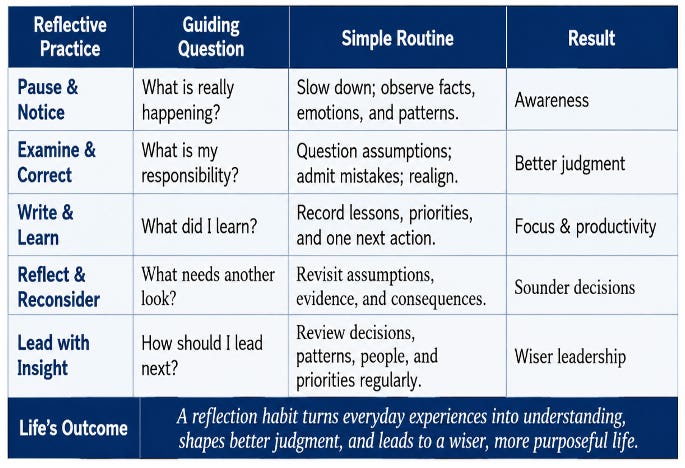
Table 1 presents reflection as a practical habit that moves individuals from awareness toward better judgment and wiser leadership. It begins with pausing to notice what is happening, then examining personal responsibility, writing down lessons, and reconsidering assumptions, evidence, and consequences. The table also shows that regular reflection can strengthen focus, productivity, decision quality, and leadership insight by turning experience into a source of learning rather than allowing it to pass unnoticed. Its guiding questions and simple routines make reflection concrete and applicable to everyday work, relationships, and personal development. The central message is that a consistent reflection habit transforms ordinary experiences into deeper understanding, better judgment, and a wiser, more purposeful life.
Table 1
From Reflection to Better Judgment and Leadership
Source: Authors’ Own Synthesis
5. Conclusion
Reflection is a disciplined practice of examining experience so that insight can shape character, judgment, relationships, and purposeful action, as illustrated by Socrates, Ivan Ilyich, Robinson Crusoe, Augustine, The Annals of the Joseon Dynasty (조선왕조실록), and Peter. In the Christian tradition, reflection involves listening to God through creation, Scripture, Jesus Christ, and the Holy Spirit and responding through faith, repentance, gratitude, obedience, and responsible living. Regular reflective writing deepens this practice by clarifying priorities, preserving lessons, revealing recurring patterns, and helping individuals and leaders convert accumulated experience into wiser judgment. Practiced consistently through pausing, observing, writing, interpreting, examining, realigning, and acting, reflection turns experience into wisdom and aligns everyday life with enduring values and purpose.
References
Augustine. (1991). Confessions (H. Chadwick, Trans.). Oxford University Press.
Barth, K. (1960). The humanity of God. John Knox Press.
Brueggemann, W. (1997). Theology of the Old Testament: Testimony, dispute, advocacy. Fortress Press.
Calvin, J. (1960). Institutes of the Christian religion (F. L. Battles, Trans.; J. T. McNeill, Ed.). Westminster Press. (Original work published 1559)
Defoe, D. (2007). Robinson Crusoe (T. Keymer, Ed.). Oxford University Press. (Original work published 1719)
Di Stefano, G., Pisano, G., & Staats, B. R. (2015). Learning by thinking: How reflection aids performance. Academy of Management Proceedings, 2015(1), Article 12709. https://doi.org/10.5465/ambpp.2015.12709abstract
Fee, G. D., & Stuart, D. (2003). How to read the Bible for all its worth (3rd ed.). Zondervan.
Foster, R. J. (1998). Celebration of discipline: The path to spiritual growth (3rd ed.). HarperSanFrancisco.
Goldingay, J. (2003). Old Testament theology: Volume 1, Israel’s gospel. InterVarsity Press.
Klein, K., & Boals, A. (2001). Expressive writing can increase working memory capacity. Journal of Experimental Psychology: General, 130(3), 520–533. https://doi.org/10.1037/0096-3445.130.3.520
Lee, S. D. (2026). God speaks—humanity responds: The meaning and practice of biblical reflection writing and sharing. UBF Press.
National Institute of Korean History. (n.d.). The tradition of compiling history in pre-modern times. https://www.history.go.kr/en/contents/contentsPage.do?groupId=000000000605&menuId=000000000609&pageId=000000000242
Pennebaker, J. W. (1997). Opening up: The healing power of expressing emotions (Rev. ed.). Guilford Press.
Peterson, E. H. (2005). Christ plays in ten thousand places: A conversation in spiritual theology. Eerdmans.
Plato. (2002). Five dialogues: Euthyphro, Apology, Crito, Meno, Phaedo (G. M. A. Grube, Trans.; J. M. Cooper, Rev.). Hackett Publishing.
Tolstoy, L. (2009). The death of Ivan Ilyich and other stories (R. Pevear & L. Volokhonsky, Trans.). Vintage Classics.
UNESCO. (1997). The Annals of the Choson Dynasty. Memory of the World Register. https://www.unesco.org/en/memory-world/annals-choson-dynasty
Wilhoit, J. C. (2008). Spiritual formation as if the church mattered: Growing in Christ through community. Baker Academic.
Willard, D. (2002). Renovation of the heart: Putting on the character of Christ. NavPress.
ABOUT THE AUTHORS
Samuel D. Lee

Ordained Minister & IT Professional
Samuel D. Lee is an ordained minister, missionary, and biblical counselor affiliated with UBF and the Canadian Evangelical Christian Churches. He holds a Ph.D. in religion with a specialization in biblical studies from Bethany Divinity College & Seminary. He is also an experienced IT professional, with more than 20 years of service at IBM as a software developer. His writing and ministry focus on helping individuals deepen their spiritual lives through reflective engagement with Scripture, personal application, and meaningful sharing. He is the author of Meditation, Confession and Healing in Writing Testimonies, first published in 2008.
Paul C. Hong

Distinguished University Professor, University of Toledo
Paul C. Hong is a Distinguished University Professor at the University of Toledo whose research focuses on global supply chain management, innovation, resilience, and international competitiveness. His interdisciplinary work increasingly examines how technology, culture, institutional capability, and human judgment shape leadership and decision-making in the AI era. He contributes to K-GSP Forum through research and writing that connect global change with practical lessons for scholars, professionals, and communities.
Original Article:

Suggested Citation
Lee, S. D., & Hong, P. C. (2026, September 10). The art of reflection: Finding meaning, wisdom, and purpose in everyday life. K-GSP Forum, pp. 1–11.
한글요약
성찰의 예술: 일상에서 의미와 지혜, 삶의 목적을 찾다
Samuel D. Lee는 목회자·선교사·성경상담가이자 IBM에서 20년 이상 근무한 IT 전문가로, 성경적 성찰과 글쓰기를 통한 영적 성장과 삶의 변화를 연구하고 실천해 왔다. Paul C. Hong은 톨레도대학교 석좌교수로서 글로벌 공급망, 혁신, 회복탄력성, 국제경쟁력과 인간의 판단 및 리더십을 폭넓게 연구하고 있다. 두 저자는 현대사회가 속도와 생산성, 즉각적인 반응을 중시할수록 오히려 삶을 멈추어 돌아보고 해석하는 성찰의 필요성이 커진다고 본다. 정보와 경험이 많아지는 것만으로 지혜가 생기는 것은 아니며, 성찰은 경험과 행동 사이에 필요한 여백을 만들어 무엇을 하고 있는지, 왜 그것이 중요한지, 무엇을 배워야 하는지, 앞으로 어떻게 더 지혜롭게 살아야 하는지를 묻게 한다.
성찰의 가치는 문학과 삶의 사례를 통해 더욱 분명하게 드러난다. 톨스토이의 『이반 일리치의 죽음』은 사회적 성공과 바쁜 삶이 반드시 의미 있는 삶을 보장하지 않으며, 삶을 돌아보지 않은 성취가 얼마나 공허해질 수 있는지를 보여준다. 반면 대니얼 디포의 『로빈슨 크루소』는 난파와 고립이라는 강제된 멈춤 속에서 크루소가 자신의 경험과 자원을 기록하고 실패와 감사의 이유를 다시 살피며 삶을 새롭게 해석하는 모습을 보여준다. 이러한 사례는 경험 자체가 사람을 지혜롭게 만드는 것이 아니라, 경험을 멈추어 관찰하고 기록하며 해석할 때 비로소 배움과 방향성이 생긴다는 점을 강조한다.
더 깊은 성찰은 개인의 내면을 넘어 역사와 공동체의 기억으로 확장될 수 있다. 아우구스티누스의 『고백록』은 과거의 야망, 관계, 탐색, 실수와 회심을 다시 해석함으로써 흩어진 경험들을 하나의 의미 있는 삶의 이야기로 통합하며, “해석된 경험이 지혜가 된다”는 원리를 보여준다. 한국의 『조선왕조실록』 역시 기록문화가 단순한 보존을 넘어 후대가 과거의 판단과 결과를 되돌아보는 역사적 거울이 될 수 있음을 보여준다. 개인에게 성찰일지가 필요한 것처럼 조직과 공동체와 국가에도 기록은 책임성, 제도적 학습, 정체성, 그리고 미래의 더 나은 판단을 위한 기반이 될 수 있다.
성찰은 통찰에서 멈추지 않고 책임 있는 행동과 변화로 이어져야 한다. 베드로가 자신의 실패를 직면하고 회복과 새로운 사명으로 나아간 것처럼, 성찰은 잘못을 인정하고 방향을 수정하며 다시 시작하도록 돕는 과정이다. 특히 성찰적 글쓰기는 경험을 축적된 학습으로 바꾸는 실천적 도구가 될 수 있는데, “무슨 일이 있었는가, 무엇을 배웠는가, 지금 가장 중요한 것은 무엇인가, 다음에는 무엇을 다르게 할 것인가”를 정기적으로 기록하면 정신적 혼잡을 줄이고 우선순위를 분명히 하며 반복되는 패턴과 새로운 통찰을 발견하는 데 도움이 된다. 이러한 글쓰기 규율은 특히 리더에게 중요하다. 글을 쓰는 리더는 단순히 자신이 한 일을 기록하는 것이 아니라, 자신이 어떤 리더가 되어 가고 있는지, 무엇을 배워야 하는지, 그리고 다음에는 어떻게 더 지혜롭게 이끌어야 하는지를 성찰할 공간을 만든다.
© K-Global Scholars and Professionals Forum. September 2026. All rights reserved. Content published in the K-GSP Forum may not be reproduced, distributed, or transmitted in any form without prior written permission from the K-GSP Forum, except for brief quotations with full attribution.
Thank you, Dr. Lee and Dr. Hong, for this thoughtful piece. The distinction that "interpreted experience does" produce wisdom — not experience alone — is one I'll carry with me. The Annals of the Joseon Dynasty as a "mirror for reflection" was a beautiful example. A meaningful and timely read.