
The Centenary Hall of Modern Poetry at Baekseok University
South Korea is home to more than one hundred literary museums, reflecting the nation’s deep reverence for literature. One of these is located in Creation Hall at Baekseok University, a private institution in Cheonan, South Chungcheong Province. Established in 2013, the modestly sized Centenary Hall of Modern Poetry presents the development of modern Korean poetry in a clear and accessible manner. It is worth visiting not only for literary scholars but also for general readers interested in the trajectory of Korean poetry since 1900. Visitors can explore major figures in modern Korean poetry, their representative works, and the sociopolitical contexts that shaped their writing. This photo essay presents selected photographs, along with my annotated translations of exhibition captions and additional information about the displays.
I visited the Centenary Hall on May 26, 2023, after touring nearby historic sites associated with Yu Gwan-sun (1902-1920), the Korean independence activist who died in prison during the Japanese colonial period. My visit to the campus was made possible by Dr. Bae-kyun Yoo, a former editorial colleague at Si-sa-yong-o-sa who taught English at Baekseok Culture University and Baekseok University for decades before retiring. We had worked on the same editorial team at the publishing company, and he came to the United States a year earlier than I did to pursue advanced degrees in English, earning an MA and PhD at two state universities in the Great Plains, following a similar academic path. Like me, he has devoted his career not only to teaching, research, and writing but also to editorial work. It was a pleasure to reconnect with a colleague from my twenties, and I am grateful for the generous hospitality he and his wife extended by hosting me overnight.
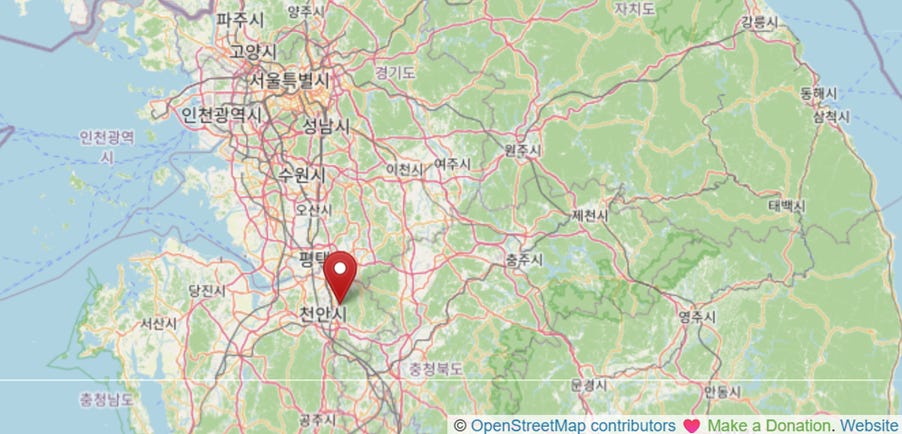
Baekseok University is located in the city of Cheonan, South Chungcheong Province, South Korea. Composite image based on map data © OpenStreetMap contributors.
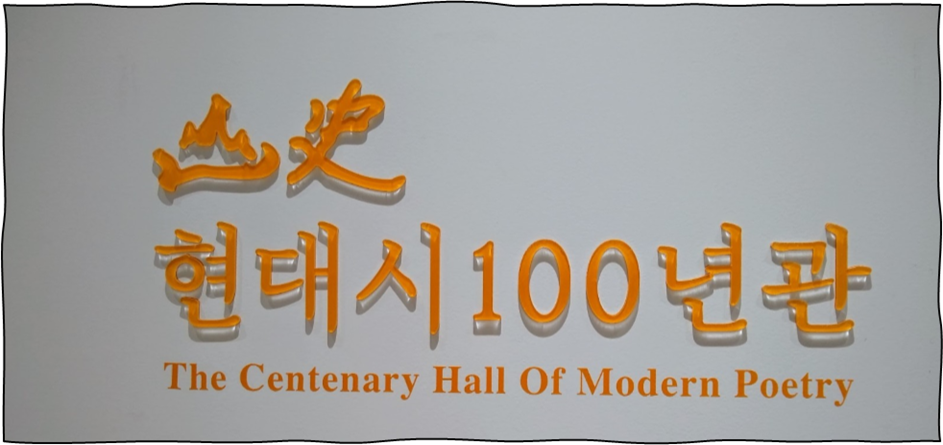
The sign at the entrance of the hall:
The top two Chinese characters (山史, “Chronicle of Mountains”) form the honorific name of the late Professor Kim Jae-hong (1947-2023), who donated the materials exhibited here. In Korea, the characters are pronounced sansa.
The second line is the Korean phrase for “The Centenary Hall of Modern Poetry.”
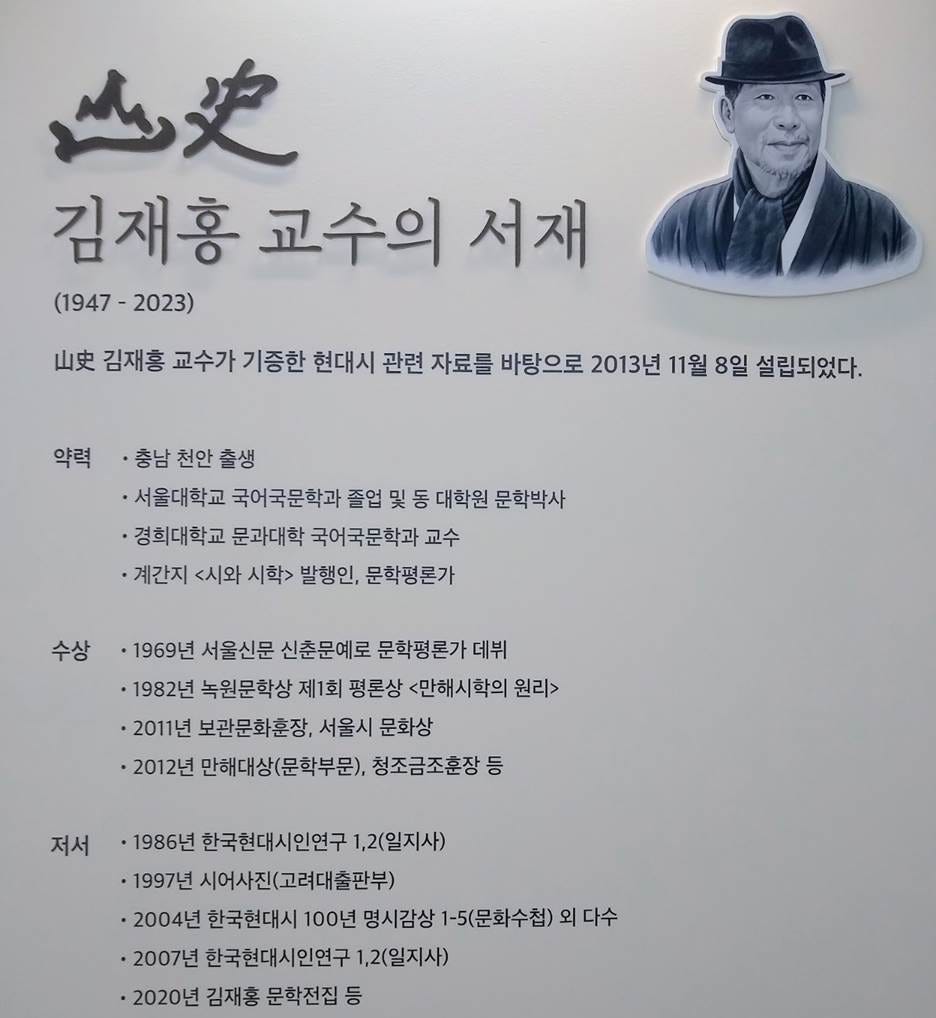
This fact sheet provides a brief biography of and credentials for Professor Kim Jae-hong. A native of Cheonan, he studied Korean language and literature at Seoul National University, where he earned his doctoral degree. He later served as a professor in the Department of Korean Language and Literature at Kyung Hee University in Seoul. A distinguished literary critic, he founded Poetry and Poetics, a quarterly journal. The lower portion of the fact sheet lists his honors, awards, and published books.
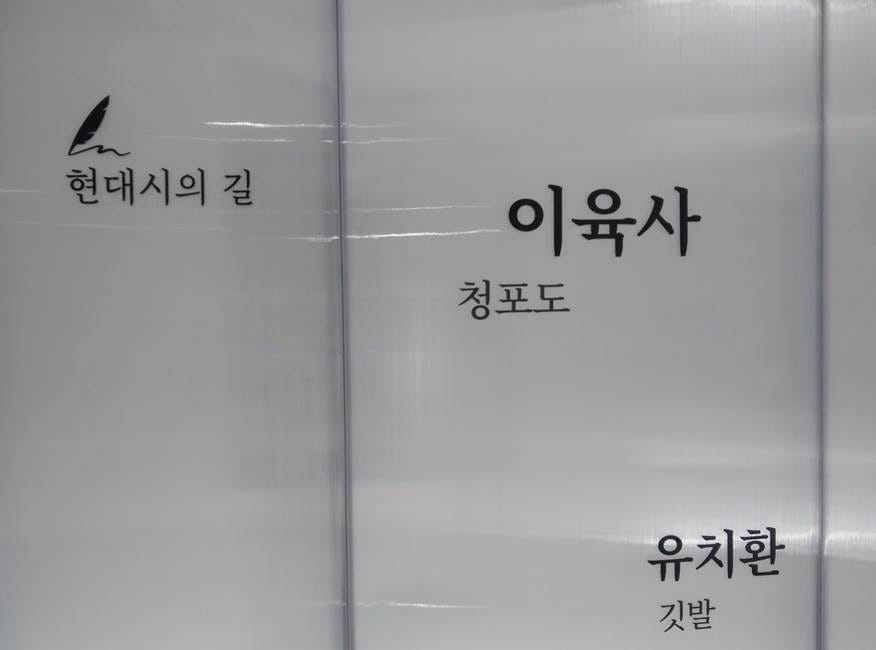
Annotated Translation:
The Path of Modern Poetry
Yi Yuk-sa (1904-1944), “Green Grapes”
Yu Chi-hwan (1908-1967), “Flag”
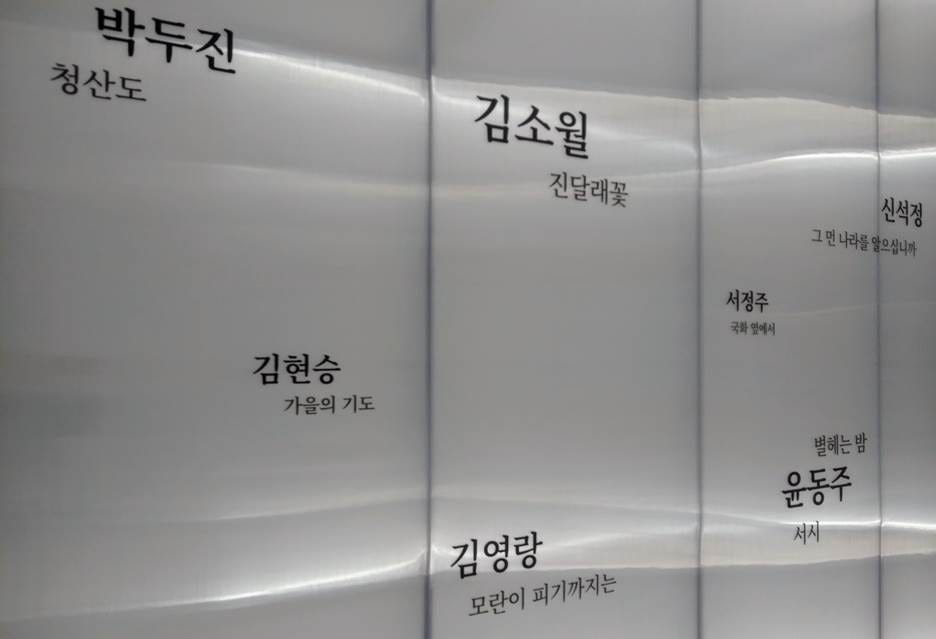
Annotated Translation:
Pak Tu-jin (1916-1998), “Green Mountain Path”
Kim Hyun-seung (1913-1975), “Autumn Prayer”
Kim So-wol (1902-1934), “Azaleas”
Kim Yeong-nang (Kim Yun-sik, 1903-1950), “Until the Peonies Bloom”
Seo Jeong-ju (1915-2000), “Beside the Chrysanthemum”
Shin Seok-jeong (1907-1974), “Do You Know That Faraway Land?”
Yun Dong-ju (1917-1945), “Counting the Stars at Night” and “Prelude”
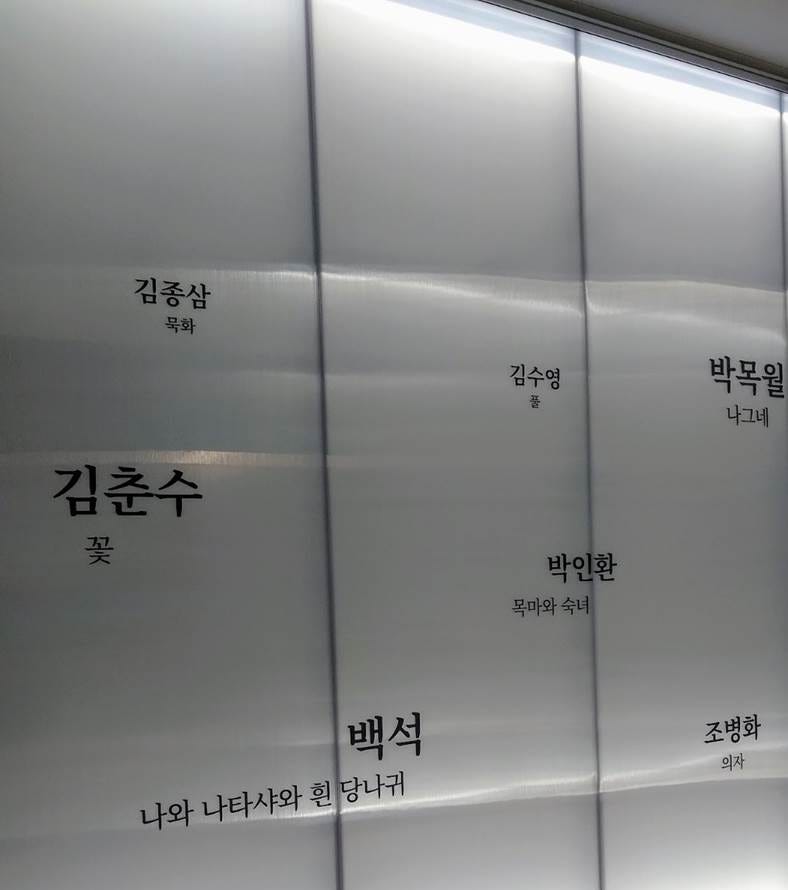
Annotated Translation:
Kim Jong-sam (1921-1984), “Ink Painting”
Kim Chun-su (1922-2004), “Flower”
Baek Seok (Baek Gi-haeng, 1912-1996), “Me, Natasha, and the White Donkey”
Kim Su-yeong (1921-1968), “Grass”
Park In-hwan (1926-1956), “The Wooden Horse and the Lady”
Pak Mok-wol (1916-1978), “The Wayfarer”
Cho Byung-hwa (1921-2003), “Chair”
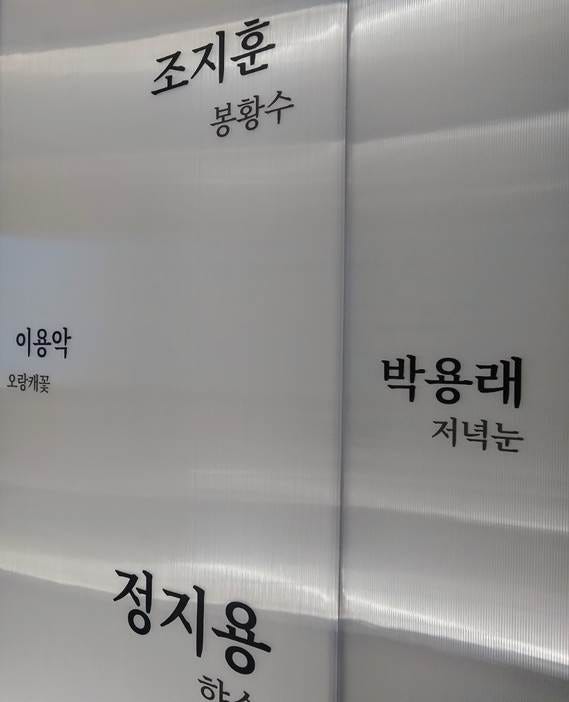
Annotated Translation:
Yi Yong-ak (1914-1971), “Violets”
Cho Ji-hun (1920-1968), “The Grief of the Phoenix”
Park Yong-rae (1925-1980), “Evening Snow”
Jeong Ji-yong (1902-c.1950), “Nostalgia”
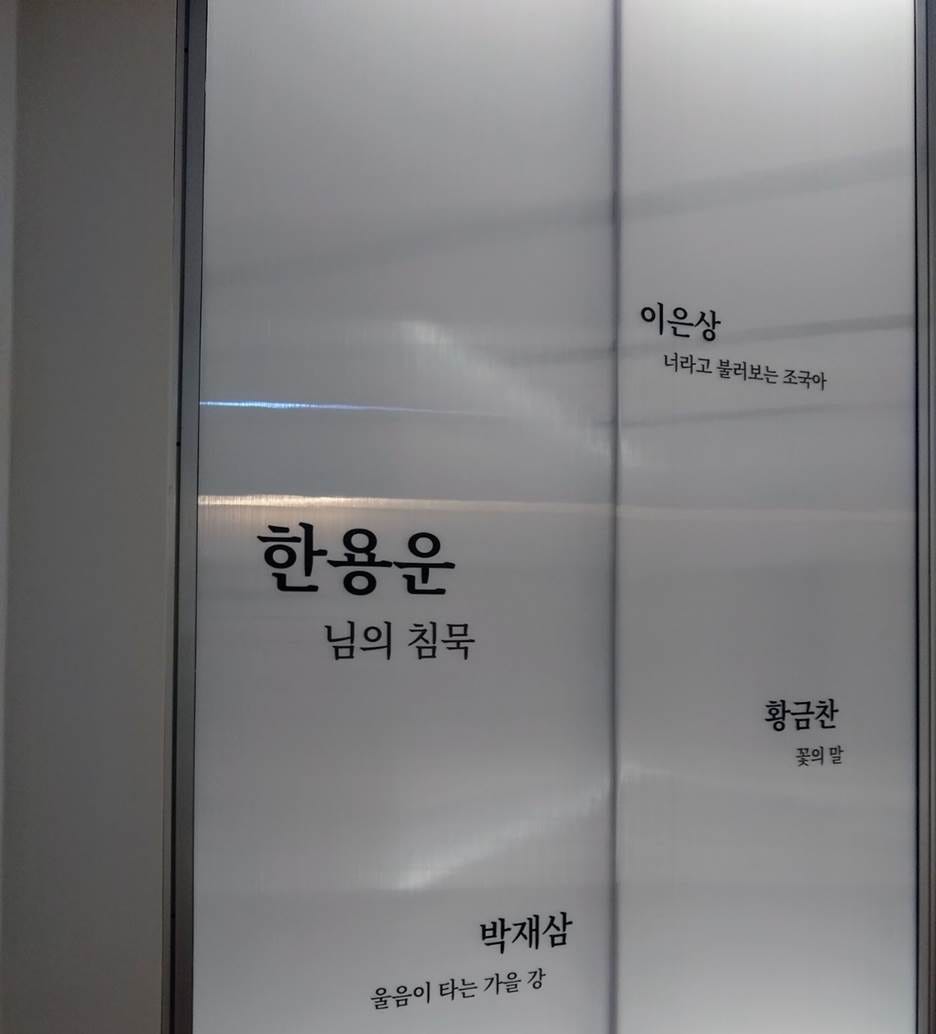
Annotated Translation:
Han Yong-un (1879-1944), “Lover’s Silence”
Park Jae-sam (1933-1997), “The Autumn River Glowing with Lamentation”
Yi Eun-sang (1903-1982), “O Homeland, Let Me Call You ‘You’”
Hwang Geun-chan (1918-2017), “What Flowers Say”
A notable omission among the featured poets is Yi Sang (Kim Hae-gyeong, 1910-1937), renowned for his modernist and avant-garde poem Crow’s Eye View (오감도, 烏瞰圖).
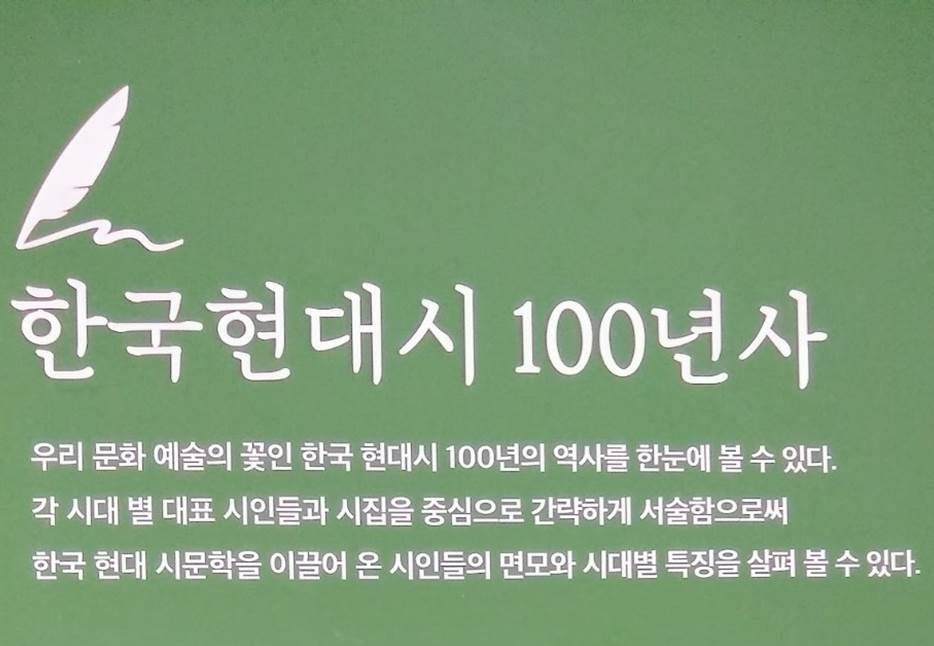
Translation:
One Hundred Years of Modern Korean Poetry
This exhibition traces the one-hundred-year history of modern Korean poetry, a flower of Korean culture and the arts. By providing brief descriptions of representative poets and poetry collections from each period, it offers insight into the poets who shaped modern Korean poetry and the distinctive characteristics of each era.
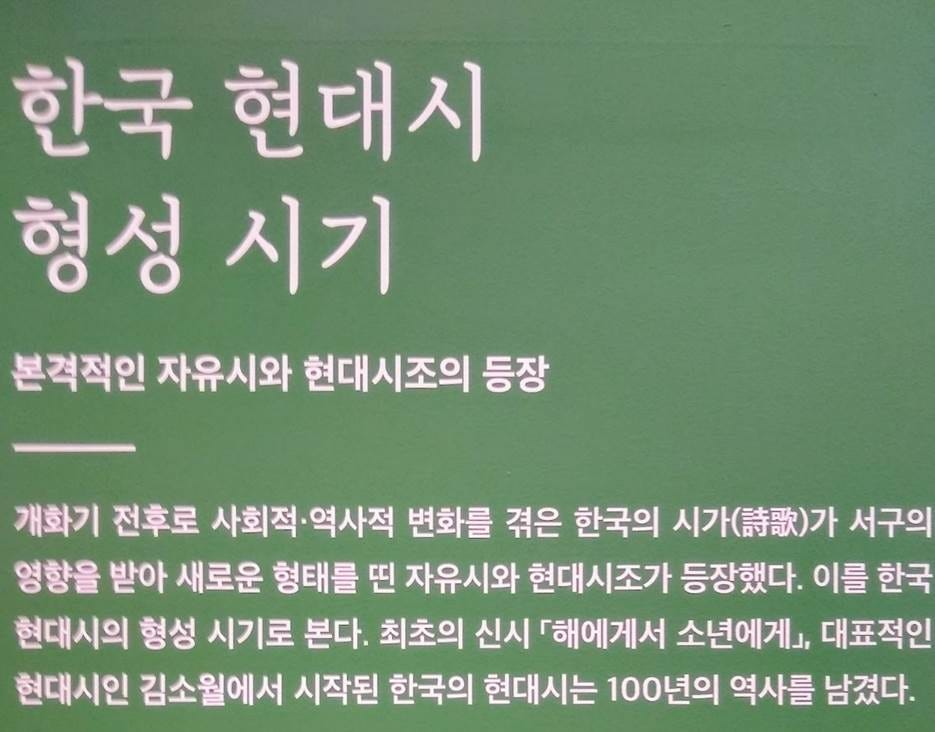
Translation:
The Formation of Modern Korean Poetry
The Emergence of Free Verse and Modern Sijo
Amid the social and historical changes surrounding Korea’s period of modernization, Korean poetry began to take on new forms under the influence of Western literature, giving rise to free verse and modern sijo. This period is regarded as the formative stage of modern Korean poetry. Beginning with Choe Nam-seon’s “From the Sea to a Boy,” often considered the first modern Korean poem, and later exemplified by such major poets as Kim So-wol, modern Korean poetry has developed a history spanning more than a century.
Translator’s note: The original text identifies “From the Sea to a Boy” (Haeeseo Sonyeon-ege, 1908) as the first sin-si (new-style poem) and refers to Kim So-wol as a representative modern poet rather than implying that modern Korean poetry began with him. The translation reflects that distinction.
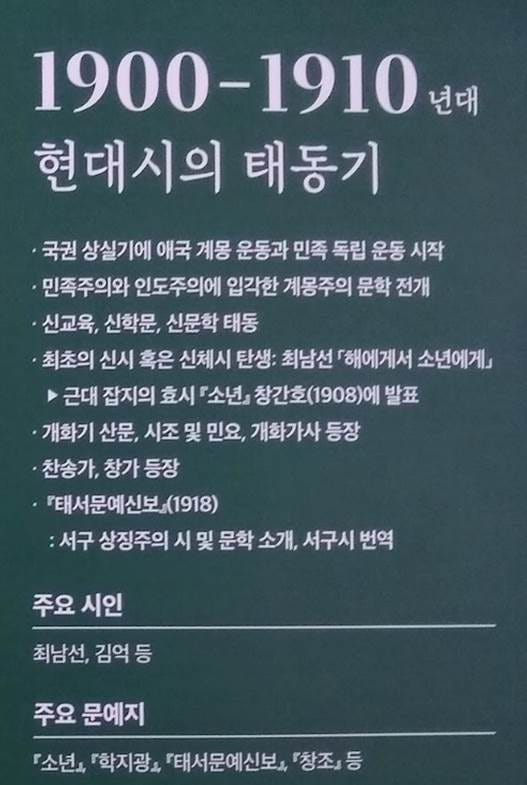
Translation:
1900s-1910s: The Emergence of Modern Korean Poetry
During the period of national sovereignty loss, the patriotic enlightenment movement and the independence movement emerged.
Enlightenment literature grounded in nationalism and humanitarianism developed.
New education, new scholarships, and new literature emerged.
The emergence of sin-si (new poetry) or sinche-si (new-form poetry) is marked by Choe Nam-seon’s “From the Sea to a Boy.” It appeared in the inaugural 1908 issue of Sonyeon (Youth), the first modern Korean magazine.
Prose of the Enlightenment period, as well as sijo, folk songs, and gasa, emerged in new forms.
Hymns and changga (school and popular songs modeled on Western music) emerged.
Taeseo Munye Sinbo (News of Western Literature and Arts, 1918), a weekly magazine, introduced Western Symbolist poetry and literature and published translations of Western poems.
This period marks the birth of modern Korean poetry and the foundations of the literary developments that followed.
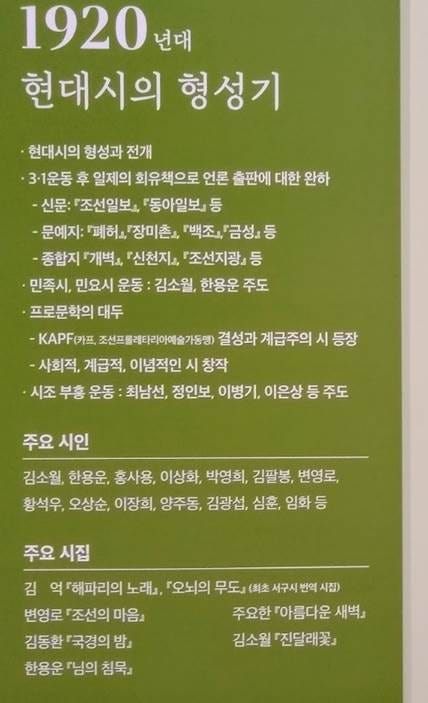
Translation:
1920
The Formative Period of Modern Korean Poetry
The formation and development of modern Korean poetry.
Following the March First Movement (1919), the Japanese colonial government relaxed restrictions on the press and publishing as part of its conciliatory cultural policy.
a. Newspapers such as The Chosun Ilbo and The Dong-A Ilbo.
b. Literary magazines such as Pyeheo (Ruins), Jangmichon (Rose Village), Baekjo (White Tide), and Geumseong (Venus).
c. General-interest magazines such as Gaebyeok (Creation), Sincheonji (New World), and Joseon Jarang (Pride of Korea).The movement for nationalist poetry and folk-song poetry, led by Kim So-wol and Han Yong-un.
The rise of proletarian literature.
a. The formation of KAPF (Korea Artista Proleta Federatio) and the emergence of class-conscious poetry.
b. The creation of poetry addressing social, class, and ideological concerns.The revival of sijo, led by Choe Nam-seon, Jeong In-bo, Yi Byeong-gi, and Yi Eun-sang.
This decade witnessed the consolidation of modern Korean poetry through diverse literary movements, expanding publication opportunities, and the coexistence of nationalist, lyrical, and proletarian poetic traditions.
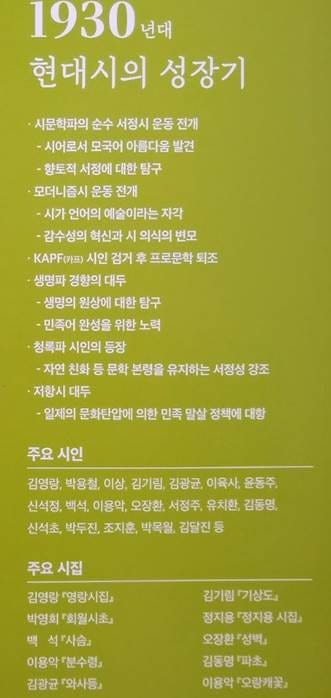
Translation:
1930s
The Growth of Modern Korean Poetry
The Poetry Literature (Simunhak) School promoted a movement for pure lyric poetry.
a. Poets discovered and cultivated the beauty of the Korean language as a poetic medium.
b. They explored rural and regional forms of lyricism.The Modernist poetry movement developed.
a. Poets became increasingly aware of poetry as an art of language.
b. New sensibilities emerged, transforming poetic consciousness.Proletarian literature declined following the arrest of KAPF-affiliated poets and writers.
The Life School (Saengmyeongpa) emerged.
a. Its members explored the fundamental nature of life.
b. They sought to refine and enrich the Korean language.The Green Deer School (Cheongnokpa) poets appeared.
a. They emphasized lyricism while maintaining literature’s essential concerns, including harmony with nature.Resistance poetry gained prominence.
a. Poets resisted Japan’s policy of cultural suppression and its efforts to eradicate Korean national identity.
This decade saw modern Korean poetry mature through diverse movements, including lyricism, modernism, life-centered poetry, and literary resistance to colonial rule.
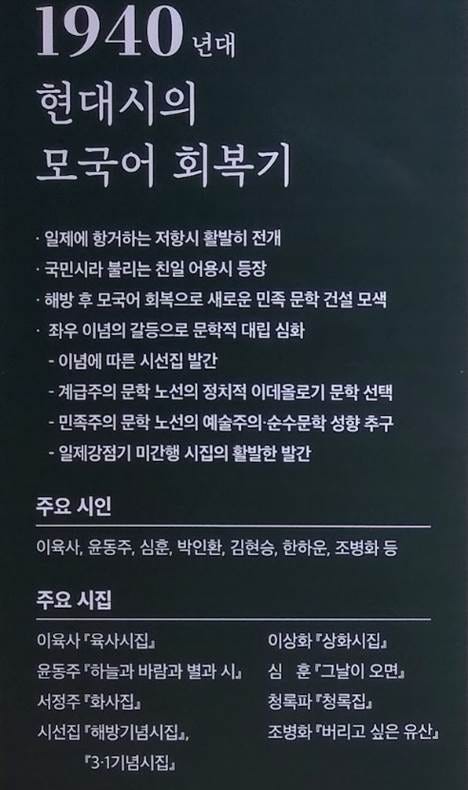
Translation:
1940s
The Recovery of the Mother Tongue in Modern Korean Poetry
Resistance poetry opposing Japanese colonial rule flourished.
Pro-Japanese propaganda poetry, known as “national poetry” (Gungminsi), emerged.
Following Korea’s liberation in 1945, writers sought to rebuild a national literature through the recovery of the Korean language.
Ideological conflicts between the political left and right intensified literary divisions.
a. Poetry anthologies reflecting competing ideological perspectives were published.
b. Writers aligned with class-based literature embraced politically oriented ideological literature.
c. Writers associated with nationalist literature pursued artistic values and the ideals of pure literature.
d. Poetry collections that had remained unpublished during the Japanese colonial period were issued in large numbers.
This decade witnessed both the suppression and recovery of Korean literary expression, as poets responded to colonial rule, national liberation, and the ideological conflicts that shaped postwar Korean society.
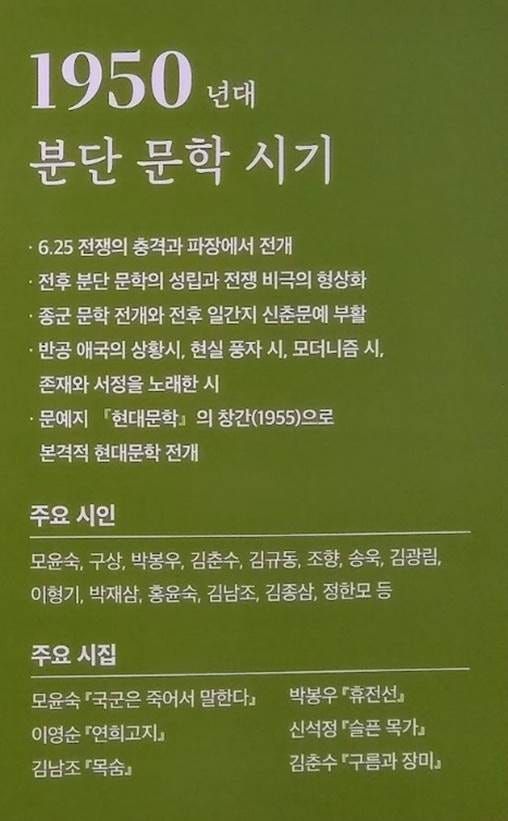
Translation:
1950s
The Era of Division Literature
Korean poetry developed in response to the shock and aftermath of the Korean War (1950-1953).
Postwar literature of national division emerged, depicting the tragedy and suffering caused by the war.
War literature flourished, and poetry contests sponsored by major daily newspapers were revived after the war.
Poetry reflecting anti-communist patriotism, social satire, and Modernist aesthetics gained prominence.
Poets explored themes of existence and lyricism.
The founding of the literary journal Hyundae Munhak (Modern Literature) in 1955 helped usher in a new phase of modern Korean literature.
This decade was shaped by the trauma of war and national division, as poets grappled with loss, ideological conflict, and the search for meaning in a fractured society.
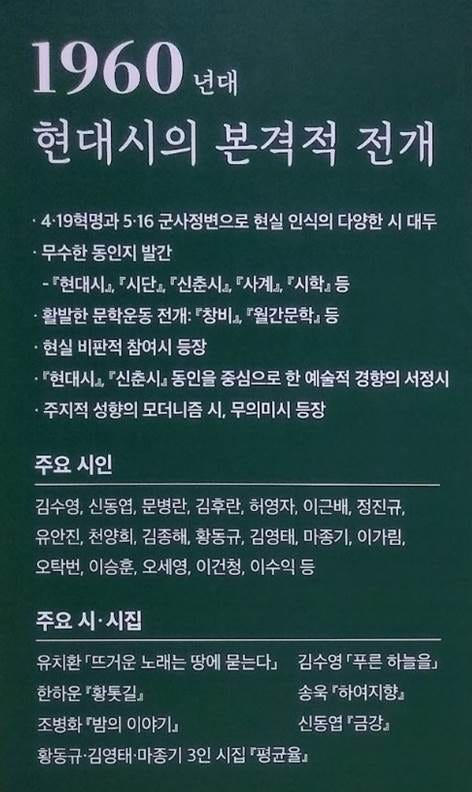
Translation:
1960s
The Full Development of Modern Korean Poetry
The April 19 Revolution (1960) and the May 16 military coup (1961) gave rise to diverse perspectives on social and political reality.
Numerous coterie magazines and poetry journals were published.
a. Notable examples include Hyundaesi (Modern Poetry), Sidan (Poetry Circle), Sinchunsi (New Spring Poetry), Sagye (The Four Seasons), and Sihak (Poetics).Literary movements flourished through influential journals such as Creation and Criticism and Monthly Literature.
Socially engaged poetry critical of contemporary realities emerged.
Lyric poetry with a strong artistic orientation developed, particularly among poets associated with the Modern Poetry and New Spring Poetry groups.
Intellectual forms of Modernism and so-called “poetry of absurdity” or “meaningless poetry” also appeared.
This decade marked the full flowering of modern Korean poetry, characterized by artistic experimentation, literary activism, and growing engagement with the political and social realities of contemporary Korea.
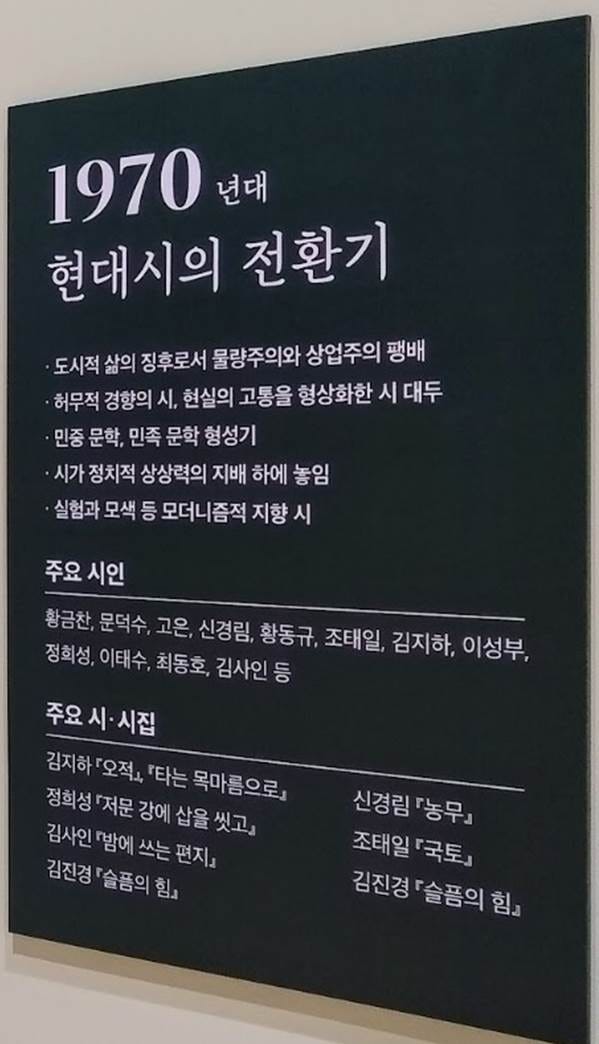
Translation:
1970s
The Transitional Period of Modern Korean Poetry
Materialism and commercialism became widespread as signs of urban life.
Poetry expressing nihilistic tendencies and embodying the suffering of reality emerged.
The formation of people’s literature (minjung munhak) and national literature (minjok munhak) took shape.
Poetry came under the influence of political imagination and engagement.
Modernist poetry with experimental and exploratory tendencies developed.
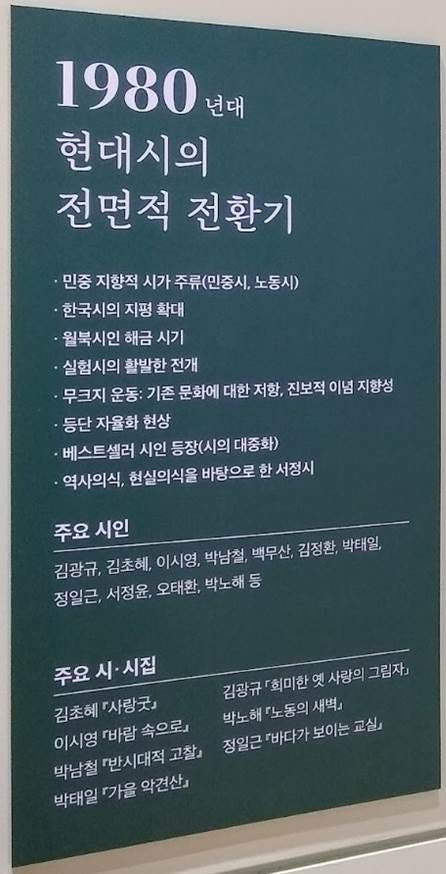
Translation:
1980s
The Period of Full Transformation in Modern Korean Poetry
Poetry oriented toward the people became the mainstream, including minjung (people’s) poetry and labor poetry.
The horizon of Korean poetry expanded significantly in terms of themes and expression.
The lifting of bans on poets who had defected to North Korea marked a major shift in the literary field.
Experimental poetry developed actively.
The mook magazine movement emerged, characterized by resistance to established culture and a progressive ideological orientation.
The system of literary debut became more open and less centralized.
Best-selling poets appeared, signaling the popularization of poetry.
Lyric poetry grounded in historical consciousness and social awareness gained prominence.
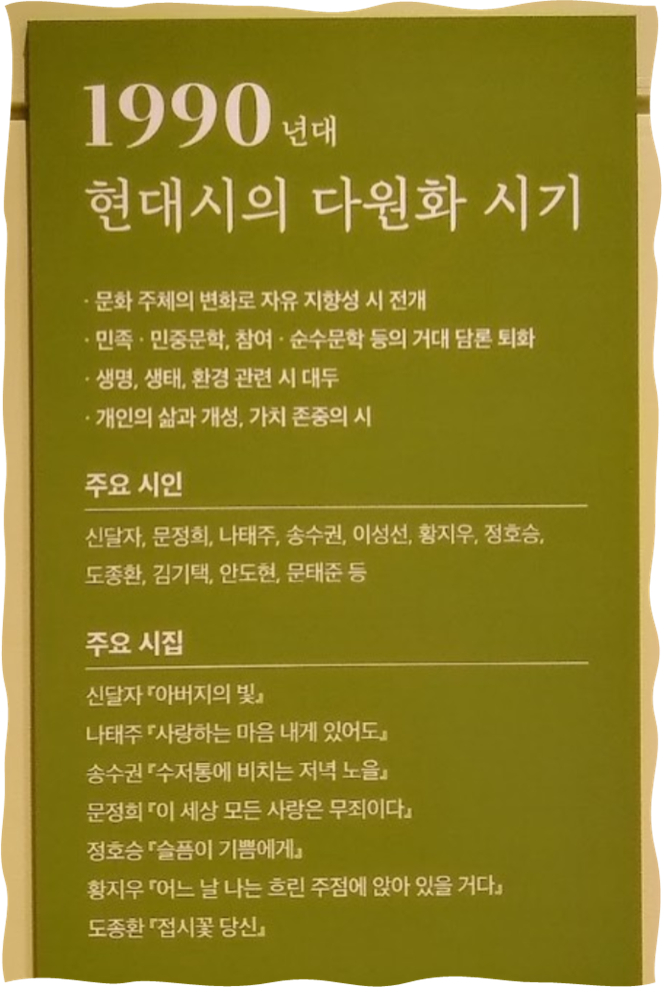
Translation:
1990s
The Period of Pluralization in Modern Korean Poetry
With shifts in cultural agency, poetry oriented toward freedom and individual expression developed.
Grand discourses such as national literature, people’s literature, engagement poetry, and pure literature began to decline.
Poetry addressing life, ecology, and environmental concerns emerged.
Poetry emphasizing individual life, personal identity, and the affirmation of diverse values gained prominence.
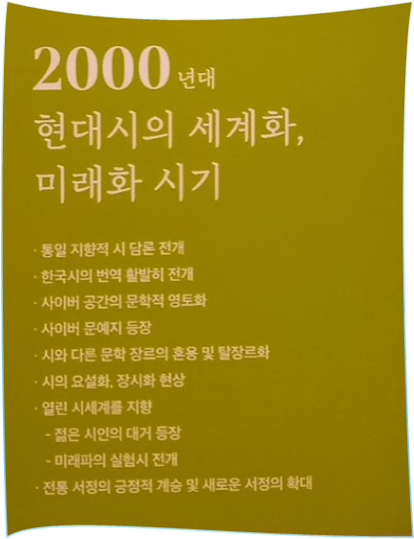
Translation:
2000s
The Globalization and Future-Oriented Development of Modern Korean Poetry
The emergence of poetic discourse oriented toward Korean reunification.
A significant increase in the translation of Korean poetry into other languages.
The expansion of literature into cyberspace as a new literary domain.
The appearance of online literary magazines.
The blending of poetry with other literary genres and the growth of cross-genre experimentation.
The proliferation of narrative poetry and long poems.
The pursuit of an open poetic vision:
a. The emergence of many younger poets.
b. The development of experimental poetry associated with the “Future School” (Miraepa).The positive inheritance of traditional lyricism and the expansion of new forms of lyrical expression.
Translator’s note: The phrase 열린 시세계 지향 literally means “orientation toward an open poetic world” or “open poetic vision.” Likewise, 미래파 (Miraepa, “Future School”) refers to an experimental poetic movement rather than a formal institution.
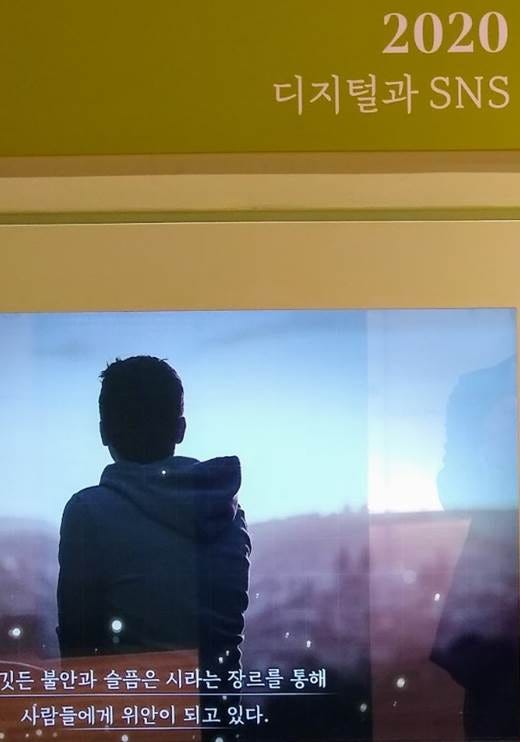
Translation:
2020
Digital and Social Media (SNS)
The anxiety and sorrow that dwell within human life are expressed through poetry, which continues to offer comfort and consolation to readers.
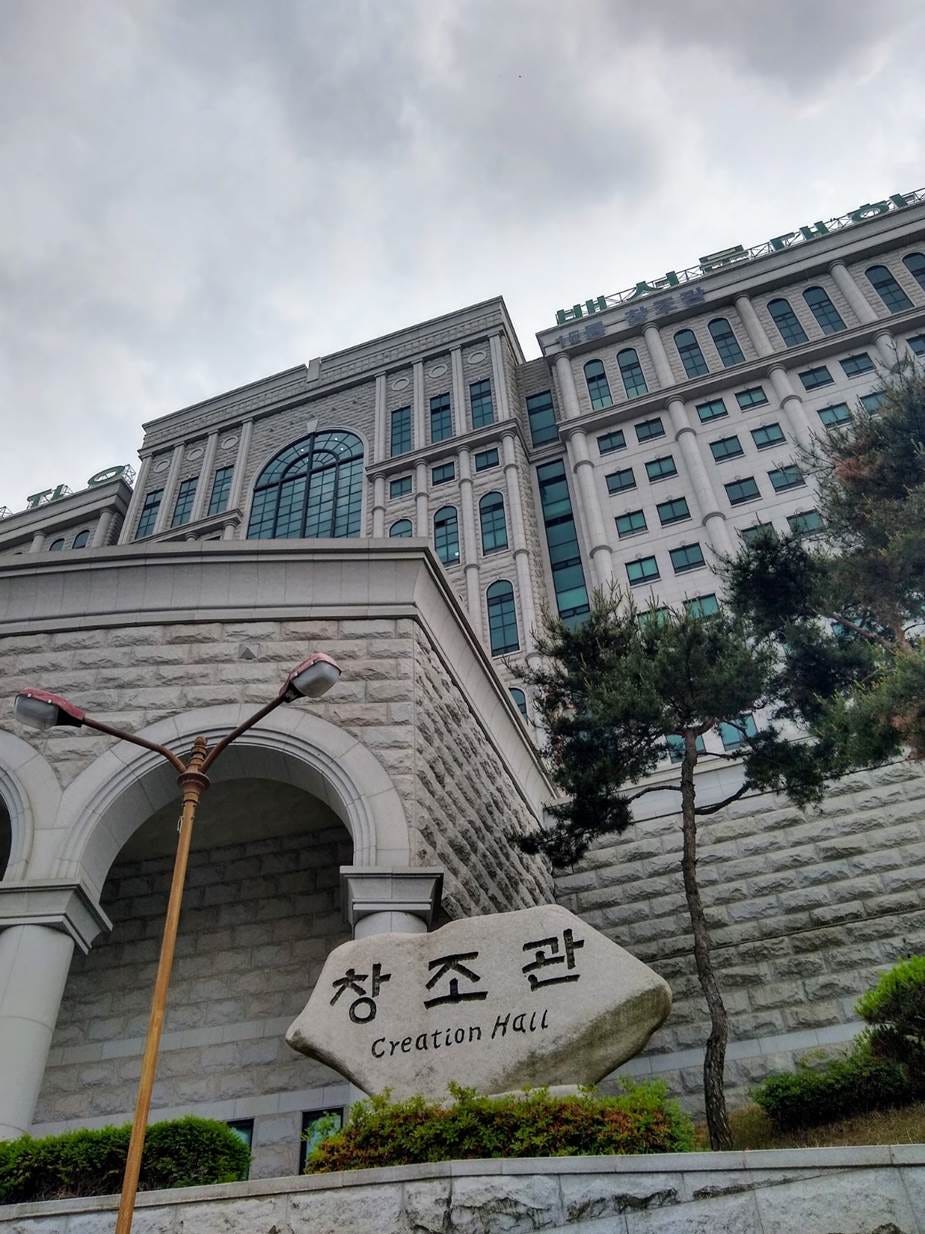
Creation Hall is home to the Centenary Hall of Modern Poetry.
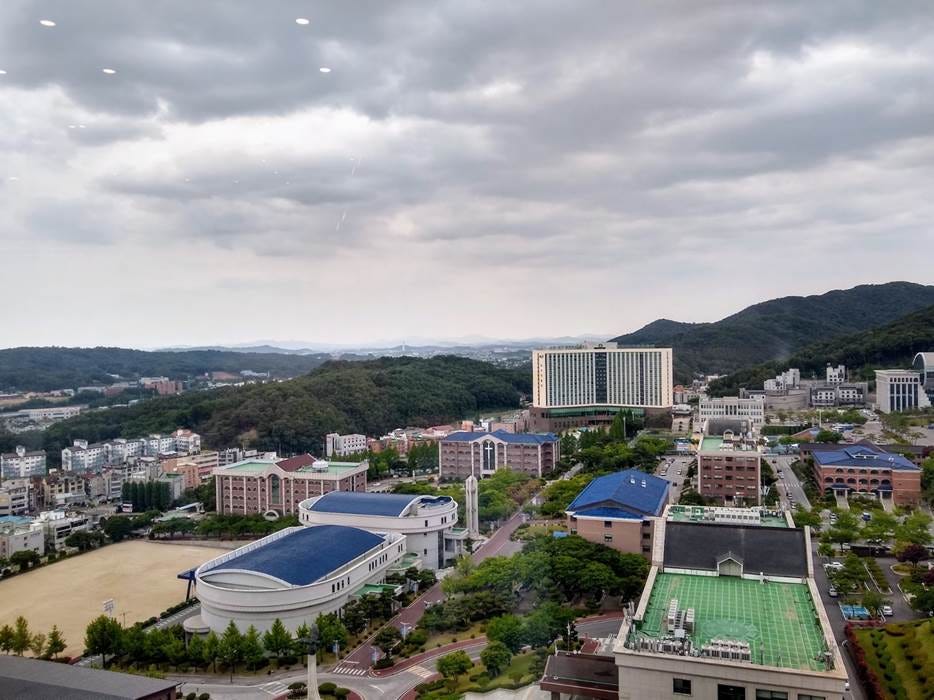
A view of the Baekseok University campus from Creation Hall.
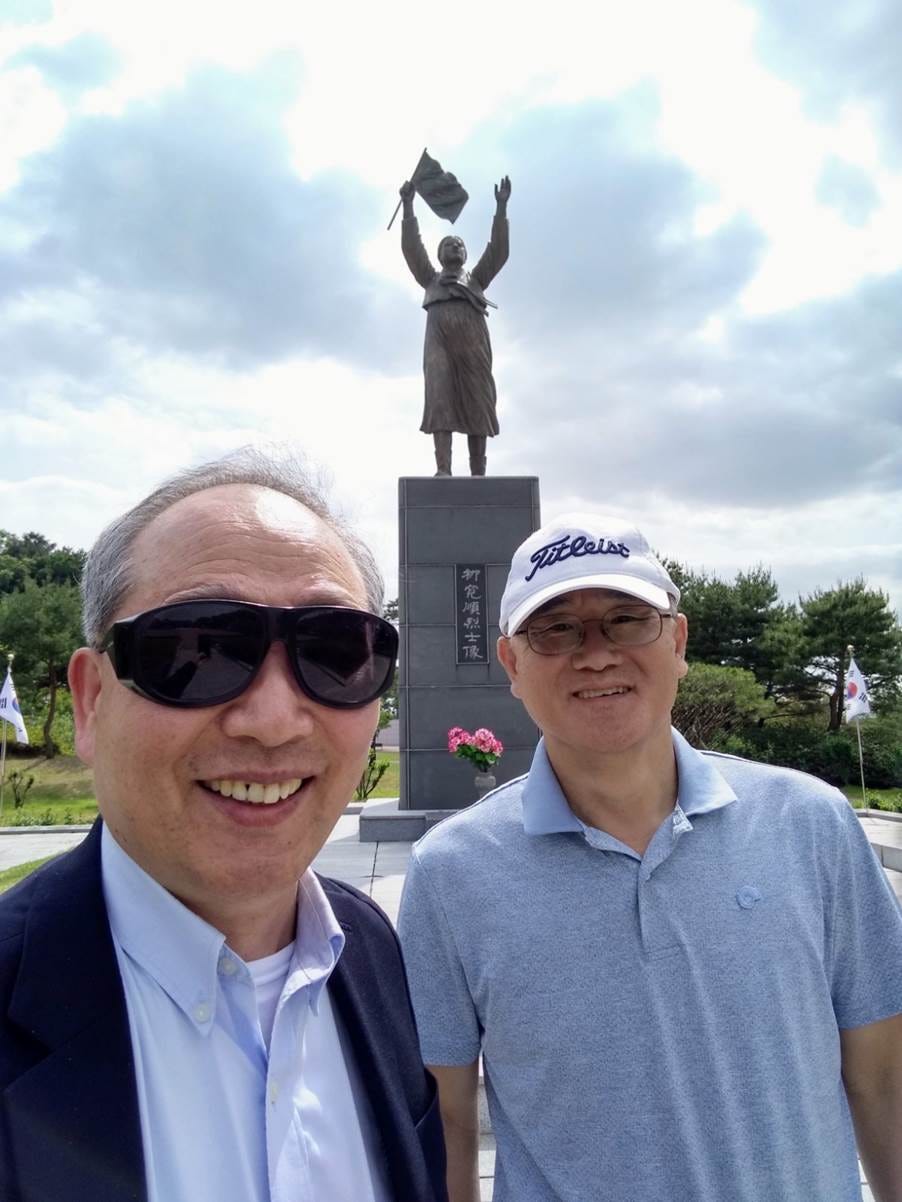
Dr. Yoo (right) and I pose for a selfie in front of a statue of Yu Gwan-sun, the Korean independence activist, in Cheonan.
About the Author
Professor of English and Creative Writing and Associate Dean of the School of Humanities and Theology, Missouri Baptist University
John J. Han, PhD, is the author, editor, co-editor, or translator of 35 books. His forthcoming book, Echoes from the Hills: Critical Essays on Ozarks Literature (co-edited with C. Clark Triplett), will be published by the University of Arkansas Press. He has also published nearly 3,000 poems in a wide range of journals and anthologies. In addition to his long tenure at Missouri Baptist University, he has taught at Kansas State University, the University of Nebraska–Lincoln, Nebraska Wesleyan University, and Washington University in St. Louis. He has also served as a visiting scholar at Georgia College & State University and the University of Ljubljana in Slovenia.
© K-Global Scholars and Professionals Forum. All rights reserved. Content published in the K-GSP Forum may not be reproduced, distributed, or transmitted in any form without prior written permission from the K-GSP Forum, except for brief quotations with full attribution.
감사합니다! 한국 시의 흐름이 한눈에 들어 옵니다. 천안 병천에 아주 오래 전에 간 기억이 납니다.
좋은데 다녀오신 기행기 잘 보았습니다. 감사합니다. 👍🥰