

EXECUTIVE SUMMARY
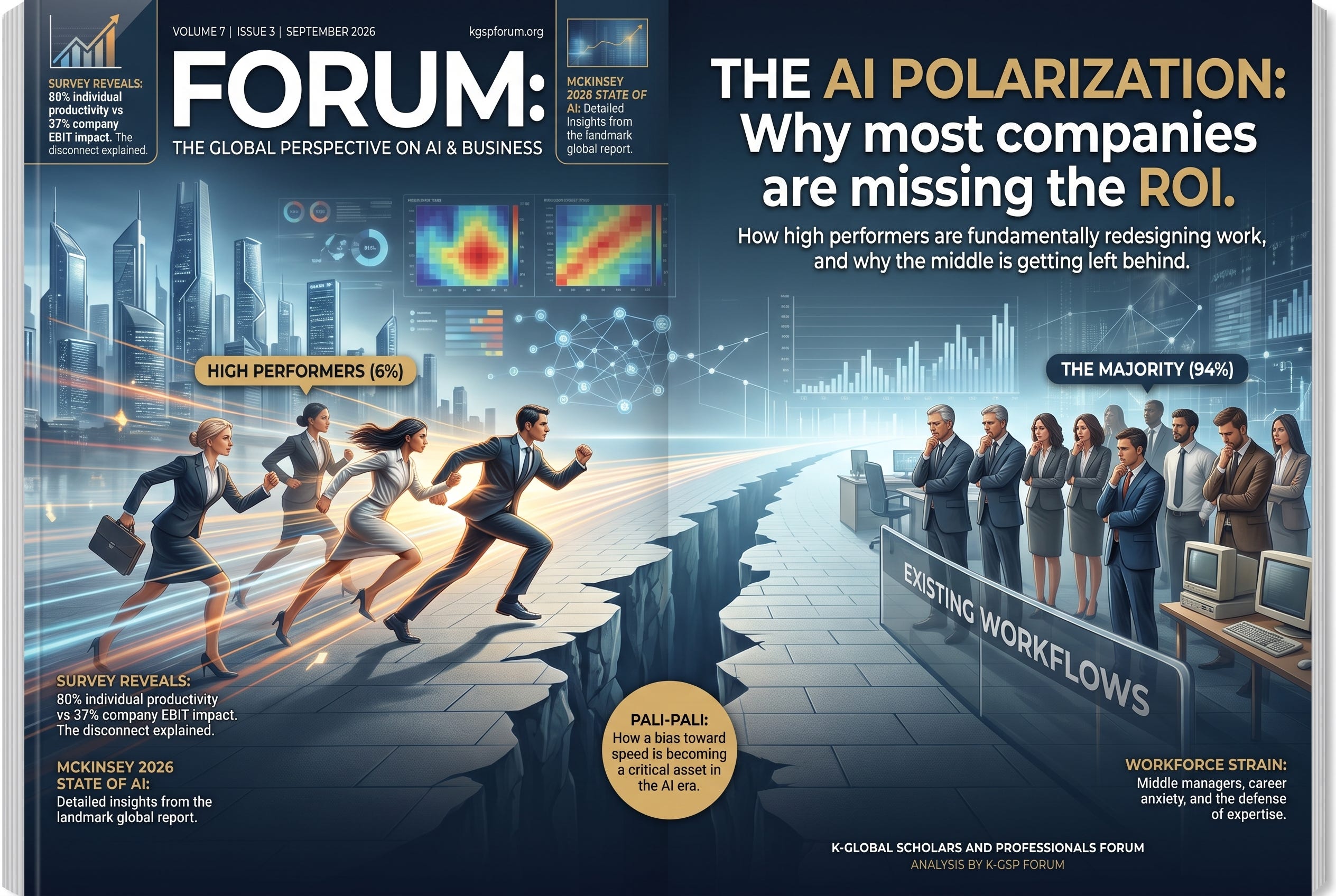
McKinsey’s 2026 State of AI survey reports a finding that should unsettle anyone thinking about workforce development: eighty percent of individuals say AI has improved their productivity, yet only thirty-seven percent of organizations report any EBIT impact, essentially unchanged from a year earlier. High performers, just six percent of respondents, look categorically different from everyone else. They deploy more tools, in more functions, and redesign workflows rather than layering AI onto existing ones. This piece argues that what we are watching is not an adoption curve but a polarization, and that the dividing line runs through attitude rather than technical skill. If that reading is right, the historical precedent is the arrival of the personal computer, and the outcome for gatekeepers was not favorable.
1. What the Survey Actually Shows
The 2026 McKinsey Global Survey on AI, fielded from May 4 to June 8, 2026, with 1,719 respondents across 97 nations, documents steady deepening of enterprise AI use. Forty-four percent report AI scaling across the enterprise, up from thirty-eight percent. Among large organizations, those above $1 billion in revenue, the share scaling AI agents rose from twenty-seven to forty percent in a single year. Among smaller organizations, that figure stayed flat at twenty-two percent.
The high-performer group is the more revealing finding. These are respondents attributing at least five percent of EBIT to AI use and describing the impact as significant. They constitute six percent of the sample, unchanged from 2025. But their behavior diverges sharply. Nearly three-quarters report fundamentally redesigning workflows because of AI, up from fifty-five percent last year, against one-quarter of everyone else. They are more than three times as likely to be scaling agents across most business functions. They are 3.3 times more likely to intend to use AI to transform their business within three years. They are more than twice as likely to spend above fifteen percent of their ICT budget on AI.
McKinsey’s own framing is instructive: the advantage cannot be reduced to budget. High performers pursue growth and innovation alongside efficiency, redesign rather than retrofit, and sustain deployment through leadership commitment, impact measurement, and risk management.
2. The Gap Is Widening, Not Closing
Adoption curves normally compress. Early adopters move first, laggards follow, and the distribution narrows. That is not what these numbers show.
The high-performer share held steady at six percent. Overall EBIT impact held steady at thirty-seven percent. Meanwhile the high performers accelerated on nearly every behavioral measure. Small organizations flatlined on agent adoption while large ones jumped thirteen points. The distance between the top and the middle grew over a year in which the underlying technology became dramatically cheaper and more accessible.
This is the signature of polarization rather than diffusion. When access improves and outcomes diverge anyway, the constraint is not access.
3. Which Dimension of Competency Is Actually Binding?
The natural assumption is that the gap is technical. It does not survive contact with the data.
Consider the standard KSAO framework: knowledge, skills, abilities, and other characteristics. If the binding constraint were knowledge, we would expect the gap to close as documentation, training, and tooling proliferated. They have, and it has not. If the constraint were skill, we would expect heavy investment in training to move the middle. Organizations have invested, and the middle has not moved much. If it were ability, in the sense of cognitive capacity, we would expect the gap to correlate with role seniority. It does not cleanly: McKinsey reports individual productivity gains as remarkably consistent across organizational levels.
That leaves other characteristics, and within that category, attitude and disposition toward change.
Katz’s classic distinction among technical, human, and conceptual skills points the same direction. The technical layer, prompting, tool selection, basic agent configuration, is genuinely learnable and increasingly commoditized. What separates high performers is conceptual: the capacity to see an end-to-end workflow, judge which parts should not exist anymore, and rebuild it. That is not a tooling question. It is a question of whether someone is willing to declare their own current process obsolete.
McKinsey’s associate partner Tara Balakrishnan reaches a compatible conclusion from the other direction, noting that the limiting factor is increasingly the organization’s ability to absorb change. Absorption capacity is dispositional, not technical.
4. So Let Us Change the Question
If the gap is not explained by capability, asking “how do we train people on AI” is the wrong question. Training addresses knowledge and skill, and neither appears to be binding.
The better question is: why do capable people decline to use tools that would demonstrably help them?
This reframing matters because it changes what an organization should actually do. Training budgets, tool licenses, and enablement programs address a constraint that is largely resolved. The unresolved constraint sits somewhere else entirely.
5. Why Low Performers Hold Back
Three explanations are worth separating, because they call for different responses.
Anxiety is the most sympathetic reading and the weakest fit with the evidence. McKinsey reports that only thirteen percent of respondents say AI makes them anxious about their career prospects. If fear of replacement drove non-adoption, that number would be far higher. Notably, though, the survey does find that mid-level managers and individual contributors report AI-related strain at forty-seven percent, against thirty-one percent for executives and senior managers. Something is happening in the middle of organizations, but it presents as strain rather than career fear.
Laziness is the least useful explanation and, I would argue, mostly wrong. The people declining to redesign their workflows are frequently working very hard inside those workflows. Effort is not the missing input.
Resistance to change fits best, and it deserves more precision than the phrase usually receives. For someone whose professional standing rests on mastery of an existing process, AI does not offer a productivity gain. It offers depreciation of their accumulated expertise. Redesigning the workflow means volunteering to reset one’s own seniority. The rational move, from inside that position, is to slow the process down.
This is where the mid-level strain figure becomes legible. Middle managers occupy exactly the position where process mastery translates into authority, and where AI-driven workflow redesign most directly threatens it.
6. Gatekeeping and Its Precedent
We have seen this before, twice within living professional memory.
When personal computers arrived in offices in the 1980s, a substantial cohort of experienced staff routed around them. Some genuinely could not type. Many more had built careers on controlling information flow through paper systems they understood and others did not. When office automation software followed, the same pattern repeated: the people whose value lay in knowing where things were filed had every reason to prevent the filing from becoming searchable.
The gatekeeping worked, for a while. It lasted long enough that organizations tolerated parallel systems, printed copies of digital documents, and executives whose email was read to them by assistants. Then the cohort turned over and the question resolved itself demographically. New entrants who had never known the old process did not need to be converted.
The reasonable expectation is that AI follows this arc, compressed. McKinsey’s finding that thirty-two percent of organizations have declined to purchase software because they could build it in-house with agentic coding tools, rising to nearly half among high performers, suggests the compression is already underway. That is not a productivity improvement. That is a category of vendor relationship disappearing inside eighteen months.
7. What This Implies for Organizational Composition
If the pattern holds, the near-term picture looks like this.
AI-native entrants and committed adopters will accumulate a disproportionate share of consequential work, not because they are favored but because work flows toward whoever can complete it. Gatekeepers will retain formal position longer than they retain actual function, which is the uncomfortable middle state that produces the strain the survey detects. Organizations will discover that their AI problem was never a technology procurement problem.
McKinsey’s own head-count data cautions against overreading the speed. Last year, thirty-two percent expected AI-driven workforce declines; only fourteen percent report them. Predictions of displacement have consistently run ahead of reality. The polarization I am describing is about the distribution of meaningful work, which redistributes well before head count does.
8. A Note on Pali-Pali (8282)
There is a cultural argument worth making here, with appropriate caution.
Korean organizational culture carries a well-known disposition toward speed, captured in pali-pali. It has drawn justified criticism: it can produce corner-cutting, shallow analysis, and decisions made before the evidence is in. Those critiques stand.
But in a transition where the binding constraint is willingness to abandon a working process before it is fully obsolete, a bias toward moving first is an asset rather than a liability. The failure mode of pali-pali is premature action. The failure mode currently strangling AI value capture is premature comfort. These are not symmetrically costly right now.
For Korean and diasporic professionals, this suggests a specific opportunity: the cultural disposition that has been treated as something to manage may, in this particular window, be the thing worth leaning into. The caveat is real, though. Speed without the workflow redesign McKinsey identifies produces exactly the pilot accumulation that separates the ninety-four percent from the six percent. Moving fast into an unredesigned process is still moving fast in the wrong direction.
9. Closing
The survey’s central tension is that individual gains are broad and enterprise gains are narrow. Eighty percent feel more productive; thirty-seven percent of organizations can find it in the financials. The gap is not a measurement problem. It is the visible signature of a workforce splitting into those who are rebuilding how work happens and those who are using new tools to do old work slightly faster.
That split will resolve. It resolved for the personal computer and it resolved for office automation. What is worth deciding now is which side of it one intends to be on, because the historical record on gatekeeping is unambiguous, and the timeline this round appears to be shorter.
Reference
Tinkoff, D., Van der Veken, L., Chui, M., & Balakrishnan, T. (2026, August 25). The state of AI in 2026: On the road to ROI. McKinsey & Company. https://www.mckinsey.com/capabilities/quantumblack/our-insights/the-state-of-ai

Prof. Dr. Jeonghwan (Jerry) Choi (Managing Editor), University of Maine at Presque Isle
Jeonghwan (Jerry) Choi, PhD is an Associate Professor of Business at the University of Maine at Presque Isle and Editor-in-Coordination of K-GSP Forum (contact: jeonghwan.choi at gmail.com). With over 25 years of industry and consulting experience, he specializes in leadership development, human resource management, organizational behavior, and social entrepreneurship. His research focuses on workforce resilience, organizational health, and self-directed leadership — bridging rigorous scholarship with practical insight to cultivate leaders who create meaningful, sustainable, and humane organizations.
한글요약
다가오는 양극화: 맥킨지 2026 AI 조사가 말해주는 것
맥킨지의 2026년 AI 조사에는 마음이 편치 않은 숫자가 하나 있다. 개인의 80퍼센트가 AI 덕분에 일이 더 잘 된다고 답했지만, 실제로 이익에 영향이 있었다고 답한 기업은 37퍼센트에 그쳤고 이 수치는 1년 전과 거의 같다. 개인은 빨라졌는데 회사는 그대로다.
눈에 띄는 것은 상위 성과 기업들이다. 전체의 6퍼센트에 불과한 이들은 다른 곳과 전혀 다르게 움직인다. 이들의 4분의 3은 AI에 맞춰 업무 방식 자체를 다시 짰다. 나머지 기업에서는 4분의 1만 그렇게 했다. 도구를 더 많이 쓰는 문제가 아니라, 기존 방식을 버릴 수 있느냐의 문제다.
그래서 문제는 기술이 아니다. 배울 자료도 도구도 넘쳐나는데 격차는 오히려 벌어졌다. 지식이나 기술이 아니라 태도가 걸림돌이라는 뜻이다. 지금까지 쌓아온 숙련이 곧 자기 위치인 사람에게 AI는 도움이 아니라 위협이다. 조사에서 중간관리자와 실무자가 임원보다 훨씬 더 큰 부담을 호소한 것도 이 지점과 맞닿아 있다.
우리는 이 장면을 이미 두 번 봤다. 사무실에 개인용 컴퓨터가 들어왔을 때, 그리고 사무자동화 프로그램이 들어왔을 때다. 그때도 한동안은 문을 막고 선 사람들이 있었지만 결국 새 도구를 쥔 세대가 사무실을 넘겨받았다. 이번에는 그 속도가 더 빠를 것이다.
한국인과 한국계 디아스포라의 ‘빨리빨리’는 그동안 비판을 많이 받아왔다. 하지만 지금처럼 익숙한 방식을 먼저 놓아야 하는 시기에는 오히려 강점이 될 수 있다. 다만 업무 방식을 다시 짜지 않은 채 속도만 내면, 결국 잘못된 방향으로 빨리 가는 셈이 된다.
© K-Global Scholars and Professionals Forum. All rights reserved. Content published in the K-GSP Forum may not be reproduced, distributed, or transmitted in any form without prior written permission from the K-GSP Forum, except for brief quotations with full attribution.