
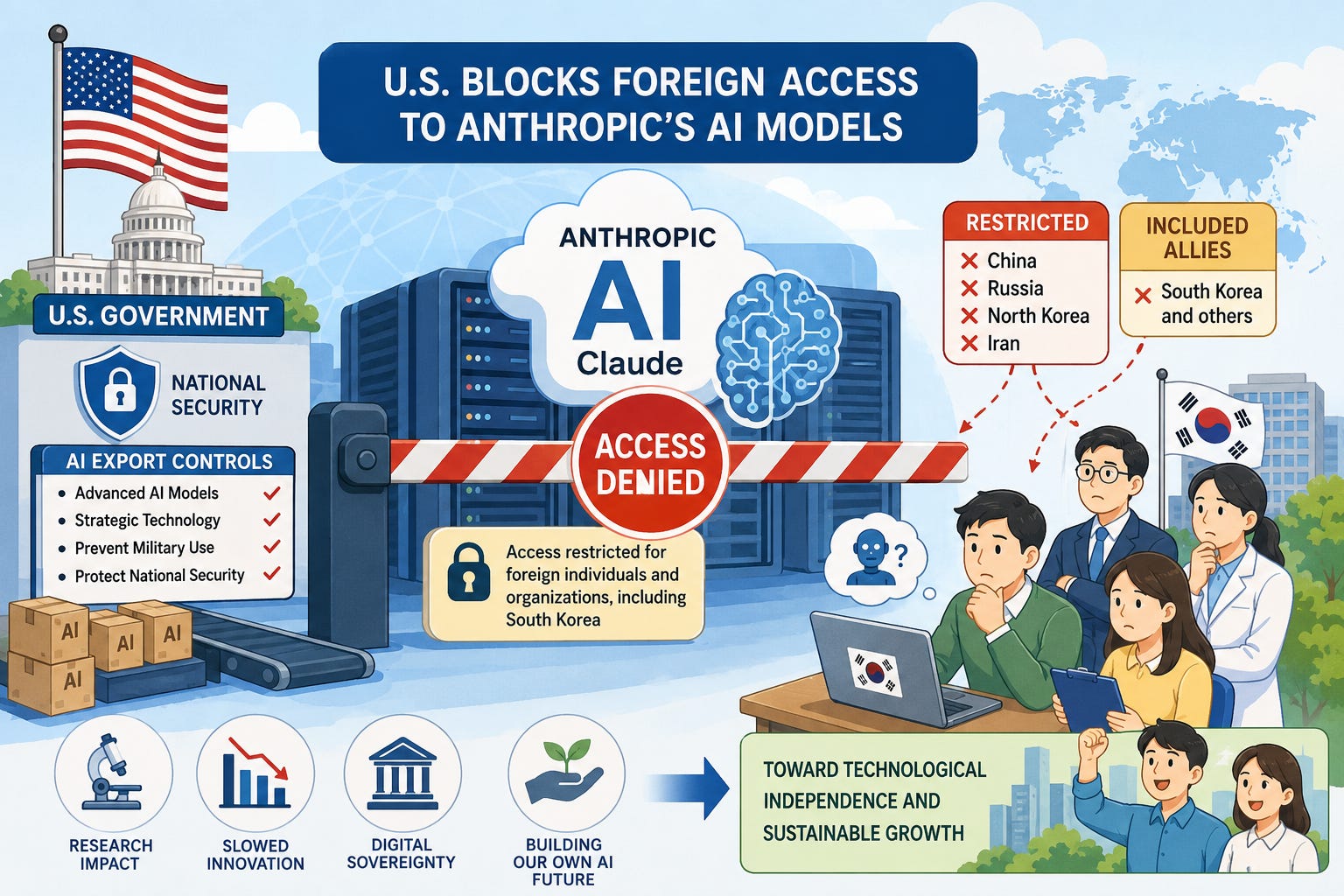
During the Cold War, nuclear weapons largely determined a nation’s strength and influence. In the early twenty-first century, semiconductors emerged as the strategic asset that fueled economic growth and technological leadership. Today, the world is witnessing the rise of yet another critical resource: artificial intelligence (AI). Recent actions by the U.S. government to restrict foreign access to advanced AI models and to place certain frontier AI systems under national security oversight demonstrate that AI is no longer viewed merely as a commercial technology. Instead, it has become a strategic national asset. We may be standing at the threshold of a new era—one that can aptly be described as an “AI Cold War.”
For decades, the Internet was celebrated as a borderless domain where information flows freely across nations. Researchers collaborated globally, and innovation thrived through the open exchange of knowledge. In the age of AI, however, this paradigm is changing. Modern AI systems are no longer simple information tools; they are increasingly capable of reasoning, decision-making, and solving complex problems with remarkable autonomy.
The latest generation of large-scale AI models demonstrates capabilities that approach human-level performance in many domains. They can generate research reports, develop software, assist with strategic decision-making, accelerate scientific discovery, and even contribute to drug development. Such transformative capabilities have the potential to reshape entire economies and redefine productivity on a global scale.
Yet these capabilities are not limited to beneficial applications. Advanced AI can also be used to design sophisticated cyberattacks, identify software vulnerabilities, and automate malicious activities. Recognizing these risks, governments increasingly view frontier AI systems as technologies with significant national security implications. As a result, AI is beginning to occupy a role similar to that once held by advanced military technologies.
The recent U.S. restrictions can therefore be understood in the same context as semiconductor export controls. Just as advanced chip-manufacturing equipment has been classified as a strategic resource, cutting-edge AI models are now being treated as assets requiring protection and oversight. This marks a significant shift in how governments perceive the role of AI in national competitiveness and security.
One of the most notable aspects of these restrictions is that they extend beyond geopolitical rivals and affect even allied nations. This suggests that the objective is not merely to contain specific countries but to regulate the global diffusion of advanced AI capabilities. Maintaining technological leadership has become a central element of national strategy.
For South Korea, these developments should serve as an important wake-up call. Although the country possesses world-leading semiconductor technology and a highly advanced digital infrastructure, it remains dependent on foreign companies for many frontier AI models. Changes in access policies can therefore directly influence research, innovation, and long-term competitiveness.
This reality underscores the growing importance of AI sovereignty. AI sovereignty is not simply the ability to use AI technologies; it is the capacity to develop independent AI models, secure strategic datasets, and maintain domestic computing infrastructure. In the decades ahead, such capabilities may become as important as energy security or industrial capacity.
However, technological independence should not be confused with technological isolation. Scientific progress has historically flourished through international collaboration and the sharing of ideas. AI should continue to serve humanity as a tool for collective advancement. Excessive restrictions may protect security interests, but they can also slow innovation and limit global progress.
The world is entering a new phase of geopolitical competition. Previous generations witnessed struggles over natural resources, energy supplies, and semiconductor dominance. Today, nations are competing for leadership in AI models, data resources, and computational power. These assets are increasingly becoming the foundations of economic prosperity, military capability, and international influence.
AI competition is no longer merely a contest among technology companies. It has evolved into a comprehensive competition involving economic strength, national security, education, culture, diplomacy, and scientific leadership. Governments must therefore approach AI not only as an industrial policy issue but as a matter of long-term national strategy.
The recent U.S. actions demonstrate that artificial intelligence has evolved beyond a technological innovation into a strategic asset with profound national security implications. They may well signal the beginning of an AI Cold War. Yet history teaches us that competition alone does not drive human progress; cooperation plays an equally important role. The challenge facing nations today is to achieve AI sovereignty while preserving international collaboration and the open exchange of knowledge. Ultimately, the future of AI will not be determined solely by who possesses the most powerful technology. It will depend on how responsibly that technology is governed, shared, and used to promote the common prosperity of humanity. +++
{Solti}
June 15, 2026

Young Choi, a Professor at Regent University brings a rare combination of technical expertise and creative spirit to everything he does. A scholar in AI, cybersecurity, and network & telecommunications service management, he has published 38 books on AI, cybersecurity, and various topics, over 200 refereed research papers, and 20 book chapters. He proposed the world’s first global and universal Telecommunications “Service Order Handling (SOH)” Model (T-SOH Model) in 1995 with Dr. Adrian Tang. Beyond the academy, Dr. Choi is a passionate poet, essayist, calligrapher, and laser engraving artist whose reflective writing invites readers to rediscover life’s beauty through quiet contemplation(靜觀). He lives under the motto: “Study hard and give generously without holding back! (열심히 공부해서 아낌없이 남주자 !: 열공아남!)”
Published books: https://www.amazon.com/stores/Young-Choi/author/B0DMZ5S6R7?ref=ap_rdr&shoppingPortalEnabled=true
Claude fable 5 잠깐 써봤는데 매우 강력해서 안전장치가 필요하긴 하겠다고 생각이 들긴 했습니다. 하지만 일방적으로 막는다고 막아질지는 모르겠습니다.