

Executive Summary
The rapid diffusion of generative artificial intelligence across academia mirrors structural dynamics observed during the dot-com and internet revolution of the late 1990s. Early institutional skepticism surrounding electronic dissemination eventually yielded to systemic transformations, altering evaluation criteria and widening infrastructure gaps. Today, leading editorial policies from the Nature Portfolio and NeurIPS establish that accountability, validation, and methodological transparency remain exclusively human responsibilities. As generative tools commoditize preliminary analytical routines, competitive advantage decouples from publication velocity. Enduring scholarship in the AI era depends on framing conceptually sound research questions, executing verifiable validation standards, and configuring infrastructure to address previously intractable empirical problems.
Title: It Was the Exact Same During the Dot-Com Bubble 25 Years Ago: Nature’s Warning on AI Papers and the Surviving Top 1% of Researchers
Source: R&D | Manager Kim (Kim Chaegim)
The integration of artificial intelligence into scholarly workflows has sparked urgent debate across universities and research laboratories. While early-career scholars often view AI as an operational instrument for summarizing literature or writing code, historical evidence suggests that technological transitions systematically reorganize the epistemic foundations of research.
Parallels from the Internet Transition
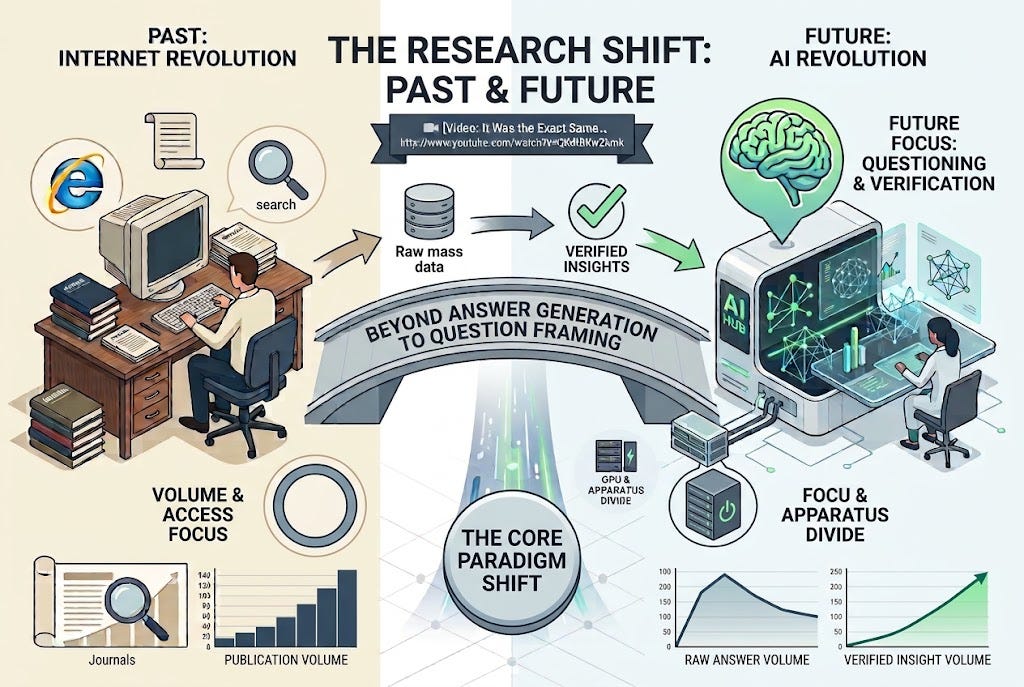
The current anxieties surrounding generative models mirror the emergence of electronic publishing during the late 1990s. Bibliometric analyses tracking library and information science confirm that technological shocks fundamentally reconfigure intellectual fronts rather than simply automating existing routines (Han, 2020). Initial institutional resistance was substantial; faculty long hesitated to equate electronic journals with established print scholarship.
However, once digital infrastructure stabilized, inquiry itself shifted. Entire subfields such as webometrics rapidly emerged and superseded conventional information-retrieval paradigms. Concurrently, technological advancement altered research structures by facilitating cross-institutional collaboration, yet it also reinforced structural disparities. Rather than closing academic divides, differential access to broadband infrastructure introduced persistent performance divides across institutions.
Accountability and Journal Governance
Contemporary scholarly governance reflects this historical precedent. Leading publication venues have established rigorous disclosure boundaries regarding generative models. The Nature Portfolio explicitly bars non-human entities from authorship, mandating that all analytical interpretations, data validity, and factual conclusions remain verifiable and attributable to human scholars. Similarly, recent NeurIPS guidelines require full provenance and experimental accountability, actively discouraging unchecked text generation to preserve peer-review integrity.
Consequently, the core criterion distinguishing rigorous scholarship is no longer whether an author leveraged AI tools, but whether the researcher possesses the methodological competence to independently audit outputs, detect spurious citations, and defend analytical assumptions against model hallucinations.
Strategic Reorientation for the Top 1% of Researchers
As algorithmic workflows commoditize answer generation and text synthesis, volume-based publication metrics inevitably decline in signal value. Developing resilience within the academic ecosystem requires pivoting toward foundational intellectual competencies:
Question Formulation Over Answer Generation: The decisive bottleneck in scholarship shifts from data collation to conceptualizing novel, falsifiable questions that previous technological paradigms could not interrogate.
Methodological Verification: Scholars must cultivate explicit verification criteria, maintaining domain-specific discernment to identify subtle theoretical contradictions that automated pipelines overlook.
Infrastructure Alignment: Rather than engaging in resource-intensive computational scaling races, researchers must situate their questions within collaborative labs and specialized empirical environments equipped with domain-specific digital instruments.
Ultimately, technological revolutions standardize mechanical production while concentrating value in theoretical precision, verification, and critical judgment.
References
Han, X. (2020). Evolution of research topics in LIS between 1996 and 2019: an analysis based on latent Dirichlet allocation topic model. Scientometrics, 125(3), 2561–2595. https://doi.org/10.1007/s11192-020-03721-0

Prof. Dr. Jeonghwan (Jerry) Choi (Managing Editor), University of Maine at Presque Isle
Jeonghwan (Jerry) Choi, PhD is an Associate Professor of Business at the University of Maine at Presque Isle and Editor-in-Coordination of K-GSP Forum (contact: jeonghwan.choi at gmail.com). With over 25 years of industry and consulting experience, he specializes in leadership development, human resource management, organizational behavior, and social entrepreneurship. His research focuses on workforce resilience, organizational health, and self-directed leadership — bridging rigorous scholarship with practical insight to cultivate leaders who create meaningful, sustainable, and humane organizations.