

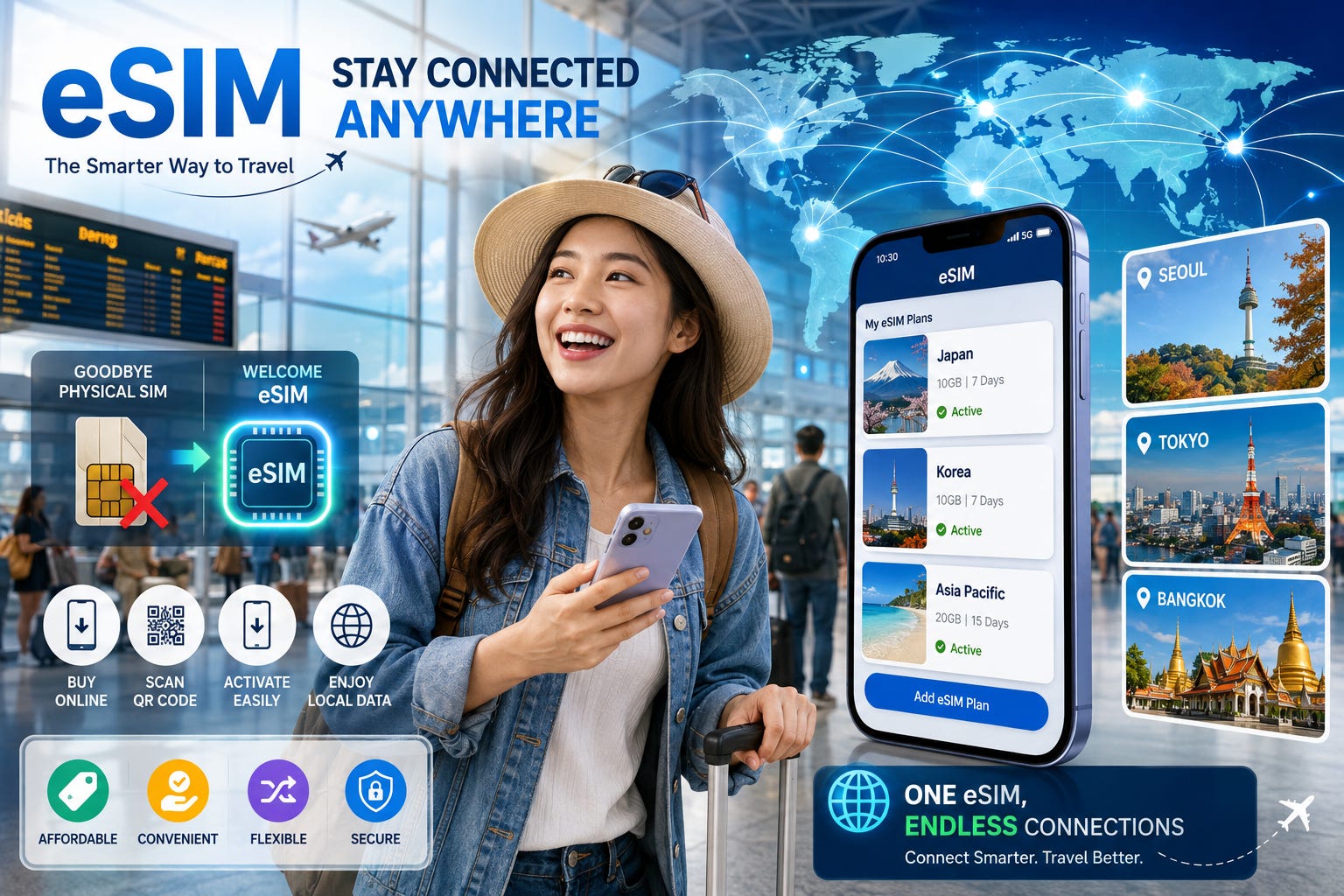
The End of the Plastic SIM? How eSIM Is Reshaping Travel, Roaming, and the Telecommunications Industry
A Tiny Technology with a Large Economic Impact
Abstract
Embedded SIM (eSIM) technology is rapidly displacing the physical SIM card as the primary means by which international travelers obtain mobile connectivity, with GSMA Intelligence (2025) projecting that eSIM smartphone connections will rise from roughly 5% of the global total at the end of 2025 to 10% by the end of 2026 and will surpass traditional removable-SIM connections by 2030. This shift is reshaping the economics of international roaming: because eSIM lowers the friction of switching providers (Federal Communications Commission, 2022), travelers can increasingly bypass their home carrier’s roaming packages in favor of destination-specific digital plans, a trend documented in recent reporting on the Korean telecommunications market (Chosun Ilbo, 2026). Drawing on Apple’s (2026a, 2026b, 2026c) technical documentation and industry analysis from GSMA (2026) and GSMA Intelligence (2025), this paper examines how eSIM is transforming consumers into “connectivity shoppers,” creating both competitive risk and opportunity for mobile network operators, introducing new security considerations tied to SIM-swap fraud, and extending beyond travel into IoT applications such as connected vehicles, industrial sensors, and remotely managed enterprise devices. The analysis concludes that the shift from carrier-centered to consumer-centered connectivity represents a structural change in the telecommunications industry rather than a temporary disruption.
Keywords: eSIM, international roaming, telecommunications, mobile connectivity, Internet of Things
From SIM card to eSIM
For decades, international travelers have faced a familiar choice: pay their home carrier for international roaming or purchase a physical SIM card after arriving at their destination. The process was simple but inconvenient. Travelers had to find a carrier store or airport kiosk, purchase a tiny plastic card, remove the existing SIM, insert the new one, and remember where they had placed the original card.
That routine is rapidly becoming outdated.
A recent report by the Chosun Ilbo (2026) highlights the rapid increase in travelers using eSIM services and the resulting pressure on the lucrative international-roaming business of traditional telecommunications carriers. The article, titled “Travelers’ eSIM Use Surges… Red Alert for Carriers’ Profitable Roaming Revenue,” illustrates a broader transformation already underway in the telecommunications industry.
The important point, however, is that eSIM is not simply a replacement for a plastic SIM card. It represents a fundamental change in how consumers purchase, activate, and change connectivity.
GSMA Intelligence’s (2025) latest assessment makes this clear. GSMA Intelligence (2025) estimates that eSIM accounted for approximately 5% of global smartphone connections at the end of 2025, a share expected to reach 10% by the end of 2026 and double again in 2027. By 2030, eSIM smartphone connections are expected to exceed those using traditional removable SIM cards (GSMA Intelligence, 2025).
The transition therefore raises a much larger question:
What happens to the telecommunications industry when connectivity becomes something consumers can purchase digitally, almost as easily as downloading an app?
From a Physical Card to a Digital Profile
An eSIM is an embedded, digital SIM that allows a compatible device to activate a mobile subscription without inserting a physical SIM card.
The practical difference is substantial.
According to Apple’s (2026a) current documentation, supported iPhones can use travel eSIMs from local carriers or worldwide service providers. Travelers can purchase a plan before departure, activate it digitally, and use it as a primary or secondary line, and supported iPhones can maintain multiple eSIM profiles while selecting which line provides cellular data (Apple, 2026a).
Consider a traveler living in Virginia who is flying to Republic of Korea for ten days.
In the traditional model, the traveler might purchase an international-roaming package from a U.S. carrier. Alternatively, after arriving in Seoul, the traveler could purchase a Korean physical SIM.
With eSIM, the traveler can purchase a Korean data plan online before departure, install the eSIM while connected to Wi-Fi, and activate it after landing.
The traveler does not have to find a store.
There is no plastic card to lose.
There is no SIM tray to open.
And the traveler can potentially retain the original U.S. telephone line while using the Korean eSIM for data.
This is a small change in hardware management but a significant change in consumer experience.
Why Travel Is the Perfect Market for eSIM
International travel is one of the most natural use cases for eSIM because travelers have a temporary and geographically specific need for connectivity.
A person who normally lives in the United States does not necessarily need a Korean or Japanese mobile plan permanently. The need may last only seven or ten days.
This makes a prepaid travel eSIM particularly attractive.
A traveler going from the United States to Japan might purchase a short-term data package before departure. Someone traveling through Korea, Japan, and Thailand might instead purchase a regional plan covering several countries.
Apple (2026b) currently notes that worldwide eSIM providers offer prepaid data plans covering more than 190 countries and regions.
The economic logic is straightforward.
If a consumer needs only a temporary data connection, why purchase a relatively expensive international-roaming package when a competing provider can sell a targeted data package digitally?
This is precisely the competitive pressure that the Chosun Ilbo (2026) article identifies.
The Consumer Is Becoming a Connectivity Shopper
The deeper transformation is behavioral.
Traditionally, a mobile subscriber had a strong relationship with one carrier. When traveling abroad, the default decision was often simply to activate international roaming through that carrier.
eSIM changes the decision-making process.
The consumer can now ask:
How much data do I need?
Which country am I visiting?
How long will I stay?
Which provider offers the best price?
Do I need voice service, or only data?
Can I use the same eSIM across several countries?
Connectivity begins to look less like a permanent subscription and more like a digital commodity that can be selected according to circumstances.
This is an important economic shift.
The consumer is no longer merely a subscriber.
The consumer is becoming a connectivity shopper.
Why This Matters to Traditional Carriers
International roaming has traditionally been valuable because customers often continued using their home carrier while abroad. The convenience was considerable: the traveler did not need to change anything.
eSIM introduces a new competitive alternative.
A customer can keep the home number while purchasing a separate travel data plan.
The Federal Communications Commission (2022) has recognized one of eSIM’s important consumer benefits: eSIM can allow users with unlocked devices to switch between providers with relatively little effort and time.
That reduced switching friction matters.
In traditional telecommunications, changing providers could involve obtaining a new SIM card, visiting a store, waiting for delivery, or dealing with activation procedures.
eSIM can eliminate much of that friction (Federal Communications Commission, 2022).
Consequently, carriers can no longer assume that international travelers will automatically purchase roaming from their home provider.
But eSIM Is Not Necessarily the Enemy of Mobile Operators
It would be a mistake, however, for telecommunications companies to interpret eSIM simply as a threat.
GSMA Intelligence’s (2025) research presents a more nuanced picture.
GSMA Intelligence (2025) reported that global smartphone eSIM adoption was still relatively low—approximately 3% of connections in 2024—but that awareness had reached about 50% in major markets. One important problem was that consumers were not being sufficiently educated or encouraged by their own mobile operators; only about 8% of eSIM-aware consumers reported discovering eSIM through their operator’s commercial efforts (GSMA Intelligence, 2025).
This creates an interesting paradox.
Consumers are becoming interested in eSIM faster than many operators are marketing it.
For mobile operators, the lesson is not to resist eSIM but to participate more aggressively in the eSIM ecosystem.
Instead of losing the travel customer to an independent eSIM provider, an operator could offer its own travel eSIM.
Instead of selling only traditional roaming packages, it could offer flexible destination-based data plans.
Instead of waiting for customers to search elsewhere, it could integrate travel connectivity directly into its mobile application.
The competitive question becomes:
Can the carrier make its own eSIM offering so convenient and attractive that customers have no reason to look elsewhere?
A Practical Example: Ten Days in Korea and Japan
Imagine a U.S. traveler planning a ten-day trip: five days in Seoul and five days in Tokyo.
There are at least three connectivity strategies.
The first is traditional roaming. The traveler keeps the U.S. SIM and activates an international roaming package.
The second is the physical-SIM strategy. The traveler purchases a Korean SIM after arrival and later replaces it with a Japanese SIM.
The third is the eSIM strategy. The traveler purchases an appropriate regional or destination eSIM before departure.
The third option has an important operational advantage.
The traveler can prepare the connection before the trip begins.
That matters because connectivity is especially important immediately after landing. Travelers need maps, transportation applications, hotel information, translation tools, messaging, and sometimes digital payment services.
The ability to activate connectivity before leaving the airport can therefore have significant practical value.
Apple (2026a) specifically describes travel eSIM as an option for maintaining connectivity abroad and notes that supported iPhones can use a travel eSIM either alone or alongside the user’s home line.
The Most Important Practical Rule: Avoid Accidental Roaming
The convenience of eSIM does not eliminate the possibility of user error.
Consider the U.S. traveler in Korea.
Suppose the traveler keeps the U.S. eSIM active for receiving messages but wants the Korean eSIM to handle mobile data.
The phone must be configured correctly.
Apple’s (2026c) current instructions allow users to select which line is used for cellular data. Apple (2026c) also warns that if both the home and travel lines remain active, roaming charges from the home line may still occur depending on the configuration and carrier.
Therefore, travelers should check their cellular settings before departure.
A simple rule is useful:
Keep your home number, if necessary, but deliberately select the travel eSIM as the data line.
This is a small technical step that can prevent an unexpectedly large roaming bill.
eSIM Also Changes the Meaning of Convenience
Physical SIM cards have a hidden cost: friction.
The card must be manufactured, distributed, stored, sold, inserted, removed, and eventually discarded.
eSIM moves much of this process into software.
A customer can purchase a plan online.
The operator can provision the profile digitally.
The user can activate it remotely.
The service can potentially be changed without physically touching the device.
This is one reason GSMA (2026) describes eSIM as a technology that is now reshaping several layers of the mobile ecosystem, including consumer handsets, international roaming, fraud management, and industrial IoT.
The transformation is therefore not merely about convenience for tourists.
It is about digitizing the distribution of connectivity itself.
The Security Question
Digital convenience also creates a new security challenge.
A physical SIM can be removed from a device. An eSIM profile cannot simply be pulled out and placed in another phone.
Apple (2026a) notes that eSIM can provide a security advantage because it cannot be physically removed if the iPhone is lost or stolen.
But the broader eSIM ecosystem still requires strong security.
GSMA’s (2026) assessment highlights SIM-swap fraud and the need for stronger fraud detection as eSIM adoption grows. The industry must detect unusual behavior, authenticate users appropriately, and coordinate defenses against increasingly sophisticated attacks (GSMA, 2026).
This is particularly important because a mobile telephone number is no longer merely a communication identifier.
It can also be connected to banking accounts, email recovery, multifactor authentication, social media, and other digital identities.
Therefore:
The more important the mobile number becomes as a digital identity, the more important eSIM security becomes.
eSIM and the Rise of IoT
The most consequential effects of eSIM may eventually occur outside the smartphone market.
Consider a manufacturer producing connected devices for global markets.
Under a traditional SIM model, a company may need different SIM configurations for different countries and networks.
This creates manufacturing and logistics complexity.
GSMA’s (2026) analysis points to the emergence of SGP.32 for IoT eSIM deployments. The specification is designed to simplify remote management of connectivity profiles and can allow enterprises to change connectivity without physically accessing deployed devices (GSMA, 2026).
Imagine a global company deploying 100,000 smart meters.
With traditional SIM management, changing the connectivity arrangement may require significant logistical effort.
With remotely managed eSIM connectivity, the organization can potentially change network profiles through software.
The same principle can apply to:
connected automobiles
logistics trackers
industrial sensors
smart meters
medical devices
agricultural equipment
drones
wearable devices
This is why eSIM should be understood as more than a travel technology.
It is part of the infrastructure of the Internet of Things.
The Automotive Example
The automobile industry provides an especially useful example.
A connected automobile sold in Korea may need different network arrangements from the same model sold in the United States or Europe.
If connectivity is embedded and remotely configurable, the manufacturer does not necessarily need to manage the same physical SIM arrangement for every market.
The vehicle becomes a globally connected digital product.
This can simplify manufacturing, logistics, maintenance, and network management.
In this sense, eSIM contributes to a broader technological movement toward software-defined products.
The same transformation can be seen in cloud computing, software-defined networking, and remotely managed devices.
The physical infrastructure remains important, but the configuration and management increasingly occur through software.
What Should Travelers Do?
For ordinary travelers, the eSIM revolution produces several practical lessons.
Before departure, check whether the phone supports eSIM.
For example, Apple (2026b) states that iPhone XS, iPhone XS Max, iPhone XR, and later models support eSIM, subject to carrier and regional availability.
Next, check whether the phone is carrier-unlocked.
On an iPhone, Apple (2026c) notes that “No SIM Restrictions” should appear under Carrier Lock when the device is unlocked.
Then compare travel plans.
Do not compare price alone. Consider:
coverage + data allowance + duration + network quality + activation method + customer support + hotspot availability.
Finally, configure the phone before boarding the airplane.
The goal is simple:
Land connected.
What Should Telecommunications Companies Do?
The implications for telecommunications companies are even more significant.
First, carriers should make eSIM activation simple.
Second, they should promote eSIM rather than treating it as a technical feature hidden inside the customer account (GSMA Intelligence, 2025).
Third, they should develop flexible international products.
Fourth, they should integrate travel connectivity into their mobile applications.
Fifth, they should use their advantages in network quality, customer support, billing, authentication, and security to compete with digital eSIM providers.
A carrier could even create a “Travel Mode” in its mobile application.
A customer enters:
Destination: Korea
Duration: 7 days
Data requirement: 10 GB
The application recommends a travel plan, activates the eSIM, configures the data line, and automatically switches the customer back to the home plan after returning.
Such a service would transform eSIM from a technical capability into a consumer experience.
The Strategic Lesson for Korea
The implications are particularly important for Korea.
Korea has a highly developed mobile communications infrastructure and a large population of international travelers. The expansion of travel eSIM means Korean telecommunications companies face competition not only from other domestic carriers but also from global digital connectivity companies (Chosun Ilbo, 2026).
The competition is moving beyond network infrastructure.
It is moving toward:
user experience, pricing, digital distribution, personalization, and trust.
A Korean traveler may purchase connectivity for Japan from a global eSIM provider before leaving Seoul. An American tourist may purchase Korean connectivity from a digital provider before boarding a flight to Incheon.
The traditional geographic boundaries of telecommunications are therefore becoming less meaningful.
From Carrier-Centered to Consumer-Centered Connectivity
The most profound lesson of eSIM is not technological.
It is economic.
For decades, telecommunications were largely carrier centered. Customers joined a network and remained within that operator’s ecosystem.
The eSIM model moves the industry toward a more consumer-centered environment.
Consumers can compare.
Consumers can switch.
Consumers can purchase temporary connectivity.
Consumers can maintain multiple profiles.
And consumers can increasingly decide which network they want for a particular place and purpose.
This does not mean that traditional mobile operators will disappear.
It means that their relationship with customers must change.
The future carrier will have to compete for every moment of connectivity.
A Small Chip, a Large Transformation
The eSIM revolution illustrates a familiar pattern in digital transformation.
A technology may appear small and technical while producing enormous economic consequences.
The physical SIM card is tiny.
But the business model built around it is enormous.
When the physical card becomes software, many of the old barriers surrounding connectivity begin to disappear.
The traveler no longer needs to wait in an airport store.
The manufacturer no longer needs to produce as many country-specific device variants.
The enterprise no longer necessarily needs physical access to every connected device.
The consumer can increasingly select connectivity according to need.
And the telecommunications operator must compete in a market where switching and comparison are becoming easier.
GSMA’s (2026) latest assessment captures the scale of the transition: eSIM is moving from a technology that the industry expected to become important to one that is increasingly being deployed at mass-market scale.
The Chosun Ilbo’s (2026) warning about pressure on profitable roaming revenue is therefore important, but it should be understood as part of a much larger transformation.
The real issue is not whether physical SIM cards will disappear tomorrow.
The real issue is whether telecommunications companies are prepared for a world in which connectivity itself becomes programmable, portable, and increasingly chosen by consumers in real time.
For travelers, eSIM means greater convenience and potentially lower costs.
For carriers, it means greater competition.
For enterprises, it means more flexible connectivity management.
For IoT, it means a more scalable global architecture.
And for consumers, it means something even more fundamental:
the freedom to choose how they connect to the world.
The age of the physical SIM card may not be completely over, but the era in which a tiny piece of plastic helped determine who provided our connectivity is clearly coming to an end.
The next question is no longer:
“Which SIM card should I insert?”
It is:
“Which connection should I choose?”
References
Apple. (2026a). Use eSIM while traveling internationally with your iPhone. Apple Support.
Apple. (2026b). Find wireless carriers and worldwide service providers that offer eSIM service on iPhone. Apple Support.
Apple. (2026c). Set up eSIM on iPhone. Apple Support.
Chosun Ilbo. (2026, August 22). Travelers’ eSIM use surges… Red alert for carriers’ profitable roaming revenue.
Federal Communications Commission. (2022). Report and order and further notice of proposed rulemaking (FCC 22-103).
GSMA. (2026, May 1). eSIM mass market deployment moves from forecast to fact.
GSMA Intelligence. (2025, July 31). Travel eSIM: A passport to growth for eSIM among MNOs? Jarich, P., & Iacopino, P.
플라스틱 SIM의 종말인가? eSIM이 여행, 로밍, 통신 산업을 어떻게 바꾸고 있는가
작은 기술, 큰 경제적 파급력
초록(Abstract)
내장형 SIM(eSIM) 기술은 해외 여행자가 모바일 연결성을 확보하는 주된 방식으로서 물리적 SIM 카드를 빠르게 대체하고 있다. GSMA Intelligence(2025)는 전 세계 eSIM 스마트폰 연결 비중이 2025년 말 약 5%에서 2026년 말 10%로 증가하고, 2030년에는 기존 탈착식 SIM 연결 수를 넘어설 것으로 전망한다. 이러한 변화는 국제 로밍 사업의 경제 구조를 재편하고 있다. eSIM은 사업자 전환의 마찰을 낮추기 때문에(Federal Communications Commission, 2022), 여행자는 본국 통신사의 로밍 요금제 대신 목적지별 디지털 요금제를 점점 더 많이 선택하고 있으며, 이는 한국 통신 시장에 관한 최근 보도에서도 확인된다(Chosun Ilbo, 2026). 본 논문은 Apple(2026a, 2026b, 2026c)의 기술 문서와 GSMA(2026) 및 GSMA Intelligence(2025)의 산업 분석을 바탕으로, eSIM이 소비자를 “연결성 쇼핑객”으로 변화시키는 과정, 이동통신사업자(MNO)에게 발생하는 경쟁적 위협과 기회, SIM 스와핑 사기와 관련된 새로운 보안 문제, 그리고 커넥티드 차량, 산업용 센서, 원격 관리 기업용 기기 등 여행을 넘어선 사물인터넷(IoT) 응용으로의 확장을 살펴본다. 분석 결과, 사업자 중심에서 소비자 중심 연결성으로의 전환은 일시적 파괴적 혁신이 아니라 통신 산업의 구조적 변화임을 시사한다.
키워드: eSIM, 국제 로밍, 통신, 모바일 연결성, 사물인터넷
SIM 카드에서 eSIM으로
수십 년 동안 해외 여행자들은 익숙한 선택에 직면해 왔다. 본국 통신사의 국제 로밍 요금제를 이용하거나, 목적지에 도착한 뒤 현지 물리적 SIM 카드를 구매하는 것이다. 이 과정은 단순하지만 번거로웠다. 여행자는 통신사 매장이나 공항 키오스크를 찾아 작은 플라스틱 카드를 구매하고, 기존 SIM을 빼내고 새 SIM을 끼운 뒤, 원래 SIM을 어디에 두었는지 기억해야 했다.
이러한 관행은 빠르게 옛것이 되어가고 있다.
조선일보(Chosun Ilbo, 2026)의 최근 보도는 eSIM 서비스를 이용하는 여행자가 급증하면서 전통적인 통신사의 수익성 높은 국제 로밍 사업이 압박받고 있음을 보여준다. “여행객 eSIM 이용 급증… 통신사 알짜 로밍 수익에 빨간불”이라는 제목의 이 기사는 통신 산업 전반에서 이미 진행 중인 더 큰 전환을 보여준다.
그러나 중요한 점은 eSIM이 단순히 플라스틱 SIM 카드를 대체하는 것이 아니라는 점이다. 이는 소비자가 연결성을 구매하고, 활성화하고, 변경하는 방식 자체의 근본적인 변화를 의미한다.
GSMA Intelligence(2025)의 최신 평가는 이를 분명히 보여준다. GSMA Intelligence(2025)는 eSIM이 2025년 말 기준 전 세계 스마트폰 연결의 약 5%를 차지했으며, 이 비중이 2026년 말까지 10%에 이르고 2027년에는 다시 두 배로 늘어날 것으로 추정한다. 2030년에는 eSIM 스마트폰 연결 수가 기존 탈착식 SIM 카드를 사용하는 연결 수를 넘어설 것으로 전망된다(GSMA Intelligence, 2025).
이러한 전환은 더 큰 질문을 제기한다.
연결성을 소비자가 마치 앱을 다운로드하듯 디지털 방식으로 구매할 수 있게 되면, 통신 산업에는 어떤 일이 벌어질까?
물리적 카드에서 디지털 프로필로
eSIM은 내장형 디지털 SIM으로, 호환 기기가 물리적 SIM 카드를 삽입하지 않고도 모바일 서비스를 활성화할 수 있게 해준다.
그 실질적 차이는 상당하다.
Apple(2026a)의 현재 문서에 따르면, 지원되는 아이폰은 현지 통신사나 전 세계 서비스 제공업체의 여행용 eSIM을 사용할 수 있다. 여행자는 출발 전에 요금제를 구매해 디지털 방식으로 활성화하고 이를 주 회선 또는 보조 회선으로 사용할 수 있으며, 지원되는 아이폰은 여러 개의 eSIM 프로필을 유지하면서 어떤 회선으로 셀룰러 데이터를 사용할지 선택할 수 있다(Apple, 2026a).
버지니아에 거주하는 여행자가 열흘간 한국으로 출장을 간다고 가정해 보자.
전통적인 방식이라면 이 여행자는 미국 통신사의 국제 로밍 상품을 구매하거나, 서울에 도착한 뒤 한국 물리적 SIM을 구매할 수 있다.
eSIM을 이용하면 이 여행자는 출발 전에 온라인으로 한국 데이터 요금제를 구매하고, Wi-Fi에 연결된 상태에서 eSIM을 설치한 뒤, 도착 후 활성화할 수 있다.
여행자는 매장을 찾아다닐 필요가 없다.
잃어버릴 플라스틱 카드도 없다.
SIM 트레이를 열 필요도 없다.
그리고 여행자는 데이터용으로 한국 eSIM을 사용하면서도 기존 미국 전화번호를 그대로 유지할 수 있다.
이는 하드웨어 관리 측면에서는 작은 변화이지만, 소비자 경험 측면에서는 상당한 변화다.
여행이 eSIM에 최적의 시장인 이유
국제 여행은 eSIM의 가장 자연스러운 활용 사례 중 하나다. 여행자는 일시적이고 지리적으로 특정된 연결성 수요를 갖기 때문이다.
미국에 거주하는 사람이 한국이나 일본의 모바일 요금제를 영구적으로 필요로 하는 경우는 드물다. 필요한 기간은 7일이나 10일에 불과할 수 있다.
이 때문에 선불 여행용 eSIM이 특히 매력적이다.
미국에서 일본으로 가는 여행자는 출발 전 단기 데이터 패키지를 구매할 수 있다. 한국, 일본, 태국을 여행하는 사람이라면 여러 국가를 아우르는 지역 요금제를 구매할 수도 있다.
Apple(2026b)은 현재 전 세계 eSIM 제공업체들이 190개 이상의 국가 및 지역을 아우르는 선불 데이터 요금제를 제공한다고 밝히고 있다.
경제 논리는 단순하다.
소비자가 일시적인 데이터 연결만 필요로 한다면, 경쟁 업체가 디지털 방식으로 목적에 맞는 데이터 상품을 판매할 수 있는 상황에서 굳이 비교적 비싼 국제 로밍 상품을 구매할 이유가 있을까?
이것이 바로 조선일보(Chosun Ilbo, 2026) 기사가 지적하는 경쟁 압력이다.
소비자는 ‘연결성 쇼핑객’이 되어가고 있다
더 근본적인 변화는 행동 양식에 있다.
전통적으로 모바일 가입자는 하나의 통신사와 강한 관계를 맺어왔다. 해외 여행 시 기본 선택지는 대개 그 통신사의 국제 로밍을 활성화하는 것이었다.
eSIM은 이러한 의사결정 과정을 바꾼다.
이제 소비자는 다음과 같이 질문할 수 있다.
얼마만큼의 데이터가 필요한가?
어느 나라를 방문하는가?
얼마나 머무를 것인가?
어느 업체가 가장 좋은 가격을 제공하는가?
음성 서비스가 필요한가, 아니면 데이터만 필요한가?
여러 국가에서 같은 eSIM을 사용할 수 있는가?
연결성은 이제 영구적인 구독보다는 상황에 따라 선택할 수 있는 디지털 상품처럼 여겨지기 시작한다.
이는 중요한 경제적 변화다.
소비자는 더 이상 단순한 가입자가 아니다.
소비자는 ‘연결성 쇼핑객’이 되어가고 있다.
전통적인 통신사에 중요한 이유
국제 로밍은 전통적으로 해외에서도 고객이 계속 본국 통신사를 이용한다는 점에서 가치가 있었다. 그 편리함은 상당했다. 여행자는 아무것도 바꿀 필요가 없었다.
eSIM은 새로운 경쟁 대안을 제시한다.
고객은 본국 전화번호를 유지하면서 별도의 여행용 데이터 요금제를 구매할 수 있다.
미국 연방통신위원회(Federal Communications Commission, 2022)는 eSIM의 중요한 소비자 이점 하나를 인정했다. 즉, eSIM은 잠금 해제된 기기를 가진 사용자가 상대적으로 적은 노력과 시간으로 사업자를 전환할 수 있게 해준다는 것이다.
이러한 전환 마찰 감소는 중요하다.
전통적인 통신 환경에서는 사업자를 바꾸려면 새 SIM 카드를 구하고, 매장을 방문하고, 배송을 기다리거나 활성화 절차를 거쳐야 했다.
eSIM은 이러한 마찰의 상당 부분을 없앨 수 있다(Federal Communications Commission, 2022).
결과적으로 통신사들은 해외 여행자가 자동으로 본국 사업자의 로밍을 구매할 것이라고 더 이상 가정할 수 없다.
그러나 eSIM이 반드시 이동통신사업자의 적은 아니다
그럼에도 불구하고 통신 회사들이 eSIM을 단순히 위협으로만 해석한다면 이는 실수일 것이다.
GSMA Intelligence(2025)의 연구는 더 균형 잡힌 시각을 제시한다.
GSMA Intelligence(2025)는 전 세계 스마트폰 eSIM 채택률이 여전히 상대적으로 낮아 2024년 기준 약 3%에 불과했지만, 주요 시장에서의 인지도는 약 50%에 달했다고 보고했다. 한 가지 중요한 문제는 소비자들이 자신이 이용하는 이동통신사업자로부터 충분한 교육이나 안내를 받지 못하고 있다는 점이었다. eSIM을 인지하고 있는 소비자 중 자사 통신사의 마케팅 활동을 통해 이를 알게 되었다고 답한 비율은 약 8%에 불과했다(GSMA Intelligence, 2025).
여기서 흥미로운 역설이 발생한다.
소비자들은 많은 통신사들이 이를 마케팅하는 속도보다 더 빠르게 eSIM에 관심을 갖기 시작하고 있다.
이동통신사업자들에게 주는 교훈은 eSIM에 저항하는 것이 아니라, eSIM 생태계에 더 적극적으로 참여하는 것이다.
독립적인 eSIM 제공업체에게 여행 고객을 빼앗기는 대신, 통신사는 자체 여행용 eSIM을 제공할 수 있다.
전통적인 로밍 상품만 판매하는 대신, 유연한 목적지별 데이터 요금제를 제공할 수 있다.
고객이 다른 곳을 찾아다니기를 기다리는 대신, 여행용 연결성을 자사 모바일 애플리케이션에 직접 통합할 수 있다.
경쟁의 핵심 질문은 다음과 같다.
통신사가 고객이 다른 곳을 찾을 이유가 없을 만큼 편리하고 매력적인 자체 eSIM 상품을 만들 수 있는가?
실제 사례: 한국과 일본에서의 열흘
미국 여행자가 서울에서 5일, 도쿄에서 5일을 보내는 열흘간의 여행을 계획한다고 가정해 보자.
연결성을 확보하는 방식은 최소 세 가지다.
첫째는 전통적인 로밍이다. 여행자는 미국 SIM을 유지한 채 국제 로밍 상품을 활성화한다.
둘째는 물리적 SIM 전략이다. 여행자는 도착 후 한국 SIM을 구매하고, 이후 일본 SIM으로 교체한다.
셋째는 eSIM 전략이다. 여행자는 출발 전에 적절한 지역 또는 목적지별 eSIM을 구매한다.
세 번째 방식에는 중요한 운영상의 이점이 있다.
여행자는 여행이 시작되기 전에 미리 연결성을 준비할 수 있다.
이는 착륙 직후 연결성이 특히 중요하기 때문에 중요한 의미를 갖는다. 여행자는 지도, 교통 애플리케이션, 호텔 정보, 번역 도구, 메시징, 그리고 때로는 디지털 결제 서비스를 필요로 한다.
공항을 떠나기 전에 미리 연결성을 활성화할 수 있다는 점은 그래서 실질적인 가치를 지닌다.
Apple(2026a)은 여행용 eSIM을 해외에서 연결성을 유지하기 위한 옵션으로 구체적으로 설명하며, 지원되는 아이폰이 여행용 eSIM을 단독으로 또는 사용자의 본국 회선과 함께 사용할 수 있다고 밝히고 있다.
가장 중요한 실용적 원칙: 의도치 않은 로밍 피하기
eSIM의 편리함이 사용자 실수의 가능성을 없애주지는 않는다.
한국에 있는 미국 여행자를 생각해 보자.
이 여행자가 메시지 수신을 위해 미국 eSIM을 활성 상태로 유지하면서도, 모바일 데이터는 한국 eSIM으로 처리하고자 한다고 가정하자.
이때 휴대폰이 올바르게 설정되어야 한다.
Apple(2026c)의 현재 안내에 따르면 사용자는 셀룰러 데이터에 사용할 회선을 선택할 수 있다. Apple(2026c)은 또한 본국 회선과 여행용 회선이 모두 활성 상태로 남아 있을 경우, 설정과 통신사에 따라 본국 회선에서 로밍 요금이 여전히 발생할 수 있다고 경고한다.
따라서 여행자는 출발 전에 셀룰러 설정을 확인해야 한다.
간단한 원칙이 유용하다.
필요하다면 본국 번호는 유지하되, 데이터 회선으로는 의도적으로 여행용 eSIM을 선택하라.
이는 작은 기술적 조치이지만 예상치 못한 큰 로밍 요금을 예방할 수 있다.
eSIM은 ‘편리함’의 의미 자체를 바꾼다
물리적 SIM 카드에는 숨겨진 비용, 즉 마찰이 있다.
카드는 제조되고, 유통되고, 보관되고, 판매되고, 삽입되고, 제거되고, 결국 폐기되어야 한다.
eSIM은 이 과정의 상당 부분을 소프트웨어로 옮긴다.
고객은 온라인으로 요금제를 구매할 수 있다.
통신사는 프로필을 디지털 방식으로 제공할 수 있다.
사용자는 이를 원격으로 활성화할 수 있다.
서비스는 기기를 물리적으로 만지지 않고도 변경될 수 있다.
이것이 바로 GSMA(2026)가 eSIM을 소비자용 단말기, 국제 로밍, 사기 관리, 산업용 IoT를 포함한 모바일 생태계의 여러 계층을 재편하고 있는 기술로 설명하는 이유다.
따라서 이 변화는 단순히 관광객의 편의를 위한 것만이 아니다.
이는 연결성 자체의 유통을 디지털화하는 것이다.
보안 문제
디지털 편리함은 동시에 새로운 보안 과제를 낳는다.
물리적 SIM은 기기에서 제거할 수 있다. 그러나 eSIM 프로필은 단순히 빼내어 다른 휴대폰에 꽂을 수 없다.
Apple(2026a)은 eSIM이 아이폰을 분실하거나 도난당했을 때 물리적으로 제거될 수 없다는 점에서 보안상 이점을 제공할 수 있다고 설명한다.
그러나 더 넓은 eSIM 생태계에는 여전히 강력한 보안이 필요하다.
GSMA(2026)의 평가는 eSIM 채택이 확대됨에 따라 SIM 스와핑(SIM-swap) 사기와 더 강력한 사기 탐지의 필요성을 강조한다. 업계는 이상 행동을 탐지하고, 사용자를 적절히 인증하며, 점점 정교해지는 공격에 맞서 방어를 조율해야 한다(GSMA, 2026).
이는 특히 중요한데, 휴대전화 번호가 더 이상 단순한 통신 식별자가 아니기 때문이다.
휴대전화 번호는 은행 계좌, 이메일 복구, 다요소 인증, 소셜 미디어 등 다른 디지털 신원과도 연결될 수 있다.
따라서 다음과 같이 말할 수 있다.
휴대전화 번호가 디지털 신원으로서 더 중요해질수록, eSIM 보안 역시 더욱 중요해진다.
eSIM과 사물인터넷(IoT)의 부상
eSIM의 가장 중요한 영향은 결국 스마트폰 시장 밖에서 나타날 수도 있다.
전 세계 시장을 대상으로 커넥티드 기기를 생산하는 제조업체를 생각해 보자.
전통적인 SIM 모델에서는 기업이 국가와 네트워크마다 서로 다른 SIM 구성을 필요로 할 수 있다.
이는 제조 및 물류상의 복잡성을 초래한다.
GSMA(2026)의 분석은 IoT용 eSIM 배포를 위한 SGP.32의 등장을 지적한다. 이 규격은 연결성 프로필의 원격 관리를 단순화하도록 설계되었으며, 기업이 배포된 기기에 물리적으로 접근하지 않고도 연결성을 변경할 수 있게 한다(GSMA, 2026).
전 세계에 10만 대의 스마트 계량기를 배포하는 글로벌 기업을 상상해 보자.
전통적인 SIM 관리 방식이라면 연결 방식을 변경하는 데 상당한 물류적 노력이 필요할 수 있다.
원격으로 관리되는 eSIM 연결성을 이용하면 조직은 소프트웨어를 통해 네트워크 프로필을 변경할 수 있게 된다.
같은 원리는 다음과 같은 분야에도 적용될 수 있다.
커넥티드 자동차
물류 추적 장치
산업용 센서
스마트 계량기
의료 기기
농업용 장비
드론
웨어러블 기기
이것이 바로 eSIM을 단순한 여행 기술 이상으로 이해해야 하는 이유다.
이는 사물인터넷 인프라의 일부다.
자동차 산업의 사례
자동차 산업은 특히 유용한 사례를 제공한다.
한국에서 판매되는 커넥티드 자동차는 미국이나 유럽에서 판매되는 동일 모델과는 다른 네트워크 구성이 필요할 수 있다.
연결성이 내장되어 원격으로 구성 가능하다면, 제조업체는 모든 시장에 대해 동일한 물리적 SIM 구성을 관리할 필요가 반드시 없어진다.
차량은 전 세계적으로 연결된 디지털 제품이 된다.
이는 제조, 물류, 유지보수, 네트워크 관리를 단순화할 수 있다.
이러한 의미에서 eSIM은 소프트웨어 정의 제품(software-defined product)이라는 더 큰 기술적 흐름에 기여한다.
같은 전환은 클라우드 컴퓨팅, 소프트웨어 정의 네트워킹, 원격 관리 기기 분야에서도 나타난다.
물리적 인프라는 여전히 중요하지만, 구성과 관리는 점점 더 소프트웨어를 통해 이루어지고 있다.
여행자는 무엇을 해야 하는가?
일반 여행자에게 eSIM 혁명은 몇 가지 실용적인 교훈을 준다.
출발 전, 휴대폰이 eSIM을 지원하는지 확인하라.
예를 들어 Apple(2026b)은 아이폰 XS, 아이폰 XS Max, 아이폰 XR 및 이후 모델이 통신사 및 지역 가용성에 따라 eSIM을 지원한다고 밝히고 있다.
다음으로, 휴대폰이 통신사 잠금 해제 상태인지 확인하라.
아이폰의 경우 Apple(2026c)은 기기가 잠금 해제되어 있으면 캐리어 잠금(Carrier Lock) 항목 아래에 “SIM 제한 없음(No SIM Restrictions)”이 표시된다고 설명한다.
그런 다음 여행용 요금제를 비교하라.
가격만 비교하지 말고 다음을 고려하라.
커버리지 + 데이터 제공량 + 기간 + 네트워크 품질 + 활성화 방식 + 고객 지원 + 핫스팟 이용 가능 여부.
마지막으로, 비행기에 탑승하기 전에 휴대폰을 미리 설정하라.
목표는 단순하다.
‘착륙과 동시에 연결되는 것’.
통신 회사는 무엇을 해야 하는가?
통신 회사에 주는 시사점은 더욱 크다.
첫째, 통신사는 eSIM 활성화 과정을 단순하게 만들어야 한다.
둘째, eSIM을 고객 계정 안에 숨겨진 기술적 기능으로 취급하기보다 적극적으로 홍보해야 한다(GSMA Intelligence, 2025).
셋째, 유연한 국제 상품을 개발해야 한다.
넷째, 여행용 연결성을 자사 모바일 애플리케이션에 통합해야 한다.
다섯째, 네트워크 품질, 고객 지원, 청구, 인증, 보안 측면의 강점을 활용해 디지털 eSIM 제공업체와 경쟁해야 한다.
통신사는 자사 애플리케이션 안에 ‘여행 모드(Travel Mode)’를 만들 수도 있다.
고객이 다음 정보를 입력한다고 가정해 보자.
목적지: 일본
기간: 7일
데이터 요구량: 10GB
애플리케이션은 여행용 요금제를 추천하고, eSIM을 활성화하며, 데이터 회선을 설정하고, 귀국 후 자동으로 본국 요금제로 전환해 준다.
이러한 서비스는 eSIM을 단순한 기술적 기능에서 하나의 소비자 경험으로 탈바꿈시킬 것이다.
한국에 주는 전략적 교훈
이러한 시사점은 한국에 특히 중요하다.
한국은 고도로 발달한 이동통신 인프라와 많은 해외 여행자 인구를 보유하고 있다. 여행용 eSIM의 확산은 한국 통신사들이 국내 경쟁사뿐 아니라 글로벌 디지털 연결성 기업들과도 경쟁해야 함을 의미한다(Chosun Ilbo, 2026).
경쟁은 네트워크 인프라를 넘어서고 있다.
경쟁은 다음과 같은 영역으로 이동하고 있다.
사용자 경험, 가격, 디지털 유통, 개인화, 신뢰.
한국인 여행자는 서울을 떠나기 전에 글로벌 eSIM 제공업체로부터 일본용 연결성을 구매할 수 있다. 미국인 관광객은 인천행 비행기에 탑승하기 전에 디지털 제공업체로부터 한국용 연결성을 구매할 수 있다.
이로써 통신 산업의 전통적인 지리적 경계는 점점 그 의미를 잃어가고 있다.
사업자 중심에서 소비자 중심 연결성으로
eSIM이 주는 가장 근본적인 교훈은 기술적인 것이 아니다.
그것은 경제적인 것이다.
수십 년 동안 통신 산업은 대체로 사업자 중심이었다. 고객은 하나의 네트워크에 가입하면 그 사업자의 생태계 안에 머물렀다.
eSIM 모델은 산업을 보다 소비자 중심적인 환경으로 이동시키고 있다.
소비자는 비교할 수 있다.
소비자는 전환할 수 있다.
소비자는 일시적인 연결성을 구매할 수 있다.
소비자는 여러 프로필을 유지할 수 있다.
그리고 소비자는 특정 장소와 목적에 맞는 네트워크를 점점 더 스스로 결정할 수 있다.
이는 전통적인 이동통신사업자가 사라진다는 의미는 아니다.
다만 이들이 고객과 맺는 관계가 변화해야 한다는 의미다.
미래의 통신사는 매 순간의 연결성을 두고 경쟁해야 할 것이다.
작은 칩, 큰 전환
eSIM 혁명은 디지털 전환에서 흔히 나타나는 익숙한 패턴을 보여준다.
작고 기술적으로 보이는 기술이 엄청난 경제적 결과를 낳을 수 있다는 것이다.
물리적 SIM 카드는 작다.
그러나 그것을 둘러싸고 형성된 비즈니스 모델은 거대하다.
물리적 카드가 소프트웨어로 바뀌면서, 연결성을 둘러싼 오래된 장벽들이 사라지기 시작한다.
여행자는 더 이상 공항 매장에서 기다릴 필요가 없다.
제조업체는 더 이상 국가별로 다양한 기기 버전을 그렇게 많이 만들 필요가 없다.
기업은 연결된 모든 기기에 반드시 물리적으로 접근할 필요가 없어진다.
소비자는 필요에 따라 연결성을 점점 더 자유롭게 선택할 수 있다.
그리고 통신사업자는 전환과 비교가 점점 쉬워지는 시장에서 경쟁해야 한다.
GSMA(2026)의 최신 평가는 이러한 전환의 규모를 잘 보여준다. eSIM은 업계가 앞으로 중요해질 것이라고 예상했던 기술에서, 이제 대중 시장 규모로 실제 배포되고 있는 기술로 옮겨가고 있다.
조선일보(Chosun Ilbo, 2026)가 지적한 수익성 높은 로밍 수익에 대한 경고는 그래서 중요하지만, 이는 훨씬 더 큰 전환의 일부로 이해되어야 한다.
진짜 문제는 물리적 SIM 카드가 내일 당장 사라질 것인가가 아니다.
진짜 문제는 연결성 자체가 프로그래밍 가능하고, 휴대 가능하며, 소비자가 실시간으로 점점 더 스스로 선택할 수 있게 되는 세상에 통신 회사들이 준비되어 있는가 하는 것이다.
여행자에게 eSIM은 더 큰 편리함과 잠재적으로 더 낮은 비용을 의미한다.
통신사에게 그것은 더 치열한 경쟁을 의미한다.
기업에게 그것은 더 유연한 연결성 관리를 의미한다.
IoT에게 그것은 더 확장 가능한 글로벌 아키텍처를 의미한다.
그리고 소비자에게 그것은 훨씬 더 근본적인 것을 의미한다.
바로 세상과 연결되는 방식을 스스로 선택할 수 있는 자유다.
물리적 SIM 카드의 시대가 완전히 끝난 것은 아닐지 모르지만, 작은 플라스틱 조각이 우리에게 누가 연결성을 제공할지를 결정하던 시대는 분명히 저물고 있다.
이제 남은 질문은 더 이상 다음과 같지 않다.
“어떤 SIM 카드를 끼워야 할까?”
이제 질문은 다음과 같다.
“어떤 연결을 선택해야 할까?”
참고문헌(References)
Apple. (2026a). Use eSIM while traveling internationally with your iPhone. Apple Support.
Apple. (2026b). Find wireless carriers and worldwide service providers that offer eSIM service on iPhone. Apple Support.
Apple. (2026c). Set up eSIM on iPhone. Apple Support.
Chosun Ilbo. (2026, August 22). Travelers’ eSIM use surges… Red alert for carriers’ profitable roaming revenue [여행객 eSIM 이용 급증… 통신사 알짜 로밍 수익에 빨간불]. 조선일보.
Federal Communications Commission. (2022). Report and order and further notice of proposed rulemaking (FCC 22-103).
GSMA. (2026, May 1). eSIM mass market deployment moves from forecast to fact.
GSMA Intelligence. (2025, July 31). Travel eSIM: A passport to growth for eSIM among MNOs? Jarich, P., & Iacopino, P.
Source Paper:

2026년 8월 22일
{솔티}

Prof. Dr. Young Choi (Editor in Chief) — Regent University
Young B. Choi is a Professor in the Department of Engineering & Computer Science at Regent University. He published 38 books with ‘Selected Readings in Cybersecurity’ (2018) (over 800 copies archived globally at university/college libraries around the world) and ‘Cybersecurity Applications and Artificial Intelligence’ (2023) available in seven major world languages. He proposed the world’s first global and universal telecommunications “Service Order Handling (SOH)” Model (T-SOH Model) (1995) with Dr. Adrian Tang. With this innovative research work, he received the IEEE NOMS ’96 Best Paper Award and became the first recipient of the Outstanding Contribution Award of the TeleManagement Forum in 1998. His research areas include Natural Language Processing-focused AI, AI-applied cybersecurity, network and telecom service management, and Korean studies on Gani Choi Rip’s Jeonggwan (靜觀: Quiet Contemplation) philosophy and Shilhak ( 實學: Practical Learning).
© K-GSP (K-Global Scholars and Professionals) Forum. All rights reserved. August 2026.
Choi, Y. B. (2026, August 22). The End of the Plastic SIM? How eSIM Is Reshaping Travel, Roaming, and the Telecommunications Industry: A Tiny Technology with a Large Economic Impact. K-GSP.