

Executive Summary
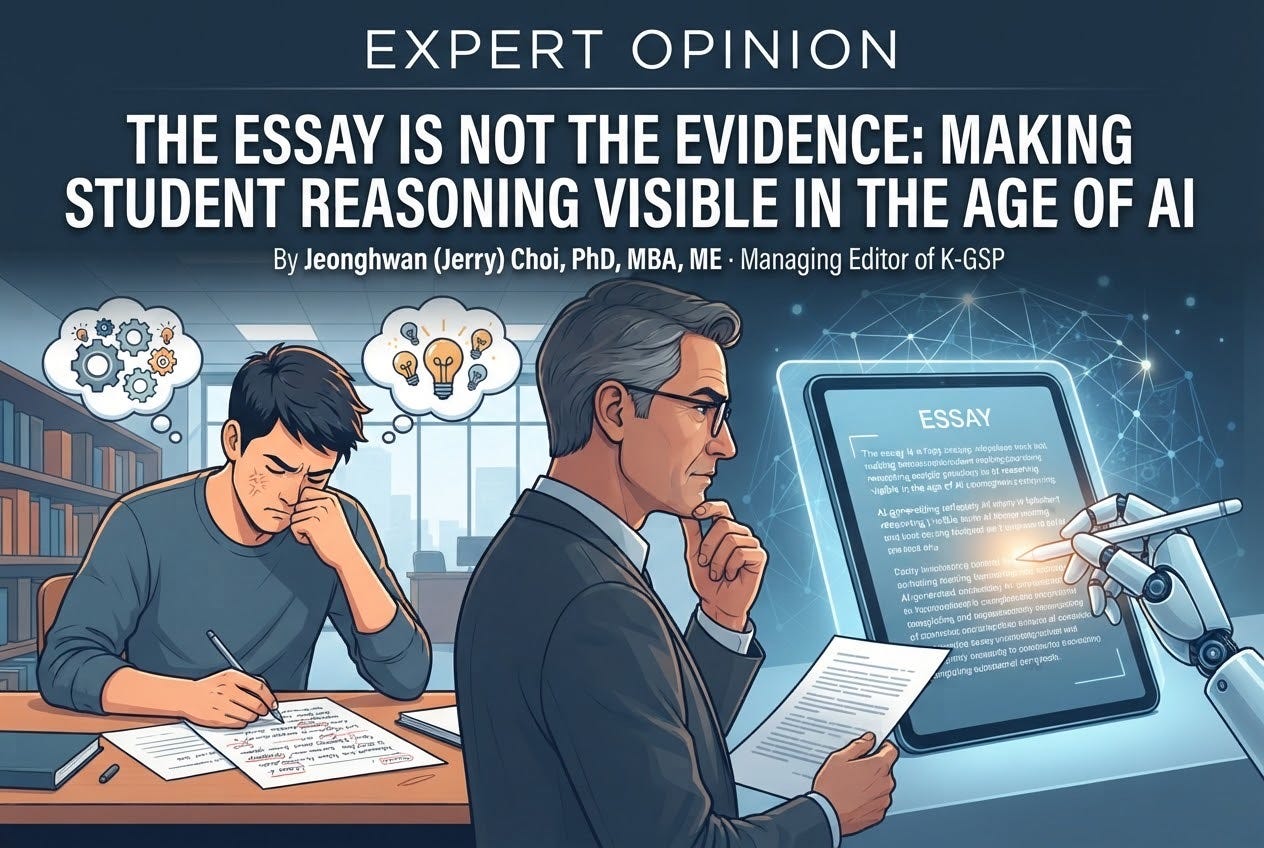
Generative AI can produce essays that look finished without showing whether students understand what they submitted. Drawing on Jay Caspian Kang’s New Yorker report on how faculty are responding to AI, this article argues that the central question for educators is not whether to permit the technology but how to make student reasoning, understanding, and intellectual ownership visible. For business education, that means assessing how students interpret evidence, explain decisions, and take responsibility for conclusions.
Keywords: generative ai, assessment, higher education, business education, intellectual ownership
1. When the Struggle Disappears
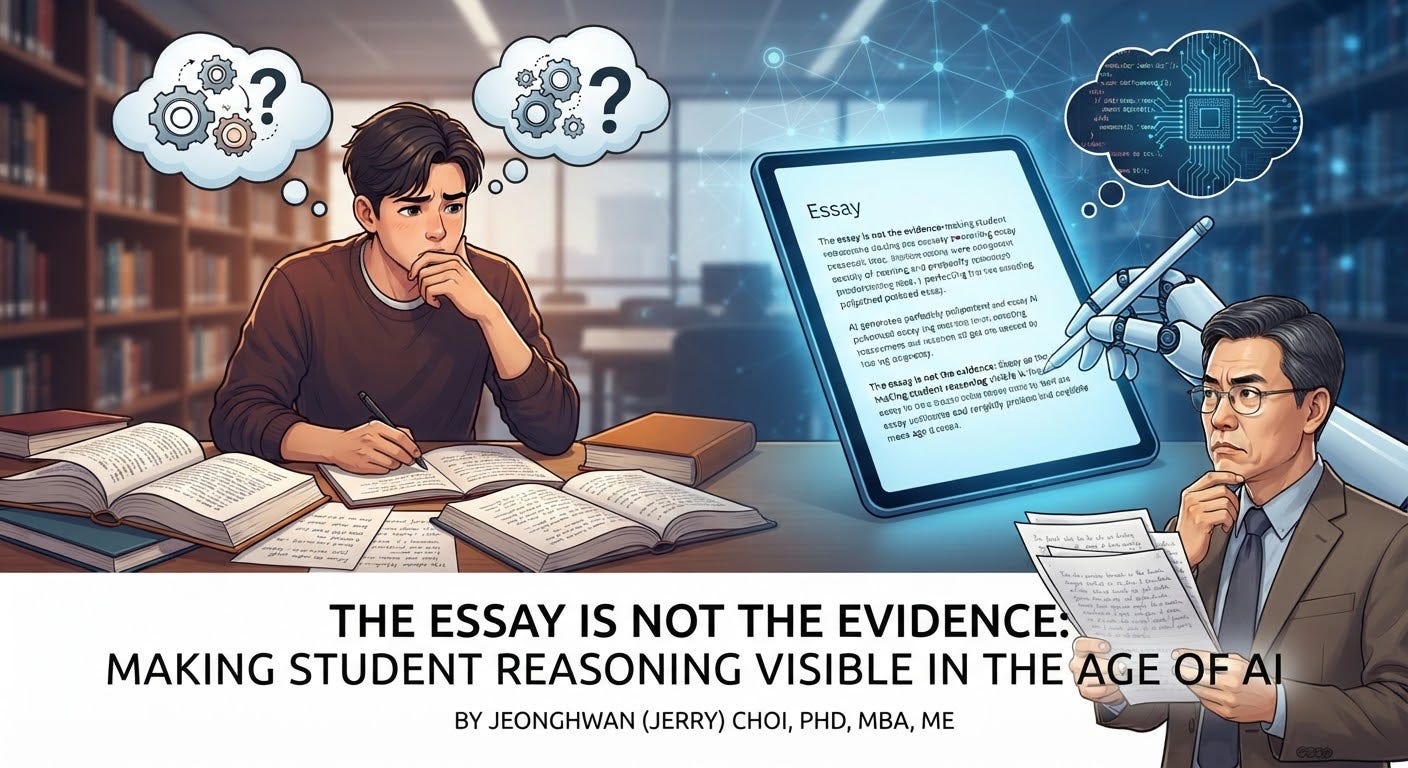
Jane Sloan Peters, a professor of religious studies, teaches a course called "Letters from Prison," in which students read accounts of what people have endured for their faith and then try to name a theme of their own. For years the task was hard. Through brainstorming and revision, most students eventually reached an idea that felt personal and showed they had worked through the texts. Then, as Peters described in a Substack post that Jay Caspian Kang discusses in The New Yorker, the struggle stopped. None of her sixty students found the task difficult, and what she received were tidy summaries and themes that seemed to cover everything while saying very little (Kang, 2026).
Her experience captures a problem many faculty now share. AI can produce a polished essay. The harder question is whether that essay still tells us what a student understands. I argue that it often cannot, and that our task is to design assessments in which student reasoning becomes visible again.
2. What the Faculty Accounts Reveal
Kang (2026) brings together the perspectives of twelve faculty members. Their accounts point to a challenge larger than academic dishonesty: the possible loss of the struggle, discovery, and human connection that make education meaningful.
2.1 Learning Is Not the Same as Completing an Assignment
An assignment has always been a proxy. A finished essay was a reasonable signal of understanding because producing one required the student to read, interpret, draft, and revise. Generative AI weakens that link. A student can now submit a coherent argument without having developed its ideas and without being able to explain or defend them.
Peters's account shows the shift. Her students used to reach their themes through effort, and the effort was where the learning happened. When that effort was outsourced, the product improved on the surface while, in her judgment, becoming emptier (Kang, 2026). This is one instructor's observation rather than a measured outcome. Still, it identifies a mechanism worth taking seriously. If understanding forms through the work of interpretation, an assessment that rewards only the final product can no longer tell us whether that work took place.
2.2 Trust Is Part of Teaching
Several professors in Kang's (2026) report describe a second loss, one located in their relationship with students. Teaching rests on a working assumption that submitted work reflects the student's own thinking. As that assumption weakens, faculty find themselves moving from mentoring to investigating, reading each paper with a quiet question about authorship in the background.
The professors describe this change as discouraging, and the reason goes beyond morale. Feedback written for a student who may not have produced the text has an uncertain recipient. Mentoring is also one of the main ways faculty pass on standards of judgment, and suspicion narrows that channel. Misuse by some students therefore carries a cost for all of them. Uncertainty about authorship changes the instructional relationship for everyone in the room, including the students who did their own work.
2.3 No Single Response, and Limited Evidence for Any of Them
Faculty responses vary widely. Some instructors are returning to handwritten essays and oral assessments. Others are redesigning assignments so that students critique AI-generated work, or use AI while remaining accountable for their own judgment (Kang, 2026).
The article is not uniformly pessimistic. Sociology professor Daniel Silver reports that redesigned projects produced more creativity and intellectual engagement than typical second-year essays. Auyon Siddiq, a management professor at UCLA, describes an AI-friendly statistics exam in which access to the technology did not remove the need for conceptual understanding (Kang, 2026).
These cases are encouraging, but they are individual classroom experiences, not evidence that one approach will work across courses, disciplines, or institutions. Each response also has costs. Oral assessment and supervised drafting demand faculty time that does not scale easily to large sections, and redesign takes repeated effort. The practical question is less which approach is correct than which one fits a particular course, class size, and learning goal.
3. Assessing Reasoning, Not Deliverables
The central question is not simply whether to allow AI. It is how to preserve learning and make students' reasoning, understanding, and intellectual ownership visible. Bans and permissions are both policies about tools. What faculty need are assessments of thinking.
In management and business education, this framing matches the work our graduates will actually do. Managers are rarely valued for producing a document. They are valued for interpreting incomplete evidence, choosing among options, explaining that choice to people who disagree, and answering for the outcome. A case analysis that arrives polished but cannot be defended in conversation tells us little about any of these capacities. Siddiq's experience points toward one possible design: permit the tool, then ask students to explain why a model fits the problem, what a result means for a decision, and what they would do if the evidence changed.
A convincing deliverable has become cheap to produce. Judgment has not. Our assessments should be built around the part that remains costly, because that is also the part students will carry with them after they leave the classroom.
References
Kang, J. C. (2026, May 26). The despair of the professor in the age of A.I. The New Yorker. https://www.newyorker.com/news/fault-lines/the-despair-of-the-professor-in-the-age-of-ai
About the Author

Prof. Dr. Jeonghwan (Jerry) Choi (Managing Editor)
Full list of his K-GSP columns:
Jeonghwan (Jerry) Choi, PhD is Editor-in-Coordination of K-GSP Forum (contact: jeonghwan.choi at gmail.com). With over 25 years of industry and consulting experience, he specializes in leadership development, human resource management, organizational behavior, and social entrepreneurship. His research focuses on workforce resilience, organizational health, and self-directed leadership — bridging rigorous scholarship with practical insight to cultivate leaders who create meaningful, sustainable, and humane organizations.
Suggested Citation
Choi, J. (2026, oct. 11). The essay is not the evidence: Making student reasoning visible in the age of AI. K-GSP Forum.
Suggested Citation

한글요약
에세이는 증거가 아니다: AI 시대, 학생의 생각을 어떻게 보이게 할 것인가
이제 AI는 그럴듯한 에세이를 쉽게 써 줍니다. 그런데 그 에세이가 학생이 정말로 무엇을 이해했는지 보여 줄 수 있을까요? 이 글은 제이 캐스피언 강(Jay Caspian Kang)이 The New Yorker에 쓴 기사를 바탕으로 이 질문을 다룹니다. 기사에는 교수 열두 명의 경험이 담겨 있습니다. 종교학 교수 제인 슬론 피터스는 예전에는 학생들이 스스로 주제를 찾느라 애를 썼지만, 이제는 60명 중 아무도 어려워하지 않았고 대신 깔끔하지만 내용 없는 글을 받았다고 말합니다. 여러 교수는 학생을 이끌어 주던 자리에서 글쓴이를 의심하는 자리로 옮겨 가고 있다고 털어놓습니다. 대응 방식은 다양합니다. 손글씨 에세이나 구술시험으로 돌아가는 교수도 있고, AI가 쓴 글을 비판하게 하거나 AI를 쓰되 판단의 책임은 학생이 지게 하는 교수도 있습니다. 사회학 교수 대니얼 실버와 UCLA 경영학 교수 아욘 시디크의 사례처럼 희망적인 경험도 있지만, 어디서나 통한다는 증거는 아닙니다. 핵심은 AI를 허용할지 말지가 아니라, 학생의 생각과 이해, 그리고 자기 결론에 대한 책임을 어떻게 드러나게 할 것인가입니다. 경영 교육이라면 근거를 해석하고, 결정을 설명하고, 결론에 책임지는 능력을 평가해야 합니다.
© K-Global Scholars and Professionals Forum. All rights reserved. Content published in the K-GSP Forum may not be reproduced, distributed, or transmitted in any form without prior written permission from the K-GSP Forum, except for brief quotations with full attribution.
Sources: The Living Library excerpt of Kang's article · Steven D. Krause, "Sad Professors"