

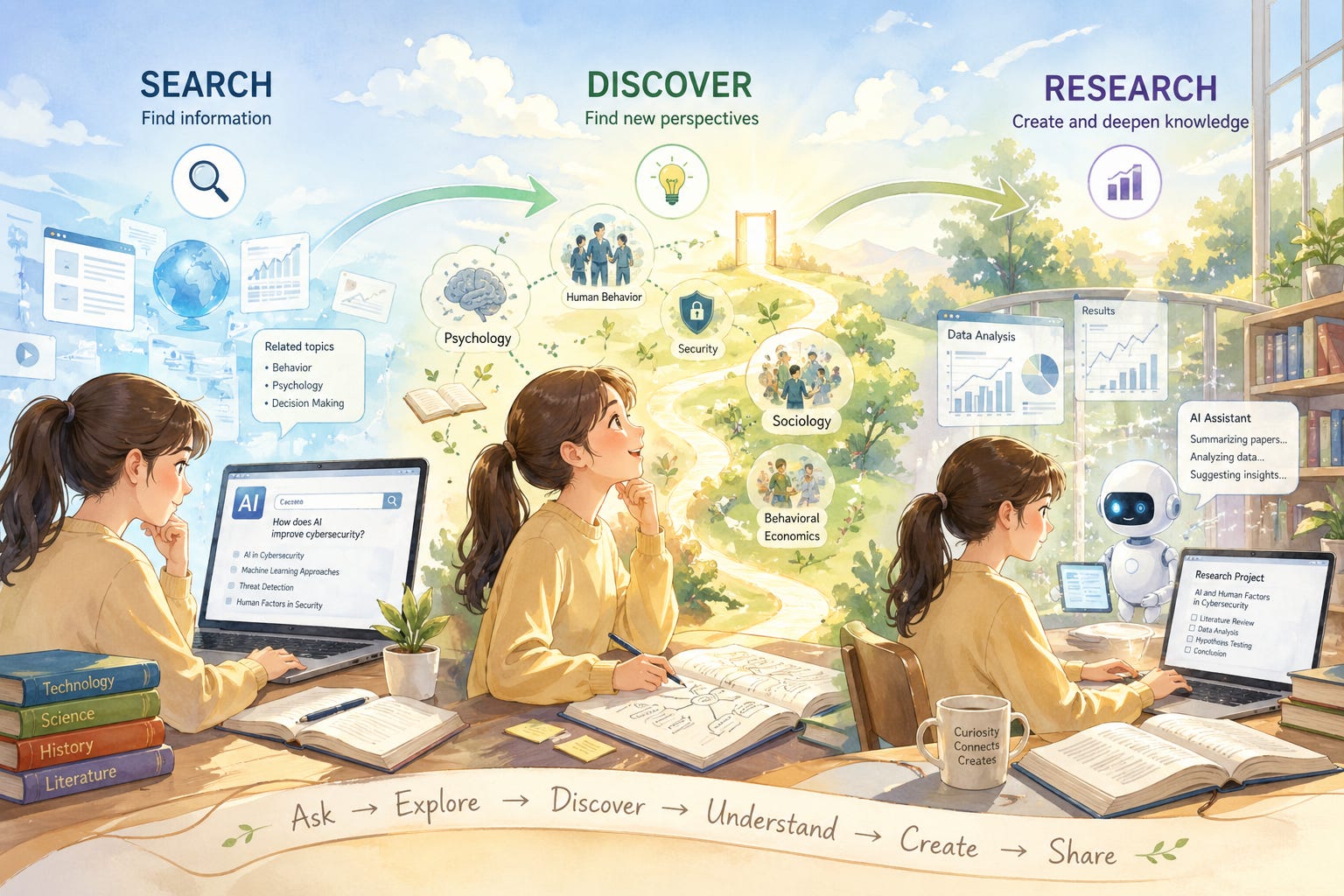
We stand today in an era saturated with information—perhaps the most information-rich period in human history. With a small device in our hands, we can access nearly all the world’s knowledge, a reality that would have been unimaginable in the past. Yet paradoxically, as access to information expands, we are confronted with deeper questions. It is no longer merely what we know that matters, but how we come to know and how we extend that knowledge. At the heart of this transformation lies a new paradigm of inquiry: Search–Discover–Research.
In the past, Search was relatively straightforward. We browsed library shelves or entered keywords into search engines to find specific information. This process was efficient, but also mechanical: the user posed a question, and the system returned a list of results. With the advent of AI, however, Search has evolved into a form of “understanding-based exploration.” Today, Search goes beyond listing information; it interprets intent, understands context, and even helps refine the question itself. Rather than simply “searching,” we now engage in a kind of dialogue with AI. In this sense, Search is no longer a passive tool but an intellectual partner that expands our thinking.
This evolution naturally leads to Discover. Discovery is the moment when we encounter the unexpected—the point at which genuine intellectual expansion begins. In traditional learning environments, opportunities for serendipitous discovery were limited. AI, however, enhances this possibility by suggesting related concepts, cross-disciplinary connections, and even emerging ideas that are not yet fully defined. It does not merely provide answers; it broadens the horizon of thought. For instance, while exploring cybersecurity technologies, one might suddenly realize that human cognitive biases and behavioral patterns play a crucial role in security vulnerabilities. At that moment, a connection emerges between technology and the humanities. This experience of discovery resembles the way Leonardo da Vinci moved fluidly between art and science to generate creative insights. In this sense, AI acts as a modern catalyst for Renaissance-like thinking.
Yet discovery alone does not complete the journey. True knowledge is forged through Research—a systematic and critical process of inquiry. Research is not merely the accumulation of information, but the careful analysis, validation, and synthesis of ideas. Here again, AI serves as a powerful tool. It can rapidly summarize vast bodies of academic literature, detect hidden patterns in data, and assist in testing hypotheses. The advancement of fields such as Artificial Intelligence and Data Science has dramatically expanded both the speed and scope of research. However, it is essential to recognize that the core of Research remains human. Deciding which questions are worth asking, formulating meaningful hypotheses, and interpreting results in a broader context all depend on human creativity and judgment.
These three stages—Search, Discover, and Research—do not form a linear sequence but rather a dynamic cycle. We begin with Search, expand our perspective through Discover, and deepen our understanding through Research. In turn, this process generates new questions, leading us back to Search once again. With the support of AI, this cycle becomes faster, richer, and more iterative. What once took years of scholarly effort can now advance in months or even weeks.
This transformation has profound implications for education and scholarship. The traditional model of knowledge transmission is no longer sufficient. What matters now is the ability to generate meaningful questions, to connect ideas across domains, and to create new value. This insight echoes the perspective of Albert Einstein, who emphasized that the formulation of a problem is often more important than its solution. In the age of AI, learners must move beyond being passive consumers of information and become active creators of knowledge.
Ultimately, the trajectory of knowledge exploration in the AI era points in a clear direction. The goal is no longer to simply “know more,” but to “understand more deeply, connect more broadly, and create something new.” Search will become increasingly automated and intelligent, Discover will grow more expansive and generative, and Research will become more integrative and creative. Within this evolving landscape, humans are not competitors to AI, but collaborators—partners in achieving higher levels of thought.
This leads us to a fundamental question: Are we merely searching for information, or are we discovering meaning? And beyond that, are we transforming those discoveries into genuine knowledge? The answer to these questions will ultimately define not only our intellectual maturity, but also the possibilities of our future in the age of AI. +++
{Solti}
April 26, 2026

Young Choi, PhD is a Professor at Regent University bringing a rare combination of technical expertise and creative spirit to everything he does. A scholar in AI, cybersecurity, and network & telecommunications service management, he has published 38 books including AI and cybersecurity area books, over 200 refereed articles, and over 20 book chapters. Beyond the academy, Dr. Choi is a passionate poet, essayist, and wooden block engraving artist whose reflective writing invites readers to rediscover life’s beauty in quiet contemplation. He lives under the motto: “Study hard and give generously without holding back! (열심히 공부해서 아낌없이 남주자 !)”
Published books: https://www.amazon.com/stores/Young-Choi/author/B0DMZ5S6R7?ref=ap_rdr&shoppingPortalEnabled=true