

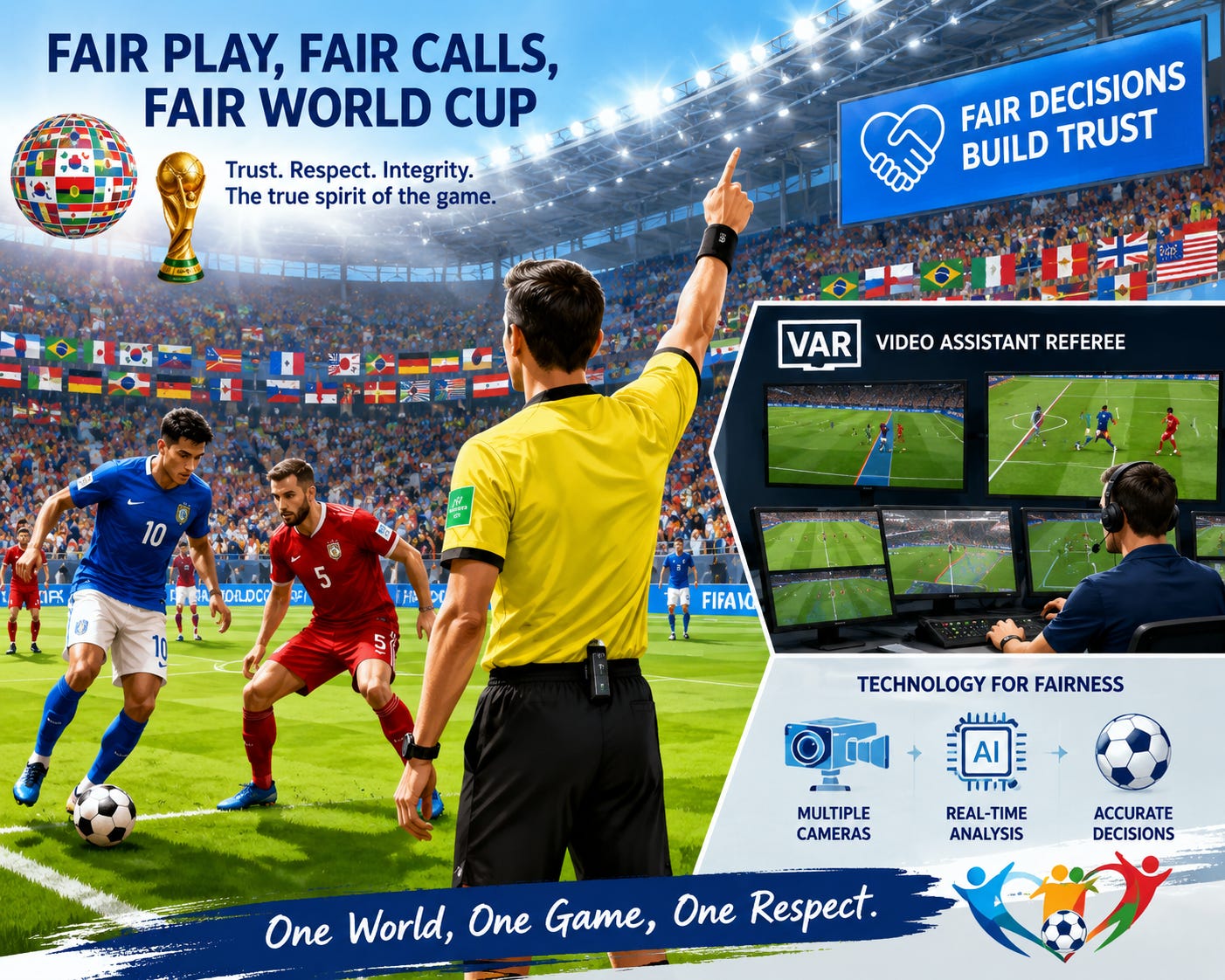
Held once every four years, the FIFA World Cup is far more than a football tournament; it is one of humanity’s greatest global celebrations. People from different nations, cultures, and languages unite to cheer, celebrate, and sometimes cry over the same game. This extraordinary event demonstrates the unique power of sport to connect the world. Yet the World Cup can inspire genuine admiration only when it rests upon an invisible but indispensable foundation: fair officiating.
Football is a sport in which a single decision can completely change the course of a match. A penalty kick, an offside call, or a red card may determine not only the outcome of a game but also the pride of an entire nation. No matter how brilliantly the players perform, the meaning of victory diminishes if the fairness of the referee’s decisions is questioned. In sports, the most valuable asset is not the final score but trust.
World Cup history is filled with unforgettable moments of brilliance, but it has also witnessed controversial decisions. Some teams have been eliminated because of questionable calls, while others have benefited from unexpected fortune. These experiences have taught the football community an important lesson: referees are human and therefore capable of making mistakes. To preserve fairness, technology has become an essential partner rather than a replacement.
This realization led to the introduction of the Video Assistant Referee (VAR) system. Designed to reduce clear and obvious officiating errors, VAR has significantly improved the fairness of the game. Although it was initially criticized for interrupting the flow of matches, it has gradually gained acceptance by correcting many decisive mistakes. VAR is not perfect because the final judgment still depends on human interpretation. Nevertheless, it has dramatically reduced errors caused simply because officials could not see an incident clearly.
More recently, Artificial Intelligence (AI) and the Semi-Automated Offside Technology (SAOT) have further enhanced the accuracy of officiating. Multiple cameras and sophisticated sensors analyze players’ movements and the ball’s position in real time, providing referees with objective information. This represents an excellent example of how human expertise and advanced technology can work together to promote fairness.
Yet even the most advanced technology cannot guarantee justice by itself. Fairness ultimately begins with human integrity. Referees are not there to decide who should win; they are there to protect the integrity of the game. Likewise, players become true champions not only through skill but also by respecting decisions and demonstrating sportsmanship. Technology serves as a valuable tool, but people remain the guardians of fairness.
The importance of fair officiating extends well beyond football. Businesses require fair evaluations, schools should provide equal opportunities and impartial assessments, and governments earn public confidence through fair enforcement of the law. If sports reflect society, then the World Cup serves as a powerful classroom, teaching how justice and fairness should function in every aspect of life.
The age of Artificial Intelligence presents an even greater challenge. Accuracy alone is no longer sufficient. AI systems must also minimize bias, provide transparency, and offer explainable decision-making. These principles mirror the expectations placed upon football referees. As AI increasingly assumes roles that influence human decisions, society will need not only Right AI—systems that produce technically correct answers—but also Just AI—systems that embody fairness, accountability, and ethical judgment.
Only one nation can lift the World Cup trophy, but fair officiating is a victory shared by every participating country. We should applaud not only spectacular goals but also decisions that uphold justice. Scores are recorded in history, but fairness remains in people’s hearts long after the final whistle.
The true champion of the FIFA World Cup is not merely the team that scores the most goals, but a tournament that earns the world’s trust. When officiating is fair, football reaches its highest ideals, and the World Cup becomes what it is meant to be—a global festival of excellence, integrity, and peace. +++
{Solti}
July 11, 2026
월드컵과 공정한 심판 판정
승패보다 더 중요한 것은 신뢰이다
4년에 한 번 열리는 FIFA 월드컵은 단순한 스포츠 대회를 넘어 전 세계인이 함께 즐기는 인류 최대의 축제이다. 국적과 언어, 문화가 다른 사람들이 하나의 공을 따라 환호하고 눈물을 흘리는 모습은 스포츠가 가진 놀라운 힘을 보여준다. 그러나 이 거대한 축제가 진정한 감동을 주기 위해서는 무엇보다 공정한 심판 판정(Fair Officiating) 이라는 보이지 않는 토대가 반드시 필요하다.
축구는 단 한 번의 판정이 경기의 흐름과 결과를 완전히 바꿀 수 있는 스포츠이다. 페널티킥 선언, 오프사이드 판정, 퇴장 여부는 선수들의 노력과 국가의 명예를 좌우하기도 한다. 아무리 뛰어난 선수들이 최고의 경기를 펼쳐도 심판의 판정이 공정하지 못하다는 의심을 받는 순간 승패의 의미는 크게 퇴색된다. 스포츠에서 가장 중요한 것은 점수가 아니라 신뢰이기 때문이다.
월드컵 역사에는 훌륭한 경기만큼이나 논란이 된 판정도 적지 않았다. 오심 때문에 탈락한 팀이 있었고, 반대로 예상치 못한 행운을 얻은 팀도 있었다. 이러한 경험은 국제축구계에 중요한 교훈을 남겼다. 심판도 인간이기에 실수를 할 수 있으며, 경기의 공정성을 높이기 위해 기술의 도움이 필요하다는 사실이다.
이러한 배경에서 등장한 것이 비디오 판독(VAR, Video Assistant Referee) 이다. VAR은 명백한 오심을 줄이고 경기의 공정성을 높이기 위해 도입되었다. 초기에는 경기 흐름이 끊긴다는 비판도 있었지만, 시간이 지나면서 명백한 오심을 상당 부분 줄였다는 평가를 받고 있다. 물론 VAR도 완벽하지는 않다. 결국 최종 판단은 사람이 내리기 때문에 해석의 차이는 여전히 존재한다. 그러나 적어도 “보지 못해서 발생한 오심”은 크게 감소하였다.
최근에는 인공지능(AI)과 반자동 오프사이드 판독 시스템(SAOT, Semi-Automated Offside Technology)까지 활용되면서 판정의 정확성은 한층 높아지고 있다. 여러 대의 카메라와 센서가 선수의 움직임과 공의 위치를 실시간으로 분석하여 심판에게 객관적인 정보를 제공한다. 이는 인간의 경험과 기술의 정확성이 서로 협력하는 좋은 사례라 할 수 있다.
그러나 아무리 뛰어난 기술이 도입되더라도 스포츠의 공정성은 결국 사람의 양심에서 시작된다. 심판은 어느 한 팀의 승리를 만드는 사람이 아니라 경기의 정의를 지키는 사람이다. 선수들 역시 판정을 존중하고 스포츠맨십을 실천할 때 진정한 챔피언이 될 수 있다. 기술은 공정성을 돕는 도구일 뿐, 공정성을 실천하는 주체는 언제나 사람이다.
공정한 심판 판정은 축구를 넘어 현대 사회에도 중요한 메시지를 전한다. 기업에서는 공정한 평가가 필요하고, 학교에서는 공정한 성적과 기회가 보장되어야 하며, 정부는 공정한 법 집행을 통해 국민의 신뢰를 얻어야 한다. 스포츠가 사회의 축소판이라면, 월드컵은 공정한 사회가 어떻게 유지되어야 하는지를 보여주는 살아 있는 교육 현장이다.
특히 인공지능 시대에는 ‘정확성(Accuracy)’만으로는 충분하지 않다. AI 역시 편향(Bias)을 제거하고 설명 가능성(Explainability)과 투명성(Transparency)을 갖추어야 한다. 이는 축구 심판이 공정해야 하는 이유와 본질적으로 같다. AI가 사회의 심판 역할을 일부 담당하게 될 미래에는 ‘Right AI’ 뿐 아니라 ‘Just AI’ 가 더욱 중요해질 것이다.
월드컵 우승 트로피는 한 나라만 차지할 수 있다. 그러나 공정한 판정과 정의로운 경기 운영은 모든 참가국이 함께 얻는 공동의 승리이다. 우리는 멋진 골뿐 아니라 공정한 판정에도 박수를 보내야 한다. 승패는 기록으로 남지만, 공정성은 사람들의 마음속에 오래 기억되기 때문이다.
진정한 월드컵의 챔피언은 가장 많은 골을 넣은 팀만이 아니라, 가장 큰 신뢰를 얻은 대회이다. 공정한 심판 판정이 있을 때 비로소 축구는 최고의 스포츠가 되고, 월드컵은 전 세계가 함께 축하하는 진정한 평화의 축제가 된다. +++
{솔티}
2026년 7월 11일

Prof. Dr. Young Choi (Editor in Chief) — Regent University
Young B. Choi is a Professor in the Department of Engineering & Computer Science at Regent University. He published 38 books with ‘Selected Readings in Cybersecurity’ (2018) (over 800 copies archived globally at university/college libraries around the world) and ‘Cybersecurity Applications and Artificial Intelligence’ (2023) available in seven major world languages. He proposed the world’s first global and universal telecommunications “Service Order Handling (SOH)” Model (T-SOH Model) (1995) with Dr. Adrian Tang. With this innovative research work, he received the IEEE NOMS ’96 Best Paper Award and became the first recipient of the Outstanding Contribution Award of the TeleManagement Forum in 1998. His research areas include Natural Language Processing-focused AI, AI-applied cybersecurity, network and telecom service management, and Korean studies on Gani Choi Rip’s Jeonggwan (靜觀: Quiet Contemplation) philosophy and Shilhak ( 實學: Practical Learning).