
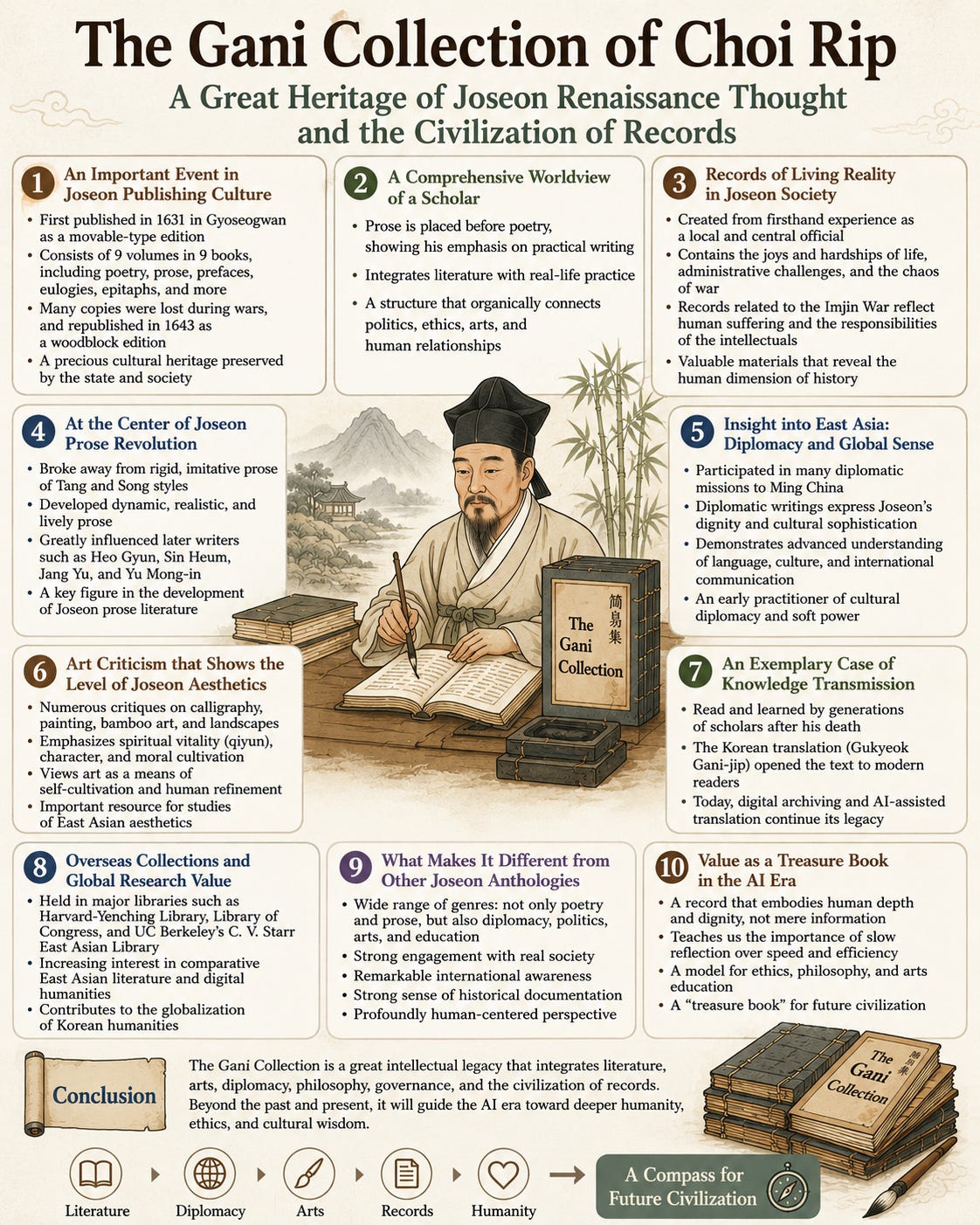
Among the intellectual figures of mid-Joseon Korea, few individuals deserve to be regarded as a true “cultural phenomenon” as much as Gan-i (簡易, 간이) Choi Rip (崔岦(최립), 1539–1612). He was not merely a poet, but simultaneously a prose stylist, government official, diplomat, educator, art critic, and pioneer of literary publication culture. The literary collection that embodies his life, philosophy, and spirit of documentation is The Gani Collection (Gani-jip, 간이집(簡易集)).
The Gani Collection is far more than a personal anthology. It is a vast intellectual archive encompassing the political, diplomatic, artistic, literary, and philosophical worlds of late sixteenth- and early seventeenth-century Joseon Korea. While official historical records such as the Annals of the Joseon Dynasty preserve the voice of state power, personal literary collections reveal the emotional life, intellectual struggles, aesthetic sensitivity, and ethical consciousness of historical individuals with far greater intimacy. Among such collections, The Gani Collection stands out as one of the finest examples in which literary excellence and documentary value coexist at the highest level.
Choi Rip lived through the trauma of the Imjin War (1592–1598), participated in diplomatic missions to Ming China, and stood at the center of literary transformation in Joseon intellectual society. Consequently, his writings contain not only poetry and refined prose, but also reflections on East Asian international order, the realities of governance, the responsibilities of scholars, aesthetic criticism, and the philosophy of self-cultivation. For this reason, The Gani Collection is now recognized not merely as a work of Korean classical literature but as an essential source for the study of East Asian civilization.
Moreover, in today’s age of artificial intelligence and digital transformation, the collection has acquired renewed relevance. AI can generate enormous quantities of information, but it cannot easily reproduce the depth of human contemplation, ethical reflection, or cultural responsibility embodied in works such as The Gani Collection. In this sense, Choi Rip’s writings are increasingly viewed as a humanistic compass for the AI era.
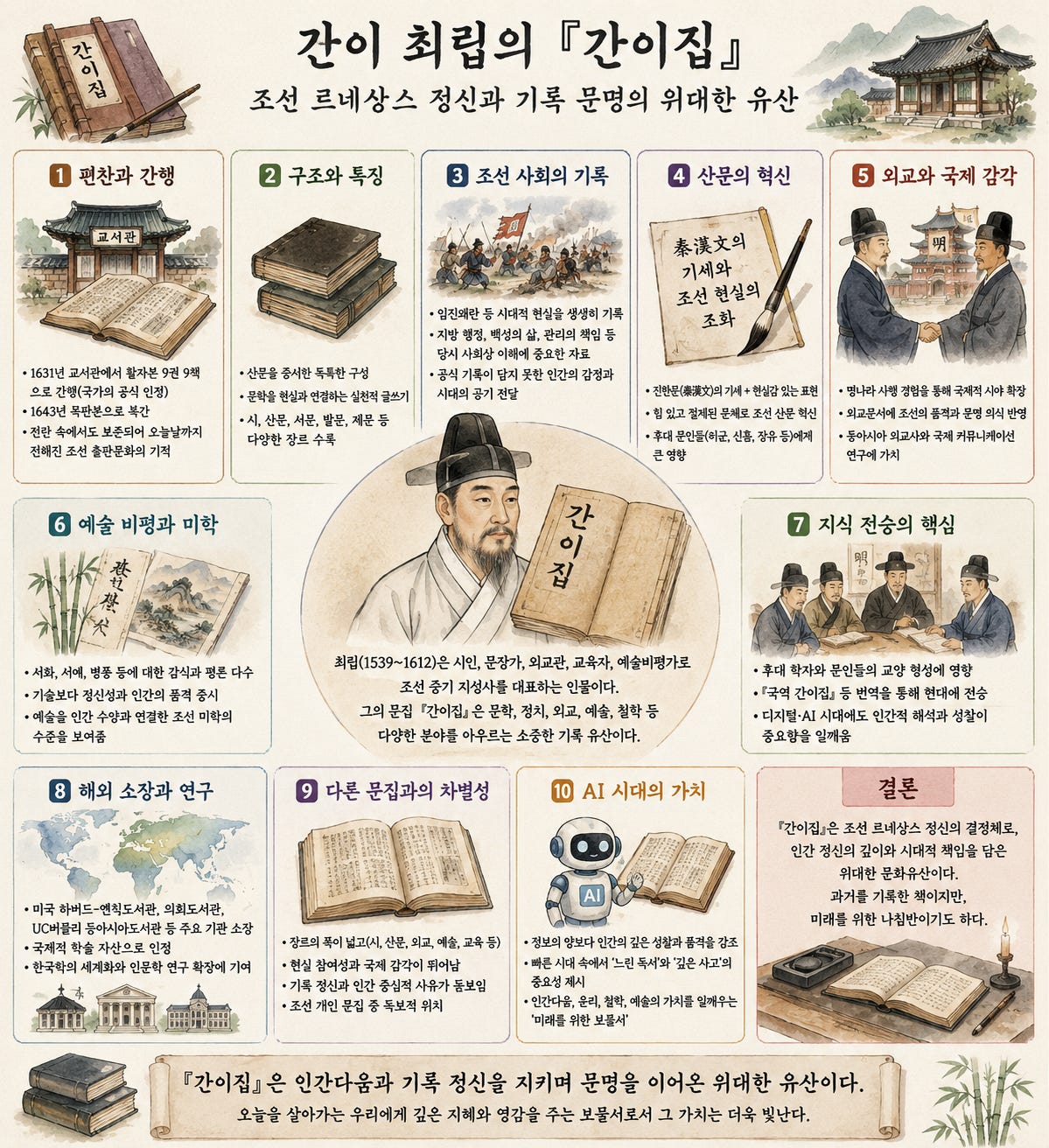
The Compilation and Publication of The Gani Collection Was a Landmark in Joseon Publishing Culture
The Gani Collection was first published in 1631, approximately twenty years after Choi Rip’s death, through Gyoseogwan, the royal publishing office of Joseon. This was not simply a private memorial project by his descendants; it represented official cultural recognition by the state itself.
The first edition consisted of nine volumes in nine books and included poetry, prose, memorial writings, prefaces, epitaphs, diplomatic texts, and literary critiques. However, many copies were lost during the Manchu invasions and subsequent periods of turmoil. As a result, the collection was republished in woodblock form in 1643.
The republication itself reveals how highly Joseon intellectual society valued Choi Rip’s writings. In an era when wars, fires, and political upheavals destroyed countless books, the survival of The Gani Collection reflects generations of cultural dedication and archival responsibility. Its continued existence may itself be considered a miracle of Korean documentary civilization.
The Structure of The Gani Collection Reflects Choi Rip’s Intellectual Worldview
The organization of The Gani Collection was highly unusual for its time. Most Joseon literary anthologies placed poetry first and prose later. Choi Rip reversed this order by emphasizing prose above poetry.
This editorial decision carried profound significance. Choi Rip did not regard literature merely as decorative art for emotional pleasure. He believed writing possessed the power to shape politics, diplomacy, education, administration, and human relationships. His prose therefore functioned as practical and ethical discourse rather than purely aesthetic expression.
Furthermore, the arrangement of the collection demonstrates an integrated intellectual worldview. His writings on art criticism contain philosophical reflections; diplomatic texts include psychological insight; and poems about nature often carry political or ethical undertones. Such interconnectedness exemplifies the holistic mode of thought characteristic of East Asian classical civilization.
The Gani Collection Preserves the Living Reality of Joseon Society
Official historical records often reflect the perspective of kings and central institutions. Personal literary collections, by contrast, preserve how intellectuals actually experienced their historical world.
Because Choi Rip served both in local administration and central government, he possessed firsthand knowledge of the realities of governance. His writings vividly portray the lives of ordinary people, the challenges of provincial administration, the burdens of public office, and the chaos brought by war.
His records concerning the Imjin War are especially important. Rather than merely documenting military devastation, Choi Rip reflected deeply on moral collapse, national responsibility, and the ethical role of intellectuals during times of crisis. In this respect, The Gani Collection functions not only as literature but also as a psychological and moral record of wartime civilization.
Modern historians value the collection precisely because it preserves dimensions of lived experience absent from official chronicles.
Choi Rip’s Prose Stood at the Center of a Literary Revolution
Prior to Choi Rip, much Joseon prose writing remained constrained by rigid imitation of Tang and Song literary styles. Choi Rip sought instead a prose style that was dynamic, realistic, and intellectually alive.
While respecting the grandeur of Qin-Han prose traditions, he developed forms of expression appropriate to Joseon realities. His writing was forceful yet restrained, scholarly yet practical. He possessed exceptional skill in balancing rhythm, structure, emotional intensity, and philosophical clarity.
Later literary figures—including Heo Gyun, Sin Heum, Jang Yu, and Yu Mong-in—recognized his influence. Choi Rip was not merely an accomplished writer; he was a reformer who redirected the evolution of Joseon prose language itself.
Contemporary literary scholarship continues to value The Gani Collection because it integrates moral seriousness with emotional realism in a remarkably sophisticated manner.
The Gani Collection Is an Important Source for Understanding East Asian Diplomacy
Choi Rip participated in multiple diplomatic missions to Ming China, experiences that broadened his worldview far beyond domestic Joseon concerns.
His diplomatic writings reveal a refined understanding of language as an instrument of national image and cultural prestige. He recognized that diplomatic rhetoric represented not merely political necessity but also civilizational dignity.
Through interaction with Chinese intellectuals and literary circles, Choi Rip cultivated an unusually advanced international sensibility. From a modern perspective, he may even be viewed as an early practitioner of cultural diplomacy and soft power strategy.
Accordingly, The Gani Collection is valuable not only for Korean literary studies but also for research into East Asian diplomatic history and intercultural communication.
Choi Rip’s Art Criticism Reveals the Sophistication of Joseon Aesthetics
Choi Rip was also an outstanding connoisseur and critic of art. The Gani Collection contains numerous evaluations of paintings, calligraphy, folding screens, bamboo paintings, and landscape art.
He did not judge artworks merely by technical skill. Instead, he emphasized spiritual vitality, moral character, and the harmony between artistic expression and human cultivation. In particular, he valued the classical East Asian aesthetic principle of giwoon sangdong (氣韻生動)—the “spiritual resonance of living energy.”
For Choi Rip, art was inseparable from self-cultivation. True artistic excellence emerged not from technique alone but from depth of character and refinement of spirit. Such perspectives remain profoundly relevant within contemporary studies of East Asian aesthetics.
In an age dominated by commercialized visual culture, his understanding of art as moral and spiritual practice appears strikingly modern.
The Gani Collection Exemplifies the Transmission of Knowledge in Joseon Civilization
In Joseon Korea, literary collections were among the primary mechanisms through which intellectual traditions were transmitted across generations.
The Gani Collection shaped the education and literary formation of later scholars for centuries. Many writers regarded Choi Rip’s prose as a model of elegant yet practical expression.
The publication of the modern Korean translation, Translated Gani Collection (Gukyeok Gani-jip), represented a major turning point in contemporary cultural transmission. As fewer readers became proficient in classical Chinese, translation became not merely linguistic conversion but cultural restoration.
Today, digital archives and AI-assisted translation technologies are creating new modes of knowledge preservation. Yet the depth of Choi Rip’s writings reminds us that true understanding requires more than technological access; it requires human interpretation and contemplation.
International Preservation and Global Scholarship Continue to Expand
Today, editions and related materials of The Gani Collection are preserved not only in Korea but also in major international libraries and research institutions.
In the United States, institutions such as the Harvard-Yenching Library, the Library of Congress, and the C. V. Starr East Asian Library at the University of California, Berkeley, have long collected and preserved Korean classical materials. The inclusion of works related to Choi Rip within such collections demonstrates that The Gani Collection is increasingly recognized as a global scholarly asset rather than merely a regional Korean text.
Recent developments in comparative East Asian literature and digital humanities have further increased academic interest in Choi Rip. As Korean Studies expands internationally, scholars are paying growing attention to Joseon intellectuals who possessed cosmopolitan perspectives and sophisticated cultural consciousness.
This movement represents not only the preservation of Korean classics but also the globalization of Korean humanistic scholarship.
What Distinguishes The Gani Collection from Other Joseon Literary Anthologies?
Joseon Korea produced countless personal literary collections, yet The Gani Collection remains distinctive in several important ways.
First, its thematic range is exceptionally broad. It includes not only poetry and prose but also diplomatic documents, political essays, educational reflections, and art criticism.
Second, it possesses strong engagement with real social life. Whereas many literary collections remain abstractly scholarly, Choi Rip’s writings are deeply connected to governance, diplomacy, and human relationships.
Third, the collection reflects remarkable international awareness shaped by direct engagement with Ming intellectual culture.
Fourth, Choi Rip displayed a powerful consciousness of historical documentation. He did not write merely to display literary elegance; he wrote with the intention of preserving civilization for future generations.
Finally, the collection is profoundly human-centered. His writings explore emotion, dignity, suffering, ethics, and interpersonal relationships with extraordinary depth.
For these reasons, The Gani Collection occupies a unique position within the tradition of Korean literary anthologies.
Why The Gani Collection Matters Even More in the AI Era
Artificial intelligence can now generate vast amounts of information with unprecedented speed. Yet information alone does not constitute wisdom.
The enduring value of The Gani Collection lies precisely here. It embodies human depth, ethical reflection, emotional maturity, and intellectual dignity. Choi Rip valued contemplation over speed, character over efficiency, and humanity over mere technique.
His writings are not texts to be consumed rapidly. They demand slow reading, repeated reflection, and inner engagement. Such experiences are becoming increasingly rare in the digital age.
Moreover, The Gani Collection offers important lessons for education in the AI era. The more technologically advanced society becomes, the more essential human capacities such as ethics, philosophy, aesthetics, and self-reflection become.
In the future, true human competitiveness will depend not simply on information processing but on integrated wisdom and moral imagination. In this sense, The Gani Collection may rightly be considered a “treasure book” for future civilization.
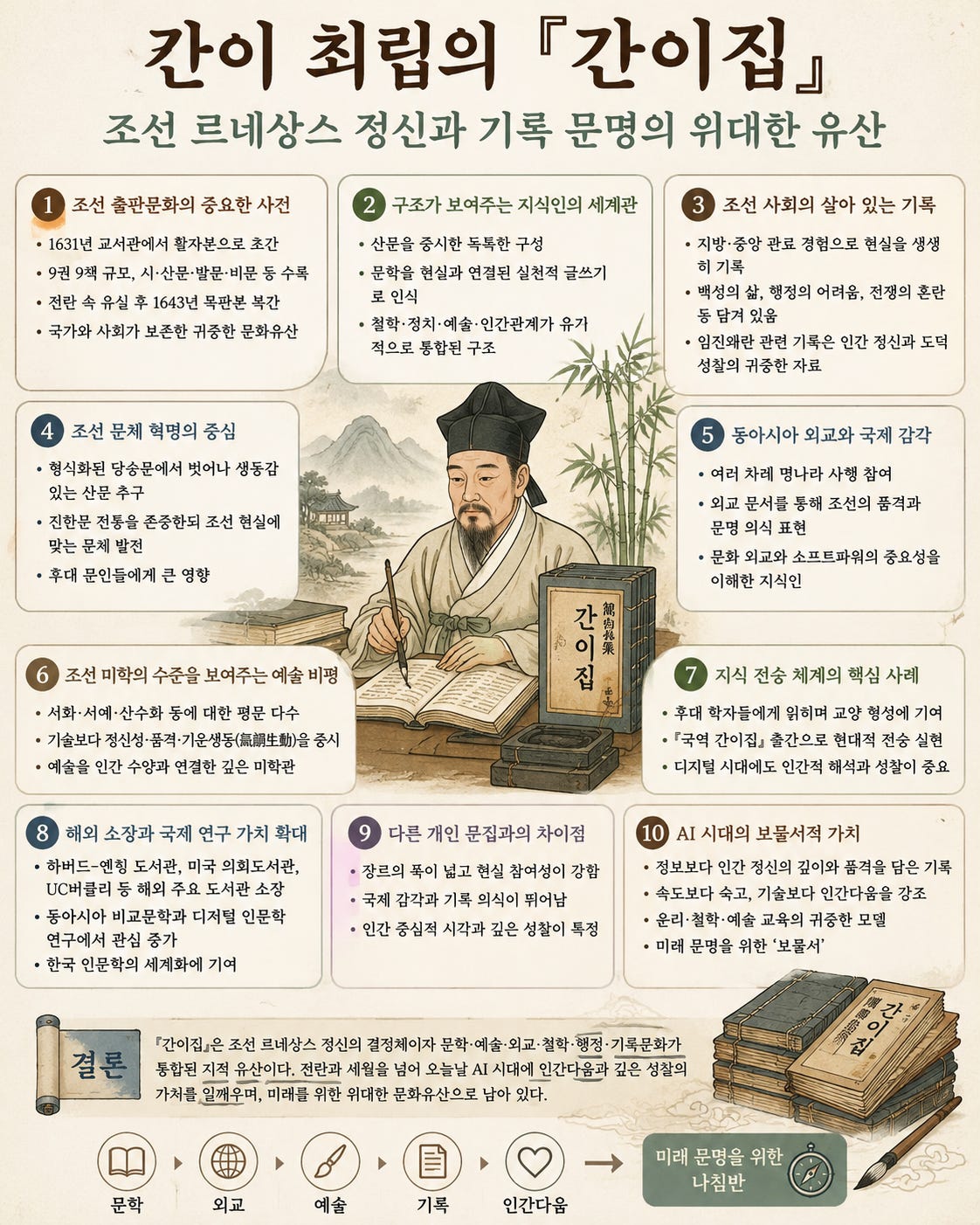
The Gani Collection is far more than a personal anthology from the Joseon Dynasty. It is a monumental synthesis of literature, diplomacy, philosophy, administration, aesthetics, and documentary culture—a living embodiment of the Korean Renaissance spirit.
Through writing, Choi Rip interpreted his age; through records, he preserved civilization; through prose, he sought to influence reality itself. His collection preserves not only intellectual achievement but also moral responsibility and cultural refinement.
Having survived wars, invasions, and centuries of historical upheaval, The Gani Collection now acquires new significance in the digital and AI-driven age. It reminds humanity why slow contemplation, ethical depth, and meaningful records remain indispensable.
Future research on The Gani Collection will likely expand beyond classical literary studies into digital humanities, AI-assisted classical literature analysis, comparative civilizational studies, and global Korean Studies. Such developments signify not merely the rediscovery of one historical figure, but the international expansion of Korean humanistic thought itself.
Ultimately, The Gani Collection is not merely a book for the past—it is a book for the future. It is a monumental record of humanity’s effort to preserve intellectual depth and moral dignity amid the changing tides of civilization. +++
{Solti}
May 15, 2026

Young Choi, PhD is a Professor at Regent University bringing a rare combination of technical expertise and creative spirit to everything he does. A scholar in AI, cybersecurity, and network & telecommunications service management, he has published 38 books including AI and cybersecurity area books, over 200 refereed articles, and over 20 book chapters. Beyond the academy, Dr. Choi is a passionate poet, essayist, and wooden block laser engraving artist whose reflective writing invites readers to rediscover life’s beauty in quiet contemplation(靜觀). He lives under the motto: “Study hard and give generously without holding back! (열심히 공부해서 아낌없이 남주자 !: 열공아남)”
Published books: https://www.amazon.com/stores/Young-Choi/author/B0DMZ5S6R7?ref=ap_rdr&shoppingPortalEnabled=true