

EXECUTIVE SUMMARY
The global meat supply chain is an interconnected ecosystem linking livestock production, processing, cold-chain logistics, international trade, regulation, distribution, and final consumption. Unlike many manufactured products, meat supply chains are constrained by biological production cycles, perishability, food-safety requirements, and strict temperature and border controls, making end-to-end coordination essential for food security, affordability, and consumer welfare. The COVID-19 experience demonstrated how disruption at major processing nodes can cascade from farms to consumers and highlighted six capabilities for resilience: information sharing, food safety and quality assurance, collaboration, technology and innovation, risk management and business continuity, and sustainability and animal welfare.
Keywords: Global Meat Supply Chain; Food Security; Cold Chain; Supply Chain Resilience; COVID-19
1. Introduction
A recent visit to Canada provided an opportunity to connect personal experience with a broader research interest in global supply chains. Conversations with Junwon Choi, an executive with extensive meat-trade and food-industry experience, moved from an informal exchange to a practical discussion of how meat travels from farms and processing facilities through refrigerated logistics networks, international borders, distributors, retailers, restaurants, and ultimately consumers. The discussion reinforced the value of viewing meat not simply as an agricultural product but as part of an interconnected global supply chain ecosystem in which agricultural production, animal health, processing, refrigeration, transportation, international trade, regulation, distribution, and demand must work together.
North America—the United States, Canada, and Mexico—is a major center of global meat production and trade. FAO-based data compiled by Our World in Data show that North America remains one of the world’s major meat-producing regions, with substantial output across poultry, beef, pork, and other livestock categories, even as Asia has become the largest producing region globally (Ritchie et al., 2023). Within this continental system, Canada plays an important role in pork production and cross-border trade with the United States and other global markets. Live animals, feed, processed meat, refrigerated transportation, and border services connect the three countries, so changes in herd size, animal-health conditions, processing capacity, transportation continuity, or border rules in one country can quickly affect availability and prices elsewhere in North America.
This article therefore examines the global meat supply chain from farm to consumer as an ecosystem rather than a simple sequence of agricultural transactions. It focuses on how the system works, why it matters economically and socially, what the COVID-19 disruption revealed about structural vulnerabilities, and which capabilities can strengthen resilience. The central premise is that performance does not depend on a single firm, processor, country, or logistics provider; it depends on the synchronization of product, information, financial, and regulatory flows across the entire ecosystem (Christopher & Peck, 2004; Hong et al., 2025; Hobbs, 2021; Ivanov et al., 2023).
2. Contextual Overview: What the Ecosystem Is and Why It Matters
The global meat supply chain is an interconnected farm-to-consumer ecosystem linking livestock and poultry production, animal health, processing, packaging, refrigeration, transportation, international trade, regulation, distribution, retail, food service, and final consumption. Because meat products are biologically time-dependent, perishable, temperature-sensitive, and subject to strict food-safety and border requirements, the system depends on coordination across organizations and countries rather than on the performance of any single stage. This section establishes why the ecosystem matters, identifies its principal stakeholders, and highlights the cross-cutting capabilities that connect the full system (Hobbs, 2021; OECD, 2021).
2.1. Why the Meat Supply Chain Is Important
The meat supply chain is strategically important because it connects food security, agricultural livelihoods, industrial processing, international trade, logistics infrastructure, employment, public health, and consumer welfare. For producing and exporting regions, it generates farm income, processing activity, logistics demand, jobs, and foreign-exchange earnings; for importing regions, trade supplements domestic production, broadens consumer choice, and helps stabilize access to protein (OECD, 2021). Its significance is intensified by limited shelf life, refrigeration requirements, traceability expectations, food-safety obligations, and the consequences of disruption for both producers and households (Hobbs, 2021; Wiedemann et al., 2015). Unlike many manufactured products, livestock cannot simply stop growing when downstream capacity is constrained and fresh meat cannot remain indefinitely in inventory, making timing, capacity synchronization, and continuity especially important.
2.2. Key Stakeholders in the Ecosystem
The global meat supply chain includes a broad range of stakeholders whose decisions collectively determine how efficiently and reliably meat moves from farm to consumer. Upstream participants include livestock and poultry producers, feed suppliers, breeding organizations, veterinarians, and animal-health providers; processors and slaughterhouses then transform animals into market-ready products through inspection, grading, processing, packaging, and quality assurance (Hong & Jeong, 2006; Hobbs, 2021). Logistics and cold-chain providers, exporters and importers, wholesalers, retailers, restaurants, food-service companies, financial institutions, technology providers, governments, and regulatory agencies support the movement, financing, monitoring, and sale of meat across domestic and international markets (OECD, 2020; OECD, 2021). Consumers complete the ecosystem by shaping demand through expectations concerning price, quality, convenience, nutrition, food safety, traceability, sustainability, and animal welfare.
2.3. Ecosystem Architecture and Cross-Cutting Enablers
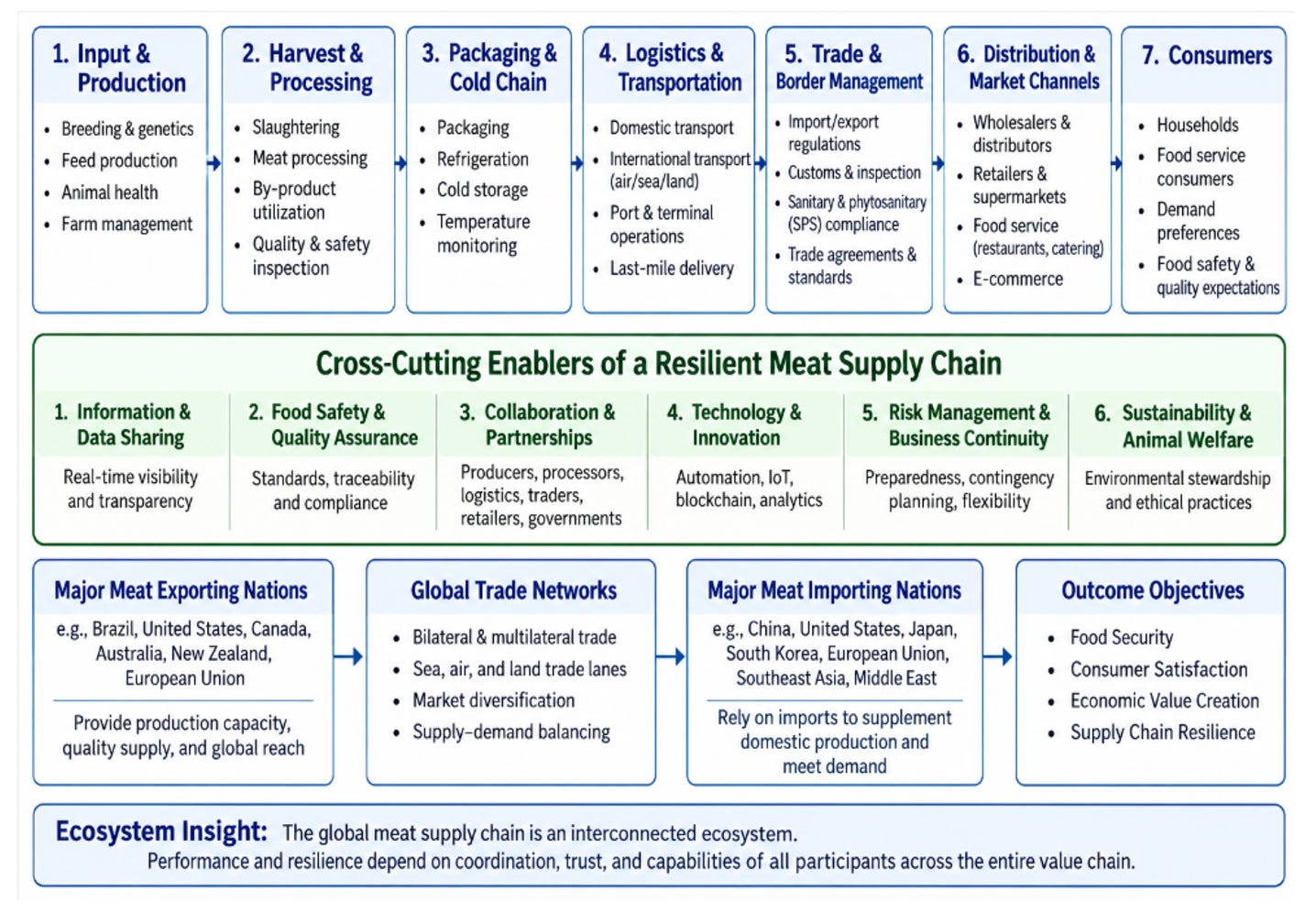
The architecture of the global meat supply chain can be understood as a connected sequence from input and livestock production through harvesting and processing, packaging and cold-chain management, logistics and transportation, trade and border management, distribution and market channels, and final consumption. Across these stages, six cross-cutting capabilities strengthen resilience: information and data sharing; food safety and quality assurance; collaboration and partnerships; technology and innovation; risk management and business continuity; and sustainability and animal welfare.
Figure 1
Global Meat Supply Chain Ecosystem
Source: Authors’ own synthesis.
Figure 1 presents the global meat supply chain as an interconnected farm-to-consumer ecosystem linking major stages of production, harvesting and processing, packaging and cold-chain management, logistics and transportation, trade and border management, distribution, retail and food service, and final consumption. Across these stages, system performance is supported by cross-cutting capabilities such as information and data sharing, food safety and quality assurance, collaboration, technology and automation, risk management, business continuity, sustainability, and animal welfare. The figure also extends the operational flow to the international level by showing how exporting and importing countries are connected through trade networks that influence food security, economic value creation, consumer access, and supply-chain resilience. Its central message is that effective meat supply-chain performance depends not on any single organization or country, but on coordination and integration across the entire ecosystem from farm to consumer.
2.4. Core Supply Chain Processes: From Farm to Consumer
The meat supply chain begins with breeding, feed procurement, animal raising, veterinary care, disease prevention, and farm-level production before livestock and poultry move to slaughtering and processing facilities for inspection, grading, cutting, packaging, and preparation for domestic or international markets (Hobbs, 2021; Vaiknoras et al., 2022). Refrigerated storage and transportation then become essential because temperature control directly affects food safety, product quality, shelf life, and marketability, while internationally traded meat must also satisfy customs documentation, inspection, sanitary and phytosanitary standards, labeling rules, and other import and export requirements. Downstream processes include international transportation, border clearance, cold storage, wholesale distribution, retailing, restaurant and institutional food service, and final household consumption, supported throughout by forecasting, inventory management, traceability, pricing information, quality assurance, financial flows, and regulatory documentation. Effective farm-to-consumer performance therefore requires the synchronization of physical product flows, information flows, financial flows, and regulatory flows, since disruption in any one of these can create cascading effects throughout the broader meat supply chain ecosystem (Christopher & Peck, 2004; Ivanov et al., 2023).
3. How the Global Meat Supply Chain Works
Building on this ecosystem overview, the analysis now follows the operational flow from farm production to final consumption. The meat supply chain combines biological production, industrial transformation, temperature-controlled logistics, border and regulatory management, and downstream market coordination. Effective performance therefore requires synchronization of physical product, information, financial, quality, and regulatory flows across upstream, midstream, and downstream stages (Christopher & Peck, 2004; Hobbs, 2021; Ivanov et al., 2023).
3.1. Upstream Production: Livestock, Feed, and Farm Management
The ecosystem begins with breeding and genetics, feed production and procurement, animal raising, veterinary care, disease prevention, animal-health management, and farm-level operations. Performance is shaped by feed costs, labor availability, disease risks, genetics, environmental conditions, welfare standards, financing, and access to downstream processing capacity. Livestock production follows biological schedules that cannot easily be paused or adjusted: animals continue to grow even when transportation or slaughter capacity is temporarily constrained. This makes upstream production unusually sensitive to downstream disruption and places a premium on communication, scheduling, animal-health management, and coordination with processors and buyers.
3.2. Midstream Operations: Processing, Packaging, Cold Chain, and Transportation
Market-ready animals move to slaughtering and processing facilities for inspection, grading, cutting, further processing, by-product utilization, quality assurance, and packaging. Processing plants serve as the critical bridge between live-animal production and market-ready food, so workforce availability, plant capacity, food-safety systems, and operating continuity affect both farmers upstream and distributors and consumers downstream. After processing, refrigeration, cold storage, temperature monitoring, trucking, warehousing, port handling, and domestic or international transportation become core operating requirements because temperature failure can reduce shelf life, damage quality, create food-safety risks, and destroy marketability. Reliable cold-chain infrastructure, rapid transportation, contingency routing, and visibility across handoffs are therefore central to both efficiency and resilience (Hobbs, 2021; Wiedemann et al., 2015).
3.3. Downstream Coordination: Trade, Distribution, and Final Consumption
The downstream system integrates international trade and border management with wholesale distribution, retailing, food service, e-commerce, and final consumption. Cross-border shipments may require animal-health documentation, sanitary and phytosanitary compliance, customs declarations, inspections, labeling, origin and traceability records, certification, tariffs, and destination-specific food-safety standards; disease outbreaks or regulatory changes can therefore delay or redirect flows immediately (OECD, 2020; OECD, 2021). After customs clearance or domestic processing, meat moves through cold storage, wholesalers, distributors, supermarkets, restaurants, institutional food-service operators, and other channels before reaching consumers. Demand forecasting, inventory management, pricing, promotion, traceability, regulatory documentation, and consumer preferences must be synchronized with physical product flows, since disruption in any one of these elements can cascade through the wider ecosystem (Christopher & Peck, 2004; Ivanov et al., 2023).
Mini-Case: Conestoga Meat Packers—Farm-to-Global-Market Integration
Conestoga Meat Packers in Breslau, Ontario, illustrates how farm ownership, processing, quality control, logistics, and international trade can be linked in one operating ecosystem. The company is farmer-owned; its 2025 compliance report states that the cooperative is owned by approximately 157 farmers, linking producers directly to processing ownership and supporting closer alignment from farm production through processing (Conestoga Meat Packers Ltd., 2025). Conestoga also reports that approximately half of its production is exported to more than 20 countries worldwide, including the United States, Mexico, Japan, China, New Zealand, and Chile. The case shows how local agricultural production can be connected to global demand through cooperative ownership, processing capacity, quality assurance, cold-chain logistics, border management, and established distribution relationships.
4. Lessons from COVID-19 and Supply Chain Disruption
The COVID-19 pandemic served as a practical stress test for the North American and global meat supply chain ecosystem. Because livestock production, processing, transportation, retailing, and food service are tightly interconnected, disruptions at one stage quickly propagated across the entire system. The crisis revealed not only operational weaknesses but also deeper structural tensions between efficiency, concentration, flexibility, and resilience (Hobbs, 2021; Vaiknoras et al., 2022).
4.1. Processing Bottlenecks and the Farm-to-Market Paradox
COVID-19 exposed the meat supply chain’s dependence on uninterrupted processing capacity, as plant closures, labor shortages, transportation disruptions, border uncertainty, and sudden shifts in demand created simultaneous pressures across the ecosystem (Hobbs, 2021; Vaiknoras et al., 2022; Whitehead & Kim, 2022). When processing capacity declined, market-ready livestock accumulated at farms, creating overcrowding, higher feed and animal-management pressures, and in severe cases forced depopulation. USDA Economic Research Service evidence underscores the severity of this disruption: about 6% of U.S. hog producers reported euthanizing hogs in response to COVID-19 slaughter-plant closures (Gillespie et al., 2026). The result was a striking supply chain paradox: surplus biological inventory upstream at farms existed at the same time as shortages and higher prices downstream at grocery stores.
4.2. Concentration, Efficiency, and Structural Vulnerability
The pandemic exposed the vulnerability created by excessive dependence on highly concentrated, large-scale processing facilities, where disruption at one major plant can quickly affect livestock production, transportation, distribution, retail supply, and consumer access. This reflects the efficiency–resilience tradeoff: systems optimized for scale, specialization, and low cost may perform well under stable conditions but become fragile when critical nodes fail. The practical lesson is to retain the advantages of large plants while complementing them with diversified regional and small-to-medium processing capacity that can provide alternative routes during emergencies (Christopher & Peck, 2004; Ivanov et al., 2023; Sheffi & Rice, 2005).
4.3. Building a More Resilient Meat Supply Chain Ecosystem
COVID-19 demonstrated the importance of workforce continuity, automation, smart-factory technologies, workplace biosecurity, flexible logistics, product redirection, and digital visibility in sustaining meat supply chain operations during disruption. It also highlighted the need for industry–government contingency frameworks involving alternative processing routes, emergency animal-management protocols, cross-border coordination, and temporary financial support when normal market channels fail (OECD, 2020; OECD, 2021). Together, these lessons show that resilience depends on diversification, flexibility, visibility, redundancy, and collaboration, supported by alternative capacity, timely information, trusted relationships, and coordinated response mechanisms.
5. Lessons and Implications: Six Capabilities for a Resilient Meat Supply Chain Ecosystem
Figure 1 identifies six capabilities that help transform an interconnected meat supply chain into a more resilient ecosystem. These capabilities can be organized into three complementary dimensions: visibility and assurance, coordination and technology, and preparedness and sustainability. Together, they enable the ecosystem to anticipate disruption, maintain continuity, protect product integrity, and adapt to changing operational, regulatory, environmental, and market conditions (Christopher & Peck, 2004; Ivanov et al., 2023; Sheffi & Rice, 2005).
Table 1
Building a Resilient Global Meat Supply Chain Ecosystem
Source: Authors’ own synthesis.
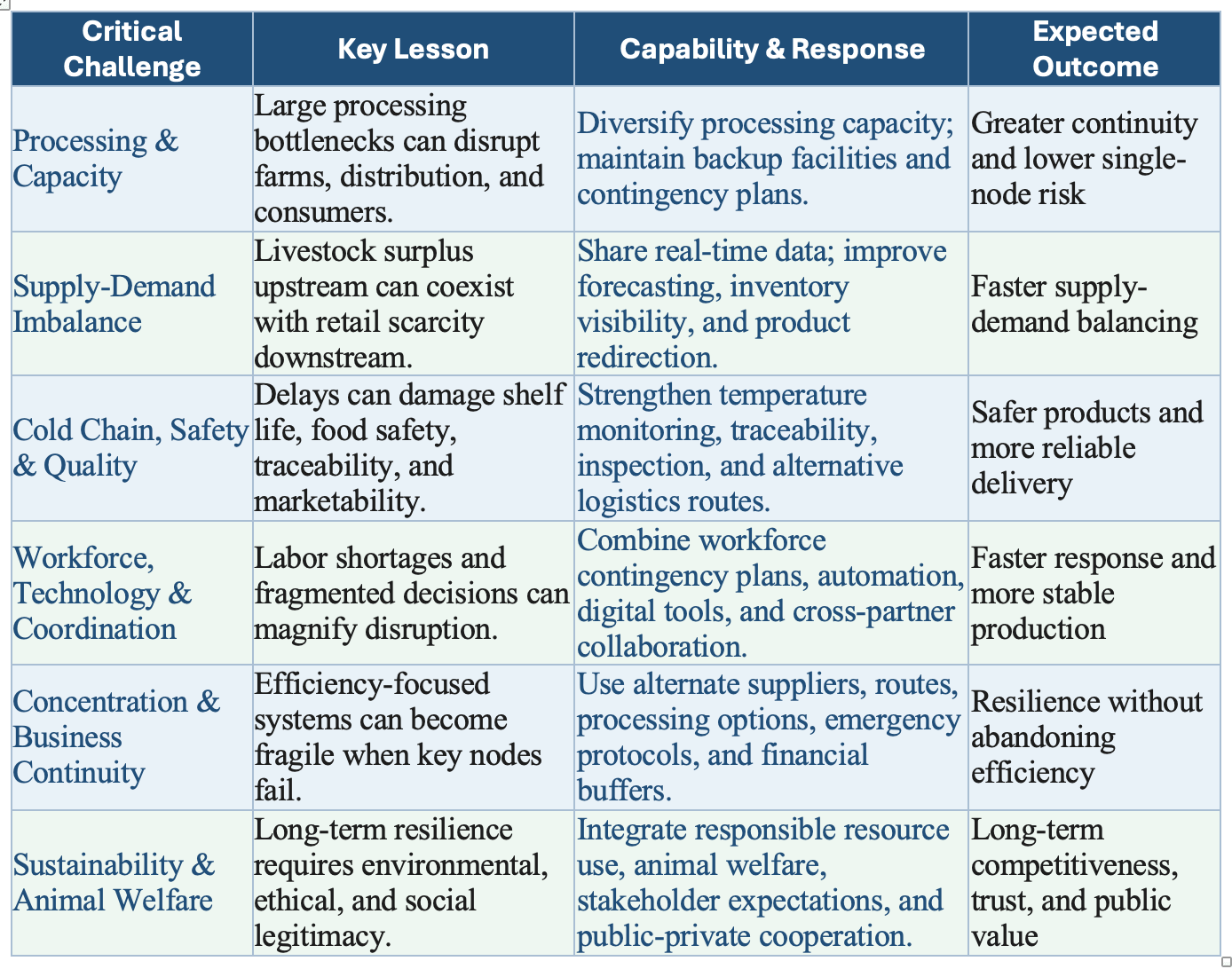
Table 1 summarizes six major resilience challenges facing the global meat supply chain ecosystem and connects each challenge with a key lesson, practical capability, and expected outcome. It shows that resilience depends on combining processing flexibility, real-time information sharing, cold-chain and quality assurance, workforce and technology coordination, business continuity planning, and sustainability with animal welfare. Overall, the table emphasizes that long-term resilience requires balancing efficiency with redundancy, coordination, trust, and public value across the full farm-to-consumer system.
5.1. Information Visibility and Food Safety Assurance
Information and data sharing strengthen resilience by providing timely visibility into livestock availability, processing capacity, inventories, transportation status, temperature conditions, border delays, and changing demand. Food safety and quality assurance complement this visibility through common standards, traceability, inspection, certification, and rapid-response procedures that protect product integrity and stakeholder confidence. Together, transparency and assurance help participants identify problems earlier, coordinate responses more effectively, and strengthen both operational resilience and public trust (Hobbs, 2021; OECD, 2021).
5.2. Collaboration, Partnerships, and Technology-Enabled Coordination
Collaboration and partnership strengthen resilience by enabling producers, processors, logistics providers, traders, retailers, regulators, and governments to coordinate capacity, transportation, product flows, and emergency responses during disruption. Technology and innovation—including automation, digital documentation, IoT-enabled monitoring, analytics, forecasting, traceability systems, and flexible production—improve visibility, responsiveness, and continuity across the ecosystem. Together, trusted relationships and digital capabilities help participants detect problems earlier, share reliable information, and redirect products, capacity, labor, and transportation resources as conditions change (Hong et al., 2025; Ivanov et al., 2023).
5.3. Risk Preparedness, Sustainability, and Long-Term Resilience
Risk management and business continuity strengthen resilience through alternative suppliers, backup processing capacity, diversified transportation routes, workforce contingency plans, emergency protocols, inventory strategies, insurance, and financial buffers that prevent local disruptions from becoming ecosystem-wide failures. Sustainability and animal welfare extend resilience beyond short-term continuity by integrating environmental stewardship, responsible resource use, ethical livestock practices, regulatory expectations, social legitimacy, and changing consumer preferences. Together, these capabilities show that long-term competitiveness requires balancing efficiency with redundancy, productivity with animal welfare, profitability with sustainability, and operational performance with public trust across the farm-to-consumer ecosystem (Christopher & Peck, 2004; OECD, 2021; Sheffi & Rice, 2005; Wiedemann et al., 2015).
6. Conclusion
The global meat supply chain is best understood as an interconnected ecosystem in which biological production, processing, cold-chain logistics, trade, regulation, distribution, and consumer demand must remain synchronized from farm to consumer. COVID-19 demonstrated that efficiency, scale, and specialization alone are insufficient when processing bottlenecks, labor shortages, transportation disruptions, and demand shifts occur simultaneously across the system. Building resilience therefore requires diversified capacity, real-time information sharing, food safety and quality assurance, collaboration, technology-enabled coordination, business continuity, sustainability, and animal welfare. Ultimately, a competitive meat supply chain ecosystem must balance efficiency with resilience, profitability with public trust, and operational performance with long-term food security and shared value.
References
Christopher, M., & Peck, H. (2004). Building the resilient supply chain. The International Journal of Logistics Management, 15(2), 1–14. https://doi.org/10.1108/09574090410700275
Conestoga Meat Packers Ltd. (2025). 2023 modern slavery compliance report. https://assets.ctfassets.net/zz7tppgvck6x/41IBW00ayCn9D4VWIZYgf7/e6fabf54162282c8f980d142b7b49b66/Bill_S-211_Compliance_Report_2025.pdf
Gillespie, J., Raff, Z., Vandeveer, M., Kee, J., Haley, M., & Ufer, D. J. (2026). The U.S. hog industry: Structural change, production systems and costs, and manure management (Economic Research Report No. ERR-361). U.S. Department of Agriculture, Economic Research Service. https://doi.org/10.32747/2026.9529778.ers
Hobbs, J. E. (2021). The COVID-19 pandemic and meat supply chains. Meat Science, 181, 108459. https://doi.org/10.1016/j.meatsci.2021.108459
Hong, P. C., Choi, M., & Jalali Sepehr, M. (2025). Navigating turbulent global markets for Chinese global firms: A conceptual framework for managing dynamic supply chain complexity. Critical Perspectives on International Business, 21(5), 724–749. https://doi.org/10.1108/CPOIB-06-2024-0055
Hong, P. C., & Jeong, J. (2006). Supply chain management practices of SMEs: From a business growth perspective. Journal of Enterprise Information Management, 19(3), 292–302. https://doi.org/10.1108/17410390610658478
Ivanov, D., Dolgui, A., Blackhurst, J. V., & Choi, T.-M. (2023). Toward supply chain viability theory: From lessons learned through COVID-19 pandemic to viable ecosystems. International Journal of Production Research, 61(8), 2402–2415. https://doi.org/10.1080/00207543.2023.2177049
OECD. (2020). Food supply chains and COVID-19: Impacts and policy lessons. OECD Publishing. https://doi.org/10.1787/71b57aea-en
OECD. (2021). COVID-19 and food systems: Short- and long-term impacts (OECD Food, Agriculture and Fisheries Papers No. 166). OECD Publishing. https://doi.org/10.1787/69ed37bd-en
Ritchie, H., Rosado, P., & Roser, M. (2023). Meat and dairy production. Our World in Data. https://ourworldindata.org/meat-production
Sheffi, Y., & Rice, J. B., Jr. (2005). A supply chain view of the resilient enterprise. MIT Sloan Management Review, 47(1), 41–48.
Vaiknoras, K., Hahn, W., Padilla, S., Valcu-Lisman, A., & Grossen, G. (2022). COVID-19 working paper: COVID-19 and the U.S. meat and poultry supply chains (AP-098). U.S. Department of Agriculture, Economic Research Service. https://ageconsearch.umn.edu/record/327338/?v=pdf
Whitehead, D., & Kim, Y. H. B. (2022). The impact of COVID-19 on the meat supply chain in the USA: A review. Food Science of Animal Resources, 42(5), 762–774. https://doi.org/10.5851/kosfa.2022.e39
Wiedemann, S., McGahan, E., Murphy, C., Yan, M.-J., Henry, B., Thoma, G., & Ledgard, S. (2015). Environmental impacts and resource use of Australian beef and lamb exported to the USA determined using life cycle assessment. Journal of Cleaner Production, 94, 67–75. https://doi.org/10.1016/j.jclepro.2015.01.073
ABOUT THE AUTHORS

Paul C. Hong
Distinguished University Professor, University of Toledo, USA
Paul C. Hong is a Distinguished University Professor of Information Systems and Supply Chain Management at the University of Toledo. His work focuses on leadership, governance, and decision-making in the AI era, integrating strategy, technology, and institutional trust. He has published extensively in leading academic journals and writes on how individuals and organizations navigate complexity, disruption, and global transformation.

Junwon Choi
Vice President, Canworld Foods Ltd. and US World Foods Ltd.
Junwon Choi is the Vice President of Canworld Foods Ltd. and US World Foods Ltd., international and domestic food trading companies. He holds an Agricultural MBA from the University of Guelph, Canada, and previously worked at the Korea Institute for Animal Products Quality Evaluation (KAPE). Leveraging extensive knowledge and experience in the global food industry, he is dedicated to serving the worldwide food service sector with fresh, frozen, and processed meat products. He strives for innovative and fully integrated trade practices that deliver mutual benefits to customers, suppliers, and employees.
Original Article:

Suggested Citation
Hong, P. C., & Choi, J. (2026, September 24). The global meat supply chain ecosystem: From farm to consumer. K-GSP Forum, pp. 1–11.
한글요약
글로벌 육류 공급망 생태계: 농장에서 소비자까지
이 글은 글로벌 육류 공급망을 단순한 농축산업의 연속 과정이 아니라, 생산자·가공업체·물류기업·수출입업체·유통업체·정부·규제기관·소비자가 상호 연결된 하나의 글로벌 공급망 생태계로 분석한다. 육류 공급망은 가축 사육과 사료 공급에서부터 도축·가공, 냉장·냉동, 운송, 통관, 국제무역, 도소매 유통, 외식산업, 최종 소비에 이르기까지 여러 단계가 긴밀하게 연계되어 있으며, 어느 한 단계의 차질도 전체 공급망에 연쇄적으로 영향을 줄 수 있다. 특히 식품안전, 온도관리, 추적성, 규제 준수, 신속한 물류가 필수적이기 때문에 육류 공급망의 경쟁력은 물리적 인프라뿐 아니라 정보 공유, 협력, 신뢰, 조정 능력에 크게 의존한다.
COVID-19 팬데믹은 이러한 글로벌 육류 공급망의 취약성을 명확하게 보여준 대표적인 사례였다. 가공공장 폐쇄와 노동력 부족, 운송 차질, 외식 수요의 급감과 가정 소비의 변화, 국경 통제와 규제 불확실성이 동시에 발생하면서 생산에서 소비에 이르는 여러 단계가 함께 흔들렸고, 일부 지역에서는 가격 상승과 제품 부족이 나타났다. 이 경험은 효율성, 규모, 전문화, 린 운영만으로는 공급망의 지속성을 보장할 수 없으며, 공급처 다변화, 대체 가공능력, 콜드체인 안정성, 디지털 가시성, 비상계획, 공공·민간 협력이 함께 필요하다는 점을 보여주었다. 따라서 COVID-19는 글로벌 육류 공급망의 강점과 약점을 동시에 드러낸 중요한 스트레스 테스트로 평가된다.
이 글의 핵심적 기여는 글로벌 육류 공급망의 회복탄력성을 강화하는 여섯 가지 핵심 역량을 체계적으로 제시한 데 있다. 첫째, 정보 및 데이터 공유는 가축 공급, 가공능력, 재고, 운송상태, 온도조건, 국경 지연과 수요 변화를 실시간으로 파악하게 하며, 식품안전 및 품질보증은 공통 기준, 추적성, 검사와 인증을 통해 제품의 안전성과 이해관계자의 신뢰를 높인다. 둘째, 생산자·가공업체·물류기업·무역업체·유통업체·정부 및 규제기관 간 협력과 파트너십은 위기 시 독립적인 대응보다 조정된 대응을 가능하게 하며, 자동화, 디지털 문서, IoT 기반 온도 모니터링, 분석, 예측과 추적성 기술은 이러한 조정능력을 강화한다. 셋째, 위험관리와 사업연속성은 대체 공급처, 백업 가공능력, 운송경로 다변화, 인력 비상계획, 비상 프로토콜과 재무적 완충장치를 통해 국지적 충격이 전체 생태계의 실패로 확산되는 것을 방지한다.
또한 지속가능성과 동물복지는 단기적인 운영 연속성을 넘어 환경적 책임, 책임 있는 자원 이용, 윤리적 축산관행, 사회적 정당성과 소비자 기대를 공급망 회복탄력성의 일부로 포함시킨다. COVID-19의 경험은 효율성과 규모만을 극대화한 공급망이 핵심 가공거점이나 노동력, 운송과 수요가 동시에 흔들릴 때 취약해질 수 있음을 보여주었다. 따라서 강한 글로벌 육류 공급망은 효율성과 회복탄력성, 생산성과 동물복지, 수익성과 지속가능성, 운영성과 공공의 신뢰를 함께 균형 있게 추구해야 한다. 궁극적으로 농장에서 소비자까지의 경쟁력과 식량안보는 어느 한 기업이나 국가의 성과보다 전체 생태계의 가시성, 협력, 기술, 유연성, 사업연속성 및 신뢰에 의해 결정된다.
저자소개:
Paul C. Hong은 미국 톨레도대학교의 정보시스템 및 공급망관리 분야 Distinguished University Professor로서, 글로벌 공급망, 전략, 기술, 회복탄력성, 거버넌스 및 조직 전환을 중심으로 연구하고 있다.
Junwon Choi는 캐나다 Canworld Foods Ltd.와 US World Foods Ltd.의 부사장으로서, 글로벌 식품산업과 육류 무역 분야의 풍부한 경험을 바탕으로 신선·냉동·가공 육류의 국제 유통, 통합적 무역 운영, 그리고 고객·공급업체·직원 간 상생 가치 창출에 힘쓰고 있다.
© K-Global Scholars and Professionals Forum. September 2026. All rights reserved. Content published in the K-GSP Forum may not be reproduced, distributed, or transmitted in any form without prior written permission from the K-GSP Forum, except for brief quotations with full attribution.