
Executive Summary
This article brings Jürgen Moltmann’s theology of divine suffering and Christian hope into conversation with Han Kang’s literary portrayals of historical violence, bodily vulnerability, grief, and remembrance. Moltmann argues that God does not remain distant from human agony but enters it through the crucified Christ, while Han Kang’s Human Acts, We Do Not Part, and The White Book portray people who refuse to abandon the violated, forgotten, and dead. Their works together suggest that authentic hope does not erase suffering but remembers victims, resists dehumanization, and keeps open the possibility of justice, reconciliation, and renewed life.
Keywords: Jürgen Moltmann; Han Kang; suffering God; historical trauma; hope
1. Introduction
In May 2026, Paul C. Hong visited the May 18 Memorial Park in Gwangju and the Jeju 4·3 Peace Park, where names, testimonies, graves, and public remembrance preserve the wounds of modern Korean history. These visits transformed historical suffering into a personal and moral question about how the living remember victims of political violence. Soon afterward, Hong discussed these questions with his longtime friend Augustine Suh, whose theological training in Germany had introduced him to Jürgen Moltmann’s theology of the suffering God, raising the central question of this article: how God, memory, and hope may be understood where historical suffering continues to call for remembrance, solidarity, and responsibility.
Human beings repeatedly ask where God is when innocent people suffer through repression, war, torture, massacre, and enforced silence. Religious explanations that portray suffering as punishment, discipline, mystery, or part of providence may deepen victims’ pain when they present God as distant from human anguish (Caruth, 1996; LaCapra, 2001; Sobrino, 2004). Moltmann approached this problem through his experience as a German soldier and prisoner of war and through the devastation associated with Nazi Germany, developing a theology in which Christian hope emerges from the cross and moves toward resurrection, justice, and renewed creation; Theology of Hope emphasizes the promise of resurrection, while The Crucified God presents God as participating in the suffering of abandoned humanity (Bauckham, 1995; Moltmann, 1993a, 1993b).
Han Kang addresses related questions through literary witness rather than systematic theology. Human Acts remembers those killed and traumatized during the 1980 Gwangju Uprising, We Do Not Part confronts the suppressed memory of the Jeju 4·3 massacres, and The White Book reflects on personal grief and fragile life (Han, 2017, 2019, 2025). Bringing Moltmann and Han Kang together creates an analogical and interdisciplinary dialogue, not a doctrinal equivalence: Moltmann offers theological language of divine solidarity and future hope, while Han Kang tests such language against wounded bodies, silenced memories, and unresolved grief. Their ethical convergence lies in resisting the erasure of victims, preserving memory, and rejecting forms of hope that bypass grief, truth, justice, and responsibility, allowing theology and literature to illuminate and challenge one another while preserving Han Kang’s independent literary voice and their important differences.
2. Moltmann’s Theology of Hope and the Suffering God
Moltmann develops hope through the inseparable relationship between resurrection and the cross. Hope resists despair because resurrection contradicts death and injustice; yet it remains truthful because the crucified God stands with those who suffer. For Moltmann, hope is therefore a call to remember victims, confront evil, and anticipate God’s promised future through practices of justice and care (Bauckham, 1995; Moltmann, 1993a, 1993b, 1996).
2.1 Hope as Resistance to the Present
For Moltmann, Christian hope is not optimism, positive thinking, or confidence that circumstances will naturally improve, but is grounded in the resurrection of Jesus Christ and the promise that death, oppression, and injustice will not have the final word (Moltmann, 1993b, 1996). Resurrection therefore challenges the present world by placing promised life against death, divine judgment against injustice, and God’s future against despair. Such hope produces resistance because those who trust God’s promised future cannot fully accept a world shaped by violence, exclusion, and suffering, but seek to anticipate that future through acts of justice, reconciliation, liberation, care, and remembrance (Metz, 1998; Moltmann, 1993b). This understanding also illuminates Han Kang’s novels, in which testimony and the remembrance of victims resist erasure and challenge the silence imposed by political power (Han, 2017, 2025; Volf, 2006).
2.2 God within Human Suffering
In The Crucified God, Moltmann challenges the image of a God who remains safely above human suffering by drawing on Luther’s theology of the cross and arguing that God is revealed through Christ’s rejection, pain, and abandonment. The cross reveals God’s suffering love and shows that God is not a distant observer but enters the condition of victims through the crucified Christ, so faith cannot speak honestly about hope while remaining detached from wounded bodies, grieving families, and communities marked by violence (Bauckham, 1995; Moltmann, 1993a). This does not mean that suffering is divinely intended, automatically redemptive, or worthy of glorification; instead, the cross exposes the destructive powers of sin, political violence, religious hostility, and abandonment while revealing divine solidarity with those who suffer (Moltmann, 1993a; Sobrino, 2004). The theological question therefore shifts from asking only why God permits suffering to asking where God is found, emphasizing that the cross names evil, calls for truth, opens possibilities for forgiveness, justice, and new life, and summons communities to remain present with those who have been wounded.
2.3 Resurrection without Forgetting the Cross
Moltmann connects the cross with resurrection, but resurrection does not cancel, conceal, or diminish the reality of suffering; Jesus is raised as the crucified one, and the wounds remain part of the identity of the risen Christ, so Christian hope affirms new life without erasing the history of violence and abandonment that preceded it (Moltmann, 1993a, 1996). Hope therefore requires faithful memory because a future that forgets victims cannot be just, and reconciliation without remembrance may become another form of oppression by asking victims to surrender their stories for the comfort of society. Moltmann envisions a future in which the dead are remembered, injustice is judged, and creation is renewed, expressing a moral seriousness in which truth must be faced, victims remembered, wrongdoing acknowledged, and reconciliation grounded in accountability (Moltmann, 1996; Volf, 2006). This vision provides a strong bridge to Han Kang, whose literature likewise insists that the dead cannot be abandoned for the sake of political stability, national pride, or personal comfort.
Moltmann — Interpretive Summary
Hope does not erase the cross; it remembers the wounded and opens a future beyond despair.
3. Han Kang’s Literature of Wounded Bodies and Historical Memory
Han Kang’s fiction approaches suffering through literary witness rather than theological explanation. Across Human Acts, We Do Not Part, and The White Book, her writing restores dignity to wounded bodies, keeps suppressed histories present, and asks what responsibility the living bear toward the dead (Han, 2017, 2019, 2025).
3.1 Human Acts: The Body as Witness
Human Acts centers on the violence surrounding the May 1980 Gwangju Uprising and follows victims, survivors, prisoners, witnesses, and grieving families across different periods, refusing to treat Gwangju as a completed historical event because its effects continue through damaged bodies, recurring memories, broken relationships, shame, silence, and unresolved grief (Caruth, 1996; Han, 2017; LaCapra, 2001). The body becomes the novel’s primary witness because oppressive power treats human beings as objects that can be beaten, tortured, killed, hidden, or denied proper mourning, while Han Kang reverses this dehumanization by restoring individuality, relationships, hopes, fears, and dignity to those political authority attempted to erase. This literary focus corresponds with Moltmann’s theology of the crucified God, while preserving an important distinction between the historical victims of Gwangju and the theological identity of Christ (Han, 2017; Moltmann, 1993a).
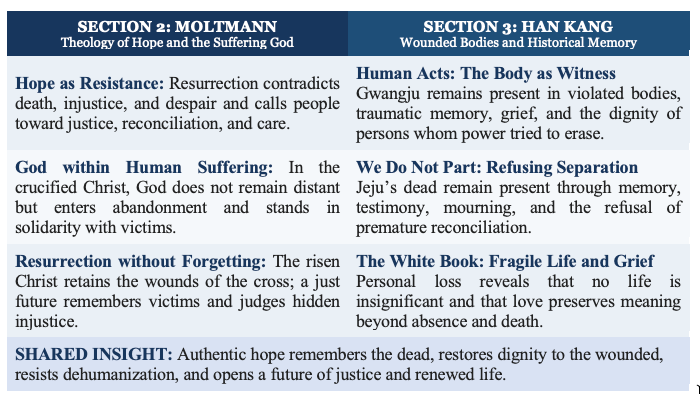
Table 1
Moltmann and Han Kang: From Suffering and Memory to Hope
Note. Source: Authors’ own synthesis.
Table 1 offers a compact comparison of Moltmann’s theology of hope and the suffering God with Han Kang’s literary witness to wounded bodies and historical memory. The table is intended as a compact guide to the dialogue rather than a repetition of the full argument.
3.2 We Do Not Part: Refusing Separation from the Dead
We Do Not Part explores the continuing presence of the Jeju massacres through friendship, family memory, dreams, research, and encounters with the landscape, showing that historical violence remains alive when the dead have not been properly mourned and survivors have been pressured into silence (Han, 2025; LaCapra, 2001). Its title expresses an ethical commitment in which the living refuse to abandon the dead simply because remembrance is painful, politically inconvenient, or socially disruptive. This refusal corresponds with Moltmann’s eschatological hope, which affirms that the dead are not lost to God and that relationships destroyed by violence are not meaningless, while Han Kang presents such hope through fragile acts of searching, naming, mourning, and speaking that resist the complete victory of violence. The novel therefore warns against premature reconciliation and joins Moltmann in emphasizing that genuine reconciliation requires truth, justice, public remembrance, and accountability (Han, 2025; Moltmann, 1996; Volf, 2006).
3.3 The White Book: Fragile Life and Personal Grief
While Human Acts and We Do Not Part focus primarily on collective historical trauma, The White Book approaches suffering through intimate and personal grief as the narrator reflects on an older sister who died shortly after birth and imagines the life that might have been lived. White objects such as cloth, snow, salt, rice, breath, and light become symbols that hold together absence, presence, vulnerability, mourning, and renewal (Han, 2019). The book asks whether one person can carry the memory of another and whether writing can preserve a form of presence for a life almost immediately interrupted, creating a quiet connection with Moltmann’s theology in the conviction that no life is insignificant or forgotten. Neither Han Kang nor Moltmann denies the reality of loss; both suggest that hope becomes possible because love and remembrance refuse to accept that death has exhausted the meaning of a person’s existence (Han, 2019; Moltmann, 1996).
Moltmann — Interpretive Summary
Hope does not erase the cross; it remembers the wounded and opens a future beyond despair.
4. Suffering, Memory, and the Ethics of Hope
This section brings Moltmann and Han Kang into ethical dialogue by showing that credible hope requires listening to victims, resisting enforced forgetting, and practicing solidarity without offering easy explanations for suffering (Metz, 1998; Sobrino, 2004; Volf, 2006).
4.1 Hope Begins by Listening to Victims
One of the strongest lessons emerging from Moltmann and Han Kang is that credible hope begins by listening carefully to those who have suffered, since moving too quickly toward forgiveness, healing, reconciliation, or resurrection can silence testimony, minimize grief, and place another burden upon the wounded (Caruth, 1996; Sobrino, 2004). Han Kang’s literature slows the reader down by directing attention to dead bodies, traumatic memories, broken speech, survivor guilt, and family sorrow, while Moltmann’s theology gains moral credibility by locating God not above suffering but within abandonment through the crucified Christ. Both perspectives therefore resist easy explanations and emphasize the importance of remaining present with those who suffer. Communities shaped by this vision create space for testimony, anger, lament, grief, and protest without treating slow recovery as a failure of faith (Han, 2017, 2025; Moltmann, 1993a).
4.2 Memory as Resistance
Authoritarian systems often seek to control not only human bodies but also public memory by renaming massacres, destroying evidence, intimidating survivors, and constructing official narratives that protect those in power, making forgetting politically useful because it weakens accountability and separates violence from its victims. Han Kang resists this process by giving literary presence to suppressed histories and presenting memory as an ethical responsibility toward those who can no longer defend their own stories (Han, 2017, 2025; LaCapra, 2001; Volf, 2006). Moltmann’s theology similarly presents God as the keeper of memory whose resurrection promise prevents victims from being erased from the future, while divine judgment restores moral seriousness by distinguishing victim from oppressor, truth from propaganda, and repentance from denial. Theological hope therefore requires historical honesty through preserving testimony, acknowledging wrongdoing, honoring the dead, and allowing memory to help protect the future from repetition (Moltmann, 1996; Volf, 2006).
4.3 Solidarity without Easy Explanation
Moltmann and Han Kang both caution against explanations that remain above suffering instead of entering its human reality, as Moltmann moves theology from divine distance toward divine participation while Han Kang replaces detached observation with embodied literary witness. Their shared emphasis is that the most faithful response to suffering may not be a complete explanation but the decision to remain present with those who have been wounded (Moltmann, 1993a; Sobrino, 2004). Solidarity therefore includes mourning with families, listening to survivors, preserving historical truth, confronting harmful institutions, and protecting vulnerable persons, while also respecting the literary, historical, and ethical integrity of Han Kang’s works. A genuine interdisciplinary dialogue allows her literature to challenge theological abstraction, while Moltmann’s theology responds by placing the cross at the center of Christian speech about God and human suffering (Metz, 1998; Sobrino, 2004).
5. The Meaning and Practice of Hope after Historical Trauma
After establishing the ethical shape of hope, this section turns to practice: how memory-centered hope becomes visible in transformation, public truth-telling, embodied care, and relationships that refuse abandonment (Moltmann, 1996; Volf, 2006).
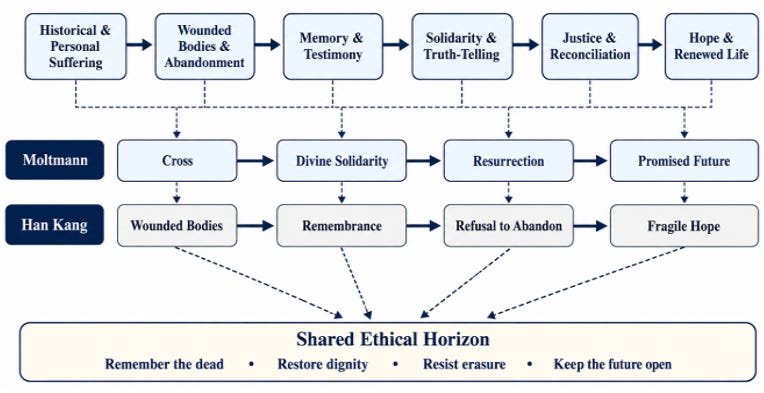
Figure 1
From Suffering to Hope: An Interdisciplinary Pathway
Note. Source: Authors’ own synthesis.
Figure 1 illustrates the interdisciplinary pathway through which suffering may be transformed into a morally credible form of hope. Beginning with historical and personal suffering, the figure traces a movement through wounded bodies and abandonment, memory and testimony, solidarity and truth-telling, justice and reconciliation, and finally hope and renewed life. It also shows how Moltmann’s theological sequence—from the cross through divine solidarity and resurrection toward a promised future—runs in parallel with Han Kang’s literary sequence of wounded bodies, remembrance, refusal to abandon, and fragile hope. These two pathways converge in a shared ethical horizon centered on remembering the dead, restoring dignity, resisting erasure, and keeping the future open.
5.1 Transformative Hope beyond Restoration
Hope after historical trauma cannot mean returning to the conditions that existed before violence, because survivors’ bodies, relationships, identities, and memories have been permanently changed, and the old social order may itself have contained structures that enabled oppression. Authentic hope therefore seeks transformation, justice, and renewed communal life instead of simply restoring what previously existed (Caruth, 1996; LaCapra, 2001). For Moltmann, resurrection is not merely the recovery of ordinary life but the beginning of a new creation that challenges the powers of death, violence, and injustice and refuses to let them define the final meaning of human existence. This future-oriented hope calls people to act in the present by resisting violence, accompanying victims, and building institutions that protect human dignity, while remaining grounded in the crucified God who enters human abandonment and suffering (Moltmann, 1993b, 1996).
5.2 Memory, Justice, and Embodied Acts of Hope
Han Kang portrays hope through small but morally significant acts such as remembering a dead friend, preserving a family story, reconstructing a silenced history, speaking despite fear, caring for an injured body, and refusing to forget a name. These actions cannot reverse death or remove past suffering, but they interrupt the logic of violence because oppression isolates, objectifies, silences, and erases, while hope reconnects, humanizes, speaks, and remembers (Han, 2017, 2019, 2025). Memory is therefore central to justice, since both theology and literature become dangerous when they protect the comfort of the powerful at the expense of victims. Moltmann emphasizes that God identifies with the crucified and preserves a future for those whom history has abandoned, while Han Kang restores individuality and voice to people reduced to bodies, statistics, or forbidden memories, showing that reconciliation without testimony, remembrance, and historical truth can become another form of exclusion (Moltmann, 1996; Volf, 2006).
5.3 Relational Hope between Promise and Uncertainty
Hope is relational because it affirms that suffering persons are not alone, the dead are not abandoned, and the past will not be surrendered to those who distorted or suppressed it. In Moltmann, this relationship is grounded in God’s solidarity with creation and the promise of resurrection, while in Han Kang it becomes visible through friendship, family, testimony, mourning, care, and literary remembrance (Han, 2017, 2019, 2025; Moltmann, 1996). Their differences deepen this understanding of hope: Moltmann expresses explicit confidence in God’s promised future, whereas Han Kang often remains within uncertainty, silence, vulnerability, and unresolved grief. Read together, Moltmann keeps grief from becoming absolute despair, while Han Kang keeps hope from becoming abstract triumphalism, presenting hope as a wounded but persistent commitment to life (Bauckham, 1995; Han, 2017, 2019, 2025).
6. Conclusion
The authors argue that Moltmann and Han Kang can be read together as an interdisciplinary dialogue between theology and literature, not as doctrinal equivalents. Moltmann offers a Christian vision of suffering and hope in which God enters abandonment through the crucified Christ and promises a future beyond death through the risen Christ, while Han Kang tests any language of hope against wounded bodies, silenced histories, and unresolved grief. Read together, they show that hope after historical trauma must be memory-centered, victim-attentive, and resistant to premature reconciliation. Such hope does not erase pain or explain it away; it remains with the wounded, preserves the truth of the dead, and opens a fragile but necessary future of justice, reconciliation, and renewed life (Han, 2017, 2019, 2025; Moltmann, 1993a, 1993b, 1996).
References
Bauckham, R. (1995). The theology of Jürgen Moltmann. T&T Clark.
Caruth, C. (1996). Unclaimed experience: Trauma, narrative, and history. Johns Hopkins University Press.
Han, K. (2017). Human acts (D. Smith, Trans.). Hogarth. (Original work published 2014)
Han, K. (2019). The white book (D. Smith, Trans.). Hogarth. (Original work published 2016)
Han, K. (2025). We do not part (E. Yaewon & P. A. Morris, Trans.). Hogarth. (Original work published 2021)
LaCapra, D. (2001). Writing history, writing trauma. Johns Hopkins University Press.
Metz, J. B. (1998). A passion for God: The mystical-political dimension of Christianity (J. M. Ashley, Trans.). Paulist Press.
Moltmann, J. (1993a). The crucified God: The cross of Christ as the foundation and criticism of Christian theology (R. A. Wilson & J. Bowden, Trans.). Fortress Press. (Original work published 1972)
Moltmann, J. (1993b). Theology of hope: On the ground and the implications of a Christian eschatology (J. W. Leitch, Trans.). Fortress Press. (Original work published 1964)
Moltmann, J. (1996). The coming of God: Christian eschatology (M. Kohl, Trans.). Fortress Press.
Sobrino, J. (2004). Where is God? Earthquake, terrorism, barbarity, and hope (M. J. O’Connell, Trans.). Orbis Books.
Volf, M. (2006). The end of memory: Remembering rightly in a violent world. William B. Eerdmans Publishing Company.
Original Article:

About the Authors

Distinguished Professor, Dr. Paul Hong (Editor in Chief) — University of Toledo
Paul C. Hong is Distinguished University Professor at the University of Toledo. Drawing on more than four decades of leadership and missional service and three decades of scholarship in leadership and supply chain management, his research examines how individuals, organizations, and societies develop the capabilities necessary for resilience, adaptation, and long-term impact. His recent work integrates history, management, philosophy, and faith-based narratives to explore leadership formation through the development of identity and purpose, interests and priorities, insight and perspective, integrity and principles, and influence through stewardship—qualities that remain essential in the age of artificial intelligence.
Byung-Yong Augustine Suh
Theologian & Director of Education, UBF
Suh is a theologian and Director of Education at UBF. After studying philosophy in Korea, he continued his theological studies in Germany and earned his doctoral degree from Kirchliche Hochschule Wuppertal. He has taught at evangelical seminaries biblical theology and systematic theology from an evangelical ecumenical perspective. His primary interests include the theology of the cross and gospel-centered theology.
© K-Global Scholars and Professionals Forum. All rights reserved. Content published in the K-GSP Forum may not be reproduced, distributed, or transmitted in any form without prior written permission from the K-GSP Forum, except for brief quotations with full attribution.
Suggested Citation: Hong, P. C., & Suh, B.-Y. A. (2026, August 27). The God Who Suffers and the Dead We Cannot Abandon: Jürgen Moltmann and Han Kang on Suffering, Memory, and Hope. K-GSP Forum, 1–11.
한글 요약
고통받는 하나님과 우리가 버릴 수 없는 죽은 이들: 위르겐 몰트만과 한강의 고통, 기억, 희망
이 글은 위르겐 몰트만의 ‘고통받는 하나님’ 신학과 한강 문학이 제기하는 상처 입은 몸, 억압된 역사, 애도와 기억의 문제를 대화하게 한다. 몰트만은 십자가와 부활을 통해 하나님이 인간의 고통을 멀리서 관찰하지 않고 그 안으로 들어오신다고 말하며, 한강은 『소년이 온다』, 『작별하지 않는다』, 『흰』을 통해 죽은 이들과 상처 입은 이들을 기억하는 문학적 증언을 제시한다. 두 사람을 함께 읽을 때 참된 희망은 고통을 지우거나 설명하는 데서 시작되지 않고, 희생자의 존엄을 보존하며 기억, 연대, 정의, 새로운 삶의 가능성을 끝까지 붙드는 데서 시작된다.
고통받는 하나님과 기억의 윤리: 몰트만에게 기독교적 희망은 낙관주의나 상황이 자연스럽게 좋아질 것이라는 기대가 아니다. 그것은 십자가와 부활에 근거하여 죽음, 억압, 불의가 최종적인 승리를 거둘 수 없다고 믿는 신앙이다. 십자가는 하나님이 안전한 거리에서 인간의 고통을 관찰하지 않고, 버림받고 고문당하며 죽어가는 이들의 자리에 함께하신다는 사실을 드러낸다. 그러나 이러한 신학은 고통을 미화하거나 모든 고난을 하나님의 뜻으로 해석하지 않는다. 오히려 십자가는 정치적 폭력, 종교적 적대, 죄와 인간의 잔혹성이 몸과 공동체를 어떻게 파괴하는지를 폭로한다. 부활 역시 십자가의 상처를 지우지 않는다. 부활하신 그리스도가 십자가에 달렸던 바로 그분이라는 사실은 정의로운 미래가 희생자의 상처와 기억을 배제할 수 없음을 의미한다. 따라서 기억 없는 화해, 진실 없는 용서, 희생자의 목소리를 듣지 않는 치유는 또 다른 억압이 될 수 있다.
한강의 문학과 상처 입은 이들의 증언: 『소년이 온다』는 1980년 광주에서 군사폭력으로 희생된 사람들과 살아남은 이들의 몸, 공포, 죄책감과 오랜 침묵을 따라간다. 이 작품에서 몸은 단순한 사물이 아니라 관계와 꿈, 존엄을 지닌 한 인간의 증언이 된다. 『작별하지 않는다』는 제주 4·3의 억압된 기억을 다루며, 살아 있는 이들이 정치적 편의나 개인적 안정을 위해 죽은 이들과 결별해서는 안 된다고 말한다. 작품의 제목은 기억하고 조사하며 증언하는 행위가 사랑과 책임의 지속임을 나타낸다. 『흰』은 태어난 지 얼마 되지 않아 죽은 언니에 대한 개인적 애도를 통해 짧고 주목받지 못한 생명도 결코 무의미하지 않다는 사실을 성찰한다. 흰 천, 눈, 소금, 쌀, 숨결과 빛은 부재와 현존, 죽음과 새로운 삶을 함께 품는 상징이 된다. 한강의 작품들은 죽음을 되돌릴 수는 없지만, 이름을 기억하고 상처 입은 몸을 돌보며 억압된 역사를 말하는 작은 행위들이 폭력의 논리를 중단시킬 수 있음을 보여준다.
희망, 연대와 새로운 삶: 몰트만과 한강이 함께 제시하는 첫 번째 통찰은 희망의 신뢰성이 고통과 얼마나 정직하게 대면하는가에 달려 있다는 점이다. 애도와 탄식을 건너뛴 희망은 피상적이며, 피해자에게 빠른 용서나 회복을 요구하는 종교적 언어는 그들의 고통을 다시 침묵시킬 수 있다. 두 번째 통찰은 기억이 정의를 위한 적극적인 저항이라는 점이다. 권위주의적 권력은 희생자의 몸뿐 아니라 기록과 증언까지 지우려 하지만, 문학과 신학은 죽은 이들을 공적인 기억 속으로 되돌려 놓는다. 세 번째 통찰은 희망이 관계적이라는 점이다. 고통받는 사람은 혼자가 아니며, 죽은 이들은 버려지지 않고, 왜곡된 과거는 가해자의 서술에만 맡겨지지 않는다. 몰트만은 하나님의 부활 약속을 통해 절망이 마지막 말이 될 수 없음을 선포하고, 한강은 불확실성과 슬픔 속에서도 기억과 애도를 지속하는 인간의 책임을 보여준다. 두 사람을 함께 읽을 때 희망은 상처를 감추는 승리의 언어가 아니라, 상처 입은 이들 곁에 머물면서 정의와 화해, 새로운 삶의 가능성을 끝까지 열어 두는 끈질긴 사랑으로 이해된다.
Thank you, Professor Dr. Hong and Dr. Suh, for this profound piece. Reading Han Kang's Human Acts taught me this: even when others crush me without mercy, I remain a person of dignity — and so I must honor myself and survive to the end. Though I may be ignored, trampled, or abandoned, I will survive and become someone who serves God and society. Moltmann's insight that "resurrection does not erase the wounds of the cross" makes that resolve even stronger. Grateful, as always, to keep learning from you. — Andrew Park, LA