

Sing Along – BUDDHA HANDS UP : PREQUEL OST / Official Music Video
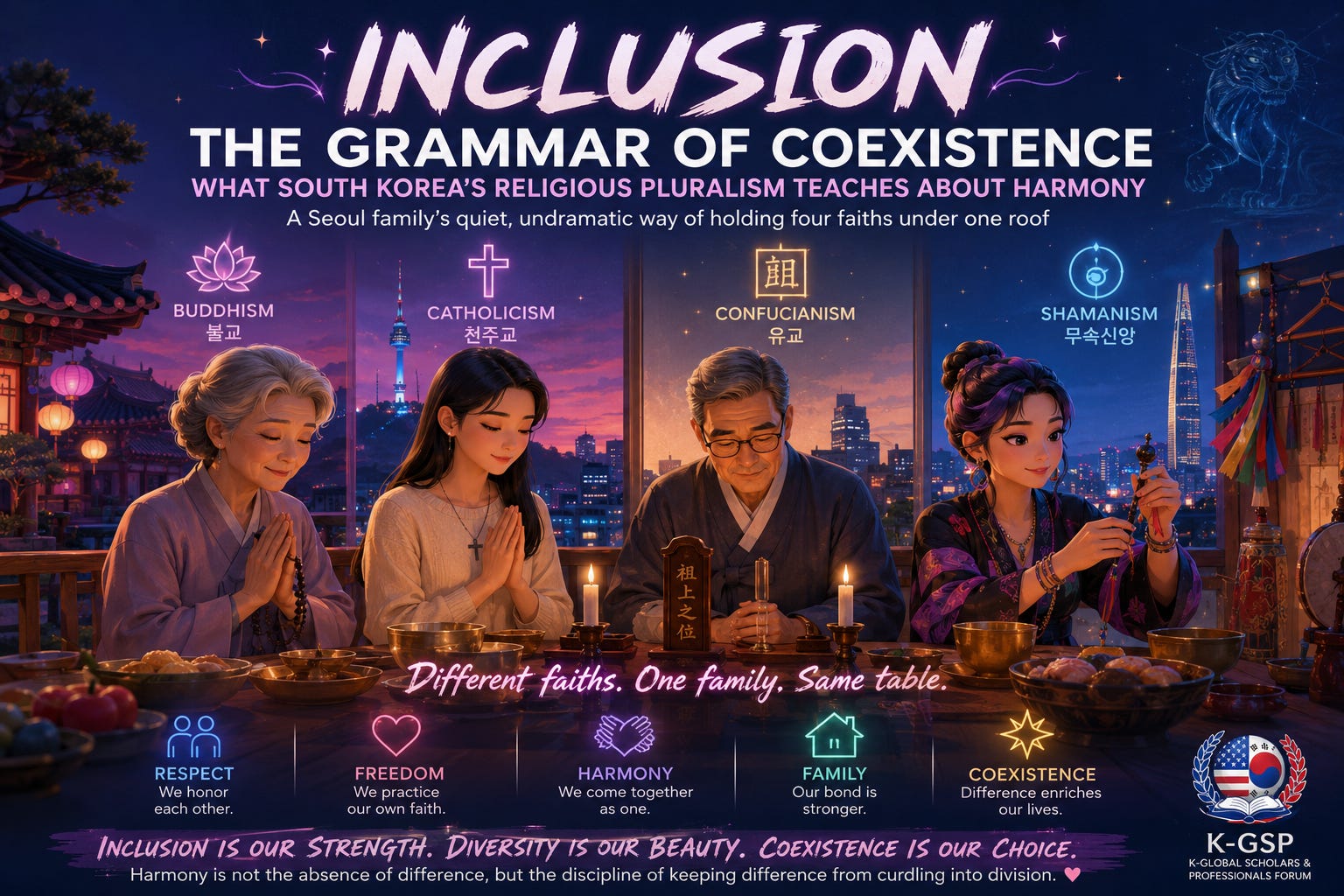
In one Seoul apartment, four people practice four different faiths, and nobody treats it as a crisis. The grandmother visits a Buddhist temple every month her grandson has an exam. Her daughter-in-law hasn’t missed Sunday protestant service in twenty years. The grandfather, Confucian in practice though he’d never claim the label, still bows before the ancestral table each chuseok, a table his Catholic wife sets without complaint. Before the family sold their apartment last year, the grandmother quietly checked the date with a shaman before anyone signed anything.
Nobody in that house calls this contradiction. They call it family.
That’s a more honest picture of Korean religious life than the old image of one syncretic individual holding every tradition at once. What actually happens looks more like a division of spiritual labor. Different family members carry different traditions. None feels obligated to convert the others. All still show up for the same chuseok dinner.
A peninsula that never chose one god.
Korea’s religious landscape has always been layered, not replaced. Shamanism, or musok, predates every imported tradition and never fully receded, not when Buddhism arrived during the Three Kingdoms period, not when Confucianism became state doctrine under Joseon, not when Christianity followed centuries later (Koehler, 2015). Each new arrival absorbed pieces of what came before instead of erasing it. Scholars have traced how Korean Protestantism took on much of shamanism’s emotional register, its emphasis on blessing and this-worldly deliverance, even while officially rejecting the source (Introduction to Religious Conflict and Coexistence, 2020). Today roughly half the country claims no religion at all, and the half that does splits across Buddhism, Protestantism, Catholicism, and homegrown faiths like Cheondogyo (Koehler, 2015). No tradition ever held enough ground to set the terms for the rest. Pluralism here was never a policy choice. It was a demographic fact that religions had to learn to live inside, the same way this family does.
Reconciliation practiced from within.
Long before “interfaith dialogue” became a phrase, Korean thinkers were doing this work inside their own traditions. The 12th-century monk Bojo Jinul refused to let Korean Buddhism split permanently over sudden versus gradual enlightenment, arguing the two were sequential moments of one experience rather than rival camps (Lee, 2020). The 19th-century reformer Suun Choe Je-u went further, founding Donghak on the claim that divinity lives within every person rather than in a distant heaven, deliberately braiding Confucian ethics, Buddhist compassion, and shamanic cosmology into one ethical core (as cited in Religions, 2020). Researchers on Jeju Island found the same instinct alive today. Interviewing shamans, Buddhists, Confucians, and Christians side by side, Yoo (2020) documented communities describing each other as “similar but superior,” a framing that lets each tradition keep its distinctiveness without letting the difference swallow the relationship.
What the household gets right.
That’s the piece the family captures better than any treatise on tolerance. Harmony here doesn’t mean agreement. The daughter-in-law isn’t pretending Mass and shamanism are the same thing. The grandfather isn’t converting anyone at the ancestral table. Theologian Kim Heup Young, writing from his own path out of a Confucian upbringing into Christianity, calls this refusal to let one tradition monopolize the conversation theo-tao, a dialogue meant to sharpen each side rather than dissolve them (Kim, 2026).
For those of us living between an inherited culture and an adopted one, the household is the more usable model. Not one person harmonizing every tradition inside themselves, which asks too much of any single mind. A family instead, letting each member carry a piece, trusting the whole to hold anyway.
Harmony was never the absence of difference. It was the discipline of keeping difference from curdling into division, one Sunday Mass, one ancestral bow, one temple visit at a time.
References
Koehler, R. (2015). Religion in Korea: Harmony and coexistence. Seoul Selection.
Lee, S. (2020). An Aristotelian interpretation of Bojo Jinul and an enhanced moral grounding. Religions, 11(7), 340. https://doi.org/10.3390/rel11070340
Yoo, Y. (2020). Similar but superior: Rhetoric of coexistence employed by religions in Jeju Island, Korea. Religions, 11(7), 340. https://doi.org/10.3390/rel11070340
Introduction to “Religious conflict and coexistence: The Korean context and beyond.” (2020). Religions, 11(7), 340. https://doi.org/10.3390/rel11070340
Kim, H. Y. (2024). 김흡영, 도의 신학 (Theodao), https://ko.wikipedia.org/wiki/%EA%B9%80%ED%9D%A1%EC%98%81
"Sing Along" is the OST music video for BUDDHA HANDS UP: PREQUEL, a short film ahead of the planned feature. Young monk Hyun-jin (Seo Do-jun) has a strange encounter in a sacred space that sparks an unstoppable dance. Hong Yun-hwa (as Sister Maria) and singer Jobin (Norazo) pair her unconventional presence with his signature groove, blurring the line between faith and instinct. Written and directed by Kwak Yong-kun, produced by Soul Crane. Posted April 5, 2026; 19,175 views at time of writing.

Prof. Dr. Jeonghwan (Jerry) Choi (Managing Editor), University of Maine at Presque Isle
Jeonghwan (Jerry) Choi, PhD is an Associate Professor of Business at the University of Maine at Presque Isle and Editor-in-Coordination of K-GSP Forum (contact: jeonghwan.choi at gmail.com). With over 25 years of industry and consulting experience, he specializes in leadership development, human resource management, organizational behavior, and social entrepreneurship. His research focuses on workforce resilience, organizational health, and self-directed leadership — bridging rigorous scholarship with practical insight to cultivate leaders who create meaningful, sustainable, and humane organizations.
© K-Global Schoalrs and Professionals Forum. All rights reserved. Content published in the K-GSP Forum may not be reproduced, distributed, or transmitted in any form without prior written permission from the K-GSP Forum, except for brief quotations with full attribution.