
EXECUTIVE SUMMARY
Hangul, the Korean alphabet created in the fifteenth century, is increasingly recognized as one of the world’s most scientific and accessible writing systems. Its simplicity, phonetic accuracy, digital adaptability, and educational efficiency have led some linguistic communities and language planners to explore its use for literacy development and language preservation. As Korean cultural influence expands globally through media, technology, and education, Hangul’s role is evolving beyond a national script into a potential model for communication, language documentation, and cultural empowerment.
Keywords: Hangul, Literacy, Language Preservation, Korean Wave, Writing Systems
1. Introduction
Hangul occupies a distinctive position among the world’s writing systems because it was intentionally designed to expand literacy. Developed in 1443 under the leadership of King Sejong the Great and promulgated in 1446, Hangul provided ordinary people with a comparatively simple and logical means of representing spoken Korean. Its systematic construction, close relationship between sounds and symbols, and accessibility for learners distinguished it from many writing systems that had evolved gradually over long historical periods.
For centuries, Hangul remained primarily associated with the Korean language, national identity, education, and cultural continuity. In recent decades, however, its international visibility has expanded substantially as interest in Korea has grown through education, trade, migration, digital media, K-pop, films, dramas, and other expressions of Korean culture. Hangul is therefore increasingly encountered not only as the script used to learn Korean, but also as a symbol of Korea’s broader cultural presence and growing global connectivity.
At the same time, interest in Hangul is beginning to extend beyond cultural attraction. Indigenous communities, language revitalization projects, educators, and linguistic researchers have explored its potential relevance for literacy development, documentation of under-recorded languages, digital communication, and preservation of endangered linguistic traditions. These developments suggest that Hangul’s global significance may depend on the interaction of several reinforcing characteristics: scientific design, learning accessibility, digital compatibility, expanding cultural visibility, and its possible usefulness in practical linguistic applications.
This article therefore asks: Why is global interest in Hangul growing, and under what conditions might that interest develop from cultural curiosity into practical linguistic application? Figure 1 summarizes the article’s central logic by tracing the progression from scientific design → learning accessibility → digital compatibility → global cultural visibility → global applications. The resulting applications may take several forms, including language learning, literacy and documentation, and language preservation, providing the conceptual foundation for the sections that follow.
2. Why Hangul Attracts Global Interest
The growing international interest in Hangul reflects three interconnected strengths—its scientific and phonetic design, accessibility for learning and language preservation, and compatibility with digital communication and Korea’s expanding soft power—which together attract diverse audiences ranging from language learners and educators to researchers, cultural communities, and literacy-oriented institutions, thereby reinforcing Hangul’s expanding relevance as both a Korean writing system and a potential global linguistic resource.
2.1 Scientific Design and Phonetic Precision
One of Hangul’s most distinctive characteristics is its intentionally systematic design. Its consonant symbols were developed to reflect aspects of the speech organs involved in pronunciation, while its vowels follow simple and consistent organizing principles, creating a close relationship between visual form and spoken sound. This structure gives Hangul a comparatively transparent sound-symbol system and distinguishes it from writing systems that developed gradually through long historical processes (Kim-Renaud, 1997, 2000; King, 1996; Lee & Ramsey, 2011).
This phonetic orientation also supports precise representation of spoken sounds and allows learners to recognize recurring patterns and connect letters with pronunciation relatively directly. Such characteristics are particularly relevant for language learning and documentation because a practical writing system must represent meaningful sound distinctions while remaining accessible to ordinary users (Coulmas, 2003; Sampson, 1985; Sohn, 1999). Hangul’s significance, however, should not be interpreted as universal superiority over other writing systems; its value lies in demonstrating how scientific design, phonetic precision, logical organization, and practical usability can be combined in ways that merit broader international attention.
2.2 Learning Accessibility and Language Preservation
A second source of global interest is Hangul’s relative accessibility for learners, supported by its limited number of basic symbols, regular combinations, and close sound-symbol correspondence, which can lower initial barriers to literacy and facilitate early reading development (Kim-Renaud, 1997, 2000; Sohn, 1999; Song, 2005). This accessibility is especially significant when considered in relation to language documentation and preservation. Minority and indigenous languages that remain primarily oral, lack standardized orthographies, or face declining intergenerational transmission may benefit from adaptable phonetic systems for recording oral histories, producing educational materials, and documenting vocabulary and pronunciation (Coulmas, 2003; Sampson, 1985). At the same time, any use of Hangul should respect identity, cultural memory, and community ownership by supporting locally defined literacy and preservation goals without displacing established scripts or traditions.
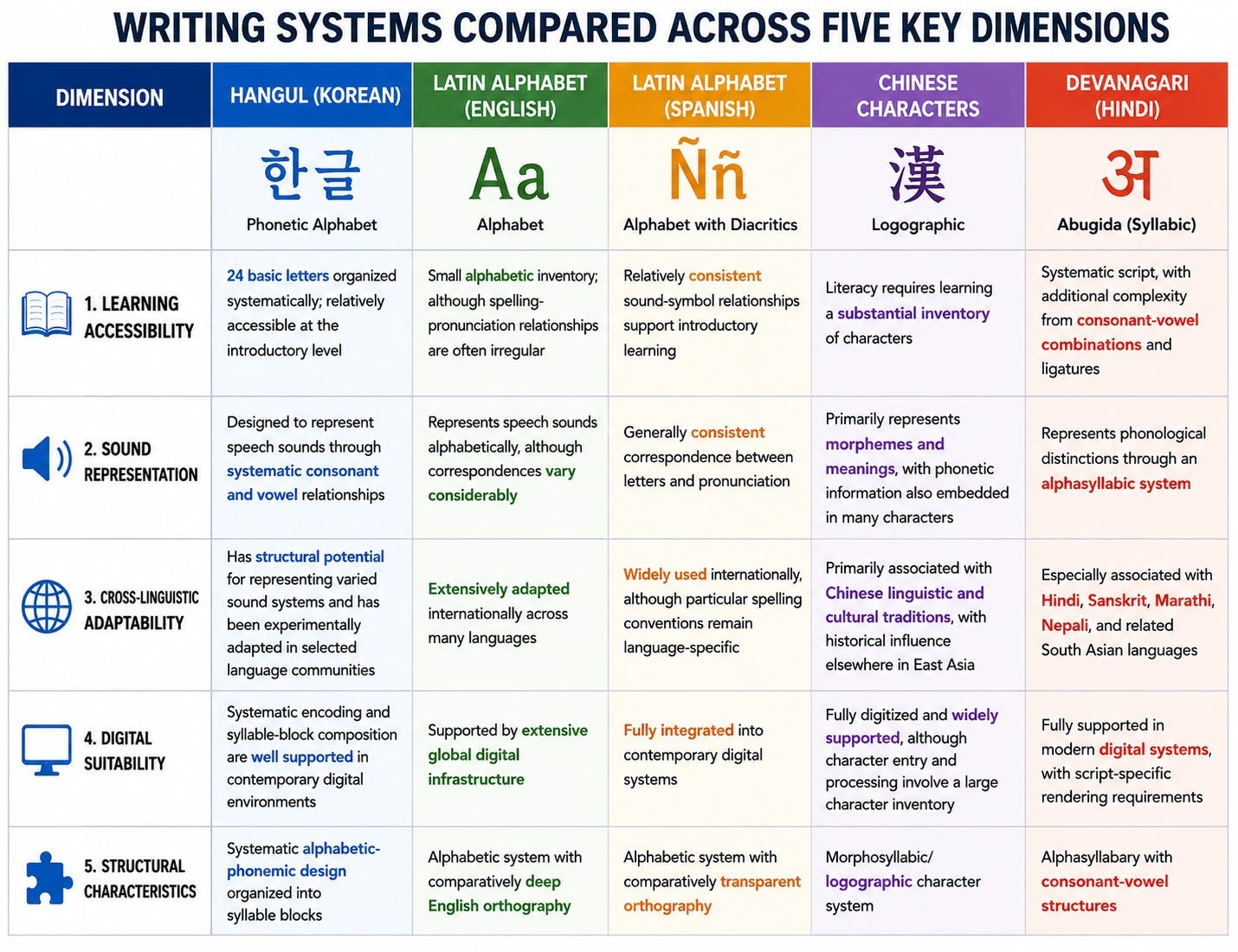
Table 1. Hangul and Selected Writing-System Traditions: Comparative Characteristics
Source: Authors’ comparative synthesis based on Coulmas (2003), Kim-Renaud (1997, 2000), King (1996), Lee and Ramsey (2011), Sampson (1985), and Sohn (1999).
Note: The comparisons in Table 1 are descriptive rather than hierarchical evaluations. Characteristics such as accessibility, sound representation, adaptability, and digital suitability depend partly on the language being represented, educational context, user population, and purpose of use. The table therefore does not imply that Hangul is universally superior to, or should replace, established writing systems.
Table 1 compares Hangul with selected writing-system traditions—Latin alphabet conventions in English and Spanish, Chinese characters, and Devanagari as used for Hindi—across learning accessibility, sound representation, cross-linguistic adaptability, digital suitability, and structural characteristics. The comparison emphasizes structural differences rather than assigning universal rankings, since the effectiveness of any writing system depends on the language, historical context, community practices, and purpose for which it is used. Hangul is distinctive for its systematic design, relatively transparent relationship between symbols and speech sounds, syllable-block organization, and adaptability to contemporary digital environments, while the other systems possess their own important linguistic, historical, and cultural strengths. Accordingly, Hangul is presented here not as a universally superior or replacement script, but as an intentionally designed writing system whose characteristics may offer useful possibilities for language learning, documentation, and locally chosen linguistic experimentation.
2.3 Digital Compatibility and Korean Soft Power
A third source of global interest is Hangul’s compatibility with contemporary digital communication, as it functions efficiently across computers, smartphones, search systems, social media, online education, and other networked platforms. This digital readiness strengthens Hangul’s international accessibility and connects its linguistic structure with broader patterns of technological modernization and global communication. At the same time, the rapid expansion of Korean cultural visibility through K-pop, dramas, films, gaming, education, tourism, and international business exposes global audiences to Korean words and written expressions, allowing Korean soft power to convert cultural attraction into educational and linguistic engagement (Nye, 2004; Choy & Hong, 2026). The interaction of digital compatibility and cultural visibility therefore helps explain why Hangul increasingly symbolizes not only Korean language and identity, but also creativity, modernity, resilience, and global connectivity (Hong & Hyun, 2025).
Hangul’s scientific design, learning accessibility, and digital compatibility are expanding its relevance beyond Korea.
3. Where Is Global Interest Emerging?
Global interest in Hangul is not concentrated in one region, nor does it arise from a single motivation. In some countries, interest is primarily connected to Korean language learning, employment, trade, and popular culture; in others, Hangul attracts attention because of its phonetic characteristics, educational accessibility, or possible usefulness for documenting languages that lack standardized writing systems. This diversity can be understood by distinguishing cultural, educational, economic, and language-preservation motivations across countries and organizations.
3.1 Asia and Central Asia
Asia and Central Asia provide some of the clearest examples of international engagement with Hangul, although the forms and motivations of that engagement vary substantially across countries and communities. The Cia-Cia community of Baubau, Indonesia, offers the best documented case of experimental adaptation of Hangul to a non-Korean language, showing both its possible usefulness for minority-language documentation and preservation and the importance of local acceptance, education, and community use for long-term viability, while also cautioning against describing Hangul as a formal replacement for Indonesia’s established writing system (Cho, 2012; Song, 2013). Mongolia and Uzbekistan illustrate a different pattern in which interest in Hangul is linked primarily to Korean-language education, employment, tourism, cultural exchange, and expanding institutional ties with Korea, as reflected in Mongolia’s early connection to the King Sejong Institute network and Uzbekistan’s rapid growth in Korean-language learning and related educational participation (King Sejong Institute Foundation, 2025). Taken together, these cases show that the regional pattern is not a single movement toward adopting Hangul as a local script, but a set of diverse pathways through which linguistic need, cultural attraction, educational opportunity, and relationships with Korea expand interest in Hangul.
3.2 North America and Europe
In North America and Europe, interest in Hangul has grown primarily within countries that already possess established writing systems and high literacy levels, making replacement of existing scripts neither necessary nor likely. The principal drivers are Korean-language education, university-based Korean studies, diaspora communities, cultural consumption, academic research, and expanding economic and technological relationships with Korea, within a broader global increase in Korean-language learning. This pattern highlights an important distinction between learning Hangul and adopting Hangul, since countries such as the United States, Canada, the United Kingdom, France, and Germany engage with Hangul mainly through language study, culture, education, business, and international exchange. Cultural visibility and institutional support can therefore sustain substantial and continuing interest in Hangul without creating a functional need or policy rationale for replacing established local writing systems.
3.3 International Institutions and Language Communities
A third area of interest extends beyond individual nations to international organizations, minority-language communities, indigenous groups, and language-preservation initiatives, where attention shifts from cultural learning toward literacy, documentation, multilingualism, and language survival. Communities lacking standardized orthographies or facing declining intergenerational transmission may find Hangul’s phonetic structure, learnability, and digital compatibility useful for recording speech, developing educational materials, and preserving linguistic heritage, although neither UNESCO nor the United Nations officially promotes Hangul as a universal or global writing system (Brouillette, 2019; Limage, 1999). Major Korean Studies institutions in the United States, Canada, the United Kingdom, and South Korea—including leading centers at Harvard, USC, Columbia, George Washington University, the University of Michigan, SOAS, the University of British Columbia, The Ohio State University, the University of Hawai’i at Mānoa, and the Academy of Korean Studies—provide durable infrastructure for language education, scholarship, academic exchange, and public engagement. Collectively, these organizations and institutions suggest that Hangul’s international significance lies not in replacing established scripts, but in supporting locally defined linguistic needs while sustaining broader educational, cultural, and scholarly engagement with Korea.
4. A 2×2 Framework for Understanding Global Interest
The international diffusion of Hangul reflects more than cultural popularity, as some countries and communities are drawn by Korean culture, education, business, and media while others recognize potential value in its phonetic structure for literacy, documentation, and language preservation; a 2×2 framework distinguishes these motivations by combining cultural and educational interest in Korea with functional linguistic need; this framework clarifies where engagement is likely to remain primarily cultural, where practical applications may emerge, and where future opportunities may develop. Countries and communities differ substantially in their functional need for Hangul and their cultural and educational interest in Korea, and the interaction of these two dimensions helps explain varying patterns of global engagement.
4.1 Four Patterns of Global Engagement
Integrated Engagement represents settings in which strong functional linguistic needs coincide with substantial cultural and educational engagement with Korea. Countries or communities in this group have practical reasons to explore Hangul and sufficient familiarity with Korea to support experimentation, learning, and possible adaptation. The Cia-Cia community in Indonesia is the clearest example because Hangul has been explored in connection with language documentation and preservation, while Mongolia, Uzbekistan, and Kazakhstan illustrate broader combinations of educational cooperation, language learning, and cultural engagement. This pattern provides the most favorable conditions for sustained practical use because linguistic need and cultural openness reinforce each other.
Cultural Engagement is characterized by high cultural and educational interest in Korea but relatively low functional need for an alternative writing system. Countries such as the United States, France, Germany, Thailand, Vietnam, and Japan already possess established writing systems, so their engagement with Hangul is driven primarily by Korean-language education, K-pop, K-drama, tourism, business, academic exchange, and other dimensions of Korean soft power. In these settings, Hangul functions mainly as a gateway to Korean language and culture rather than as a practical replacement for existing scripts. This pattern is likely to remain an important source of international Hangul learners and cultural engagement.
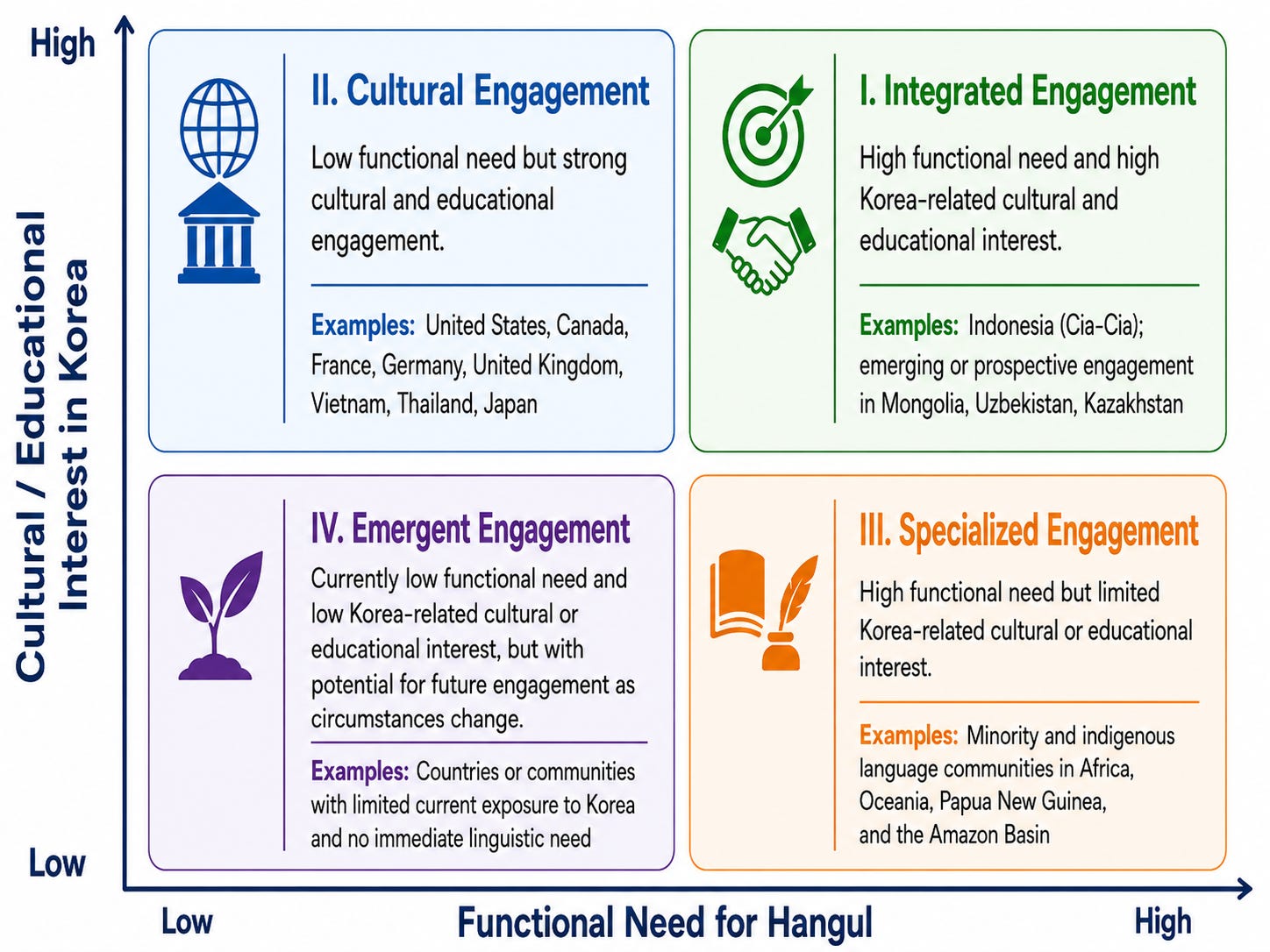
Figure 2. Global Engagement with Hangul: A 2×2 Classification Framework
Source: Authors’ Compilation
Figure 2 identifies four analytical patterns—Integrated Engagement, Cultural Engagement, Specialized Engagement, and Emergent Engagement—based on different combinations of functional linguistic need and Korea-related cultural and educational interest. These patterns are dynamic rather than permanent, as cultural exposure, educational relationships, linguistic needs, and institutional conditions may shift over time.
Specialized Engagement includes communities with meaningful functional needs but comparatively limited cultural or educational engagement with Korea. These may include minority or indigenous-language communities facing challenges such as weak orthographic standardization, language endangerment, limited literacy resources, or insufficient documentation. Indigenous-language communities in parts of Africa, Oceania, Papua New Guinea, the Pacific Islands, and other regions illustrate settings in which Hangul’s phonetic structure could potentially offer practical value. The emphasis here is on future possibility and community-defined need, especially where accessible tools are sought for documenting and preserving local languages.
Emergent Engagement describes settings in which both functional need for Hangul and cultural or educational interest in Korea remain relatively low. Countries in this group generally possess established linguistic infrastructures and have comparatively limited educational, cultural, or institutional interaction with Korea. Under these conditions, interest in Hangul is likely to remain modest. Movement toward greater engagement would depend on changes such as stronger Korean cultural visibility, expanded educational or economic relationships, or the emergence of new linguistic needs.
4.2 From Cultural Interest to Sustainable Application
The framework suggests that the future international role of Hangul will depend on how different forms of engagement develop from the interaction between functional linguistic need and Korea-related cultural and educational interest. Cultural visibility can create awareness and initial curiosity, while practical linguistic needs may create opportunities for literacy, documentation, language learning, and preservation. The four engagement patterns—Integrated Engagement, Cultural Engagement, Specialized Engagement, and Emergent Engagement—therefore provide different pathways through which interest in Hangul may develop into more sustained forms of international application.
Proposition 1. Integrated Engagement. Sustained engagement with Hangul is most likely when functional linguistic needs and Korea-related cultural or educational interest are both strong.
Integrated Engagement reflects situations in which practical linguistic need and substantial familiarity with Korea reinforce one another. Communities are more likely to experiment with, adapt, and sustain the use of Hangul when they have both a functional reason to consider the script and sufficient educational, cultural, or institutional relationships to support learning and implementation. The Cia-Cia experience in Indonesia provides the clearest illustration, while Mongolia, Uzbekistan, and Kazakhstan represent emerging or prospective forms of such engagement.
Proposition 2. Cultural Engagement. Strong Korea-related cultural and educational interest can sustain substantial engagement with Hangul even when functional need for an alternative local writing system remains limited.
Cultural Engagement emphasizes the role of Korean language education, K-culture, academic exchange, tourism, business, and other dimensions of Korean soft power in generating international interest in Hangul. In countries such as the United States, Canada, France, Germany, the United Kingdom, Vietnam, Thailand, and Japan, Hangul primarily functions as a gateway to Korean language and culture rather than as a substitute for established writing systems. Cultural visibility can therefore produce meaningful and durable engagement without necessarily resulting in local script adoption.
Proposition 3. Specialized Engagement. Hangul may have particular value where functional linguistic needs are strong even when Korea-related cultural and educational interest remains comparatively limited.
Specialized Engagement focuses on communities facing specific needs in literacy development, language documentation, orthographic development, or language preservation. In these settings, Hangul may be evaluated primarily for its phonetic structure, learning accessibility, and digital compatibility rather than because of broader cultural interest in Korea. Minority and indigenous-language communities may therefore represent settings in which the practical characteristics of Hangul become more important than Korean soft power itself.
Proposition 4. Emergent Engagement. Engagement with Hangul may develop over time even where both current functional need and Korea-related cultural or educational interest remain relatively low.
Emergent Engagement highlights the dynamic nature of international interest in Hangul. Countries or communities with limited present engagement may move toward stronger forms of involvement as Korean cultural visibility expands, educational and economic relationships deepen, digital access increases, or new linguistic needs emerge. This pattern suggests that the international position of Hangul should be viewed as evolving rather than fixed, with changing circumstances potentially creating new pathways toward cultural, specialized, or integrated engagement.
Hangul’s global future lies where Korean cultural interest connects with practical needs for language learning, literacy, documentation, and preservation.
5. Conclusion
Hangul began as a practical Korean solution for expanding literacy, but its scientific design, phonetic precision, learning accessibility, and digital compatibility have increasingly extended its relevance beyond Korea. Korea’s growing cultural influence has further expanded global awareness of Hangul, while educational, linguistic, and language-preservation needs have created additional pathways for more substantive engagement. Its future international contribution appears especially promising where cultural interest intersects with locally defined needs for language learning, literacy, documentation, and preservation. In this sense, Hangul’s broader significance lies not in replacing established writing systems, but in demonstrating how an intentionally designed script can serve as an accessible, adaptable, and practical linguistic resource in an increasingly connected world.
References
Brouillette, S. (2019). UNESCO and the fate of the literary. Stanford University Press.
Cho, T.-Y. (2012). Cia-Cia language: From the era of oral to the era of writing. Humaniora, 24(3), 324–332. https://doi.org/10.22146/jh.1374
Choy, B. G., & Hong, P. (2026). Soft power of South Korea in the digital age: Reimagining K-pop, K-movies, and cultural diplomacy through AI-enabled diffusion. In S. Kang, W. Heo, W. H. Lee, J. Lee, & Y. B. Choi (Eds.), Korean studies in the artificial intelligence era: Volume 2: Adoption insights in hospitality, culture, communication, music, and philosophy (pp. 178–209). CRC Press.
Coulmas, F. (2003). Writing systems: An introduction to their linguistic analysis. Cambridge University Press.
Hong, P. C., & Hyun, Y. R. (2025). Impact of diverse orientations in human emergency responses: Illustrations of Korean national experiences in modern history. In K. A. Thomas & J. V. Kureethara (Eds.), Education and pedagogical experiences: Coping with human emergencies and exploring resilience strategies (pp. 277–301). Routledge India.
Kim-Renaud, Y.-K. (Ed.). (1997). The Korean alphabet: Its history and structure. University of Hawai’i Press.
Kim-Renaud, Y.-K. (2000). Sejong’s theory of literacy and writing. Studies in the Linguistic Sciences, 30(1), 13–46.
King, R. (1996). Korean writing. In P. T. Daniels & W. Bright (Eds.), The world’s writing systems (pp. 218–227). Oxford University Press.
King Sejong Institute Foundation. (2025, June 30). KSIF designates 11 new KSIs in 9 countries for 2025. https://www.ksif.or.kr/cop/bbs/selectBoardArticle.do?nttId=9220000007293&bbsId=BBSMSTR_000000000141
Lee, K.-M., & Ramsey, S. R. (2011). A history of the Korean language. Cambridge University Press.
Limage, L. J. (1999). Literacy practices and literacy policies: Where has UNESCO been and where might it be going? International Journal of Educational Development, 19(1), 75–89.
Nye, J. S., Jr. (2004). Soft power: The means to success in world politics. PublicAffairs.
Sampson, G. (1985). Writing systems: A linguistic introduction. Stanford University Press.
Sohn, H.-M. (1999). The Korean language. Cambridge University Press.
Song, J. J. (2005). The Korean language: Structure, use and context. Routledge.
Song, S.-W. (2013). Being Korean in Buton? The Cia-Cia’s adoption of the Korean alphabet and identity politics in decentralised Indonesia. KEMANUSIAAN: The Asian Journal of Humanities, 20(1), 51–80.
ABOUT THE AUTHORS

Distinguished Professor, Dr. Paul Hong (Editor in Chief) — University of Toledo
Paul C. Hong is Distinguished University Professor at the University of Toledo. Drawing on more than four decades of leadership and missional service and three decades of scholarship in leadership and supply chain management, his research examines how individuals, organizations, and societies develop the capabilities necessary for resilience, adaptation, and long-term impact. His recent work integrates history, management, philosophy, and faith-based narratives to explore leadership formation through the development of identity and purpose, interests and priorities, insight and perspective, integrity and principles, and influence through stewardship—qualities that remain essential in the age of artificial intelligence.

Peter C. Park — Environmental Engineer, City of Toledo
Peter C. Park is an Environmental Engineer with more than 25 years of experience serving the City of Toledo and holds graduate degrees in Chemical Engineering and Occupational Health from the University of Toledo. He is currently pursuing certification as a Korean language instructor and has a strong interest in expanding access to Korean language and culture for both heritage learners and non-Korean speakers.
© K-Global Scholars and Professionals Forum. August 2026. All rights reserved.
Original Article:

Suggested Citation
Hong, P. C., & Park, P. C. (2026, August 18). The growing global interest in Hangul: Why nations and communities are exploring the Korean writing system. K-GSP Forum, pp. 1–12.
한글요약
한글의 세계적 관심 확대
Paul C. Hong: 톨레도대학교 석좌교수로서 글로벌 공급망, 혁신, 회복탄력성 및 한국의 글로벌 문화·기술 확산을 연구하고 있다.
Peter C. Park: 톨레도시 환경엔지니어로서 한국어 교원 자격을 준비하며 한국어와 한국문화의 교육 및 확산에 관심을 갖고 있다.
한글은 15세기 세종대왕의 주도 아래 백성들의 문해력 향상을 목적으로 창제된 문자이지만, 오늘날에는 한국의 국가 문자를 넘어 세계적 관심을 받는 언어 자원으로 확장되고 있다. 한글의 체계적인 자음과 모음 구조, 높은 음성 표기 능력, 비교적 쉬운 학습 접근성, 디지털 환경에서의 효율성은 다른 문자 체계와 구별되는 중요한 특징이다. 특히 한글은 과학적 설계와 실용성을 동시에 갖춘 문자라는 점에서 언어 학습뿐 아니라 문해 교육, 언어 기록, 소수언어 및 위기언어 보존과 같은 다양한 가능성을 보여 준다. 이러한 세계적 관심은 한글 자체의 구조적 장점뿐 아니라 스마트폰, 컴퓨터, 검색, 소셜미디어, 온라인 교육과 같은 디지털 환경의 확산, 그리고 K-pop, 한국 드라마, 영화, 게임, 관광, 교육, 비즈니스 등 한국의 소프트파워 확대와도 밀접하게 연결되어 있다.
지역별로 보면 한글에 대한 관심의 성격은 매우 다양하다. 인도네시아의 찌아찌아 공동체는 한글을 지역 언어 기록과 보존의 가능성과 연결해 왔으며, 베트남과 태국에서는 한국어 학습, 취업, 무역, 관광, 문화적 관심이 주요 동기가 되고 있다. 몽골, 우즈베키스탄, 카자흐스탄에서는 교육 교류, 노동 이동, 경제 협력, 디아스포라 및 외교 관계가 한글 학습과 관심을 촉진하는 반면, 미국, 캐나다, 프랑스, 독일, 영국 등에서는 기존 문자 체계를 대체하려는 필요보다 한국어 교육, 대학의 한국학 프로그램, 문화 소비, 학술 교류, 비즈니스 관계가 중심적 역할을 한다. 이러한 차이는 한글의 세계적 확산이 하나의 동일한 경로를 따르는 것이 아니라 각 지역의 문화적 관심, 교육적 기반, 경제적 관계, 그리고 실제 언어적 필요에 따라 서로 다른 형태로 나타남을 보여 준다.
이 논문은 이러한 차이를 설명하기 위해 한글의 기능적 필요성과 한국에 대한 문화·교육적 관심이라는 두 차원의 2×2 개념 틀을 제시하고, 국가와 공동체를 통합적 참여, 문화적 참여, 전문적 참여, 초기적 참여로 구분한다. 이 틀은 한글에 대한 관심이 단순한 한류 현상이 아니라 문화적 매력과 실제 언어적 필요가 서로 다른 방식으로 결합하는 현상임을 보여 준다. 따라서 한글의 세계화는 다른 문자 체계를 대체하는 방향으로 이해되어서는 안 되며, 특히 소수언어와 위기언어 공동체에서는 외부에서 강요되는 대체 문자가 아니라 지역 공동체가 스스로 필요성을 인정하고 선택할 수 있는 보조적 언어 자원으로 접근되어야 한다. 이러한 관점에서 한글의 장기적 국제적 가치는 한국 문화에 대한 관심이 문해 교육, 언어 학습, 기록, 보존과 같은 실제 필요와 결합하고, 과학적 설계, 교육적 접근성, 디지털 적응성, 지역 공동체의 자율적 활용 가능성이 함께 작동할 때 더욱 커질 수 있다.