

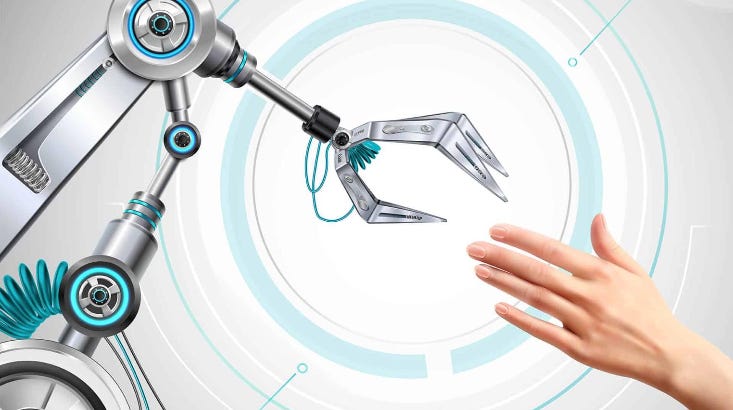
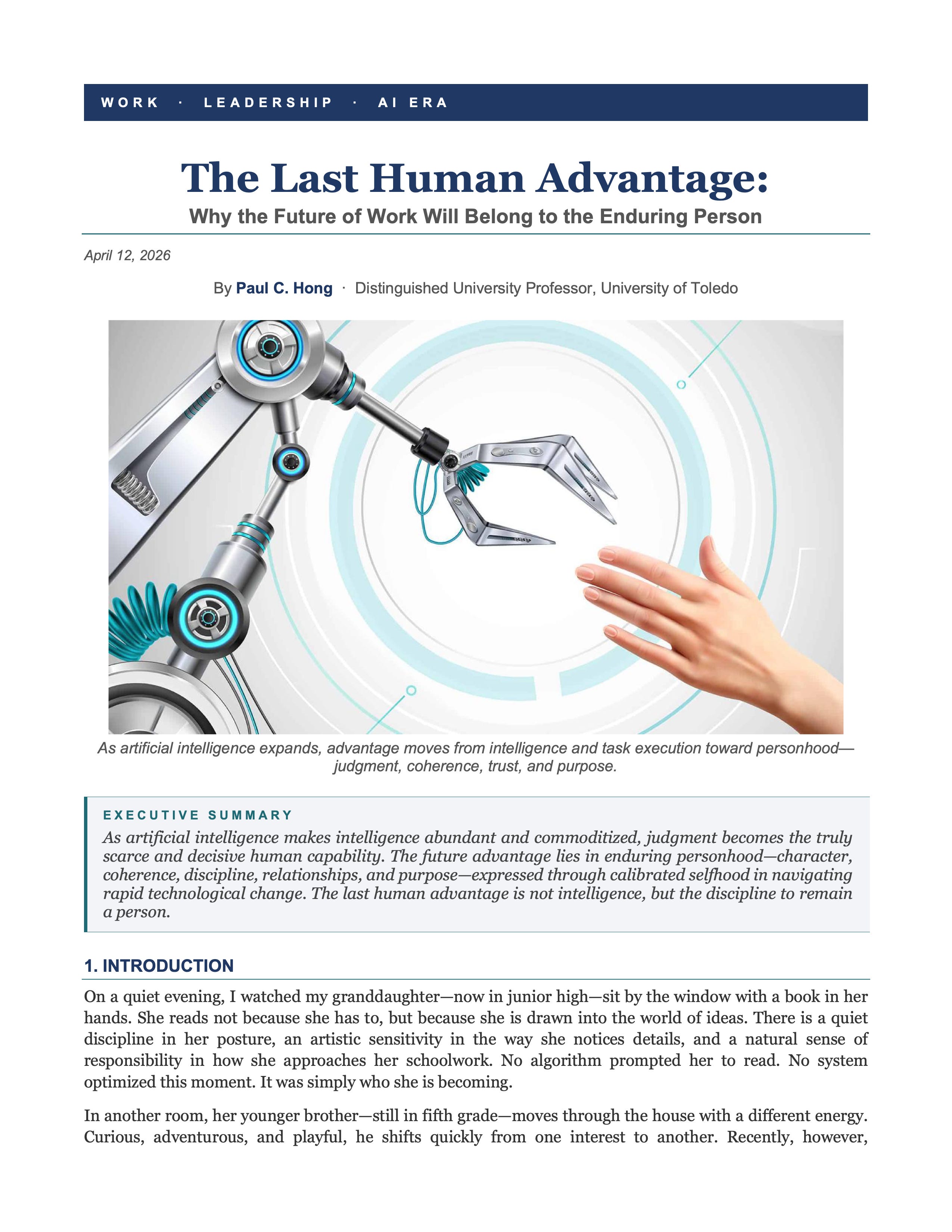
As artificial intelligence expands, advantage moves from intelligence and task execution toward personhood— judgment, coherence, trust, and purpose
Executive Summary
As artificial intelligence makes intelligence abundant and commoditized, judgment becomes the truly scarce and decisive human capability. The future advantage lies in enduring personhood — character, coherence, discipline, relationships, and purpose — expressed through calibrated selfhood in navigating rapid technological change. The last human advantage is not intelligence, but the discipline to remain a person.
1. Introduction
On a quiet evening, I watched my granddaughter — now in junior high — sit by the window with a book in her hands. She reads not because she has to, but because she is drawn into the world of ideas. There is a quiet discipline in her posture, an artistic sensitivity in the way she notices details, and a natural sense of responsibility in how she approaches her schoolwork. No algorithm prompted her to read. No system optimized this moment. It was simply who she is becoming.
In another room, her younger brother — still in fifth grade — moves through the house with a different energy. Curious, adventurous, and playful, he shifts quickly from one interest to another. Recently, however, something has begun to take root: a fascination with history — ancient civilizations, wars, the rise and fall of nations. He asks questions that are not assigned, not graded, and not guided by any digital recommendation. They come from within.
A few days ago, he had taken one of my copies of The Economist and began flipping through its pages. At first it seemed casual — images, headlines, fragments of unfamiliar language. But then he paused and began to read more carefully, asking what certain words meant, why countries act as they do, and how events are connected. It was not comprehension that mattered in that moment. It was the beginning of orientation — the shaping of attention toward the world.
Individually, these moments are ordinary. Taken together, they reveal something increasingly rare in the age of artificial intelligence: the slow formation of personhood.
For most of modern history, work has been organized around the accumulation of skill. Education systems trained the mind, organizations rewarded expertise, and careers advanced through the steady expansion of capability. Intelligence — analytical, technical, and managerial — served as the primary currency of progress. That foundation is now being quietly transformed.
As artificial intelligence advances, systems can generate code, draft strategy, diagnose disease, and simulate judgment with increasing speed and accuracy. Intelligence is becoming abundant — embedded in tools, platforms, and workflows — and increasingly commoditized. As it becomes widely accessible, it loses its power as a differentiator. What distinguishes individuals is no longer what they know, but how they decide.
This article argues that in the age of artificial intelligence, enduring advantage will depend not primarily on what individuals or organizations can do, but on who they are becoming. Character, coherence, and purpose will define the capacity to exercise judgment under uncertainty, maintain direction amid rapid change, and engage meaningfully with increasingly powerful technological systems.
2. The Quiet Formation of Personhood in the Age of AI
This shift becomes most visible not in abstract theory, but in everyday patterns of learning and performance. It is in these small but telling moments that the gap between output and understanding begins to emerge.
2.1 The Performance–Formation Gap
In recent semesters, a growing number of college students have demonstrated the ability to produce polished written reports — well-structured, grammatically precise, and analytically sound. Yet when asked to explain their reasoning or defend their conclusions, many struggle to articulate how they arrived at their answers. The output appears complete, but the underlying process remains opaque.
This pattern illustrates a critical distinction for the AI era: the difference between performance and formation. Performance can be enhanced, accelerated, and even replicated by intelligent systems. Formation, however, requires time, reflection, and internal engagement. It is through this process that individuals develop the capacity to explain, to justify, and ultimately to take responsibility for their decisions. Without such formation, individuals may appear capable in output, yet remain limited in judgment.
2.2 When Intelligence Becomes Abundant: From Doing to Deciding
Surveys of executives indicate increasing reliance on AI-generated recommendations in decision processes — particularly in forecasting, hiring, and strategic planning.¹ At the same time, these studies report growing concern about overdependence and the erosion of human judgment under conditions of uncertainty. This emerging tension signals a deeper shift in the nature of human contribution.
As intelligence becomes abundant, it loses its power as a differentiator. What remains scarce is judgment. The future of work is no longer centered on execution alone, but on the capacity to make decisions under uncertainty, interpret meaning within broader contexts, and assume responsibility for outcomes. As AI systems increasingly absorb analysis and execution, human roles move upward — from task completion to judgment, from information processing to meaning interpretation, and from output production to accountability.
Personhood, in this sense, becomes operational. The qualities formed quietly over time — attention, curiosity, discipline, and moral awareness — become the foundation for navigating a world where intelligence is ubiquitous, but judgment remains profoundly human.
“In a world where machines can generate answers, the enduring question will be who we trust to ask the right ones.”
3. The Five Dimensions of Enduring Personhood
To understand this emerging form of human advantage, it is necessary to examine the specific dimensions through which personhood is formed and sustained. These dimensions do not operate in isolation, but collectively define the conditions for coherence in the AI era.
3.1 The Emerging Divide: Fragmentation vs. Coherence
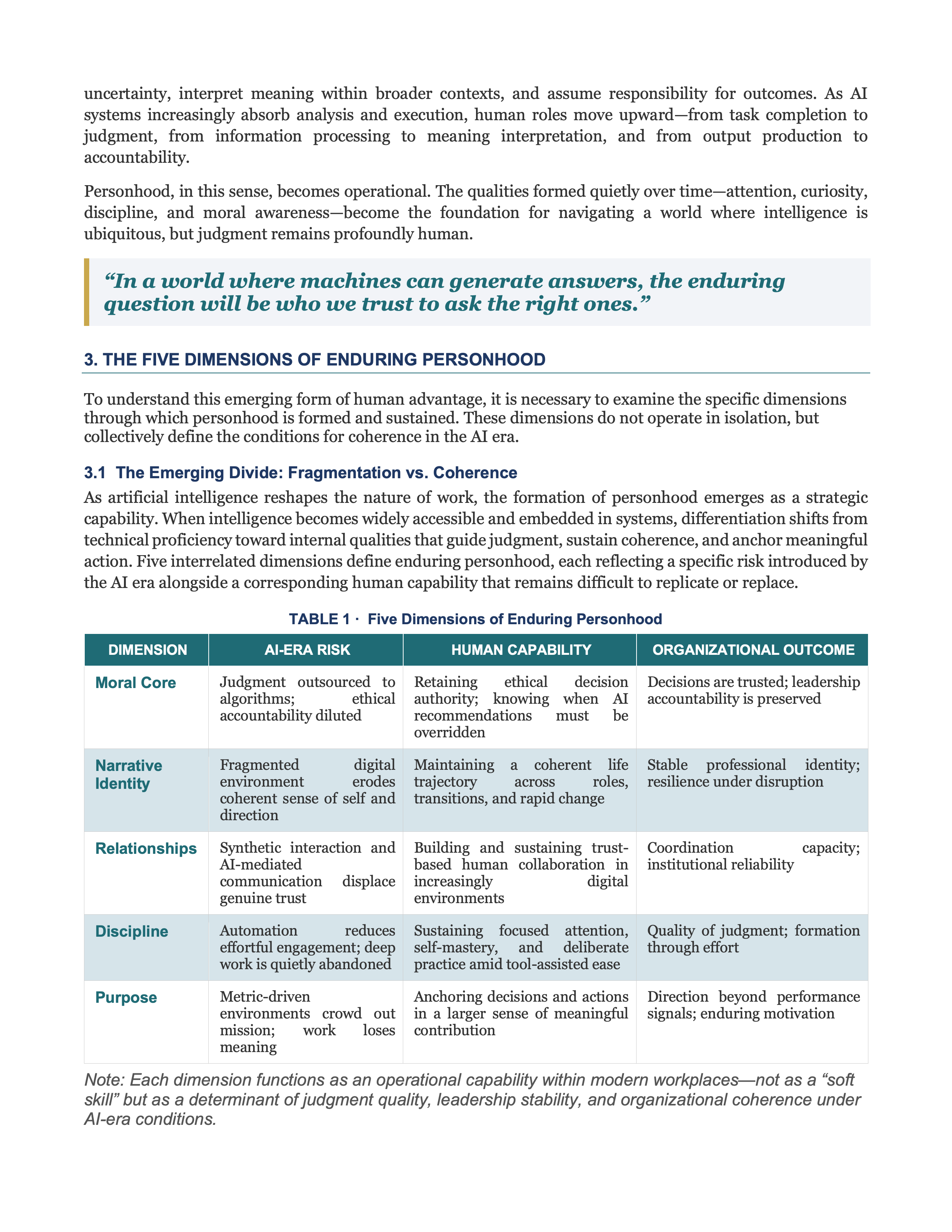
As artificial intelligence reshapes the nature of work, the formation of personhood emerges as a strategic capability. When intelligence becomes widely accessible and embedded in systems, differentiation shifts from technical proficiency toward internal qualities that guide judgment, sustain coherence, and anchor meaningful action. Five interrelated dimensions define enduring personhood, each reflecting a specific risk introduced by the AI era alongside a corresponding human capability that remains difficult to replicate or replace.
Table 1 · Five Dimensions of Enduring Personhood
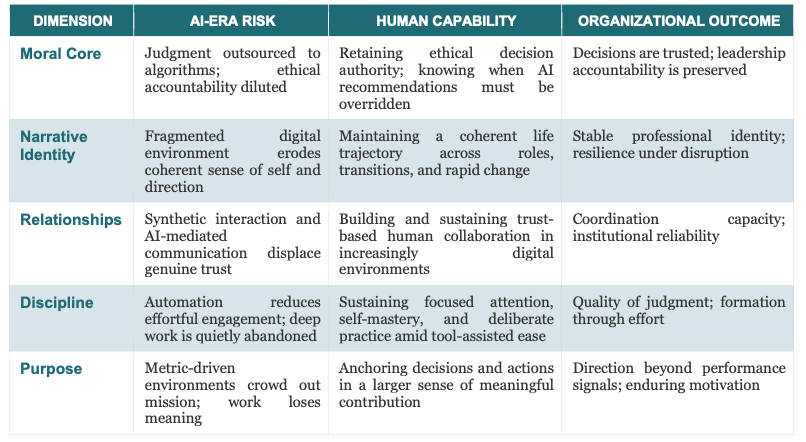
Note: Each dimension functions as an operational capability within modern workplaces — not as a "soft skill" but as a determinant of judgment quality, leadership stability, and organizational coherence under AI-era conditions.
These are not “soft” qualities. They directly shape whether decisions are trusted, whether leadership remains stable, and whether organizations sustain coherence under pressure. In this sense, they function as operational capabilities within modern workplaces.
The presence or absence of these dimensions creates a new divide — not defined by education or technical skill, but by the degree of internal coherence individuals are able to sustain. On one side are those who rely excessively on AI outputs, drift across roles without integrating their experiences, and optimize for short-term performance metrics. On the other are those who use AI as a tool rather than a substitute for thinking, integrate their experiences into a meaningful trajectory, and anchor their actions in a larger sense of purpose.
3.2 Calibrated Selfhood and Organizational Implications
The pressures of rapid technological change do not operate only at the system level; they increasingly shape individual behavior and decision-making. In leadership contexts, instability appears as oscillation — overreaction, premature commitment, and strategic drift. These same patterns now emerge at the level of individual work: chasing every new tool, overdependence on automated systems, and a gradual loss of identity coherence.
What is required is not resistance to technology but the development of calibrated selfhood. Calibrated individuals know when to rely on AI and when to step back. They maintain internal stability amid external acceleration and regulate their attention, judgment, and response. This capacity for self-regulation becomes essential in environments where external systems are increasingly powerful but internally neutral.
Organizations are increasingly systems of human coherence, not just processes and technologies. Failures in modern organizations rarely stem from a lack of data; they arise from misaligned judgment, broken trust, and the inability to coordinate meaning across functions. The individual becomes a micro-nexus — a point where values, decisions, relationships, and actions must align. When this alignment holds, coordination becomes possible. When it breaks down, even the most advanced systems fail.
3.3 Timeless Illustrations of Enduring Personhood
The five dimensions are not new constructs. They reflect patterns of human formation explored across centuries of literature. In Pride and Prejudice, Elizabeth Bennet’s development reflects the importance of moral core and narrative identity — the capacity to revise one’s understanding through disciplined self-examination. In The Old Man and the Sea, Santiago embodies discipline and purpose under apparent failure: outcomes may be uncertain, but the quality of action, rooted in self-mastery, remains within human control. In Les Misérables, Jean Valjean’s transformation illustrates how trust, relationships, and moral coherence become the foundation for enduring influence.
These works reveal that the qualities now emerging as strategic capabilities in the AI era have long been central to human flourishing. What changes today is not their importance, but their visibility. As artificial intelligence reshapes external capability, these internal dimensions become more decisive.
4. Leadership and Institutional Implications
The implications of this shift extend beyond individual development to the structures that shape work itself. Leadership and institutions must now adapt to a world in which judgment, rather than intelligence alone, defines effectiveness.
4.1 Leadership in the Age of Abundant Intelligence
Leadership is fundamentally redefined when intelligence is no longer scarce. The role of the leader shifts from directing execution to shaping judgment. Leaders must model calibrated judgment — demonstrating when to rely on systems and when to question them. Overreliance on AI can produce efficiency without understanding, while underutilization results in missed opportunities. The challenge is not technological adoption, but disciplined discernment.
Leadership stability depends increasingly on internal coherence. Under conditions of rapid change, the risks of overreaction, premature commitment, and strategic drift intensify. Leaders who lack a stable internal framework oscillate in response to external signals. By contrast, those grounded in a clear moral core, narrative identity, and sense of purpose maintain direction even as conditions shift.
4.2 Institutional Design and the System of Human Coherence
Institutions must be reconsidered at the systemic level. Traditional metrics — efficiency, output, and technical proficiency — remain necessary but are no longer sufficient. Organizations must increasingly assess qualities that are less visible but more consequential: reliability of judgment, integrity under pressure, and the ability to sustain coherence across changing roles and environments.
Education and training must move beyond knowledge transmission toward the formation of disciplined attention, ethical reasoning, and narrative coherence. In a world where information is abundant and instantly accessible, the critical differentiator lies in how individuals integrate that information into meaningful and responsible action. The future of work will depend not only on technological advancement, but on the deliberate cultivation of individuals capable of sustaining judgment, coherence, and responsibility within increasingly complex systems.
5. Conclusion: The Last Human Advantage
The future of work will not be decided by how fast we adopt artificial intelligence, but by how deeply we form the human person. In a world where machines can generate answers, the enduring question will be who we trust to ask the right ones. In a time when identities can be simulated, scaled, and fragmented, the most valuable individuals will be those who remain coherent.
The last human advantage is not intelligence. The future will not belong to those who know the most, but to those who remain most fully human. It is the discipline to remain a person.
“The last human advantage is not intelligence. It is the discipline to remain a person.”
¹ See McKinsey Global Institute (2023) and Pew Research Center (2024) for evidence on increasing reliance on AI in decision-making and growing concern over erosion of human judgment.
About the Author

Paul C. Hong is a Distinguished University Professor and Chair of Information Systems and Supply Chain Management at the University of Toledo. His work focuses on leadership, governance, and decision-making in the AI era, integrating strategy, technology, and institutional trust. He has published extensively in leading academic journals and writes on how individuals and organizations navigate complexity, disruption, and global transformation.
Original Document:
© K-Global Scholars and Professionals Forum. All rights reserved. Content published in the K-GSP Forum may not be reproduced, distributed, or transmitted in any form without prior written permission from the K-GSP Forum, except for brief quotations with full attribution.
On behalf of Dr Gowtham R:
Dear Dr Paul Hong C,
Thanks for sharing this insightful cum reflective piece of work. I truly consensus with the following points
- What distinguishes individuals is no longer what they know, but how they decide.
- Character, coherence, and purpose will define the capacity to exercise judgment under uncertainty, maintain direction amid rapid change, and engage meaningfully with increasingly powerful technological systems. It is through this process that individuals develop the capacity to explain, to justify, and ultimately to take responsibility for their decisions. Without such formation, individuals may appear capable in output, yet remain limited in judgment.
- The future of work is no longer centered on execution alone, but on the capacity to make decisions under uncertainty, interpret meaning within broader contexts, and assume responsibility for outcomes.
- As AI systems increasingly absorb analysis and execution, human roles move upward — from task completion to judgment, from information processing to meaning interpretation, and from output production to accountability.
- Personhood, in this sense, becomes operational. The qualities formed quietly over time — attention, curiosity, discipline, and moral awareness — become the foundation for navigating a world where intelligence is ubiquitous, but judgment remains profoundly human.
- Five Dimensions of Enduring Personhood.
Generating meaningful sights and taking the right decisions matters a lot. Thank you
Note: I am not able to post my comments in the comments box on the website. It pops up "invalid value". After trying multiple times, with no options left, I am sharing my observations via email.
Dr Gowtham R
Assistant Professor of Commerce & PhD Coordinator |
School of Commerce, Finance and Accountancy
Thank you for sharing this insightful piece.
It made me reflect deeply on what truly defines human uniqueness.
What stood out most is the idea that our last advantage is not optimization, but the ability to create entirely new frameworks.
While AI excels within given systems, humans are able to generate meaning from confusion, contradiction, and the unknown.
This distinction between “framework users” and “framework creators” is especially powerful.
It reminds me that being human is not just about solving problems, but about defining reality itself.
Perhaps this ability is deeply connected to our awareness of limits—even death.
Once again, thank you—this is a piece that truly makes us think about what it means to be human.