

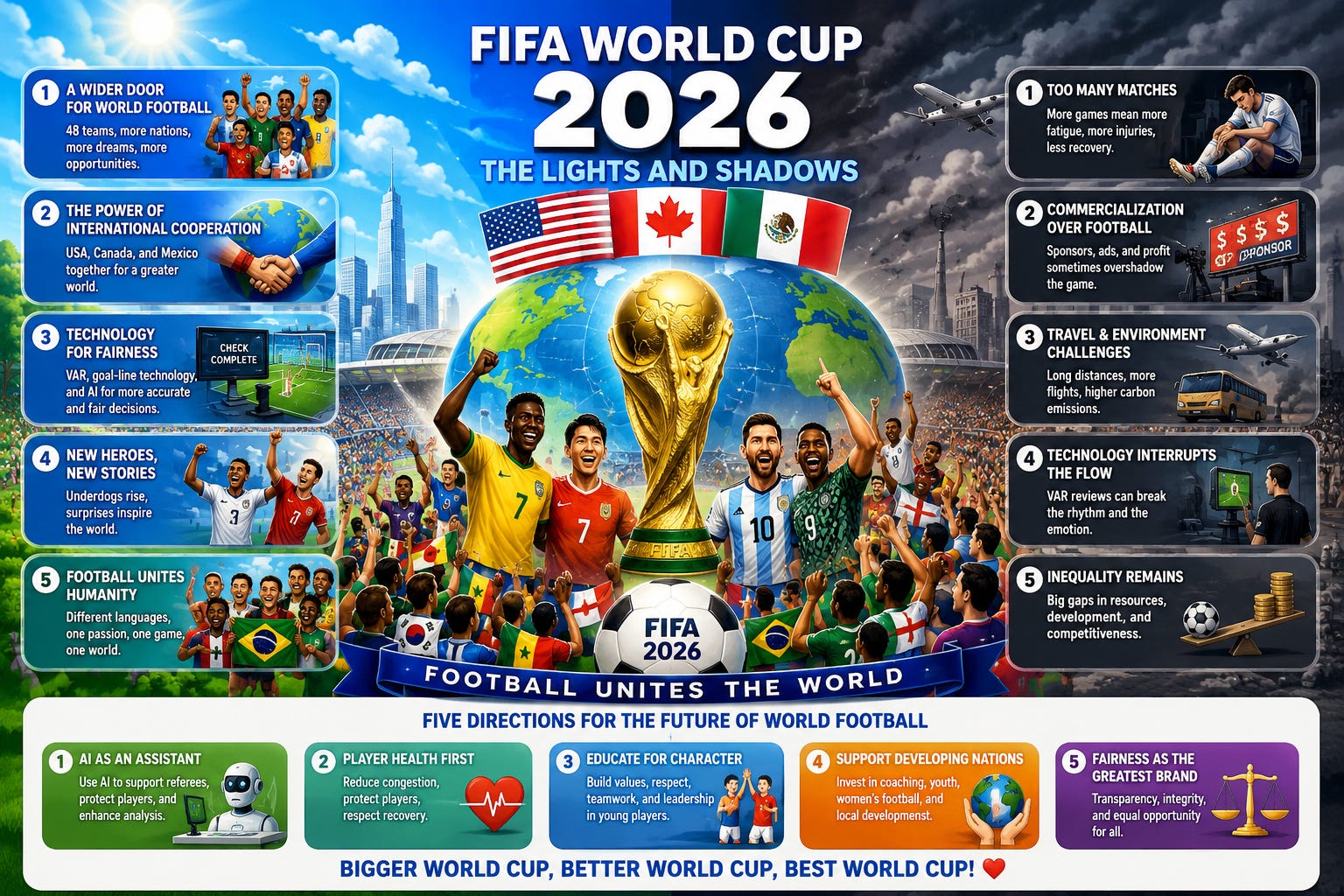
“Football is far more than a game played with a ball. It is humanity’s greatest classroom, where we learn how to compete with excellence while living together in harmony.”
The FIFA World Cup 2026 marked a historic milestone in the evolution of international football. Co-hosted by the United States, Canada, and Mexico, it became the largest World Cup ever held, expanding from 32 to 48 participating nations. This transformation opened a new chapter in the history of the world’s most popular sport while simultaneously revealing both the remarkable achievements and significant challenges facing global football.
The tournament delivered unforgettable moments, dramatic upsets, and inspiring stories of perseverance. Yet behind the spectacular celebrations lay important questions about commercialization, player welfare, technological dependence, and sustainability. For this reason, FIFA World Cup 2026 will likely be remembered not only as a successful tournament but also as a turning point that challenged the football community to envision a better future.
The Five Bright Sides of FIFA World Cup 2026
1. A Wider Door Opened for World Football
The expansion to 48 teams gave unprecedented opportunities to emerging football nations from Asia, Africa, North America, Oceania, and beyond. Countries that had previously struggled to qualify finally experienced football’s grandest stage.
Participation itself became a catalyst for long-term development. Young players gained inspiration, national football associations acquired valuable experience, and millions of supporters witnessed their countries competing among the world’s elite. The philosophy of “participation as progress” became one of the tournament’s greatest legacies.
2. Joint Hosting Demonstrated the Power of International Cooperation
The successful collaboration among the United States, Canada, and Mexico illustrated how sport can transcend political borders and cultural differences.
Despite distinct political systems, economic priorities, and social traditions, the three nations coordinated logistics, transportation, security, and fan engagement on an unprecedented scale. Their partnership demonstrated that football possesses a unique diplomatic power capable of building trust where politics often struggles.
The World Cup became not merely a sporting event but a celebration of international cooperation.
3. Technology Improved Fairness
Technological innovations—including Video Assistant Referee (VAR), Goal-Line Technology, and AI-assisted semi-automated offside systems—significantly enhanced officiating accuracy.
Although controversies did not disappear entirely, objective technological assistance reduced many critical errors and strengthened public confidence in the fairness of competition.
Technology proved that its highest purpose in sport is not replacing human judgment but supporting justice.
4. New Football Powers Captured Global Attention
One of the enduring beauties of the World Cup is its unpredictability.
As in previous tournaments, several emerging nations challenged traditional football giants, reminding the world that passion, discipline, and teamwork often outweigh historical reputation.
The World Cup continues to affirm that football remains the world’s most democratic sport, where dreams can occasionally overcome statistics.
5. Football Once Again United Humanity
During a period marked by geopolitical tensions and social divisions, billions of people gathered around televisions, smartphones, and stadiums to share a common emotional experience.
Supporters celebrated extraordinary goals, applauded acts of sportsmanship, and mourned heartbreaking defeats together. Social media transcended national boundaries as fans expressed admiration for athletes regardless of nationality.
Football once again demonstrated its extraordinary capacity to unite humanity through shared joy.
The Five Shadows of FIFA World Cup 2026
1. Too Many Matches, Too Little Recovery
Expanding the tournament inevitably increased the number of matches.
Elite players already burdened by demanding club schedules faced greater risks of fatigue, injury, and burnout. Critics argued that the tournament’s expansion emphasized quantity over quality.
The long-term health of athletes deserves greater consideration in future international calendars.
2. Commercialization Continued to Grow
Corporate sponsorships, broadcasting rights, advertising campaigns, and commercial branding often appeared to overshadow the sport itself.
While financial investment is essential for organizing a global event of this magnitude, excessive commercialization risks transforming football from a cultural celebration into a purely commercial enterprise.
The game should remain the centerpiece—not the marketplace surrounding it.
3. Geographic Scale Increased Travel Burdens
Hosting the tournament across North America’s vast geography created significant logistical challenges.
Players, coaching staffs, media personnel, and supporters frequently traveled thousands of kilometers between matches. Such extensive travel affected player recovery, fan accessibility, and environmental sustainability through increased carbon emissions.
Future mega-events must carefully balance global reach with ecological responsibility.
4. Technology Sometimes Interrupted the Rhythm of the Game
While VAR improved accuracy, repeated reviews occasionally disrupted the natural flow and emotional intensity of matches.
Football has traditionally thrived on spontaneity and continuous action. Excessive technological intervention risks diminishing the game’s unique emotional rhythm.
Technology should enhance football without reducing its human spontaneity.
5. Competitive Inequality Still Exists
Although more nations participated than ever before, genuine championship contenders remained concentrated among a relatively small group of traditional football powers.
Differences in youth development systems, financial investment, coaching infrastructure, sports science, and domestic league quality continue to create significant competitive disparities.
Expanding participation is only the first step; achieving competitive balance requires much deeper structural investment.
Five Directions for the Future of World Football
1. AI Should Assist Football, Not Replace Human Leadership
Artificial intelligence has tremendous potential in referee support, injury prevention, tactical analysis, player performance monitoring, and fan engagement.
However, the ultimate responsibility for decision-making should remain with qualified human officials.
The future belongs to human-centered AI—not AI-centered sport.
2. Player Well-being Must Become Football’s Highest Priority
Modern elite football players often compete in domestic leagues, continental competitions, national team tournaments, and international friendlies with minimal recovery time.
FIFA should collaborate with clubs, leagues, and players’ associations to redesign the international calendar, ensuring adequate rest and long-term health protection.
Healthy athletes produce the highest-quality football.
3. Football Education Should Build Character as Well as Skill
The world’s greatest footballers should be recognized not only for technical brilliance but also for integrity, humility, leadership, and respect.
Youth academies should emphasize sportsmanship, teamwork, responsibility, and ethical decision-making alongside athletic excellence.
Winning trophies is admirable; developing honorable individuals is even more valuable.
4. Greater Investment Should Reach Developing Football Nations
FIFA’s long-term success depends not merely on constructing world-class stadiums but on investing in sustainable football ecosystems.
Priority should be given to coaching education, youth academies, grassroots football, women’s football, sports medicine, and local league development.
Tomorrow’s football superpowers may emerge from today’s developing football communities.
5. Fairness Should Become Football’s Greatest Brand
The future success of FIFA should not be measured solely by television ratings, sponsorship revenue, or attendance records.
Instead, its highest achievement should be earning global trust through transparent governance, ethical leadership, fair competition, and equal opportunity.
The most valuable World Cup is not necessarily the richest one—it is the fairest one.
Football’s Greatest Victory Lies Beyond the Final Score
FIFA World Cup 2026 ushered in a new era for international football. The expansion to 48 nations broadened opportunity, AI-assisted technologies improved officiating accuracy, and multinational cooperation showcased the unifying power of sport. At the same time, the tournament highlighted significant challenges, including commercialization, player overload, environmental sustainability, technological dependence, and persistent competitive inequality.
The future of world football should therefore move beyond creating merely a “Bigger World Cup.” It should strive to build a “Better World Cup”—one that is fairer, more sustainable, more inclusive, and more deeply rooted in human dignity.
In the age of artificial intelligence, football must become more than a faster or more technologically sophisticated game. It should serve as a global model demonstrating how innovation, ethics, creativity, and international cooperation can flourish together.
Ultimately, the greatest champion of every World Cup is not simply the nation that lifts the trophy, but the global community that learns to compete with excellence, respect diversity, embrace fairness, and build a more peaceful future together.
References
FIFA. (2026). FIFA World Cup 2026 Regulations. Fédération Internationale de Football Association. https://www.worldcup2026football.co.uk/wc-2026-regulations.pdf +++
{Solti}
July 19, 2026
FIFA World Cup 2026의 빛과 그림자
세계인의 축제에서 인류 공동체의 미래를 배우다
“축구는 단지 공을 차는 스포츠가 아니다. 그것은 인류가 경쟁하면서도 함께 살아가는 법을 배우는 가장 아름다운 교실이다.”
2026년 FIFA 월드컵은 역사상 가장 큰 규모의 월드컵이다. 미국, 캐나다, 멕시코가 공동 개최하고, 참가국도 기존 32개국에서 48개국으로 확대되었다. 이는 세계 축구의 새로운 장을 연 역사적 사건인 동시에, 세계 스포츠가 직면한 새로운 도전들을 보여주는 시험대이기도 하다.
이번 대회는 놀라운 감동과 예상 밖의 이변을 만들어냈다. 그러나 화려한 조명 뒤에는 해결해야 할 과제들도 적지 않았다. 따라서 FIFA 2026은 “성공한 월드컵”인 동시에 “더 나은 미래를 준비해야 하는 월드컵”으로 기억될 것이다.
Ⅰ. FIFA 2026 월드컵의 다섯 가지 빛
1. 세계 축구의 문이 더욱 넓어졌다.
48개국 체제는 아시아, 아프리카, 북중미, 오세아니아 국가들에게 역사적인 기회를 제공하였다.
과거에는 본선 진출조차 어려웠던 국가들이 세계 최고의 무대를 경험하게 되었으며, 이는 장기적으로 세계 축구의 균형 발전을 촉진한다.
“참가 자체가 성장”이라는 새로운 철학이 탄생한 것이다.
2. 공동 개최가 국제협력의 모범을 보여주었다.
미국·캐나다·멕시코는 서로 다른 정치, 문화, 경제 환경을 가지고 있지만 월드컵 운영에서는 긴밀하게 협력하였다.
이는 스포츠가 외교보다 강한 신뢰를 만들 수 있음을 보여주는 사례였다.
축구는 국경을 넘어 협력하는 글로벌 플랫폼이 되었다.
3. 기술은 심판의 공정성을 높였다.
VAR, 골라인 기술, AI 기반 오프사이드 판정은 인간의 실수를 크게 줄였다.
물론 논란은 완전히 사라지지 않았지만,
“공정성을 향한 기술의 진화”
라는 점에서는 분명한 진보였다.
4. 예상 밖의 국가들이 세계를 놀라게 했다.
이번 대회에서도 축구 강국만이 아니라 새로운 강자들이 등장하였다.
이는 월드컵이 단순한 전력 순위가 아니라
꿈과 도전의 무대임을 다시 증명하였다.
축구는 여전히 가장 예측하기 어려운 스포츠이다.
5. 축구가 다시 세계인을 하나로 만들었다.
정치적으로 분열된 시대에도 월드컵 기간만큼은 수십억 명이 같은 경기를 시청하였다.
SNS에서는 국적을 초월하여 선수들을 응원하고,
감동적인 장면들이 전 세계로 공유되었다.
축구는 여전히 인류 최대의 공통 언어이다.
Ⅱ. FIFA 2026 월드컵의 다섯 가지 그림자
1. 지나치게 많은 경기 수
48개국 체제로 인해 경기 수가 크게 증가하였다.
선수들은
부상
피로 누적
회복 부족
이라는 문제를 더욱 심각하게 경험하였다.
월드컵의 질보다 양이 커졌다는 비판도 존재한다.
2. 상업주의의 심화
스폰서,
광고,
방송권,
마케팅이 축구 자체보다 더 큰 관심을 받는 순간들이 있었다.
월드컵이 거대한 비즈니스 이벤트가 되어가는 현실은 많은 팬들에게 아쉬움을 남겼다.
3. 개최 도시 간 이동 부담
북미 대륙은 매우 넓다.
선수와 팬 모두 장거리 이동을 반복해야 했으며,
이는 경기력과 관람 경험 모두에 영향을 미쳤다.
환경 측면에서도 상당한 탄소 배출이 발생하였다.
4. 기술 의존의 부작용
VAR는 공정성을 높였지만,
경기의 흐름을 자주 끊기도 했다.
팬들은
“감정보다 기술이 먼저”
인 시대를 경험하였다.
축구의 자연스러운 리듬이 일부 희생되었다.
5. 축구 빈부격차는 여전히 존재한다.
참가국은 늘어났지만,
우승 경쟁은 여전히 몇몇 강국 중심이다.
재정,
유소년 시스템,
지도자 수준,
리그 경쟁력의 차이는 쉽게 좁혀지지 않는다.
진정한 세계 축구의 균형 발전은 아직 갈 길이 멀다.
Ⅲ. 앞으로 세계 축구가 나아가야 할 다섯 가지 방향
1. AI는 심판이 아니라 축구를 돕는 조력자가 되어야 한다.
AI는
판정 지원
선수 보호
부상 예방
전술 분석
에는 적극 활용되어야 한다.
그러나 최종 판단은 인간 심판의 책임 아래 이루어져야 한다.
기술은 인간을 대체하는 것이 아니라 인간을 지원해야 한다.
2. 선수 건강이 최우선 가치가 되어야 한다.
국가대표,
클럽,
대륙대회,
친선경기가 지나치게 많아지고 있다.
FIFA는 경기 수를 줄이고 회복 기간을 충분히 보장하는 새로운 국제 일정을 마련해야 한다.
좋은 축구는 건강한 선수에게서 나온다.
3. 축구 교육을 인성 교육과 연결해야 한다.
세계 최고의 선수는
기술만 뛰어난 사람이 아니라
존중,
배려,
정직,
리더십을 갖춘 사람이어야 한다.
유소년 축구는 승리보다 인격을 먼저 가르쳐야 한다.
4. 개발도상국 축구를 더욱 지원해야 한다.
FIFA는 경기장보다
지도자 양성,
유소년 아카데미,
여성 축구,
지역 리그 발전에 더 많은 투자를 해야 한다.
축구의 미래는 새로운 나라에서 시작될 수도 있다.
5. “공정한 축구”가 최고의 브랜드가 되어야 한다.
앞으로 FIFA가 추구해야 할 최고의 가치는
“가장 돈이 많은 월드컵”
이 아니라
“가장 공정한 월드컵”
이어야 한다.
공정성은 스포츠가 존재하는 이유이며,
신뢰는 월드컵의 가장 큰 자산이다.
승패보다 더 중요한 것은 축구가 남기는 유산이다.
FIFA 2026은 새로운 시대의 시작을 알렸다.
48개국 체제는 더 많은 국가에게 희망을 주었고, AI 기술은 심판 판정의 정확성을 높였으며, 공동 개최는 국제 협력의 가능성을 보여주었다. 동시에 상업주의, 선수 과부하, 환경 부담, 기술 의존, 경쟁력 격차라는 과제도 분명히 드러냈다.
앞으로 세계 축구는 더 많은 국가가 참여하는 ”큰 월드컵(Big World Cup)”을 넘어, 더 공정하고 지속 가능하며 인간 중심적인 ”좋은 월드컵(Good World Cup)”을 지향해야 한다.
AI 시대의 축구는 단지 더 빠르고 더 정교한 스포츠가 아니라, 인간의 창의성과 기술, 윤리와 협력이 조화를 이루는 새로운 문명의 모델이 되어야 한다. 월드컵의 진정한 우승자는 결국 한 나라가 아니라, 서로 다른 문화를 존중하며 함께 미래를 만들어 가는 인류 공동체일 것이다.
참고문헌
FIFA. (2026). FIFA World Cup 2026 Regulations. Zurich, Switzerland: Fédération Internationale de Football Association. https://www.worldcup2026football.co.uk/wc-2026-regulations.pdf +++
{솔티}
2026년 7월 19일

Prof. Dr. Young Choi (Editor in Chief) — Regent University
Young B. Choi is a Professor in the Department of Engineering & Computer Science at Regent University. He published 38 books with ‘Selected Readings in Cybersecurity’ (2018) (over 800 copies archived globally at university/college libraries around the world) and ‘Cybersecurity Applications and Artificial Intelligence’ (2023) available in seven major world languages. He proposed the world’s first global and universal telecommunications “Service Order Handling (SOH)” Model (T-SOH Model) (1995) with Dr. Adrian Tang. With this innovative research work, he received the IEEE NOMS ’96 Best Paper Award and became the first recipient of the Outstanding Contribution Award of the TeleManagement Forum in 1998. His research areas include Natural Language Processing-focused AI, AI-applied cybersecurity, network and telecom service management, and Korean studies on Gani Choi Rip’s Jeonggwan (靜觀: Quiet Contemplation) philosophy and Shilhak ( 實學: Practical Learning).