

EXECUTIVE SUMMARY
Across history, leaders have achieved extraordinary victories yet later faced decline as smaller, often overlooked vulnerabilities¹ accumulated over time—a pattern described here as the Mosquito Effect. In the AI era, this dynamic becomes more pronounced, as technological systems increase both the scale of achievement and the speed at which minor errors can propagate across interconnected domains. Accordingly, leadership is likely to favor not only those who achieve rapid success, but those who sustain performance through disciplined attention to small, compounding risks.
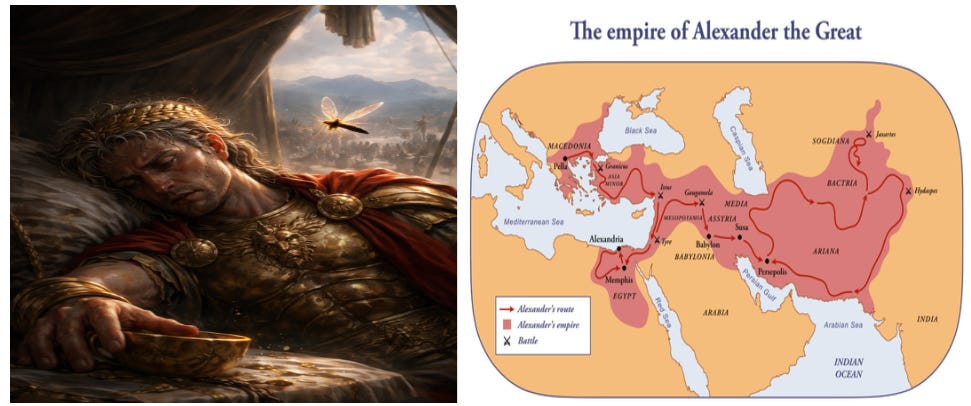
Figure 1. The Mosquito and the Empire: Scale vs. Fragility
Source: Left image—AI-generated depiction of Alexander the Great; right image—historical map of Alexander’s empire (educational/public domain use); composition and annotations by the author.
A visual contrast between imperial scale and human vulnerability, illustrating how even the greatest empires remain exposed to small, overlooked risks.
INTRODUCTION
Recent political transitions in several countries serve as reminders that power is rarely as permanent as it appears. Across different historical contexts—from ancient empires to modern political systems, authority has often appeared stable until underlying pressures gradually became decisive. What may seem like sudden change is rarely abrupt. Rather, it often reflects the culmination of small, incremental forces that have developed over time.
This article introduces the Mosquito Effect as a conceptual lens to interpret how small, often overlooked factors can accumulate and shape long-term outcomes. While history frequently emphasizes decisive victories and dominant leadership, a complementary perspective suggests that enduring outcomes are often influenced by how well minor vulnerabilities are recognized and managed.
In earlier periods, such vulnerabilities tended to accumulate gradually—through misjudgments, strained relationships, or unnoticed inefficiencies. In the contemporary environment, artificial intelligence alters this dynamic by compressing time and expanding scale. As a result, relatively small errors can propagate more quickly across interconnected systems.
In this context, the central challenge of leadership extends beyond achieving success to sustaining it over time.
THE ACCUMULATION OF SMALL FORCES IN HISTORY
Across historical contexts, major outcomes often emerge not from a single decisive action, but from the interaction of multiple smaller forces that accumulate over time. Leadership operates within these complex dynamics, where seemingly minor factors—if left unaddressed—can influence broader trajectories.
2.1. Invisible Drivers of Outcomes: Beyond Great Leaders
In War and Peace, Leo Tolstoy challenges the conventional belief that history is shaped primarily by great individuals.² His portrayal of Napoleon Bonaparte suggests that outcomes are influenced not only by leadership decisions, but also by broader conditions such as weather, morale, communication, and timing.
This perspective reframes success and failure as outcomes of interacting forces rather than singular acts of leadership. What appears as decisive action may, in part, reflect underlying systemic dynamics.
From this viewpoint, the Mosquito Effect can be understood as the gradual accumulation of small misalignments, minor oversights, delayed responses, or constrained feedback—that, over time, contribute to larger outcomes.
2.2. Strategic Overreach and Systemic Breakdown: The Case of the Peloponnesian War
The Peloponnesian War³ provides a macro-level illustration of how accumulated pressures can influence systemic outcomes. The prolonged conflict between Athens and Sparta involved not only military competition, but also challenges related to endurance, resource allocation, and internal stability.
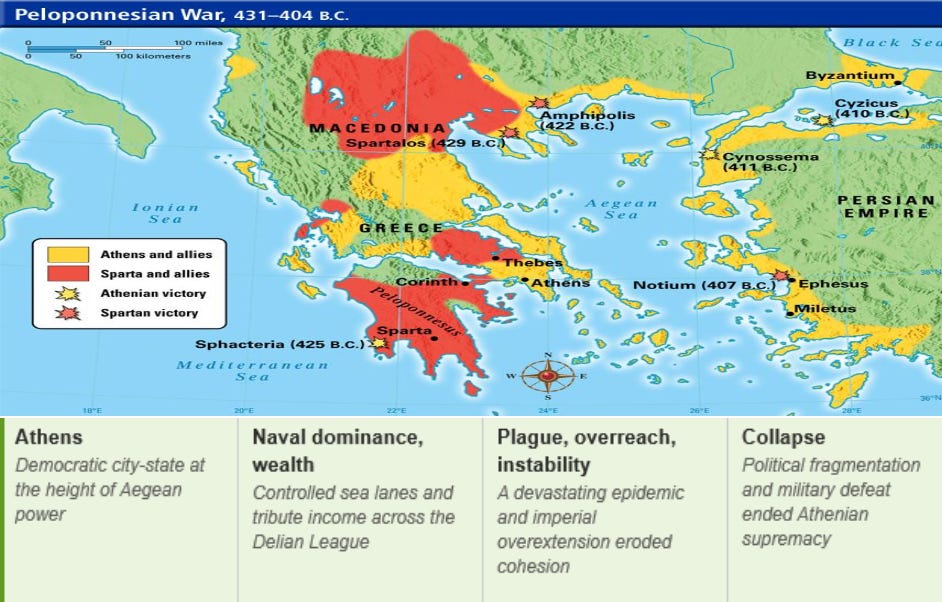
Figure 2. The Peloponnesian War: From Athenian Dominance to Systemic Collapse (Source: Historical map of the Peloponnesian War (public domain/educational use), adapted by the author.)
Athens entered the conflict with considerable advantages, including naval strength and economic capacity. However, over time, a combination of factors—including strategic overextension, internal political tensions, and external shocks such as disease—placed increasing strain on its system.
While no single factor determined the outcome, the interaction of these pressures contributed to a gradual weakening. Sparta, by contrast, maintained relative cohesion and persistence, ultimately shaping the final outcome.
This case suggests that when expansion is not matched with balance and adaptability, even strong systems may become more sensitive to accumulated stress.
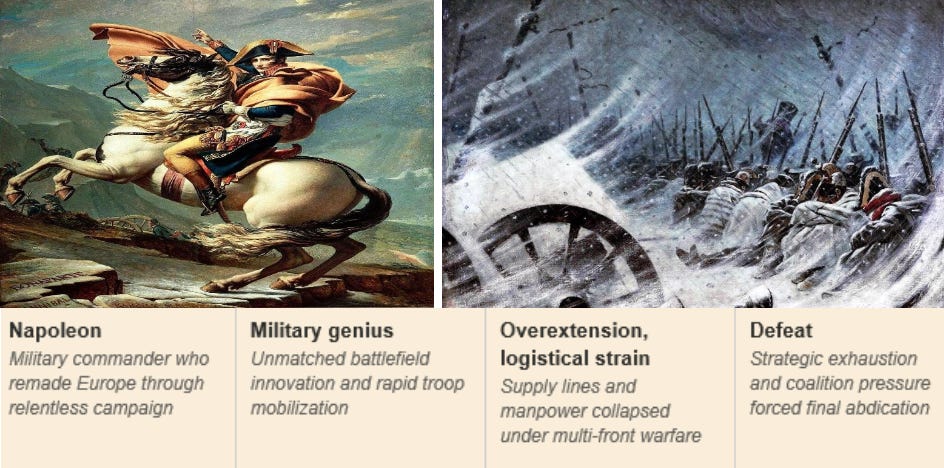
Figure 3. Napoleon: From Alpine Triumph to Russian Ruin Source: Left image—Jacques-Louis David, Napoleon Crossing the Alps (public domain); right image—historical depiction of the 1812 Russian campaign (educational use); annotations and synthesis by the author.
The left image — Jacques-Louis David’s Napoleon Crossing the Alps — is an act of deliberate mythology. Napoleon sits astride a rearing white stallion, cloak billowing, arm raised toward a conquerable sky. In reality he crossed on a mule, hunched against the cold. David painted not what happened but what Napoleon needed the world to believe: that he was a force of nature, beyond the conditions that defeated ordinary men. This is the Mosquito Effect at its most dangerous — the moment when visible, overwhelming strength makes everyone, including the leader himself, stop looking at what is quietly accumulating underneath. His victories were real, his genius was real, but so were the small surrenders forming in the silence beneath his legend: supply lines designed for short Central European campaigns, a court that had become a mirror reflecting only what he wished to hear, and alliances held by transaction rather than loyalty.
The right image — the retreat from Moscow, 1812 — shows the arithmetic of that accumulation made visible. There is no hero, no horse, no upward gesture. There are only masses of indistinguishable men dissolving into a blizzard that does not notice them. Of the 685,000 soldiers who entered Russia, fewer than 100,000 returned capable of fighting. Yet Tolstoy, in War and Peace, refuses the consolation of a single dramatic turning point. He argues that Napoleon did not lose Russia through any catastrophic error of generalship. He lost it because the growing confidence surrounding his leadership may have limited the scope for critical feedback and adaptive adjustment over time. At the same time, the growing force of his own legend—the belief that his will could override geography, weather, logistics, and human endurance—gradually constrained his capacity for judgment.⁴
Tolstoy’s deeper insight is that historical analysis often emphasizes decisive battles and turning points because they provide clear and compelling narratives. However, collapse rarely results from a single moment of failure. Rather, it reflects the gradual accumulation of smaller factors—limited feedback, overlooked risks, and weakened relational foundations—that develop over time.
Viewed in this way, the contrast between the two images is not merely symbolic but analytical. The conditions that led to Napoleon’s retreat were not sudden; they were shaped by earlier decisions, structural constraints, and evolving assumptions about control and capability. What appears as a dramatic reversal can therefore be understood as the outcome of incremental pressures that were not fully recognized or addressed.
WINNING VS. ENDURING IN THE AI ERA
Across historical and contemporary contexts, a recurring divide emerges between those who achieve rapid, visible success and those who sustain it over time. This distinction reflects not differences in initial capability, but in the ability to manage complexity, maintain relationships, and adapt under changing conditions. In the AI era, this divide becomes even more pronounced, as both success and vulnerability are amplified simultaneously.
3.1. The Leadership Divide: Victory Without Endurance
A recurring paradox in leadership is that the very qualities that drive rapid success often undermine long-term sustainability. Across history, leaders who achieve swift and visible victories frequently struggle to preserve them, revealing a structural divide between performance and endurance. This is not a matter of talent or ambition, but of what is prioritized and sustained over time.

Figure 4. From Conquest to Collapse: The Rise and Fall of Xiang Yu Source: AI-generated images illustrating Xiang Yu’s rise and decline; conceptual design and annotations by the author.
Xiang Yu was born into a noble and warrior-class background during the late Qin dynasty, inheriting both elite status and military tradition. Renowned for his extraordinary physical strength, courage, and tactical brilliance, he achieved a series of decisive victories against overwhelming odds, quickly emerging as the most formidable force in the struggle for control of China. His leadership on the battlefield inspired fierce loyalty, and his early successes appeared to make him the inevitable unifier of the realm. Yet his strengths were concentrated in personal valor and command rather than governance. He struggled to maintain alliances, dismissed capable advisors, and relied heavily on his own judgment, limiting his ability to build a durable political order.
These two images contrast Xiang Yu’s battlefield dominance with his final tragic moment by the river, symbolizing the shift from overwhelming victory to irreversible collapse.
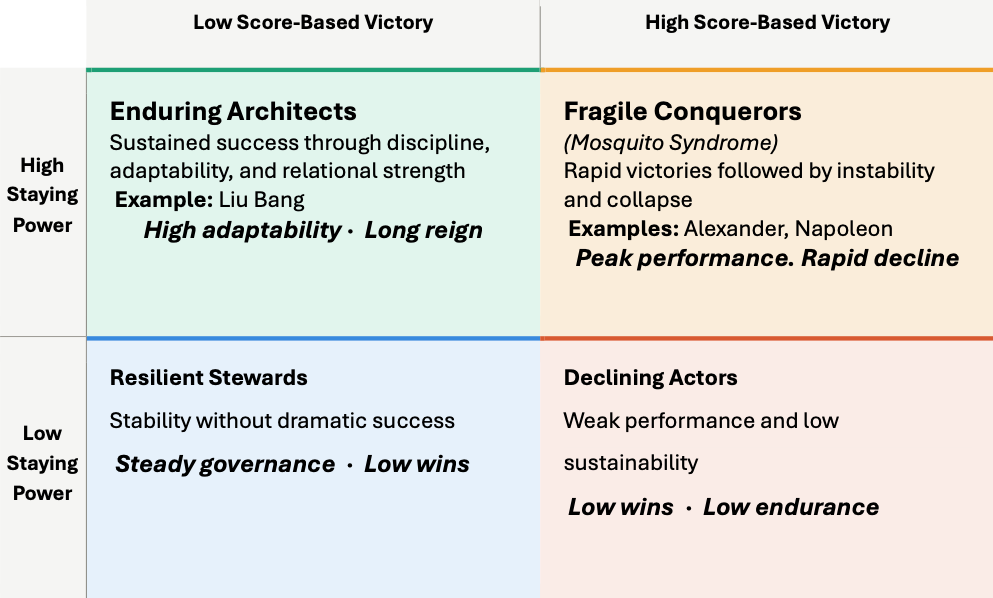
Figure 5. Leadership Typology: Victory vs. Endurance
Source: Author’s conceptual framework and design.
In contrast, Liu Bang came from a humble, peasant background and lacked both the military prowess and aristocratic stature of Xiang Yu. He experienced repeated setbacks and was often outmatched in direct confrontation. However, Liu Bang’s enduring advantage lay in his ability to attract and retain talented advisors, build trust-based relationships, and adapt strategically over time. Surrounded by capable counselors, he developed a more resilient and inclusive leadership structure that extended beyond individual capability. While Xiang Yu won battles, Liu Bang built a system. Ultimately, this difference determined the outcome: Liu Bang established the Han dynasty,⁵ one of the most enduring in Chinese history, demonstrating that long-term success depends not on initial dominance, but on sustained alignment, adaptability, and institutional strength. Their contrast reflects differing leadership configurations—one centered on battlefield excellence, the other on relational and institutional development.
Across these cases, the same divide emerges: the difference between winning and lasting. Victory is typically driven by speed, intensity, and concentration of power, whereas endurance depends on discipline, adaptability, and relational strength. When these sustaining elements are absent, even the most extraordinary success becomes inherently fragile—impressive in the moment, but vulnerable over time.
This distinction is captured in Figure 5, which presents a typology of leadership based on two dimensions: score-based victory and staying power. Leaders who combine high performance with strong endurance become Enduring Architects, capable of sustaining success through adaptability and relational depth. In contrast, Fragile Conquerors achieve rapid victories but remain vulnerable to collapse patterns exemplified by figures such as Alexander and Napoleon, where repeated success may reduce sensitivity to emerging risks over time. At lower levels of performance, Resilient Stewards maintain stability without dramatic wins, while Declining Actors exhibit both weak performance and low sustainability.
This typology highlights a crucial insight: high performance alone does not ensure endurance; in many cases, it conceals underlying vulnerabilities.
3.2. Amplified Fragility: The Mosquito Effect in the AI Era
In the AI era, fragility no longer remains contained within isolated systems but expands rapidly across interconnected networks.⁶ What begins as a small, localized disruption can propagate through multiple layers of digital infrastructure, linking decisions, data flows, and operational processes in ways that are often invisible until consequences emerge. This shift from contained error to systemic impact is no longer gradual but immediate, reflecting a new reality in which scale and connectivity transform minor weaknesses into global risks.

Figure 6. Localized Failure and Global Propagation: Amplified Fragility in the AI Era
Source: Conceptual digital images of network disruption and global connectivity (educational use); composition and annotations by the author.
These images show how a small, localized disruption can rapidly spread through interconnected global systems, where minor vulnerabilities now cascade across complex networks and escalate into systemic consequences.
In the AI era, the dynamics of Alexander’s Mosquito Syndrome become not only relevant but systemic. Artificial intelligence dramatically expands the capacity for achievement, enabling leaders to operate at unprecedented levels of speed, scale, and complexity. Decisions that once took months can now be executed in seconds, and systems that once influenced local outcomes now shape global dynamics.
Yet this amplification applies equally to vulnerability. Small errors—once contained—can now propagate rapidly across interconnected systems: a minor bias in data may influence millions of decisions, a flawed assumption can misguide large-scale strategy, and overreliance on automation can erode human judgment. What was once a “mosquito” becomes a cascading systemic risk.
This creates a potential overestimation of control. Much like Napoleon Bonaparte in War and Peace, leaders may believe they are directing outcomes, while in reality they are increasingly dependent on complex, opaque systems that are difficult to fully understand or govern. The result is a new form of fragility: high capability combined with low resilience.
Alexander’s Mosquito Syndrome occupies the high-performance but low-endurance quadrant, revealing that rapid victories—when unsupported by discipline, relational stability, and self-regulation—lead to fragile success. In the AI era, where small errors scale rapidly, the transition from fragile conqueror to enduring architect becomes the defining challenge of leadership.
FROM ENDURING PERSONHOOD TO ENDURING LEADERSHIP
Leadership in the AI era is increasingly defined not only by the ability to achieve, but by the capacity to sustain outcomes over time. This shift reflects a deeper integration of personal formation, systemic awareness, and leadership discipline—an alignment that becomes essential in an age of amplified capability and risk.
4.1. A Unified Framework: Personhood, Systems, and Leadership
These dynamics can be understood across three interconnected levels: individual formation, system behavior, and leadership practice. At the individual level, sustained performance depends on inner discipline, judgment, and consistency over time. At the system level, outcomes are shaped not only by major shocks but by the accumulation of pressures, misalignments, and constraints that gradually influence stability. At the leadership level, effectiveness depends on recognizing and managing small, often overlooked vulnerabilities before they scale into larger risks.
Across these levels, a consistent pattern emerges: outcomes are rarely determined by a single decisive event. Instead, they reflect the interaction of multiple factors that accumulate over time. What appears as sudden breakdown is often the result of long-developing structural strain, while sustained success reflects the ability to maintain alignment, adapt to changing conditions, and manage emerging risks.
Together, these perspectives suggest a unified insight: enduring outcomes depend not only on achieving success, but on sustaining it through disciplined attention to small, compounding factors across individual, organizational, and systemic levels.
4.2. The AI Imperative: From Achievement to Sustainability
In the AI era, this integration becomes not only relevant but urgent. Artificial intelligence amplifies capability, accelerates system stress, and magnifies small errors, linking the dynamics of personhood, systems, and leadership more tightly than ever before. What once evolved gradually now unfolds in compressed time, making the consequences of misjudgment both immediate and far-reaching.
This convergence demands a fundamental shift—from achievement to sustainability, from winning to lasting. Leadership can no longer rely on scale or speed alone; it must incorporate disciplined awareness of small risks, systemic constraints, and human limitations. The capacity to endure becomes the defining measure of effectiveness.
This article, therefore, stands as a natural sequel within a coherent framework. If enduring personhood establishes the inner foundation, and breakpoint thinking explains systemic transformation, the Mosquito Effect reveals why leadership fails to convert victory into endurance. Across all three, the same lesson emerges: in an age of amplified power, long-term success depends not on the magnitude of achievements, but on the disciplined management of small, accumulating vulnerabilities.
Enduring personhood builds the leader; recognizing breakpoints preserves the system; mastering the “mosquito” sustains victory.
“The future will not belong to those who win the most battles, but to those who endure the longest without being undone by the smallest mistake.”
CONCLUSION: THE SMALL DETERMINES THE LASTING
Tolstoy showed that history is shaped by countless small forces. The Peloponnesian War demonstrated that great powers collapse through accumulated strain. Alexander’s story reminds us that even the greatest conqueror cannot escape human vulnerability. In the AI era, these lessons converge. Technology amplifies both capability and fragility, making small errors more consequential than ever before. This dynamic is increasingly discussed in the emerging governance literature on AI risk.⁷ Across history and in the AI era alike, enduring outcomes are shaped not only by major forces, but by how well smaller, often overlooked risks are recognized and managed.
ABOUT THE AUTHOR
Paul C. Hong DISTINGUISHED UNIVERSITY PROFESSOR · UNIVERSITY OF TOLEDO
Paul C. Hong is a Distinguished University Professor and Chair of Information Systems and Supply Chain Management at the University of Toledo. His work focuses on leadership, governance, and decision-making in the AI era, integrating strategy, technology, and institutional trust. He has published extensively in leading academic journals and writes on how individuals and organizations navigate complexity, disruption, and global transformation.
K-SGP Forum · Leadership & Governance Research April 2026 All rights reserved
Notes
Taleb, N. N. (2007). The black swan: The impact of the highly improbable. Random House.
Tolstoy, L. (2010). War and peace (L. Maude & A. Maude, Trans.; A. Mandelker, Rev.). Oxford University Press. (Original work published 1869)
Thucydides. (2009). The Peloponnesian War (M. Hammond, Trans.). Oxford University Press. (Original work written c. 431 BCE)
Zamoyski, A. (2004). 1812: Napoleon’s fatal march on Moscow. HarperCollins.
Sima Qian. (1993). Records of the grand historian: Shiji (B. Watson, Trans.). Columbia University Press. (Original work written c. 94 BCE)
Brynjolfsson, E., & McAfee, A. (2014). The second machine age. W. W. Norton & Company.
Bengio, Y., et al. (2026). International AI Safety Report 2026. UK Department for Science, Innovation and Technology.

Distinguished Professor, Dr. Paul Hong — University of Toledo
Paul C. Hong is a Distinguished University Professor and Chair of Information Systems and Supply Chain Management at the University of Toledo. His work focuses on leadership, governance, and decision-making in the AI era, integrating strategy, technology, and institutional trust. He has published extensively in leading academic journals and writes on how individuals and organizations navigate complexity, disruption, and global transformation.
Original Document:

© K-Global Scholars and Professionals Forum. All rights reserved. Content published in the K-GSP Forum may not be reproduced, distributed, or transmitted in any form without prior written permission from the K-GSP Forum, except for brief quotations with full attribution.
It was particularly impressive how the sustainability of leadership was illustrated through the metaphor of the “mosquito effect.” What stood out most and has stayed with me is the idea that Liu Bang’s leadership created a solid foundation for victory by building systems of relationships and coordination.
In the age of AI, we can easily become absorbed in the joy of winning and overlook the importance of small connections and relationships. I strongly resonate with the author’s argument that, in the future, the most important quality of a leader will not be the pursuit of victory, but the management of sustainability.
I was also deeply moved by the way the author connected moments from complex world history and literary narratives to the realities of our modern world.