
Artificial intelligence (AI) is no longer a technology of the future—it has become part of our daily lives. Students use it to complete assignments, businesses rely on it to improve productivity, and researchers employ it to accelerate scientific discovery. As AI capabilities continue to expand, many have predicted that human expertise will gradually lose its value. Yet recent evidence suggests the opposite: in the age of AI, human expertise has become more valuable than ever.
A recent study by Anthropic provides compelling evidence. Analyzing approximately 400,000 real-world coding sessions using Claude Code, the researchers found that the most successful users were not necessarily those with the greatest knowledge of AI itself. Rather, they were individuals with deep expertise in their own domains. These users clearly defined problems, specified detailed requirements, critically evaluated AI-generated outputs, and continuously refined their prompts until they achieved their goals (Hitzig et al., 2026).
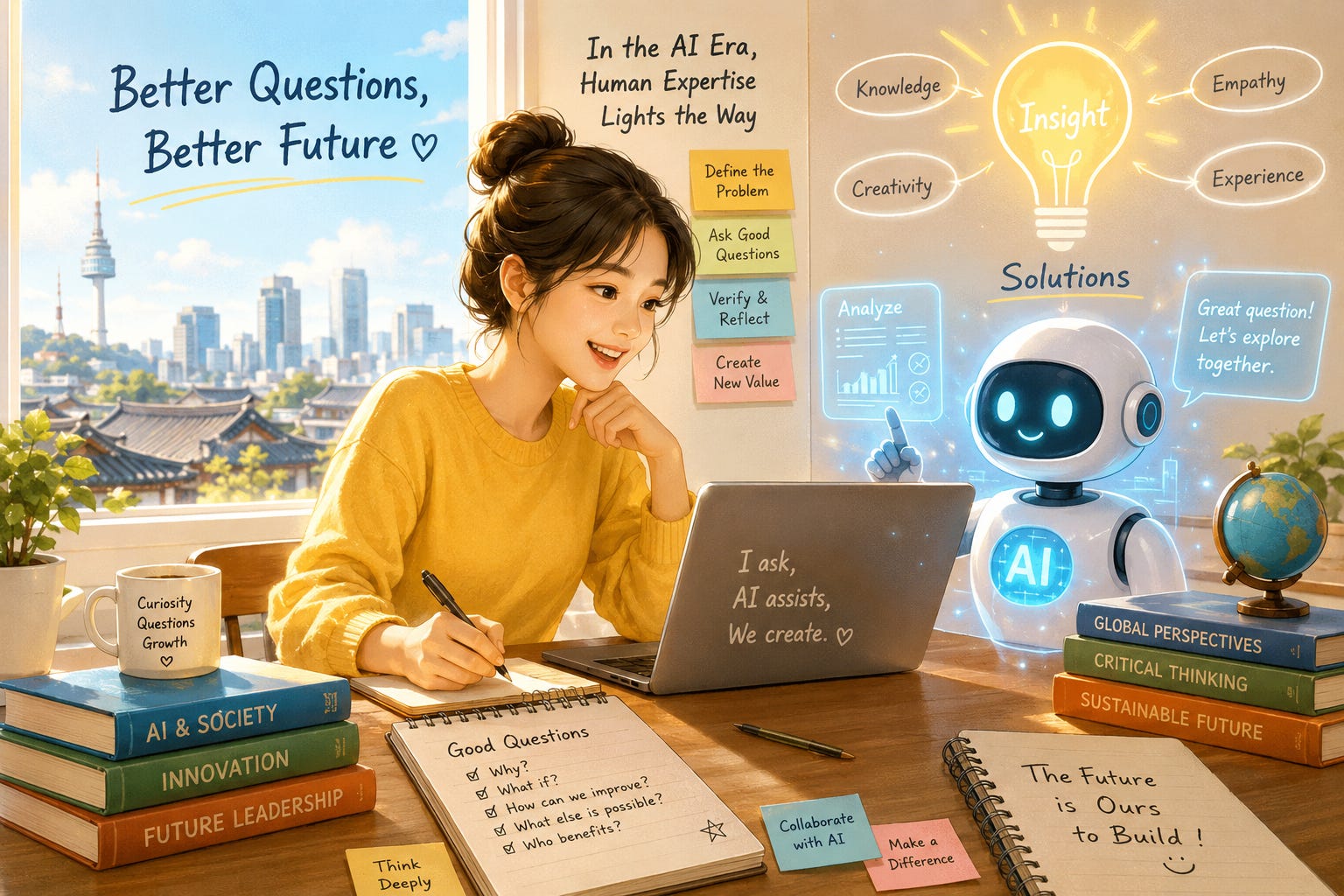
This finding offers an important lesson. In the AI era, competitive advantage depends less on how much information one possesses than on the ability to ask thoughtful, precise, and meaningful questions.
Today, information is abundant. AI systems can generate thousands of answers within seconds. Ironically, the easier it becomes to obtain answers, the more valuable good questions become. A vague prompt inevitably produces a vague response. A carefully designed prompt, however, often leads to remarkably insightful and practical results.
As a university professor, I observe this phenomenon regularly while supervising student projects. Although every student has access to the same AI tools, the quality of their outcomes varies significantly. Some students accept the first response they receive, while others refine their questions repeatedly, challenge the AI’s assumptions, request alternative perspectives, and verify the accuracy of the information before reaching a conclusion. The latter group consistently produces more thoughtful, creative, and reliable work.
South Korea enters the AI era with significant advantages. It possesses one of the world’s most advanced digital infrastructures, a highly educated population, and a culture that values learning. These strengths provide an excellent foundation for AI-driven innovation. Nevertheless, education must evolve. Memorizing correct answers is no longer sufficient. Students should learn to identify meaningful problems, formulate effective questions, evaluate AI-generated information critically, and integrate diverse perspectives into sound judgments.
This transformation is particularly important for overseas Koreans. In today’s global knowledge economy, success belongs not merely to those who know the most, but to those who can define new problems, connect ideas across disciplines, and collaborate effectively with intelligent machines. AI can reduce language barriers and democratize access to knowledge, but curiosity, creativity, ethical judgment, and critical thinking remain uniquely human strengths.
Traditional Korean wisdom teaches that learning is a lifelong journey. That wisdom has never been more relevant. In the AI era, lifelong learning means more than accumulating knowledge; it means continuously developing the ability to think critically, adapt quickly, and ask increasingly better questions.
AI is not replacing human intelligence; it is amplifying it. Just as telescopes expanded human vision and microscopes revealed invisible worlds, AI extends the reach of human thinking. Yet every powerful tool depends on the wisdom of its user. AI can generate countless possibilities, but only human beings can determine which possibilities truly matter.
South Korea successfully led the world through industrialization and the digital revolution. The next challenge is to become a global leader in the age of artificial intelligence—not simply by developing better AI systems, but by cultivating people who can use AI wisely, ethically, and creatively.
Ultimately, the winners of the AI era will not be those who possess the most powerful artificial intelligence. They will be those who ask the best questions.
Reference
Hitzig, Z., Massenkoff, M., Lyubich, E., Heller, R., & McCrory, P. (2026, June 16). Agentic Coding and Persistent Returns to Expertise. Anthropic. https://www.anthropic.com/research/claude-code-expertise
{Solti}
July 1, 2026
AI 시대, 한국인의 경쟁력은 ‘질문하는 능력’이다
질문의 힘
인공지능(AI)은 이제 더 이상 미래의 기술이 아니다. 학교에서는 과제를 돕고, 기업에서는 업무를 자동화하며, 연구실에서는 새로운 발견을 가속화하고 있다. 많은 사람들은 AI가 발전할수록 인간의 전문성은 점차 중요하지 않게 될 것이라고 예상했다. 그러나 최근의 연구 결과는 오히려 그 반대의 사실을 보여 준다. AI 시대일수록 인간의 전문성과 사고력은 더욱 중요한 자산이 되고 있다.
AI 기업들이 실제 사용자들의 작업 과정을 분석한 연구에 따르면, AI를 가장 효과적으로 활용하는 사람들은 단순히 AI 사용법을 많이 아는 사람들이 아니었다. 오히려 자신이 속한 분야를 깊이 이해하고 있는 전문가들이었다. 그들은 AI에게 단순한 명령을 내리지 않았다. 문제를 명확하게 정의하고, 필요한 조건을 제시하며, 결과를 끊임없이 검증하고 수정해 더 나은 해결책을 만들어 갔다. (참고문헌 참조: (Hitzig et al., 2026))
이 연구는 우리에게 중요한 교훈을 준다. AI 시대의 경쟁력은 ‘얼마나 많은 정보를 알고 있는가’보다 ‘얼마나 좋은 질문을 할 수 있는가’에 달려 있다는 것이다.
오늘날 인터넷에는 방대한 정보가 넘쳐난다. AI 역시 수많은 답을 몇 초 만에 만들어 낸다. 그러나 답이 많아질수록 오히려 질문의 중요성은 더욱 커진다. 질문이 모호하면 AI 역시 모호한 답을 내놓는다. 반대로 질문이 구체적이고 논리적일수록 AI는 놀라울 만큼 수준 높은 결과를 제공한다.
필자는 대학에서 학생들에게 AI를 활용한 프로젝트를 지도하면서 비슷한 현상을 자주 경험한다. 같은 AI를 사용하더라도 결과는 학생마다 크게 달라진다. 어떤 학생은 한 번의 질문으로 만족하지만, 다른 학생은 다섯 번, 열 번 질문을 다듬으며 결과를 발전시킨다. 후자의 학생들은 AI를 단순한 답변 생성기가 아니라 함께 사고하는 협력자로 활용한다.
한국은 세계 최고 수준의 디지털 인프라와 높은 교육열을 갖춘 나라이다. 이러한 강점은 AI 시대에도 큰 경쟁력이 될 수 있다. 그러나 이제는 교육의 방향도 조금 달라질 필요가 있다. 암기와 정답 중심의 교육에서 벗어나 문제를 발견하고, 질문을 설계하며, 다양한 관점을 비교하고, AI의 결과를 비판적으로 검토하는 능력을 길러야 한다.
특히 해외에서 활동하는 한국인들에게 이러한 변화는 더욱 중요한 의미를 가진다. 글로벌 사회에서는 정답을 외우는 사람보다 새로운 문제를 정의하는 사람이 더 높은 가치를 인정받는다. AI는 언어의 장벽을 낮추고 정보 접근의 격차를 줄여 주지만, 창의적인 질문과 통합적인 사고력은 여전히 인간만이 발휘할 수 있는 경쟁력이다.
우리 선조들은 오래전부터 “배움에는 끝이 없다”고 말했다. AI 시대에도 이 정신은 변하지 않는다. 다만 배움의 방식이 달라질 뿐이다. 이제는 지식을 많이 저장하는 사람이 아니라, 지식을 연결하고 새로운 질문을 만들어 내는 사람이 미래를 이끌게 될 것이다.
AI는 인간을 대신하는 존재가 아니라 인간의 가능성을 확장하는 도구이다. 망원경이 인간의 시야를 넓혀 주고 현미경이 보이지 않던 세계를 보여 주었듯이, AI는 우리의 사고를 더욱 멀리, 더욱 깊이 확장시켜 준다. 그러나 그 도구를 어떤 방향으로 사용할지는 결국 인간의 몫이다.
대한민국은 산업화와 정보화를 세계적인 성공 사례로 만들어 낸 나라이다. 이제 AI 시대에도 세계를 선도하기 위해서는 기술 자체보다 그것을 활용하는 인간의 역량에 더욱 집중해야 한다. 질문하는 능력, 비판적으로 사고하는 능력, 그리고 AI와 협력하여 새로운 가치를 창조하는 능력이야말로 한국 사회가 다음 세대를 위해 길러야 할 가장 중요한 자산이다.
AI 시대의 승자는 가장 뛰어난 인공지능을 가진 나라가 아니라, 가장 뛰어난 질문을 던질 수 있는 사람들을 가장 많이 길러 낸 나라가 될 것이다. 그 미래를 만들어 가는 주인공이 바로 우리 자신이기를 기대한다. +++
참고문헌
Hitzig, Z., Massenkoff, M., Lyubich, E., Heller, R., & McCrory, P. (2026, June 16). Agentic Coding and Persistent Returns to Expertise. Anthropic. https://www.anthropic.com/research/claude-code-expertise
{솔티}
2026년 7월 1일

Prof. Dr. Young Choi (Editor in Chief) — Regent University
Young B. Choi is a Professor in the Department of Engineering & Computer Science at Regent University. He published 38 books with ‘Selected Readings in Cybersecurity’ (2018) (over 800 copies archived globally at university/college libraries around the world) and ‘Cybersecurity Applications and Artificial Intelligence’ (2023) available in seven major world languages. He proposed the world’s first global and universal telecommunications “Service Order Handling (SOH)” Model (T-SOH Model) (1995) with Dr. Adrian Tang. With this innovative research work, he received the IEEE NOMS ’96 Best Paper Award and became the first recipient of the Outstanding Contribution Award of the TeleManagement Forum in 1998. His research areas include Natural Language Processing-focused AI, AI-applied cybersecurity, network and telecom service management, and Korean studies on Gani Choi Rip’s Jeonggwan (靜觀: Quiet Contemplation) philosophy and Shilhak ( 實學: Practical Learning).