
Executive Summary
This article examines how early maternal relationships influenced the emotional development, character formation, creativity, and life trajectories of selected Korean and Western historical figures. Through comparative cases including Shin Saimdang and Yi Yulgok, Yi Sun-sin, Yi Hwang, Jeong Yak-yong, Yeonsangun, Immanuel Kant, Virginia Woolf, Bertrand Russell, W. Somerset Maugham, Stendhal, Friedrich Nietzsche, and Ernest Hemingway, it shows how maternal love, guidance, loss, memory, distance, and conflict may become sources of both struggle and achievement. These cases suggest that maternal care is a profound but not universally available blessing that can provide an important emotional and moral foundation, while character and destiny continue to develop through later relationships, education, historical circumstances, personal choices, and resilience.
Keywords: Motherhood; Character Formation; Childhood Development; Great Thinkers; Human Destiny
1. Introduction
Among the seven defining dimensions I have used to explain Korea’s remarkable historical development—the 7Ms of Mother, Memories, Meaning, Mountains, Motivation, Minute, and Mastery—I intentionally place Mother first. This ordering reflects more than Korean history or Confucian family tradition; it recognizes that before nations are built, institutions established, or leaders emerge, character is first nurtured within the family. Mothers often serve as a child’s earliest teacher, moral guide, emotional anchor, and source of resilience. Korean history illustrates this through Shin Saimdang’s influence on Yi Yulgok, the filial devotion and moral grounding evident in Admiral Yi Sun-sin’s life, and the sacrifices of countless mothers who endured war and poverty while educating the postwar generation (Deuchler, 1992; Kim, 2014; Yi, 1977).
This pattern is also visible in the contrasting Korean cases examined in this article. Yi Hwang and Jeong Yak-yong developed moral, scholarly, and practical perspectives within family environments that valued discipline, learning, and responsibility, while Yeonsangun’s experience of his mother Queen Yun’s deposition and death demonstrates how maternal loss, political violence, and unresolved grief can become intertwined with destructive leadership. These examples show that maternal presence, guidance, loss, and memory may influence confidence, resilience, relationships, moral judgment, and one’s interpretation of the world. Such experiences are formative, but they do not determine destiny independently of education, political circumstances, personal choices, and later relationships (De Bary & Haboush, 1985; Deuchler, 1992; Kalton, 1988; Lee, 1996).
Modern developmental psychology reinforces the importance of these early relationships through John Bowlby’s attachment theory and Donald Winnicott’s concept of the “good enough mother.” The lives of Virginia Woolf, W. Somerset Maugham, Stendhal, Immanuel Kant, Bertrand Russell, Friedrich Nietzsche, and Ernest Hemingway, considered alongside Shin Saimdang and Yi Yulgok, Yi Sun-sin, Yeonsangun, Yi Hwang, and Jeong Yak-yong, show how maternal love, loss, discipline, distance, and conflict became intertwined with later character, creativity, philosophy, leadership, and achievement. By comparing Korean and Western figures across different centuries and callings, this article argues that maternal influence is formative but not deterministic. Mothers often help establish the emotional, moral, and intellectual foundations upon which individuals later build character, purpose, and contribution (Ainsworth et al., 1978; Bowlby, 1969; Cassidy et al., 2013; Winnicott, 1965).
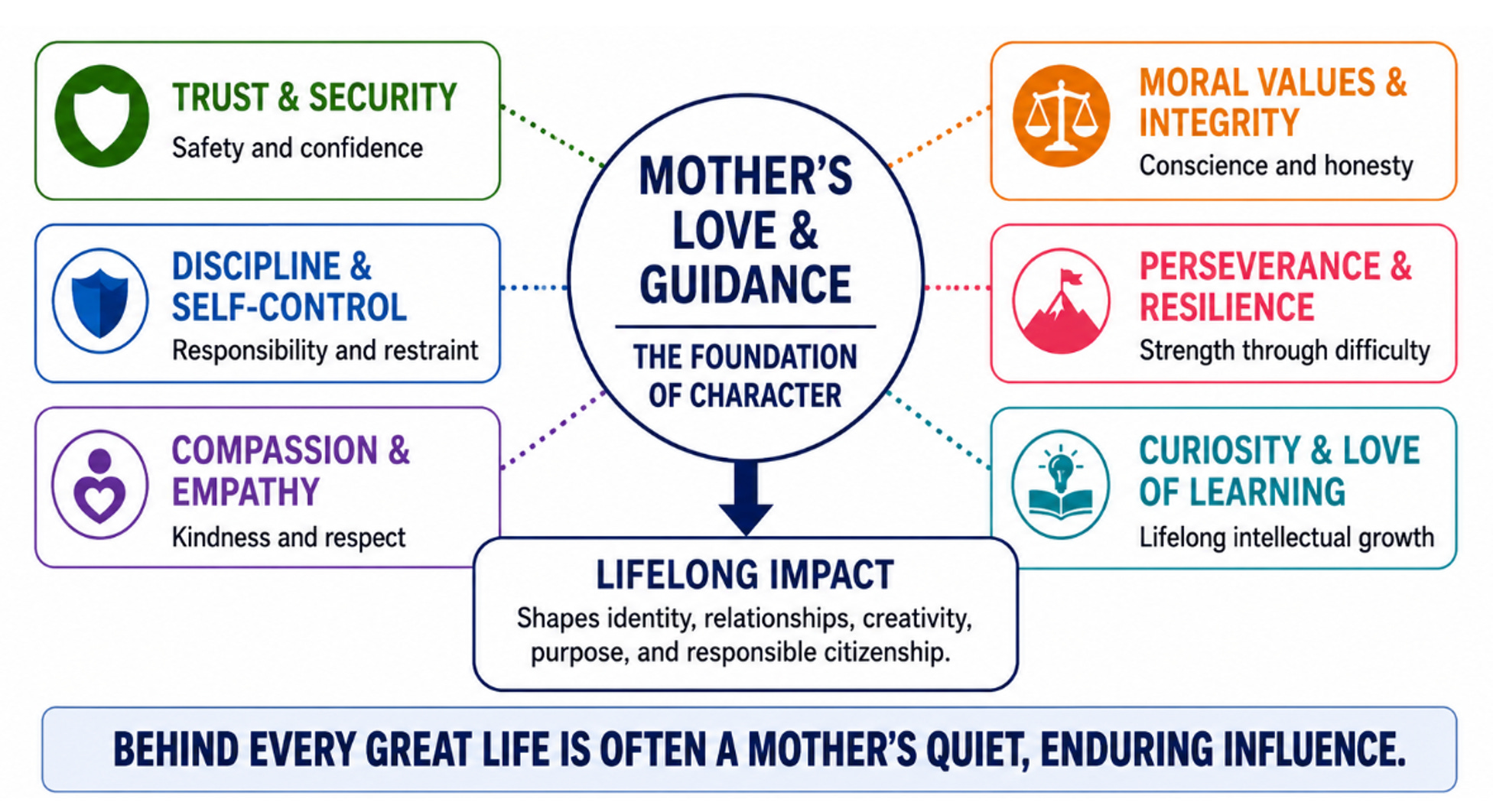
Figure 1
Maternal Love and the Foundation of Character
Note. Source: Developed by the authors with AI-assisted visual refinement.
Figure 1 illustrates the article’s central argument that a mother’s love and guidance provide an early foundation for character formation. From this emotional bond emerge six interconnected developmental qualities—trust and security, discipline and self-control, compassion and empathy, moral values and integrity, perseverance and resilience, and curiosity with a love of learning—which together shape identity, relationships, creativity, purpose, and responsible citizenship. Although maternal influence does not determine destiny, it often establishes the emotional and moral architecture upon which individuals build meaningful lives and contribute to families, communities, and society (Ainsworth et al., 1978; Bowlby, 1969; Cassidy et al., 2013; Masten, 2014; Winnicott, 1965).
2. Maternal Love as the Foundation of Character
Although maternal influence takes many forms, a loving and morally grounded mother often provides the earliest environment in which trust, discipline, compassion, perseverance, responsibility, resilience, healthy relationships, and confidence develop, laying a lasting foundation for moral growth, intellectual development, and lifelong purpose (Ainsworth et al., 1978; Bowlby, 1969; Cassidy et al., 2013; Masten, 2014; Winnicott, 1965).
2.1 Shin Saimdang and Yi Yulgok: Maternal Wisdom and Scholarly Formation
Korean history offers a powerful example of constructive maternal influence in the relationship between Shin Saimdang and her son Yi I, widely known by his pen name Yulgok. Shin Saimdang was respected not only as an accomplished painter, poet, and calligrapher but also as a thoughtful mother who cultivated learning, discipline, moral seriousness, and self-reflection within the home. She integrated intellectual development with character formation, modeling a life in which artistic creativity, practical responsibility, family devotion, and Confucian learning strengthened one another. Her example gave Yi Yulgok an early environment in which study was understood not merely as preparation for personal advancement but as a means of developing wisdom, integrity, and responsibility toward society (De Bary & Haboush, 1985; Deuchler, 1992; Kim, 2014).
Yi Yulgok later became one of the most influential Confucian scholars and statesmen of the Joseon Dynasty. His philosophical writings, educational thought, concern for public administration, and emphasis on practical national preparedness reflected both intellectual brilliance and a deeply formed sense of duty. Although his achievements cannot be attributed to maternal influence alone, Shin Saimdang’s guidance helped establish the habits of learning, moral discipline, creativity, and public responsibility upon which his later work developed. Their relationship demonstrates that a mother may shape both the inner character and intellectual direction of a child by integrating affection, example, education, and moral expectation in everyday family life (De Bary & Haboush, 1985; Kim, 2014; Lee, 1996).
2.2 Yi Sun-sin and Immanuel Kant: A Mother’s Moral Legacy
Admiral Yi Sun-sin and philosopher Immanuel Kant lived in different civilizations and pursued very different callings, yet both illustrate how maternal guidance can establish a lasting foundation of duty, integrity, and moral courage. Yi Sun-sin’s mother is remembered in Korean historical tradition as a strong and principled woman who encouraged discipline, loyalty, perseverance, and responsibility. Her influence helped form the inner character that later enabled him to withstand political injustice, military crisis, imprisonment, and repeated personal hardship without abandoning his duty to defend the nation. His leadership during the Japanese invasions of Korea reflected not only strategic genius but also steadfast self-control, courage, and devotion to the common good. While many factors shaped his achievements, the moral discipline cultivated within his family provided an important foundation for his extraordinary resilience and public service (Yi, 1977).
Immanuel Kant likewise attributed his earliest moral formation to his mother, Anna Regina Reuter Kant. Although the family lived in modest circumstances, she possessed deep religious conviction, intellectual curiosity, reverence for nature, and strong personal integrity. Kant later recalled that she had planted in him the first “germ of goodness,” opened his heart to nature, and exerted a lasting beneficial influence on his life. These early lessons can be seen in his later emphasis on duty, moral law, personal responsibility, human dignity, and the principle that people should never be treated merely as instruments. Together, Yi Sun-sin and Kant demonstrate that a mother’s moral legacy may take different forms—steadfast courage in national service or disciplined reasoning in moral philosophy—but in both cases it begins with daily example, ethical instruction, and the formation of conscience long before public greatness becomes visible (Kuehn, 2001).
A nation’s future is first written in the hearts of its mothers
long before it is recorded in the pages of its history.
3. Maternal Loss, Emotional Distance, and Human Struggle
Not every great life begins with maternal security; early loss, emotional distance, neglect, or political disruption may create loneliness and lifelong struggle, yet these wounds also reveal the resilience of the human spirit, becoming either enduring burdens or catalysts for creativity, reflection, and achievement (Bowlby, 1969; Masten, 2014).
3.1 The Tragedy of Yeonsangun: When Maternal Loss Distorts Leadership
Among Korea’s most tragic historical figures, Yeonsangun of the Joseon Dynasty illustrates how early maternal trauma can profoundly influence personality and leadership. His biological mother, Queen Yun, was deposed and later executed during his childhood after falling out of favor with the royal court. The young prince grew up largely unaware of the circumstances surrounding her death, only discovering the truth after ascending the throne. The revelation generated overwhelming grief, resentment, and a consuming desire for revenge against those whom he believed had destroyed his mother (Deuchler, 1992; Lee, 1996).
Historians have long regarded this traumatic discovery as one of several important factors contributing to Yeonsangun’s increasingly tyrannical rule. His violent purges, distrust of officials, emotional instability, and relentless vengeance devastated the kingdom and ultimately led to his removal from the throne. Although political struggles, royal succession, and court intrigue also shaped his reign, the tragedy demonstrates how unresolved childhood trauma can distort judgment when combined with unchecked political power. Yeonsangun’s story stands as a sobering reminder that emotional wounds left unattended may influence not only individual lives but also the destiny of entire nations (Lee, 1996; Masten, 2014).
3.2 Virginia Woolf and Bertrand Russell: Maternal Loss and the Search for Emotional Security
Virginia Woolf and Bertrand Russell experienced maternal loss at different stages of childhood, yet both lives demonstrate how early absence can leave a lasting psychological imprint. Woolf regarded her mother, Julia Stephen, as the emotional center of the family, admiring her intelligence, compassion, beauty, and devotion. Julia’s sudden death when Woolf was thirteen became one of the defining emotional events of her life, contributing to recurring grief and psychological instability. Russell lost both parents before the age of four and therefore had little opportunity to form a sustained maternal relationship. Raised primarily by his grandmother, Lady Russell, he grew up in a household shaped by strict moral principles, intellectual seriousness, and public service. In both cases, maternal absence created an enduring search for emotional security, although Woolf carried the vivid memory of maternal affection while Russell depended more heavily on later caregivers and inherited moral structure (Russell, 1967; Woolf, 1985).
Both figures transformed early loss into intellectual and creative achievement. Woolf repeatedly revisited the memory of her mother in her novels and essays, especially in To the Lighthouse, where maternal love, memory, family, identity, and grief become central themes. Russell’s autobiography likewise reveals that beneath his philosophical achievements lay a lifelong search for certainty, love, and human connection. His advocacy of reason, peace, education, and social reform reflected not only intellectual conviction but also a deep awareness of human vulnerability. Together, their lives show that maternal loss can shape emotional life for decades, but later relationships, education, reflection, and creative work may help individuals transform absence into insight, resilience, and enduring contribution (Masten, 2014; Russell, 1967; Woolf, 1985).
3.3 W. Somerset Maugham and Stendhal: Maternal Loss, Memory, and Literary Insight
W. Somerset Maugham and Stendhal, whose full name was Marie-Henri Beyle, both lost beloved mothers during childhood, although the emotional consequences developed differently. Maugham’s mother, Edith Mary Maugham, died of tuberculosis when he was eight, and his father died two years later, leaving him to be raised by a strict and emotionally reserved uncle. Stendhal lost his mother, Henriette Gagnon, at seven and later found little warmth from his authoritarian father. In both lives, maternal loss created enduring loneliness and a heightened sensitivity to affection, belonging, and human vulnerability (Morgan, 1980; Stendhal, 1958).
Both writers transformed these early wounds into distinctive literary insight. In Of Human Bondage, The Razor’s Edge, and The Moon and Sixpence, Maugham explored loneliness, suffering, ambition, and the search for meaning, while Stendhal’s The Red and the Black and The Charterhouse of Parma examined love, freedom, authenticity, and conflict with social convention. Maugham converted private grief into empathy and sober observation, whereas Stendhal preserved the memory of maternal love as a source of emotional intensity and artistic sensitivity. Their lives show that brief maternal affection followed by profound loss can shape imagination and creative expression across a lifetime, preparing the discussion of how early family relationships also influence philosophy, identity, and worldview (Morgan, 1980; Stendhal, 1958).
A mother’s influence does not determine destiny, but it often lays the emotional and moral foundation upon which destiny is built.
4. Maternal Influence and the Formation of Perspective
Maternal influence extends beyond emotional security by shaping how individuals interpret morality, knowledge, identity, suffering, and public responsibility. Yi Hwang and Jeong Yak-yong illustrate disciplined scholarship and practical responsibility, while Nietzsche and Hemingway show how family tension may be transformed into philosophical and literary expression without determining later outcomes (De Bary & Haboush, 1985; Kalton, 1988; Lee, 1996).
4.1 Maternal Foundations of Moral and Practical Learning
Yi Hwang, widely known as Toegye, lost his father in early childhood and was raised in a family environment that emphasized learning, discipline, and moral self-cultivation. His mother, Lady Park of the Chuncheon Park clan, formed part of the household context from which his seriousness about study and character emerged. Yi Hwang later became one of Korea’s most influential Neo-Confucian philosophers, emphasizing reverence, reflective self-examination, disciplined learning, and cultivation of the heart-and-mind. Although his mature philosophy developed through extensive study and public experience, his early family formation helped establish the inward discipline that characterized his scholarship and teaching (De Bary & Haboush, 1985; Kalton, 1988).
Jeong Yak-yong, known as Dasan, was born into a learned Joseon family and lost his mother, Lady Yun of the Haenam Yun clan, while still a child. The intellectual and cultural inheritance of his maternal family, together with the education provided within his wider household, contributed to the early development of his curiosity and practical orientation. He later became a leading Silhak scholar whose writings addressed government, ethics, technology, administration, and the well-being of ordinary people. Together, Yi Hwang and Jeong Yak-yong illustrate how maternal and family foundations may support complementary perspectives of moral self-cultivation and practical responsibility for society (De Bary & Haboush, 1985; Lee, 1996).
4.2 Maternal Conflict, Resistance, and Perspective Development
Friedrich Nietzsche lost his father at the age of four and was raised by his mother, Franziska Nietzsche, together with his grandmother and aunts in a deeply religious Lutheran household. This environment provided stability, discipline, and sustained exposure to Christian morality, while also becoming the background against which he later questioned inherited religion and conventional values. Ernest Hemingway likewise developed part of his literary perspective through conflict with his strong and accomplished mother, Grace Hall Hemingway, and although education, war, travel, ambition, and personal tragedy also shaped him, this family tension became important emotional and intellectual material that he later resisted, reinterpreted, and transformed (Dearborn, 2017; Safranski, 2002).
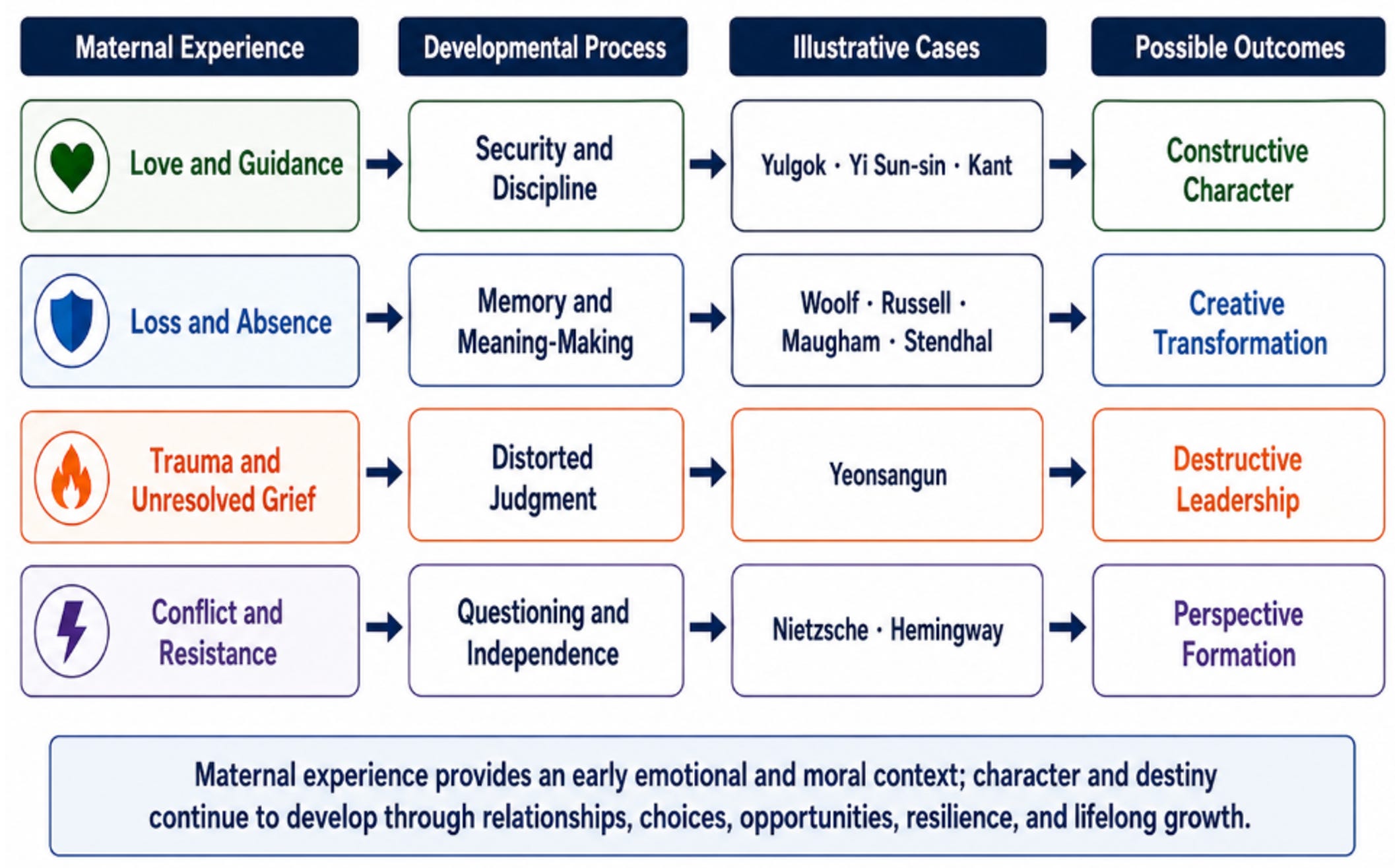
Across these four cases, maternal influence operates less as a direct cause than as an early interpretive context through which individuals encounter authority, morality, identity, discipline, affection, and conflict. Yi Hwang developed disciplined moral reflection, Jeong Yak-yong extended inherited learning toward practical social responsibility, Nietzsche converted religious upbringing into critical resistance, and Hemingway transformed family tension into literary themes of endurance, independence, and self-command. Figure 2 presents these patterns within a broader framework in which mothers provide early nurturing, emotional security, and guidance, while fathers, mentors, education, faith, later relationships, temperament, historical circumstances, personal choice, reflection, and resilience continue to shape character and perspective over time (Cassidy et al., 2013; Masten, 2014).
Figure 2 illustrates how maternal experiences—including love, guidance, loss, emotional distance, and conflict—may contribute to different pathways of character and perspective development. Constructive foundations are illustrated in Figure 2 by Yi Yulgok, Yi Sun-sin, and Immanuel Kant, while the related cases of Yi Hwang and Jeong Yak-yong further demonstrate how wider family, educational, and intellectual environments may support moral and practical development (Dearborn, 2017; Kim, 2014; Kuehn, 2001; Morgan, 1980; Russell, 1967; Safranski, 2002; Stendhal, 1958; Woolf, 1985; Yi, 1977). These historically grounded cases are illustrative rather than causal, supporting the article’s central argument that maternal experience provides an early emotional and moral context while character and destiny continue to develop through temperament, other caregivers, education, mentors, institutions, historical circumstances, personal choices, resilience, and later relationships (Cassidy et al., 2013; De Bary & Haboush, 1985; Deuchler, 1992; Kalton, 1988; Lee, 1996; Masten, 2014; Yi, 1977).
Figure 2
The Mother Factor: From Early Maternal Experience to Character, Perspective, and Destiny
Note. Source: Developed by the authors with AI-assisted visual refinement.
Great lives are rarely born from perfect childhoods; they emerge when love, loss, and suffering are transformed into character, wisdom, and enduring contribution.
5. Conclusion
This article has focused on the “mother factor” in the lives of selected extraordinary individuals, showing how maternal love, guidance, loss, distance, and conflict may influence character, creativity, leadership, and destiny without determining them completely. Beyond these prominent cases, countless children throughout the world grow up with little opportunity to receive a mother’s sustained care because of death, poverty, war, displacement, illness, family separation, or other difficult circumstances; their lives remind us never to take maternal presence for granted. Those who experience devoted motherhood—and those entrusted with the opportunity and responsibility to provide maternal care—possess a profound blessing, because affection, sacrifice, discipline, prayer, and faithful presence can shape a human life for generations. Spouses, families, institutions, and communities therefore have compelling reasons to respect, honor, support, and remain grateful to those who bear the privileges, sacrifices, and responsibilities of motherhood.
AI-Assisted Visual Disclosure: AI tools were used to assist in developing and refining the conceptual figures. The figures were reviewed and edited by the authors and are intended as original explanatory illustrations rather than empirical models or historical reproductions.
References
Ainsworth, M. D. S., Blehar, M. C., Waters, E., & Wall, S. (1978). Patterns of attachment: A psychological study of the Strange Situation. Lawrence Erlbaum Associates.
Bowlby, J. (1969). Attachment and loss: Vol. 1. Attachment. Basic Books.
Cassidy, J., Jones, J. D., & Shaver, P. R. (2013). Contributions of attachment theory and research: A framework for future research, translation, and policy. Development and Psychopathology, 25(4, Pt. 2), 1415–1434. https://doi.org/10.1017/S0954579413000692
De Bary, W. T., & Haboush, J. K. (Eds.). (1985). The rise of Neo-Confucianism in Korea. Columbia University Press.
Dearborn, M. V. (2017). Ernest Hemingway: A biography. Alfred A. Knopf.
Deuchler, M. (1992). The Confucian transformation of Korea: A study of society and ideology. Harvard University Asia Center.
Kalton, M. C. (Trans.). (1988). To become a sage: The Ten Diagrams on Sage Learning by Yi T’oegye. Columbia University Press.
Kim, S. (2014). Vacillating images of Shin Saimdang: The invention of a historical heroine in colonial Korea. Inter-Asia Cultural Studies, 15(2), 274–290. https://doi.org/10.1080/14649373.2014.911440
Kuehn, M. (2001). Kant: A biography. Cambridge University Press.
Lee, P. H. (Ed.). (1996). Sourcebook of Korean civilization: Vol. 2. From the seventeenth century to the modern period.Columbia University Press.
Masten, A. S. (2014). Ordinary magic: Resilience in development. Guilford Press.
Morgan, T. (1980). Somerset Maugham. Simon & Schuster.
Russell, B. (1967). The autobiography of Bertrand Russell: Vol. 1. 1872–1914. Little, Brown and Company.
Safranski, R. (2002). Nietzsche: A philosophical biography (S. Frisch, Trans.). W. W. Norton & Company.
Stendhal. (1958). The life of Henry Brulard (J. Stewart & B. C. J. G. Knight, Trans.). Noonday Press.
Winnicott, D. W. (1965). The maturational processes and the facilitating environment: Studies in the theory of emotional development. International Universities Press.
Woolf, V. (1985). Moments of being (J. Schulkind, Ed., 2nd ed.). Harcourt Brace Jovanovich.
Yi, S. S. (1977). Nanjung ilgi: War diary of Admiral Yi Sun-sin (H. T. Ha, Trans.). Yonsei University Press.
Original Article:

Suggested Citation: Paul C. Hong & Sarah Y. Hong (2026). The mother factor: Lessons on how maternal relationships shape character and destiny. K-GSP Forum, 1–10.
About the Authors

Distinguished Professor, Dr. Paul Hong (Editor in Chief) — University of Toledo
Paul C. Hong is a Distinguished University Professor at the University of Toledo and serves as an affiliated faculty member of the University’s Asian Studies Program. His interdisciplinary scholarship explores how individuals, families, organizations, and societies cultivate character, resilience, wisdom, and enduring purpose across generations. Integrating insights from history, psychology, philosophy, leadership, literature, and faith, his recent work examines the formative influences that shape human flourishing beyond professional achievement. In the age of artificial intelligence, he argues that uniquely human qualities—including moral character, compassionate relationships, ethical judgment, and intergenerational stewardship—will become increasingly essential for responsible leadership and the long-term well-being of individuals, families, and societies.
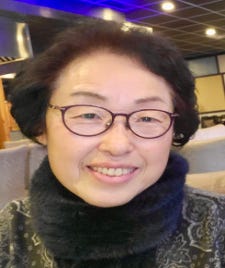
Sarah Y. Hong
Retired Nursing Officer and Mother of Prayer
Sarah Y. Hong is a retired registered nurse and former Korean Army nursing officer who has devoted her life to nursing, motherhood, family care, and Christian ministry. As a Korean Army nursing officer during the Vietnam War era, she gained early experience caring for wounded service members and others in need. As the mother of four children, grandmother of six grandchildren, and longtime life partner of coauthor Paul C. Hong, she brings both professional caregiving experience and an intergenerational family perspective to this study of maternal influence. Beyond her own family, she has served for many years as a prayer mother and compassionate mentor to individuals and families across a broader Christian community. She also enjoys drawing and painting, finding inspiration in the works of Vincent van Gogh and Claude Monet.
어머니 요인: 모성 관계가 성품과 운명을 형성하는 방식에 관한 교훈
저자 소개: 폴 C. 홍(Paul C. Hong)은 미국 톨레도대학교의 석좌교수로, 공급망 관리·리더십·거버넌스·인간의 성품과 회복탄력성을 연구하며 역사, 심리학, 철학, 문학과 신앙을 통합하여 인간의 성장과 책임 있는 삶을 탐구하고 있다. 사라 Y. 홍(Sarah Y. Hong)은 대한민국 예비역 육군간호장교이자 은퇴한 간호사로, 베트남전 시기 부상병을 돌본 경험을 바탕으로 평생 간호, 가족 돌봄, 기독교 사역과 기도의 삶을 실천해 왔다.
이 글은 신사임당과 율곡 이이, 임마누엘 칸트, 버지니아 울프, 버트런드 러셀, 서머싯 몸, 스탕달, 연산군, 프리드리히 니체, 어니스트 헤밍웨이 등 역사적 인물들의 삶을 통해 어머니와의 초기 관계가 성품, 정서, 창의성, 리더십과 인생의 방향에 어떤 흔적을 남기는지를 비교한다. 핵심 주장은 어머니의 사랑이나 상실이 운명을 기계적으로 결정하지는 않지만, 한 인간이 이후의 삶을 세워 가는 정서적·도덕적 토대를 형성한다는 것이다.
건강한 모성 관계는 신뢰, 안정감, 절제, 공감, 도덕성, 인내와 배움에 대한 사랑을 길러 주는 첫 번째 환경이 될 수 있다. 신사임당은 예술적 재능과 가정교육, 유교적 학문과 도덕적 본보기를 결합하여 율곡 이이가 학자이자 국가적 책임을 지닌 지도자로 성장할 수 있는 기초를 마련했다. 칸트의 어머니 안나 레기나는 가난한 환경 속에서도 신앙, 자연에 대한 경외, 정직과 책임을 가르쳤고, 이러한 영향은 훗날 칸트의 의무, 도덕법과 인간 존엄성에 대한 철학적 강조 속에 반영되었다. 반면 울프와 러셀은 어린 시절 어머니를 잃었으며, 그 상실은 평생 정서적 안정과 사랑을 추구하게 한 원인이 되었지만 동시에 문학, 철학, 평화와 교육에 대한 깊은 통찰로 전환되었다. 이 사례들은 어머니의 존재가 직접적인 가르침뿐 아니라 정서적 기억, 도덕적 분위기와 일상의 본보기를 통해 평생 지속될 수 있음을 보여준다.
모성의 상실이나 갈등은 동일한 결과를 낳지 않는다. 연산군은 어머니 폐비 윤씨의 죽음에 대한 진실을 뒤늦게 알고 깊은 원한과 복수심에 사로잡혔으며, 해결되지 않은 상처는 권력과 결합되어 폭정과 파괴적 리더십으로 나타났다. 서머싯 몸은 어머니를 여덟 살에 잃은 뒤 외로움과 정서적 고립을 겪었지만, 그 고통을 인간의 나약함과 의미 추구를 이해하는 문학적 통찰로 바꾸었다. 스탕달은 짧았지만 깊었던 어머니의 사랑을 평생 기억하며 사랑, 자유, 진정성과 인간관계의 복잡성을 탐구했고, 니체는 어머니와 여성 가족들이 제공한 엄격한 종교적 환경에 반발하면서 오히려 전통 도덕과 종교를 비판하는 독창적 철학을 발전시켰다. 헤밍웨이는 강한 성격의 어머니와 갈등을 겪으며 독립, 용기, 남성성, 고통 속의 존엄이라는 주제를 문학적으로 탐구했지만, 그의 삶은 창조적 성취가 반드시 정서적 상처를 치유하는 것은 아님을 함께 보여준다.
이 글이 제시하는 실천적 교훈은 분명하다. 본문은 특별한 성취를 이룬 인물들의 사례를 중심으로 어머니의 사랑과 지도, 상실과 갈등이 성품과 삶의 방향에 어떤 영향을 줄 수 있는지를 살펴보았지만, 오늘날 세상에는 전쟁, 빈곤, 질병, 사별, 이주와 가족 해체로 인해 어머니의 돌봄을 충분히 경험하지 못하는 수많은 아이들이 있다. 그러므로 헌신적인 어머니의 사랑과 지속적인 돌봄을 경험하는 것은 결코 당연한 일이 아니라 깊이 감사해야 할 축복이며, 사랑, 훈육, 희생, 기도와 성실한 현존은 한 사람의 삶을 넘어 다음 세대에까지 영향을 미칠 수 있다. 남편들은 아내가 감당하는 모성의 특권과 책임, 보이지 않는 희생과 수고를 존중하고 지지하며 감사해야 하고, 가정과 사회도 아버지, 보호자, 교사, 멘토와 공동체가 함께 모든 아이에게 안정감, 존엄성, 회복탄력성과 희망을 제공하도록 노력해야 한다. 부모가 완전하지 못했거나 어린 시절에 상실과 갈등을 경험했더라도 인간은 교육, 신앙, 건강한 관계, 성찰, 선택과 인내를 통해 치유되고 성장할 수 있으며, 어머니는 삶의 첫 장에 중요한 흔적을 남기지만 각 사람은 평생 자신의 다음 장을 계속 써 내려간다.
Reading this article deeply moved me and prompted me to reflect on my own life. I have always believed that family plays a vital role in shaping a person's character, but this article helped me appreciate even more profoundly how a mother's love, sacrifice, and guidance can influence the course of a person's life. The comparisons between historical figures from both Korea and the West made the author's message both convincing and inspiring.
As I read, I could not help but think of my own mother and her quiet devotion to our family. She sacrificed so much for her children, often putting our needs before her own without expecting recognition or reward. Looking back, I realize that many of the values I hold today—perseverance, responsibility, faith, and compassion—were nurtured through her example. What I once took for granted, I now recognize as one of the greatest blessings in my life.
This article also made me miss my late mother even more. I found myself wishing that I could see her one more time, simply to thank her for everything she had done for me. Although she is no longer with us, her love, prayers, and the lessons she taught continue to live in my heart and influence my life every day. In many ways, I feel that her legacy is still shaping the person I am becoming.
I especially appreciated the balanced perspective of the article. Rather than claiming that a mother's influence completely determines a person's destiny, it wisely acknowledges that education, faith, relationships, historical circumstances, personal choices, and resilience also play essential roles. I found this perspective both realistic and deeply encouraging.
This is more than an article about motherhood; it is a reminder to cherish those who have loved and sacrificed for us, often without recognition. It inspired me to live a life worthy of my mother's sacrifices and to pass on the same love, faith, and values to the next generation. It is a thoughtful and memorable article that will stay with me for a long time.
Based on my personal experience, I believe that a strong, healthy bond with one's mother during early childhood plays an important role in shaping a person's character and fostering stable social and emotional development.
On another note, after learning about your wife's background, I think I understand why your family feels so loving, warm, and harmonious.