

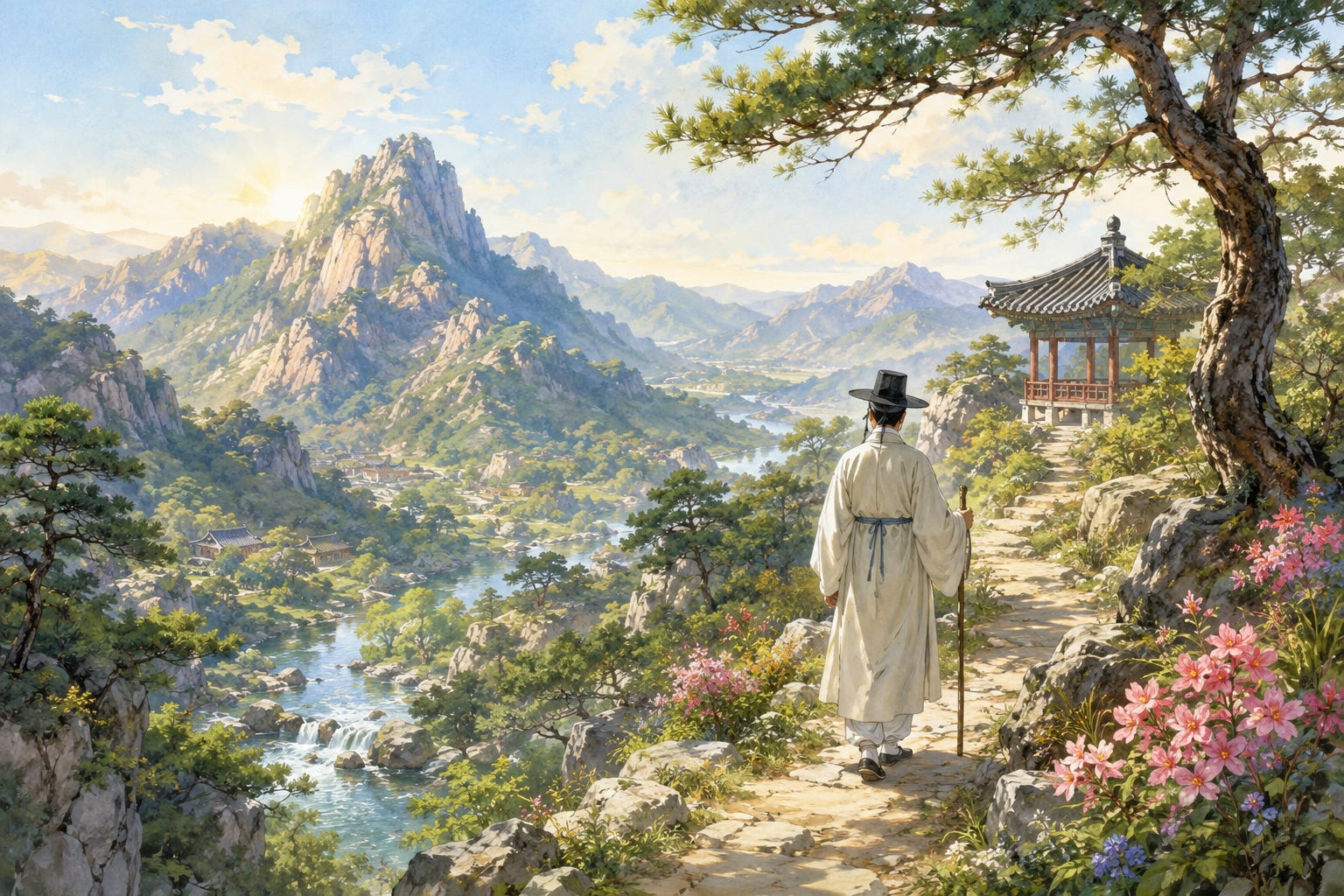
As I read Gongsanrok in Volume 7 of The Gani Collection, the first thought that came to my mind was this: a mountain may never speak, yet it is one of the greatest teachers in life. While climbing a mountain, Choi Rip did far more than record the magnificent scenery before him. As he walked along the mountain paths, he reflected on his own life and contemplated the virtues, attitudes, and principles that human beings should uphold. Consequently, Gongsanrok is not merely a record of a mountain journey but a profound meditation on the wisdom of life discovered through nature.
Today, we can reach even the highest mountains with the help of automobiles or cable cars. Yet the more convenient our lives become, the fewer opportunities we have to slow down and truly experience nature. Choi Rip climbed the mountain one step at a time, embracing the sound of the wind, the murmur of mountain streams, and the fragrance of the forest with all his senses. For him, the true purpose of the journey was not to arrive quickly at the destination but to learn through every step of the climb.
What impressed me most was Choi Rip’s humility before nature. Standing before majestic mountain peaks, he realized how small human beings are in comparison with the grandeur of the natural world. Gazing upon endless forests and valleys, he came to appreciate nature’s magnificence and timelessness. His reflections remind us that nature should not be regarded as something to conquer but as a precious companion with whom we must live in harmony. In today’s world, where environmental degradation and climate change have become urgent global concerns, his perspective is more meaningful than ever.
Another remarkable aspect of Gongsanrok is Choi Rip’s warmth toward the people he encountered along his journey. He treasured every meeting, appreciated the beauty of sharing the landscape with others, and treated everyone with kindness and respect. Through his travels, he quietly teaches us that nature encourages people not to compete against one another but to understand, appreciate, and care for each other. His observations reveal that genuine human relationships are nurtured through humility, empathy, and mutual respect.
Reading this work also led me to realize that life itself resembles climbing a mountain. The ascent is often difficult and demanding, but once we reach the summit, we gain a broader and clearer view of the world. Likewise, our failures and hardships are not meaningless obstacles; they are essential steps in our personal growth. Although Choi Rip climbed a physical mountain, his greatest journey was inward, leading him to a deeper understanding of his own heart and character.
Although Gongsanrok was written centuries ago, its message remains remarkably relevant today. Love for nature, respect for others, and the continual practice of self-reflection are timeless values that never lose their significance. After finishing this work, I found myself wanting to slow down instead of constantly striving for higher achievements. I hope to appreciate the path I am currently walking, cherish each step with gratitude, and continue growing through every experience.
Gongsanrok is far more than a record of climbing a mountain; it is a timeless story about the growth of the human spirit. The peace, wisdom, and inner strength that Choi Rip discovered in nature continue to offer comfort, encouragement, and renewed hope to people living in today’s fast-paced world. For this reason, I believe Gongsanrok remains a treasured classic whose enduring message continues to resonate deeply with readers more than four centuries after it was written. +++
{Solti}
July 23, 2026
Chinese Character Explanation
公 (Gong): In this context, Gong (公) refers to the place name Gongsan (公山) rather than its general meaning of “public” or “official.”
山 (San): Means “mountain.”
錄 (Rok): Means “record” or “written account.”
Therefore, 公山錄 (Gongsanrok) literally means:
“A travel record documenting what the author saw, heard, experienced, and reflected upon during his journey to Gongsan (Mount Gong).”
The Historical Significance of Gongsan (公山)
Gongsan (公山) is the historical name of what is now widely known as Palgongsan (八公山, Mount Palgong), located in present-day Dong-gu, Daegu, South Korea.
Since ancient times, Gongsan has been celebrated for its magnificent natural scenery and rich historical and cultural heritage. It has long been regarded as one of Korea’s distinguished mountains, attracting numerous scholars, poets, and literary figures who composed poetry and travel essays inspired by its beauty and tranquility.
In Gongsanrok, Choi Rip goes far beyond simply describing the mountain’s landscape. Through his journey, he explores timeless themes such as:
The beauty of nature
Human humility
Reflection on life
Harmony between humanity and nature
Self-cultivation and the growth of moral character
Consequently, Gongsanrok (公山錄) should be understood not merely as a travel narrative but as a reflective literary work in which Choi Rip records the wisdom of life and the process of self-examination inspired by his journey through nature. It is both a travel account and a philosophical meditation, illustrating how the natural world can nurture personal growth, inner peace, and enduring wisdom.
산이 들려준 가장 깊은 가르침
『간이집』 제7권 「공산록(公山錄)」을 읽고
『간이집』 제7권 「공산록(公山錄)」을 읽으며 가장 먼저 떠오른 생각은 “산은 말을 하지 않지만, 가장 많은 것을 가르쳐 주는 스승”이라는 것이었다. 최립은 산을 오르며 눈앞에 펼쳐지는 아름다운 풍경만을 기록하지 않았다. 그는 산길을 걸으며 자신의 삶을 돌아보고, 자연 속에서 인간이 지켜야 할 도리와 마음가짐을 깊이 생각했다. 그래서 「공산록」은 단순한 산행 기록이 아니라 자연을 통해 삶의 지혜를 배우는 성찰의 글로 다가왔다.
오늘날 우리는 높은 산도 자동차나 케이블카를 이용해 쉽게 오를 수 있다. 그러나 편리함이 커질수록 천천히 걸으며 자연을 느끼는 기회는 줄어들고 있다. 최립은 한 걸음 한 걸음 산길을 오르며 바람 소리와 계곡의 물소리, 숲의 향기를 온몸으로 받아들였다. 그의 여행은 빠르게 목적지에 도착하는 일이 아니라, 걸어가는 과정에서 배우는 일이었다.
무엇보다 인상 깊었던 것은 자연을 대하는 그의 겸손한 태도였다. 웅장한 산봉우리 앞에서 그는 인간의 작은 존재를 깨닫고, 끝없이 이어지는 숲과 계곡을 바라보며 자연의 위대함을 느꼈다. 이러한 모습은 인간이 자연을 정복의 대상으로만 바라보기보다 함께 살아가야 할 소중한 동반자로 존중해야 한다는 사실을 일깨워 준다. 오늘날 환경 문제와 기후 변화가 심각해지는 시대에 그의 생각은 더욱 큰 의미를 가진다.
또한 「공산록」에는 사람을 대하는 따뜻한 마음도 담겨 있다. 길에서 만나는 사람들과의 인연을 소중히 여기고, 함께 풍경을 감상하며 서로를 배려하는 모습은 참된 인간관계가 무엇인지를 보여 준다. 자연은 사람을 경쟁하게 만들기보다 서로를 이해하고 존중하도록 이끈다는 사실을 최립은 자신의 여행을 통해 조용히 전하고 있다.
이 글을 읽으며 나는 삶도 산을 오르는 과정과 닮아 있다는 생각을 했다. 오르막길에서는 힘이 들지만 정상에 서면 더 넓은 세상을 바라볼 수 있다. 실패와 어려움도 결국 우리를 성장시키는 과정이라는 사실을 산은 말없이 가르쳐 준다. 최립은 산을 오르며 자연을 보았지만, 결국 자신의 마음을 더 깊이 들여다보았던 것이다.
『공산록』은 오래된 기행문이지만 지금의 우리에게도 여전히 살아 있는 메시지를 전한다. 자연을 사랑하는 마음, 사람을 존중하는 태도, 그리고 끊임없이 자신을 돌아보는 자세는 시대가 변해도 결코 변하지 않는 삶의 가치이다. 이 책을 덮으며 나 역시 더 높은 곳만 바라보며 서두르기보다, 지금 걷고 있는 길을 감사하는 마음으로 천천히 걸어가고 싶다는 다짐을 하게 되었다.
『간이집』 제7권 「공산록」은 산을 기록한 글이 아니라 사람을 성장시키는 이야기이다. 최립이 자연 속에서 발견한 평온과 지혜는 오늘날 바쁘게 살아가는 우리에게도 깊은 위로와 새로운 용기를 전해 준다. 그래서 이 책은 수백 년이 지난 지금도 독자의 마음속에 오래도록 울림을 남기는 귀한 고전이라 생각한다. +++
2026년 7월 23일
{솔티}
한자 풀이
公(공): 공(公). 여기서는 공산(公山)이라는 지명의 ‘공’입니다.
山(산): 산, 산악.
錄(록): 기록, 기록한 글.
따라서, 公山錄 (공산록)은 “공산을 여행하며 보고 듣고 느낀 것을 기록한 기행문”이라는 뜻입니다.
공산(公山)의 역사적 의미
공산(公山)은 오늘날 대구광역시 동구에 위치한 팔공산(八公山)의 옛 이름으로 알려져 있습니다. 공산은 예로부터 수려한 자연경관과 깊은 역사적 의미를 지닌 명산으로, 많은 문인과 선비들이 이곳을 찾아 시와 기행문을 남겼습니다.
최립은 「공산록」에서 단순히 산의 경치를 묘사하는 데 그치지 않고,
자연의 아름다움
인간의 겸손
삶의 성찰
자연과 인간의 조화
자기 수양과 인격의 성장
을 함께 담아냈습니다.
따라서 「공산록(公山錄)」은 공산을 여행하며 자연 속에서 삶의 지혜와 자기 성찰을 기록한 기행문으로 이해할 수 있습니다.

Prof. Dr. Young Choi (Editor in Chief) — Regent University
Young B. Choi is a Professor in the Department of Engineering & Computer Science at Regent University. He published 38 books with ‘Selected Readings in Cybersecurity’ (2018) (over 800 copies archived globally at university/college libraries around the world) and ‘Cybersecurity Applications and Artificial Intelligence’ (2023) available in seven major world languages. He proposed the world’s first global and universal telecommunications “Service Order Handling (SOH)” Model (T-SOH Model) (1995) with Dr. Adrian Tang. With this innovative research work, he received the IEEE NOMS ’96 Best Paper Award and became the first recipient of the Outstanding Contribution Award of the TeleManagement Forum in 1998. His research areas include Natural Language Processing-focused AI, AI-applied cybersecurity, network and telecom service management, and Korean studies on Gani Choi Rip’s Jeonggwan (靜觀: Quiet Contemplation) philosophy and Shilhak ( 實學: Practical Learning).