
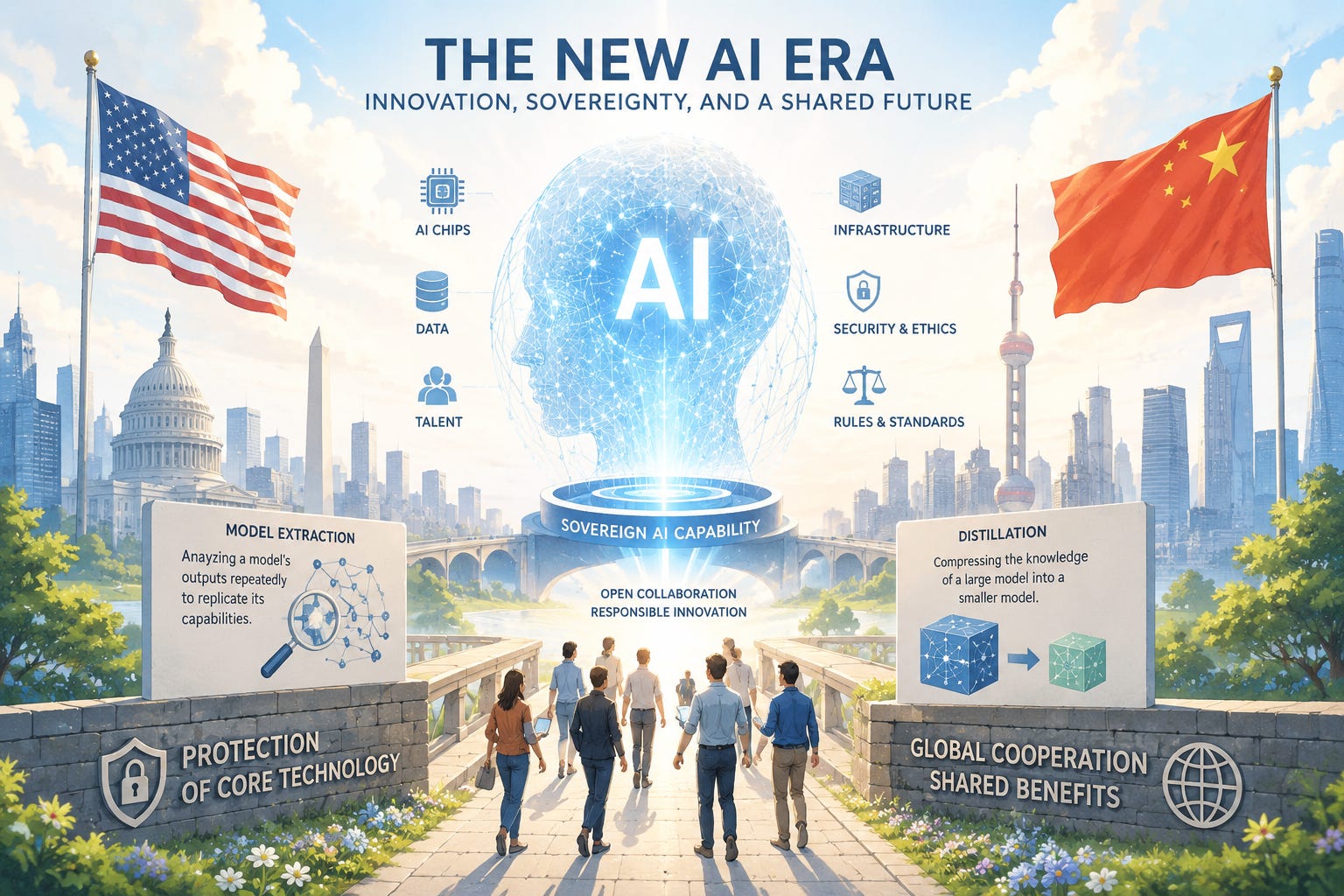
Recent reports that the United States government has warned Chinese artificial intelligence (AI) firms against attempts at “model extraction” and “distillation” represent far more than an ordinary technology dispute. Model extraction refers to the process of repeatedly analyzing the outputs and response patterns of another company’s advanced AI system in order to replicate its core capabilities. In simple terms, it resembles tasting a famous restaurant’s signature dish countless times until one can closely reproduce the recipe. Distillation, meanwhile, is a widely used AI technique in which the knowledge of a massive AI model is compressed into a smaller and more efficient model. It is similar to learning from a concise study guide distilled from a professor’s extensive lectures. The concern, however, is that these techniques may allow competitors to imitate highly valuable AI capabilities at a fraction of the original development cost. This controversy therefore signals not merely corporate rivalry, but the emergence of a new global contest over intellectual property, technological sovereignty, and strategic AI power.
In previous industrial eras, steel and oil determined national strength. During the digital revolution, semiconductors and internet platforms became the defining assets of global competitiveness. In the age of generative AI, however, the most valuable strategic asset is increasingly the AI model itself — a concentration of reasoning abilities, learned patterns, linguistic intelligence, and compressed human knowledge.
At the center of this debate lies the growing recognition that AI models are no longer ordinary software products. Building frontier-scale large language models requires enormous GPU resources, vast electrical infrastructure, years of accumulated data, and some of the world’s most elite researchers. If rival firms or nations can reproduce significant portions of these capabilities through extraction or distillation, the balance of technological power could shift dramatically.
This situation resembles the reverse engineering of advanced military technology. A nation that invests decades developing a next-generation fighter jet would view the unauthorized replication of its design as a direct national security threat. AI systems may be invisible compared to physical weapons, but their long-term impact on economies, information ecosystems, and geopolitical influence may prove even greater.
The controversy also demonstrates that AI competition has evolved beyond corporate rivalry into a broader strategic contest between the United States and China. Washington has already imposed restrictions on advanced semiconductor exports, limited access to high-performance GPUs, and strengthened measures to protect AI-related intellectual property and talent. Now, the protection of AI model knowledge itself is increasingly being framed as a matter of national security. This marks a profound transformation in how governments perceive artificial intelligence — not merely as a commercial technology, but as a core strategic infrastructure of the twenty-first century.
Ironically, however, technological containment may accelerate global AI development rather than slow it. History repeatedly shows that restrictions often encourage technological self-reliance. American semiconductor controls previously stimulated domestic innovation efforts in countries such as Japan and China. Likewise, intensified AI restrictions are likely to encourage greater investment in indigenous chips, open-source AI ecosystems, national computing infrastructure, and sovereign AI research initiatives.
For South Korea, the implications are especially important. The country still tends to view AI primarily through the lens of services and applications. Yet true competitiveness in the AI era depends on far more than consumer-facing innovation. It requires independent foundation model development, AI semiconductors, large-scale data center infrastructure, advanced cybersecurity frameworks, and sustained cultivation of elite research talent. In other words, future leadership will depend upon comprehensive AI sovereignty.
Although South Korea possesses world-class semiconductor manufacturing capabilities, it remains relatively limited in the development of globally dominant frontier AI models and platforms. If dependence on foreign AI ecosystems continues to deepen, the nation could eventually face a form of “digital dependency,” where key economic, educational, and cultural systems rely heavily on external AI infrastructures controlled abroad.
More importantly, the global AI race is not solely about economics or technological advantage. AI increasingly shapes education, healthcare, research, finance, defense, and even cultural discourse. The nations whose AI systems become global standards may also gain disproportionate influence over language, values, narratives, and future knowledge systems. In this sense, the competition for AI leadership is ultimately a competition for civilizational influence.
Yet technological protectionism alone cannot become the final answer. Innovation flourishes through openness, collaboration, and the exchange of ideas. Excessive isolation risks weakening the very ecosystems that drive scientific progress. The real challenge is achieving balance: protecting critical technologies and national security interests while preserving international cooperation in research, ethics, governance, and responsible AI development.
Ultimately, America’s warning should be understood as more than a diplomatic signal. It reflects the emergence of a new global order in which the ability to create, protect, and scale intelligence itself may define national power. AI models are no longer mere software tools. They are rapidly becoming strategic assets that shape economic competitiveness, national security, cultural influence, and the future direction of human civilization. For South Korea and the broader international community, the time has come to approach AI not simply as a technological trend, but as a long-term national and civilizational strategy. +++
{Solti}
May 7, 2026

Young Choi, PhD is a Professor at Regent University bringing a rare combination of technical expertise and creative spirit to everything he does. A scholar in AI, cybersecurity, and network & telecommunications service management, he has published 38 books including AI and cybersecurity area books, over 200 refereed articles, and over 20 book chapters. Beyond the academy, Dr. Choi is a passionate poet, essayist, and wooden block engraving artist whose reflective writing invites readers to rediscover life’s beauty in quiet contemplation(靜觀). He lives under the motto: “Study hard and give generously without holding back! (열심히 공부해서 아낌없이 남주자 !)”
Published books: https://www.amazon.com/stores/Young-Choi/author/B0DMZ5S6R7?ref=ap_rdr&shoppingPortalEnabled=true
Well. Technically Chinese distillation should be considered as cheating, personally I think so.