
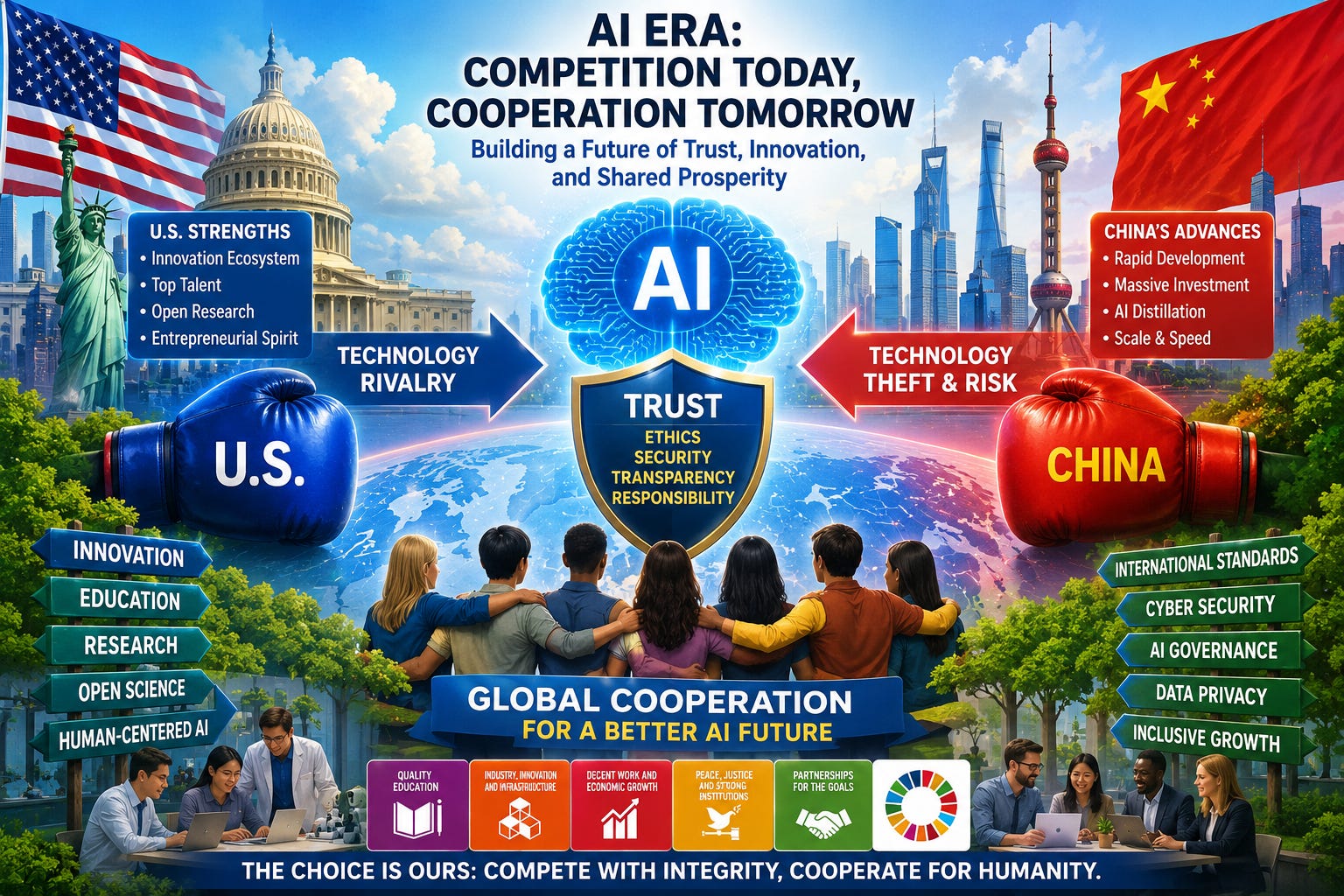
Recent reports indicate that the U.S. government is considering additional sanctions against Chinese AI companies over allegations that they have replicated cutting-edge American AI models through a technique known as AI distillation. According to the reports, rather than building frontier AI models entirely from scratch, some Chinese firms are believed to have learned from the outputs of advanced American models, dramatically reducing development time and cost while achieving competitive performance.
At first glance, this appears to be another dispute over intellectual property. Yet, in reality, it represents something far more significant: the emergence of a new geopolitical landscape shaped by artificial intelligence.
During the Cold War, strategic power was measured by nuclear weapons and missile technology. Today, national competitiveness increasingly depends on AI algorithms, semiconductor technologies, massive datasets, computing infrastructure, and the highly skilled talent capable of developing them. Artificial intelligence has become not merely an industrial technology but a strategic asset influencing national security, economic prosperity, and global leadership.
One of the most fascinating aspects of today’s AI revolution is how innovation itself has evolved. Traditionally, groundbreaking technologies required years of research, billions of dollars in investment, and countless failures before achieving success. In contrast, generative AI has introduced techniques such as knowledge distillation, allowing developers to build competitive models by learning from the outputs of existing frontier systems. As innovation accelerates, protecting technological leadership becomes increasingly difficult.
Yet one fundamental truth remains unchanged:
Technology can be replicated, but creativity cannot.
An AI model may be imitated, but the culture that fosters innovation, encourages risk-taking, supports academic freedom, and attracts the world’s brightest minds cannot be copied overnight. America’s continued leadership in AI stems not only from technological superiority but also from its open research ecosystem, entrepreneurial spirit, and global collaboration.
At the same time, the United States faces its own strategic dilemma. While stricter export controls and technology restrictions may slow competitors in the short term, they may also encourage rival nations to accelerate the development of independent technological ecosystems. History repeatedly demonstrates that sanctions, while intended to contain competition, often stimulate domestic innovation and self-reliance.
For Korea, this evolving AI rivalry presents both challenges and opportunities. Korea possesses world-class capabilities in semiconductors, telecommunications, robotics, advanced manufacturing, and digital infrastructure. However, in the realm of frontier AI foundation models, it finds itself navigating between the world’s two largest AI powers.
Rather than simply aligning with one side, Korea’s long-term strategy should be to become a globally trusted AI nation—one that combines technological excellence with ethical leadership. Achieving this vision requires sustained investment in foundational AI research, cybersecurity, AI governance, international standards, and cross-border scientific collaboration.
The Korean global scholarly and professional community also has an essential role to play. Korean researchers, entrepreneurs, and professionals working across North America, Europe, and Asia possess invaluable international experience and networks. Their collective expertise can help bridge technological innovation with responsible global governance, contributing to a more trustworthy AI ecosystem.
Artificial intelligence was designed to emulate human intelligence. Ironically, the greatest challenge facing humanity today is not whether machines can think like humans, but whether humans can continue to act wisely while developing increasingly powerful machines.
The current U.S.–China AI dispute is therefore much more than a technology conflict. It raises a profound question for all of us:
Will the AI era become an age of technological confrontation, or an era built on trust, cooperation, and shared human progress?
The K-GSP Forum believes the answer is clear. The future of AI leadership will not be determined solely by the most powerful algorithms or the largest computing clusters. True leadership will belong to those who combine innovation with integrity, technological excellence with ethical responsibility, and national competitiveness with a commitment to advancing the common good of humanity. +++
{Solti}
July 25, 2026
AI 시대의 새로운 냉전: 기술은 훔칠 수 있어도 신뢰는 훔칠 수 없다
미·중 AI 경쟁이 우리에게 던지는 질문
최근 미국 정부는 중국 AI 기업들이 미국의 최첨단 인공지능 모델을 ‘증류(distillation)’ 기법으로 사실상 모방하여 성능을 높였다는 의혹을 제기하며 추가 제재 가능성을 시사했다. 보도에 따르면 중국의 AI 기업들은 막대한 비용을 들여 초거대 AI를 처음부터 개발하기보다, 이미 개발된 고성능 AI의 출력 결과를 학습하여 시간과 비용을 크게 절감하는 전략을 활용한 것으로 알려졌다.
겉으로 보면 이는 단순한 기술 분쟁처럼 보인다. 그러나 조금 더 깊이 들여다보면 이것은 ‘21세기 AI 시대의 새로운 지정학(Geopolitics)’이 시작되었음을 보여주는 사건이다.
과거 냉전 시대의 핵심 자산은 핵무기와 미사일이었다. 오늘날 국가 경쟁력을 좌우하는 것은 AI 알고리즘, 반도체, 데이터, 컴퓨팅 인프라, 그리고 이를 창조하는 인재들이다. 이제 AI는 단순한 산업 기술이 아니라 국가 안보와 경제 패권을 결정하는 전략 자산이 되었다.
흥미로운 점은 AI 기술의 발전 방식이다. 과거에는 새로운 기술을 개발하려면 수년간의 연구와 막대한 투자, 수많은 실패를 감수해야 했다. 그러나 생성형 AI 시대에는 이미 만들어진 모델의 결과를 학습하는 증류 기법을 통해 상대적으로 적은 비용으로도 상당한 수준의 성능을 확보할 수 있다. 기술 혁신의 속도가 빨라지는 만큼, 기술 보호의 어려움도 함께 커지고 있는 것이다.
하지만 우리는 여기에서 한 가지 중요한 사실을 기억해야 한다.
기술은 복제할 수 있지만 창의성은 복제하기 어렵다.
AI 모델은 모방할 수 있어도 새로운 아이디어를 만들어내는 연구 문화, 실패를 장려하는 혁신 생태계, 세계 최고의 인재들이 자유롭게 협력하는 환경은 단기간에 흉내 낼 수 없다. 오늘날 미국이 여전히 AI 혁신을 선도하는 이유도 바로 이러한 개방성과 창의성에 있다.
반대로 미국 역시 고민이 적지 않다. 지나치게 강력한 수출 규제와 기술 봉쇄는 단기적으로는 경쟁국의 성장을 늦출 수 있지만, 장기적으로는 상대국이 독자적인 기술 생태계를 구축하도록 자극할 가능성도 있다. 역사는 언제나 제재가 혁신을 촉진한 사례를 여러 차례 보여 주었다.
이러한 미·중 경쟁은 한국에도 중요한 과제를 던진다. 한국은 AI 반도체, 통신, 로봇, 제조, 바이오 등 세계 최고 수준의 산업 기반을 보유하고 있다. 그러나 AI 플랫폼과 초거대 모델 분야에서는 미국과 중국 사이에서 전략적 선택을 요구받는 위치에 있다.
한국이 선택해야 할 길은 단순히 어느 한쪽을 따라가는 것이 아니다. “독창적인 AI 기술과 국제적 신뢰를 동시에 구축하는 ‘책임 있는 AI 강국’”이 되는 것이다. 이를 위해서는 핵심 원천기술 투자와 함께 AI 윤리, 사이버 보안, 국제 표준화, 글로벌 연구 협력을 지속적으로 확대해야 한다.
특히 한국계 글로벌 학자와 전문가들이 세계 각국에서 축적한 경험과 네트워크는 이러한 전략을 뒷받침하는 소중한 자산이다. AI 경쟁은 한 국가만의 싸움이 아니라, 국제 사회가 함께 신뢰를 구축하고 지속 가능한 혁신을 만들어 가야 하는 공동의 과제이기 때문이다.
AI는 인간의 지능을 모방하도록 설계되었다. 그러나 AI를 만드는 인간 사회는 모방보다 창조를, 경쟁보다 신뢰를, 독점보다 협력을 선택할 때 더 큰 발전을 이룰 수 있다.
이번 미·중 AI 갈등은 단순한 기술 분쟁이 아니다. 그것은 우리 모두에게 하나의 질문을 던진다.
“우리는 AI 시대를 ‘기술 전쟁’의 시대로 만들 것인가, 아니면 ‘신뢰와 협력의 시대’로 만들 것인가?”
K-GSP Forum은 그 답이 분명하다고 믿는다. 진정한 AI 리더십은 가장 강력한 알고리즘에서 나오지 않는다. 인류 공동의 번영을 위해 기술을 책임 있게 활용하려는 신뢰와 윤리에서 시작된다. +++
2026년 7월 25일
{솔티}

Prof. Dr. Young Choi (Editor in Chief) — Regent University
Young B. Choi is a Professor in the Department of Engineering & Computer Science at Regent University. He published 38 books with ‘Selected Readings in Cybersecurity’ (2018) (over 800 copies archived globally at university/college libraries around the world) and ‘Cybersecurity Applications and Artificial Intelligence’ (2023) available in seven major world languages. He proposed the world’s first global and universal telecommunications “Service Order Handling (SOH)” Model (T-SOH Model) (1995) with Dr. Adrian Tang. With this innovative research work, he received the IEEE NOMS ’96 Best Paper Award and became the first recipient of the Outstanding Contribution Award of the TeleManagement Forum in 1998. His research areas include Natural Language Processing-focused AI, AI-applied cybersecurity, network and telecom service management, and Korean studies on Gani Choi Rip’s Jeonggwan (靜觀: Quiet Contemplation) philosophy and Shilhak ( 實學: Practical Learning).