

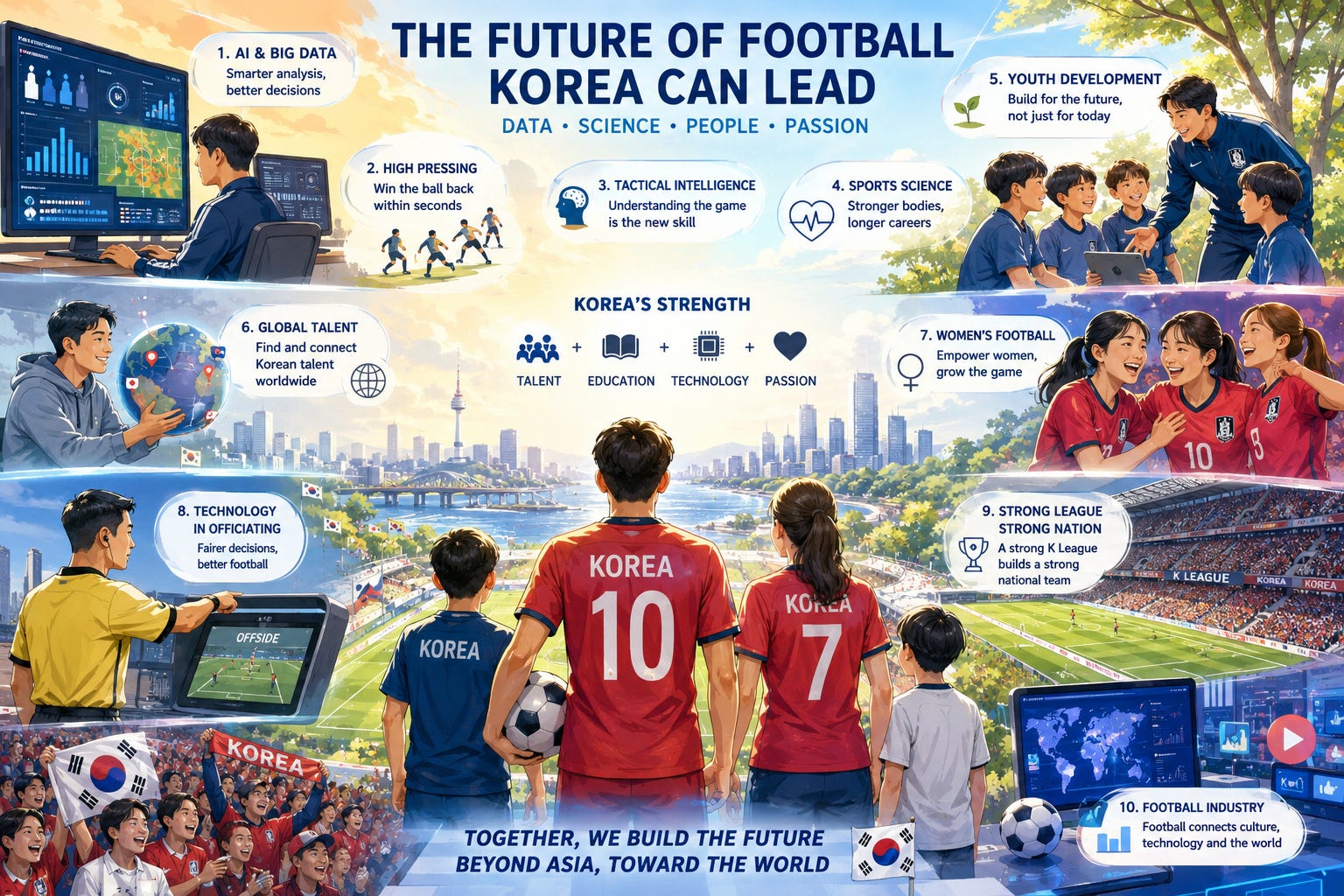
As a football fan who has loved the game for more than sixty years, I found the 2026 FIFA World Cup to be far more than a global sporting event—it was a remarkable opportunity to glimpse the future of world football. As I watched the matches and reflected on what I observed, AI-assisted analysis helped me better understand the emerging trends that are reshaping the modern game. In this essay, I explore the ten most significant trends in contemporary football and suggest practical strategies that could help the Republic of Korea develop into a true football powerhouse on the international stage.
Football is no longer a sport where individual talent alone determines victory. The 2026 FIFA World Cup has clearly demonstrated how rapidly the game is evolving. Artificial intelligence (AI), big data, sports science, youth development, and player management have all become decisive factors in national competitiveness.
Korean football can no longer be satisfied with being merely one of Asia’s strongest teams. To become a genuine global powerhouse, it must accurately understand today’s football trends and establish a long-term vision for the future.
The following are ten major trends shaping modern world football and practical ways Korea can embrace them.
1. Artificial Intelligence and Big Data Are Revolutionizing Football
Elite clubs and national teams now collect millions of data points from every match. AI analyzes player movements, predicts opponents’ tactics, recommends substitutions, and even designs set-piece strategies.
At the 2026 FIFA World Cup, AI-supported analytics have become an integral part of coaching and match preparation.
What Korea Should Do
Establish an AI Football Analytics Center within the Korea Football Association.
Build a centralized national football database.
Encourage K League clubs to share standardized performance data for long-term player development.
2. High Pressing Has Become the Global Standard
Today’s elite teams aim to regain possession within five to eight seconds after losing the ball. Modern football is no longer about simply defending—it is about recovering possession as quickly as possible.
This aggressive pressing style has become the hallmark of successful teams in Europe.
What Korea Should Do
Improve players’ physical conditioning and endurance.
Develop specialized coaches in pressing tactics.
Increase the pace and intensity of K League matches.
3. Tactical Intelligence Is Now as Important as Technical Skill
In the past, outstanding dribbling ability often defined great players.
Today, success depends equally on:
Spatial awareness
Decision-making
Positioning
Passing angles
Tactical adaptability
Modern AI systems now assist coaches in evaluating these tactical decisions in real time.
What Korea Should Do
Youth academies should incorporate:
Tactical education
Video analysis
Decision-making training
Match analysis as core components of player development.
4. Sports Science Is Extending Players’ Careers
Leading European clubs continuously monitor:
Sleep quality
Nutrition
GPS tracking
Heart rate
Muscle fatigue
Injury risk
Preventing injuries has become one of the most valuable investments in modern football.
What Korea Should Do
Expand sports medicine programs.
Develop individualized fitness monitoring systems.
Introduce AI-based injury prediction and prevention technologies.
5. Youth Development Determines National Competitiveness
The world’s strongest football nations invest in players from the age of eight or younger. Rather than emphasizing short-term victories, they prioritize long-term growth and technical development.
What Korea Should Do
Youth football should focus on:
Creativity instead of winning at all costs.
Technical mastery.
Multi-position experience.
Long-term player development pathways.
6. Global Talent Identification Is Becoming Essential
Many successful football nations actively recruit dual-nationality players and members of their overseas diaspora. Advanced scouting technologies and AI-powered databases make identifying global talent faster and more effective than ever before.
What Korea Should Do
Build a worldwide database of Korean heritage players.
Expand international scouting networks.
Strengthen partnerships with overseas youth academies.
7. Women’s Football Is Growing at an Unprecedented Pace
Women’s football has become one of the fastest-growing sectors in global sports. FIFA and many national federations continue to increase investment in player development, professional leagues, and athlete health.
What Korea Should Do
Strengthen the WK League.
Expand girls’ youth football programs.
Develop more female coaches and technical staff.
8. Refereeing Is Becoming Increasingly Technology-Driven
Modern football now utilizes:
Semi-automated offside technology
Smart match balls
AI-assisted officiating
Three-dimensional player tracking
Technology has significantly improved the accuracy and fairness of refereeing.
What Korea Should Do
Increase technological investment in the K League.
Enhance referee education and certification.
Expand data-driven officiating systems.
9. Strong Professional Clubs Build Strong National Teams
Spain, Germany, France, and England all demonstrate one important lesson:
A successful national team is built upon a strong domestic professional league.
National team success is the result—not the starting point—of a healthy football ecosystem.
What Korea Should Do
Improve the overall competitiveness of the K League.
Strengthen the pathway from youth academies to professional clubs.
Enhance the financial sustainability of professional football.
10. Football Has Become a Global Industry
Football today extends far beyond the pitch.
It has become closely connected with:
Digital content
Tourism
Broadcasting
Data analytics
Artificial intelligence
Global entertainment
Modern football is one of the world’s largest cultural and economic industries.
What Korea Should Do
Expand the international marketing of the K League.
Develop AI-powered fan engagement services.
Export Korean football content globally.
Train professionals in football business and sports technology.
“Korea Must Compete Through Systems, Not Passion Alone”
Reaching the semifinals of the 2002 FIFA World Cup remains one of the greatest achievements in Korean football history. Yet while Korea celebrated that historic success, world football continued to evolve at an extraordinary pace.
Today, passion and determination alone are no longer enough to compete with the world’s elite. Sustainable success requires data-driven decision-making, scientific player development, artificial intelligence, world-class youth academies, professional league management, and long-term investment.
Fortunately, Korea possesses remarkable strengths: exceptional human talent, one of the world’s most advanced digital infrastructures, and a culture that values education, innovation, and discipline. If these national advantages are fully integrated into football, Korea can aspire not only to become a football powerhouse but also a global leader in football innovation.
The next historic moment for Korean football will not be created by chance. It will be built through vision, science, technology, and unwavering commitment. The future belongs to those who prepare for it today. +++
{Solti}
June 28, 2026
세계 축구의 새로운 물결, 그리고 한국 축구가 나아갈 길
현실과 통계를 바탕으로 본 세계 축구의 10가지 변화와 한국 축구의 미래
60년 넘게 축구를 사랑해 온 팬으로서, 2026 FIFA 월드컵은 단순한 스포츠 축제를 넘어 세계 축구의 미래를 엿볼 수 있는 소중한 무대였다. 경기를 지켜보며 떠오른 여러 생각을 AI의 분석과 함께 정리해 보니, 현대 축구를 이끄는 새로운 흐름이 더욱 선명하게 보였다. 이 글에서는 그 가운데 가장 중요한 10가지 흐름을 바탕으로 한국 축구가 국제무대에서 진정한 축구 선진국으로 도약하기 위한 실천 방안을 함께 모색해 보고자 한다.
축구는 더 이상 뛰어난 개인 기술만으로 승부가 결정되는 스포츠가 아니다. 2026 FIFA 월드컵은 세계 축구가 얼마나 빠르게 진화하고 있는지를 보여주는 무대가 되고 있다. AI, 빅데이터, 스포츠 과학, 유소년 육성, 선수 관리까지 모든 요소가 국가 경쟁력을 결정하는 시대가 되었다.
한국 축구 역시 아시아 강호라는 위치에 만족해서는 안 된다. 이제는 세계 축구의 흐름을 정확히 이해하고 장기적인 전략을 마련해야 한다.
다음은 현재 세계 축구를 이끄는 가장 중요한 10가지 흐름이다.
1. AI와 빅데이터가 감독보다 더 많은 정보를 제공한다
오늘날 유럽의 상위 리그는 선수 한 명당 경기 중 수백만 개의 데이터를 분석한다.
2026 FIFA 월드컵에서는 경기당 약 1억5천만 개 이상의 데이터 포인트가 생성되며, AI가 상대 전술 분석, 선수 교체 시점, 세트피스 전략까지 지원하고 있다.
한국 축구의 과제
대한축구협회 AI 분석센터 설립
모든 국가대표 경기 데이터 축적
K리그 전 구단 데이터 공유 시스템 구축
2. 강한 압박(High Press)이 세계 표준이 되었다
현재 유럽 강팀들은 공을 잃은 후 5~8초 안에 다시 탈취하는 압박 축구를 기본 전술로 사용한다.
이제 단순한 수비가 아니라 “공을 다시 빼앗는 속도”가 경기력을 결정한다.
한국 축구의 과제
체력 중심 훈련 확대
압박 전술 전문 코치 육성
K리그 경기 템포 향상
3. 선수의 전술 이해력이 기술만큼 중요하다
과거에는 드리블이 뛰어난 선수가 최고였다.
지금은
공간 인식
패스 각도
위치 선정
능력이 더욱 중요하다.
최근 AI 기반 전술 분석도 이러한 전술적 의사결정을 지원하고 있다.
한국 축구의 과제
유소년부터
전술 교육
경기 분석 교육
영상 분석
을 필수화해야 한다.
4. 스포츠 과학이 선수 수명을 늘리고 있다
유럽 명문 클럽들은
수면
영양
GPS
심박수
근육 피로도
까지 실시간 관리한다.
부상 예방이 최고의 투자라는 인식이 확산되고 있다.
한국 축구의 과제
스포츠 의학 확대
개인별 체력 데이터 관리
AI 기반 부상 예측 시스템 구축
5. 유소년 육성이 국가 경쟁력을 결정한다
현재 세계 강국들은
8세부터
10년 이상
체계적으로 선수를 육성한다.
단기 성적보다 장기 성장에 투자한다.
한국 축구의 과제
승리보다 성장 중심
창의성 교육
다양한 포지션 경험 제공
6. 세계는 글로벌 인재를 적극 발굴한다
유럽 국가들은 해외 이중국적 선수와 디아스포라 선수 발굴에도 적극적이다. 기술과 데이터는 이러한 인재 탐색을 더욱 효율적으로 만들고 있다.
한국 축구의 과제
해외 한인 선수 데이터베이스 구축
글로벌 스카우트 확대
해외 유소년과의 연계 강화
7. 여성 축구에 대한 투자가 급속히 증가한다
세계 각국은 여성 축구를 미래 성장 동력으로 보고 있다.
FIFA 역시 여성 선수 건강과 경기력 향상을 위한 글로벌 프로젝트를 시작했으며, 각국의 투자도 확대되고 있다.
한국 축구의 과제
WK리그 활성화
여자 유소년 확대
지도자 양성
8. 심판도 기술과 함께 진화한다
반자동 오프사이드 시스템
스마트 볼
AI 판독
3D 추적 기술
등이 이미 국제대회에서 활용되고 있다.
한국 축구의 과제
K리그 기술 투자 확대
심판 교육 강화
데이터 기반 판정 시스템 도입
9. 클럽 시스템이 국가대표 경쟁력을 만든다
스페인
독일
프랑스
잉글랜드
모두 강한 프로리그가 국가대표의 기반이다.
국가대표는 프로리그의 결과이지 원인이 아니다.
한국 축구의 과제
K리그 경쟁력 향상
유소년-프로 연결 강화
재정 안정성 확보
10. 축구는 하나의 산업이 되었다
축구는 이제
콘텐츠
관광
방송
데이터 산업
AI 산업
과 연결된 거대한 경제 생태계다. 2026 월드컵의 기록적인 관중과 글로벌 관심은 축구의 산업적 가치가 계속 커지고 있음을 보여준다.
한국 축구의 과제
K리그 글로벌 마케팅
AI 기반 팬 서비스
디지털 콘텐츠 수출
축구 산업 전문 인재 양성
“한국 축구도 이제 시스템으로 승부해야 한다”
2002년 월드컵 4강은 한국 축구의 위대한 역사였다. 그러나 세계 축구는 그 이후에도 멈추지 않고 진화했다. 이제는 열정과 정신력만으로는 세계 정상에 오르기 어렵다. 데이터, 과학, 인공지능, 유소년 육성, 체계적인 리그 운영, 그리고 장기적인 투자와 혁신이 함께 이루어질 때 비로소 지속 가능한 경쟁력이 만들어진다.
한국은 뛰어난 선수 자원과 높은 교육 수준, 세계 최고 수준의 IT 인프라를 갖춘 나라다. 이 강점을 축구와 결합한다면 ‘축구 강국’을 넘어 ‘축구 혁신 국가’로 도약할 수 있다. 미래의 월드컵에서 세계를 놀라게 할 한국 축구는 우연히 탄생하지 않는다. 오늘부터 과학과 데이터, 그리고 사람에 대한 꾸준한 투자로 준비할 때, 그 꿈은 현실이 될 것이다. +++
{솔티}
2026년 6월 28일

Prof. Dr. Young Choi (Editor in Chief) — Regent University
Young B. Choi is a Professor in the Department of Engineering & Computer Science at Regent University. He published 38 books with ‘Selected Readings in Cybersecurity’ (2018) (over 800 copies archived globally at university/college libraries around the world) and ‘Cybersecurity Applications and Artificial Intelligence’ (2023) available in seven major world languages. He proposed the world’s first global and universal telecommunications “Service Order Handling (SOH)” Model (T-SOH Model) (1995) with Dr. Adrian Tang. With this innovative research work, he received the IEEE NOMS ’96 Best Paper Award and became the first recipient of the Outstanding Contribution Award of the TeleManagement Forum in 1998. His research areas include Natural Language Processing-focused AI, AI-applied cybersecurity, network and telecom service management, and Korean studies on Gani Choi Rip’s Jeonggwan (靜觀: Quiet Contemplation) philosophy and Shilhak ( 實學: Practical Learning).