

The New Geography of AI
Data Centers, Energy, and the Future of Digital Civilization
Executive Summary
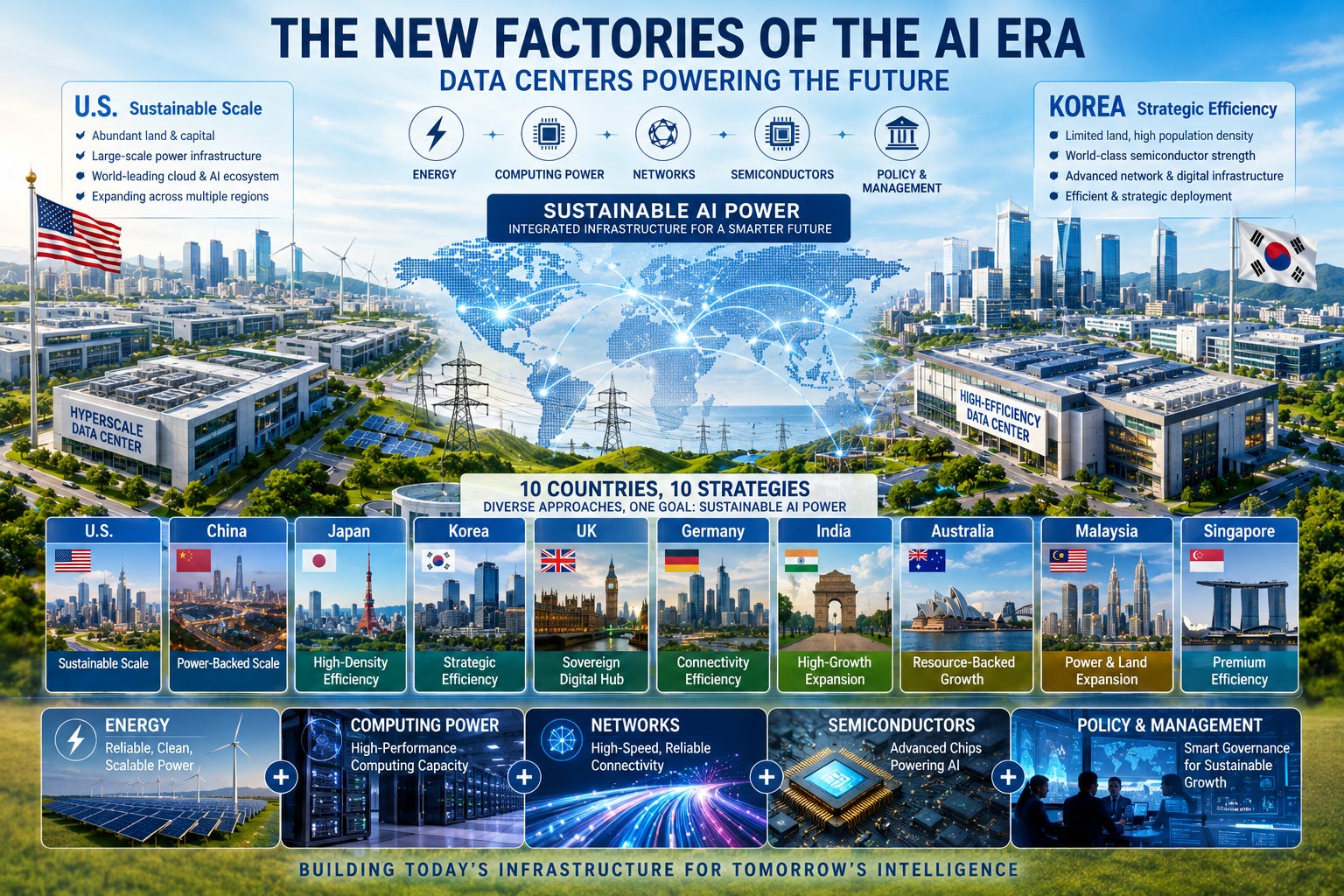
In the age of artificial intelligence, data centers are no longer simply facilities for storing and processing computer servers. If factories were the centers of production during the Industrial Revolution, data centers are becoming the new factories of the AI era. Instead of automobiles, steel, or chemicals, these new factories produce data, algorithms, AI models, and digital services. Yet the productive capacity of these new factories depends on much more than computing technology. Electricity, land, cooling systems, networks, semiconductors, capital, and systems of policy and management must operate together as an integrated infrastructure.
The global data center industry is now entering a new phase. JLL (2026) projects that global data center capacity will increase by approximately 97 GW between 2025 and 2030, reaching nearly 200 GW by 2030. The investment required to support this expansion could reach approximately $3 trillion. These projections demonstrate that data centers are no longer a supporting component of the IT industry; they are becoming one of the world’s major investment and infrastructure sectors (JLL, 2026).
Yet countries are entering this competition through very different paths. The United States is rapidly expanding large-scale data centers by drawing on its vast land resources, enormous capital base, extensive energy and telecommunications infrastructure, and world-leading cloud and AI companies. Its emerging strategy can be described as Sustainable Scale. South Korea, by contrast, must operate within a much smaller geographic area, high urban density, and strong concentration of population and industry around the Seoul metropolitan region. Its challenge is to connect electricity, networks, semiconductor industries, and data centers as efficiently as possible. Its strategy is therefore better described as Strategic Efficiency.
These differences can also be seen across other major markets. China is pursuing large-scale expansion supported by its enormous power and industrial base. Japan combines technological sophistication with high-density efficiency. The United Kingdom is developing a digital hub centered on London’s financial and telecommunications ecosystem, while Germany emphasizes connectivity and industrial integration. India and Australia are expanding rapidly through new market opportunities and resource advantages, while Malaysia is emerging as a major hub by leveraging relatively abundant land and power. Singapore represents a distinctive model in which limited land and high costs are addressed through exceptional efficiency, connectivity, and infrastructure reliability.
Data center competition, therefore, is no longer merely a matter of real estate or the IT industry. It has become a competition over national infrastructure—one directly connected to energy strategy, industrial policy, urban planning, semiconductor competitiveness, telecommunications, environmental policy, and national security.
From Factories to Data Centers
The Industrial Revolution fundamentally transformed the way human beings produced goods. Steam power and electricity moved production from homes and small workshops into large-scale factories, making factories the beating heart of the modern economy. As automobiles, steel, chemicals, and electronics grew around large manufacturing facilities, national industrial competitiveness increasingly depended on how many factories a country could build and how efficiently it could operate them.
Today, humanity is entering another industrial transformation. This time, much of the center of production is moving from physical factories into digital environments. Yet there is a striking paradox: the more digital the economy becomes, the more important its physical infrastructure becomes. Artificial intelligence requires cloud computing and networks; cloud computing requires data centers; and data centers require enormous amounts of electricity, cooling, connectivity, and advanced semiconductors.
The scale of this transformation is becoming increasingly visible. JLL (2026) projects that global data center capacity will rise from approximately 103 GW in 2025 to nearly 200 GW by 2030—almost doubling in five years. The industry is expected to grow at an annual rate of roughly 14 percent during this period, while total investment associated with the expansion could approach $3 trillion when both facilities and IT infrastructure are considered (JLL, 2026).
The future of AI, therefore, is not being created only on screens. It is being built in physical spaces where concrete and steel meet silicon and fiber, and where computing systems meet electricity grids and cooling infrastructure.
In this sense, the data center can rightly be called the new factory of the AI era.
A World of Different Data Center Strategies
The global data center market in 2026 reveals very different national strategies and structural conditions. Cushman & Wakefield (2026), which evaluates 107 global markets across 24 variables, argues that the industry is entering an era of managed growth rather than unlimited expansion. Electricity availability, grid connections, land, permitting, regulation, and community acceptance are becoming decisive factors in determining where new facilities can actually be built.
This shift reveals an important reality. The future competitiveness of data centers will not be determined simply by asking, “How many data centers does a country have?” The more important question will be:
How reliably, efficiently, and strategically can a country deliver new computing capacity?
The United States is expanding through scale. South Korea is seeking competitiveness through integration and efficiency. Malaysia is opening new geographic space through land and power advantages. India is combining a huge digital market with rapid infrastructure growth. Japan and Singapore are attempting to overcome spatial limitations through efficiency.
The geography of data centers is therefore not simply a competition in numbers. It is a competition among different national strategies for building digital capacity.
The American Model: Sustainable Scale
The United States has the world’s strongest advantage in data center scale. According to Stanford HAI (2026), the United States had 5,427 data centers, more than ten times the number in any other country. The country is also the world’s largest concentration of AI infrastructure, supported by enormous investments in computing capacity, electricity, cloud infrastructure, and advanced technology.
The scale of the American market is also visible across its major data center regions. CBRE (2026) reported that operational supply across eight major North American markets reached 10,903 MW in the first half of 2026, an increase of 33.7 percent year over year. Under-construction capacity reached 7,481.1 MW, while vacancy fell to only 1.4 percent. Remarkably, 80.4 percent of capacity under construction had already been preleased, demonstrating the extraordinary strength of demand from AI and cloud computing (CBRE, 2026).
Northern Virginia provides perhaps the clearest illustration of the American model. In the first half of 2026, the market had approximately 4,496.5 MW of operational capacity and another 2,420.2 MW under construction. Its vacancy rate was only 0.2 percent (CBRE, 2026).
The American advantage, however, is not simply that the country has abundant land. Its deeper advantage lies in the integration of global cloud companies, AI firms, semiconductor companies, investment capital, telecommunications networks, and energy infrastructure into a powerful industrial ecosystem.
The scale of capital supporting this ecosystem is extraordinary. Stanford HAI (2026) estimates that private AI investment in the United States reached approximately $285.88 billion in 2025, far exceeding China’s approximately $12.41 billion. This capital advantage gives the United States an enormous capacity to invest not only in AI research and services but also in the physical infrastructure required to support them.
Yet America’s greatest strength is creating a new challenge. Electricity supply, transmission capacity, land availability, permitting, and community opposition are increasingly becoming bottlenecks. CBRE (2026) identifies power availability and infrastructure-delivery schedules as critical determinants of data center location and leasing activity, while local opposition and zoning restrictions can delay projects. The United States is therefore moving from an era of scale toward an era of sustainable scale.
Republic of Korea: Strategic Efficiency
Korea faces fundamentally different conditions from those of the United States. It possesses world-class telecommunications infrastructure, a globally competitive semiconductor industry, high levels of digital adoption, and a powerful manufacturing base. Yet it has a much smaller territory, high population density, and a strong concentration of population and economic activity in the Seoul metropolitan area. Securing sufficient electricity and large development sites is consequently much more difficult.
The Korean market continues to expand rapidly. Cushman & Wakefield (2026) reports that Greater Seoul had approximately 663 MW of operational data center capacity in the first half of 2026, representing a 10 percent increase. Colocation vacancy fell dramatically from 6.9 percent in the second half of 2025 to only 1.1 percent in the first half of 2026. At the same time, development interest is expanding toward Incheon, Gyeonggi Province, and other regions where electricity and industrial infrastructure can be more readily secured.
These developments demonstrate why Korea cannot simply pursue a strategy of unlimited scale. What Korea needs is the integration of land, electricity, networks, semiconductors, and AI industries into a single strategic framework. The question of where to build a data center is therefore also a question of where to locate the industries of the future.
Korea may also benefit from a functional division of geographic roles. Low-latency services and applications requiring close proximity to corporate customers may remain concentrated around the Seoul metropolitan area, while energy-intensive AI training and other workloads could increasingly be located in regions with greater power availability (Cushman & Wakefield, 2026). This spatial strategy could transform Korea’s geographic constraint into an advantage based on efficiency.
The country’s competitiveness will not come from competing with the United States in the sheer amount of land available for construction. Instead, it will depend on how intelligently Korea can use limited space, connect electricity and networks, and integrate its globally competitive semiconductor industry with AI and data center infrastructure. This is the essence of Strategic Efficiency.
The Rise of Malaysia, India, and Australia
The emerging geography of data centers reveals the rapid rise of Southeast Asia, South Asia, and Australia.
Malaysia is perhaps the clearest example. Johor, located next to Singapore, offers relatively abundant land and development space at a lower cost. Cushman & Wakefield (2026) reports that Johor’s data center development pipeline reached 3,088 MW in the first half of 2026, with 602 MW under construction and approximately 1,110 MW already operational.
Southeast Asia as a whole is expanding rapidly. The APAC data center development pipeline reached a record 26.5 GW in the first half of 2026, including 4.8 GW under construction and 21.7 GW planned. Southeast Asia accounted for approximately half of APAC’s under-construction capacity (Cushman & Wakefield, 2026).
But rapid expansion also creates new challenges. Data centers consume large amounts of electricity and water, while requiring substantial land. Environmental pressures and community concerns therefore become increasingly important as new projects are developed.
India is also experiencing rapid growth. Its operational data center capacity has approached 1.8 GW, with Mumbai serving as the largest hub and Hyderabad, Chennai, and Delhi NCR strengthening their positions (Cushman & Wakefield, 2026). India’s combination of a massive digital consumer market and rapidly expanding infrastructure gives it substantial long-term potential.
Australia is emerging as another important market because of its abundant energy resources and large geographic area. These cases demonstrate that the future location of data centers does not necessarily have to remain concentrated in traditional metropolitan centers.
The common lesson is simple: New digital industries require new geographic space.
Japan, the United Kingdom, Germany, and Singapore: Efficiency in Mature Markets
Japan continues to expand its data center industry despite high urban density and limited land. Its competitive strength lies not simply in capacity but in its ability to combine advanced technology, industrial depth, network connectivity, and institutional stability.
The United Kingdom has developed a major digital hub around London, where finance, telecommunications, cloud services, and technology intersect. Yet shortages of land and electricity are pushing new development increasingly toward areas outside central London.
Frankfurt is similarly one of Europe’s major data center centers. Its strong Internet-exchange ecosystem, network connectivity, and proximity to Europe’s industrial economy provide significant advantages. At the same time, power availability, land, and permitting increasingly constrain further growth.
These mature markets reveal an important transition. As the industry becomes more developed, the question changes from “How much can we build?” to “Under what conditions can we build sustainably?”
Singapore presents an even more distinctive case. Despite its small territory and high land costs, it has established itself as a global data center hub. Cushman & Wakefield (2026) identifies Singapore as one of the world’s strongest markets in terms of power-grid stability, illustrating how infrastructure quality and reliability can compensate for geographic limitations. Singapore demonstrates that competitiveness does not always require building more.
Sometimes it means creating greater value from less space.
Data Centers Are Becoming Power Centers
The most important resource in the data center competition is ultimately electricity.
The International Energy Agency (IEA, 2025) projects that global data center electricity consumption will more than double to approximately 945 TWh by 2030. Electricity use by data centers is expected to grow by approximately 15 percent annually between 2024 and 2030, while electricity consumption by accelerated servers—primarily associated with AI—is projected to grow by roughly 30 percent annually.
The transformation is particularly significant in the United States. The IEA (2025) estimates that data centers could account for nearly half of U.S. electricity-demand growth through 2030.
This fundamentally changes the nature of the data center industry.
In the past, the first questions in selecting a data center location were often about land and network connectivity. Today, access to electricity is becoming the decisive factor.
A site may have excellent land, but without sufficient power it cannot become a major data center. A building may be complete, but without a reliable grid connection it cannot support large-scale AI operations.
The future location of data centers is therefore becoming less a matter of conventional real estate and more a matter of industrial geography connected to power.
Cushman & Wakefield (2026) similarly identifies power as the most important constraint in the global data center market. The speed of grid connections, transmission reliability, and the ability to add generation capacity increasingly determine where new facilities can be developed.
From Real Estate to National Infrastructure
The era of treating data centers simply as real estate development projects is coming to an end. In the past, the basic idea was relatively simple: find suitable land, construct a building, and install servers. AI-era data centers are fundamentally different.
They require reliable electricity grids, high-capacity telecommunications networks, advanced semiconductors, sophisticated cooling systems, and water management. They also require cybersecurity and physical security, environmental safeguards, community acceptance, and efficient permitting processes.
Building a data center is therefore increasingly similar to building a national industrial system. The scale of investment reinforces this conclusion. JLL (2026) estimates that up to $3 trillion may be required to support approximately 100 GW of new data center capacity by 2030, including investment in facilities as well as IT equipment such as GPUs and network infrastructure.
Data center policy can therefore no longer be separated from industrial policy, energy policy, land-use planning, telecommunications policy, environmental policy, and national security.
The Geography of AI Is Being Rewritten
The Internet once appeared capable of making physical distance irrelevant. Yet the rise of AI is revealing a new geography. AI may appear to exist everywhere, but the computing resources required to operate AI systems are concentrated in specific physical locations. Those locations contain enormous data centers, and those data centers require electricity.
The geography of AI is therefore becoming a geography of power. Regions with abundant electricity, strong networks, available land, reasonable regulation, and supportive communities are likely to become the next centers of AI infrastructure.
This has an intriguing historical parallel. During the Industrial Revolution, factories followed water, coal, railways, and ports. In the twenty-first century, the geography of AI is increasingly being shaped by the combination of energy, computing, networks, and semiconductors.
If the industrial map of the nineteenth century was shaped by energy and transportation, the AI map of the twenty-first century will be shaped by the infrastructure that connects intelligence to physical resources.
What Korea Can Learn from the Global Comparison
Korea is by no means a latecomer in the data center competition. Its semiconductor industry, advanced telecommunications infrastructure, digital economy, and manufacturing base provide exceptional foundations. Yet Korea does not need to copy the American model.
The United States can use its vast geographic space and enormous capital resources to pursue scale. Korea cannot compete in exactly the same way because of its limited land and high population density.
Korea’s strength lies elsewhere. Semiconductors → Data Centers → Networks → AI → Industrial Services. The strategic task is to connect these elements into one integrated industrial ecosystem. The fundamental Korean question should therefore not be: “How many data centers should we build?” It should be: “Where should we build them, with what sources of power, connected to which networks, and for which industries?” The answer will help determine Korea’s future competitiveness.
A particularly important issue is the relationship between the Seoul metropolitan area and the rest of the country. Rather than simply choosing between concentration and decentralization, Korea could develop a functional spatial division. Low-latency services and customer-facing applications could remain close to the metropolitan market, while power-intensive AI training and large-scale computing workloads could increasingly move toward regions with greater electricity availability. Such an approach could turn Korea’s geographic limitation into a source of strategic efficiency.
A New Industrial Geography
The location of data centers will increasingly become more than a matter of urban development or industrial real estate. It will become a question of how a nation draws its future industrial map.
Seoul and the surrounding metropolitan region possess powerful advantages in finance, telecommunications, technology, and business services. Yet constraints on electricity and land will encourage further development in surrounding and non-metropolitan regions.
These regions could gain new economic opportunities. If sufficient electricity, industrial land, and network connectivity are available, data centers could become important anchors of regional economic development.
But simply moving data centers outside the capital region will not be enough. AI companies, research institutions, semiconductor industries, cloud services, talent, and educational institutions must also become connected to these new locations.
Only then can a data center become more than a server building. It can become the foundation of a regional industrial ecosystem.
This should be an important principle of Korea’s future data center policy: a data center should be understood not as an isolated facility but as a digital industrial platform connecting energy, industry, research, education, networks, and regional economies.
The New Factories of the AI Era
The global data center industry is entering a new stage. The age of simple expansion is giving way to an era of managed growth (Cushman & Wakefield, 2026).
Electricity is becoming the most important bottleneck. Land connected to reliable power is becoming increasingly valuable. Permitting and community acceptance are becoming strategic considerations. Environmental sustainability is becoming an essential component of competitiveness.
Within this changing environment, the United States and South Korea will inevitably follow different paths. The United States is pursuing Sustainable Scale, expanding the absolute capacity of AI infrastructure through massive investment, abundant resources, and an enormous industrial ecosystem. Korea must pursue Strategic Efficiency, combining limited space and resources in the most intelligent and productive way possible.
This difference is not simply a matter of national preference. It reflects the different geographic, industrial, energy, and urban structures of the two countries. It also leads to a broader principle: Scale creates capacity, but efficiency creates strategic resilience.
If the United States asks, “How much computing capacity can we build?” Korea should ask, “How efficiently and strategically can we deploy computing power?” Ultimately, sustainable AI competitiveness cannot be created by any single resource.
Sustainable AI Power
Energy + Computing Power + Networks + Semiconductors + Policy & Management. When these five elements are connected, the data center becomes more than a building. It becomes a critical component of national competitiveness. Factories during the Industrial Revolution combined steel, machinery, electricity, capital, and labor to create a new industrial civilization. Data centers in the AI era will combine data and algorithms, semiconductors and electricity, networks and human intelligence to create a new digital civilization.
The future of AI will be written in code. But that future will ultimately be built on concrete and steel, silicon and fiber, and above all, power. Where we build data centers today, how we build them, and what purposes we give them will help determine the geography of AI tomorrow.
Data centers are the new factories of the AI era. And these new factories are rewriting the industrial geography of the world.
References
CBRE. (2026, August 27). North America data center trends H1 2026: Construction increases while vacancy falls to new low. CBRE Research. CBRE North America Data Center Trends H1 2026
Cushman & Wakefield. (2026). 2026 global data center market comparison. Cushman & Wakefield Research. 2026 Global Data Center Market Comparison
Cushman & Wakefield. (2026, August). Asia Pacific’s data centre development pipeline reaches record 26.5GW in H1 2026. Cushman & Wakefield. APAC Data Centre H1 2026 Update
International Energy Agency. (2025). Energy and AI. IEA. IEA: Energy and AI
JLL. (2026). 2026 global data center market outlook: Navigating AI demand, power constraints and global opportunities in 2026. Jones Lang LaSalle. JLL 2026 Global Data Center Outlook
Stanford Institute for Human-Centered Artificial Intelligence. (2026). AI Index report 2026. Stanford University. Stanford AI Index 2026
AI가 다시 쓰는 새로운 지리학
데이터센터와 에너지, 그리고 디지털 문명의 미래
Executive Summary
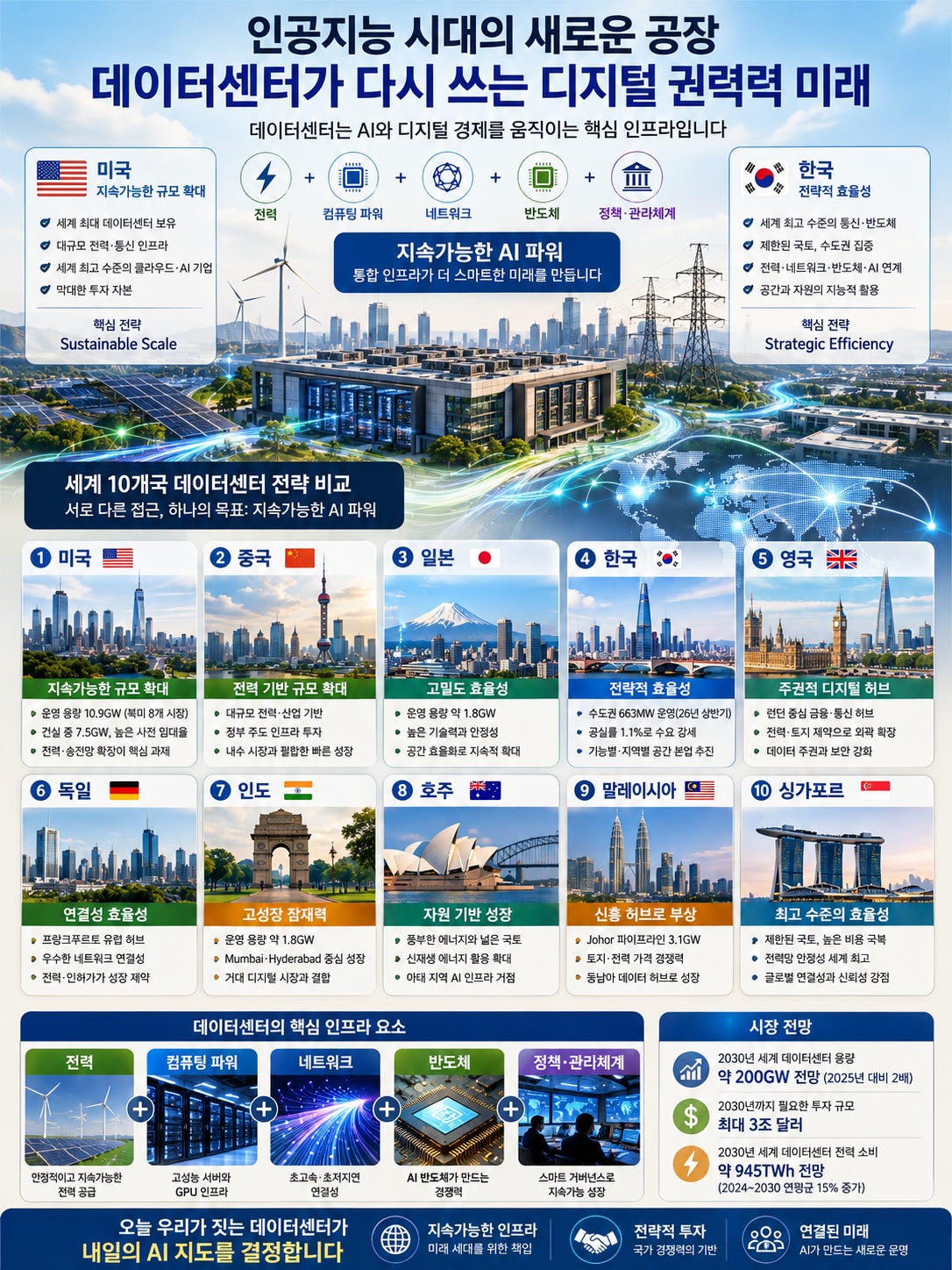
인공지능 시대에 데이터센터는 더 이상 단순한 서버 보관 시설이 아니다. 과거 산업혁명 시대에 공장이 생산의 중심이었다면, 오늘날 데이터센터는 인공지능과 디지털 경제를 움직이는 새로운 공장이다. 그 안에서는 자동차나 철강 대신 데이터와 알고리즘, 인공지능 모델과 디지털 서비스가 생산된다. 그리고 이 새로운 공장의 생산능력을 결정하는 것은 컴퓨터의 성능만이 아니다. 전력, 토지, 냉각, 네트워크, 반도체, 자본, 정책과 관리체계가 하나의 거대한 시스템으로 결합되어야 한다.
세계 데이터센터 산업은 이제 단순한 성장 단계를 넘어 새로운 국면으로 진입하고 있다. JLL(2026)은 2026년부터 2030년까지 세계 데이터센터 용량이 약 97GW 증가하여 2030년 약 200GW에 이를 것으로 전망하며, 이를 위해 최대 3조 달러의 투자가 필요할 것으로 추정한다. 이는 데이터센터가 더 이상 IT 산업의 하위 인프라가 아니라 세계 경제의 거대한 투자 영역으로 변하고 있음을 의미한다. (JLL)
그러나 모든 국가가 같은 방식으로 이 경쟁에 참여하는 것은 아니다. 미국은 넓은 국토와 거대한 자본, 풍부한 전력·통신 인프라, 세계적인 클라우드 및 AI 기업을 바탕으로 대규모 데이터센터를 빠르게 확대하고 있다. 미국의 전략은 한마디로 ‘지속가능한 규모 확대(Sustainable Scale)’라고 할 수 있다. 반면 한국은 제한된 국토와 높은 도시 밀도, 수도권 집중이라는 조건 속에서 전력과 네트워크, 반도체 산업과 데이터센터를 효율적으로 연결해야 한다. 한국의 전략은 ‘전략적 효율성(Strategic Efficiency)’에 가깝다.
이러한 차이는 다른 나라에서도 다양한 형태로 나타난다. 중국은 거대한 전력과 산업 기반을 활용한 규모 확대, 일본은 높은 기술력과 공간 효율성을 결합한 고밀도 전략, 영국은 금융·통신 중심지를 활용한 디지털 허브 전략, 독일은 네트워크와 산업 기반을 활용한 연결성 중심 전략을 보여준다. 인도와 호주는 빠른 성장과 풍부한 자원을 바탕으로 새로운 데이터센터 시장을 확대하고 있으며, 말레이시아는 상대적으로 풍부한 토지와 전력을 활용해 빠르게 부상하고 있다. 싱가포르는 제한된 국토와 높은 비용에도 불구하고 높은 효율성과 연결성을 유지하는 독특한 모델을 보여준다.
따라서 데이터센터 경쟁은 더 이상 부동산이나 IT 산업만의 문제가 아니다. 그것은 국가의 에너지 전략, 산업정책, 도시계획, 반도체 경쟁력, 네트워크 인프라, 환경정책, 안보와 직결되는 국가 인프라 경쟁이 되고 있다.
공장에서 데이터센터로
산업혁명은 인간의 생산 방식을 근본적으로 바꾸었다. 증기기관과 전력은 생산을 가정과 소규모 작업장에서 대형 공장으로 이동시켰고, 공장은 근대 경제의 심장이 되었다. 자동차, 철강, 화학, 전자산업이 거대한 공장을 중심으로 성장하면서 한 국가의 산업 경쟁력은 얼마나 많은 공장을 건설하고 얼마나 효율적으로 운영할 수 있는가에 의해 크게 좌우되었다.
오늘날 우리는 또 하나의 산업혁명을 지나고 있다. 이번에는 생산의 중심이 물리적인 공장에서 디지털 공간으로 이동하고 있다. 그러나 역설적으로 디지털 경제가 발전할수록 그것을 지탱하는 물리적 시설은 더욱 중요해진다. 인공지능은 클라우드와 네트워크를 필요로 하고, 클라우드는 데이터센터를 필요로 하며, 데이터센터는 막대한 전력과 냉각시설, 네트워크와 반도체를 필요로 한다.
세계 데이터센터 산업의 규모가 이러한 변화를 잘 보여준다. JLL(2026)은 세계 데이터센터 용량이 2025년 약 103GW에서 2030년 약 200GW로 거의 두 배 증가할 것으로 전망한다. 같은 기간 산업은 연평균 약 14% 성장할 것으로 예상되며, 부동산 자산가치 창출뿐 아니라 GPU와 네트워크 장비를 포함한 IT 설비투자까지 고려하면 총투자 규모는 약 3조 달러에 이를 수 있다. (JLL)
따라서 인공지능의 미래는 화면 속에서만 만들어지는 것이 아니다. 그것은 콘크리트와 철강, 실리콘과 광섬유, 전력망과 냉각시설이 만나는 물리적 공간에서 만들어진다. 이 점에서 데이터센터는 인공지능 시대의 새로운 공장이라고 부를 수 있다.
세계는 서로 다른 데이터센터 전략을 만들고 있다
2026년 세계 데이터센터 시장을 보면 국가와 지역마다 매우 다른 전략과 조건이 나타난다. Cushman & Wakefield(2026)는 세계 107개 시장을 24개의 변수로 분석하면서 데이터센터 산업이 이제 무제한적인 확장보다 ‘관리된 성장(managed growth)’의 단계에 들어섰다고 평가한다. 특히 전력 확보, 전력망 연결, 토지, 인허가, 규제, 지역사회의 수용성이 데이터센터 입지를 결정하는 핵심 요소로 부상하고 있다. (Cushman & Wakefield)
이러한 변화는 중요한 사실을 보여준다. 앞으로 데이터센터 경쟁력은 단순히 “몇 개의 데이터센터를 가지고 있는가”가 아니라 “얼마나 안정적으로, 효율적으로, 그리고 전략적으로 새로운 용량을 공급할 수 있는가”에 의해 결정될 것이다.
미국은 규모를 통해 경쟁력을 확대하고 있고, 한국은 통합과 효율성을 통해 경쟁력을 확보하려 한다. 말레이시아는 토지와 전력이라는 새로운 공간을 제공하고 있으며, 인도는 거대한 디지털 시장과 성장 잠재력을 결합하고 있다. 일본과 싱가포르는 제한된 공간을 높은 효율성으로 극복하려 한다. 따라서 세계 데이터센터의 지리학은 단순한 숫자의 경쟁이 아니라 서로 다른 국가전략의 경쟁이라고 볼 수 있다.
미국의 모델: 지속가능한 규모 확대
미국은 세계 데이터센터 경쟁에서 가장 강력한 규모의 우위를 가지고 있다. Stanford HAI(2026)에 따르면 미국에는 5,427개의 데이터센터가 있으며, 이는 다른 어떤 국가보다 10배 이상 많은 규모다. 미국은 또한 AI 데이터센터의 최대 집중 국가로, 막대한 전력과 컴퓨팅 자원을 바탕으로 AI 인프라를 빠르게 확장하고 있다. (Stanford HAI)
북미 주요 8개 데이터센터 시장에서도 이러한 규모의 우위가 뚜렷하게 나타난다. CBRE(2026)에 따르면 2026년 상반기 이들 시장의 운영 중 공급량은 10,903MW로 전년 대비 33.7% 증가했으며, 건설 중인 용량은 7,481.1MW로 24.8% 증가했다. 공실률은 1.4%로 낮아졌고, 건설 중인 용량의 80.4%가 이미 사전 임대된 상태였다. 이는 AI와 클라우드 수요가 신규 공급을 거의 즉시 흡수하고 있음을 보여준다. (CBRE)
Northern Virginia는 미국 모델을 상징적으로 보여준다. 이 지역은 2026년 상반기 약 4,496.5MW의 운영 용량을 보유한 북미 최대 시장이었으며, 2,420.2MW가 건설 중이었다. 공실률은 불과 0.2%였다. 그러나 토지와 인허가 제약으로 건설 증가 속도는 이전보다 둔화되고 있다(CBRE, 2026). (CBRE)
미국의 장점은 단순히 땅이 많다는 데 있지 않다. 세계적인 클라우드 기업, AI 기업, 반도체 기업, 투자자본, 광범위한 광섬유 네트워크와 전력 인프라가 하나의 산업생태계로 연결되어 있다는 점이 핵심이다. Stanford HAI(2026)에 따르면 2025년 미국의 민간 AI 투자는 약 2,858.8억 달러에 달했다. 이는 중국의 약 124.1억 달러와 비교해 압도적인 규모이며, 미국이 AI 연구와 서비스뿐 아니라 이를 뒷받침하는 물리적 인프라에도 거대한 자본을 투입할 수 있는 기반을 보여준다. (Stanford HAI)
그러나 미국의 장점이 동시에 새로운 문제를 만들고 있다. 전력 공급과 송전망 확장, 토지 확보, 인허가, 지역사회 반발이 데이터센터 확장의 새로운 병목이 되고 있기 때문이다. CBRE(2026)는 전력 가용성과 인프라 공급 일정이 입지 선정과 임대 활동을 결정하는 가장 중요한 요인이라고 지적하며, 지역사회 반대와 용도지역 규제가 프로젝트를 지연시키고 있다고 분석한다. (CBRE) 미국도 이제 ‘규모의 시대’에서 ‘지속가능한 규모의 시대’로 이동하고 있는 것이다.
한국: 전략적 효율성
한국의 상황은 미국과 근본적으로 다르다. 한국은 세계 최고 수준의 통신 인프라와 강력한 반도체 산업, 높은 디지털 활용도와 제조업 기반을 갖추고 있다. 그러나 국토가 좁고 인구와 산업이 수도권에 집중되어 있으며, 전력과 대규모 개발용지를 확보하는 일이 쉽지 않다.
2026년 상반기 한국 데이터센터 시장에서는 AI와 클라우드 수요가 계속 확대되고 있다. Cushman & Wakefield(2026)에 따르면 Greater Seoul의 운영 데이터센터 용량은 663MW로 상반기에 10% 증가했으며, 코로케이션 공실률은 2025년 하반기 6.9%에서 2026년 상반기 1.1%로 급격히 낮아졌다. 동시에 전력 확보가 가능한 인천과 경기 지역 등 수도권 주변 지역으로 개발 관심이 확대되고 있으며, 수도권 외 지역에서도 대규모 전력과 산업 인프라를 갖춘 입지가 주목받고 있다. (Cushman & Wakefield) 이러한 변화는 한국의 데이터센터 전략이 단순한 ‘규모 확대’가 될 수 없음을 보여준다.
한국이 필요한 것은 공간·전력·네트워크·반도체·AI 산업을 하나의 전략으로 연결하는 것이다. 데이터센터를 어디에 건설할 것인가라는 질문은 곧 어느 지역에 미래의 디지털 산업을 배치할 것인가라는 질문이 된다. 특히 한국에서는 수도권과 비수도권의 역할을 구분할 필요가 있다. 저지연 서비스와 기업 고객을 위한 AI 추론(inference) 수요는 수도권에 가까운 위치를 필요로 할 수 있지만, 막대한 전력을 필요로 하는 AI 학습(training) 작업은 전력 여유가 있는 비수도권 지역으로 분산할 수 있다(Cushman & Wakefield, 2026). 이러한 공간적 분업은 한국의 제한된 국토를 극복하는 하나의 현실적인 전략이 될 수 있다. (Cushman & Wakefield)
최근 한국 시장의 투자 전망도 이러한 변화의 중요성을 보여준다. Cushman & Wakefield(2026)는 한국의 향후 코로케이션 데이터센터 파이프라인을 지원하기 위해 2030년까지 약 136억 달러의 자본지출이 필요할 것으로 전망했다. 이는 한국 데이터센터 산업이 단순한 부동산 시장이 아니라 국가적 규모의 디지털 인프라 투자 영역으로 성장하고 있음을 보여준다. (Cushman & Wakefield)
한국의 경쟁력은 미국처럼 넓은 땅을 이용해 규모를 확대하는 데 있지 않다. 오히려 제한된 공간을 얼마나 지능적으로 활용하고, 전력과 네트워크를 얼마나 효율적으로 연결하며, 세계적인 반도체와 AI 산업을 데이터센터와 결합할 수 있는가에 달려 있다. 이것이 한국형 전략적 효율성이다.
말레이시아, 인도, 호주의 부상
데이터센터 산업의 새로운 지도를 보면 동남아시아와 남아시아, 호주가 빠르게 부상하고 있다.
말레이시아는 대표적인 사례다. 특히 Johor는 싱가포르와 가까우면서도 상대적으로 넓은 토지와 개발공간을 제공한다. Cushman & Wakefield(2026)에 따르면 2026년 상반기 Johor의 데이터센터 개발 파이프라인은 3,088MW에 달했으며, 이 가운데 602MW가 건설 중이었다. 운영 용량도 1,110MW에 이르렀다. (Cushman & Wakefield)
동남아시아 전체도 빠르게 성장하고 있다. 2026년 상반기 APAC 데이터센터 개발 파이프라인은 26.5GW로 사상 최대를 기록했으며, 이 가운데 4.8GW가 건설 중이고 21.7GW가 계획 단계에 있었다. 특히 동남아시아는 APAC 건설 중 용량의 약 50%를 차지했다(Cushman & Wakefield, 2026). (Cushman & Wakefield)
그러나 이러한 성장은 새로운 도전도 가져온다. 데이터센터가 소비하는 전력과 물, 토지에 대한 부담이 커지면서 환경과 지역사회 문제도 함께 고려해야 하기 때문이다.
인도 역시 빠르게 성장하고 있다. 인도는 약 1.8GW의 운영 데이터센터 용량을 확보한 가운데 Mumbai, Hyderabad, Chennai, Delhi NCR 등을 중심으로 추가적인 개발이 진행되고 있다(Cushman & Wakefield, 2026). 인도는 거대한 디지털 소비시장과 데이터센터 산업을 결합할 수 있다는 점에서 장기적인 성장잠재력이 크다.
호주 역시 풍부한 에너지와 넓은 국토를 바탕으로 새로운 AI 인프라의 중심으로 부상하고 있다. 이러한 사례는 데이터센터의 입지가 반드시 기존 대도시에 집중될 필요가 없다는 사실을 보여준다.
이들 국가의 공통점은 하나다. 새로운 디지털 산업은 새로운 지리적 공간을 필요로 한다.
일본, 영국, 독일, 싱가포르: 성숙한 시장의 효율성
일본은 높은 도시 밀도와 산업 기반에도 불구하고 데이터센터를 효율적으로 확대하고 있다. 일본의 강점은 단순한 용량보다 기술력과 산업생태계, 네트워크 연결성, 안정적인 제도환경을 결합할 수 있다는 데 있다.
영국은 London을 중심으로 금융, 통신, 클라우드 서비스가 결합된 디지털 허브를 형성하고 있다. 그러나 토지와 전력의 제약 때문에 데이터센터 개발은 점차 런던 외곽으로 확대되고 있다.
독일의 Frankfurt 역시 유럽의 대표적인 데이터센터 중심지다. 인터넷 교환과 네트워크 연결성이 뛰어나고 유럽 산업경제와 가깝다는 장점이 있지만, 전력과 토지, 인허가 문제가 성장의 제약으로 등장하고 있다.
이러한 유럽 시장의 상황은 데이터센터 산업이 성숙할수록 새로운 질문을 제기한다는 점에서 중요하다. “얼마나 많이 건설할 것인가?”에서 “어떤 조건에서 지속가능하게 건설할 것인가?”로 질문이 바뀌기 때문이다.
싱가포르는 더욱 흥미로운 사례다. 좁은 국토와 높은 토지가격이라는 매우 불리한 조건에도 불구하고 세계적인 데이터센터 허브로 자리 잡았다. Cushman & Wakefield(2026)는 싱가포르를 세계 주요 데이터센터 시장 가운데 전력망 안정성이 특히 높은 시장으로 평가하고 있다. (Cushman & Wakefield) 싱가포르는 ‘많이 건설하는 것’보다 ‘제한된 공간에서 더 높은 가치를 만들어내는 것’이 얼마나 중요한지를 보여준다.
데이터센터는 전력센터가 되고 있다
데이터센터 경쟁에서 가장 중요한 자원은 결국 전력이다. 국제에너지기구(IEA, 2025)에 따르면 세계 데이터센터의 전력소비는 2030년 약 945TWh로 두 배 이상 증가할 전망이다. 2024년부터 2030년까지 데이터센터 전력소비는 연평균 약 15% 증가할 것으로 예상되며, AI에 주로 사용되는 가속 서버의 전력소비는 연평균 약 30% 증가할 것으로 전망된다. (IEA)
특히 미국에서 이러한 변화는 더욱 두드러진다. IEA(2025)는 2030년까지 미국의 전력수요 증가에서 데이터센터가 차지하는 비중이 거의 절반에 이를 것으로 전망한다. 이는 데이터센터가 더 이상 IT 산업만의 문제가 아니라 국가 에너지정책의 핵심 변수가 되고 있음을 의미한다. (IEA)
이러한 변화는 데이터센터 산업의 성격을 근본적으로 바꾸고 있다. 과거 데이터센터를 건설할 때 가장 먼저 고려한 것은 토지와 네트워크였다. 이제는 전력 확보 가능성이 가장 중요한 조건이 되고 있다. 좋은 땅이 있어도 전력이 없다면 데이터센터를 지을 수 없다. 건물이 있어도 송전망이 연결되지 않으면 AI 서비스를 운영할 수 없다. 따라서 미래의 데이터센터 입지는 ‘부동산’이 아니라 전력과 연결된 산업입지가 된다.
Cushman & Wakefield(2026)도 전력이 세계 데이터센터 시장의 가장 중요한 제약요인이라고 평가한다. 대규모 전력 수요에 대한 연결기간, 송전망 안정성, 발전능력의 증가 여부가 새로운 입지를 결정하고 있기 때문이다. (Cushman & Wakefield)
부동산에서 국가 인프라로
데이터센터를 단순히 부동산 개발사업으로 보는 시대는 끝나가고 있다. 과거에는 ‘좋은 땅을 찾아 건물을 짓고 서버를 설치하면 된다’고 생각할 수 있었다. 그러나 AI 시대의 데이터센터는 훨씬 복잡하다. 전력망이 필요하고, 안정적인 네트워크가 필요하며, 고성능 반도체가 필요하다. 냉각시설과 물 관리도 필요하고, 사이버보안과 물리적 보안도 필요하다. 환경문제와 지역사회 수용성, 인허가 절차도 고려해야 한다. 따라서 데이터센터 하나를 건설하는 것은 사실상 하나의 국가 산업시스템을 건설하는 일과 비슷해지고 있다.
세계적인 투자 규모 역시 이를 뒷받침한다. JLL(2026)은 2030년까지 약 100GW의 새로운 데이터센터 공급을 위해 최대 3조 달러의 투자가 필요할 것으로 추정한다. 데이터센터 건물 자체뿐 아니라 GPU, 네트워크 장비와 같은 IT 설비에 대한 투자까지 포함하면 그 규모는 더욱 커진다. (JLL) 따라서 데이터센터 정책은 산업정책, 에너지정책, 국토정책, 통신정책, 환경정책, 국가안보정책을 서로 연결해야 한다.
AI의 지리학이 다시 쓰이고 있다
인터넷은 한때 물리적 거리를 사라지게 할 것처럼 보였다. 그러나 AI 시대가 되면서 우리는 오히려 새로운 지리학을 발견하고 있다.
AI는 어디에나 존재하는 것처럼 보이지만, 실제 AI를 작동시키는 컴퓨팅 자원은 특정 장소에 집중되어 있다. 그 장소에는 거대한 데이터센터가 있고, 데이터센터에는 전력이 필요하다. 따라서 AI의 지리학은 결국 전력의 지리학과 연결된다. 전력이 풍부한 지역, 네트워크가 강한 지역, 토지가 확보되는 지역, 규제가 합리적인 지역, 지역사회가 개발을 받아들이는 지역이 새로운 AI 중심지가 될 가능성이 높다. 이는 과거 산업혁명에서 공장이 수력과 석탄, 철도와 항구를 따라 이동했던 것과 흥미로운 유사성을 보여준다.
19세기의 산업지도가 에너지와 교통에 의해 결정되었다면, 21세기의 AI 지도는 에너지·컴퓨팅·네트워크·반도체의 결합에 의해 결정될 것이다.
한국이 세계 비교에서 배울 수 있는 것
한국은 데이터센터 경쟁에서 결코 후발주자가 아니다. 세계 최고 수준의 반도체 산업, 빠른 통신망, 높은 디지털 활용도, 강력한 제조업 기반은 중요한 경쟁력이다. 그러나 한국이 미국의 모델을 그대로 따라갈 필요는 없다. 미국은 넓은 공간과 거대한 자본을 활용하여 규모를 확대할 수 있다. 한국은 제한된 국토와 높은 인구밀도 때문에 같은 방식으로 경쟁하기 어렵다.
한국의 강점은 다른 곳에 있다. 반도체 → 데이터센터 → 네트워크 → AI → 산업서비스라는 연결고리를 하나의 산업생태계로 만들 수 있다는 점이다. 따라서 한국의 핵심 질문은 “얼마나 많은 데이터센터를 건설할 것인가?”가 아니다. 더 중요한 질문은 다음과 같다. “어디에, 어떤 전력으로, 어떤 네트워크와 연결하여, 어떤 산업을 위해 데이터센터를 건설할 것인가?” 이 질문에 대한 답이 한국의 미래 경쟁력을 결정할 것이다.
특히 한국에서는 데이터센터를 수도권과 비수도권 가운데 어느 한쪽에 집중하거나 분산시키는 단순한 접근보다 기능별 공간분업을 고려할 필요가 있다. 저지연 서비스와 고객 접근성이 중요한 영역은 수도권과 가까운 곳에 배치하고, 대규모 전력이 필요한 AI 학습과 같은 작업은 전력 공급 여건이 좋은 지역으로 분산하는 방식이다(Cushman & Wakefield, 2026). (Cushman & Wakefield) 이러한 전략은 한국의 약점으로 여겨졌던 국토의 제한성을 오히려 효율성의 원천으로 전환할 수 있다.
새로운 산업지리
앞으로 데이터센터의 입지는 단순히 도시와 산업단지의 문제가 아니다. 그것은 국가의 미래 산업지도를 다시 그리는 문제가 될 것이다.
서울과 수도권에는 금융·통신·IT 생태계라는 강점이 있다. 그러나 전력과 토지의 제약은 새로운 지역으로의 분산을 촉진할 것이다. 비수도권 지역은 이러한 변화에서 새로운 기회를 얻을 수 있다. 충분한 전력과 산업용지, 네트워크가 제공된다면 데이터센터는 지역경제의 새로운 핵심 산업이 될 수 있다. 그러나 단순히 데이터센터를 지방으로 이전하는 것만으로는 충분하지 않다. 데이터센터와 함께 AI 기업, 연구기관, 반도체 산업, 클라우드 서비스, 인재와 교육기관이 함께 연결되어야 한다. 그래야 데이터센터가 단순한 ‘서버 건물’이 아니라 지역의 새로운 산업 생태계가 된다.
이것이 한국의 데이터센터 정책이 추구해야 할 중요한 방향이다. 데이터센터를 하나의 독립적인 시설로 보는 것이 아니라, 에너지와 산업, 연구와 교육, 네트워크와 지역경제를 연결하는 디지털 산업 플랫폼으로 보는 것이다.
인공지능 시대의 새로운 공장
세계 데이터센터 산업은 이제 새로운 단계로 진입하고 있다. 단순한 성장의 시대를 넘어 ‘관리된 성장(managed growth)’의 시대가 시작되고 있다(Cushman & Wakefield, 2026). (Cushman & Wakefield)
전력은 가장 중요한 병목이 되고 있다. 토지는 전력 접근성이 있는 곳에서 더욱 가치가 높아지고 있다. 인허가와 지역사회 수용성도 중요해지고 있다. 환경과 지속가능성 역시 데이터센터의 경쟁력을 결정하는 요소가 되고 있다.
이러한 변화 속에서 미국과 한국은 서로 다른 길을 걸을 수밖에 없다. 미국은 Sustainable Scale, 즉 지속가능한 규모 확대를 통해 AI 인프라의 절대적인 용량을 늘리고 있다. 한국은 Strategic Efficiency, 즉 전략적 효율성을 통해 제한된 공간과 자원을 가장 효과적으로 결합해야 한다. 이 차이는 단순한 국가별 특징이 아니다. 그것은 각 나라가 가진 지리와 산업구조, 에너지 체계, 도시구조에 대한 서로 다른 해답이다. 그리고 이 비교에서 하나의 중요한 원칙이 부상한다. 규모는 생산능력을 만든다. 그러나 효율성은 전략적 회복탄력성을 만든다.
미국이 “얼마나 많은 컴퓨팅 용량을 건설할 수 있는가?”를 묻는다면, 한국은 “어떻게 컴퓨팅 파워를 가장 효율적이고 전략적으로 배치할 것인가?”를 물어야 한다. 궁극적으로 지속가능한 AI 경쟁력은 하나의 요소로 만들어지지 않는다.
지속가능한 AI 파워
에너지 + 컴퓨팅 파워 + 네트워크 + 반도체 + 정책·관리체계. 이 다섯 요소가 서로 연결될 때 데이터센터는 단순한 건물이 아니라 국가 경쟁력의 핵심 인프라가 된다. 산업혁명 시대의 공장이 철과 강철, 전력과 노동을 결합하여 새로운 산업문명을 만들었다면, AI 시대의 데이터센터는 데이터와 알고리즘, 반도체와 전력, 네트워크와 인간의 지혜를 결합하여 새로운 디지털 문명을 만들어 갈 것이다.
미래의 AI는 코드 속에서 작성될 것이다. 그러나 그 미래는 결국 콘크리트와 철강, 실리콘과 광섬유, 그리고 전력 위에 세워질 것이다. 그리고 우리가 오늘 어디에, 어떻게, 어떤 목적으로 데이터센터를 건설하는가에 따라 내일의 AI 지도가 결정될 것이다.
데이터센터는 AI 시대의 새로운 공장이다. 그리고 그 공장들이 새로운 세계의 산업지리를 다시 쓰고 있다.
참고문헌
CBRE. (2026, August 27). North America data center trends H1 2026: Construction increases while vacancy falls to new low. CBRE Research. CBRE North America Data Center Trends H1 2026
Cushman & Wakefield. (2026). 2026 global data center market comparison. Cushman & Wakefield Research. 2026 Global Data Center Market Comparison
Cushman & Wakefield. (2026, August 10). Asia Pacific’s data centre development pipeline reaches record 26.5GW in H1 2026. Cushman & Wakefield. APAC Data Centre H1 2026 Update
Cushman & Wakefield. (2026, September 4). South Korea’s data centre market to require US$13.6 billion in investment by 2030 as AI infrastructure demand accelerates. Cushman & Wakefield. (Cushman & Wakefield)
International Energy Agency. (2025). Energy and AI. IEA. IEA: Energy and AI
JLL. (2026). 2026 global data center market outlook: Navigating AI demand, power constraints and global opportunities in 2026. Jones Lang LaSalle. JLL 2026 Global Data Center Outlook
Stanford Institute for Human-Centered Artificial Intelligence. (2026). AI Index report 2026. Stanford University. Stanford AI Index 2026
2026년 9월 13일
{솔티}

Prof. Dr. Young Choi (Editor in Chief) — Regent University
Young B. Choi is a Professor in the Department of Engineering & Computer Science at Regent University. He published 38 books with ‘Selected Readings in Cybersecurity’ (2018) (over 800 copies archived globally at university/college libraries around the world) and ‘Cybersecurity Applications and Artificial Intelligence’ (2023) available in seven major world languages. He proposed the world’s first global and universal telecommunications “Service Order Handling (SOH)” Model (T-SOH Model) (1995) with Dr. Adrian Tang. With this innovative research work, he received the IEEE NOMS ’96 Best Paper Award and became the first recipient of the Outstanding Contribution Award of the TeleManagement Forum in 1998. His research areas include Natural Language Processing-focused AI, AI-applied cybersecurity, network and telecom service management, and Korean studies on Gani Choi Rip’s Jeonggwan (靜觀: Quiet Contemplation) philosophy and Shilhak ( 實學: Practical Learning).
© K-GSP (K-Global Scholars and Professionals) Forum. All rights reserved. 2026.
Suggested Citation:
Choi, Y. B. (2026, September 13). The New Geography of AI: Data Centers, Energy, and the Future of Digital Civilization. K-GSP.