

Executive Summary
AI has made it easier than ever to generate solutions. It has not made it easier to secure a client’s trust, get specialists to commit, or put an answer to work. This essay introduces three original concepts from my ongoing research: the orchestrapreneur, orchestrapreneurship, and orchestrapreneurial capability. Together they describe how one accountable person can bring together a client, independent specialists, and AI agents to solve a problem none of them could solve alone.
Keywords: orchestrapreneur, orchestrapreneurship, solopreneur, human–AI collaboration, early-career professionals
Authorship and Copyright Notice. The terms orchestrapreneur, orchestrapreneurship, and orchestrapreneurial capability, their definitions, and the analytical distinctions in Table 1 are the original work of Jeonghwan (Jerry) Choi. They come from his ongoing theoretical manuscript on entrepreneurial coordination across firm boundaries and are first published here on November 5, 2026. © 2026 Jeonghwan (Jerry) Choi. All rights reserved. Please cite this article whenever you use, adapt, or discuss these terms or definitions.
1. Credentials Are No Longer the Whole Story
A few days ago, a Korean entrepreneur and commentator, Tae Hyung Kim, posted something that has stayed with me. In his words:
“We’re entering a brutal job market where credentials alone won’t be enough for early-career professionals. Getting hired will take experience thinking independently, finding a problem nobody has recognized yet, seeing that it is too complex to solve alone, working with AI to tackle it, and planning a business around the solution (Kim, Nov. 03, 2026).”
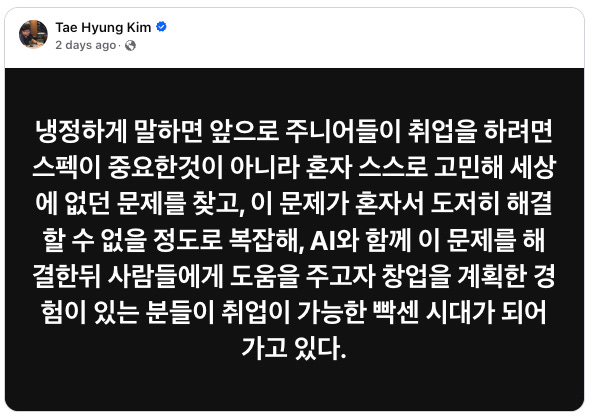
I agree, and I would put it more briefly. Early-career professionals increasingly need an AI-enabled solopreneur mindset: the ability to spot overlooked problems, work independently with AI to develop solutions, and create value for others.
Dara Denney, a well-known voice in marketing, takes the idea further. She argues that middle managers will disappear quickly, because AI lets one person set the strategy and do the heavy lifting too.
But there is a catch, and it is easy to miss. A good solution is no longer the hard part. AI can draft five of them before lunch. The hard part is everything that surrounds the solution. Someone has to win permission to use the client’s data. Someone has to convince a busy specialist to share what they really know. Someone has to catch the mistakes the AI makes with such confidence, and then bring the client to the point of actually using the result. This work of organizing people, information, and trust deserves its own name. I call it orchestrapreneurship.
2. Three Concepts and Their Neighbors
The word combines orchestrator and entrepreneur. The idea is someone who conducts an ensemble they do not own, and who carries the risk of the performance.
Figure 1
The Orchestrapreneur: One Accountable Person Bridging Client Boundaries, Human Expertise, and AI
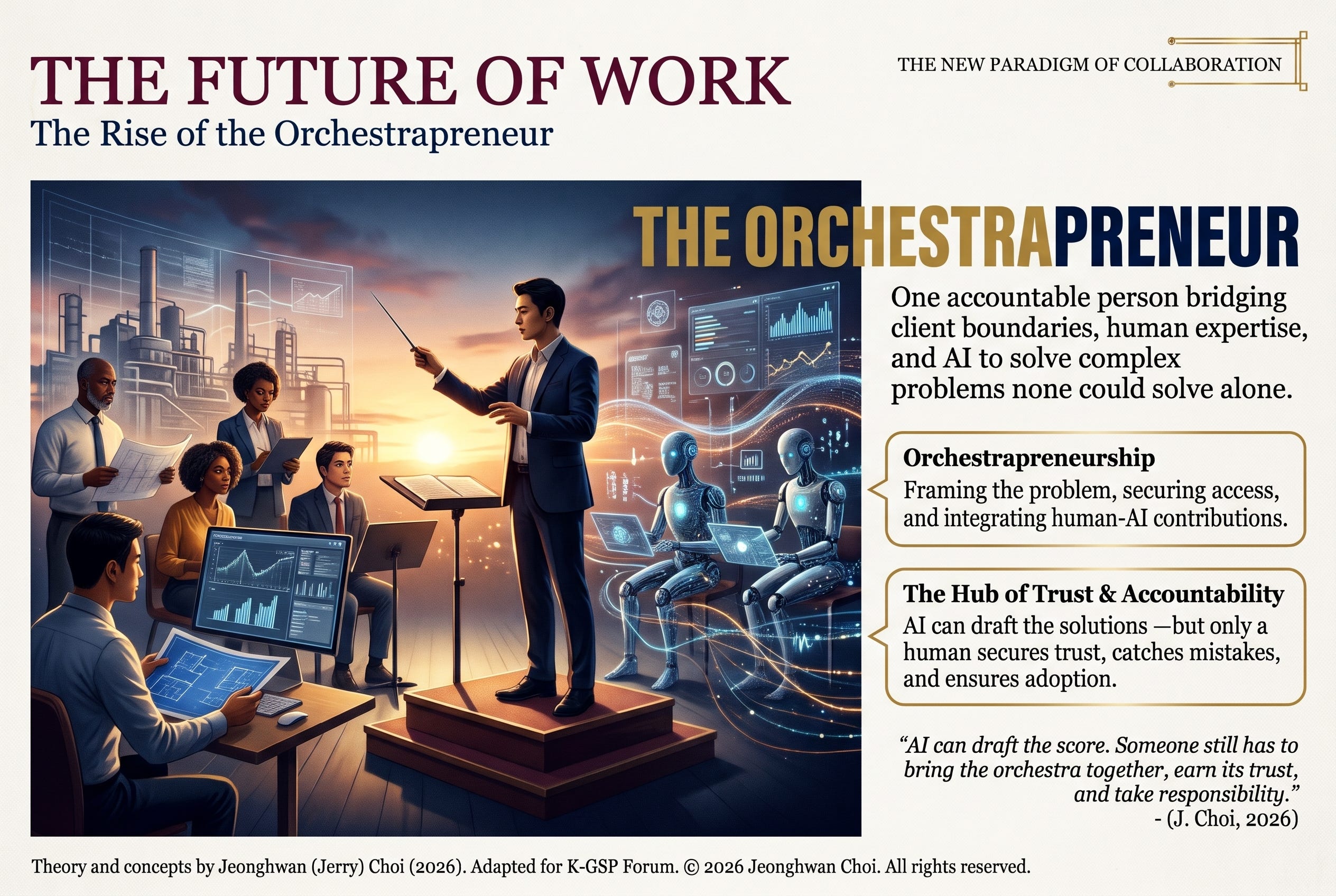
Note. The orchestrapreneur is shown as a conductor who coordinates independent human specialists and AI agents to address a complex client problem. Orchestrapreneurship refers to framing the problem, securing access, and integrating human and AI contributions. The figure is a conceptual illustration, not an empirical model. Concepts and definitions are by Jeonghwan (Jerry) Choi (2026). Image for illustrative purposes. © 2026 Jeonghwan (Jerry) Choi.
2.1 The Orchestrapreneur, the Process, and the Capability
An orchestrapreneur is an individual who takes entrepreneurial responsibility for a consequential problem or opportunity, and who brings together, coordinates, and governs complementary human contributions and partly autonomous AI activity. The orchestrapreneur stands between a client organization and a network of independent specialists, solopreneurs, client employees, and AI agents, none of whom has to report to them.
Orchestrapreneurship is the organizing process that role performs: framing the problem, securing access and participation, setting limits on what AI may decide on its own, integrating contributions, and adjusting the arrangement as the work develops. It is something people do, and it can fail.
Orchestrapreneurial capability is the individual’s capacity to carry out that coordination and governance. It differs from what a person actually does in a given engagement, and from how the engagement turns out.
My framework builds on two strong foundations. Dhanaraj and Parkhe (2006) explained how a hub firm orchestrates a network of independent companies. Raisch and Fomina (2025) showed how humans and AI can combine in different patterns of problem-solving. Neither explains how a single person, with no hub firm behind them, makes such a network workable across a client’s boundary. That is the gap these concepts address.
2.2 Where the Boundaries Lie
New labels are cheap, so I want to be clear about what these concepts are not. Table 1 sets out the distinctions.
Table 1
Analytical Distinctions and Neighboring Roles
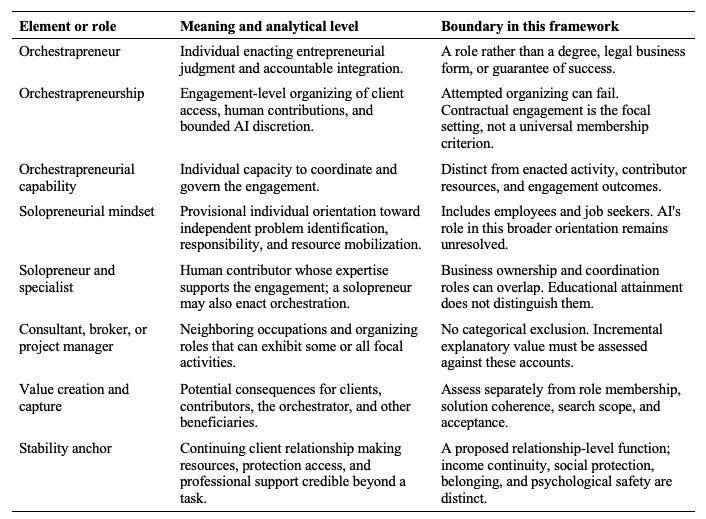
Orchestrapreneur. Individual enacting entrepreneurial judgment and accountable integration. Boundary: A role rather than a degree, legal business form, or guarantee of success.
Orchestrapreneurship. Engagement-level organizing of client access, human contributions, and bounded AI discretion. Boundary: Attempted organizing can fail. Contractual engagement is the focal setting, not a universal membership criterion.
Orchestrapreneurial capability. Individual capacity to coordinate and govern the engagement. Boundary: Distinct from enacted activity, contributor resources, and engagement outcomes.
Solopreneurial mindset. Provisional individual orientation toward independent problem identification, responsibility, and resource mobilization. Boundary: Includes employees and job seekers. AI’s role in this broader orientation remains unresolved.
Solopreneur and specialist. Human contributor whose expertise supports the engagement; a solopreneur may also enact orchestration. Boundary: Business ownership and coordination roles can overlap. Educational attainment does not distinguish them.
Consultant, broker, or project manager. Neighboring occupations and organizing roles that can exhibit some or all focal activities. Boundary: No categorical exclusion. Incremental explanatory value must be assessed against these accounts.
Value creation and capture. Potential consequences for clients, contributors, the orchestrator, and other beneficiaries. Boundary: Assess separately from role membership, solution coherence, search scope, and acceptance.
Stability anchor. Continuing client relationship making resources, protection access, and professional support credible beyond a task. Boundary: A proposed relationship-level function; income continuity, social protection, belonging, and psychological safety are distinct.
Note. Definitions are proposed analytical distinctions, not validated scale dimensions. The focal unit is a problem-solving engagement; individual capacities and client organizational choices retain their respective levels. © 2026 Jeonghwan (Jerry) Choi.
Three points matter most. First, the orchestrapreneur is a role, not a credential. A PhD does not make you one, and a solo business license does not either. Second, consultants and project managers can act as orchestrapreneurs. What sets the role apart is the combination of entrepreneurial responsibility for the problem, coordination across the client boundary, interdependent human work, and AI given limited discretion. Third, the solopreneurial mindset is the orientation that may lead someone into the role. Employees and job seekers can have it too.
2.3 What This Looks Like in Practice
Many solopreneurs already work this way without having a word for it. A short video on solopreneurship (Solopreneur video, n.d.) shows one person combining tools, freelancers, and AI to do work that once required a company:
Now raise the stakes. Picture a manufacturer whose deliveries keep failing. AI agents generate alternative schedules. An independent operations expert tests them for feasibility. A software freelancer builds the interface. The plant managers alone can approve a change in production. Someone has to win access to the plant’s data, translate between the data person’s “prediction problem” and the manager’s “missed delivery problem,” spot when an AI schedule quietly breaks a constraint, and bring the managers in before the team falls in love with an unworkable answer. That someone is the orchestrapreneur.
The role has limits. One person’s attention can run out when AI agents produce more than anyone can review. A client can hand over responsibility without the authority to act on it. Some problems are simply better solved inside the firm. My framework treats these limits as part of the theory, not footnotes to it.
3. A Skill Worth Teaching
For students and early-career professionals, I think this is the practical message. Credentials and AI fluency are only the starting point. What sets people apart is the ability to frame a real problem, admit what you cannot do alone, recruit the right people, give AI a clear but limited role, and remain answerable for the whole. Universities can teach pieces of this. Real capability comes from supervised work on real problems, where trust has to be earned.
For Korean diaspora scholars and professionals, the role may feel familiar. Many of us have spent our careers translating between institutions, languages, and expectations that do not quite line up. Orchestrapreneurship gives that bridging work a name and a theory.
AI can draft the score. Someone still has to bring the orchestra together, earn its trust, and take responsibility when the music falls flat.
References
Dara Denney, YouTube Shorts.
Dhanaraj, C., & Parkhe, A. (2006). Orchestrating innovation networks. Academy of Management Review, 31(3), 659–669. https://doi.org/10.5465/amr.2006.21318923
Kim, T. H. (2026, November). 냉정하게 말하면 앞으로 주니어들이 취업을 하려면 스펙이 중요한것이 아니라…[Facebook post]. Facebook. https://www.facebook.com/socialego
Raisch, S., & Fomina, K. (2025). Combining human and artificial intelligence: Hybrid problem-solving in organizations. Academy of Management Review, 50(2), 441–464. https://doi.org/10.5465/amr.2021.0421
About the Author

Prof. Dr. Jeonghwan (Jerry) Choi (Managing Editor)
Full list of his K-GSP columns:
Jeonghwan (Jerry) Choi, PhD is Editor-in-Coordination of K-GSP Forum (contact: jeonghwan.choi at gmail.com). With over 25 years of industry and consulting experience, he specializes in leadership development, human resource management, organizational behavior, and social entrepreneurship. His research focuses on workforce resilience, organizational health, and self-directed leadership — bridging rigorous scholarship with practical insight to cultivate leaders who create meaningful, sustainable, and humane organizations.
Suggested Citation
Choi, J. (2026, November 5). Meet the orchestrapreneur: A new name for leading people and AI across firm boundaries. K-GSP Forum. https://doi.org/10.5281/zenodo.23989241
Original Article

한글요약
오케스트라프러너를 소개합니다: 조직의 경계를 넘어 사람과 AI를 이끄는 새로운 역할
AI 덕분에 해결책을 만드는 일은 어느 때보다 쉬워졌습니다. 하지만 고객의 신뢰를 얻고, 전문가들의 진짜 참여를 이끌어 내고, 그 해결책을 실제로 쓰이게 만드는 일은 여전히 어렵습니다. 김태형 님은 앞으로 주니어들이 취업하려면 스펙보다, 스스로 세상에 없던 문제를 찾고 그 문제가 혼자 풀기 어려울 만큼 복잡하다는 것을 깨닫고 AI와 함께 해결하며 창업까지 계획해 본 경험이 필요하다고 말합니다.
필자는 이 흐름을 설명하기 위해 세 가지 새로운 개념을 제시합니다. 오케스트라프러너(orchestrapreneur)는 중요한 문제에 대해 기업가적 책임을 지고, 고객 조직과 독립 전문가, 1인 기업가, AI 에이전트를 연결해 조율하는 개인입니다.
오케스트라프러너십(orchestrapreneurship)은 그 사람이 문제를 정의하고, 접근 권한과 참여를 확보하고, AI에게 제한된 재량을 맡기고, 결과를 통합해 나가는 조직화 과정입니다.
오케스트라프러너 역량(orchestrapreneurial capability)은 이 조율과 관리를 해낼 수 있는 개인의 능력입니다. 이 역할은 학위나 사업자 등록으로 정해지지 않으며, 컨설턴트나 프로젝트 매니저도 이 역할을 할 수 있습니다. 또한 한 사람이 검토할 수 있는 양에는 한계가 있고, 어떤 문제는 조직 안에서 푸는 것이 더 낫다는 점도 이론의 일부로 다룹니다.
여러 제도와 언어 사이를 오가며 일해 온 한인 디아스포라 학자와 전문가들에게 이 역할은 낯설지 않을 것입니다. 이 세 개념과 표 1의 정의는 최정환 박사의 독창적인 연구 성과이며, 저작권은 필자에게 있습니다. 인용 시 본 글을 출처로 밝혀 주시기 바랍니다.
Comment:
Dr. Choi, your distinction between generating solutions and taking responsibility for implementing them is particularly relevant to doctoral education. Your proposed concept of orchestrapreneurship offers a useful lens for examining how scholar-practitioners integrate human expertise, AI, and accountability.
In doctoral coaching, I see candidates with access to research tools, AI, and faculty guidance who still struggle to turn those resources into a coherent research plan. The challenge is often not information but defining the problem, aligning research questions and methods, knowing when to seek expertise, and maintaining independent scholarly judgment.
This insight shapes my coaching approach: helping candidates establish clear deliverables, use academic support strategically, set ethical boundaries for AI, and retain ownership of their scholarship. I also appreciate your distinction between a proposed framework and an empirically validated model.
It raises an important question: How can doctoral programs better prepare scholars to coordinate people and technology without compromising intellectual independence or research integrity?
Answer:
Thank you for your thoughtful insights. I agree that doctoral education, particularly professional doctoral programs, should move beyond developing research expertise alone toward cultivating highly capable orchestrapreneurial problem solvers.
Traditional doctoral education rightly emphasizes academic rigor, disciplinary expertise, and methodological competence. However, the growing integration of human expertise and autonomous AI agents calls for an additional capability: the ability to identify hidden, overlooked, or unresolved problems and orchestrate diverse expertise and technologies to address them responsibly.
Engineering education offers a useful parallel, as complex problem-solving increasingly demands the integration of specialized technical knowledge, interpersonal and intrapersonal competencies, and managerial capabilities.
I envision the future of professional doctoral education as developing scholars who combine deep disciplinary expertise with advanced orchestrapreneurial capability. Such scholars should be able to uncover consequential real-world problems, transform them into researchable questions, coordinate human experts and AI agents, and integrate fragmented inquiries into coherent, actionable knowledge.
Importantly, AI should expand scholarly capacity without replacing independent intellectual judgment, ethical responsibility, or research integrity.
This is where I believe the proposed concept of orchestrapreneurship could make a meaningful contribution to professional doctoral education: preparing scholar-practitioners not merely to produce knowledge, but to orchestrate its responsible creation, integration, and implementation.