

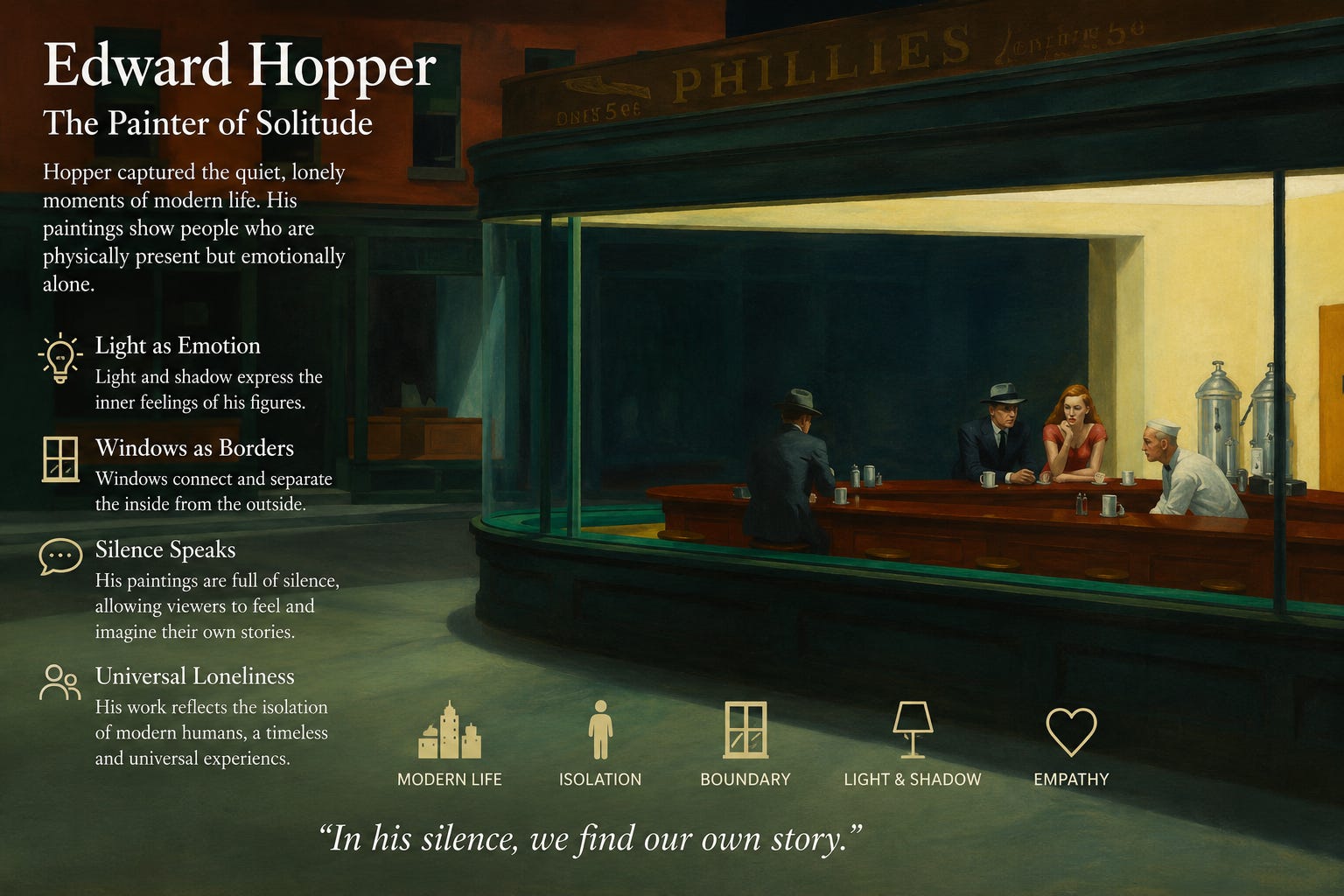
In today’s world, people are more connected than ever before. Smartphones and social media deliver the lives of others to us in real time throughout the day. Yet paradoxically, the human heart seems to be sinking into even deeper loneliness. The world of the American painter Edward Hopper has recently gained renewed attention because it portrays this modern solitude with remarkable precision and quiet intensity. The figures in his paintings do not perform dramatic actions. They simply gaze out of windows, sit silently in cafés, or endure another ordinary day in silence. Yet it is precisely this silence that gives profound comfort to contemporary viewers. His work artistically demonstrates the truth that “the solitude of others helps us understand our own.”
First, Hopper’s paintings communicate human emotion through “frozen moments” rather than dramatic narratives. While films and television dramas often move audiences through conflict and excitement, Hopper transforms seemingly uneventful moments into art itself. An empty street or a late-night diner evokes the quiet emptiness that many people have experienced in their own lives. In art criticism, this is often described as a “static narrative.” The less movement there is, the more vividly human emotion emerges.
Second, one of the most important elements in his work is light. Hopper’s light is not merely illumination; it is a psychological language. Sunlight entering through a window, the dim glow of neon signs, or the faint light of a hotel room all intensify feelings of isolation and emotional distance. Even ordinary viewers standing before his paintings instinctively feel a sense of melancholy. This is because the light itself speaks on behalf of human emotion.
Third, although Hopper painted cities, he was truly painting the human interior. The streets of New York, cafés, train stations, and hotel rooms are not simply backgrounds. They symbolize how modern civilization can isolate individuals. People occupy the same spaces yet rarely communicate with one another. Strikingly, this resembles today’s subway scenes where everyone stares silently at their smartphones.
Fourth, his work reveals what may be called the “aesthetics of silence.” Contemporary culture constantly demands expression, reaction, and endless conversation. Hopper’s figures, however, hardly speak at all. Instead, they endure their existence quietly within silence. From the perspective of art criticism, this creates “inner tension.” Because so little is explicitly stated, viewers are invited to fill the emotional space themselves.
Fifth, windows appear repeatedly throughout Hopper’s paintings. A window connects the inside and the outside, yet it also divides them. The figures gazing through windows seem to long for connection with the world while remaining unable to fully approach it. This symbolizes the emotional distance experienced by modern people. We live in an age of constant connection, yet genuine closeness often remains elusive.
Sixth, Hopper’s art grants viewers the freedom to interpret. He never fully explains the stories of his characters. As a result, people naturally project their own experiences into his paintings. One viewer may recall the loneliness of unemployment, another the ending of a relationship, and yet another the emptiness of life itself. His work reminds us that great art does not provide fixed answers; rather, it becomes a mirror reflecting each person’s life.
Seventh, Hopper’s paintings carry even greater significance in the age of artificial intelligence. While AI maximizes efficiency and speed, it also raises new concerns about the loss of authentic human connection. The loneliness visible in Hopper’s work is not merely a twentieth-century problem; it is also a deeply contemporary one. In a world overflowing with screens but lacking meaningful conversation, his paintings invite us to reconsider the essential solitude of human existence.
Eighth, art critics admire Hopper because of his extraordinary restraint. He never exaggerates emotion. There are no screaming figures or overly dramatic expressions. Yet this restraint creates even deeper emotional resonance. In some ways, it resembles the East Asian aesthetic concept of “the beauty of emptiness” or “negative space.” Because he does not explain everything, his paintings leave a more lasting emotional echo.
Ninth, Hopper’s work raises philosophical questions about human existence itself. Why are people lonely? Why do we feel isolated even when surrounded by others? Can human beings ever truly understand one another? His paintings offer no direct answers. Instead, they quietly place these questions before us. This is one of the greatest powers of art. Great art does not merely create beautiful images; it compels us to reflect upon the meaning of human existence.
Tenth, the enduring popularity of Hopper’s paintings ultimately comes from their power of empathy. People long for someone to understand their loneliness. Hopper’s works seem to whisper gently, “You are not alone in feeling alone.” For this reason, his paintings are sorrowful yet deeply comforting at the same time. By witnessing the solitude of others, people often discover the strength to endure their own lives.
Ultimately, Edward Hopper’s art reveals the essence of humanity through silence rather than spectacle, through moments rather than events, and through emptiness rather than explanation. The loneliness in his paintings is not simply sadness; it is a mirror reflecting the existential condition of modern life. In an age that is increasingly fast and noisy, people often find their deepest consolation in quiet art. That is why Hopper’s paintings feel less like ordinary works of art and more like a silent conversation with the human soul. +++
{Solti}
May 17, 2026

Young Choi, PhD is a Professor at Regent University bringing a rare combination of technical expertise and creative spirit to everything he does. A scholar in AI, cybersecurity, and network & telecommunications service management, he has published 38 books including AI and cybersecurity area books, over 200 refereed articles, and over 20 book chapters. Beyond the academy, Dr. Choi is a passionate poet, essayist, and wooden block laser engraving artist whose reflective writing invites readers to rediscover life’s beauty in quiet contemplation(靜觀). He lives under the motto: “Study hard and give generously without holding back! (열심히 공부해서 아낌없이 남주자 !: 열공아남)”
Published books: https://www.amazon.com/stores/Young-Choi/author/B0DMZ5S6R7?ref=ap_rdr&shoppingPortalEnabled=true