

EXECUTIVE SUMMARY
This article analyzes two outward-facing models of a meaningful life through Cicero and Marcus Aurelius. Both exemplify commitment to public responsibility, Cicero through civic participation and Marcus Aurelius through imperial duty under sustained pressure. While differing in temperament, their lives reveal a shared pattern: deep engagement with external roles that impose continuous demands and constrain personal autonomy. Rather than rejecting these models, the article treats them as instructive but cautionary. It highlights the risks of over-engagement, role absorption, and prolonged exposure to conflict. The analysis suggests that while public responsibility can generate meaning and impact, it often comes at the cost of psychological space and self-directed life design.
Keywords: Civic Duty, Role Burden, Over-engagement, Stoic Endurance, Public Life
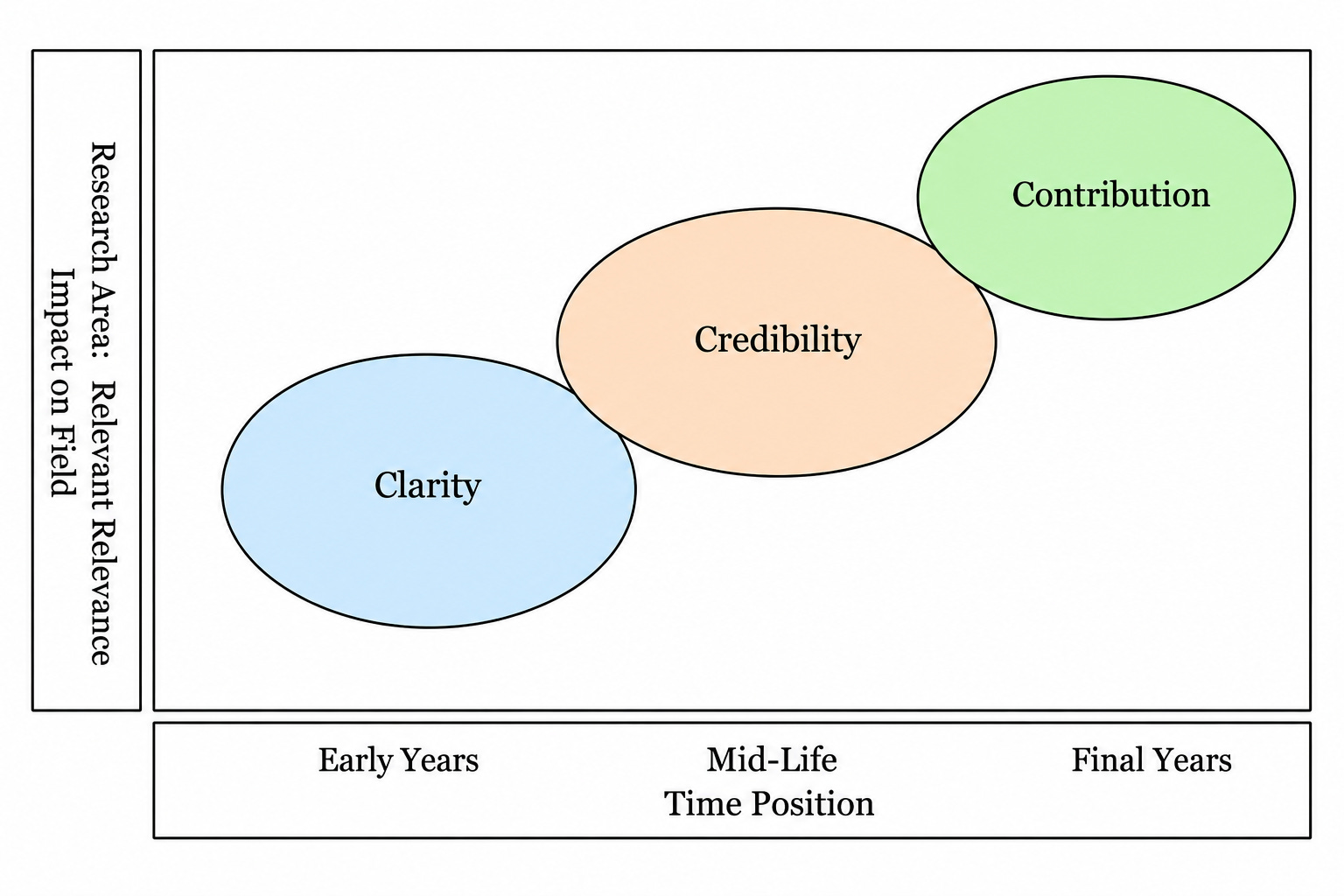
Figure 1. The Engagement Trajectory Across the Life Course
Engagement evolves from clarity to credibility and ultimately to contribution, as individuals expand their impact over time, from short-term relevance through respect to enduring resonance.
1. Introduction
In one striking image of contemporary power, Donald Trump arrived in China accompanied not only by senior political officials, but also by a formidable entourage of corporate leaders, investors, strategists, and negotiators. The visit unfolded through a relentless sequence of summits, state ceremonies, business forums, trade discussions, media engagements, and strategic meetings, an almost theatrical display of modern engagement at the highest level. Beneath the spectacle, however, lay a deeper reality: influence today demands continuous exposure to complexity, accelerated decision-making, and sustained responsiveness across political, economic, and informational domains.
This observation recalls an earlier world explored in Letters from a Stoic and Meditations. Although Stoic philosophy is often associated with inward reflection and detachment, both Seneca and Marcus Aurelius lived intensely outward-facing lives shaped by governance, conflict, diplomacy, and public responsibility. Their writings reveal not withdrawal from the world, but an effort to preserve clarity and discipline while operating within systems of immense demand and constant pressure. This aligns with longstanding arguments that meaning and significance are often constructed through participation, obligation, and contribution within broader social and political orders (Esfahani Smith, 2017).
Yet this same mode of engagement carries hidden costs. Continuous immersion in external demands can fragment attention, reduce reflective capacity, and erode autonomy (Newport, 2016). Over time, overstimulation and perpetual responsiveness may produce not greater effectiveness, but diminishing coherence and control (Crawford, 2015). The lives of Cicero, Marcus Aurelius, and many contemporary leaders suggest that intense engagement is inherently double-edged: it creates influence and significance while simultaneously generating strain, dispersion, and overreach. This article examines how individuals, firms, and empires confront that tension, and how enduring success often depends not on continuous expansion, but on the disciplined capacity to pull back, reconsolidate, and rebuild from a stronger core. This article contributes a conceptual framework for understanding engagement as both a source of meaning and a structural constraint in the AI era.
2. Why Ancient Lives Matter in the AI Era
At first glance, figures such as Cicero and Marcus Aurelius may appear distant from contemporary AI-shaped American life, yet that very distance sharpens their relevance as a lens on enduring pressures of meaning, responsibility, and uncertainty, for while the AI era amplifies speed, access, and external demands, it does not resolve the fundamental human challenge of living meaningfully under constraint, and thus they stand not as relics but as case studies in navigating conditions where decision-making, public exposure, and role expectations exceed personal control.
2.1. Lessons on Meaning Through Engagement
Both Cicero and Marcus Aurelius demonstrate that meaning is often forged through sustained engagement with the larger world rather than withdrawal from it. In the AI era, where automation can reduce human involvement and algorithmic systems increasingly mediate action, their lives remind us that purpose is closely tied to responsibility, judgment, and participation. Cicero’s immersion in civic life and Marcus Aurelius’s endurance in imperial leadership show that engagement creates significance by placing the individual within networks of obligation and consequence. For professionals and leaders in contemporary America, this suggests that meaning cannot be outsourced to technology. It must still be constructed through deliberate involvement in institutions, communities, and decision processes that shape collective outcomes.
2.2. Warnings About Over-Engagement and Role Burden
A second implication is the need to actively preserve psychological space in the face of sustained engagement. The experiences of Cicero and Marcus Aurelius demonstrate how easily inner life can be compressed under continuous external pressure, a dynamic intensified in the AI era by constant information flow and expectations of rapid response. Reclaiming autonomy, therefore, is not achieved through disengagement alone, but through the deliberate establishment of boundaries that protect time for reflection, judgment, and self-directed thinking. The later lives of Seneca and Marcus Aurelius reinforce this point. Despite Seneca’s extensive writings on tranquility and detachment (Seneca, 2015), his final years were entangled in political volatility under Emperor Nero, ultimately leading to his forced suicide. His philosophical commitment to inner freedom did not shield him from the risks of proximity to power.
Similarly, Marcus Aurelius, whose Meditations articulate discipline, restraint, and acceptance, spent his final years directing military campaigns along the Danube rather than in philosophical retreat (Aurelius, 2003; Aurelius, 2011). Worn by prolonged warfare and illness, likely the Antonine plague, he died in a military encampment, embodying the enduring tension between inner aspiration and external obligation. These cases highlight a broader Stoic insight: even the most reflective individuals remain constrained by the roles they inhabit (Sellars, 2019). In the AI era, where engagement is amplified and normalized, this tension becomes even more pronounced (Crawford, 2015; Newport, 2016). The lesson is not that philosophy fails, but that without deliberate limits, outward engagement can overwhelm inward autonomy, underscoring the need for a balanced model that integrates meaningful contribution with protected space for renewal and self-direction.
2.3. Cross-Cultural Recurrence of Engagement Risks
This pattern is not unique to the Greco-Roman world, as similar dynamics appear in the Korean Joseon dynasty, where scholar-officials such as Jo Gwang-jo were drawn into cycles of power, factional conflict, and eventual downfall when moral commitments to governance collided with court politics. The Literati Purges (사화 sahwa) illustrate the severity of this system, as loss of royal favor or factional misalignment often led to exile, execution, and even the eradication of entire family lines, reflecting the totalizing risks of political engagement.
What is striking is not merely the historical distance of these events, but their structural similarity to modern forms of engagement, where individuals operating in politics or business remain vulnerable to shifts in power, organizational conflict, and reputational risk. While the scale and form differ, the underlying logic persists. Deep engagement in high-stakes systems can generate meaning and impact but also exposes individuals to forces beyond their control, requiring awareness, boundaries, and deliberate navigation.
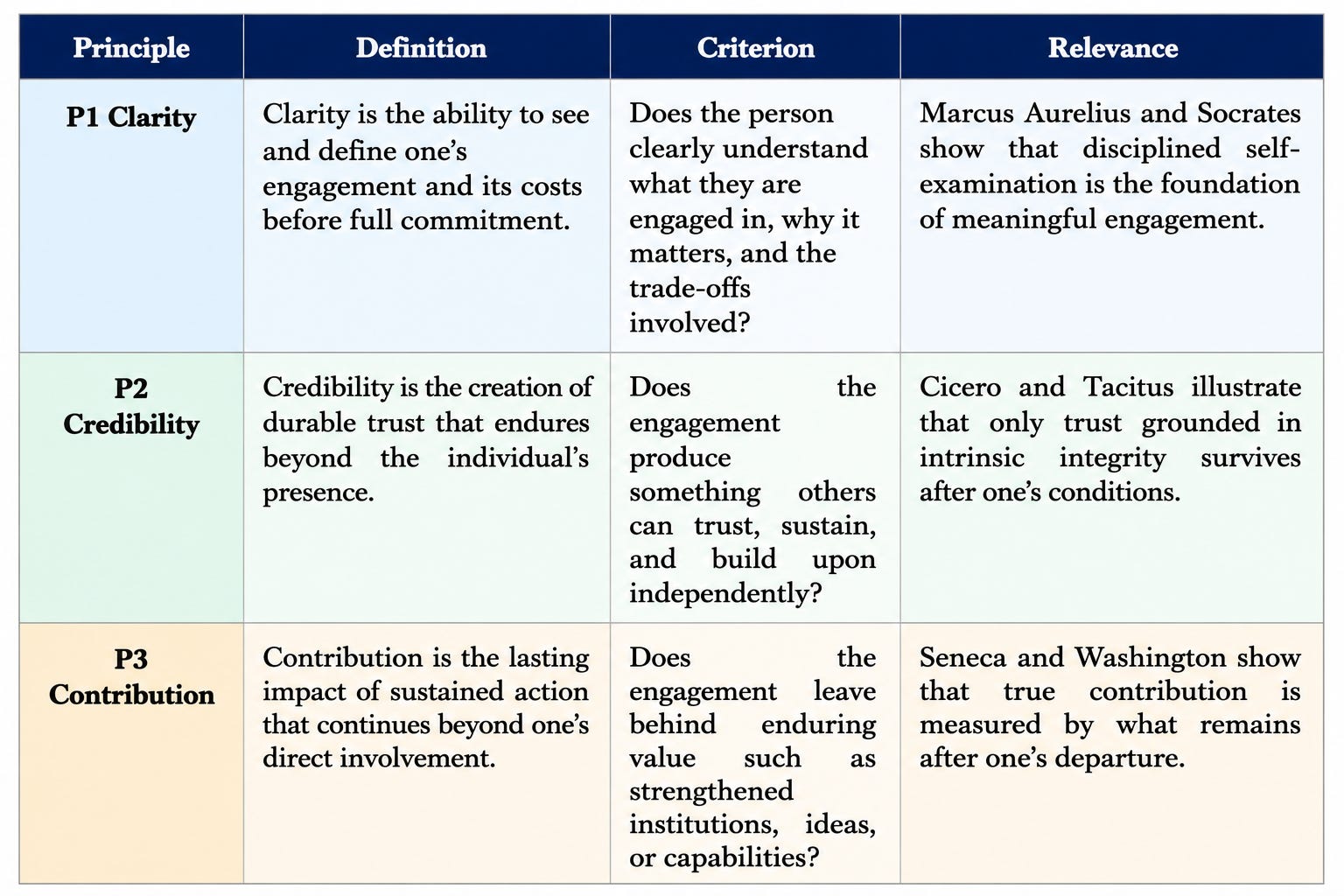
Table 1. Three Governing Principles of an Engaged Life
3. The Trap of Engagement: When Roles Take Over
The lives of Cicero and Marcus Aurelius reveal how engagement evolves from purposeful choice into absorbing necessity, as roles, institutions, and expectations gradually dictate action and constrain withdrawal, until engagement itself becomes a condition that shapes not only what they do, but how they live, think, and direct their attention.
3.1. When the Role Becomes the Self
For both Cicero and Marcus Aurelius, the boundary between role and identity gradually dissolved. Cicero was not merely a participant in Roman politics. He became inseparable from the volatile fate of the Republic itself. Likewise, Marcus Aurelius was not simply an emperor performing duties; he lived within a continuous state of responsibility that defined his daily existence. In such conditions, roles expand beyond functional tasks into total frameworks that organize perception, relationships, and judgment.
This dynamic is not confined to antiquity. In the AI era, professionals increasingly find themselves in roles that demand constant visibility, responsiveness, and performance. The difference is scale and speed: digital systems amplify expectations, making disengagement more difficult and role boundaries more porous. Engagement, therefore, is no longer just something one does. It becomes something one is. And once that shift occurs, stepping back is no longer a simple decision. It becomes a structural challenge.
3.2. The Hidden Cost: Losing the Ability to Step Back
The deeper danger of this absorption is not exhaustion alone, but the gradual erosion of distance, the ability to step back, reflect, reassess, and choose differently. As engagement intensifies, decision-making shifts from personal judgment toward unfolding necessity, leaving individuals like Cicero and Marcus Aurelius increasingly reactive, shaped by pressures that allow little room for pause.
This pattern is even more pronounced in the AI era, where continuous information flow and real-time expectations compress time and attention, creating a paradox in which expanding influence coincides with contracting autonomy. While the engaged life promises meaning and relevance (Esfahani Smith, 2017), without deliberate limits it can undermine the very autonomy required for reflective judgment (Crawford, 2015), turning commitment into constraint and purpose into a system that is difficult to escape.
3.3. From Structural Pattern to Conceptual Framework
The preceding analysis shows that the engaged life is not merely a sequence of individual choices but a structured condition shaped by identity, institutional roles, and expanding spheres of influence. As illustrated in the lives of Cicero and Marcus Aurelius, engagement begins with purposeful action but gradually evolves into a system that organizes how individuals think, act, and allocate their attention. What emerges is a pattern in which identity becomes role-dependent, structure becomes externally driven, and impact increases alongside exposure to volatility and constraint.
Table 2. Benefits and Risks of an Engaged Life Across Contexts
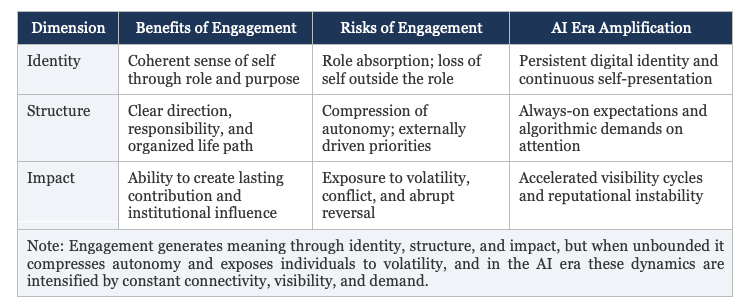
Note. Engagement generates meaning through identity, structure, and impact, but when unbounded it compresses autonomy and exposes individuals to volatility, and in the AI era these dynamics are intensified by constant connectivity, visibility, and demand.
Table 2 provides a conceptual framework for understanding engagement as a dual-force system organized around identity, structure, and impact. Across each dimension, engagement generates coherence, direction, and meaningful contribution while also creating vulnerabilities such as role absorption, reduced autonomy, and greater exposure to instability. In the AI era, these tensions intensify as constant connectivity, persistent visibility, and accelerated feedback loops expand both the opportunities and the pressures associated with sustained engagement.
Taken together, this structural pattern reveals a central insight: engagement is inherently ambivalent, simultaneously enabling and constraining by expanding influence while narrowing autonomy. This duality shifts the question from whether to engage to how to engage under increasingly demanding conditions, requiring a disciplined approach that actively evaluates limits in environments designed to fragment attention and reward constant responsiveness (Newport, 2016).
4. Reconstructing Meaningful Engagement in the AI Era
Before examining its limits, engagement endures as a powerful ideal because it transforms action into meaning by linking individuals to systems where contributions matter and identity is shaped through participation, and in the AI era this function becomes even more critical as automation heightens the human need for purpose, agency, and connection to something larger than oneself, making the central challenge not to abandon engagement but to preserve its meaning under conditions that increasingly threaten to dilute or overwhelm it.
4.1. The Discipline of Selective Engagement
Precisely because engagement is meaningful, it must be exercised with discipline. In contrast to the relatively fixed roles of Cicero or Marcus Aurelius, modern individuals face an expanding field of possible engagements driven by digital systems and AI-enabled platforms. The risk is not disengagement, but overextension, participating in too many activities without coherence or depth.
Selective engagement becomes essential. It involves choosing commitments based on alignment with values, long-term purpose, and capacity, rather than reacting to every available demand. This selectivity protects the quality of engagement, ensuring that involvement remains meaningful rather than fragmented. Without it, engagement risks becoming diffuse and performative, losing the very depth that gives it significance.
4.2. Protecting the Conditions for Meaningful Engagement
At the same time, the conditions that make engagement meaningful must be actively preserved. The experiences of Cicero and Marcus Aurelius show how sustained external pressure can compress inner life, even for those committed to reflection and discipline. In the AI era, this compression is intensified by constant connectivity and the expectation of immediate response.
Meaningful engagement requires more than participation. It requires the capacity to think, reflect, and choose deliberately. This, in turn, depends on protected psychological space. Without such space, engagement becomes reactive rather than intentional, and individuals risk losing the autonomy that gives their actions meaning in the first place.
A sustainable model of engagement must therefore balance outward contribution with inward preservation. It must enable individuals to remain connected to the world while retaining the distance necessary to interpret, evaluate, and direct their own involvement. Only under such conditions can engagement continue to generate meaning without devolving into exhaustion or loss of self.
4.3. Knowing When to Slow Down, and When to Stop
If engagement gives life meaning, the deeper question is not simply how to engage, but when to reduce or step away from it. The lives of Cicero and Marcus Aurelius offer limited guidance here, not because the issue lacks importance, but because their roles left little room for withdrawal, illustrating how deeply embedded individuals become in systems of responsibility and how, without intentional boundaries, engagement tends to persist by default rather than by choice. Slowing down, therefore, is not passive but requires deliberate withdrawal from systems optimized for continuous engagement (Crawford, 2015; Newport, 2016), beginning at the point where additional involvement yields diminishing meaning, increased fragmentation, or a sustained loss of reflective capacity. In the AI era, this threshold becomes harder to detect as constant inputs override traditional signals of fatigue or completion, making it necessary to consciously reduce commitments, response speed, and exposure to ongoing demands in order to restore proportionality between engagement and capacity.
Stopping raises a deeper issue: the meaning of retirement. Retirement is not the end of productivity, but a structural transition from externally defined roles to self-directed life design. Rather than disengagement, it represents a reconfiguration of attention, from obligation to intention and from constant responsiveness to selective participation, allowing continued connection without subordination to continuous demands. Yet modern engagement systems, particularly in American life, do not easily release individuals, as professional identity, social expectations, and digital connectivity extend engagement far beyond formal roles, making it difficult not only to stop but to redefine oneself afterward. The lesson across both ancient and modern contexts is clear: unless slowing down and stopping are consciously designed, they rarely occur meaningfully, and a sustainable life course must therefore include not only principles of engagement but also principles of exit to preserve autonomy, coherence, and the capacity for intentional living.
In the AI era, the ability to disengage wisely may become as important as the ability to engage effectively.
5. Conclusion
The modern world rewards constant engagement, continuous connectivity, perpetual responsiveness, and relentless expansion across professional, social, and digital domains. Yet the same forces that create influence and growth can also erode focus, fragment attention, and weaken control when expansion outpaces human, organizational, or political capacity. Across individuals, firms, and empires, the decisive advantage belongs not to those who remain endlessly engaged, but to those who recognize when acceleration becomes excess. In an age defined by AI, information saturation, and escalating complexity, enduring strength will increasingly depend on the ability to reconsolidate deliberately: to reduce noise, restore coherence, and concentrate energy on what truly matters. The future may belong not to those who do the most, but to those who know exactly what to sustain, what to abandon, and when to pull back in order to move forward again.
References
Aurelius, M. (2003). Meditations: A new translation (G. Hays, Trans.). Modern Library.
Aurelius, M. (2011). Meditations: With selected correspondence (R. Hard, Trans.; C. Gill, Intro.). Oxford University Press.
Crawford, M. B. (2015). The world beyond your head: On becoming an individual in an age of distraction. Farrar, Straus and Giroux.
Esfahani Smith, E. (2017). The power of meaning: Crafting a life that matters. Crown.
Newport, C. (2016). Deep work: Rules for focused success in a distracted world. Grand Central Publishing.
Sellars, J. (2019). Lessons in Stoicism. Allen Lane.
Seneca, L. A. (2015). Letters from a Stoic (R. Campbell, Trans. & Intro.). Penguin Classics. (Original work published 1969)
Original Article.

About the Author

Distinguished Professor, Dr. Paul Hong — University of Toledo
Paul C. Hong is a Distinguished University Professor and Chair of Information Systems and Supply Chain Management at the University of Toledo. His work focuses on leadership, governance, and decision-making in the AI era, integrating strategy, technology, and institutional trust. He has published extensively in leading academic journals and writes on how individuals and organizations navigate complexity, disruption, and global transformation.
© K-Global Scholars and Professionals Forum. All rights reserved. Content published in the K-GSP Forum may not be reproduced, distributed, or transmitted in any form without prior written permission from the K-GSP Forum, except for brief quotations with full attribution.
Thank you for sharing this thoughtful article.
I really appreciated its insight that people do not always need more engagement—they often need a sense of belonging first. The coffee shop analogy was especially meaningful. It reminded me that a healthy community is not built by constantly asking people to participate, but by creating a place where they feel welcome, valued, and free to engage at their own pace.
This is a valuable lesson not only for organizations and communities, but also for churches and Bible study groups.
Thank you again for sharing. It gave me much to reflect on.
Thanks Dr. Hong for writing this article. How to engage in post-retirement life is important. This article helps me to think about sustained interest, coherence and focused attention in life, not too much fragmented in interests here and there. My three focuses of life at this stage are the unity of the church, wellbeing of the family and my integrity as a person and a member of the church