
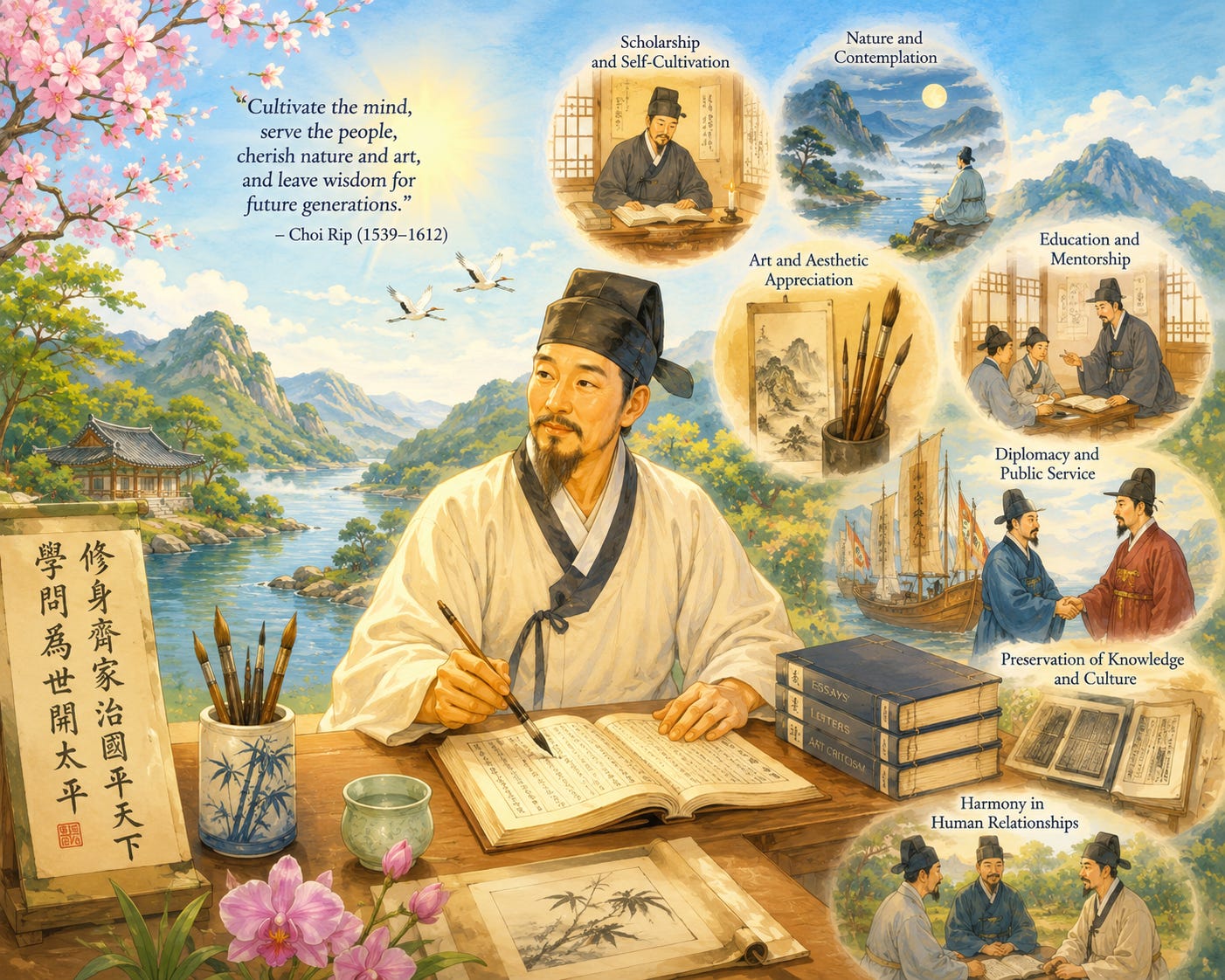
“Cultivate the mind,
serve the people,
cherish nature and art,
and leave wisdom for future generations.”
- Choi Rip (1539-1612)
Choi Rip, a distinguished literary figure and philosopher of the mid-Joseon Dynasty, was far more than a poet or scholar. He was a practical intellectual who crossed the boundaries of politics, diplomacy, education, literature, publishing, and artistic criticism, seeking to integrate the whole of human life into a harmonious spiritual world. Although rooted in Neo-Confucian thought, his philosophy transcended rigid doctrinal formalism by embracing human emotion, the order of nature, artistic beauty, and social responsibility. In this sense, he may rightly be regarded as one of the representative “Renaissance men” of Korean history.
At the core of Choi Rip’s philosophy was the harmony between inner self-cultivation and practical action in society. He did not regard learning merely as a means of passing civil service examinations. Rather, he believed that scholarship should mature the individual, stabilize society, and illuminate the age through moral force. Consequently, his writings consistently reveal a balance between personal reflection and public responsibility. This was not simply a conventional Confucian moral doctrine, but an integrated worldview that sought harmony throughout the entirety of human existence.
One of the most remarkable aspects of his philosophical activity was his exploration of the human spirit through literature. Choi Rip understood poetry not merely as emotional expression, but as a discipline that revealed the dignity and depth of the human soul. His classical Chinese poems often portrayed both the transience and nobility of human existence through the beauty of nature. In particular, his restrained language and serene tone embodied the spirit of “Jeonggwan” (靜觀), or contemplative observation, which stood at the center of his philosophy. Through quiet contemplation, he sought to perceive the essential truths of the world.
He also viewed nature not simply as scenery, but as a mirror reflecting the human spirit. Rivers, mountains, moonlight, flowers, rain, and mist in his writings were not decorative images; they symbolized philosophical pathways through which human desire could be emptied and life’s balance restored. From the perspective of modern ecological philosophy and environmental humanities, his view of nature appears strikingly contemporary.
Choi Rip’s philosophy was also expressed uniquely through his theory of art. He regarded calligraphy and painting not merely as technical skills, but as manifestations of human character and spiritual refinement. His artistic criticism emphasized not external form, but the inner vitality and spiritual energy embodied within a work. This perspective resonates with the East Asian aesthetic principle of “Giwoon Sangdong” (氣韻生動), or spiritual resonance and living movement, demonstrating how he understood art as an extension of moral and intellectual cultivation.
His ideas about education were equally practical and profound. He believed education was not simply the transmission of knowledge, but the formation of human character. For this reason, he viewed teachers not merely as instructors, but as guides who shaped the direction of life itself. Such an educational philosophy offers important insights even in the age of artificial intelligence. As technology advances, the importance of human character, ethical judgment, and wisdom becomes even greater.
His activities as a diplomat also reflected his philosophical convictions. During the national crisis of the Imjin War, he was not merely a literary figure, but a responsible intellectual committed to solving real-world problems. Through diplomacy and administration, he sought to restore national order and stabilize the lives of ordinary people. This demonstrates that his philosophy was not confined to abstract contemplation, but was implemented in the realities of society and governance.
His commitment to publishing and documentation represented another important philosophical practice. Choi Rip believed that writing was not simply for personal fame, but a dialogue with future generations. Therefore, he devoted considerable effort to preserving and organizing both his own writings and those of others. This attitude reflected his deep understanding of the public nature of knowledge and the importance of cultural transmission.
In human relationships, Choi Rip consistently emphasized harmony and dignity. He warned against excessive competition and the pursuit of power, while stressing courtesy, restraint, and respect among people. His essays frequently portray the ideal Confucian gentleman who respects others while maintaining self-discipline. Such ethical teachings remain highly relevant in today’s intensely competitive society.
A profound spirit of self-reflection also permeated his philosophy. Choi Rip understood clearly the finitude of human life, and therefore believed that one must live with dignity and integrity. More important than worldly success, he argued, was the preservation of a clear and upright spirit. This perspective forms one of the central themes running throughout his poetry and prose.
Above all, the significance of Choi Rip’s philosophy lies in the fact that he did not separate scholarship, art, politics, nature, and ethics into isolated domains. He believed that all dimensions of human life were interconnected within a harmonious order. Such an integrated mode of thinking holds even greater value in today’s highly fragmented and specialized world.
In conclusion, the philosophy of Choi Rip represents an intellectual legacy that sought to harmonize humanity, artistry, practicality, and public responsibility within the Neo-Confucian tradition of Joseon Korea. He was not merely a Confucian scholar, but a practical humanist who continuously explored the meaning of living a truly human life. His philosophy continues to resonate deeply today. In an era dominated by technology and speed, his thought reminds us of the enduring importance of human dignity, contemplative wisdom, and the pursuit of a harmonious life. +++
{Solti}
May 14, 2026

Young Choi, PhD is a Professor at Regent University bringing a rare combination of technical expertise and creative spirit to everything he does. A scholar in AI, cybersecurity, and network & telecommunications service management, he has published 38 books including AI and cybersecurity area books, over 200 refereed articles, and over 20 book chapters. Beyond the academy, Dr. Choi is a passionate poet, essayist, and wooden block laser engraving artist whose reflective writing invites readers to rediscover life’s beauty in quiet contemplation(靜觀). He lives under the motto: “Study hard and give generously without holding back! (열심히 공부해서 아낌없이 남주자 !: 열공아남)”
Published books: https://www.amazon.com/stores/Young-Choi/author/B0DMZ5S6R7?ref=ap_rdr&shoppingPortalEnabled=true