

EXECUTIVE SUMMARY
The TIME100 Most Influential Companies maps a profound shift in modern capitalism: corporate influence is now measured as much by visibility, cultural resonance, AI leadership, and narrative power as by what firms actually produce. From 2021 to 2026, the list migrated from pandemic-era digital platforms and ESG narratives toward AI ecosystems, creator economies, and prestige consumer brands — tracing the rise of an attention-driven “prestige economy.” Yet this vision of influence consistently underrepresents the material foundations of civilized life: manufacturing, energy, logistics, semiconductors, and infrastructure. The gap it exposes is not incidental. It is a widening divide between the companies that shape public imagination and those that sustain modern civilization.
Keywords: Prestige Economy, Attention Capitalism, AI Power, Narrative Influence, Industrial Civilization
1. Introduction
The TIME100 Most Influential Companies is not simply a business ranking. It is a map of how the contemporary world imagines reality, power, and progress in the age of AI. As the fourth essay in this series on ontology in the AI era, this piece examines how institutions like TIME participate in constructing a new hierarchy of existence — one where visibility, algorithms, platforms, AI ecosystems, creator networks, and narrative influence increasingly determine what is perceived as “real,” “important,” and “future-oriented.”
Between 2021 and 2026, the list evolved steadily: from pandemic platforms and biotech resilience toward generative AI, creator capitalism, wellness branding, and prestige consumer ecosystems. That evolution reveals something deeper than editorial preference — it maps a transformation in the underlying logic of capitalism itself. Influence is no longer measured solely by production. It is measured by the capacity to shape attention, perception, identity, and the collective imagination of what comes next (Harari, 2024).
But ontology is not merely about what exists. It is about what is recognized as existing, what becomes visible, and what remains hidden beneath dominant narratives. The TIME100 presents a world led by AI, platforms, media, and symbolic consumption, while quietly underrepresenting the industrial, logistical, and infrastructural systems that materially sustain civilization — energy grids, ports, semiconductors, manufacturing networks, mining, agriculture, and heavy engineering. The list does not simply describe reality. It curates and interprets reality through the lens of prestige capitalism and the global attention economy (Debord, 1994). The picture is illuminating — and incomplete. It captures the architecture of cultural and technological influence while obscuring the industrial systems that keep the lights on.
This essay argues that the TIME100 increasingly reflects the logic of prestige capitalism and symbolic influence while underrepresenting the industrial infrastructures that materially sustain technological civilization.
2. TIME100 Most Influential Companies (2020–2026)
This study conducts a longitudinal interpretive analysis of the TIME100 lists from 2020 through 2026. Rather than evaluating financial performance alone, the analysis examines recurring symbolic themes, sectoral representation, technological narratives, and shifting patterns of corporate legitimacy across the annual rankings. The TIME100 is treated here as a cultural artifact — a document that reveals changing assumptions about influence, futurity, and economic significance in the AI era.
What emerges is a clear trajectory: corporate influence has migrated from industrial production toward digital infrastructures, symbolic visibility, algorithmic mediation, and artificial intelligence. The lists reveal how corporations increasingly shape social reality itself through communication, identity formation, economic coordination, cultural meaning, and AI-driven systems of perception and governance (Castells, 2010).
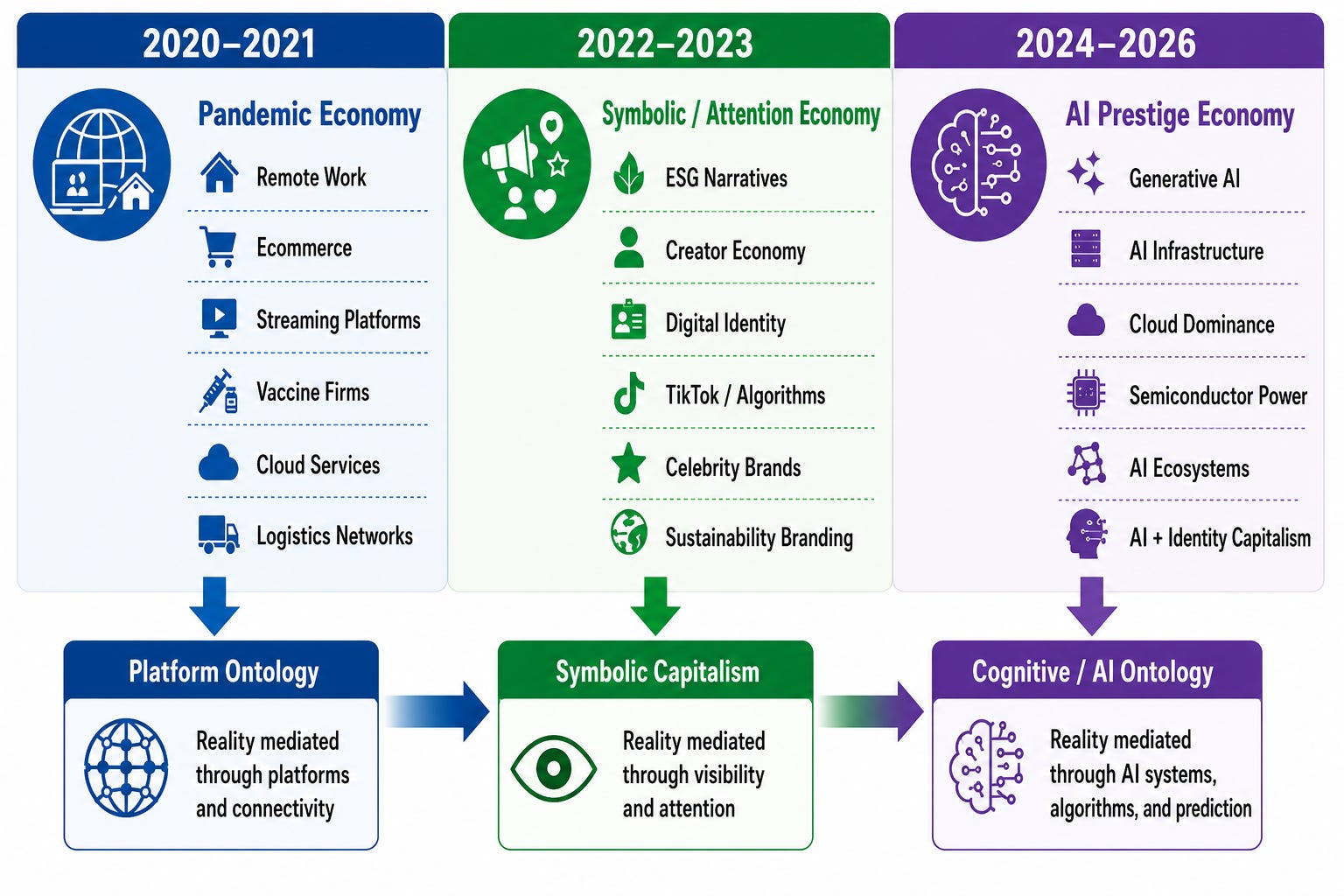
Figure 1. Evolution of Corporate Influence in the TIME 100 (2020-2026)
Figure 1 summarizes this historical transition, illustrating movement from Platform Ontology (2020–2021) through Symbolic Capitalism (2022–2023) toward Cognitive/AI Ontology (2024–2026). The arc is clear: corporate influence evolved from mediating connectivity and visibility to increasingly governing cognition, prediction, and algorithmic forms of social organization — a movement from physical production toward systems that shape attention, identity, and thought itself.
2.1. 2020–2021: From Pandemic Capitalism to Platform Society
The early TIME100 lists reflected the extraordinary conditions created by global pandemic and the rapid acceleration of digital dependency. The most influential firms were those enabling remote existence: Amazon in ecommerce, Netflix in streaming, Microsoft Azure and Amazon Web Services in cloud infrastructure, Pfizer in vaccine development, and FedEx and UPS in logistics. Influence during this period became synonymous with resilience — the capacity to sustain economic and social life during disruption. These firms emerged not merely as successful businesses, but as infrastructural actors shaping everyday reality through digital connectivity, biotechnology, and computational systems.
This period consolidated what scholars have called a “platform society,” in which social existence became increasingly mediated through digital interfaces and algorithmic systems (Srnicek, 2017). Remote work normalized the virtualization of labor, streaming platforms transformed cultural consumption, and ecommerce ecosystems redefined the relationship between producers and consumers. At a deeper level, the pandemic accelerated a shift in corporate legitimacy: firms were valued not solely for profitability, but for their ability to maintain societal functionality during systemic crisis. Corporations came to be seen not merely as economic actors, but as quasi-governing institutions organizing communication, mobility, labor, and collective social experience (Nadella, 2017).
2.2. 2022–2023: ESG, Creator Economies, and the Rise of Symbolic Capital
By 2022 and 2023, the TIME100 had begun shifting from pandemic resilience toward sustainability, ESG values, creator culture, and symbolic influence. Climate-conscious branding, diversity discourse, socially responsible capitalism, and digital identity became increasingly visible markers of corporate legitimacy. The rise of creator economies and digital personalities transformed that legitimacy further: visibility, authenticity, and emotional connection became sources of economic power in their own right. Influence was no longer confined to firms producing material goods or building technological infrastructure. It extended to those shaping cultural narratives, lifestyle aspirations, and collective social identities.
This period also revealed the growing fusion of entertainment, commerce, and digital attention within the global economy. TikTok, Instagram, and YouTube transformed attention itself into a primary economic resource. Firms increasingly functioned as symbolic ecosystems — generating communities, identities, and emotional attachment rather than simply products or services. The tension this revealed, however, was real. Industrial systems such as energy infrastructure, manufacturing, transportation, and logistics remained materially indispensable despite receiving comparatively little prestige recognition. The rise of the prestige economy thus reflected a broader transformation: symbolic capital increasingly overshadowed industrial visibility within contemporary society (Bourdieu, 1984; Zuboff, 2019).
2.3. 2024–2026: AI-Centered Prestige Capitalism and the Ontology of the Future
From 2024 onward, the TIME100 became dominated by artificial intelligence, semiconductor ecosystems, cloud infrastructures, and AI-integrated consumer platforms. OpenAI, NVIDIA, Microsoft, Alphabet, and TSMC emerged as new symbols of economic and cultural power. Influence became closely tied to the capacity to shape not just markets, but human perception itself — how people search, communicate, learn, create, and imagine. In this sense, the AI era’s cognitive framework differs fundamentally from earlier technological paradigms: AI firms increasingly mediate the production of knowledge, meaning, and perception across society (Brynjolfsson et al., 2019; Floridi, 2023).
At the same time, the AI era intensified the convergence between technology and prestige capitalism. AI was no longer simply infrastructure — it became a civilizational narrative, promising transformation across nearly every dimension of life. Companies associated with AI became symbols of futurity, innovation, and elite relevance, while creator brands, wellness technologies, luxury consumer ecosystems, and personalized digital services were integrated into expanding AI-driven identity economies. Yet this AI-centered prestige economy also produced important blind spots. It consistently obscured the material systems upon which AI itself depends: semiconductor manufacturing, electricity generation, rare earth extraction, logistics networks, industrial robotics, and physical infrastructure. The TIME100 thus reflected a defining contradiction of the AI era — societies increasingly celebrate companies shaping perception and imagination while underrecognizing those sustaining the material foundations of technological civilization (Lanier, 2013; Smil, 2022).
The AI era increasingly rewards visibility, narrative influence, and symbolic power over industrial production.
3. Representing Reality Through the TIME100 (2020–2026)
The TIME100 Most Influential Companies represents one particular way of organizing contemporary economic reality in the AI era. It is not a neutral inventory of the world’s most economically indispensable firms. It is a prestige-oriented interpretation of influence, centered on visibility, technological futurity, cultural relevance, and narrative power. The TIME100 does not merely describe reality. It helps construct it. Visibility increasingly competes with industrial continuity as the measure of influence.
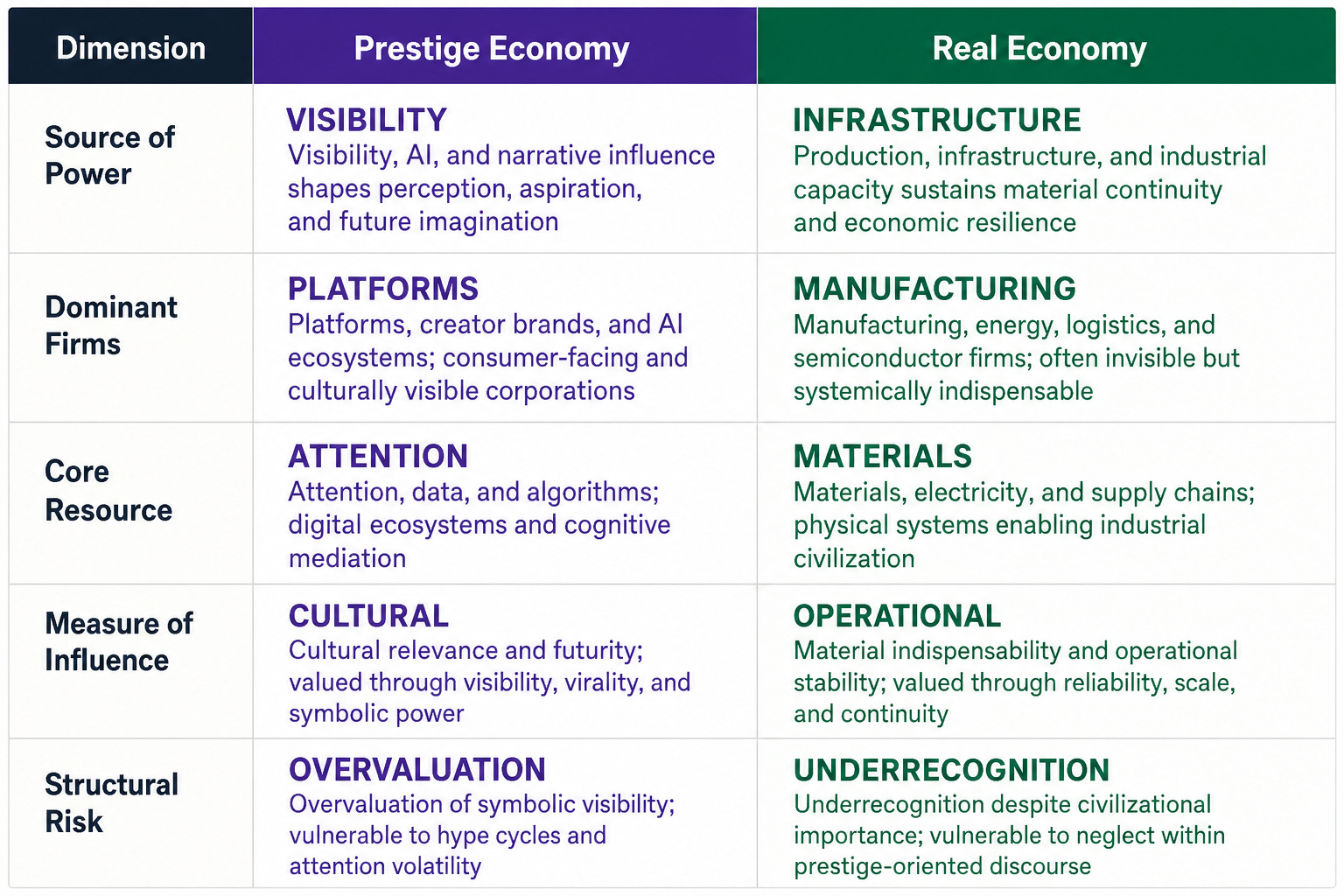
The widening gap between prestige visibility and industrial indispensability is captured in Table 1. Between 2020 and 2026, the TIME100 increasingly emphasized firms associated with AI, digital platforms, creator economies, cloud infrastructures, wellness technologies, and consumer-facing ecosystems. In doing so, the list captures important transformations in how modern societies imagine progress, innovation, and corporate power. But from a civilizational perspective, it also reveals the limits of prestige-centered representations of reality. Firms that sustain the material foundations of industrial civilization — ASML, Samsung, Siemens, Caterpillar, and major energy and shipping infrastructures — often remain underrepresented despite their systemic indispensability.
Table 1. Prestige Economy vs. Real Economy in the AI Era
3.1. 2020–2021: Pandemic Reality and the Rise of Platform Framework
During the pandemic years, the TIME100 captured an important transformation in how social reality was restructured under conditions of global crisis. The list correctly recognized that digital platforms, cloud infrastructures, vaccine developers, logistics networks, and ecommerce systems had become indispensable mechanisms for sustaining economic continuity and social interaction. In many respects, TIME accurately identified the rise of a new infrastructural power, in which corporations increasingly mediated communication, labor, healthcare, entertainment, and consumption. The pandemic accelerated a broader transition toward a platform-centered society, and the TIME100 reflected that transformation with considerable insight.
At the same time, the list revealed a deeper ontological shift in the meaning of institutional authority. Where earlier industrial eras associated societal stability with governments, factories, and physical infrastructure, the pandemic elevated digital corporations into quasi-governing actors capable of organizing social existence during systemic disruption. Yet the representation of reality within the TIME100 also contained important limitations. It underrepresented the material infrastructures enabling pandemic survival itself — agricultural systems, shipping networks, energy supply chains, manufacturing ecosystems, sanitation workers, and public health institutions. The ontology the list presented privileged visibility, innovation, and symbolic relevance over the hidden industrial systems upon which digital civilization ultimately continued to depend.
3.2. 2022–2023: Symbolic Capitalism and the Attention Economy
Between 2022 and 2023, the TIME100 increasingly represented reality through the lens of symbolic influence, cultural visibility, and attention-based capitalism. The rise of ESG narratives, creator economies, digital identity platforms, and socially conscious branding reflected a broader transformation in how influence was understood. TIME recognized that economic power was no longer confined to industrial production or traditional corporate hierarchy — it increasingly depended on the ability to shape narratives, communities, lifestyles, and emotional attachment. The list effectively captured the transition from industrial capitalism toward a prestige economy centered on symbolic capital and algorithmic attention (Bourdieu, 1984).
This period also demonstrated the growing importance of digital platforms and creator-driven ecosystems in shaping public discourse, consumer behavior, and cultural identity across global society. TikTok highlighted the significance of algorithmic influence, while celebrity brands and creator enterprises reflected the fusion of commerce, media, and personal identity into integrated systems of visibility and power. The limitations of this representation, however, became increasingly apparent: symbolic influence often overshadowed materially indispensable sectors such as industrial manufacturing, heavy engineering, energy systems, and logistics infrastructure. Countries whose global influence depends strongly on industrial capability — Germany, Japan, and South Korea, among them — remained comparatively underrepresented despite their central role in sustaining the global economy. The TIME100 reflected the logic of the attention economy more than a complete picture of civilization itself (Debord, 1994; Zuboff, 2019).
3.3. 2024–2026: AI Prestige Capitalism and the Ontology of the Future
From 2024 onward, the TIME100 increasingly represented reality through the lens of artificial intelligence and future-oriented prestige capitalism. Firms associated with generative AI, semiconductor ecosystems, cloud infrastructures, autonomous systems, and AI-enhanced consumer platforms emerged as symbols of civilizational transformation. TIME insightfully recognized that AI was not merely another technological sector but a new cognitive infrastructure capable of reshaping communication, creativity, education, labor, governance, and knowledge production itself. In doing so, the list captured a genuine shift in the nature of corporate power — influence increasingly belonging to organizations shaping the architecture of perception and cognition rather than simply producing physical goods (Acemoglu & Johnson, 2023; Smil, 2022).
Modern civilization still depends on the hidden material infrastructures often overlooked by prestige capitalism.
4. Conclusion
The TIME100 Most Influential Companies does more than document the rise of AI, platforms, and creator capitalism. It maps how the modern world has come to define reality itself — through visibility, algorithms, and narrative power. Yet beneath this prestige economy of attention and symbolic influence lies a quieter and more durable architecture: energy, manufacturing, logistics, semiconductors, and the industrial systems that continue to sustain everyday life long after the headlines fade.
The central challenge of the AI era is therefore not technological innovation alone. It is the widening gap between what societies celebrate and what they materially depend upon. Lists like the TIME100 do not merely observe this gap — they legitimize it, conferring recognition on the visible and withholding it from the indispensable. A civilization that cannot see what sustains it cannot govern what threatens it.
The future will belong not to those who shape the imagination of the world, but to those with the wisdom to look beyond the spectacle and the courage to value what remains hidden in plain sight.
That tension — between what is celebrated and what is required — raises a deeper and more unsettling question: what kind of world would emerge if the prestige economy were allowed to define reality entirely? The next article in this series, “If Only TIME100 Companies Existed: Imagining the World of Prestige Capitalism,” takes this thought experiment to its logical conclusion. It imagines a world where only the firms recognized by the TIME100 actually exist — infinite AI, seamless platforms, luminous brands — but without the mines, factories, power grids, and supply chains that make such a world physically possible. What that fiction illuminates is not merely the distortion of a ranking. It is the misreading of civilization itself.
References
Acemoglu, D., & Johnson, S. (2023). Power and progress: Our thousand-year struggle over technology and prosperity.PublicAffairs.
Bourdieu, P. (1984). Distinction: A social critique of the judgement of taste (R. Nice, Trans.). Harvard University Press. (Original work published 1979)
Brynjolfsson, E., Rock, D., & Syverson, C. (2019). Artificial intelligence and the modern productivity paradox: A clash of expectations and statistics. In A. Agrawal, J. Gans, & A. Goldfarb (Eds.), The economics of artificial intelligence: An agenda (pp. 23–57). University of Chicago Press.
Castells, M. (2010). The rise of the network society (2nd ed.). Wiley-Blackwell.
Debord, G. (1994). The society of the spectacle (D. Nicholson-Smith, Trans.). Zone Books. (Original work published 1967)
Floridi, L. (2023). The ethics of artificial intelligence: Principles, challenges, and opportunities. Oxford University Press.
Harari, Y. N. (2024). Nexus: A brief history of information networks from the Stone Age to AI. Random House.
Lanier, J. (2013). Who owns the future? Simon & Schuster.
Nadella, S. (2017). Hit refresh: The quest to rediscover Microsoft’s soul and imagine a better future for everyone. Harper Business.
Smil, V. (2022). How the world really works: The science behind how we got here and where we’re going. Viking.
Srnicek, N. (2017). Platform capitalism. Polity Press.
Zuboff, S. (2019). The age of surveillance capitalism: The fight for a human future at the new frontier of power.PublicAffairs.
Original Article:

About the Author

Distinguished Professor, Dr. Paul Hong — University of Toledo
Paul C. Hong is a Distinguished University Professor and Chair of Information Systems and Supply Chain Management at the University of Toledo. His work focuses on leadership, governance, and decision-making in the AI era, integrating strategy, technology, and institutional trust. He has published extensively in leading academic journals and writes on how individuals and organizations navigate complexity, disruption, and global transformation.
© K-Global Schoalrs and Professionals Forum. All rights reserved. Content published in the K-GSP Forum may not be reproduced, distributed, or transmitted in any form without prior written permission from the K-GSP Forum, except for brief quotations with full attribution.