
A fascinating transformation is emerging in today’s educational landscape. Students are no longer being evaluated solely through written assignments; instead, they are increasingly being asked to explain and defend their ideas verbally through discussion and dialogue. The rapid advancement of generative AI has raised profound questions about the true meaning of education. In an era where artificial intelligence can draft essays, summarize information, and even construct logical arguments, traditional forms of assessment are losing their ability to measure authentic learning. The growing movement among universities to revive oral examinations and Socratic dialogue reflects a significant shift in educational philosophy.
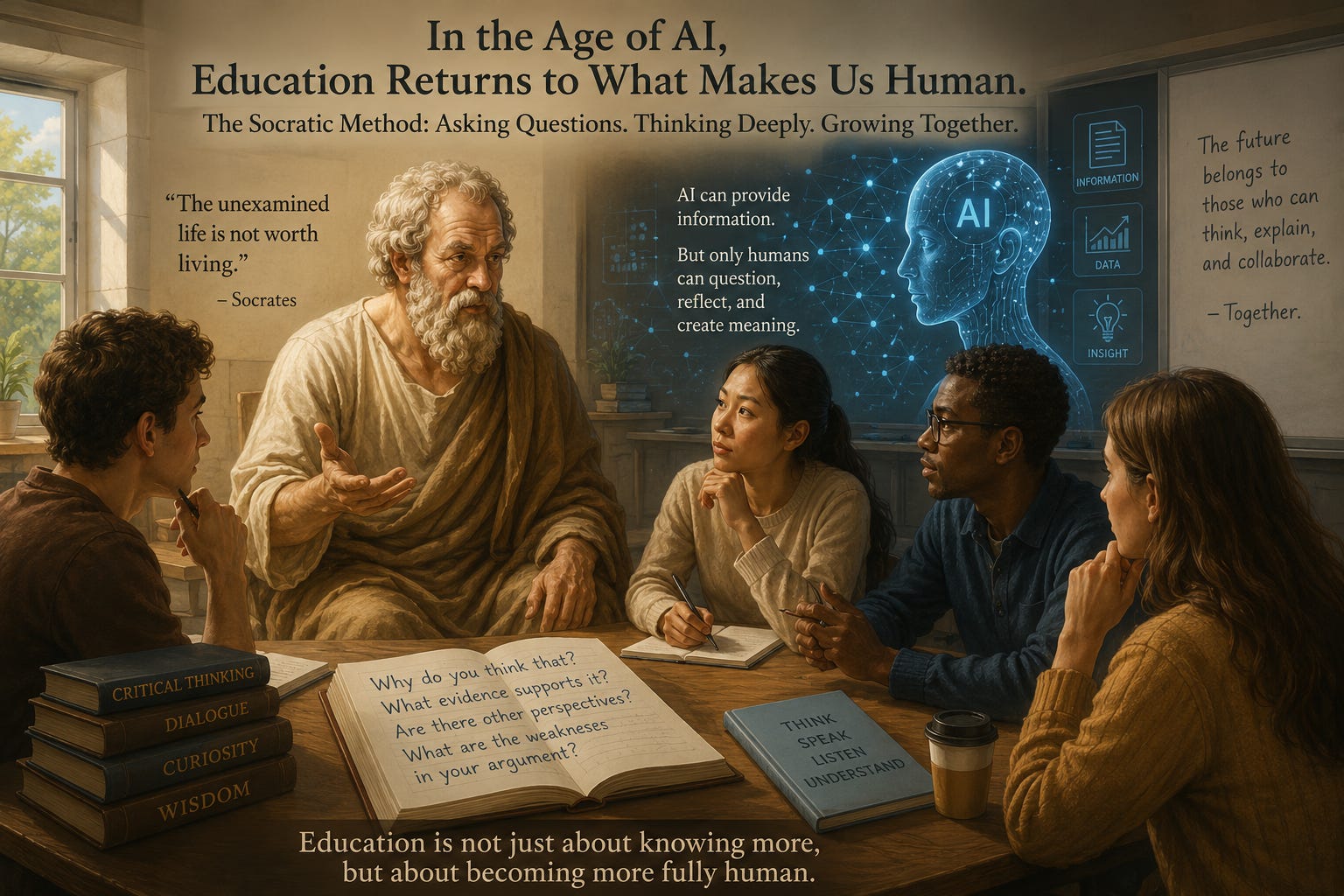
The ancient Greek philosopher Socrates emphasized education through questioning and dialogue. Rather than encouraging students to memorize answers, he challenged them to explain why they believed what they believed. Ironically, in the age of cutting-edge artificial intelligence, humanity is returning to one of the oldest educational methods in history. This phenomenon reveals an important truth: the more advanced technology becomes, the more valuable uniquely human reasoning and judgment become.
Generative AI has already transformed the environment of academic assignments. Students can now use AI systems to generate drafts, organize ideas, and refine writing structures. The growing problem, however, is that professors are finding it increasingly difficult to determine whether submitted work genuinely reflects a student’s own intellectual process. Education is therefore confronting a fundamental question: how can institutions evaluate not merely the final product, but the authenticity of thinking itself?
In this context, the return of oral examinations appears both natural and necessary. When students must verbally explain their reasoning and respond spontaneously to questions, superficial understanding is quickly exposed. Submitting AI-generated writing may be easy, but articulating complex ideas in one’s own words requires a completely different level of intellectual mastery. Speech is not merely a tool for communication; it is a window into the depth and clarity of thought.
The Socratic method becomes especially powerful in the AI era. Professors can continuously challenge students with questions such as: “Why do you think that?”, “What alternative perspectives exist?”, or “What are the weaknesses in your argument?” This process nurtures critical thinking and self-reflection rather than passive knowledge consumption. AI may provide information, but it cannot fully replace the deeply human process of examining one’s own assumptions through dialogue and introspection.
The central competitive advantage in the future will no longer be the simple possession of information. AI systems already outperform humans in searching, organizing, and retrieving knowledge. What will matter instead is the ability to connect ideas, interpret meaning, and create new insights. Such abilities develop through deep conversation, debate, questioning, and intellectual exchange. The capacity to demonstrate one’s reasoning through spoken dialogue may therefore become one of the defining skills of the future workforce.
What is particularly noteworthy is that this transformation extends beyond the humanities. According to the article, fields such as engineering and medicine are also increasing the use of direct dialogue and oral evaluations between professors and students. This suggests that the very definition of expertise is evolving in the AI age. The future professional will not simply be someone who possesses information, but someone capable of explaining complexity, persuading others, and collaborating effectively in uncertain environments.
These educational changes also carry important implications for countries like South Korea, where education has traditionally emphasized memorization and standardized testing. In the AI era, however, the ability to formulate meaningful questions may become more important than the ability to produce correct answers quickly. If students are not given sufficient opportunities to express their own ideas, engage in debate, and defend their reasoning logically, societies may struggle to cultivate the creative and adaptive thinkers needed for the future.
This shift also raises deeper philosophical questions about human uniqueness. AI can now write essays, generate artwork, and even compose music. What, then, remains uniquely human? Perhaps the answer lies in the living dynamics of conversation itself. Human beings question, hesitate, express emotion, and generate insight through interaction with others. This living process of thought and dialogue remains difficult for AI to fully replicate.
The true purpose of education has never been merely the transmission of information. Genuine education helps individuals learn how to think, judge, reflect, and grow as human beings. AI can become an extraordinary educational tool, but it cannot replace the formation of human character and intellectual maturity. Indeed, the AI era may require people to ask deeper questions, communicate more precisely, and engage in more rigorous dialogue than ever before.
Ultimately, we are living in a deeply paradoxical moment. At the very time when artificial intelligence has reached unprecedented levels of sophistication, education is rediscovering its most profoundly human foundations. The revival of the Socratic method is not simply an educational trend; it is a recognition that human understanding still grows through dialogue, questioning, and reflection. The real educational revolution of the AI era will not come from technology alone, but from learning how to preserve and strengthen our humanity within a technological world. +++
{Solti}
May 23, 2026

Young Choi, PhD is a Professor at Regent University bringing a rare combination of technical expertise and creative spirit to everything he does. A scholar in AI, cybersecurity, and network & telecommunications service management, he has published 38 books including AI and cybersecurity area books, over 200 refereed articles, and over 20 book chapters. Beyond the academy, Dr. Choi is a passionate poet, essayist, and wooden block laser engraving artist whose reflective writing invites readers to rediscover life’s beauty in quiet contemplation(靜觀). He lives under the motto: “Study hard and give generously without holding back! (열심히 공부해서 아낌없이 남주자 !: 열공아남!)”
Published books: https://www.amazon.com/stores/Young-Choi/author/B0DMZ5S6R7?ref=ap_rdr&shoppingPortalEnabled=true
We have recently reintroduced the oral exam method in colleges to assess students’ thinking and communication skills.