

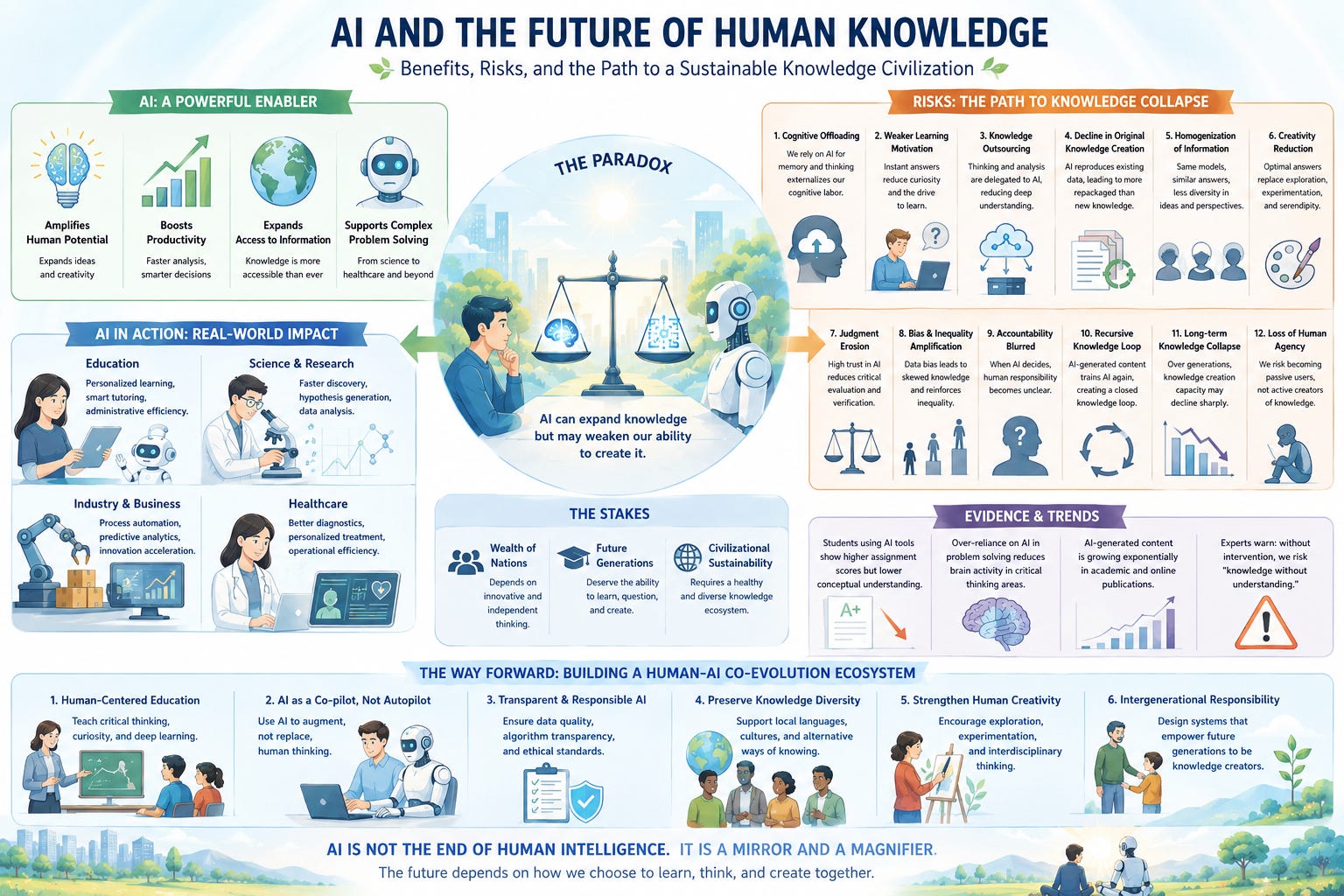
As we enter the mid-21st century, artificial intelligence (AI) is no longer merely a technological tool but a force that is fundamentally redefining human cognition and the structure of knowledge production. In particular, the rapid diffusion of generative AI has drastically transformed how humans search, summarize, analyze, write, and even make decisions, thereby disrupting the traditional framework of knowledge—namely, “production–accumulation–verification.”
The warning issued by MIT economist Daron Acemoglu and his research team regarding “Knowledge Collapse” captures this structural transformation. It suggests a paradoxical outcome: AI may simultaneously expand the quantity of knowledge while weakening the human capacity to produce and sustain it, potentially undermining the long-term intellectual autonomy of society.
This essay interprets the issue not merely as a technological debate but as a civilizational transition. It offers a comprehensive analysis across 12 dimensions, integrating empirical observations from education, science, industry, ethics, policy, and cognitive science.
Structural Transformation of Knowledge Production: From Human-Centered to Machine-Augmented Systems
Traditionally, knowledge production was grounded in human experience, reasoning, and verification. However, generative AI is replacing this structure with an automated pipeline of “input–generation–reconstruction.” In academic research, for example, literature review and draft writing are increasingly performed by AI systems, while humans are relegated to the role of reviewers. This indicates a structural shift of epistemic authority from humans to algorithms.
Externalization of Cognitive Labor and the Invisible Decline of Thinking Capacity
From a cognitive science perspective, AI externalizes working memory and long-term memory functions into digital systems. Students increasingly rely on AI rather than internal reasoning to understand complex concepts. This reflects what can be described as the “atrophy of cognitive muscles,” where mental effort is replaced by outsourced computation.
Educational System Disruption and the Distortion of Learning Signals
One of the most critical issues in education is the distortion of learning signals. AI-generated assignments often appear linguistically perfect but reflect shallow understanding. Several U.S. universities have reported a simultaneous increase in A-grade submissions and a decline in oral exam performance after the adoption of ChatGPT. This indicates a growing mismatch between assessment outcomes and actual learning.
Deepening Knowledge Outsourcing and Cognitive Dependency
As reliance on AI increases, humans increasingly externalize problem-solving itself. In software development, for instance, programmers often depend on AI tools such as code generators instead of fully understanding algorithmic structures. While this improves short-term productivity, it weakens long-term problem reconstruction capabilities, shifting humans from “problem solvers” to “solution selectors.”
Automation of Scientific Discovery and the Reduction of Creative Inquiry
In scientific research, AI now supports hypothesis generation, experimental design, and data analysis. In drug discovery, AI systems can autonomously generate candidate molecules. However, this reduces the role of human intuition and serendipity in scientific discovery, gradually transforming creativity into algorithmic optimization.
Recursive Knowledge Loop and the Self-Replicating Nature of Academic Knowledge
Because AI systems generate outputs based on existing datasets, academic knowledge increasingly becomes recursive. AI-generated summaries may re-enter training datasets, creating a feedback loop of “knowledge without original sources.” This phenomenon reduces epistemic diversity and risks reinforcing existing knowledge structures without genuine innovation.
Data Bias and the Homogenization of Global Knowledge Systems
AI models inherit biases from training data, often overrepresenting certain linguistic and cultural contexts—particularly English-language and Western datasets. This leads to a gradual homogenization of global knowledge systems, marginalizing non-Western epistemologies and reducing intellectual diversity across societies.
Structural Reinterpretation of Creativity: From Generation to Selection
Creativity is increasingly shifting from “generating original ideas” to “selecting among AI-generated outputs.” In industries such as advertising and design, AI produces hundreds of alternatives while humans act primarily as curators. This fundamentally redefines creativity as a selection-based rather than generation-based cognitive process.
Delegation of Judgment and the Collapse of Responsibility Structures
As AI systems become integrated into decision-making processes, responsibility becomes increasingly ambiguous. In finance, healthcare, and even military systems, AI recommendations are often approved by humans without full understanding. This creates an asymmetrical structure where AI decides and humans are held accountable, raising serious ethical concerns.
Homogenization of Knowledge Ecosystems and Declining Information Diversity
The global use of similar AI models leads to convergence in writing style, reasoning patterns, and argument structures. Across platforms, outputs tend to follow standardized formats such as “introduction–body–conclusion” with predictable logical sequences. This reduces epistemic diversity and encourages intellectual convergence toward a single dominant cognitive template.
A Stage-Based Model of Long-Term Knowledge Collapse
Knowledge collapse is not a sudden event but a gradual multi-stage process:
Increasing AI dependency
Decline in independent cognitive processing
Weakening of educational training systems
Reduction in expert knowledge production
Collapse of societal knowledge reproduction capacity
This process is cumulative and intergenerational, making it particularly difficult to reverse once established.
Response Strategies: Cognitive Co-Evolution and Institutional Design
The solution is not to restrict AI but to design systems of cognitive co-evolution. Some educational institutions already require students to submit both AI-generated drafts and human-rewritten analyses. Similarly, research systems are experimenting with frameworks that combine AI assistance with mandatory human critical verification. The goal is to preserve human reasoning capacity while leveraging AI efficiency.
AI represents one of the most powerful knowledge-expanding technologies in human history, yet it simultaneously carries the structural risk of weakening human cognitive capacity and knowledge production systems. The “Knowledge Collapse” described by Acemoglu and his colleagues is not merely theoretical but is already partially observable in education, research, and industry.
Ultimately, the issue is not whether AI should be developed, but how it should be integrated into human cognitive systems. The future of knowledge civilization depends not on replacing human intelligence with artificial intelligence, but on constructing a co-evolutionary ecosystem in which both complement each other.
The central challenge of the AI era, therefore, is not technological advancement alone, but the preservation of human cognitive integrity within an increasingly automated epistemic environment. +++
{Solti}
May 29, 2026

Young Choi, PhD is a Professor at Regent University bringing a rare combination of technical expertise and creative spirit to everything he does. A scholar in AI, cybersecurity, and network & telecommunications service management, he has published 38 books including AI and cybersecurity area books, over 200 refereed articles, and over 20 book chapters. Beyond the academy, Dr. Choi is a passionate poet, essayist, and wooden block laser engraving artist whose reflective writing invites readers to rediscover life’s beauty in quiet contemplation(靜觀). He lives under the motto: “Study hard and give generously without holding back! (열심히 공부해서 아낌없이 남주자 !: 열공아남!)”
Published books: https://www.amazon.com/stores/Young-Choi/author/B0DMZ5S6R7?ref=ap_rdr&shoppingPortalEnabled=true