

Abstract
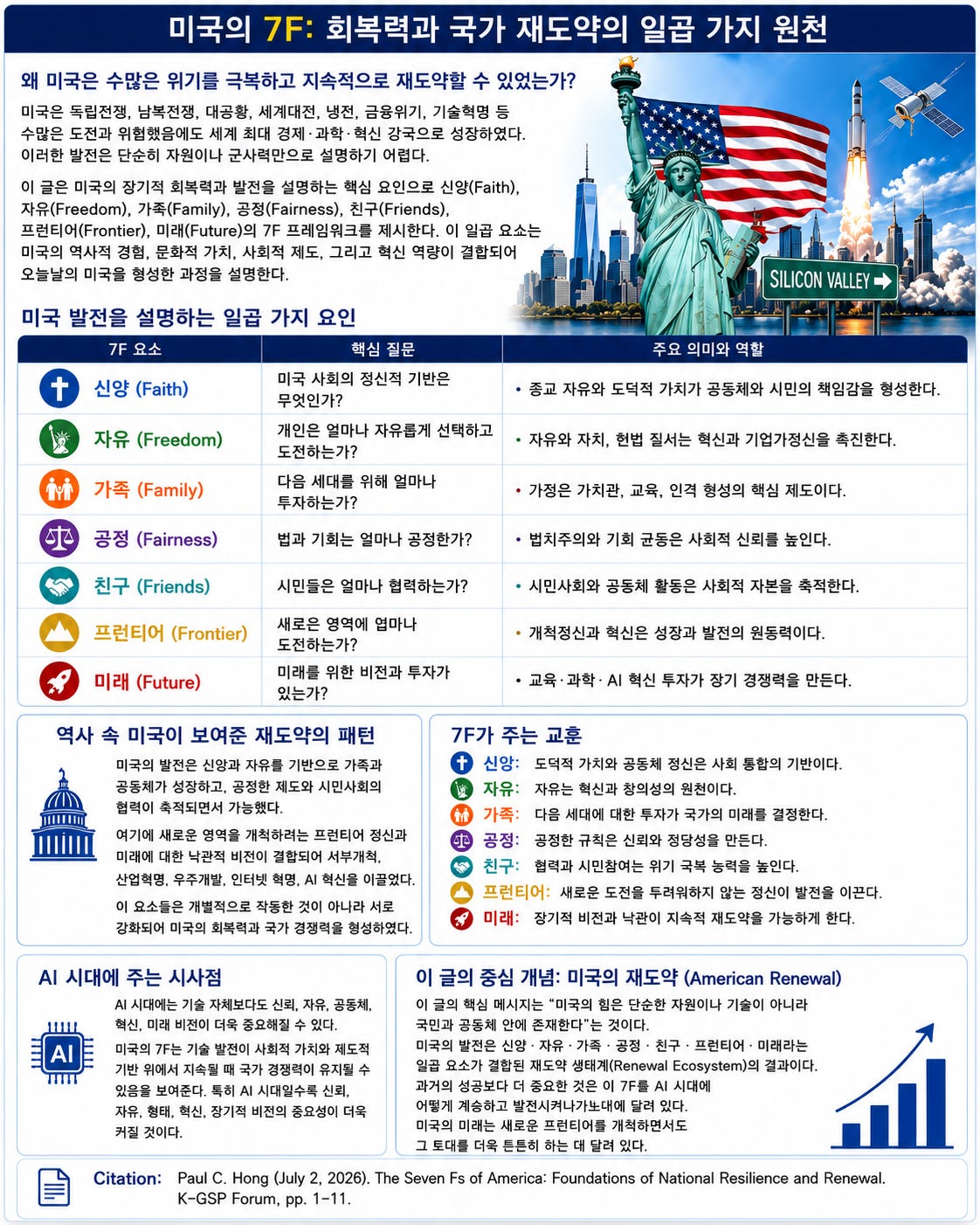
As the United States commemorates its 250th anniversary, this article examines America’s enduring character through the framework of the Seven Fs: Faith, Freedom, Family, Fairness, Friends, Frontier, and Future. Inspired by Alexis de Tocqueville’s search for the underlying sources of American democracy and informed by the perspective of a Korean-American scholar who spent the first twenty-five years of life in Korea and the next five decades living, working, and traveling throughout nearly every region of the United States, the framework identifies the cultural values, civic institutions, and social traditions that have contributed to America’s resilience, innovation, and global influence. In an era increasingly shaped by artificial intelligence and technological disruption, the Seven Fs offer a holistic lens for understanding how America’s historical strengths can continue to support democratic vitality, economic competitiveness, social cohesion, and human flourishing in the twenty-first century.
Keywords: America; Tocqueville; National Resilience; Civil Society; Human Flourishing.
1. Introduction
In January 1977, I arrived in Atlanta, Georgia, from South Korea as a young lay missionary with limited English proficiency, a sense of calling, and a deep curiosity about the country that would become my home for the next five decades. Having spent the first twenty-five years of my life in Korea, I encountered a society distinguished by its scale, diversity, openness, and optimism. Over the ensuing years, I studied, worked, taught, raised a family, and traveled throughout nearly every region of the United States, experiences that provided a unique comparative perspective shaped by engagement with both Korean and American cultures.
As the United States commemorates its 250th anniversary in 2026, it is an appropriate moment to reflect on the deeper sources of the nation’s resilience, influence, and continuing capacity for renewal. Such reflection is particularly important during a period marked by political polarization, demographic change, rapid technological advancement, global competition, and the transformative emergence of artificial intelligence. While public attention often focuses on immediate challenges, a broader historical question remains: What enduring characteristics have enabled the United States to adapt, prosper, and maintain its vitality across generations?
This article proposes the Seven Fs of America—Faith, Freedom, Family, Fairness, Friends, Frontier, and Future—as an interpretive framework for understanding the nation’s historical development, resilience, and continuing capacity for renewal. The framework does not suggest that American history or contemporary society has consistently reflected these ideals, nor does it overlook the nation’s struggles with inequality, injustice, social conflict, and other enduring challenges. Rather, these seven dimensions represent recurring cultural values, civic institutions, and social practices that have shaped American identity, democratic life, economic dynamism, and national aspirations while helping the nation respond to periods of challenge and change. As America enters the AI era, the Seven Fs framework suggests that long-term success will depend not only on technological advancement but also on renewing the human foundations that have historically supported democratic vitality, economic competitiveness, social cohesion, and human flourishing. Whereas the Seven Ms framework highlights the developmental drivers of Korea’s rapid modernization, the Seven Fs framework focuses on the cultural and institutional foundations that have contributed to America’s long-term resilience and renewal.
2. Conceptual Foundations of the Seven Fs Framework
Before examining each of the Seven Fs individually, it is important to recognize that the framework does not seek to define all Americans but rather provides an interpretive lens for understanding the recurring cultural values, civic institutions, and social practices that have contributed to America’s resilience, adaptability, and long-term development.
2.1. Why Nations Develop Distinctive Characteristics
Although individuals differ widely within every society, nations often develop recurring cultural patterns shaped by history, geography, institutions, beliefs, and shared experiences (Huntington, 2004; Inglehart & Welzel, 2005). These patterns influence how people organize communities, respond to challenges, educate future generations, pursue opportunities, and envision the future. While national frameworks should never be treated as rigid stereotypes, they can provide useful perspectives for understanding why societies often respond differently to similar circumstances.
The United States presents a particularly interesting case because of its extraordinary diversity. Americans trace their origins to virtually every region of the world and represent a wide range of ethnic, religious, political, and cultural traditions. Yet throughout this diversity, certain recurring themes have appeared repeatedly across American history, including commitments to faith, liberty, family formation, fairness, civic engagement, exploration, and future-oriented optimism (Bellah et al., 2007; Huntington, 2004). The Seven Fs framework seeks to identify these recurring themes and examine how they have contributed to the nation’s endurance and development across nearly two and a half centuries.
Figure 1 presents the Seven Fs Framework of American Resilience and Renewal, illustrating Faith, Freedom, Family, Fairness, Friends, Frontier, and Future as seven interconnected foundations that have shaped America’s historical development and enduring vitality. Centered on the concept of resilience and renewal, the framework highlights how these cultural values, civic institutions, and societal capabilities collectively support democratic governance, economic opportunity, social cohesion, innovation, and long-term adaptation. As the United States commemorates its 250th anniversary and enters the AI era, the framework suggests that America’s continued success will depend not only on technological advancement but also on preserving and renewing the foundational strengths represented by the Seven Fs.
Figure 1.
The Seven Fs Framework of American Resilience and Renewal.
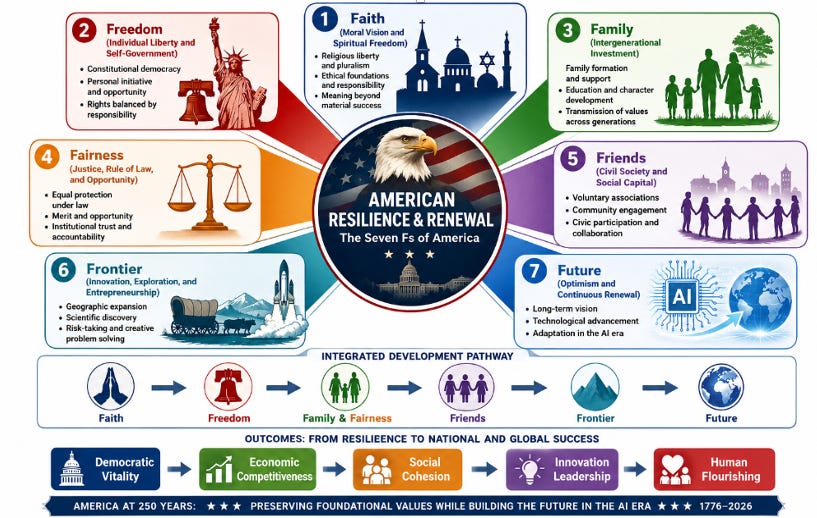
Source: Author-developed conceptual model. Figure visualization created using generative artificial intelligence based on detailed prompts, framework design, and content developed by Paul C. Hong (2026).
2.2. Renewal as the Central Theme
At the center of the Seven Fs framework lies the concept of Renewal. Renewal refers to the capacity of individuals, communities, and institutions to adapt to changing circumstances while preserving essential principles and values. American history can be understood as a continuous process of renewal through which successive generations have confronted wars, economic crises, social conflicts, technological disruptions, and geopolitical challenges while seeking to preserve the nation’s founding ideals.
Renewal differs from mere survival. It involves learning, adaptation, innovation, and reinvention. Throughout its history, the United States has repeatedly demonstrated the ability to transform challenges into opportunities (Putnam & Garrett, 2020; Zakaria, 2008), whether through westward expansion, industrialization, scientific discovery, entrepreneurial innovation, civil rights reforms, or technological leadership. The Seven Fs represent interconnected sources of this renewal, providing the cultural, social, and institutional foundations that have enabled America to evolve while maintaining a sense of national continuity and purpose.
2.3. The Seven Fs as an Interpretive Framework
The Seven Fs framework consists of seven interconnected dimensions that together provide a holistic lens for understanding America’s resilience, adaptability, and capacity for renewal. Faith reflects the moral and spiritual foundations that have shaped personal responsibility and civic life, while Freedom represents the nation’s commitment to liberty, self-government, and individual opportunity. Family emphasizes the role of households in transmitting values, developing character, and investing in future generations, whereas Fairness highlights the importance of justice, rule of law, equal opportunity, and institutional legitimacy.
The remaining dimensions focus more directly on the civic and developmental forces that have contributed to America’s growth and vitality. Friends represent the voluntary associations, community networks, and social capital that strengthen civic engagement and social cohesion, while Frontier captures the spirit of exploration, entrepreneurship, innovation, and willingness to embrace uncertainty, and Future reflects optimism, aspiration, and confidence in continued progress. Together, these seven dimensions provide a framework for understanding how America has sustained resilience, encouraged innovation, strengthened democratic life, and pursued national renewal across generations, particularly as it navigates the opportunities and challenges of the AI era.
The Seven Fs framework should not be interpreted as suggesting that American history has consistently embodied these values or that the nation’s development has been free from conflict, injustice, or contradiction. Throughout its history, the United States has confronted profound challenges, including slavery, racial discrimination, unequal treatment of Indigenous peoples, economic inequality, political polarization, and periods in which national practices fell short of proclaimed ideals. The significance of the Seven Fs lies not in the absence of these shortcomings but in the continuing capacity for self-correction, institutional adaptation, civic engagement, and democratic reform that has enabled the nation to pursue renewal while confronting its imperfections.
The enduring strength of America lies beneath its institutions and within its people.
3. A Framework for Understanding National Renewal
America has evolved through periods of profound change, including territorial expansion, industrialization, immigration, economic transformation, social reform, global conflict, and technological innovation. The Seven Fs seek to identify these enduring foundations and explain how they have interacted to shape American development from the founding era to the emerging AI age.
3.1. Historical and Cultural Foundations
The first four dimensions—Faith, Freedom, Family, and Fairness—represent the historical and cultural foundations of the American experience (Bellah et al., 2007; Huntington, 2004). Faith reflects the moral and spiritual traditions that have influenced civic responsibility, personal character, and community life. Freedom captures the nation’s longstanding commitment to liberty, self-government, individual initiative, and constitutional rights. Family serves as the primary institution through which values, responsibilities, and aspirations are transmitted across generations, while Fairness embodies the pursuit of justice, equal opportunity, and the rule of law.
Together, these dimensions have helped create a social environment that balances individual liberty with communal responsibility. Throughout American history, churches, families, schools, civic organizations, and legal institutions have played critical roles in shaping citizens and sustaining democratic society (Bellah et al., 2007; Tocqueville, 2000). Although debates continue regarding how these values should be interpreted and applied, they remain deeply embedded within the American narrative and continue to influence public life, social expectations, and national identity.
3.2. Civic and Developmental Foundations
The next two dimensions—Friends and Frontier—reflect the civic and developmental forces that have contributed to America’s growth and adaptability. Friends refers to the social capital generated through voluntary associations, civic organizations, community networks, and interpersonal relationships that foster trust, cooperation, and collective problem-solving (Brooks, 2025; Fukuyama, 1995; Putnam, 2000). These social connections generate trust, cooperation, leadership development, and collective problem-solving beyond the reach of government institutions alone. Frontier symbolizes the spirit of exploration, innovation, entrepreneurship, and willingness to venture into the unknown (Turner, 1921). Historically, the frontier represented geographic expansion across a continent, but its meaning has continually evolved. In successive generations, Americans have pursued new frontiers in science, technology, medicine, aviation, space exploration, business creation, and digital innovation. Together, Friends and Frontier help explain how civic collaboration and entrepreneurial initiative have repeatedly transformed challenges into opportunities for advancement.
Table 1 operationalizes the Seven Fs framework by defining each dimension and illustrating its expression through representative examples and historical developments. Rather than treating the Seven Fs as abstract concepts, the table demonstrates how Faith, Freedom, Family, Fairness, Friends, Frontier, and Future have been manifested through specific institutions, social practices, and historical experiences that have shaped American society. The inclusion of Renewal as the central integrating theme highlights the nation’s capacity to preserve enduring principles while adapting to changing economic, social, technological, and geopolitical circumstances.
Table 1.
The Seven Fs Framework: Definitions, Examples and Historical Illustrations
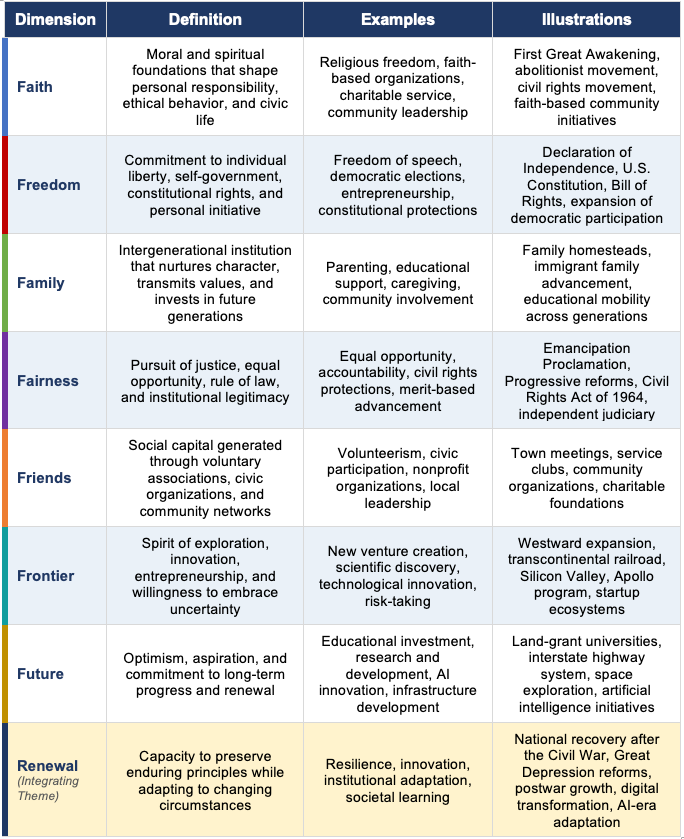
Source: Author’s Own.
The interaction of these seven dimensions helps explain America’s ability to preserve democratic institutions, integrate diverse populations, foster innovation, expand economic opportunity, and repeatedly renew itself across generations. While no single dimension fully explains the American experience, their combined influence provides a useful framework for understanding the nation’s historical resilience, global influence, and continuing capacity for adaptation in the AI era.
3.3. Future Orientation and National Renewal
The final dimension, Future, serves as the integrating force that connects America’s historical foundations with its continuing aspirations. Throughout its history, the nation has been characterized by a belief that improvement is possible and that future generations can achieve greater opportunities than previous ones (Inglehart & Welzel, 2005; Nye, 2011). This future-oriented outlook has encouraged investment in education, innovation, infrastructure, scientific research, and institutional development. It has also contributed to America’s capacity to recover from setbacks and envision new possibilities.
Future does not operate independently of the other six dimensions. Rather, it draws strength from Faith’s moral vision, Freedom’s opportunities, Family’s investment in future generations, Fairness’s legitimacy, Friends’ social capital, and Frontier’s innovative spirit. Together, the Seven Fs form an interconnected system that supports national renewal. As the United States enters an era increasingly shaped by artificial intelligence, demographic change, and global competition, understanding these foundational dimensions may provide valuable insights into how America can preserve its core strengths while adapting to emerging challenges.
Resilience emerges when liberty, community, and innovation work together.
4. The Seven Fs Across Three Eras of National Development
The Seven Fs may be understood not only as individual dimensions but also as a developmental system that has evolved across different periods of American history. Although each dimension contributes independently to national resilience and renewal, their influence has been cumulative and mutually reinforcing over time. Figure 2 illustrates how the Seven Fs have interacted across three broad eras of national development, linking foundational values, civic institutions, and future-oriented capabilities to America’s continuing capacity for adaptation, innovation, and renewal.
Figure 2 illustrates the Seven Fs as an interconnected system that has evolved across successive eras of American history. Beginning with the foundational strengths of Faith, Freedom, and Family, extending through the developmental contributions of Fairness, Friends, and Frontier, and culminating in the future-oriented dimension of Future, the framework demonstrates how cultural values, civic institutions, and innovative capacities have reinforced one another over time. Viewed collectively, these dimensions help explain how America has sustained resilience, encouraged innovation, strengthened democratic life, and pursued renewal while adapting to changing national and global circumstances.
Figure 2.
America at 250 Years: The Seven Fs Across Three Eras of National Development
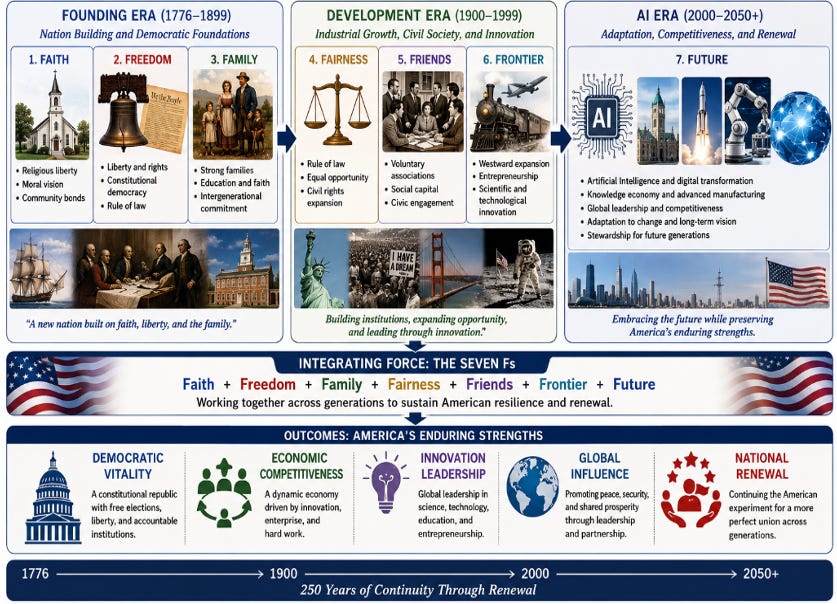
Source: Author-developed conceptual model. Figure visualization created using generative artificial intelligence based on detailed prompts, framework design, and content developed by Paul C. Hong (2026).
4.1. Founding Era Foundations: Faith, Freedom, and Family (1776–1899)
The first three dimensions—Faith, Freedom, and Family—formed the foundational pillars of American society during the nation’s formative years. Faith contributed moral vision, civic responsibility, and community engagement; Freedom established the principles of liberty, self-government, and individual opportunity; and Family provided the intergenerational institution through which values, character, and aspirations were transmitted. Together, these dimensions created a social and cultural foundation that supported democratic governance, personal responsibility, and national cohesion during the early development of the republic (Bellah et al., 2007; Tocqueville, 2000).
4.2. Development Era Foundations: Fairness, Friends, and Frontier (1900–1999)
As the nation expanded and industrialized, Fairness, Friends, and Frontier became increasingly important in shaping economic growth, institutional development, and civic life. Fairness strengthened legitimacy through the rule of law, equal opportunity, and expanding civil rights; Friends generated social capital through voluntary associations, community networks, and civic participation; and Frontier encouraged exploration, entrepreneurship, innovation, and a willingness to embrace uncertainty (Putnam, 2000; Turner, 1921). Together, these dimensions helped transform the United States into a dynamic society characterized by institutional adaptability, technological advancement, and broad-based opportunity.
4.3. The AI Era and Future-Oriented Renewal (2000–2050+)
The final dimension, Future, serves as the integrating force that connects America’s historical foundations with its continuing aspirations. Building upon Faith, Freedom, Family, Fairness, Friends, and Frontier, Future reflects optimism, adaptability, and a commitment to long-term progress through education, innovation, research, and technological advancement (Inglehart & Welzel, 2005; Nye, 2011). As the United States enters an era increasingly shaped by artificial intelligence, demographic change, and global competition, its continued success will depend not only on technological leadership but also on preserving and renewing the enduring strengths represented by the Seven Fs. The sequence suggests that national resilience emerges not from any single institution but from the cumulative interaction of values, civic capital, innovation, and long-term vision. The AI era therefore represents not a departure from America’s historical foundations but a new test of its ability to renew them while adapting to unprecedented technological and societal change.
America’s future depends on renewing its foundations while embracing new frontiers.
5. Conclusion
The framework presented in this article should not be interpreted as uniquely American virtues nor as claims that the United States has consistently embodied these ideals throughout its history; rather, it identifies recurring cultural values, civic institutions, and social practices that have contributed to the nation’s resilience, adaptability, and capacity for renewal. Together, Faith, Freedom, Family, Fairness, Friends, Frontier, and Future have helped shape the American experience by supporting democratic vitality, economic dynamism, social cohesion, innovation, and national renewal across nearly two and a half centuries. As the United States enters its third century, its future success will depend not only on technological leadership but also on renewing the human foundations that have long sustained American resilience, opportunity, innovation, and human flourishing.
References
Bellah, R. N., Madsen, R., Sullivan, W. M., Swidler, A., & Tipton, S. M. (2007). Habits of the heart: Individualism and commitment in American life (Updated ed.). University of California Press.
Brooks, D. (2025). How to know a person: The art of seeing others deeply and being deeply seen. Random House.
Fukuyama, F. (1995). Trust: The social virtues and the creation of prosperity. Simon and Schuster.
Huntington, S. P. (2004). Who are we? The challenges to America’s national identity. Simon & Schuster.
Inglehart, R., & Welzel, C. (2005). Modernization, cultural change, and democracy: The human development sequence.Cambridge University Press.
Nye, J. S., Jr. (2011). The future of power. PublicAffairs.
Putnam, R. D. (2000). Bowling alone: The collapse and revival of American community. Simon & Schuster.
Putnam, R. D., & Garrett, S. R. (2020). The upswing: How America came together a century ago and how we can do it again. Simon & Schuster.
Tocqueville, A. de. (2000). Democracy in America (H. C. Mansfield & D. Winthrop, Trans.). University of Chicago Press. (Original work published 1835–1840)
Turner, F. J. (1921). The frontier in American history. Henry Holt and Company. (Original work published 1893)
Zakaria, F. (2008). The post-American world. W. W. Norton & Company.
Original Article:

Citation: Paul C. Hong (July 2, 2026). The Seven Fs of America: Foundations of National Resilience and Renewal. K-GSP Forum, pp. 1–11.
About the Author

Distinguished Professor, Dr. Paul Hong (Editor in Chief) — University of Toledo
Paul C. Hong is a Distinguished University Professor and affiliated faculty member of the Asian Studies Program at the University of Toledo. Born and educated in South Korea, he arrived in the United States in 1977 as a young lay missionary and has since spent nearly five decades living, teaching, researching, and traveling across America. As a Korean American scholar who has experienced both societies firsthand, he brings a comparative perspective to the study of leadership, national competitiveness, cultural values, civic institutions, and societal renewal. Through his interdisciplinary writings on the United States, Korea, history, culture, leadership, and public affairs, he explores the values, institutions, and ecosystems that enable nations to adapt, innovate, and renew themselves across generations. This article reflects his continuing effort to understand the enduring foundations of American resilience, renewal, and long-term competitiveness as the nation approaches its 250th anniversary.
© K-Global Scholars and Professionals Forum. All rights reserved. Content published in the K-GSP Forum may not be reproduced, distributed, or transmitted in any form without prior written permission from the K-GSP Forum, except for brief quotations with full attribution.
Thank you, Dr. Paul Hong for sharing this thoughtful article.
Reading it made me reflect again on how America is not built only on systems or economic strength, but on foundational values like Faith, Family, and Freedom. What stood out to me is how important these unseen principles are in shaping and sustaining a healthy society.
I also agree that when personal freedom is balanced with responsibility, and when families and communities are strong, society becomes much more stable and meaningful. This was a helpful reminder to think not only about the present, but also about the values we pass on to the next generation.
Isaac and Rebekah.